Thursday, July 16, 2009

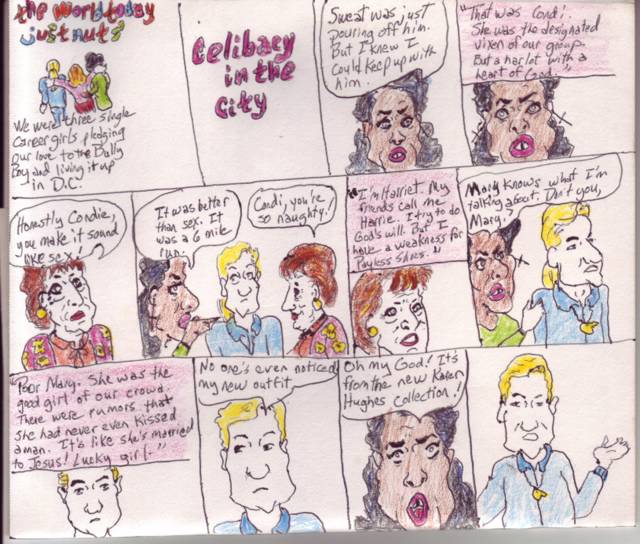
Celibacy in the City


Celibacy in the City first posted October 4th. A Tuesday. I didn't plan to post it. I made a joke about it, Harriet Miers' nomination, Harriet Miers period. And then I thought about the joke and all the Bush women. By the time I thought I was going to bed, it was running through my head. I got back up and drew it.
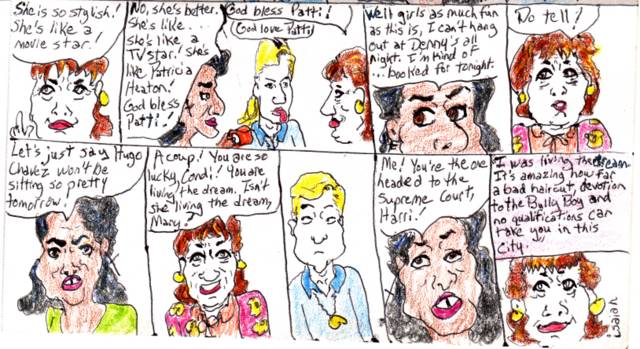


It was always funny to me. I still love this one because the hardest thing was slowly down since it was all clear before I grabbed a pen.


Here's C.I.'s "Iraq snapshot:"

Thursday, July 16, 2009. Chaos and violence continue, the tensions over Kirkuk continue and garner a little attention, US House Rep John Hall notes the disparity in the treatment of veterans based upon gender and declares "Congress cannot allow that to happen to this nation's daughters who have served her" and more.


"Good morning, ladies and gentlemen," declared US House Rep John Hall today, "the Veterans Affairs Disability and Memorial Affairs Subcommittee and the Subcommittee On Health joint-hearing on Eliminating the Gaps: Examining Women Veterans' Issues will now come to order." Hall is the Chair of the Subcommittee on Disability Assistance Memorial Affairs and he chaired the joint-committee hearing this morning. This hearing follows Tuesday's Senate Committee on Veterans Affairs hearing on women veterans' issues (here for
Tuesday snapshot, here for Kat Tuesday, here for Wednesday's snapshot, here for Kat Wednesday). The hearing was divided into three panels with a length break (over an hour) between the second and the third panel. The first panel was composed of women veterans: Grace After Fire's Kayla Williams, Disabled American Veterans' Joy J. Ilem, Service Women's Action Network's Anuradha Bhagwati, Wounded Warrior Project's Dawn Halfaker and National Association of State Women Veterans Coordinators, Inc and the Texas Veterans Commission's Delilah Washburn. The second panel was composed of GAO's Randall Williamson, Society's for Women's Health Research and Georgetown University Medical Center's Janice L. Krupnick. Panel three was made up of VA's Bradley Mayes, Patrica Hayes, Lawrence Deyton and Irene Trowell-Harris. We'll focus on the first panel.

In his opening remarks, Subcommittee Chair Hall addressed some of the recent Congressional hearings:

I am particularly eager to recognize the women veterans in this room today and to be enlightened by their experiences with the Dept of Veterans Affairs. VA owes them the proper benefits and care -- just like their male counterparts. However, they are a unique population, since they comprise only 1.8 million of the 23.4 million veterans nationwide and deserve special attention. So VA's mission to care for them must not only be achieved but monitored and supported as well. Sadly, that is not always the case. In response to reports of disparities, during the 110th Congress the Disability Assitance and Memorial Affairs and Health Subcommittees held a joint hearing on women and minority veterans. This Congress too has been very active in its oversight activities to assist women veterans and a record number of them have testified at various hearings. Additionally, on May 20th, Chairman [Bob] Filner of the full [House] VA Committee hosted a special roundtable discussion with women veterans from all eras who were able to paint a picture of military life as a female in uniform and then as a disabled veteran entering the VA system. In many cases, they have served alongside their male counterparts but have not had the same recognition or treatment. Chairman Filner also hosted a viewing and discussion session with Team Lioness members who were on search operations and engaged in firefights but, since there is no citation or medal for this combat service, their claims are not always recognized by VA as valid, so they are denied compensation.

Hall would also note, after the first panel's opening statements, that
HR 3155, the Caregiver Assistance and Resource Enhancement Act, had been voted out of committee and referred to the House. Michael Michaud is the Chair of the Subcommittee On Health and we'll note this from his opening remarks:

Another example of this Committee's commitment to women veterans is our work on HR 1211, the Women Veterans Health Care Improvement Act, which was introduced by Ms. Stephanie Herseth Sandlin. My Subcommittee favorably reported this bill to the full Committee in early June and this important legislation passed the House recently on June 23, 2009. Specifically, HR 1211 requires key studies assessing the VA health care services provided to women veterans -- including an assessment of barriers. The bill also provides seven days of medical care for newborn children of women veterans receiving maternity care, authorizes a child care pilot program, requires mental health professionals to receive training on caring for veterans to serve on the VA's Advisory Committee On Wommen Veterans and the Advisory Committee On Minority Veterans. While we have made some progress on the issues facing women veterans, it is clear that more needs to be done. Just earlier this week, there was an article in MSNBC about the VA inadequately serving women veterans. This article described the key findings of a GAO report which reveald that no VA hospital or outpatient clinic is complying fully with federal privacy requirements. In other words, many VA facilities had gynecological tables that faced the door, including one door that opened to a waiting room. Beyond these privacy concers, VA facilities were built to serve male veterans and, therefore, do not accomodate the presence of children. This means that some women veterans have had to resort to changing babies' diapers on the floors of VA hospitals due to the absence of changing tables in the women's bathrooms. In light of these challenges which continue to face women veterans, it is important that we do more to address these issues.

US House Rep Harry Teague noted briefly, "I think that everybody has had enough of us talking about this issue and we need to hear from the experts and let them tell us what the problems are and what we need to do to ensure that all female veterans get a chance to get the help that they deserve and the benefits that they have earned." Which is a good lead in to the following exchanges.

Chair John Hall: I would start with Ms. Ilem and ask when the VA trains it's service officers does it provide special sensitivity training on issues pertinent to female veterans, for instance MST [Military Sexual Trauma}?

Joy Ilem: Yes, as far as I'm aware within our service program -- I mean, there's definitely discussion of MST claims. We have a number of women NSOs but it's provided to all our NSOs -- information about VA's, you know, manuals and regulations, looking for different evidence to help them support their claims and different ways that they can help.

Chair John Hall: How many of your service officers are female? Can they assist in developing claims even if a veteran is from another state?
.
Joy Ilem: Yes, our NSOs can provide services to anyone. I think in our NSO corps of about 260, I would have to look at the exact number, but I think there's a range of about 30 now. There's been a number of recent new hires of women veterans especially from OEF-OIF populations.

Chair John Hall: And the time that DAV has been working with these issues relating to women veterans, what is your observation on how well VA has responded to the concerns you've raised and how successfuly are they addressing those issues?

Joy Ilem: I think I mentioned in my testimony, one of the concerns I've had, I've been reaching out to the VA for some time and we would appreciate the subcommittee's assistance just to verify especially on the SAPRO, the DoD Sexual Assault Prevention & Response Office -- looking at their confidentiality policy issues, it appears that there's some problem they may have in being able to release those records even with the -- for restricted reports of military sexual assault -- even with the consent of the veteran and so trying to work with VA staff just to try and see if they're collaborating with them to work through some of these barriers and to make sure that their claim developers are aware of the SAPRO policies and where in each of the military services these records are kept and for how long? And can VA, with the consent of the veteran, get access to those reports which can include a physical examination as well as mental health and counseling treatment. So we think those records are critical and we would ask that the Subcommittee try to work to see if VA does in fact collaborate with SAPRO on those policies.

Chair John Hall: Thank you. And Ms. Bhagwati, is the lack of legal representation more determental to women when their claims are the result of a crime?

Anuradha Bhagwati: I'm sorry, sir, the lack of legal work?

Chair John Hall: Legal represenation.

Anuradha Bhagwati: Absolutely, sir. I'm finding that, without the assistance of an attorney, many of those legal claims would be left behind. It takes a lot of courage, stamina, finacial assistance for a veteran -- either male or female -- to pursue an appeal or reconsideration of a claim. A lot of pride and a lot of issues wrapped around a veteran's identity go into the claim process and when a claim is rejected by the VA -- even when the claim is deemed to be sort of sufficient to get an awarding of compensation -- when that denial happens, it can be life shattering. And many veterans, both male and female, just fall off the map.

Chair John Hall: I understand more all the time as we have these hearings about the issues surrounding reproting problems with MST, but what about domestic violence that takes place while the wife is on active duty? How are those instances of PTSD or other disabilities resulting from those injuries adjucated by the VA?

Anuradha Bhagwati: Sir, that remains to be seen. I think a lot of data as both the congressman and Ms. Halfaker pointed out has not been collected on domestic violence in particular. Right now, I can tell you anecdotally, we're working on a case in the marine corps with a -- an NCO who's going through through a commissioning program whose partner spent five days in jail for attempting to kill her and that partner who spent five days in jail is now at Officer Candidate School. So that shock factor -- it's almost unbelieveable that that can happen but there are ways around the system. And DoD needs to explore that.

Chair John Hall: Unfortunately, there are ways around the system not just for men who assault women but also for men who assault men. I know one case particulary that I'm familiar with in my district but it's more egregious and harder to rectify when it's an attack on a female soldier. Ms. Halfaker, for the more seriously injured female veteran is there an outreach effort made directly too them? Are there OEF-OIF coordinators trained to specifically interact with them regarding their needs?

Dawn Halfaker: Sir, I think there is much needed outreach programs. I don't think there is anything specifically targeted for women veterans and I think that's where you get a lot of women initially slipping through the cracks -- especially with the Guard Reserve component. I-I also believe that, you know, peer support is probably a good way to start advocating. It's been Wounded Warriors Project's experience that women -- and particularly this generation of veterans -- are much more responsive and receptive to kind of learning about programs and things like that through their peer network. So I think that the VA needs to explore ways to promote outreach using peer neatworks and things like that. As far as the OEF - OIF coordinators at the hospitals? I mean, it was my experience that there's a lot of inconsisitency and variablity. The VA facility that I go to, the model just to have any kind of coordinatior was stood up incredibly late and its my sense that the coordinators could use a lot more education on the specific programs and -and clinical care that women need and how women can best access thtat care.

Chair John Hall: Thank you. And Ms. Washburn, your suggestion to track MST data has been made by the Center for Women Veterans and its advisory committee but has not yet been implemetned by the VBA. How effective do you think the Center and the committee are in promoting these issue and acting as change agents on behalf of the women they represent?

Delilah Washburn: I believe those things that are imposed by Congress get done, I believe those recommendations sometimes do not.

Chair John Hall: Can you provide us with any more information on the training protocol that the state women veterans coordinator receive in order to assist veterans in filing claims? And secondly what outreach activites to your women's veterans coordinators or do your women's veterans coordinators already perform?

Delilah Washburn: Most of our women's veterans coordinators are also state service officers and are also acredited with other service organizations such as the American Legion, Veterans of Foreign Wars, Military Order of the Purple Heart. So we hold more than just one military organization credential. So whenever we have the opportunity to counsel with our veterans, whether it's male or female, we have to maintain the accreditation that the Dept of Veterans Affairs mandates for service officers. So we have annual training, we have testing and we are proficient at doing those jobs as service officers. And in most cases with the new training force that we see in the regional offices with all the new employees that have bene hired, most of our service organizations and veteran coordinators are more knowledgable than the new VA employees. So we are doing the very best job that we can do to help train some of the new VA employees by pointing out things that they have missed in the letter of the law that says that they can grant benefits. So we're doing our very best job as service officers to continue to not only help them through the maze -- the bureacratic maze -- of getting their claims processed.

Chair John Hall: Thank you. And Ms. Williams, I'm going to ask you this question and then ask each of the other panelists so quickly, because my time is long expired here, quickly give me an answer if VA and the DoD could do one thing to better assist women veterans what would that be?

Kayla Williams: I believe that electronic medical records are absolutely imperative to prevent problems with lost paperwork and missing files and missing records. And that that would really help smooth the transition from the DoD to the VA.

Chair John Hall: Ms. Washburn?

Delilah Washburn: Yes, sir.

Chair John Hall: Ms. Halfaker? I'm just asking for an answer to that same question, just quick if you could.

Delilah Washburn: The one thing that I think that they could do immediately that will make a difference, and not just for gender specific issues, we're talking about we no longer have to worry about providing the stressor for Post Traumatic Stress Disorder. If you're in combat its conceeded. And let's press on with getting a diagnosis and write those claims and get them off the table because the near million claims that are pending is just something that we cannot continue to live with. It's a barrier to veterans getting their benefits.

Chair John Hall: Thank you for the wonderful endorsement of my bill
HR 952.

Dawn Halfaker: Outreach.

Chair John Hall: Outreach. Ms. Bhagwati? Microphone please.

Anaradha Bhagwati: Sorry, sir. One thing on the DoD side would be enforcement of VO policy and sexual assault policy. On the VA side, it would be education and training of claims officers about what it's like to be a woman in uniform.

Joy Ilem: I think just true collaboration on all levels within VA, VHA and VVA would be really extremely important. There's just so many areas where they can benefit working together to really solve the problem. It just can't be done piece meal. It helps to work on the preventative side with DoD and during that transition period for women coming to VA.

Chair John Hall: Thank you. And if our members from the Disability Assistance Committe would not object, I would go to our only member of the Health Committee who's here, Ms. Brown.

US House Rep Corrine Brown: Thank you, Mr. Chairmen. And thank you for holding this hearing. I'm going to be real brief. You know, in the early 90s, I called for the first women veterans hearings and then we had a roundtable discsuon a couple of months ago and it seems as if things have not improved. And part of it is the culture. What, if you were making recommendations to the VA or to the Congress, what would you recommend that we do to change the culture and that's for all the panelists? We can start with Ms. Williams?

Kayla Williams: That's a great question and I think one that both the Dept of Defense and the VA are struggling with every day.I truly believe that this conflict is going to change the way that women are treated within the military and the VA because young leaders, young soldiers and service members, they serve alongside women in combat. As they grow in their leadership positions through time, they're used to serving alongside women they're beginning to recognize that women are service members too -- that they aren't just females that happened to show up sometimes. And that change in attitude will slowly trickle through the rest of the system but that's going to take a very long time. I do think that cultural change can also come from systemic changes. When I first got out of the military I went to the VA facility in Washington, DC, which I must admit was an atrocious experience for me. The facility was not clean, I was not given coordinated care and I had a truly unpleaseant experience that scared me away from the VA for many years. Just last month, I went to the VA facility in Martinsburg, West Virgingia and had a profoundly different experience at their OEF - OIF integrated care clinic. I saw several providers, I was led from one appointment to the other to make sure that I knew where I was going. I was sensitively asked about MST, about my combat experiences. And this model is one that I think is worthy of emulation though it may not be perfect in every facility. They also have a women's care clinic. So I know that by putting these facilites in place, staffing them with the right people, that proper care can be given.

US House Rep Corrine Brown: When you first went to the facilities that was in when? When you first?

Kayla Williams: I went to the DC VA in 2006 and then I went to the Martinsburg VA just last month.

US House Rep Corrine Brown: Yes, ma'am?

Delilah Washburn: That's an excellent question. There are several points that I would like to share with you. In today's culture, I could see just from the veterans that talk with us that some of the problems that they face is that now we have appointments that come in the mail to us and we're notified of five or six different appointments. They're not on the same day and these are people that are trying to hold a job down. And they just cannot go to all of these appointments. So -- and then we have child care on top of that. So we have we can't take off from work, so the hours that they're being seen is an issue. We have children that we have to provide care for and -- because we can't take them to the VA, we already know that -- and those are concerns. And why can't we do a better job at scheduling? Why can't we provide it during hours that they're available? If its once a month on a Saturday, why can't we do a women's clinic once a month on a Saturday? If we're doing women's health on Wednesday, why can't we do that from noon to six p.m. to give them an opprotunity to go after work? And where that there would be someone else to help with children? So those are some things that we need to look at that I think culturally we have to change. When we're talking about Military Sexual Trauma, there are so many of the cases that are identified by DoD and where DoD is taking action under the Uniform Military Code of Justice and we already see that these women are having medial problems -- physical as well as mental health issues -- and why don't we get them through the medical evaluation process because that is a disability. And it would help us if DoD would step up and if they have an opportunity to be awarded a military evaluation board or a PEB board, lets get it done because we are finding all too often, after we do finally get them through the VA syste, we're going back to do correction on military record. So DoD could do a better job. If it's an opportunity where they can meet the requirements of medical evaluation, lets get it done.

US House Rep Corrine Brown: Those are some very good suggestions and I don't know why we can't do that Saturday or Sunday afternoon and have someone there to take care of the kids. I mean, I don't see why we can't. Because you were talking about the waiting list and what did you say was the waiting list for women?

Delilah Washburn: We do have appointments that come out through the VA computer system that will often times not consolildate to get you there on one day and often times we have folks that are coming in from a rural area, that's traveling 100 or 200 miles to the large VA medical center. So that's a hardship, transportation is a hardship.

US House Rep Corrine Brown: Right, transportation is a hardship. Question do we have any, and I've been thinking about it, do we give any kind of a gas voucher or anything like that?

Delilah Washburn: There are some organizations, whether it's Disabled American Veterans where they have a transportation program, there are some organizations, Veterans of Foreign Wars they give vouchers, and often times the VA medical centers have monies for that as well but it's not the norm and not everyone knows that they can get help. We're just not advertising it.

US House Rep Corrine Brown: Okay. Thank you. Next. I don't have much time. Next? Yes, ma'am?

Dawn Halfaker: Yeah, I think that, you know, perception and culture can change through action and I think, you know, some of the recommendations that Wounded Warriors Project is prepared to make are actions such as outreach, peer support, consistency in the way VA delivers care and services to women veterans. And it's interesting, I've had the exact same experiences as Ms. Williams. First went to Walter Reed Army Medical Center to the VA facility in Washington, DC. and just had horrible experience after experience there. And again, they are -- they've made some strides in trying to coordinate a OEF - OIF care model where they have, you know, the case managers and things lik that but again it's not -- I don't think that the women veterans who are continuing to recevie care have actually felt any of the changes and certainly there's been no change in culture at that particulra VA.

US House Rep Corrine Brown: And this is the one in DC?

Dawn Halfaker: Yes, ma'am.

US House Rep Corrine Brown: Is it just bad for women or is it bad for everybody?

Dawn Halfaker: I think that would be a good question. I mean, I think that it was initially bad for me just because, you know, when you do just walk through the doors to the VA, it's very -- it's not a pleasant environment. And it's not a safe environment. You know, often times you may encounter somebody yelling, cat calling at you, making a crude remark and it's just, I think, a true culture shock going from the military where that would never be tolerated to a VA facility where you're trying to get care and, you know, you're uncomfortable.

US House Rep Corrine Brown: You know this is the second or third time I've heard about the cat calls and I just don't know how you deal with it because they're not in the military any longer, they're civilains. And you know we face this probelm if we're walking down the street and we see a work crew or something.

Dawn Halfaker: Yes, ma'am, I think that-that it's a leadership issue and, you know, if I was the director of that hospital, I would do whatever I had to do to ensure that that environment couldn't happen so I think it's a leaderhsip issue.

Kayla Williams: And, if I may, ma'am, I do believe that that facility inadequately serves both male and female veterans. My husband's care at that VA was so bad. He was sent back and forth between multiple clinics, told he was in the wrong place, his paper work was lost, he felt that the doctors didn't care about him. His experience there was so bad that he has since refused to go back to the VA at all and relies exclusively on civilian providers even though they are less familiar with blast injuries and post-traumatic stress that results form combat.

US House Rep Corrine Brown: Just quickly.

Anuradha Bhagwati: Ma'am, my personal exprinces with the VA hospital in New York City have been personally devestating and I pay out of pocket for as much care as I need. I use the VA right now for emergency care. You know, I've experienced MST and I had a very bad expereince with a claim. It doesn't take much to disappoint me right now with VA care. I-I every time I walk in there I go with open arms, a generous spirit, I hope to be received well. And there are some fantastic health care providers there, but there are, by and large, both male and female staff members and medical staff do not understand what its like to be a woman in uniform.

US House Rep Corrine Brown: You know and I've had, when I've said part of the problem is the VA and the number and when I've suggested that perhaps we may need to do vouchers so people can go outside, I got real push back from the women. So I mean, if the service is not there, what can we do to change the system? And when I talk to women veterans well they want to go to the VA but the service isn't what they want.

Anuradha Bhagwati: Well ma'am, I think we need to push the VA to provide equal services for women. That needs to be done comprehenslivly. We can't give up on the VA but I need to stress that, especially for women who have been traumatized, now that can be through sexual trauma, post-traumatic stress from combat, whatever the case may be, if they're expereinceing negative epsidoses at the Va hosptials they may just turn away and never come back and so fee-based care needs to be an option. If you talk to women who've been working around MST for awhile, they will -- I would say by and large they agree that fee-based care needs to be accesible for surivors of MST whether that's --

US House Rep Corrine Brown: It should be an option?

Anuradha Bhagwati: Aboslutely.

US House Rep Corrine Brown: Okay, that's what I'm thinking. Yes, ma'am?

Ideally, we'll come back to the hearing tomorrow. There's more on the first panel. In a perfect world, there'd be time tomorrow to go over some other things from it and from the second panel. Remember that
Kat will cover the hearing tonight at her site as well. Hopefully, this hearing will get plenty of coverage from the press and if that happens, tomorrow we can just provide some links to that coverge.

Turning to Iraq where
Farah Stockman (Boston Globe) reports that "UMass Boston professor Padraig O'Malley laid a wreath today at the site of a bombing in Iraq that killed at least 72 people last month which appeared to be aimed at foment ethnic tensions in the volatile Kirkuk region. Kirkuk is one of five 'divided' cities participating in a peace forum established in Boston by O'Malley this past April. Elected representatives from Kirkuk visited Massachusetts this past April to learn about how Boston had overcome violence and division during the busing crisis of the 1970s." Parliamentary and presidential elections take place in the Kurdistan region July 25th. Mohammed A. Saliah (Asia Times) observes that the US efforts in Iraq are said to include the postponement of the vote the KRG intended to hold on their new constitution: "The Kurdish draft constitution had heightened tensions between Kurds and other ethnicities in the country such as Arabs and Turkomans, as well as the Iraqi government." The referendrum on the proposed KRG constitution is not the only one currently on hold. Article 140 of Iraq's Constitution calls for an election to be held to resolve the issue of oil-rich Kirkuk. The disputed territory is claimed by both the central government out of Baghdad and the KRG. Jonathan Steele (Guardian) writes, "Although the referendum has been delayed, the pause may only last a few months. Obama's team will have to work hard to resolve a crisis that has simmered since Saddam Hussein's overthrow in 2003. At that time the Kurds took the opportunity to rush out of their autonomous enclave and establish their forces in the disputed territories, creating a new de factor internal boundary in Iraq that diplomats now describe as 'the trigger line'." AFP quotes an unnamed "senior Western diplomat" stating, "I think we are in a situation that neither side wants a war but, where there are serious tensions and people are extremely well armed, then something could easily happen." AFP also notes "a growing numver of incidents between the Iraqi army and the Kurdish peshmerga". The Kurdish Globe reports that KRG President Massoud Barzani is calling for the constitution to be followed on the disputed issue of Kirkuk and "Barzani rejected the proposal that Kirkuk should be divided on 4 sectors, 32% for each of the Kurdish, Arab and Turkoman communities and 4% for the Christians, as a solution. 'Why should the elections be held then' Barzani said criticizing the solution." In the spring of 2004, the Iraqi Governing Council's Law of Administration for the State of Iraq for the Transitional Period (known as the Transitional Administrative Law) went into effect. It specifically notes Kirkuk: "The Iraqi Transitional Government, and especially the Iraqi Property Claims Commission and other relevant bodies, shall act expeditiously to take measures to remedy the injustice caused by the previous regime's practices in altering the demographic character of certain regions, including Kirkuk, by deporting and expelling individuals from their places of residence, forcing migration in and out of the region, settling individuals alien to the region, depriving the inhabitants of work, and correcting nationality. [. . .] The previous regime also maniputlated and changed administration boundaries for political ends. [. . .] The permanent resolution of disputed territories, including Kirkuk, shall be deferred until after these measures are completed, a fair and transparent census has been conducted and the permanent constitution has been ratified. This resolution shall be consistent with the principle of justice, taking into account the will of the people of those territories." Iraq's Constitution was adopted by referendum October 15, 2005. [PDF format warning, click here for the Constitution.] Article 140 is the section which applies to Kirkuk:

First: The executive authority shall undertake the necessary steps to complete the implementation of the requirements of all subparagraphs of Article 58 of the Transitional Administrative Law.
Second: The responsibility placed upon the executive branch of the Iraqi Transitional Government stipulated in Article 58 of the Transitional Administrative Law shall extend and continue to the executive authority elected in accordance with this Constitution, provided that it accomplishes completely (normalization and census and concludes with a referendum in Kirkuk and other disputed territories to determine the will of their citizens), by a date not to exceed the 31st of December 2007.

That's what the Constitution states, the one
Chibli Mallat (The Daily Star) notes Iraqi leaders quote from. December 2007 came and went. It has still not been followed. It's not difficult to comprehend what Article 140 is stating, it's straight forward; however, there's an effort of late to take a situation and render the Kurdish side invisible -- see Sam Dagher's article last Friday (click here for critique). A letter on A20 (national edition) of Tuesday's New York Times addressed the one-side nature of the article:
To the Editor: Re "
Defiant Kurds Claim Oil, Gas and Territory" (front page, July 10):The Iraqi Constitution, specifically Article 140, requires a vote by referendum to resolve Iraq's disputed territories. To cast this as a "threat" is unfair. The Iraqi Kurds are simply trying to carry out the constitutionally mandated referendum.Furthermore, the Iraqi Kurds are not defying Baghdad in formulating a regional constitution; they are embracing their right to create such a document, which is allowed in the Iraqi Constitution. The Kurds, who represent the most stable and progressive element of Iraq, have made it clear that they desire to be a part of a united Iraqi nation. To allow for a responsible and phased withdrawal of American forces from Iraq, which is the stated policy of the Obama administration, several issues must first be resolved, the most important of which is that of the disputed territories. Only then will a stable and united Iraq be able to thrive. Jay Garner Erbil, Iraq, July 10, 2009 The writer, a retired lieutenant general in the Army, was director of the Office for Reconstruction and Humanitarian Assistance for Iraq in 2003.

While that's predicted to be a shaky line that violence could break out along, violence today and last night was largely aimed at pilgrims.

Bombings?

Sahar Issa (McClatchy Newspapers) reports a Baghdad roadside bombing which injured eight pilgrims. Reuters notes that six pilgirms were wounded in a Baghdad roadside bombing last night and that today a Mosul car bombing injured three police officers.

Shootings?

Sahar Issa (McClatchy Newspapers) reports 1 police officer shot dead by "Iraqi Emergency Force" and notes a suspected bomber was shot dead by Iraqi security forces in Falluja.

On the pilgrimage,
Sam Dagher (New York Times) explains, "On Saturday, Iraq's majority Shiite population will commemorate the death of Imam Musa al-Kadhim, a revered religious figure buried in Kadhimiya in northern Baghdad. Pilgrims have already started trekking to his shrine from all over the country. The event usually attracts hundreds of thousands of people despite the potential danger."

On the ongoing illegal war,
Dr. Abdul Ruff Colachal (Kashmir Watch) shares his thoughts which include:

US troops' withdrawal from Iraq's cities and towns to their military bases has been loudly acknowledged by the Iraqi regime and its agents, but they underplay the role of the remaining troops. As pro-West Iraqis celebrated the US withdrawal, a car bomb in the northern city of Kirkuk killed at least 27 people. The Americans, loud and overbearing after their speedy victory six years ago, fell quiet and thoughtful that day because of fear of retaliation by the suppressed and terrorized people. USA stressed that there would still be a lot of US combat capabilities in Iraq for months to come" and "still have a very robust number of US troops in Iraq and, in fact, those troops will not begin to withdraw from Iraq until probably several months from now. Signs were draped on some of Baghdad's concrete blast walls reading " Iraq : my nation, my glory, my honor" made to order by the ruling regime. That in simple language only means western terror war in Iraq has not ended! Though there are many ifs and buts yet many believe that it is beginning of the end of war in that unfortunate country.. Some 131,000 US troops remain in Iraq until at least September, including 12 combat brigades encircling cities if not saturating them, and the total is not expected to drop below 128,000 until after the Iraqi national election in January. Pentagon says roughly 150 American bases have been dismantled or handed over to the Iraqis across the country, but in some cases, especially in Baghdad, city limits have been redrawn to allow American bases to remain to control Iraq effectivley through the neo-Iraqi regime. Nor will the total number of U.S. troops in Iraq decline overall. USA determines the entire course of Iraqi life hereafter as well.

Turning to the US, as always Cedric's "
Worst Drama Queen in the World" and Wally's "THIS JUST IN! WORST DRAMA QUEEN IN THE WORLD!" was a must read. They're calling out a tele-bully who's having a hissy fit over a conscientious objector, Major Stefan Frederick Cook. We're not going to attack Cook. If he speaks publicly somewhere, we will note him the way we note other war resisters. There have been some whose reasoning I've agreed with 100%, some a little less. Doesn't matter. We are not and will not be a place where we join a dog pile on a CO. That others need to says a great deal about them -- some do it for respectability (which I could care less about as anyone who knows me . . .) and some do it to serve their modern day Christ-child. Neither option interests us. I haven't read any legal opinion and I know nothing about his attorney so we're not quoting anything here. He's not spoken publicly. If and when he does, we'll make a point to include him. Evan Knappenberger is someone who's seen a pile on from time to time for speaking out -- and sometimes those participating in it were especially shocking (the inside-enemy is always the most disappointing). He made it through the attacks on him and continues to speak out. At CounterPunch he writes about a CO, his friend Amy:

In 2007 while in Iraq, Amy started reading feminist literature. As a woman steeped in a male-dominated world of violence and oppression, feminism must have struck a chord. As Amy read, she started noticing the way she was changing emotionally and intellectually.
Amy decided to apply for Conscientious Objector status. She spent a week in between shifts, mortar attacks and guard duties trying to put into words exactly how, why, and when she had become opposed to violence. Never having loaded, much less having fired her M-4 rifle, it never occurred to her to turn the weapon in to her commander along with the CO packet when she was finished. In fact, a soldier without a weapon in Iraq is trouble waiting to happen: you can't even get in to the mess-hall without one.
Because of this oversight, her commander turned down Amy's request for CO status. Amy couldn't really be opposed to violence if she carried a rifle slung on her back, could she? The army was not willing to give up a good linguist for some conscientious abstraction when they needed bodies so badly. So Amy was punished and berated by her comrades. She was mocked and ridiculed by the men in her unit. Her moral standing had come full-circle; the freedom she had joined to protect was now being denied to her. The day her unit returned from Baghdad to Fort Hood, Texas, she left. She deserted. She went AWOL.
"They told me that my unit was scheduled to go back before my time was up," she explained. "It was either re-up for a different station, or spend another 15 months in Iraq."

He goes on to advocate for santury cities in a strong column worth reading. We mentioned Cedric a second ago and his wife Ann is filling in for
Mike and has been since last Friday. This is the first time I've noted it here. "Katyln Tracy," "Sonali Kolhatkar forgot the forgotten war," "Legal abuses by Bush and Barack" and "Ron Jacobs, Margaret Kimberley" are her entries so far. In one of them, the first, she's again speaking openly about her rape and abortion and all are worth reading. My apologies to Ann for not making the time until now to note here that she's filling in for Mike.


We opened with women in the US and we'll close with the focus on Iraqi women, this is from Dawn Calabi's "
Iraq: Don't Forget Displaced Women" (Refugees International):As a humanitarian talking with displaced Iraqis be prepared for a lot of anger. "You destroyed my country," said one woman. "Those ruling have no place for us. What will you do?" Millions of people have been displaced inside and outside the country. Small numbers have returned home. For others, insecurity, plus the absence of the rule of law, infrastructure, employment prospects, or basic services like water, sanitation, education or health care prevent them from returning home. Individuals or members of groups targeted for religion, ethnicity or politics are unlikely to return. These families, often headed by women, live in extremely poor, overcrowded conditions, subject to extreme heat and cold. Many are skeptical Iraq will invest the political and financial resources needed for safe sustainable returns. In Erbil, a displaced woman living in a tent wanted the world to understand. "We need security in Iraq…tell the politicians to make an agreement. Poor people are the victims of the struggle. Kurd, Arab, Sunni, Shia, Christian, we are all one people, Iraqis, and we need a secure country! Ask our government, the Government of Iraq and the Kurdish Regional Government (KRG) to pay attention to our needs, to see how we are living and suffering." Unlike last year, Iraq has not contributed to the UN or neighboring countries aiding its citizens. The KRG complained of receiving insufficient funds to pay grants to people registered as internally displaced and insufficient medicines for those with chronic illnesses. But displaced people inside Northern Iraq are grateful to the KRG.

iraq
the boston globefarah stockman
mohammed a. salihrefugees internationaldawn calabimcclatchy newspapersthe new york timessam dagher


Read on ...

Thursday, July 9, 2009

More wisdom from Bill Bennett's Book of Virtuous Weight Loss


That's "More wisdom from Bill Bennett's Book of Virtuous Weight Loss" from October 1, 2005.

Bill Bennet wanted to destroy Social Security and the gambling addict inspired the above.


Here's C.I.'s "Iraq snapshot:"

July 9, 2009. Chaos and violence continue, the US military announces a death, Nouri al-Maliki launches a verbal attack on the KRG (while setting himself up as a law-abiding-martyr), 5 Iranians are finally freed, Thomas E. Ricks pimps 'miracle cures' and more.

Yesterday violence made a strong impression in Iraq even if the press wasn't paying attention. (See Timothy Williams' article in today's New York Times which reduces the deaths to an aside saved for the final paragraph of the article and note that Williams was one of the few reporting on Iraq that you could find in a US paper today.) If the ongoing, never-ending illegal war has demonstrated anything over the last six years and counting, it's that reality always crashes into the latest wave of Operation Happy Talk. Jamal al-Badrani (Reuters) counts 50 dead in Iraq today from bombings in northern Iraq and Baghdad. Ned Parker and Usama Redha (Los Angeles Times) report on two suicide bombers in Tal Afar where one bomber detonated outside the home of a police officer causing a crowd to gather, at which point, the second bomber detonated. Nada Bakri (Washington Post) adds that the police chief states the bombers wore police uniforms and, "The first suicide bomber managed to sneak inside the house of a counter-terrorism officer and blew himself up, causing the home to collapse. The attack took place in a neighborhood called al-Qala, inhabited by mostly Shiites. When neighbors gathered to help the family trapped inside, a second suicide bomber struck, increasing the bloodshed." Caroline Alexander (Bloomberg News) explains, "Tal Afar, a mostly Turkmen town about 30 miles (48 kilometers) west of Mosul, has been targeted by militans before. In March 2007, it was hit by one of the deadliest single attacks since the U.S.-led invasion of 2003 when a suicide truck bomb killed more than 150 people." Jomana Karadsheh and CNN count 35 dead and sixty-five injured from the two bombings. The two Tal Afar bombings were not the only reported violence today . . .

Bombings?

Laith Hammoudi and Sahar Issa (McClatchy Newspapers) report a Baghdad market bombing which claimed 7 lives and left twenty injured, a Baghdad roadside bombing which left five people injured, a Baghdad sticky bombing which injured two people, a Baghdad bicycle bombing which left four people injured, two Baghdad bombings which claimed 9 lives and left thirty-five people wounded and a Ramadi car bombing which claimed the life of the bomber and left four police officers wounded. Reuters notes a Mosul roadside bombing which injured one person and a Kirkuk roadside bombing which claimed 1 life and left three injured.

Shootings?
Reuters notes one woman and one man were wounded in a Mosul attack by unknown assailants and 1 Iraqi soldier was shot dead in Kirkuk.

Today the
US military announced: "BAGHDAD – A Multi-National Division–Baghdad Soldier died July 8 after being found unresponsive at a Coalition forces facility. The Soldier's name is being withheld pending notification of next of kin. The names of deceased service members are announced through the U.S. Department of Defense Official Web site at http://www.defenselink.mil/ . The announcements are made on the Web site no earlier than 24 hours after notification of the service member's primary next of kin. MND-B will not release any additional details prior to notification of next of kin and official release by the DoD. The incident and cause of death are currently under investigation." It's the first US service member announced death in Iraq for the month and it brings the total number of US service members killed in the illegal war to 4322.


"I don't know the exact percentage but I'm sure it's well over 70% that want the US out as soon as possible,"
explains Mike Tharp in a video posted at McClatchy. He's speaking with Paul Jay for The Real News Network (click here for the clip at TRNN). Tharp states, "They've seen the last six years as an occupation, not as a liberation, not as bringing freedom and democracy to Iraq but instead the loss of tens of thousands of Iraqi lives as well as over 4300 American troop losses, a trillion dollars spent by the US, I don't know what estimates are put on the damage done to the Iraqi society and economy but it's incalcuable." On the topic of the physical damage done to Iraq . . .

Today the United Nations Educational, Scientific and Cultural Organization (UNESCO) has issued [PDF format warning] "FINAL REPORT on Damage Assessment in Babylon." The twenty page report prepared by the International Coordination Committee for the Saveguarding of the Cultural Heritage of Iraq explores the damage done by the US' decision to install a military base on an archaeological site in Babylon after the issue was raised by Iraq's Minister of Culture. The report explains the historical context:

Babylon is unquestionably one of the most important archaelogical sites in the world. It was the capital city of two of the most famous kings of antiquity, Hammurabi (1792-1750 BC) who introduced one of the world's first law codes, and Nebuchadnezzar (604-562 BC) who built the Hanging Gardens of Babylon, one of the Seven Wonders of the World. Alexander the Great chose Babylon as his new capital but died before he could implement this plan. The existence of Babylon is first mentioned in cuneiform texts of the Akkadian period (2371-2230 BC), but the city did not become significant until the time of Hammurabi. It was substantially enlarged in the Neo-Babylonian period (626-539 BC) when it became the largest city of the contemporary world. Although its location was forgotten for centuries the fame of Babylon survived through a number of historical and religious texts. In view of the historical and archaelogical significance of Babylon, recent allegations of damage to the site during its occupation as a military camp are particularly serious.

Since 1935, Bablyon has been listed as an archaeological site. In 2003, the US invaded and the Iraq War started, the Hammurabi and Nebuchadnezzar museums were looted ("Fortunately, the objects in the two museums were plaster replicas rather than the origianls"). April 21, 2003, the US military created Camp Alpha -- a US base that continued through December 22, 2004 during which time the US military and contractors such as KBR "directly caused major damage to the city by digging, cutting, scraping, and leveling." Nine trenches and two pits were dug including on areas that had not been excavated. This was true of cuts, scrapings and leveling efforts by the US military and contractors as well. In addition the report notes:

The Ishtar Gate serves as a ritual gate leading into the northern part of the inner city. The damage to the gate includes smashed bricks on nine of the bodies of the animals adorning the gate. These animals depcit the legendary dragon-snake, the symbol of Marduk, the god of the city of Babylon. [. . .] Major damage can be observed in the southern part of the Proecessional Way, which was rediscovered during the Babylon Revival Project excavations in 1979. Starting from the Nabu-sha-Hare Temple, the effects of heavy vehicle wheels are clear, breaking the paving of the street. Three rows of 2-ton concrete blocks were placed in the middle of the Processional Way on top the paving by heavy vehicles, which is itself an encroachment. These blocks were removed by helicopter on November 29, 2004 to prevent further damage to the Processional Way. In addition, a row of HESCO containers with soil taken from the eastern wall of the sacred precinct were placed on the way, and barbed wire was attached by steel stakes to the wall itself and in the middle of Processional Way. There is also a cut in the wall itself with a length of 2.5 m, a depth of 50 cm, and a height of 1.5 m.

UNESCO's director of the Office for Iraq
Moahmed Djelid states, "In view of Babylong's historical and archaeological significance, recent allegations of damage to the site during its military use were particularly serious. The report is key because it establishes a description of damages on which there is international agreement. Without pointing fingers, we now have a clear picture of the situation. It provides the starting-point for the major challenge of restoration and conservation."

In related news,
CBC reports nearly seventy stolen Iraqi artificats were recovered and returned by the Dutch government. Mike Corder (AP) adds, "Dutch Education, Culture and Science Minister Ronald Plasterk said the ancient artifacts were surrendered by Dutch art traders after police informed them they were stolen. U.S. customs authorities and Interpol had alerted Dutch officials that the items were being sold here."

In other diplomatic news, five Iranian diplomats were rounded up by US forces in Iraq in January of 2007 and have been held ever since in indefinite detention/imprisonment.
BBC News reports they have been released. Mike Tharp (McClatchy Newspapers) goes with the number four (four diplomats) and reports they were not released to Tehran but to Iraqi officials and then they met with Nouri al-Maliki. Philippe Naughton (Times of London) quotes Hassan Ghashghavi, spokesperson for Iran's Foreign Ministry, stating, "They called their families from there. They are in good health. They will be handed over to our embassy within hours. They were innocent and arrested against all international regulations under the Vienna convention." They are: Mohsen Bagheri, Majid Dagheri, Mahmoud Farhadi, Majid Ghami and Abbas Jami. Liz Sly and Ned Parker (Los Angeles Times) quote Hoshyar Zebari, Foreign Minister of Iraq, stating the five are "happy and safe." At the US State Dept today, spokesperon Ian Kelly continued the pattern of the Bush administration by insisting they were not diplomats, stating they were connected to Iranian paramilitary forces (Iranian Revolutionary Guard) and declaring that, along with turning the five over to the Iraqi government, they passed on "our concerns". Kelly stated the hand-off took place after Iraq requested it and that it went "to our obligations under the US - Iraq Security Agreement."

Yesterday's snapshot included: " Alsumaria reports that despite claims that a vote on Kirkuk might be able to take place before the elections now scheduled for January, no suche elections will be happening. AP adds, 'On Wednesday, Iraqi officials said the Kurdish-run north of the country could not vote this month on a draft constitution, a document perceived by Iraqi Arabs as an effort to expand Kurdish authority at the expense of the central government'." The most recent [PDF format warning] US State Dept status report on Iraq (July 1st) explained that the constitution passed the Kurdish Parliament June 24th with 96 members voting for it and that the members of the Iraqi Parliament immediately objected to the planned July 25th vote (same time the KRG holds their elections) and to the Constitution itself. Gina Chon (Wall St. Journal) interviews Nouri al-Maliki and quotes him stating the KRG is guilty of "provocations" and then declaring, "I am struggling for the unity of Iraq, and Iraq cannot be divided into two." Chon doesn't note it, but that is a "provocation" from Nouri because the KRG already considers itself independent of the central government in Baghdad. Chon reveals that US forces are currently sending drones all over Kurdistan in an attempt to spy (she doesn't use the word "spy") on the region and how Iraqi and Kurdish forces interact. Chon quotes al-Maliki on the non-progress between the KRG and the central government in Baghdad stating, "We are upset, but we are not worried because there is a constitution and we can tell (the KRG) they are violating it." Again, that's a "provocation." The KRG does not feel they are violating it with regards to land disputes or anything else. In terms of the oil rich Kirkuk, the KRG isn't violating anything because the Constitution said that an election was to take place to determine Kirkuk's fate. That's 2005. It's now 2009. The election has never taken place and al-Maliki just this week refused to allow it again. Who is violating the Constitution of Iraq?

And who's played the Quiet Game? As noted last week, former US House Rep and 2008 US presidential candidate Cynthia McKinney was imprisoned by the Israeli government.
Margaret Kimberly (Black Agenda Report) notes what some focused on while ignoring McKinney:

While Cynthia McKinney languished in an Israeli jail, black leaders mobilized to say and do absolutely nothing. Jesse Jackson and Al Sharpton were busy advising Michael Jackson's family, too busy apparently to deal with any other issues. Perhaps that explains their silence on the subject of McKinney and Maguire. McKinney's former colleagues in the Congressional Black Caucus must have also been similarly occupied. They too went out of their way to say and do nothing about the illegal and immoral treatment of someone they should have defended very publicly.
The silence from the corporate media is, sadly, not at all surprising. The complete surrender of black American leadership is also sad and also not surprising, but is nonetheless disgraceful, and should not pass without comment. Cynthia McKinney was one of the first victims of the corporate takeover of the Congressional Black Caucus. She was targeted for defeat in 2002 by Zionists and other powerful forces determined to get rid of one of the few truly progressive members of congress.
The black caucus could have responded in any number of ways to prevent falling prey to McKinney's fate. They might have insured electoral success by mobilizing their supporters, resurrecting movement politics and exposing the forces who would seek to undermine popular will. Instead they chose to capitulate, to go along to get along. They decided not to put up a fight for themselves or for their constituents, who were left without the representation they thought they were getting when they made their choices on Election Day.
As always, the result of capitulation is more capitulation, and it now spreads beyond the hallowed halls of Congress. The only national action requested by the president of the
National Action Network, was a demand for a Michael Jackson postage stamp and a national day of mourning.

Back in the US now,
Cynthia McKinney appeared on Democracy Now! yesterday:

CYNTHIA McKINNEY: Well, clearly, we just had a visit to Gaza by President Carter, Former President Carter. Basically, he acknowledged that with the complete and utter devastation that the people of Gaza experienced at the hands of weapons that were supplied to Israel by the United States, he said that unfortunately the Palestinians are treated worse than human beings. I challenge the Israelis to respond to what President Carter had to say.

AMY GOODMAN: Former Congress member McKinney, tell us about the jail. Were you able to reach the Obama administration while you were there?

CYNTHIA McKINNEY: Well, the jail was very interesting. In fact, the first most interesting thing I witnessed was the seemingly endless stream of people of color who are being processed as we were being processed. And on my cell block, there were women from Africa and Asia who thought they were going to Israel because Israel was the Holy Land. And many of them, not all of them, but many of them had United Nations refugee status. They have been certified by UNHCR as refugees, but what they were told as they faced the threats and intimidation from the police is that the United Nations is not in Israel.

[. . .]

AMY GOODMAN: Former Congress member McKinney, we only have ten seconds. But, you've just been deported. What are your plans right now?

CYNTHIA McKINNEY: Well, I would like to see the children of Gaza have the coloring books and crayons that we had on board with us. I would like to see the houses that have been destroyed rebuilt. I would like to see the lives rebuilt for the people of Gaza and I would like to see the people of Palestine have, and enjoy their human rights.

AMY GOODMAN: Do you think president Obama is headed in that direction?

CYNTHIA McKINNEY: I think you can probably answer that as well as we can, because while we were in detention, the Foreign Ministry of Ireland made protests and asked the government of Israel to release its nationals, several Members of Parliament --

AMY GOODMAN: We have 5 seconds.


CYNTHIA McKINNEY: from the United Kingdom --

AMY GOODMAN: -- 5 seconds --

CYNTHIA McKINNEY: -- also wanted to censure Israel. Nothing from the United States.


Turning to the world of JUNK SCIENCE. Thomas E. Ricks is a journalist. He forgets that a lot lately. He forgets it in blog posts where he writes about "we" when referring to the US military, for example.
He forgets it today with one of the dumbest and most disgusting things he could do -- and, yes, I am aware of his highly unprofessional tendency to post cheesecake photos which is surely the middle aged male blogger equivalent of purchasing a sports car. Thomas E. Ricks is a journalist. He's not a doctor. He's not trained in helping anyone. His training is supposed to be in ferreting out information and attempting to determine whether information is reliable or not. If so, he's supposed to promote it. Today he promotes some unnamed marine's anger passed off as 'medical counseling.' Unlike "Doctor" Thomas E. Ricks, I showed the crap he posted to medical professionals who work with veterans. The consensus? The unnamed marine has a problem with what he sees as 'weakness' (any illness) and Thomas E. Ricks didn't even grasp that or what he posted. After including the lay 'diagnosis,' Tom's babbling about this and that but the guy's already argued -- telling Tom to ask Nate Flick -- that "it should mean he's cured, not that it's always just around the corner". There's not a cure. If Thomas E. Ricks had offered the same nonsense on the topic of alcoholism, he'd be the joke of the net today but because there's such a strong desire in this culture to deny sickness, crap like this will be embraced. PTSD is a diagnosis. Neither Thomas E. Ricks nor his unnamed marine are experts on science or even the diagnosis they claim to be weighing in on. Sometimes people just makes asses out of themselves and today it's Thomas Ricks and his unnamed friend. And shame on him, at a time when veterans' health care is so woefullly underfunded, for promoting the notion that an illness that can be treated but not cured is 'curable' and apparently the fault of the person with PTSD. And question for Thomas E. Ricks, should the marine kill himself or someone else while Ricks is alive, how much blame will Tom grab? He should have a huge portion of it because he's encouraged the marine's delusion that he's 'cured'. Lastly, what kind of an ass prints a medical 'diagnosis' that calls the mind a "bone"? What kind of a journalist endorses that? Tom, I know you can't do math for s**t but are you telling me you failed science as well? The brain's an organ. Not a bone. If I recorded a workout video tomorrow, I'd have to include a heads up at the start that people should check with their doctors first but Tom is so sure of himself and he's buddy that he fails to do even that. It's irresponsible. Ethically and journalistically. We may return to this topic tonight. I've still got calls coming in from people who work with PTSD patients and it's not pretty. Again, it was irresponsible for Thomas E. Ricks to pimp that Quack Science -- ethically irresponsible and journalistically irresponsible. As dumb decisions go, it ranks alongside the refusal to allow Dr. David Orgen to testify at Trevor Loope's mental assessment hearing at Fort Drum. Next up for Thomas E. Ricks: Restoring missing limbs via leeches.

Finally, in
snapshot yesterday we noted the Voices of Honor press conference. The press conference didn't receive the attention it deserved so we'll note US House Rep Patrick Murphy's remarks again and some of the press it did receive.
US House Rep Patrick Murphy: My name is Patrick Murphy, I'm a Democrat from the eighth district of Pennsylvania which is Bucks County and far north east Philadelphia. I am now a United States Congressman in my second term but prior to that I was in the military since 1993. I rose up to through the ranks to become a professor at West Point. And then when 9-11 happened, I served on two deployments. My first one with General [David] Petraeus and my second one as a paratrooper with the 82nd Airborne Division in Baghdad from 2003 to 2004. That's why every day I wear the 82nd Airborne pin on my lapel, I don't wear the Congressional pin because 19 of my fellow paratroopers never made it home. I am proud to be the lead sponsor today of the Military Enhancement Readiness Act -- a bill that will finally repeal the discriminatory Don't Ask, Don't Tell policy. Our troops are fighting in Iraq and Afghanistan and are stretched dangerously thin. These men and women in our military understand what it takes to serve our country and the values that our military and our nation hold dear. They take an oath to support and defend the Constitution of the United States, yet the Don't Ask, Don't Tell policy when it took effect in 1993 has discharged over 13,000 troops -- honorable men and women. That is the equivalent of three and a half combat brigades. They have been discharged not for any type of sexual misconduct but because of their sexual orientation. The policy is not working for armed services and it hurts national security. Attitudes on Don't Ask, Don't Tell have changed -- have changed in our military and have changed in the public at large. Up to 75% of Americans support repeal and the number is even higher in the age bracket of those we are recruiting from 18 years of age to 29. Former senior military leaders agree that it is time to re-evaluate and to repeal the Don't Ask, Don't Tell policy. Opponents of lifting the ban arguing that allowing gays and lesbians to serve openly will be detremental to unit cohesion and morale. As a former Army officers and West Point professor, that is an insult to me and to all the troops serving in uniform. In Iraq, my men did not care what race, color, creed or sexual orientation their fellow paratroopers were. They cared, whether they could get the job done. We cared about serving with honor and coming home alive. Over 20 nations, include our two strongest allies, Great Britain and Israel, allow gays and lesbians to serve openly without any determental impact on unit cohesion or morale. Believe me, our heroes serving in the US military are the best fighting forces in the entire world. We are second to none. And we are just as good as those who serve in Great Britain and Israel. Our president, President Barack Obama, has stated that if Congress will get a bill to his desk repealing Don't Ask, Don't Tell, he will sign it into law. It is now our job, and my job specifically, to quarterback this through the Congress of the United States to do just that. I cannot tell you today how long it is going to take. All I can tell you is that paratroopers don't quit and paratroopers get the job done. To remove honorable, talented and committed Americans from serving in our military is contrary to the values that our military life holds dear. My time in Iraq and at West Point teaching the next generation of military leaders taught me that our military deserves and expects the best and the brightest that are willing to serve. I stand here today with these honorable and noble veterans. Together we will continue the fight to make our nation and our military stronger.
The Voices of Honor website has
posted videos from the press conference. Those who are better served by or prefer audio can refer to Free Speech Radio News yesterday (click here for the segment reported by Matt Pearson). Brian Montopoli (CBS News) reports, "The event was a kickoff to the 'Voices Of Honor' national tour sponsored by gay rights groups the Human Rights Campaign and Servicemembers United that features members of the military who oppose the Clinton-era compromise that allows gays to serve only if they keep their sexuality a secret. Murphy's office also helped set up a Web site called www.letthemserve.com." Elida S. Perez (Scripps Howard News Service) notes several speakers at the event and we'll excerpt this section:Alex Nicholson, a former U.S. Army human intelligence collector and founder of Servicemembers United was discharged from the military six months after Sept. 11, 2001 when his commanders found out he was gay."This is the cost of maintaining Don't Ask, Don't Tell: a multilingual human intelligence collector who speaks Arabic and has an advanced degree," Nicholson said, adding that despite everything, he would go back into the military if the law was repealed.Josh Drobnyk covers the conference here for The Morning Call. Amanda Ruggeri (US News & World Reports) covered it, Kat covers it at her site and the other NPC event we attended yesterday -- Mullen's speech, Bob Roehr (Windy City Times) covers the issue and Kilian Melloy covers it for Boston's Edge and notes:

One officer, Lt. Dan Choi, who recently was subjected to a recommendation of discharge for publicly declaring his homosexuality, told readers in an email circulated by The Courage Campaign, "At West Point, I recited the Cadet Prayer every Sunday. "It taught me to 'choose the harder right over the easier wrong' and to 'never be content with a half truth when the whole can be won.'"

Stan noted Dan Choi's e-mail July 2nd and we'll include it in full:

Dear friend -- I've got some bad news. After 10 years of service to our country--including leading combat patrols, rebuilding schools and translating Arabic in Iraq for 15 months--the Federal Recognition Board issued its recommendation on Tuesday that I be discharged from the Army for "moral and professional dereliction" under the military's "Don't Ask, Don't Tell" policy. The board's decision to fire me is not the end. Now that this panel of four officers has recommended my discharge, it still must be approved by senior officials in the Army, a process that could take a few weeks to a year. Unless something unexpected happens, it may be just a matter of time before the Army officially fires me. I will not give up, no matter the odds. Because I know that the only way we will win this fight to repeal "Don't Ask, Don't Tell" is by facing it head on. And I need your help again to keep up the fight. I've made my case to President Obama--supported by more than 140,000 of your signatures. I've made my case to the Army--supported by more than 160,000 of your signatures. And I will continue to make my case until they fire me for good.Now we need to make our case to House Speaker Nancy Pelosi. Will you join me in asking Speaker Pelosi to strongly support legislation currently in Congress that would repeal "Don't Ask, Don't Tell"?
Please sign on to our letter before July 4th and I'll personally deliver your signatures to the Speaker ASAP.At West Point, I recited the Cadet Prayer every Sunday. It taught me to "choose the harder right over the easier wrong" and to "never be content with a half truth when the whole can be won." The Cadet Honor Code demanded truthfulness and honesty. It imposed a zero-tolerance policy against deception, or hiding behind comfort. That's why I can't give up now. I've got to keep fighting. My fellow servicemembers--and the 70 fellow West Point graduates who have also come out of the closet to join Knights Out, the organization I co-founded to push for repeal of "Don't Ask, Don't Tell"--would expect nothing less. The only way we can win this fight for the truth is if the political cost of discrimination eventually becomes too great for the system to operate successfully. We need to raise the political cost in Congress so that Speaker Nancy Pelosi understands that, as Supreme Court Justice Thurgood Marshall once said, "justice too long delayed is justice denied." Speaker Pelosi needs to make "Don't Ask, Don't Tell" a priority now and come out strongly in support of legislative action to repeal this discriminatory law. Will you stand by my side now and sign our letter to the Speaker before July 4th? You have my word that I will deliver your signatures to Speaker Pelosi personally. As I said a few days ago, national security means many things, but the thing that makes us secure in our nation and homes is love. What makes me a better soldier, leader, Christian and human being is love. And I'm not going to hide my love. Love is worth it. Thank you for your support. Daniel W. Choi 1LT, IN New York Army National Guard P.S. You can also help by joining the Repeal Don't Ask Don't Tell Cause and inviting your friends.


iraq
mcclatchy newspapersmike tharpthe washington postnada bakrithe los angeles timesned parkerusama redhabbc newsthe new york timestimothy williams
caroline alexanderbloomberg news
sahar issa
laith hammoudi
liz slycnn
gina chonthe wall street journal
margaret kimberleydemocracy nowamy goodman
cbs newsbrian montopolielida s. perezfree speech radio newsmatt pearsonjosh drobnyk
amanda ruggeribob roehr
kilian melloy
Read on ...

Friday, July 3, 2009

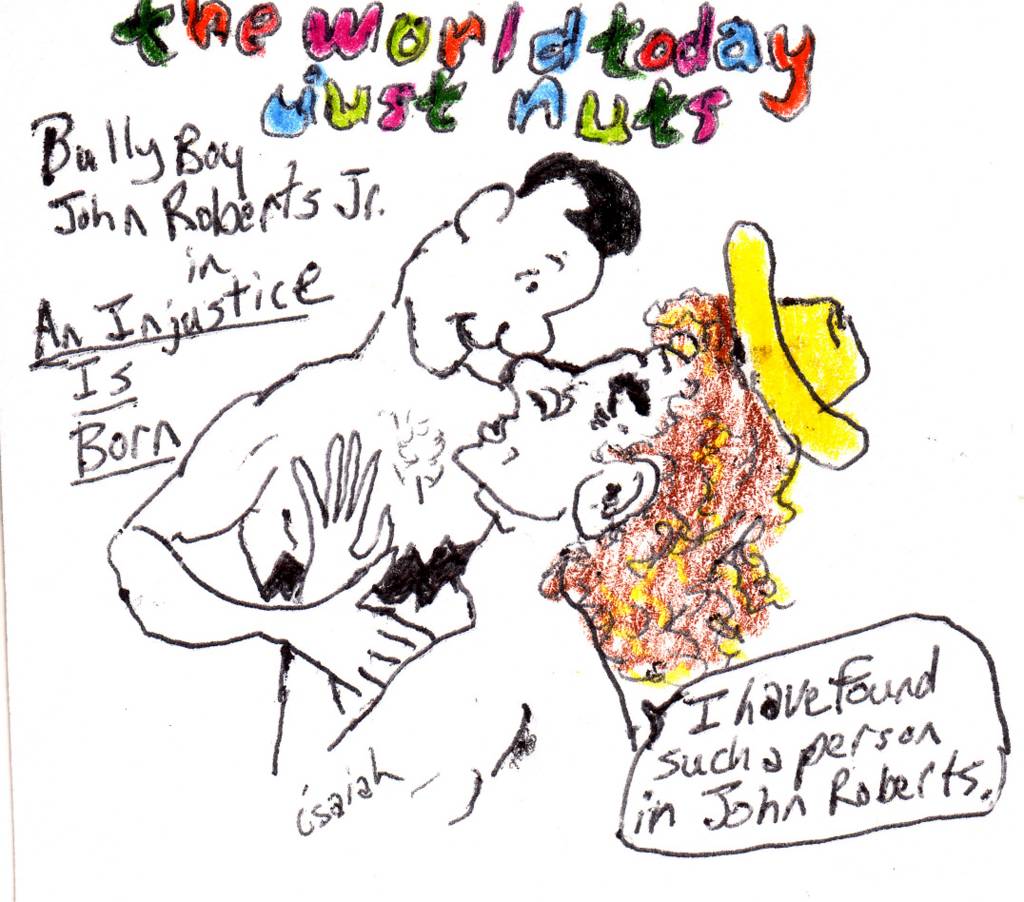
An Injustice Is Born


September 11, 2009, "An Injustice Is Born."


The movie comics always get attention and this one wasn't an exception. If you don't get the film, it's Barbra Streisand's A Star Is Born. Bully Boy's got his hair fixed like her. It's a silly comic about a silly nominee who never should have been seated on the Court.

Roberts was always drawn like Charlie Brown, both because he looked a little like him and also because he was a block head.

Though Roberts is bare chested to get the poster feel of the Streisand movie, I went ahead and included the stripe on his chest as if he were wearing the Charlie Brown shirt.


Moving to another topic. Dona, Jess, Dallas and I wrote an article for Third ("A Rucka, a Batwoman, a Zeus and a Heatwave") and that was a lot of fun to write and a lot of fun to take part in.

Zeus Comics (in Dallas, Texas) is a very nice store and if you're ever in that area, you should check it out (it's on Lemmon Avenue). I will if I'm back in Dallas any time soon.

And thank you to Dallas, Dona and Jess for being so much fun to work with.

Here's C.I.'s "Iraq snapshot:"

Friday, July 3, 2009. Chaos and violence continue, Joe Biden is in Iraq, so are land mines and the UN is drawing attention to the crisis, al-Sadr followers protest Biden, and more.

"Biden has come here to divide Iraq according to his plan." Vice President Joe Biden arrived in Iraq
yesterday and among today's activities is a protest of his visit by supporters of Moqtada al-Sadr. Andrew Quinn and Sattar Rahim (Reuters) report al-Sadr supporters marched in Baghdad and remarks from al-Sadr (including "Biden has come here to divide Iraq according to his plan") were read aloud to the crowd. The remark by al-Sadr refers to Biden's support for a federation of three autonomous areas in Iraq: Shia, Sunni and Kurd. That plan is among the reasons Biden has become the point-person for the administration on Iraq because the Kurds are increasingly unhappy with the US and increasingly vocal about what they see as US abandonment of their interests and needs. Quinn and Rahim note that al-Sadr's supporters were vocal as well, chanting "down, down USA" while burning US flags during their protest. Jane Arraf (Christian Science Monitor) reports the Kurds aren't the only ones worrying that Iraq has been abandoned and she quotes Hoyshar Zebari, Iraq's Foreign Minister, stating, "My message to them [US] is . . . you lost Afghanistan in 2001, 2002, and 2003 because you turned your attention to Iraq from Afghanistan -- now you are redirecting your attentions of Afghanistan and if you disengage with Iraq, it could be another failure. The situation is not that solid." Sheryl Gay Stolberg and Timothy Williams (New York Times) quote Biden declaring he is there to ask: "What is their plan to resolve the real differences that exist?" Mark Silva (Chicago Tribune) quotes Biden stating, "The reason I came is the president wants focus within the White House on the implementation of our administration's plan to both draw down troops in Iraq and also to promote a political settlement on unresolved issues from boundary disputes to the oil law."
Alsumaria notes it is is a three-day visit and that the vice president "arrived to Baghdad Airport amidst a sand storm which prevented him from conducting a scheduled visit to the US Embassy." The White House offers three photos of the arrival and Biden being greeted by Zebari and the top US commander in Iraq Gen Ray Odierno. Thomas M. Defrank (New York Daily News) reports Biden had breakfast with son Beau. Delware's WDEL has an audio report here. Beau Biden is the Attorney General for the state of Delaware and serving in Iraq as a captain in Delaware's Army National Guard. Biden's the first child of a president or vice president to serve in this decade's Iraq War. (The 2008 Republican presidential ticket had two candidates with children serving in Iraq. US Senator John McCain's son Jimmy served in Iraq. Governor Sarah Palin's son Track is serving in Iraq.) Despite George W. Bush sending other people's children into harm's way, neither of his daughters served in his illegal war of choice. Nor did Mary or Deferment Cheney, Dick Cheney's daughters, serve.


Taking a sidebar on Dick Cheney, for those who have forgotten, retired Ambassador Joe Wilson was sent by the CIA to Nigeria to vet accusations that Saddam Hussein (then president of Iraq) was attempting to obtain yellow-cake uranium from the country. Wilson found no evidence to support the claims. Despite that investigation, the false assertion began working its way into cases for the illegal war made by the Bush administration and Bully Boy Bush himself would say that they'd recently learned Saddam attempted to obtain yellow-cake uranium from Africa. Was that Nigeria?Wilson, at that point didn't know, and attempted to find out. Maybe Saddam had tried with another African country? Nope. It was Nigeria. The administration was lying.What do you do?Wilson began warning reporters and then began speaking out publicly.In retaliation, the administration that LIED and attacked. This was their pattern repeatedly. When former Treasury Secretary Paul O'Neill went public with issues, the administration attacked him and the press -- hey, David Gregory -- ran with the administration's lies and presented them as fact. In O'Neill's case, he was being accused of stealing government information on discs. Gregory stood on camera, for Today, waiving a copy of Ron Suskind's The Price of Loyalty and repeating the White House charges with a who-knows-what-really-happened spin. Apparently the only one who could know reality would be the non-idiots who knew to read the introduction of a book before repeating baseless charges because the discs are covered in the intro. (As was so often the case on Today, Katie Couric would have to grab the mop and clean up for her co-workers the following day.)Now they were going after Joe Wilson.And it wasn't enough to go after Joe Wilson because this was a petty, mafia-like administration. They didn't just go after Wilson, they went after his wife and began outing her to the press as a CIA agent until they found some one (Robert Novak) willing to print their tale.Valerie Plame was an undercover CIA agent and her cover was blown by the government she worked for.Thanks to the efforts of George H.W. Bush and his administration, what had just taken place was a crime. Not for reporters, but for government officials or workers involved in the outing.Dick Cheney's right-hand I. Lewis (Scooter) Libby ended up convicted from the investigation. Many thought and hoped others would be as well. That was not the case. It was hoped that with a new administration, Valerie Plame and Joe Wilson would have the support of the government on their side as they attempted to discover what had happened to them.That has not been the case. "Status quo you can believe in" is the Obama administration's slogan and they've done everything they can to prevent the truth from coming out.R. Jeffrey Smith's "
New Evidence Cheney Swayed Reaction to Leak" (Washington Post) takes you through the latest that's emerged as Barry O's Justice Dept argues the truth must be buried. One of their claims is that to allow Cheney's testimony during the Plamegate investigation to be known would prevent other vice presidents from offering testimony to a criminal investigation. Uh, no, it wouldn't. And if testimony means anything, it means that it's not buried out of fear of what might happened some day.Barack's administration is not open, it's not trying to be open and is not attempting to put the US back on balance. It is attempting to continue all the abuses from the Bush administration. And it gets a lot of help from a cowardly Congress. (It's noted in the article that Congress once fought the Bush White House to make Cheney's testimony public. Not noted in the article is that any member of Congress could make Cheney's testimony public on the House or Senate floor.)

Back to Iraq, Biden is not the only official visiting Iraq.
Alsumaria reports that France's Prime Minister Francois Fillon met with Nouri al-Maliki and Jalal Talabani today with Fillon and Maliki doing a joint-press conference at Baghdad International Airport ". . . Fillon pointed out that Iraq is on the right track. No one should be worried over Iraq redress for it intends to cooperate with its neighbor and it constitutes an intergral part of the region's stability. France undertakes to help Iraq to reach stability as soon as possible, to resolve conflicts with its neighbor and to get fast result, Fillon said. He also added that France takes upon itself assisting Iraq to emancipate from international sanctions which hinder development process." Xinhua reports the two "signed a cooperation agreement to promote bilateral economic, cultural and scientific relations. According to the statement, the agreement stated that France comitted to support Iraq to join the World Trade Organization (WTO) and to conclude a partenership agreement with the European Union." CCTV observes (link has text and video) that Fillon was heading a delegation of "30 high-level business executives" and quotes him stating, "It is high time now we look to the future. The team accompanying me represents major French firms. Currently we have firms working in Iraq in the field of transportation and airports." At the start of the week, Jonas Gahr Storra met with Zebari. Store is the Norewegian Foreign Affairs Minister. Among the topics discussed were assisting Iraq in clearing land mines. Yesterday Patrick Quinn (AP) explained that the United Nations sees Iraq as "one of the world's most contaminated countries" when it comes to land mines and quotes the UN"s Development Fund's Kent Paulusson stating, "The government needs to recognize the size of the problem and deal with it. [. . .] Some areas are so contaminated that people can't live there." CNN notes that UNICEF joined the UN Development Fund in drawing attention to the land mine problem in Iraq and notes UNICEF's report: "The report says about 1 million Iraqi children are at risk of being injured or killed by mines and unexploded ordnance. Some 2,000 children -- a quarter of all victims -- have been maimed or killed by cluster bomblets since 2003, the report said." Aseel Kami (Reuters) adds Iraq's Environment Ministry estimates there are 25 million land mines in Iraq and that the border between Iraq and Iran "is particularly mine-infested." David Morgan (Global Arab Network) observes, "Vast stretches of potentially highly productive agricultural land cannot be cultivated because of the potentially lethal hazards presented by explosive materials that still lie undetected. Hundreds of Iraqi people continue to suffer injuries and dozens have been killed."
Today the
United Nations High Commissioner for Refugees notes a new "special residentail centre for Iraqi refugees in the southern Armenian village of Darbnik. The building, a former agricultural college provided to UNHCR by the government last year, features 46 apartments and a social and recreation room. It was rehabilitated by UNHCR implementing partner, YMCA/Shelter." The Iraq War has resulted in a refugee crisis of both external and internal refugees. The refugees are a diverse group but a large number of them are Iraqi Christians. The assault on Iraq's LGBT community has led to a number of them becoming refugees as well. Sunday July 5th BBC Radio 5 airs Gay Life After Saddam (7 to 8 p.m. in England -- that will be eleven to noon PST). Ashley Byrne and Gail Champion produce the special for Made in Manchester. James Chaperlard (Crain's Manchester Business) reports:

In Gay Life After Saddam, presenter Aasmah Mir finds out how life for the country's gay, lesbian, bisexual and transgendered community (LGBT), has got worse since the fall of Saddam Hussein in 2003. Human rights campaigners claim hundreds of LGBT people have been killed or tortured while others have fled the country fearing for their safety since Saddam was toppled from power six years ago.

Not noted in the article but among the people interviewed for the special is Nouri al-Maliki, puppet of the occupation.

At CounterPunch today,
Anthony DiMaggio offers a look at Iraq and it's a serious attempt so he gets a link. I don't agree with the bulk of anything he says and feel he's repeating points that were made some time ago and that many don't hold up today. The continued and illegal occupation does stabilize Iraq. It puts into power the US interest, their puppets, and it blocks any real representation of Iraqis. It is not a sovereign government. It's one that would not exist were the US not still occupying the country.The illegal war itself and the continued occupation breed violence but part of the breeding is not just resentment over the continued presence of the US, it's also resentment over the installation of the puppet government. The exiles placed in power (by the US) are not representative of Iraq.The US took sides, installed one faction, a fundamentalist faction, and backed them because they believed this faction was ruthless and unafraid to resort to violence (the US was correct on both counts) and that these thugs would intimidate Iraqis into silence.Violence has never gone away in Iraq since the start of the illegal war. But that doesn't mean the puppet regime doesn't 'stabilize' it to a point where the violence lowers slightly, just enough to lull people into looking the other way.The 'civil war' wasn't a civil war. It was a genocide where the thugs in power went about ethnically cleansing parts of Baghdad. They succeeded. They did that with the whole world watching and with most of us not even grasping what was going on.DiMaggio is taking on the continued presence of US forces and also disputing the idea that there's any level of 'stability' in Iraq currently. The resentment and rage goes beyond the presence of foreign fighters. It goes to the fact that the 'rulers' are exiles installed by the occupiers, not chosen by the people. And those 'rulers' do allow for a form of 'stability' but they do it by targeting the Iraqi civilians and by using terror tactics.DiMaggio's argument's great for 2003 but it's completely out of step today because the people still pushing for continued war on and occupation of Iraq are not being countered with any claims DiMaggio's making. Their argument is that when the US leaves, violence levels will soar. DiMaggoi insists that US forces on the ground cause resentment and violence. That was true in 2003 and remains true today; however, we know more today and what he's saying isn't enough. It's not just the military, it's what they prop up, it's the 'government' the US has created.The response to those who insist in 2009 that the illegal war must continue for stability is that no one knows what will happen when US forces leave but there's not a real government there now and claiming stability via a thug regime doesn't encourage democracy or allow US forces to ever leave. The government is not of the people and it doesn't represent them. It will always need force behind it to remain in power.Lastly, the referendum on the Status Of Forces Agreement is not happening this month. It can't. It requires planning. The US stepped in and al-Maliki was more than happy to go along with it. The claim is it will now be held in January when national elections are held. Alsumaria explains, "Meanwhile, the government seeks to delay the referendum till January 2010, when the country also holds parliamentary elections as holding both at the same time will save money. In this concern, lawmakers and electoral authorities say there is no way a referendum can be organized in just a month." Jane Arraf (Christian Science Monitor) reports, "Attention here is now shifting to national elections expected in January. The elections are seen as the best hope for addressing the grievances of Iraqi factions that feel they've been left out of a political system created by the US and dominated since 2003 by a Shiite-led government."


Turning to some of today's reported violence . . .

Bombings?

Laith Hammoudi (McClatchy Newspapers) reports a Mosul roadside bombing which injured three Iraqi soldiers and a Tikrit roadside bombing wounded one police officer.

Shootings?

Laith Hammoudi (McClatchy Newspapers) reports 1 person was shot dead in Mosul and "an officer in the Iraqi army called Saddam Hussein" was shot ded in Kirkuk. Reuters notes "three judges who were traveling together in a car in northern Hilla" were injured in a shooting by unknown assailants.

Corpses?

Reuters notes 1 male corpse was discovered in Mosul and 1 female corpse in Hilla -- both has "bullet wounds to . . . head and chest".

Yesterday the
US Defense Dept identified the four soldiers killed in Baghdad June 29th: "They were assigned to the 120th Combined Arms Battalion, Wilmington, N.C. Killed were: Sgt. 1st Class Edward C. Kramer, 39, of Wilmington, N.C. [;] Sgt. Roger L. Adams Jr., 36, of Jacksonville, N.C. [;] Sgt. Juan C. Baldeosingh, 30, of Newport, N.C. [and] Spc. Robert L. Bittiker, 39, of Jacksonville, N.C." Jennifer McLogan (WCBS) speaks with Baldeosingh's sisters Jennyfer and Diana Baldeosingh. Jennyfer states, "At first it's anger. Why did he go? Why him?" Diana states, "Some of them have done two or three tours, they have families and kids, they need to be with them -- not over there. We did our time there. It's time to come home, please." John Valenti and Sophia Chang (Newsday -- link has text and video) also speak with the two sisters and they note: "He also leaves behind his wife, Rebecca, and three young daughters -- Emily, 2, and 5-year-old twins, Isabella and Kylie." ENCToday speaks with Brian Wheat, the stepfather of Robert Bittiker and explains, "Bittiker leaves behind his wife Tami, and two sons Cameron, 14, and Ronnie, 18, who just graduated from Southwest High School". The Salisbury Post notes Edward Kramer's wife Vicki issued a statement explaining, "He loved us very much and he did this for his children [Erica, age nine, and Megan, age seven] so they wouldn't have to". Catherine M. Welch (WHQR) reports a Sunday event to remember Kramer, "A memorial walk is planned for Sunday at 6:00 p.m. It will start at the Wilmington Fire Department Headquarters on Marketstreet in downtown Wilmington and end at the National Guard Armory."

World Can't Wait has several upcoming actions including:

Monday, July 13, The World Can't Wait and other organizations will protest the inclusion of military recruiters at the national NAACP Convention in New York City.
4:30-7:00pm New York Hilton Hotel 1335 6th Avenue (53/54 Streets)Also, on Thursday, July 16, when Barack Obama addresses the convention, we'll be there protesting the expanded war in Afghanistan, drone attacks on civilians in Pakistan, and Obama's refusal to release the torture photos and prosecute the Bush era war criminals. 9:30am until noon @ New York Hilton
Read letter sent by NYC High School student to Benjamin Jealous, CEO of the NAACP, asking him why recruiters are invited to the convention. Sign on to letter to be sent to the officers and Board of the NAACP this week:To Benjamin Jealous, President & CEO, NAACP

iraqjane arraf
the christian science monitorthe new york timessheryl gay stolberg
timothy williams
mark silvathe chicago tribune
anthony dimaggio
mcclatchy newspapers
laith hammoudi
aseel kami
alsumaria

cnn

Read on ...
Creative Commons License
This work is licensed under a Creative Commons Attribution-Share Alike 3.0 Unported License.