Thursday, August 6, 2009

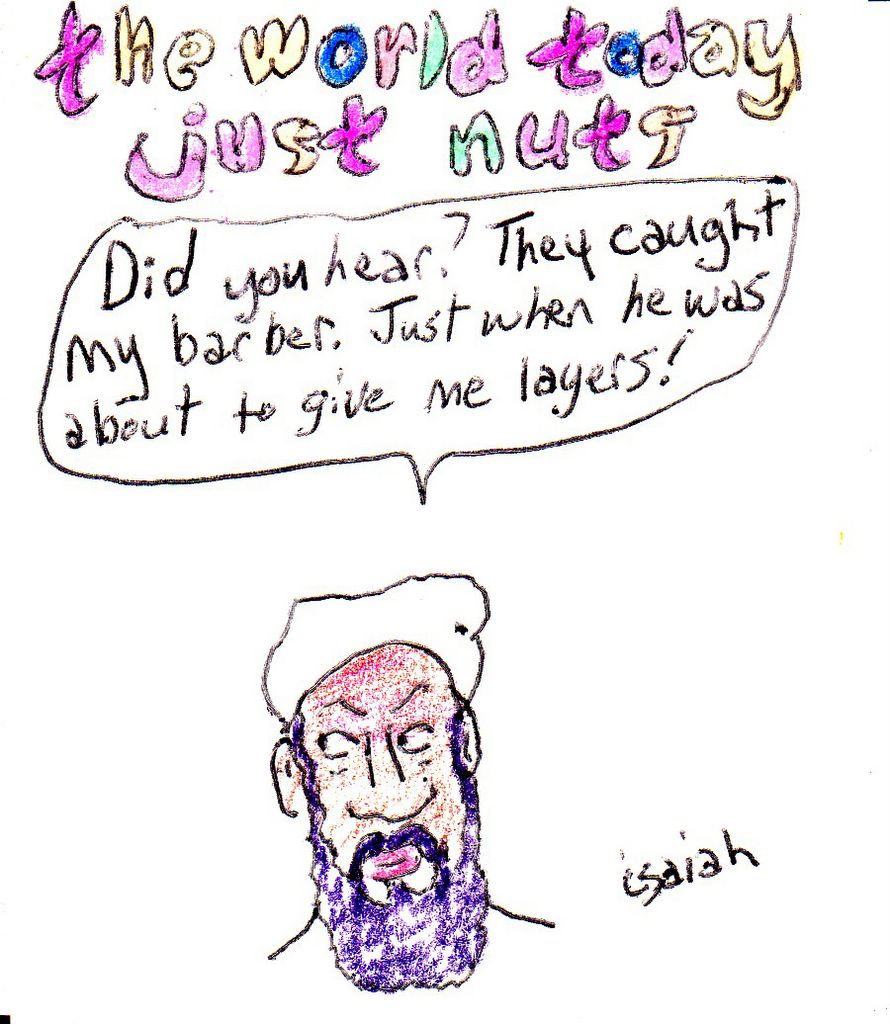
US forces caught the barber!


That's from October 16, 2005. The news then was "They caught Osama's barber!" Truly, I'm not making that up. Some weeks, the Bush administration made it very easy to draw a comic.

So I have Osama asking if you've heard the news and then lamenting that this was "Just when he was about to give me layers!"


Here's C.I.'s "Iraq snapshot:"

Thursday, August 6, 2009. Chaos and violence continue, Anthony Zinni explains how he was almost the US Ambassador to Iraq, the US State Dept and White House are criticized for no visible efforts regarding the victims of Camp Ashraf, Iraqi Christians and Sahwa are targeted in violence, and more.

US Gen Anthony Zinni is now retired from the military. He is now promoting a new book he's written with Tony Koltz entitled
Leading the Charge: Leadership Lessons from the Battlefield to the Boardroom. He was supposed to be serving in the current administration. On NPR's The Diane Rehm Show today, Diane raised that issue.

Diane Rehm: General Zinni, you almost went to work for the Obama administration. I'd like to hear from you --

Anthony Zinni: Right.

Diane Rehm: -- what happened.

Anthony Zinni: Well, uh, I was called right before the inauguration and asked if I would be willing to serve as, uh, to serve in the administration in a couple of possibilities. And then --

Diane Rehm: By whom?

Anthony Zinni: By General [James L.] Jones, the National Security Advisor. And I said I would given the-the positions he mentioned,. And right after the inauguration, he called and asked if I would serve as the ambassador to, uh, Iraq. And I said I would. And, uh, received a call from the vice president thanking me that I would take that on --

Diane Rehm: Vice President [Joe] Biden.

Anthony Zinni: Vice President Biden. And, uh, I met with Secretary of State [Hillary] Clinton and, uh, deputy -- two deputies. Spent a long time with her in the office. She was asking me what I understood about Iraq, my assessment. I had just gotten back not long before that doing an assessment out there. And then I left that meeting, you know, understanding fully, you know, I was going to be the nominee. I mean I was told to prepare for it, we would move the process forward very quickly because of the outgoing Ambassador Ryan Crocker was coming out very quickly.

Diane Rehm: You shook hands on it?

Anthony Zinni: Yes, we did. I mean, there was no way I left and didn't think this was going to happen. And actually thought I had a very short period of time to get my affairs in order. I mean, obviously, there are a number of things you have to do in your own financial family and all that sort of thing. And for -- a week went by and I was told to stay in touch, be prepared, quote: "Move the paperwork forward." That we were going to move up the confirmation hearings. And nothing was happening. And I tried to contact people and I couldn't get any answers. And finally late -- about a week later -- I finally got a hold of General Jones and he informed me I was not the choice and I was kind of shocked and surprised by it. And then the next morning in the Washington Post, I read that it's Chris Hill and I thought: "Had I not gotten ahold of General Jones, that's how I would found out." To be honest with you, I-I don't, I can understand people changing their minds and I don't object to that. You know that's a fact of life. I-I was just put back by not being called or told by anyone and, to this day, I haven't had anybody explain to me what happened so. But I moved on. Clearly, you know, you have to understand Washington and the way things work and I've moved on from there.

Diane Rehm: What's your best guess as to why you were not chosen?

Anthony Zinni: Honestly, Diane, I don't know. Uh, one of the reasons -- I-I started getting calls that very day from the media, from the press and, uh, people saying, "These are the rumors we're hearing." And they were attributed to senior government officials so that was disturbing. And many of the-the reasons given, I clearly knew were not right because --

Diane Rehm: Such as?

Anthony Zinni: Such as, "Well the Pentagon didn't want you." Or, "A certain general didn't want you." All-all of whom I knew personally and it's just the opposite and matter of fact were calling me upset that-that it hadn't gone through. So I began to be bothered by some of the rumors that obviously were coming out of the -- supposedly attributed by the media to senior government officials.

Diane Rehm: What kinds of rumors?

Anthony Zinni: Well, it was this particular lobby that worked against you, it was this particular individual that-that stopped it or this person. And-and to me that -- you know, to me, many of them I knew weren't true, many of them I thought were only based on rumor and so I thought it important since they were asking me what happened I tried to not engage them but then I finally said, "Well look, let me just tell you the course of events that went by. So there's no misunderstanding that I didn't know or understand that I was be the nominee. And what happened." And-and to this day, nobody's told me what happened. Not that I'm interested anymore. But [laughing] I haven't been told.

Diane Rehm: So even speaking with General Jones, he did not give you a reason?

Anthony Zinni: He did not. Our last conversation, right after that was "Well I'll get back to you as I find out." And, you know, that was in January and then I have not heard anything about it. Not that I'm, again, I'm not interested anymore in what happened.

Diane Rehm: Of course you're not interested anymore since it's over and done with. On the other hand, as a human being, if I had been in your position, I would have felt really stung.

Anthony Zinni: Yeah -- well, yes. I guess the best way to describe my feelings, was I was disappointed because there were many friends and people I respected tremendously in this process and, uh, so that-that created a disappointment and confusion on my part as to what exactly happened.

We'll come back to another section of
The Diane Rehm Show in a bit. As Michael Crowley (New Republic) pointed out this week, Chris Hill has no experience with Iraq, doesn't speak Arabic "and has a background in Eastern Europe and Asia." Chris Hill demonstrated in his confirmation hearings that he didn't grasp the issues at stake around disputed Kirkuk. Hill doesn't appear to grasp the issue of the MEK or how the lack of visible efforts to stop the targeting of the MEK by Nouri al-Maliki's forces is causing global outrage. James Morrison (Washington Times) reports Democrats and Republicans in the US House of Representatives have called out the inaction in a letter to the US State Dept -- 21 Democrats, 11 Republicans including Barbara Lee, Sheila Jackson Lee, Brad Sherman, Diane Watson, John Boozman, Bob Inglis, Ted Poe, Dana Rohrabacher, Carolyn B. Maloney and Edolphus Towns. The representatives note, "A community of protected persons has been set upon by security forces of the state to which we relinquished their protection. We believe there is cause to fear the forced expulsion of the Ashraf residents by Iraqi forces." The legislators urge Hillary to instruct Chris Hill to address with Nouri's government "international law and with the assurances Iraq gave the U.S. regarding Ashraf residents." Last Tuesday, Nouri al-Maliki ordered the assault on Camp Ashraf, home to the MEK. The MEK has been in Iraq for decades. They are Iranian exiles welcomed into Iraq by Saddam Hussein. They are currently considered "terrorists" by the US. They were formerly considered such by the European Union and England; however, both re-evaluated and took them off the terrorist watch list. The US military protected the residents of Camp Ashraf during the first six years of the Iraq War. UPI explains, "Iraqi police in July stormed the Camp Ashraf base of the People's Mujahedin of Iran using tear gas and water cannons, promising to expel the 3,500 members of the group." Today The Economist notes, "After the Americans took over in 2003, the PMOI people at Camp Ashraf, as the place is known, were disarmed. More recently the Iraqis decided to take over the camp, doubtless with the ecnouragement of their ruling fellow Shias in Tehran. Ignoring American protests, the Iraqi forces killed at least 11 inmates. If such crude methods are used elsewhere -- for instance, in handling insurgents wanting to come onside -- natioanl reconciliation is unlikely to be achieved." The National Council of Resistance of Iran released the following statement today:

At 9:45 local time this morning, two Iraqi helicopters armed with heavy machine guns flew at low altitude over Camp Ashraf in a bid to intimidate the residents and patrol the area. The helicopters also dropped propaganda flyers. In light of last weeks' massacre of defenseless residents of Ashraf by Iraqi suppressive forces and the US forces' inaction in this respect, and in view of the US forces' role in Iraq's aerial control, particularly in Diyala province;
1- The Iranian Resistance expresses its strongest protest to the American forces for allowing Iraqi helicopters to fly over Ashraf and demands aerial security guarantees from the US forces for Ashraf and prevention of a war crime by violation of Ashraf air space. Considering widespread influence of the terrorist Qods force in Iraq, which has been emphasized by US commanders in Iraq on a number of occasions, and with regards to Iranian regime's plots to annihilate the residents of Ashraf, opening of Ashraf air space to such flights would no doubt be misused by the Iranian regime to commit further crimes.
2- According to our information, the clerical regime's ambassador to Baghdad, Revolutionary Guard Kazemi Qomi who is one of the commanders of terrorist Qods force, had provided the content of the propaganda flyers to the office of the Iraqi Prime Minister on Tuesday, August 4, to be dropped on Ashraf.
3- There is no doubt that all these measures have been dictated by the Iranian regime's Supreme Leader Ali Khamenei to the government of Iraq in the midst of Iranian people's escalating uprising. Nouri al-Maliki, Iraqi Prime Minister, has now turned into a tool in the hands of the Iranian regime to be used against mullahs' main opposition.
Ashraf's defenseless residents who stood empty handed against barrage of bullets in one of the most barbaric criminal attacks last week by the Iraqi forces do not give any credit to Khamenei and Maliki aerial shows, thus they tore up the documents produced by Khamenei's Revolutionary Guards in Qom and Baghdad before the eyes of Iraqi forces and set fire to them.
Secretariat of the National Council of Resistance of Iran August 6, 2009

Former US House Rep Tom Tancredo pens a column about the MEK for the Washington Times and he states:

Human Rights Watch has called for an impartial investigation into the Iraqi police action. Videos of the July 28 attacks show police wielding not only batons and water canons but iron bars in their assault on unarmed residents. Military Humvees ran over injured protesters. Residents also claim that at least two people were killed by sniper fire. Iraqi security forces have prevented journalists from entering the camp to interview residents.
Independent observers know that the action on July 28 is hardly an isolated incident, as it came on the heels of repeated Iraqi government statements that it intends to disband the camp and evict its residents. Such statements are contrary to the agreement signed with the United States guaranteeing the safety of the refugees.
Iraq is also a party to the International Covenant on Civil and Political Rights, which forbids the forcible return of political refugees who face torture or cruel punishments. But where can they go if the United States continues to label them terrorists?

Iraq's
Alsumaria reports that Shirwan Waeli, Minister of State, declared they will not grant asylum to the refugees. Mohammed Abbas (Reuters) reports that Nouri's bag boy Ali al-Dabbagh issued denials that water, medical supplies and food were being blocked from arriving at Camp Ashraf and notes that the claims of the blockage comes from human rights activists as well as Camp Ashraf residents.

The betrayal of the residents of Camp Ashraf should alarm some in England. Today US Maj Gen Richard Nash briefed reporters at the Pentagon. Nash was appearing via satellite from Basra and he was explaining how, in sourthern Iraq, Iraqis are showing leadership. The British turned Basra over to the US and the US is now eager to pass it on to Iraqis. Nash declared, "The Iraqis have stepped up to the challenge and have faced threates head on." How does this apply to England? As the British troops left, they left behind a dog and a cat and asked the Americans to take care of them.
Deborah Haynes (Times of London) reports the dog is Sandbag and has 32,000 Facebook friends and 6,000 people who petitioned the British government to allow Sandbag to come to England. Instead, Downing Street released this statement: "Our US colleagues have assured us that both Sandbag and Hesco will be well cared for. Both are currently fit and healthy." Hesco is the Iraqi cat the British soldiers adopted. Of course, the residents of Camp Ashraf were assured by Americans that they would be protected. And, seeing how that turned out, maybe the world should worry Nouri will next launch an assault on Sandbag and Hesco? If so, apparently the White House will remain mute as it has throughout the Camp Ashraf assault.

Turning to some of today's reported violence . . .

Bombings?

Laith Hammoudi (McClatchy Newspapers) reports a Baghdad sticky bombing which claimed 1 life and left three people injured, a Baghdad bombing which claimed 1 life and a Mosul bombing which claimed 2 lives and left one person injured. Reuters notes a Kirkuk car bombing which claimed 4 lives and left thirty injured, and a Mosul home bombing which injured two Christian females.

Shootings?

Laith Hammoudi (McClatchy Newspapers) reports 1 money exchange office owner shot dead in Baquba and an attack on a Sahwa checkpoint in Baquba which claimed the life of 1 Sahwa. Reuters notes 1 woman shot dead in Mosul by a drive-by and 1 man shot dead in a Mosul home invasion.

Corpses?

Reuters notes 1 corpse discovered in Mosul.

At the end of last month,
Ruth noted that three journalism students, Jennifer Canfield, Tom Hewitt and Jessica Hoffman, with the University of Alaska were headed to Iraq. They are in Iraq and they are reporting at Short Timers. Tom Hewitt offers an overview of events so far including:

While on our way to get our credentials at the Combined Press Information Center in the Green Zone, our convoy came within a few minutes of being hit by an IED, which made the situation getting into the Green Zone a bit tricky due to fears of another attack. We eventually made it into the CPIC, however, and got credentialed.

On the subject of journalists in Iraq,
Shon Meckfessel (The Nation) states, "I'm writing this statement to help people understand what happened to my three friends, Shane Bauer, Sarah Shourd and Josh Fattal, who went missing by the Iran/Iraq border. I have been close friends with Shane and Sarah for years, and recently met Josh, a longtime friend of Shane. Shane is a language student and freelance journalist; Sarah is an English teacher, and Josh arranges student exchange trips. All of us have done some writing about our travels, and all of us share a deep appreciation for Middle Eastern cultures." His statement continues. The three were said to have been hiking. They were in northern Iraq, Kurdistan, and allegedly ended up on Iranian soil. (Anyone paying attention to Iraq in the last years knows the external border disputes especially with regards to Iran though it generally gets more attention when the external border dispute has to do with fishermen allegedly entering Iranian waters.) The three are currently held and jailed by the Iranian government. For more on them, see Meckfessel's statement.

Now returning to
The Diane Rehm Show where Diane spoke with retired Gen Anthony Zinni today. She raised the issue of Col Timothy Reese's memo.

Diane Rehm: General, there's talk that the administration may declare victory and leave Iraq sooner than planned. What are your thoughts?

Anthony Zinni: Well I-I think first of all in terms of combat troops, I-I think the schedule we're on is the right one. Uh, we've done about all we can do in terms of our troops -- coalition troops -- patrolling the streets and in the cities. We have worked hard enough and long enough with the Iraqi security forces that they have the capability to stand up to the challenge. Now they will have problems, they're not perfect. I do think as we go forward, we'll have to continue security assistance programs helping them with the right equipment training education of their leaders and officers. And that's not just military, that's police and-and other security elements that they have there. But I think that's on track. And I think -- I think an ongoing program of that kind of support is necessary to maintain. It's now up to the Iraqi government. I mean, I think we have put him in a position to succeed. It's going to be an issue of their capability and competence to administer, to allocate funds to build programs. I spent some time over there, late last year, at the request of Ambassador Crocker and General [Ray] Odierno, part of an assessment team looking around and I came away -- especially when I was with some of the ministers and some of the ministries in the Iraqi government -- you know, realizing that they're learning something that they have no experience in and that's how to govern, how to build a bureaucracy, how to make policy. They have some inherent friction points. Obviously it isn't like there's one party in office so you can be consistent. They have a Sunni, a Kurd, a Shia. And you have differences that they have to come to grips with internally. They're beginning to learn the -- how bureaucracies function and how governments need to-to do the nitty gritty of getting things done. And in walking some of the streets and talking to some of the people, trying to assess what some of their expectations are, it came out clear to me that it will succeed if they feel their government is responsive to their needs. They want security. They want their essential services met. They want that electricity on 24-7 and garbage picked up.

Diane Rehm: But suppose all that breaks down. Then what happens to the US and its military?

Anthony Zinni: Well -- it -- I feel, you know, of course, I opposed going into Iraq when we did. Wrong war, wrong place, wrong time. And you know that's -- people have come down on different sides of that but the reason I did is we could not afford a deep stabilized disconnected Iraq -- especially since we had other requirements around the world particularly Afghanistan, Pakistan and the entire Taliban and al Qaeda. It-it -- a fragmented destabilized Iraq, right in the heart of the Middle East, I don't think will be for the international community, will be, uh, uh, able to cope with that or able to deal with that by ignoring it. That was my concern: Once you're in, you're in all the way. And I don't think you're going to see a total collapse but I do think my worry would be and-and I don't think this will happen but you could get a fragmentation and see a Kurdish area, a Sunni area, a Shia area split up and, you know, the violence that may go with that. Because at the points where they meet and the fault lines of course there's-there's great danger. Uh, that is going to be difficult for the region. And that's going to wash over and create more problems that we have and-and I would hate to say this but I think we're going to be in a position where we can't let that happen and we need to redefine that "we" is not only the United States. And we need to build more support for ensuring it doesn't happen to begin with or be prepared to take the right actions to react to it.

Diane Rehm: But isn't there very little support internationally?

Anthony Zinni: There is very little support internationally. As a matter of fact, one of my worries about Afghanistan, we're beginning to see waning support and I know you want to talk about that but Iraq of course because the initial entry into Iraq was not received favorably, you know, in the international community with some exceptions. And so the stomach for reengagement obviously isn't there. But I want to say I left there -- and I went there as a skeptic of course and-and-and -- but I admired what General Petraeus did, what Ryan Crocker did, General Odierno because I think they turned it around and gave it a chance. I would -- I would say right now, I do think it will have bumps along the road but it can succeed and I would give you some things to watch. There are three elections in this year. We've already had one, it went very well. If the other two go well, and what I mean by well, the people come out to vote, it's secure, there's no fraud or-or excess influence that shouldn't be -- inappropriate influence, those are going to be good signs. If you begin to see essential services, they're being met. You see the electricity going up, I think then it's going to be on its way to reasonable stability -- at least in the near term and maybe in the long term even more sustainable stability.

What three elections this year is he talking about? The one that's taken place, that he's describing, sounds like the Kurdistan elections last month. But he means the January elections (14 provinces voted). If he's including national elections, they're supposed to take place next January (though they could be postponed again). He does say "him" (apparently meaning Nouri) in the above remarks. It's a prettied-up-view of Iraq. But let's stick with elections.
We'll drop back to Friday to rerun this:


By the way, Patrick Cockburn was one of the fools insisting in the last weeks that the Iraqis would be able to vote yesterday on the treaty masquerading as a Status Of Forces Agreement. That didn't happen. That was never going to happen. It was obvious for some time and by June, with no move to organize voting and poll workers, it was obviously not happening. But fools and liars -- like Cockburn -- continued to insist it would. Just like they continue to lie that the White House was forced into the SOFA when the White House got everything they wanted with the SOFA.
Timothy Williams and Abeer Mohammed cover some of yesterday's reported violence in today's New York Times and also explain:

["]The government of Prime Minister Nuri Kamal al-Maliki has proposed scheduling the referendum for Jan. 15 to coincide with parliamentary elections.On Thursday, one of the few public mentions of the July 30 deadline was made by Tariq al-Hashemi, one of Iraq's two vice presidents."This date had been carefully chosen to provide the necessary time to have a tangible result," Mr. Hashemi said in a statement. "Failure to meet the date is a delay that denies the Iraqi people their rights."In the meantime, various Iraqi governmental entities pointed fingers at one another for failing to convene an election.["]

The brackets are to note that's all from the paper (obvious in the origianl entry but both paragraphs above are in bold print). It's obvious. And something else is obvious, Patrick Cockburn isn't the worst reporter in indymedia. The worst reporter is the one who stole the New York Times article and has sentences in 'their' report that are word-for-word from the NYT report by Williams and Mohammed. Just a thought, besides being theft, is it really smart for those allegedly against the Iraq War to steal from the New York Times to begin with? It's really not an "anti-war" paper. But pay attention and see if you can spot the NYT rip-off, it's an article that's popping up at many sites currently.

In Iraq, Als
umaria reports Parliament is outraged by Nouri's latest stunt: Calling treaties memos of understanding so he can bypass Congress. You know, the US might be able to call this out . . . Oh wait, they US Congress (including the now-president of the US, Barack Obama) rolled over after the SOFA was approved by the Iraqi Parliament. And Bully Boy Bush called it a SOFA (it was a treaty) to avoid having to put it through the US Congress for approval. Hmmm. It appears Nouri was watching and did learn something -- though not what Zinni outlines as things needed to pass on. Meanwhile, the Bremer walls are coming down around Baghdad -- at least some of them. Maybe. The ethnic cleansing that took place to purge Baghdad ended some time ago. Baghdad's still targeted with bombs, don't pretend it isn't. But the walls were primarily about -- as so many rightly feared -- corralling and herding the 'undesirables,' the ones targeted. Ernesto Londono (Washington Post) kind of notes the walls, but really focuses on the more impostant issues such as: "Iraqi authorities have threatened to seize U.S. vehicles that do not have Iraqi license plates, sending hundreds of American government employees and contractors scrambling to Baghdad's equivalent of the DMV." Sam Dagher (New York Times) notes the claims that "most" of the walls will be removed in 40 days. That claim has been made before, by the way. No one seems aware of that. Dagher notes that the plans do "not cover many of the giant walls put up by the United States military two years ago around Baghdad neighborhoods like Dora, Huriya and Saidiya that experienced the worst of the sectarian bloodshed."

Jason Swindlehurst, Jason Creswell, Alec Maclachlan, Alan McMenemy and Peter Moore, all British citizens, were kidnapped in Baghdad May 29, 2007. Jason Swindlehurst and Jason Creswell were dead when their bodies were turned over to the British authorities after the two leaders of the group bragging about having done the kidnappings were released from US custody. (The same group, and why the brothers had been imprisoned originally by the US, bragged about their actions in assaulting a US base and killing 5 American soldiers.) The British government considers Alec and Alan to be dead (the families remain hopeful) and it is thought (by the British government) that Peter Moore is alive. The group taking credit for the kidnappings and for the deaths of 5 US soldiers is alternately called the Righteous League or the League of Righteous by the press. The press? They got press this week, see
Monday's snapshot, because Nouri met with them to bring them back into the government. As noted in the Tuesday snapshot, the press spin that the group has given up violence is false. Their spokesperson says they will not attack Iraqis but that they will continue to go after US service members.Peter Moore is assumed alive and Alec and Adam may be. And Nouri's welcoming the group back to the 'political' process in Iraq? Nouri's spokespeople refute claims made by Gordon Brown's flacks. They claim he's pressing the group on the British citizens. Nouri's spokesperson dismissed that idea and stated it's not a concern for Nouri. Jason Swindlehurst's sister Lizzette Swindlehurst tells the Skelmersdale Advertiser, "To me he [Gordon Brown] could have done something. At the end of the day he is the one with the power in the country, isn't he? I don't know how my mum and dad feel, but I think a lot more could have been done than they said they were doing. I think they knew more as well." Mark Johnson (Skelmersdale Advertiser) quotes her explaining, "They [doubters] were originally saying he had committed suicide. He would not have taken his own life. He would not have done that. Only people who knew him knew he would not do that. He had too much to live for -- he had a little girl." Steve Orme (Liverpool Echo) covers the funeral yesterday. Orme quotes father Russell Swindlehurst stating, "We may not have agreed with their [the government's] policy on the news blackout, but who is to say if the media was informed of everything that went on, the outcome would have been different?"

Turning to the US,
Debra Sweet (World Can't Wait) writes about the peace movement and notes four upcoming dates:


Monday October 5, in Washington DC. Protest at the White House against Obama's Wars, on the anniversary of the US attack on Afghanistan, in coalition with
National Campaign for Nonviolent Resistance (NCNR) and Witness Against Torture, Activist Response Team & Veterans for Peace. We will march from McPherson Square to the White House, and the action will include non violent civil resistance.
Tuesday October 6.
We Are Not Your Soldiers! A day of resisting recruitment in high schools, nationwide. In high schools, this means everything from wearing a button or orange armband, to holding film showings & talks, to bringing in anti-war veterans of Iraq & Afghanistan, to sitting in or walking out to protest at recruiting stations. In support of these actions, we urge people to hold war protests on October 6 at recruiting stations, or city centers.

Saturday, Sunday October 10/11:
Equality March in Washington DC. World Can't Wait will be present to support the just demand for marriage equality for gay & lesbian partners and for the repeal of the "Defense of Marriage Act." We are not against the repeal of the discriminatory "Don't Ask, Don't Tell" policy, but we plan to challenge anyone to say why people should go into the military now, when they will contribute to the illegal, unjust, illegitimate, immoral war, and occupations.

Saturday, October 17: Local Protests to
End the Iraq & Afghanistan Wars and Occupations.

A majority of people taking the
survey said they are ready to organize for October, or want more information. The basic plans are coming together, and we're asking YOU to develop the details as we go forward.

iraq
the diane rehm show
npr
laith hammoudimcclatchy newspapers
the times of londondeborah haynes
mohammed abbas
alsumaria
the washington posternesto londonothe new york timessam dagher
steve ormemark johnson
debra sweet


Read on ...

Thursday, July 30, 2009

Sucking Up


That's my comic for October 9, 2005. Andrea Mitchell had released her book Talking Back and I offered it should be entitled Sucking Up.


Sometimes I have an idea ahead of time, sometimes I'm searching madly for one.

The above is an example of needing to do a comic and having no ideas. (To be clear, C.I. is always telling me to take time off and saying we'll all be just fine with it but I do know a lot of members count on the Sunday comic so I try as much as I can do one. In addition to the comics I'm doing for the newsletters.)

So when that happens, I generally flip channels, flip through the morning paper and go through magazines looking for any idea.

And I always tell myself that I'll go for a walk in a second and that'll clear my head. I almost always forget the walk and if I'd just get into motion an idea would come to me.

So that's a little insight. Probably too much.


Here's C.I.'s "Iraq snapshot:"

Thursday, July 30, 2009. Chaos and violence continue, the assault on Camp Ashraf continues, the inquiry into the Iraq War begins in England, a US military colonel in Iraq advises that the US needs to remove all forces by August 2010, a Senate committee hears testimony stating the federal circuit should be removed from the VA appeals process, and more.

Yesterday's snapshot included quoting Elisabeth Bumiller (New York Times) report, "The Iraqis will be unable to handle their own air defense after all American troops withdraw from the country by the end of 2011, the top commander of American forces in Iraq said Tuesday. . . . Asked if the Iraqis would be in a position to fly their own defensive air patrols at the end of 2011, when a United States agreement with Iraq calls for all American troops to be out of the country, General Odierno replied, 'Right now, no'." And then noting, "If you don't realize what a shock Bumiller's article is and how much it needs to be buried for some, note how heavily an AP story about Gates declaring maybe some US troops may leave earlier. Some. May. Some. News gets in the cycle, better dump a bunch of fluff. " Bumiller was one of the few to cover that but the fluff made it everywhere. Surprising when you consider, as Katie Couric noted on yesterday's CBS Evening News with Katie Couric, that there are 130,000 US forces in Iraq, "10,000 are scheduled to be withdrawn by the end of this year. According to Gates, 5,000 more could be home for the holidays." Of the 'news,' Thomas E. Ricks (Foreign Policy) notes, "Obama has broken a campaign promise to take a brigade a month (I think he was right to do this, but that's neither here nor there.) Right now, we have about as many troops in Iraq as on average over the last six years." Instead of actually writing about the assault on Camp Ashraf, Ricks strings together a small number of words with a link to Juan Cole.

Juan Cole's post that went up early, early Thursday morning -- this morning -- demonstrates both all that's wrong with the Iraq 'coverage' and all that's wrong with I'm-for-the-war-I'm-against-it-I'm-for-it-again Juan (and don't bother disputing that, I'm not Steve Rendall, I can nail it to the wall because I actually do the work). At his laughably named "Informed Comment," he had to do an update to a post written this morning, an update that says "The Iraqi government is now acknowledging that 7 MEK members were killed in the assault on Camp Ashraf." Prior to that Juan can't tell you anything about deaths. Not even a "one side claims . . . and the other claims . . ." But Juan's just discoved, late today, that the Iraqi government said 7 were killed. Juan just discovered that. Late today. Informed Comment? From yesterday's snapshot, "Alsumaria quotes an unnamed Iraqi security source stating '200 Iranian residents and 50 Iraqi security forces [were] wounded' and that Nouri ordered the assault. [. . .] Mohammed Tawfeeq (CNN) reveals Iraq's Interior Ministry is admitting to 7 deaths -- MEK is stating they have lost 11 members." So 'professor' Juan, at "Informed" Comment, decides to weigh in this morning and doesn't even know the basics -- and a death total would be among the basics. Informed, my ass.

"What happens when the US abandons some good friends?" Katie Couric asked that at the start of yesterday's
CBS Evening News with Katie Couric, The footage of the assault was shown. Footage. What other network newscast made time for this story? And while you're checking that, step on over to PBS and find out if The NewsHour made time for the story. (Answer: No.) Footage of the assault. Footage and violence supposedly drive TV news so what's the excuse for the silence from others on Camp Ashraf? From the segment on Camp Ashraf (link has text and video):

Katie Couric: When the US began turning over security to the Iraqis, it stopped protecting some valuable allies, thousands of Iranian exiles. And their camp outside Baghdad is now under attack. For two days, Iraqi police have been beating the residents. No food or doctors have been allowed in. All with the approval of Iran's government. Here's chief foreign affairs correspondent Lara Logan.
Lara Logan: It started peacefully but quickly turned violent. Iraqi police using wooden sticks against these unarmed civilians. These people are Iranians living inside Iraq, members of an Iranian opposition group known as the MEK. It was the MEK that provided the US with intelligence on Iran's nuclear program.

Ali Safavi (Nationcal Council of Resistance of Iran): Were it not for the MEK, the world would not be in a position to find out about Iran's nuclear weapons program and the mullahs may have had the bomb.

Lara Logan: The MEK have lived in this camp, known as Camp Ashraf, for decades. The Iranian government wants them expelled and accuses them of being involved in the recent unrest in Iran. Since the US invasion, the camp's roughly 3,000 residents have been living under US protection. That ended in January when the Iraqis took control under the security agreement. Now the US appears to have washed their hands of the people of Ashraf. US Secretary of State Hillary Clinton (speaking at the State Dept): It is a matter now for the government of Iraq to resolve. Lara Logan: Images captured by the inside Ashraf showed the dead and wounded. Residents told CBS News at least 11 people were killed, hundreds wounded and thirty arrested. The number's impossible to verify because the Iraqi government has sealed off the camp. The attack was seen as the latest sign American influence in Iraq is waning as Iranian influence rises. Iraq's Prime Minister Nouri al-Maliki and his government increasingly pro-Iranian.
Kenneth Katzman: The Iranians would have to cross the border to get at them directly because Camp Ashraf is clearly over the border. But they have an obviously willing ally in Prime Minister Malik, willing to do their bidding.

Lara Logan: The Iranian government praised the Iraqi governement action against MEK saying they're cleaning the country of terrorists.

This morning,
AFP reported that while Iraq says everything is under 'control' and a police station is set up, Iraq's refused to allow reporters to enter the camp. Not noted in the report, they're also rebuffing requests from human rights organizations and charities. But today in a US State Dept briefing, spokesperson Ian Kelly asserted the US military now had access.

Ian Kelly: Embassy officials met yesterday with representatives of the government of Iraq. We wanted to stress the importance to the government of Iraq, the importance of Iraq fulfilling its commitment to the US government to treat the camp residents humanely. And we also proposed permitting an assessment of injuries and possible deaths, an assessment by US forces. The government of Iraq did agree to allow US forces to provide medical assistance to those who were injured in Camp Ashraf. And there is, right now, a US medical team there performing this assistance. We're providing medical care and treatment, medical supplies and assessing any kind of follow-on treatment or support that these residents might require. And regarding other issues regarding Camp Ashraf, we'd refer you, of course, to the government of Iraq.


UPI notes, "Statements by members of the PMOI blame Iraqi Prime Minister Nouri al-Maliki for the assault on the Ashraf residents. The PMOI claims several hundred residents were severely wounded, with at least 12 people dead." An Iraqi security official (unnamed) tells AFP that 11 MEK have died -- seven on Tuesday and two on each day since. Sebastien Malo (The Daily Star) reports that tensions remain high and that the assault continues -- the most recent "clashes occurred on Thursday morning according to [MEK spokesperson Shariar] Kia." Kia refuted rumors that the MEK has weapons noting that Camp Ashraf has been inspected repeatedly and he noted that residents had begun a hunger strike. The weapons charge is ridiculous and it needs to be noted that the Iraqi government is trying to circulate false rumors that MEK have shot one another to garner sympathy from the world. Yes, Nouri is just that stupid and sick. This is the thug the US installed. Oliver August (Times of London) observes the Iraqi government's "brazen actions show that the balance of power in Baghdad has shifted in ways unthinkable when President Bush was in office, or even a few weeks ago." Robin Corbett (Guardian) points out:

The violent attack on the residents of Ashraf City was a clear indication of the Iranian regime's growing influence in Iraq and the coalition's failure to uphold international law.
In scenes reminiscent of those seen on the streets of Iran: unarmed civilians were attacked with batons, chains, hot-water cannons, rocks, armoured personnel carriers and machine guns. In video footage released by the residents, civilians inside the camp are brutally beaten, while bodies of the dead victims show gunshot wounds as the cause of numerous deaths.
The underlying message of the attack, which is still continuing, is the incredible influence that the Iranian regime now holds. However far it has infiltrated Iraq and caused violence there since the 2003 invasion, it seems that the regime now has a willing partner in Nouri al-Maliki to do its bidding in eliminating the main Iranian opposition group, the People's Mujahideen Organisation of Iran (PMOI), which is based in Ashraf.
PMOI members there are "protected persons" under the
Fourth Geneva Convention, but the attitude of the US administration and UK government has been far from forceful. To look on as civilians are killed and wounded is nothing but shameful.

Sonic grenades are said to be used by the Iraqis, ones made by Defense Techonology in Casper, Wyoming. I believe this is exactly what now Vice President Joe Bidenwarned about in an April 2008 Senate Foreign Relations Committee hearing back when he was a senator and chair of that committee. We'll come back to that. The National Council of Resistance of Iran released the following statement today:NCRI - The Iranian Resistance's Leader, Mr. Massoud Rajavi, released a statement broadcast yesterday by the Simaye Azadi (Iran National Television), with regards to the brutal assault of Iraqi forces against Camp Ashraf residents in Iraq. Mr. Rajavi said: Through his agents in Iraq, the regime's Supreme Leader, Ali Khamenei, took revenge for the Iranian people's uprising from Ashraf, which is the strategic nucleus of the struggle for freedom. He wishfully thinks that by targeting Ashraf the uprising would cease; But, the water that has already gone over the dam can't be forced back into the regime's channel and save the disintegrating religious regime. Mr. Rajavi urged all Iranians across the world to rush to support the hunger strike and demands of Ashraf residents, which are: 1. The leaving of Iraqi forces from Ashraf; 2. Protection of Ashraf to be assumed by US forces, who have disarmed and signed agreements with every single one of Ashraf residents about protecting them until the determination of their final status; 3. Presence of lawyers and international human rights organizations in Ashraf, which has been banned for the past 7 months; 4. Presence of a representative of the UN Security Council or Secretary General in Ashraf for talks about the determination of the final status of Ashraf residents; 5. Compliance of the Iraqi government with the April 24, 2009 resolution of the European Parliament on the humanitarian situation of Ashraf residents; 6. Prosecution and punishment of parties who ordered or perpetrated the brutal attacks and massacre in Camp Ashraf by an international tribunal for crimes against humanity.

At Thomas Rick's post linked to earlier, the New York Times'
Bill Keller leaves a link promoting an article at the outlet he's executive-editor of. Are times really that tough? Will Keller next be forced to stand in the center of Times Square crying, "Extra! Extra! Read all about it!"? If so, it would probably be preferable to Bill's attempts to flaunt his 'education.' Translation, his Diogense reference may impress the same people who thought Diane Chambers (Cheers character) was educated. Those of us who studied philosophy in grad school? We're aware that he doesn't grasp the name he dropped (even if we're generous and apply to it either Digoenes -- Laertius or Sinope). We're also aware it was pretty stupid not to have indicated which one he was speaking of but that it was pretty pretentious to drop to begin with.

So what had Bill Keller flaunting his poor education?
Michael R. Gordon's report on a memo written by Col Timothy R. Reese ("adviser to the Iraqi military's Baghdad command") which states:

As the old saying goes, "Guests, like fish, begin to smell after three days. Since the signing of the 2009 Security Agreement, we are guests in Iraq, and after six years in Iraq, we now smell bad to the Iraqi nose. [. . . ] The massive partnering efforts of U.S. combat forces with I.S.F. [Iraqi Security Forces] isn't yielding benefits commensurate with the effort and is now generating its own opposition. We should declare our intentions to withdraw all U.S. military forces from Iraq by August 2010. This would not be a strategic paradigm shift, but an acceleration of existing U.S. plans by some 15 months.

Because the US military is now becoming sitting ducks. Barack "stupidly" made the decision to continue the illegal war. And each day, thug Nouri takes a piss on the US military. Pressed and aware his puppet masters are watching, he'll say, "Oh, we shouldn't have prevented the US miltiary from responding to an attack on them." But it happens again. (It has happened more than once already.) They're sitting ducks and, we'll repeat, when a Somolia event happens, Barack's going to finally learn the meaning of outrage. It won't be pretty. The illegal war is unjust and needs to end for that reason alone. But it's equally true that Barack's actions (actually, his inaction, Bully Boy Bush was better at playing bully and keeping Nouri in line, Barack fawns over Nouri) are endangering the US miltiary. They need to be out of Iraq immediately. Col Reese is not a crackpot, nor is he alone in his assessment within the US military. Many in the brass are making comments that they may start taking public. The US military, at present, are sitting ducks. And the military brass blames the ineffective actions of Barack for that. (Some also think that Barack fell into the trap the previous administration set for him. Either way, it's due to his own ignorance.)

Turning to some of today's reported violence . . .

Bombings?

Mohammed Al Dulaimy (McClatchy Newspapers) reports a Baghdad roadside bombing which wounded eighteen people, a Qaem city suicide car bombing which claimed 3 lives and left twenty injured. Reuters notes the Qaim bombing death toll has risen to 4 and a bombing of the Reform and Development Movement's offices in Baquba which resulted in the deaths of 6 men and 1 woman who were attending a meeting at the time.

Shootings?

Mohammed Al Dulaimy (McClatchy Newspapers) reports 2 traffic police officers shot dead in Mosul.

In England, an inquiry is being conducted into the Iraq War and commenced this morning. No report is expected to be released prior to their national elections. Even so, as Rebecca's pointed out, Gordon Brown's taking a hit on this (deserved).
Carole Walker reports on the inquiry for BBC (link has video and text) and we'll note her opening for recap:The official end of the British military mission in April of this year, cleared the way for this inquiry. Its aim is to learn the lessons of the conflict which claimed the lives of 179 British service men and women. When Gordon Brown announced the inquiry last month, he said evidence would be heard in private to protect national security. But after numerous protests, the man appointed to head the inquiry, Sir John Chilcot, said he believed that as much as possible should be held in public. Now some want the scope of his inquiry to be extended.Francis Elliott and Sam Coates (Times of London) explain, "Tony Blair was today confirmed as one of the witnesses who will appear before Britain's long awaited inquiry into the Iraq war as it was launched with a promise to level criticism where necessary. The former prime minister is likely to be joined by Gordon Brown among those called to give evidence." Deborah Summers, Andrew Sparrow and Haroon Siddique (Guardian) quote Chilcott, "The inquiry is not a court of law, and nobody is on trial. But I want to make something absolutely clear -- the committee will not shy away from making criticism. If we find that mistakes were made, that there were issues which could have been dealt with better, we will say so frankly."

Yesterday's snapshot offered some coverage of the US House Committee on Veterans Affairs hearing entitled Meeting the Needs of Injured Veterans in the Military Paralympic Program. Kat offered more last night at her site, focusing on US House Rep Ann Kirkpatrick's questioning of the second panel. The snapshot was long (too long) and had to be edited which meant losing some details of that hearing and all details of another hearing which we'll cover today, the US Senate's Committe on Veterans Affairs hearing entitled the Review of Veterans Disability Compensation: Forging a Path Forward. I had copies of Senator Daniel Akaka's opening statement and Richard Burr's -- Akaka's the Chair, Burr's the Ranking Member but I was only present for the second panel where Michael P. Allen (Steston University College of Law), Daniel Bertoni (GAO) and John WIlson (Disabled American Veterans) testified (via a friend, Congressional staffer, we'll briefly note one section from the first panel).

In his prepared opening statement, Chair Akaka noted, "My goal is to ensure that claims are adjudicated accurately and in a timely fashion. Everyone involved realizes that there is no quick fix to solving all the problems with disability claims, but the Committee, teaming with the Administration and those who work with veterans, intends to do all it can to improve this situation. To bring optimal change to a process as complicated and important as this, we must be deliverative, focused, and open to input from all who are involved in this process. It is in that spirit that we have held previous hearings, and it is the backdrop for this hearing as well." Ranking Member Burr's prepared remarks included, "It takes more than five months on average for VA to make an initial decision on a claim for veterans' benefits and, if the veteran decides to appeal, the delays can go on for years. In fact, Professor Allen noted in a recent article that the average time from when a veteran files a claim with VA until getting a decision by the Court of Appeals for Veterans Claims is between five and seven years! I think a process that takes that long is indefensible. Our veterans and their families deserve better."

On the first panel, Senator Jon Tester asked the VA's Patrick Dunn for some hard numbers. Tester noted, the VA had 406,000 pending claims and wondered how that compared to one year age and Dunn responded that it was about 25,000 to 30,000. Tester wanted to know at what point a claim gets a red flag and the VA works on addressing it? At 365 days, Dunne said, the claim is referred to a team known as the VA Tiger Team. This is not when appeals make the claim reach 365 days. This is before any appeal is made. Point being, there are claims being filed by veterans that the VA is not getting and veterans are waiting over a year. How many, Tester wanted to know? About 11,000 was the number Dunne provided.

And as outrageous as that number is, grasp that all the numbers are climbing each month, the number of claims pending. Tester asked about more employees being added but Dunne didn't want to go for that and claimed more employees would mean more administrative duties -- Dunne, in effect, said the VA doesn't need more employees. In one year, these numbers will be higher. "We haven't hit break even yet, we're still going the wrong direction," Tester stated. In one year's time, no one better play surprised when the number have risen yet again.

Senator Patty Murray introduced the second panel and took over the chair duties. Michael Allen, in his prepared statement, provided an overview of the process, "A veteran wishing to receive a benefit to which she believes she is entitled begins the process by submitting an application with one of the VA's regional offices (RO). If the veteran is satisfied with the benefits awarded, the process is at an end. However, there are a number of reasons why the veteran may be dissatisfied with the RO's decision. When the veteran is dissatisfied with the RO's decision, she has the option to pursue an appeal within the Department by filing a 'Notice of Disagreement' (NOD) with the RO. The NOD triggers the RO's obliagation to prepare a 'Statement of the Case' (SOC) setting for the bases of the decision being challenged. If the veteran wishes to pursue her appeal after receiving the SOC, she must file VA-Form 9 with the RO indicating her desire that the appeal be considered by the Board of Veterans' Appeals ('Board')." That provides a strong overview of the process (which continues into the courts). Having submitted his prepared remarks, Allen wisely used his opening remarks to speak to the committee, not read from his written remarks. His verbal remarks can be boiled down to his advocacy for "a working group to study the system. What changes can be made in the process from beginning to end including judicial review?"

Tester reviewed the number on the first panel for claims filed, not appeals (Dunne told Tester he didn't have numbers on the appeals but would get back to him with them). The GAO's Daniel Bertoni stated on the second panel that the VA is taking 96 days more to resolve appeals than it did in 2003 and he stated this had to do with workload. (Remember, Dunne rejected the idea that the VA needs more employees to handle caseloads.) Bertoni presented those figures while reading aloud from his prepared remarks. He ran out of time and never got to this section, "We have reported that an infusion of a large number of staff has the potential to improve VA's capacity. However, quickly absorbing these staff will likely pose human capital challenges for VA, such as how to train and deploy them. The additional staff has helped VA process more claims and appeals overall, but as VA has acknowledged, it has also reduced individual staff productivity. . . . According to VA, this decline in productivity is attributable primarily to new staff who have not yet become fully proficient at processing claims and to the loss of experienced staff due to retirements. VA expects its productivity to decline further before it improves, in part because of the challenges of training and integrating new staff."
We'll note this exchange where one witness (and only one) advocated for cuttng the federal court out of the review process.

Senator Patty Murray: Mr. Bertoni, let me begin with you. You testified that the VA has not collected date to evaluate the impact of using the resource centers to redistribute work load. We've heard that mentioned by several of our colleagues this morning concerning that. Can you tell us what measurement you would recommend the VA use to evaluate the effectiveness of these center?

Daniel Bertoni: I think critical to any process -- any of these processes-- timeliness, accuracy and consistency. I-I think it behoves any manager as opposed to going out talking to the troops trying to discuss issues on sight -- that's all important and good but I-I think there's no substitute to the data -- to help management make good date driven decisions. So if you have a resource center and there is indications -- and you do the analysis -- and indications of problems in certain areas, you can take, make remedial interventions. To date, I don't believe that is occuring. I think even most very recently, I don't believe there were any quality assurance reviews being conducted. That would be first and foremost very critical. What type of quality assurance reviews are being done? What is the MI data showing? And what do you do with that data going forward to make the interventions that need to be done?

Senator Patty Murray: Okay, thank you very much for that. Mr. Allen, you talked about the current structure for judicial review of veterans benefits and it has two appellate levels of the veterans court and federal circuit that you indicate increased delays and can be duplicative. You raised the option of removing the federal circuit from the structure of the veterans benefits determination process one way of perahps delaying or reducing some of the delays in this system. Didn't sound like you were 100% committed to that. Can you tell us why you sort of lean towards the federal circuit?

Michael Allen: Sure, Senator, let me start out by saying that it seemed to me that when Congress created the Veterans Corps, one of the things it was trying to do was to create an independent body to review these issues outside of the VA and that that body would be the expert in that area of the law. But since this was a new process, it provided for this second layer of review at the federal circuit. Now I should say that the level of review at the federal circuit is not plenary, is not total. The federal it doesn't have jurisdiction to review any matter of fact or quite oddly any application of law to fact. It, in theory, should only review pure questions of law. Now it made perfect sense to structure the system, at least in my view, at the time like that. Today I think that on balance it's not worth having the federal circuit involved anymore. I don't say that lightly because that is a major change And what it goes to is that what are the competing values that one wants? Because if the value that was absolutely top on the list was making sure that the maximum number of judges' eyes looked at a case, figuring that would reduce over all inaccuracy in decision, well then it might make sense to have this two level court. To use a silly analogy if you're absolute 100% number one value in a day in making sure that your pants don't fall down wearing belt and suspenders makes perfect sense. It is not irrational because that is your value. But I think that for the federal circuit employment here it is not having the maximum number of eyes looking at a case because over time having that second layer review has increased delay and I am not sure -- I'm sure myself, that it has not increased the quality of veterans law sufficiently to justify its continued place in the system.

Senator Patty Murray: Okay Colonel Wilson have you given any thought to a proposal to remove the federal circuit from the veterans benefits determination process and what that would mean?

John Wilson: No ma'am, I have not but would be glad to respond later.

Senator Patty Murray: If you could respond to the committee, I'd appreciate it. Mr. Bertoni, do you have any input on that?

Daniel Bertoni: I would say we have not looked into that or given any considerations there but I would say the would be a range of stakeholders that you would have to bring in to get --

Senator Patty Murray: That's why you suggested the commission, right?

Daniel Bertoni: Yes.

Michael Allen: Yes, that's right senator.

Senator Patty Murray: Alirght. Senator Burr?

Senator Richard Burr: Mr. Allen, you're right. It is a major shift. But I think we're all challegned to look at it in a different context and I was serious months ago when I suggested to the service organizations, let's start with the blank sheet of paper and come in and tell you how you would design it in the 21st century. To the credit of DAV they took on the task and I'm appreciative of that. You're right when you mention the word commission. What little bit of hair I have on the back of my neck did stand up. So let me ask, what additional information do you believe a commission would find that we don't have readily available to us today?

Michael Allen: I thought of two ways to respond to that. The first and most direct is I don't know what additional information the commission would have that you don't and I don't mean to refer back to [former] Secretary [of Defense Donald] Rumsfeld but there are things that we know we don't know out there. But more importantly, Senator, I think --

Senator Richard Burr: And that was sort of the basis of why you had the creation of the VA appellate process and the federal court. We didn't know what we were going to run into.

Michael Allen: Absolutely and second, though Senator, I think that the key, because I think that this has been the key over time as various veterans benefits issues have been discussed, is it reaches a tipping point when enough of the relevant constitutincies come together on an idea. And I don't know whether something can truly be successful if it's in fact deemed to be imposed.

Senator Richard Burr: How long do you think a commission would need to do -- need to take to accomplish the work that you perceive a commission should -- should attempt to
accomplish?

Michael Allen: Part of it would be how broadly the commission should be structured. In-in-in my perfect world, I would say that it should actually be a commission that looks at the claims processing from cradle to grave because the situation we have now, some have described it as a spider web, and that's not quite right, I think, because it is an older spider web -- the administrative process -- on which a new spider web has been grafted and anything you do to one part is going to effect another. And I think now that we have a system that we have seen if it starts at the beginning and looks at the end because things that are done at claims processing on the administrative level are going to make a difference in the judicial review arena as well and vice versa so if the process were from beginning to end, I think, this could probably be done -- with commitment -- in-in six months.

Lastly, for those wondering about the KRG elections. Some outlets are reporting things. These are a prelimnary count, not an official one and the KRG has made no announcement regarding the elections yet -- not even the most basic assumption that the current president, Masoud Barzani, was re-elected as president. We'll wait for the official results or until the KRG issues their statement, which ever comes first. The
KRG does note the following from the US Embassy in Iraq on the elections:

The US Embassy in Baghdad congratulates the people of the Kurdistan Region of Iraq for coming out to vote in large numbers for the regional presidential and parliamentary elections, thus demonstrating their commitment to the democratic process. Representatives from the US Mission in Iraq closely followed the elections at polling stations throughout the Kurdistan Region. The Embassy commends the Independent High Electoral Commission (IHEC) and its staff for efficiently organizing and conducting the elections. We call upon all citizens to remain patient as election results are tabulated and certified, and as IHEC reviews complaints that have been filed.

And they note
this statement from UK MP Dave Anderson (Labour Party):

I am glad to hear that initial reports from the elections in the Kurdistan Region indicate a large turnout, especially among women voters, and which the UN says took place in an orderly environment, notably free of violence. We congratulate the Iraqi Kurds on this and look forward to working with the President, Government and all parties in Parliament to cement links between Iraqi Kurdistan and the UK. As our recent fact finding delegation reported there are great opportunities for increased trade investment and a host of cultural sporting social and other exchanges.

At present, that's all that's known about Saturday's elections.


iraq
the cbs evening news with katie courickatie couric
lara logan
bbc newscarole walkerfrancis elliottsam coatesthe times of londondeborah summersandrew sparrowharoon siddique
thomas e. ricks
the new york timesmichael r. gordon


Read on ...

Thursday, July 23, 2009

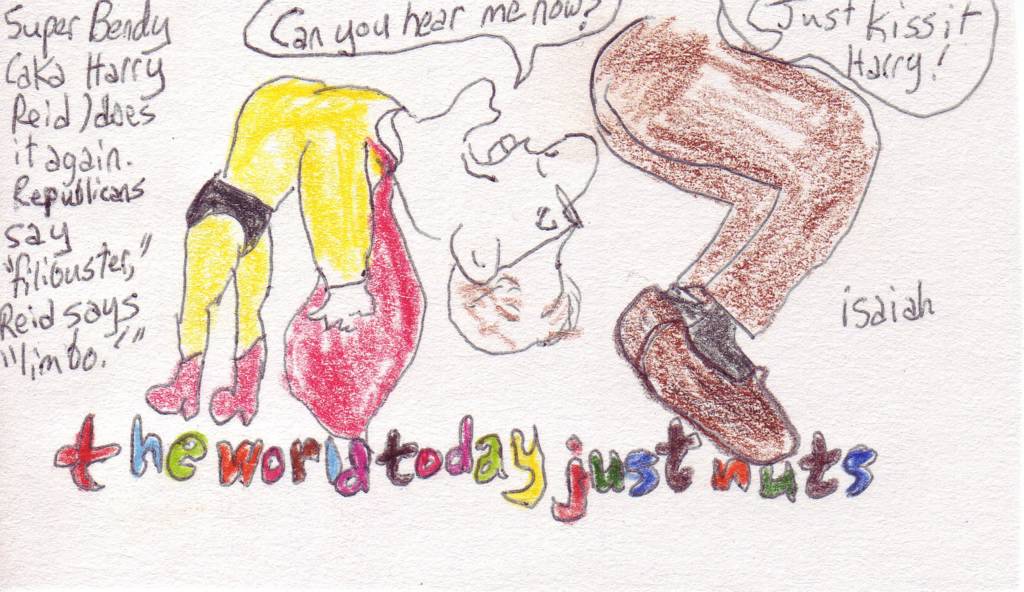
The Bendy Harry Reid


Micah e-mailed me to tell me I missed one of my comics. Only one? I'm trying to archive in order and I sometimes did a mid-week comic or a bonus comic. So I will miss some.

The above is "The Bendy Harry Reid" which first ran on May 24, 2005.


Harry Reid has no spine. Didn't then, doesn't now. Yet he's Senate Majority Leader. (For now. If Dems retain control in the 2010 elections, I expect Harry to be replaced by someone else and would bet it would be John Kerry.)

I'm sure I will miss others and may have done so already. If you find one I missed, let me know like Micah did and I'll be sure to include it. I honestly don't know half these comics unless I see them. I've done over 200 of them, maybe over 300. And unless I'm looking at them, it's easy to forget. Thanks to Micah for catching my mistake.

Here's C.I.'s "Iraq snapshot:"

Thursday, July 23, 2009. Chaos and violence continue, the US Ambassador in Iraq doesn't appear to stay at his post very much ("Is he here? I look in the pool hall . . ."), Nouri admits US troops may stay in Iraq past 2011, the House Veterans Committee holds a hearing on the needs of disabled veterans and their families (though some witnesses seem unclear on that topic), and more.

This morning the Subcommittee on Disability Assistance and Memorial Affairs of the House Committee on Veterans Affairs held a hearing entitled Examining the Ancillary Benefits and Veterans Quality of Life Issues.

"This Subcommittee has actively tackled many complex and complicated issues that have been encumbering the Veterans Benefits Administration and and it's ability to properly compensate veterans who file disability claims," explained US House Rep John Hall who is the Chair of the Subcommittee. "These issues have majorly centered on VA business processes and operations. Today's hearing will focus on the actual appropriateness of available benefits in meeting the needs of disabled veterans and their families."

US House Rep Doug Lamborn is the Ranking Member and, due to other demands, made his opening remarks before Hall did and then Lamborn had to leave the hearing. The hearing was grouped around three panels. The first was composed of
Paralyzed Veterans of America's Carl Blake, National Veterans Legal Service Program's Ronald Abrams and Blinded Veterans Association's Thomas Zampieri. The second panel was composed of National Academies' Lonnie Bristow, Economic Systems Inc.'s George Kettner, Quality of Life Foundation's Kimberly Munoz and National Organization on Disability's Carol Glazer. The third panel was the VA's Bradley Mayes and Thomas Pamperin.

Chair John Hall: Mr. Zampieri, as you noted in your testimony, eye and ear injuries have been associated with TBI, with explosions of roadside bombs in Iraq and Afghanistan among other battlefields and theaters of combat. Do you feel that VA has done a sufficient job evaluating all the face and head trauma completely and accurately to compensate veterans and provide them with all necessary ancillary-ancillary benefits?

Thomas Zampieri: Thank you for the question. I think it's actually a concern of ours and probably safe to say many of the other VSOs that individuals with Traumatic Brain Injuries that have sensory associated symptoms have a very difficult time in getting their ratings because so many of those are subjective kind of complaints. You know we frequently hear a a lot about the problems with tinnitus, for example. Frequently TBI patients complain of photophobia which is extreme sensitivity to light. And those are very difficult to rate. But those things can have quite an impact on the individual's ability to function and also their relationship socially, employment wise. And so we're concerned about the way TBI assessments are done in regards to sensory losses. I know that the VA has put a lot of effort towards looking at new assessment methods and congratulate them for-for recognizing this is a serious problem.

Chair Hall then asked him whether there were any devices currently are in the works that hoped to address sight issues and he pointed to the Brainport Vision Device which was a topic of the May 13th House Veterans Affairs Committee hearing. From
that day's snapshot:

Robert Beckman [Brainport Technologies] spoke of a portable device, the Brainport Vision Device, where a small camera ("with zoom capability") is hooked to other neurochannels ("such as the tongue"). Beckman stated, "One blind user with two glass eyes was able to successfully shoot a basketball and another used the Brainport Vision Device at an indoor rock climbing gym to see the next rock holds and at home with his daughter to play Tic-Tac-Toe."

"The Brainport Vision Device will not replace the cane or the sight dog," he continued. "But it will become an important, additional tool to improve the safety, mobility and quality of life for blind users. Some examples. Finding the open seat on a crowded bus or train. Identifying the direction to the target building in a confusing parking lot. Finding the handle in order to remove a hot pot from the stove. Wicab recently sponsored clinical testing of the Brainport Vision Device at the Atlanta VA. Dr. Michael Williams, the PI concluded, 'Bottom line, the device performs remarkably well for the tasks that we looked at in phase one'. To optimize the device we need feedback from a much larger pool of users who are blind. We would welcome the opportunity to further test the Brainport Vision Device at VA sites. Perhaps those willing soldiers who are blind as a result of a blast injury should be first in line to test this new technology?"

Zampieri noted the device was still in the early stages of research and stated those who have tested it would declare "it holds some hope, but it's not going to replace natural vision." Under questioning from Hall, Abrams explained that he had a relative in residential care "and it cost over $90,000 to $100,000 to put somebody in a home and homecare, if you need twenty-four hour care, is hugely expensive."

"First observation," declared Glazer on the second panel noting an ongoing program -- Army Wounded Warrior Career Demonstration Project -- the National Organization on Disability is conducting with the army, "a fundamental mismatch many of the supports for veterans are constrained to an active service model placing the burden on veterans and their families to find and approach agencies But we find that the most seriously injured soldiers, especially with cognitive injuries are not really able to effectively access these services. [. . .] Second observation, the need to deal with both a veteran and the family member. As others have stated, the process of recovering from injury and coming home and coming to terms with disability is a very complex process that impacts the entire family. Ancillary benefits in our belief must be available to veterans and family members."

Glazer would go on to note issues such as criminal charges for veterans suffering from PTSD or TBI, training in the management of personal finances. Glazer, and her organization, are a little too Republican for me (Tom Ridge chairs the organization) and it's a little too "smile and pull up those bootstraps." But Glazer was one of the few who knew how to speak. Globbidy-gook? No one gives a damn. Don't reference a model, for example, in another country, without explaining it. If that's the root of your response to Hall's question, you're wasting everyone's time including your own. I don't usually note "I like this organization, I don't like that one" but on this panel, Glazer's being noted because she knows how to speak and because two others will be ignored, I want to be really clear that no one reads this as I'm endorsing Glazer's organization. And let's also note that when all you do is toss out a bunch of numbers, no one's really impressed. In fact, it's assumed you actually don't know what you're talking about -- including your numbers -- or you'd be offering testimony that people could actually follow. I've never seen as many blank stares in a hearing before (true of the first panel to a lessor degree). Those not doing blank stares? A man to the right of us repeatedly put his hand over his face during the second panel, at a loss as to what was being said. At the end of the hearing, he stated he felt as if it had been conducted in a foreign language. Glazer knew how to speak and so did Kimberly Munoz.

Munoz was asked to estimate the amount spent by veterans and their families for assistance and stated she didn't know that answer but that it varies due to the fact "that some families have the assistance they need to get the benefits they need from VA and they have to use less out of pocket to get the services their veteran needs. Other families who may have not had the guidance from perhaps a VSO or who don't have the education in our country -- maybe they've moved here from another country -- and they don't speak our language, it's hard for them to run through all the rules and regulations and applications
and so they have a difficult time accessing the benefits that they need. There was a study that was released by the Center for Naval Analysis that estimated 19 months of lost income of around $2,000 some odd dollars for a total of $36,000 average loss per family of a catastrophically injured service member. That's their income loss which isn't necessarily answering your question of how much do they spend out of pocket to get the services but it is -- it is a figure that's been widely reported."

Chair John Hall: Thank you and what additional factors do you think VA should specifically consider when it adjudicates aid and attendance or housebound rates?

Kimberly Munoz: I think they need to consider the -- one of the key questions is: Can the veteran keep themselves safe from the hazards of daily living? There's many other questions related to a body part function or a loss of a body part but buried deep in there is can the veteran keep himself safe from the hazards of daily living? For those who have Post Traumatic Stress Disorder and stand-alone TBI I believe that that is a key to determining whether or not that veteran needs aid and attendance. The aid and attendance can also vary in terms of do you need physical aid and attendance or do you need oversight? So one package of aid and attendance does not meet the needs of every single veteran.

Chair John Hall: That seems to me that that judgment about the safety of the veteran living independently is similar to a judgment that one would have to make about an Alzheimer-Alzheimer's patient, for instance. In many families they go through that difficult time when they realize that a stove or an electric socket is no longer a safe thing for this adult family member to be handling alone.

Kimberly Munoz: Some of the family members have suggested specially adapted equipment be included in the grants available for home modifications -- like stoves that automatically turn off after a certain amount of time. Or other appliances that consider short term memory loss for some of the Traumatic Brain Injury patients.

Chair John Hall: And what else do you think Ms. -- Ms. Munoz what else could the VA do to improve the quality of life of disabled veterans and their families.

Kimberly Munoz: It sounds simple but I know it's very difficult and that is: Make it easier for families to get what they need. Anytime you look at the Title 38 and try to determine, "Well what am I -- what is this veteran eligible -- or how do I go about it?" It's so hard to know who is eligible for what. One family care giver told me the story of, you know, "We thought we were eligible for respite care and then when we called my son's rating wasn't, wasn't high enough." Or the SMC [Special Monthly Compensation] code wasn't the right code. So they work very hard then to find out, "Well how to I get that code?" And that's a backwards way to work a system. You need to find out what does that veteran need, much like you [George Kettner] suggested, what is the need of that veteran and what is the need of that family so that they can live safely and live independently -- not how do we get you pigeon holed into the right code so that you get the services that that code offers.

Can you follow that? Yes, you can. And an organization that sends a speaker like that. or Glazer, into a hearing is way ahead of others. You need to know the topic of the hearing -- a problem for one person on the first panel who repeatedly answered questions with a variation of "I don't know" -- and you need to be able to speak clearly on the topic. Glazer advocated for less benefits -- I'm not joking -- and whether anyone agreed with her or not, everyone could follow what she was saying. (She was saying that benefits can prevent work. And that's as much as I'm doing to circulate her nonsense argument.)

Yesterday's snapshot noted the House Veterans Subcommittee on Oversight and Investigations. Kat covered it last night at her site (and plans to cover today's hearing at her site tonight). Despite the fact that the New York Times and one of their reporters were repeatedly trashed in that hearing, the paper of some record ignored the hearing, as did most of the press. Walter F. Roche Jr. (Pittsurgh Tribune-Review) covers the VA's Kent Wallner's testimony. I didn't find him believable, Roche obviously did and use the link to read about that aspect of yesterday's hearing. Rachel Baye and Naomi Jagoda (The Daily Pennsylvanian) cover the hearing and zoom in on Dr. Gay Kao and his attempt to play victim.

Also in yesterday's snapshot was Nouri al-Maliki, puppet of the occupation, and US President Barack Obama's performace at the Rose Garden. Apparently journalists also wanted to play a role -- something other than reporter -- judging from the articles filed on the nonsense. For perspective, we drop back to Whit Stillman's Barcelona. Specifically, a party where American Fred (Chris Eigeman) is discussing his home country.

Female Party Goer: You can't say Americans are not more violent than other people?
Fred: No.

Female Party Goer: All those people killed in shootings in America?

Fred: Oh. Shootings, yes. But that doesn't mean Americans are more violent than other people. We're just better shots.

America's not more violent, insists Fred, they're just better shots. Apparently some similar defense was on the minds of
Karen DeYoung (Washington Post), Jeff Zeleny (New York Times) and Mark Silva (Los Angeles Times and other Tribune properties). None of the three challenges Barack's laughable assertion that "Violence continues to be down". No, it doesn't. As we explained yesterday, the trend in lower violence ended with the month of January. Starting with February, you see an uptick in violence. That trend has held each passing month. We also cited Al Jazeera which was explaining, "An estimated 437 Iraqis were killed in June, the highest death toll in 11 months, and the near daily attacks have continued in July." June, the most recent month with data, saw "the highest death toll in 11 months," but Barack wants to claim violence is down? Apparently Iraq isn't more violent currently, it's just seen better shots and better bomb builders? DeYoung has the strongest article, then Zeleny and then Silva. One compliment to all three is they covered it. Strongly or badly, they covered it. Nouri al-Maliki met with Barack Obama yesterday. The Iraq War is six years old and counting. Where was the coverage? Amy Goodman's pathetic two sentences in headlines? That's something to be proud of? How pathetic. What do you get instead? You get the crap Bob Somerby's calling out today (the mind readers who 'just know' something but don't know a thing -- which didn't stop Amy Goodman from doing yet another segment on it today). You really need to ask how the media -- Big and Small -- is serving you because in this round of Liar's Poker, seems to be a lot of Liz Smiths sitting down at the table wanting to be dealt in.

Back to this morning's articles: Where are Americans? The leader of a country the US remains at war with visits and where are the voices of Americans? We do grasp that the Iraq War continues, right? Check
yesterday's snapshot and then read the articles again. A poll was released yesterday. It addressed Iraq. Where's any citation of the results? From yesterday's snapshot:A new AP-GfK Roper poll finds a decrease in the number of respondents who believe Barack will remove troops from Iraq -- 15% lower than the last poll. [PDF format warning, click here for the data breakdown.] 62% of respondents ranked "The Situation in Iraq" as either "Extremely important" or "Very important." The poll found an increase of five percent on the number of respondents who disapprove of Barack's handling of the Iraq War. Is this increase a result of angry right-wingers upset over Barack's so-called plan? Maybe. But the respondents were asked if they believed Barack would "remove most troops from Iraq?" In January, 83% of respondents said it was likely and 15% said it was unlikely. The 83% who thought it was coming has fallen to 68%. The number who believe it is not happening has risen to 26%.
Nouri and Barack meet up at the White House yesterday as a poll is released which finds the number of people who believe Barack will "remove most troops from Iraq" has fallen from 83% in January to 68% presently -- a 15% drop. Where's that in any of the articles?The articles repeatedly (and falsely) claim the US will be out of Iraq in 2011. That's not what's happening. It's not even claimed to be happening. Does no one listen to Adm Mike Mullen, Gen Ray Odierno or even Secretary of Defense Robert Gates? Reading the articles today, it doesn't appear that anyone does. Uh-oh. Reality slaps them in the face.
Aljazeera reports, "The Iraqi prime minister has admitted US troops could stay in the country beyond 2011." Yeah, he did it today and it's only a surprise if you've never grasped what the Status Of Forces Agrement does and does not do. The Washington Post, for example, has one person on staff who understands the SOFA completely. That's one more than the New York Times has. Drop back to real time coverage (Thanksgiving 2008) and you'll see the Washington Post could explain what it did and didn't do and get it right. No other US outlet can make that claim. (The Los Angeles Times hedged their bets but did appear to grasp it in an article co-written by Tina Susman.) McClatchy Newspapers? Oh goodness, Leila Fadel made an idiot of herself over the SOFA. Even more so than the New York Times (Elisabeth Bumiller -- in December and January -- offered some realities but they were lost on the other reporters at the paper). The Times just got it wrong. Fadel got it wrong and sang praises of it. It wasn't reporting, it was column writing passed off as such. Today, Nouri declared, "Nevertheless, if the Iraqis require further training and support we shall examine this at the time, based on the needs of Iraq." Sound familiar? It should. This month you should have heard Adm Mike Mullen make the same statement, you should have heard General Ray Odierno make it over and over beginning in May and US Secretary of Defense Robert Gates has made it many times -- generally he's asked when he's visiting a foreign country because US reporters don't really seem to care. One exception would certainly be Dahr Jamail who was on KPFA's Flashpoints yesterday and explained, "We still have over 130,000 troops in Iraq. Troops are not being withdrawn from Iraq. They are being relocated to different bases, some of the bases still within cities, but they are not being withdrawn thus far." Dahr's latest book The Will to Resist: Soldiers Who Refuse to Fight in Iraq and Afghanistan has just been released this month. IPA provides this context from Global Policy Forum's James Paul: "For all the talk of 'U.S. withdrawal' from Iraq, the reality on the ground is starkly different. U.S. troops still patrol the cities, in flagrant violation of the U.S.-Iraqi security agreement, while Washington remains hugely influential in the politics of the country. The gigantic U.S. embassy looms large in Baghdad, U.S. forces still hold thousands of Iraqi prisoners in the vast U.S. prison camp in the southern desert, dozens of U.S. military bases remain in place including the sprawling 'Camp Victory' complex in Baghdad and Washington continues to press towards its ultimate goal -- the de facto privatization of Iraq's vast oil resources."

At
Time magazine online, Bobby Ghosh offers a look at yesterday's press conference and what it means:

You wouldn't know all that from al-Maliki's performance at a Rose Garden press conference on July 22. Standing alongside Obama, the Iraqi Prime Minister was the picture of self-confidence. He talked about broadening Iraq's relationship with the U.S. and cooperation in the area of economics, culture and education as well as a conference in October for potential investors in Iraq. "All of this comes as a natural consequence of [Iraq's] stability," he said.
(See pictures of the U.S. troops' six years in Iraq.)
But in private, Iraqi officials concede that the stability is, well, unstable. Before any meaningful economic and cultural cooperation takes place, they say, the U.S. must shepherd Iraq through to the elections, scheduled for January 2010. They worry that the Obama Administration, eager to move on to more pressing problems at home and abroad, may not realize just how fragile Iraq is. The Obama Administration "must not lose its focus" in Iraq, Foreign Minister Hoshiyar Zebari told journalists on July 21.

Spencer Ackerman (Washington Independent) examined the speech by Nouri today and contrasted it with remarks by Afghanistan's Ambassador to the US (Said Jawad) where Jawad noted, at length, US military fatalities. Ackerman observes, "By contrast, in his speech today to the U.S. Institute of Peace, here's the closest Iraqi Prime Minister Nouri al-Maliki came to recognizing the fact that over 4,300 U.S. troops have died in Iraq: "He extended his thanks to 'the international community and all the countries that have cooperated and helped Iraq,' saying Iraq would enjoy a 'solid relationship with a great and strong country like the United States'."

Chris Hill is the US Ambassador to Iraq. He's in the US (we'll get to it) and today he was interviewed by Andrea Mitchell on MSNBC's
Andrea Mitchell Reports (link offers video options -- Hill is "Iraq, what next?"):

Andrea Mitchell: You're here obviously because Prime Minister Maliki's here and met with the president. There are still tensions over the terms of disengagement if you will. What do we know now as a result of the meetings? About the way Iraq is stepping up to the plate and taking on its own governance?

Chris Hill: Well, first of all, this is pretty complex withdrawal. We have 130,000 troops in country, we just brought them out of the remaining cities. This is a, you know, major undertaking. And for the Iraqis, it was a major development, a major political development for them. So they're very pleased at how it went. Now it's a complex business. You have the world's greatest fighting force, the United States military, turning it over to the IRaqis who aspire to being better than they are but, you know, this is going to be a work in progress. Certainly the world's greatest fighting force has also become the world's greatest training force. That is, we have done a lot of work for the Iraqis. We've really tried to prepare them for this but, you know, they'll be some glitches through this but we will work through them. And I think, so far, so good.

Andrea Mitchell: The Pentagon has said that things are working with the fact that there are new rules of the road, the US is not in the cities. Yet commanders in the field are still complaining that there are time lags and intelligence lags, that you have to get permission from the Iraqis before you can engage. That doesn't work in a fighting field.

Chris Hill: Well, first of all, I think overall, it's going very well. You know there's a joint-operation center where the Iraqis and the US military sit together. They get the information at the same time, they make the decisions about what to do. So overall, it's going well but are there incidents where it hasn't gone well, are there incidents where the Iraqi say we want to do X and the American military guys say we want to do Y? Of course there are, and there will probably continue to be. But I think what is important is to stand back and look at where we are --

And that's as much of Hill as I can take.
Back in March, Ava and I were asked by a MSNBC friend to note Andrea Mitchell Reports:

"But I'm in there fighting every day because I got a few more dreams in me." A male friend at MSNBC asked us Friday night why we never mentioned Andrea Mitchell Reports? We honestly weren't aware of it. He pointed out that Mitchell, a reporter, is actually anchoring a daily hour long show (airs Monday through Friday, one p.m. to two p.m. EST). He pointed out that Women's Media Center and other "women-centric" (his term) outlets had tongue-bathed non-journalist Rachel Maddow for her on air musings and abusings but no one's giving Andrea Mitchell credit for holding down a solid hour of news. That may be due to the fact that MSNBC hasn't created a site for her. We looked and couldn't find it. We could find other MSNBC programs (even Al Roker Reporting: Marijuana Inc.), but no page for Andrea Mitchell's show. But, yes, it is disturbing that the "women-centric" outlets can repeatedly note the factually-challenged Rachel Maddow, the non-journalist on a news channel, but they can't give even a mild shout-out to Andrea. "But I'm in there fighting every day because I got a few more dreams in me." Though we frequently disagree with Andrea, we wouldn't ever claim that she's not out "there fighting every day because I got a few more dreams in me." And when we might lose faith in all, it's good to find someone who is. Her fights aren't usually our fights, but she keeps fighting. And for those who doubt the power of doing that, Katie Couric.

The same friend advised about the Hill interview today and that MSNBC (finally) has a webpage for
Andrea Mitchell Reports. Ava and I will note that on Sunday but this is the first I've heard that they finally gave her program a webpage. So we'll note it and underscore it and make sure everyone grasps that. (I'm not being sarcastic about community readers or even drive-bys. I am underscoring the fact that MSNBC had a one hour program driven by an actual journalist -- not a sports commentator or drive-time hijinks radio reject or any of the others -- and they refused to promote the show or even give it a webpage.) In terms of Hill.

Why is he in the US? Andrea says on air that it's because of al-Maliki being in the US. Hill's not supposed to hold Nouri's hand when Nouri travels. More importantly, early voting has started in the KRG. What is Hill doing back? This is his second trip to the US since going to Iraq and, for those who've forgotten, despite telling John Kerry he would leave immediately upon confirmation for Iraq, when his nomination was confirmed, he waited days before leaving. And that was at the end of April. It's July and Chris Hill, so eager to be confirmed, is now out of Iraq for his second trip to the US. And he's out at a time when you would think the ambassador would want to be present, to monitor reports on the elections. As for his comments to Andrea Mitchell about what's going on in Iraq, we'll drop back to
Liz Sly and Ned Parker (Los Angeles Times) interview Hill:

The Times asked whether the embassy will have enough information to judge what is happening in Iraqi cities now that U.S. forces will be restricted in their movements and based outside of cities.
Hill: We have embassies operating in scores of countries, and developing good information about what is going on is always a challenge anywhere in the world. I think our contacts in Iraq are better than in most countries. Our ability to reach senior ministers, our ability to talk to people, get their views and get information from them is pretty good in Iraq compared to many countries we operate in. I personally don't feel we have a problem there. If you are comparing it to a time when we ran all the security ourselves, that is obviously a different era. It was a different era that was not sustainable for the rest of history. Clearly there is a point where you return security to the host country security forces.

What's going on Iraq? Chris Hill depends on stringers to tell him, not unlike many a US outlet. The KRG holds provincial and presidential elections Saturday, early voting has begun.
Heath Druzin (Stars and Stripes) explains that despite "a canopy of colorful campaign banners and a stream of breathless programs on party-run television channels, there's an eerie quiet on the streets of this regional capital just days before elections in Iraq's autonomous Kurdish region." He quotes "Change" candidate Dara Saeed stating that people are "afraid of the police and security forces, of being fired from their jobs" and don't want to say who they'll vote for. Change is one party competing with the KRG's two long dominat political parties: Jalal Talabani (president of Iraq) represents the Patriotic Union of Kurdistan, Masoud Barzani (president of the KRG) represents the Kurdish Democratic Party. Gina Chon (Wall St. Journal) reports "Change" is former PUK members who are "fed up with the party's leadership" and "who are attracting voters who are frustrated with what they say has been corruption, curbs on democracy and the neglect of basic services in recent years." NPR's Quil Lawrence (Morning Edition) follows that theme for his report and notes the so-called Change Party. Lawrence offers his opinions and those of others. It's an overview and one that is cheapened by the snarky intro Linda Wertheimer offers. Ranj Alaaldin (Guardian) offers the opinion (he's doing a column, not a report) that "the status quo is likely to continue for a while" and, on the power-sharing/horse-trading of the past, "The PUK and KDP, as a coalition government, have a number of agreements to divide key governmental positions equally between them. The Kurdistan region presidency, for example, is held by the KDP in return for its support for a Talabani presidency in Baghdad. Most important of all is the KRG premiership which carries a host of decision-making powers. A KDP official, Nechirvan Barzani, also holds this position. He should have relinquished the role to the PUK in 2008 but, with Talabani's consent and against the will of PUK politburo members, is to carry on until after the elections; the understanding was that he would then make way for leading PUK candidate Barham Salih." AFP explains early voting has begun for the Kurdish military, the "police, prisoners and the sick."

Violence continued today in Iraq with multiple bombings.

Reuters reports a Kirkuk roadside bombing which claimed 1 life and left three injured, a Ghazaliya bombing that injured three members of one family, a Yusufiya roadside bombing (targeting the US military) which claimed the life of 1 Iraqi bystander and left two more injured, a Kirkuk grenade attack which left three US soldiers and one Iraqi interpreter and one Iraqi bystander injured. Sahar Issa (McClatchy Newspapers) reports a Baquba roadside bombing which wounded 1 Iraqi soldier and notes of the three family members wounded in the bombing that they were "a returning displaced family."


We'll close with Cindy Sheehan. First, her radio program
Cindy's Soapbox airs each Sunday and this Sunday the scheduled guest is Gore Vidal. And we'll note this from her latest column, "George W. Bush, Part III" (Cindy's Soapbox).Okay, so the United States of America has had a new puppet regime for six months now. I was never so much into giving Obama a "chance" and I think it's way past time to call Obama and his supporters out, like we called Bush and his supporters out. Our Presidents are merely puppets for the Robber Class and Obama is no exception. I am observing very little "change" in actual policy, or even rhetoric from an Obama regime. Granted, his style and delivery are more polished than the last puppet, but especially in foreign policy, little has changed. Evidently we elect Presidents based on empty rhetoric and if we can find someone who can say as little as possible with using as many words as he can, that's better. I knew a year ago when Obama and his ilk were blathering on about "change" that they didn't mean positive "change" for us, but it's a shame Obama's voters didn't ask him to be a little more specific or demand some good "change." Besides foreign policy where he is a complete disaster, it appears Obama's jobs program is little more than adding tens of thousands of troops to an already bloated military, instead of bringing troops home from anywhere. Billions will go to the money trap of the Pentagon to invest in recruiting our innocent, young, jobless and hopeless youth, when the budgets of peace groups who do counter recruitment are tanking. This is the 3rd week in July and already it's the deadliest month for US and coalition troops deaths in Af/Pak. Who would ever have thought when violence is surged that deaths would surge, also? I think I've seen this movie before.

Oops. we'll note this from
ETAN last:

Groups Oppose U.S. Training of Indonesia's Notorious Kopassus Special Forces Contact: John M. Miller, ETAN, +1-718-596-7668 July 23 - More than 50 U.S. organizations today urged the U.S. government to "strictly prohibit any U.S. cooperation with or assistance to the Indonesian Special Forces (Kopassus)' in a letter sent today to President Obama, Secretary of State Hillary Clinton and members of Congress. The letter was coordinated by the East Timor and Indonesia Action Network (ETAN). "Restrictions on U.S. military assistance to Indonesia are needed to support democracy and human rights in Indonesia. Supporting Kopassus, which has <
http://www.etan.org/news/2008/04brikop.htm>a long history of terrorizing civilians, would send the worst possible signal to those fighting for justice and accountability in Indonesia and East Timor," said John M. Miller, National Coordinator of ETAN. The letter, signed by human rights, religious, peace and other groups, states, "The history of Kopassus human rights violations, its criminality and its unaccountability before Indonesian courts extends back decades and includes human rights and other crimes in East Timor, Aceh, West Papua and elsewhere." A recent <http://www.hrw.org/en/news/2009/06/24/indonesia-abuses-special-forces-continue-papua>Human Rights Watch report documents how Kopassus soldiers "arrest Papuans without legal authority, and beat and mistreat those they take back to their barracks." In 2008, the Bush administration proposed to restart U.S. training of Kopassus. the State Department legal counsel reportedly ruled that the ban on training of military units with a history of involvement in human rights violations, known as the Leahy law, applies to Kopassus as a whole. "The previous administration was forced to conclude that training Kopassus was both illegal and bad policy. The Obama administration should maintain this restriction," said Miller. The text of the letter is below. The letter with a complete list of signatures can be found at http://www.etan.org/news/2009/07kopassus.htm. ---Text of Letter We the undersigned organizations call upon the U.S. government to strictly prohibit any U.S. cooperation with or assistance to the Indonesian Special Forces (Kopassus). This force, more than any other in the Indonesian military, stands accused by the Indonesian people of some of the most egregious human rights violations. The annual human rights report of the U.S. Department of State, the East Timor's (Timor-Leste) truth commission (CAVR), United Nations human rights monitors, and the full range of Indonesian and international human rights have reported in detail the many crimes of Kopassus. Those responsible for these violations continue to enjoy broad impunity for their actions, even in a democratizing Indonesia. The history of Kopassus human rights violations, its criminality and its unaccountability before Indonesian courts extends back decades and includes human rights and other crimes in East Timor, Aceh, West Papua and elsewhere. In 1998, a program -- organized and led by then Kopassus commander (and recent vice- presidential candidate) General Prabowo Subianto -- kidnapped, tortured and killed pro-democracy activists. Prabowo told reporters he is unrepentant over these crimes saying, "we could say it was preventative detention." Other well-documented Kopassus crimes include organizing anti-Chinese rioting in Jakarta in 1998 and the 1984 massacre at Tanjung Priok in Java. Throughout 24 years of brutal Indonesian occupation of East Timor, Kopassus personnel, tortured and killed civilians in an attempt to intimidate and terrorize the population. Kopassus personnel played a key role, including organizing militia proxies, in the violence and destruction during 1999, the occupation's final year. The crimes of Kopassus are not only in the past. A recently published Human Rights Watch report details ongoing Kopassus human right violations in West Papua. The report documents how Kopassus soldiers "arrest Papuans without legal authority, and beat and mistreat those they take back to their barracks." Those who favor engagement argue that U.S. training could lead to reform of Kopassus. This argument is clearly refuted by history. For decades, the U.S. trained and gave other assistance to Kopassus personnel, including General Prabowo and other leading officers. This relationship had no ameliorative affect, rather, it provided the equipment and skills used for repression. U.S. law prohibits the training of military units with a history of involvement in human rights violations. This provision has been long been interpreted as narrowly as possible. However, in 2008, the State Department ruled that the ban, known as the Leahy law, applies to Kopassus as a whole. We believe that this ruling should apply and the U.S. must continue to refuse to train Kopassus.


iraqdahr jamailflashpointskpfakaren deyoungthe washington postthe new york timesjeff zelenythe los angeles timesmark silvacindy sheehancindy sheehans soapboxgore vidalaljazeeraipajames paul
liz sly
the los angeles timesned parker
stars and stripesheath druzingina chonthe wall street journal
nprmorning edition
quil lawrenceranj alaaldin
etan


Read on ...
Creative Commons License
This work is licensed under a Creative Commons Attribution-Share Alike 3.0 Unported License.