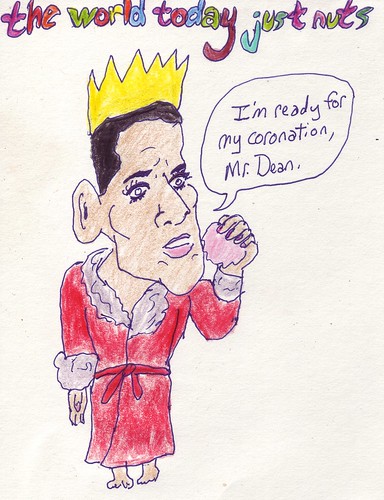
Thursday, December 15, 2011

The Endorsement

theendorsement

May 18, 2008, "The Endorsement."

Remember when John Edwards had enough press love to be considered respectable? And how the press raved over Johnny's endorsement? And used it to ignore Hillary's primary wins?

John Edwards is sleaze.

Here's C.I.'s "Iraq snapshot:"


Thursday, December 15, 2011. Chaos and violence continue, Morning Joe brews a new form of sexism: Erasing all US women who served in the Iraq War, a mayor is kidnapped in Iraq (and killed), Senator Patty Murray calls for a new outpatient care center for veterans and more.
Today on The Takeaway (PRI), the issue of Iraq was addressed. Excerpt:
Celeste Headlee: Ned Parker has covered the war since the beginning as the former Baghdad bureau chief for the Los Angeles Times now at the Council on Foreign Relations. So let me ask you about the future of Iraq. Obviously, we've gotten comments from American generals who are worried that this country will descend into chaos. You heard an Iraqi woman just a moment ago talking about how she's optimistic although the government is weak. What -- what do you think? Is this a country that will remain united? Where the path to diplomacy is shaky but-but sure?
Ned Parker: In terms of the country's internal politics?
Celeste Headlee: Yeah.
Ned Parker: Well -- I -- That's what struck me so much my recent trip to Iraq. I was in Iraq this summer from May 'till early August. And at that time I saw many worrying trends in Iraq. The politics of the country were becoming very polarized again and very sectarian -- reminiscent of 2003, 2004 and '05 and the build up to civil war. And also saw a lot of alarming trends from the government by -- from the prime minister's office of security forces being used in questionable raids where people were detained and would disappear into special jails where their families and lawyers could not talk to them. Pro-democracy protesters who were trying to have their own equivalent of an Arab Spring to criticize the corruption among the elite government officials and the lack of transparency started to be attacked in May and June by plain clothes government agents and pro-Maliki supporters. While army looked on, these men would go around and beat people on one occasion. And I had been in Egypt in Tahrir Square in February and had some mobs there attacking pro-democracy protesters. And it was the same thing. So I saw all of that this summer and when I came back it was the same if not worse. And Iraqis are in charge of their destiny and America I don't think in recent years has effectively used its clout and leverage to try to help promote this process of national reconciliation or the respect of civil liberties and freedom of speech.. Particularly I think since 2010 there was an effort of getting a government in place because there had been [crosstalk] Yeah and with the deadline on troops leaving, there was an emphasis on just having a stable figure in power that America could deal with at the expense of these important things: rule of law, freedom of speech. So all of these seems to be going and that was the case when I went back.
Celeste Headlee: Well we've got like a minute-and-a-half left so let me ask you this very complicated question which is Iraq five years from now, ten years from now, stable? Peaceful?

Ned Parker: It's uh -- I mean, I wish I had a crystal ball. I sure hope so. You know I very much respect Iraqis, I have spent a lot of time there and I think everyone wants to see Iraq work out for the best but we really don't know there are so many worrying and different trends there. As I said, the politics have become far more sectarian, in the political class there's very little trust between kind of the Shi'ite elite and Sunnis. There's talk within different provinces of creating their own regions because --
Celeste Headlee: Separating off.
Ned Parker: Right Sunni provinces no longer trust Baghdad so they want to declare their own region. With what's happening in Syria that could also polarize things So it's so complicated. That could lead to more unrest and an authoritarian regime. Or perhaps Iraq will have their own Arab Spring that will lead to responsible government and a process of reconciliation.
From radio we'll switch to TV but before noting something worth noting will first note PIG BOY Willie Geist. Willie is part of the sewer of MSNBC -- the non-news shows, the yackety-yack where buffoons pass themselves off as informed -- and today on Morning Joe he felt the need to weigh in on those US service members who had lost their lives serving in Iraq. It's a serious issue and it's insulting to here people say "4500" -- try getting the actual number you lazy ass fools (and, yes, I'm aware that would include Barack). But Willie did all of them one better, he wanted to talk about the "brothers" who were left behind because they died there. The "brothers." And no one corrected him, not one damn person -- guest or the huge cast of Morning Joe -- stopped the frat boy Bob Somerby has so rightly and so often criticized to inform him that US service members who died in the Iraq War were not just men, women died as well. In July of 2008, CNN would note that the number of female US service members who have died in the Iraq War had already reached 100. As of September 23, 2011, 111 female US service members had died in the Iraq War according to Noonie Fortin -- and 13 US civilian women died in the Iraq War as well. Fortin provides a write up on each one of the dead (including the civilians like DynCorp contractor Deborah Klecker who died at age 51 in June 2005). The first US female service member to die in Iraq was PFC Lori Ann Piestewa (also the first Native American to die in the Iraq War) on March 23, 2003. And the last so far was August 7, 2010, SPC Faith R. Hinkley of Colorado. Here's the link to trash (only because Ava and I will be commenting further at Third on Sunday unless Bob Somerby grabs it Friday).
Twelve minutes and 17 seconds into the clip, Willie Boy asks, ". . . what is the bitter-sweet feeling if that's the way to put it for some of these guys who are happy to be going home but remembering the brothers left behind?"
111 women dead. And no guest or cast member of Morning Joe (it's not a news show) could bother to object when "Tucker Carlson's boy toy" bothered to render women who have served in the Iraq War invisible, including those who died while serving. Maybe Morning Joe can spend tomorrow apologizing to the loved ones of the 111 women who died serving in Iraq as well as to the women who served in Iraq and made it home? (And the total number of US military personnel killed in the Iraq War? The Pentagon's official count currently stands at 4487 -- one up from last week. If you're going to note the deaths and if you think they matter, you bother to get the number right and not go with an estimate.)
Richard Engel: But the biggest change for Iraq may be closer ties with it's Shi'ite neighbor Iran. These days Alkadhimiya is full of Iranian tour groups who come with their own guides with signs in Farsi. Under Saddam, no Iranians came to Iraq, Saddam was Iran's enemy. Today, more than 2 million Iranians visit Iraq every year. Iraq's new dynamic is on display here every day. After nearly nine years, it's Iraq Shi'ites who have benefited the most, they have won this country. The United States toppled a dictator who's been replaced by a Shi'ite government with close ties to Iran. It's hard to imagine how that was ever part of the plan. Across town at Baghdad's famous book market, Kareem Hanash, himself a Shi'ite, doesn't want US troops to leave. He says Iran has calculated all of this very well; they want a Shi'ite Iraq so they can control the assets, economy and politics. Fear of Iran's growing power is sharper still in the Sunni-stronghold of Falljua. Once Iraq's deadliest war zone, Falluja remains violent. A bomb killed 3 policemen here just after we arrived. Police say Sunni radicals killed them because they work for the Shi'ite government. Compared to other parts of Iraq, there's been little development in Sunni towns like Falluja. This building was destroyed by US forces seven years ago and still looks like this. People here accuse the government of persecuting them, ignoring them, trying to cut Sunnis out of the new Iraq. A cloth merchant told me, "You crossed a thousand miles from America. Why? If you want the oil, take the oil. If you want our money, take it. But you have destroyed life, the whole system."
Staying on Falluja, Fadhil al-Badrani, Patrick Markey and Giles Elgood (Reuters) note the US military's two major assaults on Falluja, the first in March 2004, "Hundreds of Iraqis and dozens of U.S. troops were killed but the insurgency was not quelled. Six months later, the U.S. Marines went back in. A month-long assault destroyed much of the city, killed an estimated 1,300 Iraqi fighters and civilians, and wounded thousands more. More than 100 U.S. troops also died."
Turning to today's violence, Reuters notes the corpses of 3 government workers were found in Dhuluiya (all were shot dead, all had their hands bound), the mayor of Jurf al-Sakhar and his son were kidnapped (the mayor was then killed) and 2 Ramadi bicycle bombings claimed 2 lives and left three people injured.
Verbal violence took place at Fort Bragg yesterday when Barack Obama spoke. Bill Van Auken (WSWS) analyzes the speech:
Obama won the 2008 election in large measure due to the deep-going hostility among the American electorate to the wars begun under the Bush administration. He pledged to end the war in Iraq within 16 months of coming to office. Once in the White House, however, he retained Bush's secretary of defense, Robert Gates, and largely ceded policy decisions to the Pentagon brass.
The December 31, 2011 deadline for completing troop withdrawals was set not by Obama, but was rather part of the Status of Forces Agreement reached between Bush and the Iraqi regime in 2008. Bush, like Obama, had fully intended to renegotiate this pact to allow permanent stationing of US troops in the country.
As it is, Washington is doing its best to maintain its grip on Iraq, replacing uniformed troops with an army of up to 17,000 under the nominal direction of the US State Department. It is to include a force of 5,500 private mercenary security contractors, a massive CIA station, and Special Operations troops operating covertly out of uniform. Tens of thousands of US troops are being kept in place across Iraq's border in Kuwait and elsewhere in the Persian Gulf, while the US Navy and the US Air Force remain in control of the country's coastlines and airspace.
And Nouri remains in control of Iraq because the US government installed the puppet during the Bush administration and because the Barack administration wasn't going to allow anyone else to be prime minister, the will of the voters (expressed in the 2010 elections) be damned. Dar Addustour reports that the only hope for Iraq's government is for the blocs to meet and iron out their differences. Al Sabaah notes Parliament wants Nouri to appear before them next week to answer questions regarding the status of Iraqi security forces, the withdrawal and the absence of heads for the three security ministries (Defense, Interior and National Security). (This would be the questioning that Moqtada al-Sadr called for weeks ago.) Yes, Iraq remains in Political Stalemate II -- a fact that so much Iraq coverage this week has ignored repeatedly. Noting Barack's false claim that the Iraqi government is inclusive, Warren Olney (To the Point) launched into a discussion Tuesday about the realities. A journalist wasn't up to reality (your first clue was the assertion that "the Americans are leaving" -- which the journalist stated she told to Iraqis who complained about the ongoing occupation. No, 17,000 State Dept employees aren't leaving. Not even all US troops are leaving. There's no reason not to know these things or to not know that violence has increased over the last 17 months.) So instead of wasting our time on that nonsense, We'll note the Center for Strategic and International Studies' Anthony Cordesman from the same broadcast:
Anthony Cordesman: Well I think we need to be concerned more broadly. The structure that we created around the Constitution really never properly defined the role of the Council to the Republic, the legislature. It attempted to limit the power of the president [prime minister[, but it gave him authority in ways where whoever drafted it was less concerned with money and military appointments than theoretical lines of authority. They've never really resolved how to manage the provincial and local government structures -- although that has improved over time. And here we are, nearly two years after the last election [March 7, 2010], you really don't have a functioning Cabinet. You don't have a Minister of Interior who is in charge of the internal security forces. And the Prime Minister is acting as Minister of Defense in part because a body which also is not part of the Constitution but was supposed to be a mix of Sunni and Shi'ite parties with the head or the leading opposition figure [Ayad] Allawi has never been able to work. We really need to be extremely cautious about what is happening there and certainly Maliki has attempted to centralize power but the problem goes far deeper than Maliki.
Warren Olney: Thank you for calling him "prime minister." I called him "president" earlier and that is not the office that he holds. How concerned are you, Anthony Cordesman, about the sectarian issues?
Anthony Cordseman: Well I think again we need to be very concerned. The reason that the US tried to keep troops was the risk of bringing back Sunni and Shi'ite tension and an insurgency. But, more than that, the real fear that clashes in the north between the Kurds and the Arabs could turn into a significant new form of fighting and that, at best, it needed a buffer so that it could be resolved peacefully. We look at the levels of violence and the way that the US tends to count violence in terms of signficant acts still shows a relatively high count. But if you look at other ways of counting which are sort of terrorist and lower levels of violence -- the counts that are used, for example, by the counter-terrorism center, still show a very high level of violence inside Iraq. And reports by another US figure indicated that the pattern of violence was rising as US forces went down.
While so many in the press rush to lie and pretty up things with yet another wave of Operation Happy Talk, not everyone went surfing. Jack Healy (New York Times) did participate in one of the few honest looks at Nouri al-Maliki this week (click here for Healy, Tim Arango and Michael D. Schmidt's article on Nouri) and today he writes about the rally denouncing the US in Falluja yesterday:

Once an inner ring of Iraq's wartime inferno, Falluja is only too eager to say goodbye to nearly nine shattering years of raids, bombings and house-to-house urban combat. At least 200 American troops were killed in this city. Untold thousands of Iraqis died, civilians and insurgents who are mourned equally as martyrs.
We noted the rally in yesterday's snapshot. Strangely, Healy was the only one with an article published this morning (in print, last night online) who could explore the rally. Equally strange, the Operation Happy Talk-ers had no time to mention what Ann noted last night, Press TV reported:

Unknown gunmen have attacked a US military base in the southern Iraq city of Basra with several mortar shells, military sources say.
Possible casualties or damages are yet to be reported.
The outpost is located in Basra International Airport, the second largest international airport in Iraq.

A lot of waves of Operation Happy Talk crashing up against reality as they had time to file on Leon Panetta, US Secretary of Defense, taking part in a "white flag" ceremony in Baghdad today.

Meanwhile Dar Addustour speaks with officials in Moqtada al-Sadr's political bloc who explain that Iraq has put special forces on the ground in civilian clothing and, in addition, they note that there are "foreign" intelligence agents in Iraq (US). And in another article they note Moqtada's words about resisting the continuation of US occupation in any manner are again being noted.

Al Mannarah reports that Saleh al-Mutlaq, Deputy Prime Minister for Service Affairs, declared on Tuesday that the Diyala provincial council's decision to move towards semi-autonomy for the province was "rushed" and would harm Iraq because, with so many US forces leaving, everyone must work together on security and stability. Dar Addustour notes that a delegation from Parliament went to Diyala to discuss the latest issue (the move towards semi-autonomy). They're also exploring the protests against the move (protests by residents in Diyala Province) and hearing from Mohammed Hassan, provincial council chief, that he had nothing to do with it, he didn't know that this was going to happen, he didn't even know that there was going to be a request forwarded for semi-autonomy. If he thinks that makes him look good, I'm at a loss as to how. He's the chief of the council. He should have had some inkling towards the feelings of the council members on this issue.

US Secretary of Defense Leon Panetta will leave Iraq to go to Turkey (Friday) where he will discuss, Dar Addustour notes, $111 million of drone equipment the US will be providing Turkey.
In the US, veterans care is already overwhelming the VA health care system and that's only going to get worse. Senator Patty Muarry is the Chair of the Senate Veterans Affairs Committee and she's calling for a new outpatient clinic in the state of Washington:
FOR IMMEDIATE RELEASE Contact: Murray Press Office
Thursday, December 15, 2011 (202) 224-2834

Chairman Murray Urges VA to Establish New, Full-Time CBOC on North Olympic Peninsula

(Washington, D.C.) -- Senate Veterans' Affairs Committee Chairman Patty Murray has sent a letter to Department of Veterans Affairs (VA) Secretary Eric Shinseki about the critical need to establish a new, full-time Community Based Outpatient Clinic (CBOC) on the North Olympic Peninsula. In her letter, which urges the VA to include funding for a new clinic in the Department's Fiscal Year 2013 budget, Murray cites the growing need for veterans care in the Northern Peninsula region and rising enrollment at the current Port Angeles facility. In addition to sending the letter to Secretary Shinseki, Murray also hand delivered the letter and discussed this issue with Dr. Robert A. Petzel, the VA's top health official, yesterday in a meeting in her office.

"For too long, the needs in the North Olympic Peninsula have outpaced VA's ability to provide veterans in the region with adequate health care services," said Chairman Murray. "While the current lease has been extended until the end of fiscal year 2012, I believe that veterans in the North Olympic Peninsula cannot wait any longer for a new clinic that has sufficient staff, space and hours to meet the needs of veterans living in this rural region of Washington state."

Since its establishment in 2008, the Port Angeles outreach clinic has served more than 14,000 veterans living on the North Olympic Peninsula. As a result of the strong growth in this rural area, the Port Angeles outreach clinic has already exceeded maximum physical capacity and can neither expand services nor accommodate additional personnel. The need for care is expected to grow, with a 20 percent increase in enrollment projected over the next 10 years. Currently, the clinic occupies approximately 1,500 net usable square feet in a building owned by the Olympic Medical Center. A new CBOC would provide primary care and mental health services in a much larger space five days a week.

The full text of Chairman Murray's letter is below:

The Honorable Eric K. Shinseki
Secretary of Veterans Affairs
810 Vermont Avenue, NW
Washington, DC 20420

Dear Secretary Shinseki:

As you continue to work toward our shared goal of increasing veterans' access to VA services and benefits, I write to urge your support for the establishment of a new, full-time Community Based Outpatient Clinic (CBOC) on the North Olympic Peninsula.

Since its establishment in 2008, the Port Angeles outreach clinic has served a critical and growing need for the more than 14,000 veterans living on the North Olympic Peninsula. In FY 2010, the clinic delivered primary care and mental health services to 1,200 veterans (a 6.5 percent increase over FY 2009), and accommodated 4,876 patient visits (a 5 percent increase over FY 2009). As a result of the strong growth in this rural area, the Port Angeles outreach clinic has already exceeded maximum physical capacity and can neither expand services nor accommodate additional personnel. The need for care is expected to grow, with a 20 percent increase in enrollment projected over the next 10 years.

When I wrote to you in August 2010 requesting that the Department examine in earnest a full service CBOC to serve veterans in the North Olympic Peninsula, you let me know that the VA Puget Sound Health Care System (VAPSHCS) was working on a lease expansion proposal to develop a larger outreach clinic when the current lease with Olympic Medical Center expires at the end of fiscal year 2011 and that VAPSHCS will request that the outreach clinic be upgraded to a full-time CBOC "as space, staff and hours of operations are expanded." I believe the time has come for veterans living on the North Olympic Peninsula to have access to the level of care and services afforded by a full-time CBOC.

For too long, the needs in the North Olympic Peninsula have outpaced VA's ability to provide veterans in the region with adequate health care services. While the current lease has been extended until the end of fiscal year 2012, I believe that veterans in the North Olympic Peninsula cannot wait any longer for a new clinic that has sufficient staff, space and hours to meet the needs of veterans living in this rural region of Washington state.

As you finalize the Department's Fiscal Year 2013 budget, I urge you to include in your request sufficient funding to establish a new, full-time CBOC on the North Olympic Peninsula.

I thank you for your enduring commitment to our nation's veterans and look forward to learning of your plans.

Sincerely,

Patty Murray
Chairman


###

Meghan Roh

Deputy Press Secretary

Office of U.S. Senator Patty Murray

@PattyMurray

202-224-2834

Get Updates from Senator Murray

Read on ...

Thursday, December 8, 2011

Electable?

electable

From May 11, 2008, that's "Electable?" and what it drives home today is that three months before Sarah Palin's intelligence was repeatedly mocked, we already had an idiot on the national landscape -- but the press worked overtime to protect him.


Here's C.I.'s "Iraq snapshot:"

Thursday, December 8, 2011. Chaos and violence continue, gridlock continues in Iraq, more remains of the fallen have been dumped in a landfill, and more.
Laura Meckler (Wall St. Journal) reports the White House has scheduled a speech Wednesday at Fort Bragg for US President Barack Obama. Because surely what America needs from Barack now is yet another speech? Because at Fort Bragg there's little chance of his being put on the spot about the continued high unemployment? Margaret Talev and Viola Gienger (Bloomberg News) explain the speech will take place two days after Barack meets with Iraqi Prime Minister Nouri al-Maliki at the White House and, "President Barack Obamais focusing on the withdrawal of U.S. forces from Iraq by year's end, even as his administration continues talks behind the scenes about the future American role there."
If he's attempting to spin it, not only has he already given that speech two months back, but he'll also be going up against what Lt Gen Frank Helmick declared yesterday as reported by Luis Martinez (ABC News) and Courtney Kube (NBC News):
"We really don't know what's going to happen. But we do know this: We do know that we have done everything we can in the time that we -- that we have been here for the Iraqi security forces to make sure that they have a credible security forces to provide for the security, the internal security of their country."
Hossam Acommok (Al Mada) reports that Aziz Ugaili, National Alliance MP, is noting that over 26 security companies will remain in Iraq after December 31st and questioning the claim of US withdrawal while also expressing his fear that, in DC later this month, Nouri al-Maliki will sign an agreement with the US involving 'trainers.' Meanwhile Al Mada also reports that the Sadrist movement is declaring that the US remnants after December 31st will be fair targets and that the US is not planning to keep a small number of staff for the embassy the way other countries do. In addition, Al Mada reports that the UAE has offered their services in training Iraqi forces.
Iraq has a prominent visitor today. Bi Mingxin (Xinhua) reports, "Arab League (AL) chief Nabil al- Arabi arrived in Baghdad on an official visit to hold talks with Iraqi leaders over sanctions against Syria, an official at the Iraqi Foreign Ministry said Thursday." He's already met with Iraq's Foreign Minister Hoshyar Zebari. While the media is placing the emphasis of the meeting on a potential March Arab summit, that's a smokescreen. Regardless of whether the summit takes place in March (it was repeatedly postponed in 2010), the reality is that al-Arabi is visiting due to concern over Iraq's position regarding Syria. Dar Addustour noted al-Arabi is also scheduled to meet with President Jalal Talabani, Prime Minister Nouri al-Maliki and Speaker of Parliament Osama al-Nujaifi today while in Iraq. In addition, Al Sabaah adds that he's supposed to meet with unnamed Iraqi officials.

Sabrina M. Peterson (International Affairs Review) explores the decision of the Iraqi government to stand with the Syrian government:

Today, while other Arab states have condemned Syria and called for the regime to step down, Iraq has demonstrated its support. Iraq has not called for Assad to relinquish power, but instead has advocated gradual reform. The Maliki government has made moves to strengthen its economic ties with Syria since before the violence broke out this year and has been strengthening those ties since. This past summer, Iraq hosted a tour of Syria's top government and business leaders, a visit that led to a new pact to increase bilateral trade. Iraq is now Syria's biggest trading partner.

The Iraqi government also supports Syria because it fears that if the Assad regime collapses, violence could spill over into Iraq and cause further instability. Sectarianism is another important reason: Maliki is a Shia Muslim who spent years in exile in Syria before returning to post-Saddam Iraq. Quite probably Maliki feels a sectarian affinity for Assad, a member of the Alawite sect of Shia Islam. Maliki and the Assad family both share a common fear of Sunni-led insurgencies.


Al-Masry Al-Youm reports, "Dozens of Syrian citizens in Cairo staged a protest outside the Iraqi Embassy on Thursday to condemn what they labeled Iraq's pro-Assad stance. The protesters chanted against the Iraqi authorities after Iraq refused to approve economic sanctions imposed by the Arab League against Syrian President Bashar al-Assad's regime." For ABC News, Barbara Walters interviewed President Bashar al-Assadi (link is video and text):
Walters: But you have people who are against you who are protesting every day. It started with people marching with olive branches and with their children asking for more freedom, for freedom of press, for freedom of expression, and much of the country now, sir, is not supporting you, that's what these, that's what your crisis is about.
Assad: Yeah. That's why we had the reform started quickly, after the very beginning that you described as simple, so we didn't take the role, we didn't play the role of stubborn government, they say they need more freedom. We right away had new party laws, new media law, new election law, new local administration law, and we are revising our constitution now. Showing your opinion, whether you like somebody or doesn't like government or president or whoever, should be through the election, the ballot box, this is the only way.
Walters: If you have elections, will they be elections for president?
Assad: No, no, we are going to have first of all the local administration election this month...
Walters: Local administration, but what about the president?
Assad: Yeah, after that, we are going to have the parliamentarian election, which is the most important. Talking about presidential election, it's going to be in 2014, this is the...
Walters: People don't want to wait that long, till 2014.
Assad: Which people?
Walters: The people who are protesting.
Assad: How, how, how much, how many, are they majority or not, that's why you need, you need to wait first of all for the parliamentarian election, these election will tell you are you going to have majority or minority, then when you can think about presidential election, but not before, before that you don't have any indication, any clear indication.
Walters: In 2014, when there are presidential elections, will you allow opposition parties?
Assad: That's why we are changing the constitution.
Walters: OK. And if somebody else wins, will you step down in 2014?
Assad: If he wins he's going to be in my position, I don't have to step down, he's going to be president. So you don't step down. He will win the election, he will be president. So step down means you leave, while if you win the election, he's going normally, he's going to be in that position instead of me.
Speaking with Bill Weir on Nightline last night, Barbara Walters declared that there appears to be a disconnect and that Assad has trouble reconciling what's taking place in parts of Syria. Deutsche Presse-Agentur reports, "Iraq said Thursday it would initiate contacts with the Syrian government in an effort to persuade it to accept an Arab League plan to end months of violence in the country." Ammar Karim (AFP) quotes Nabil al-Arabi stating, "Our conversation (with Iraq) . . . was to explore whether the Iraqi government is willing to exert its influence with Syria. The Iraqi government told us that it will carry out contacts with the Syrian government to resolve this issue." Al Arabiya notes the Arab League has called for international monitors; however, "in an interview with ABC's Barbara Walters on Wednesday the embattled Syrian president Bashar al-Assad said he will not allow Arab League observers unfettered access to monitor the crackdown."
Conflicts continue between the Baghdad-based central government and the Kurdistan Regional Government over issues of oil especially with regards to the KRG's deal with ExxonMobil. UPI notes, 'Nouri al-Maliki is stepping up the pressure on ExxonMobil to back off ab reakaway oil exploration deal with the Kurds' semi-autonomous enclave and the betting is the world's largest oil company will fold." CNN quotes KRG Prime Minister Barham Salih stating, "There is no way that we will be dissuaded from our constitutional right to developing our resources and allow ourselves to ever again become hostages to the whims of some bureaucrats in Baghdad. We've been there before. Oil was used to strangle our people, to commit genoicde." J. Jay Park (Financial Times of London) attempts to make sense of the legal issues but keeps coming back to a 2007 draft or a more recent draft or -- Those are bills. They aren't laws. Though many drafts have been written, the oil and gas issue was never resolved by law.
A lot of things remain unresolved in Iraq. In fact, "unresolved" would be the government's Facebook status. Political Stalemate I was a period in Iraq following the March 7, 2010 elections. It ended in November of 2010 only as a result of a meet-up in Erbil and the political parties signing off on an agreement in which all but State of Law made political concessions. The results of the March 7th elections, even after Nouri al-Maliki bitterly contested them and stamped his feet until a few post-election votes were tossed his way, were that Iraqiya came in first and Nouri's political slate State of Law came in second. Iraqis do not elect their prime minister, the Parliament does. Per the Constitution, Ayad Allawi, the leader of Iraqiya, should have had first crack at forming a government. First crack? You become prime minister-designate and then have thirty days to name a Cabinet (nominate people for positions and have Parliament vote in favor of them). If you can't accomplish that in 30 days, per the Constitution, a new prime minister-designate is supposed to be named.

Nouri al-Maliki refused to surrender the post of prime minister. So the March 7th elections were followed by over 8 months of gridlock, Political Stalemate I. The Erbil Agreement found all but State of Law making major concessions so that the country could pull together. (During that eight month period, Parliament had one session which was little more than roll call.) Iraqiya, the winner in the elections, was supposed to see their leader (Allawi) head an independent security commission, the KRG was promised Article 140 would finally be followed (Article 140 of the Constitution addresses disputed territories such as Kirkuk -- it calls for a census and referendum to be held in Kirkuk by the end of 2007. Nouri was prime minister then and refused to implement Article 140.) Many promises were made but the only one that concerned Nouri was that he would remain prime minister.

With all sides signing off on the Erbil Agreement, it appeared that Iraq would be moving forward on a national level. Nouri was named prime minister-designate (unofficially named, Jalal Talabani would wait two weeks before making it official to give Nouri 30 days plus two weeks to form a Cabinet). Before November drew to a close, Nouri would announce the planned census to take place in December was off. He would claim that the national security commission had to be put on hold but would be created earlier. By the time he was illegally moved from prime minister-designate to prime minister, Iraq was in Political Stalemate II. And that's where it has remained. Illegally moved from prime minister-designate to prime minister? The Constitution says 30 days to name Cabinet. That's not 'partial' cabinet, that's the full Cabinet. Nouri did not name a full Cabinet. Most importantly he said he would 'temporarily' fill the security ministries -- Defense, National Security and Interior. Salam Saadi (Rudaw) offers this today on the Erbil Agreement:

After the 2010 elections in Iraq, the Kurdistani bloc set 18 conditions before agreeing to join the Prime Minister Nuri al-Maliki's cabinet. Among those conditions was the full implementation of Article 140, which was designed to solve the issue of the disputed territories.
In Erbil, the capital of the autonomous Kurdistan Region, Maliki agreed to all the conditions set forth by the Kurdish leaders. Two years on, however, the Kurds complain that the Iraqi prime minister hasn't met any of the pledges he made in what is known the Erbil agreement.
The Erbil agreement reads. "The Iraqi coalition government will be considered void if the Kurdish alliance withdraws from it, if the Iraqi government fails to meet the agreed upon articles of the Iraqi constitution.
Meanwhile Nouri's announcement in February of this year that he would not seek a third term was a means to appease an angry public. More recently, his legal advisor has been telling the press that no law prevents Nouri from seeking a third term. Dar Addustour reports that MP Aziz Ugaili (National Alliance) is not proposing just such a law. If passed, it would forbid anyone from holding a third term, limit all prime ministers to two terms and the two terms would not have to be consecutive. Would it be retroactive for Ibrahim al-Jaafari and Ayad Allawi? (Both have served one term as prime minister since the US invasion of Iraq.) It would have to be retroactive or it wouldn't limit Nouri to two terms. If it wasn't retroactive, that would mean Nouri could claim, "Okay, under this law, I will only serve two terms -- from the minute it passes." Thereby allowing himself four terms as prime minister.


On the issue of broken promises, Nouri promised a reduction in pay for various officials back in February 2012. Iraq just passed their 2012 budget. Dar Addustour notes that the Sadr bloc in Parliament is stating that 40% of that budget goes to the three presidencies.

Nouri's chief rival is Ayad Allawi who bested Nouri in the March 2010 elections and should be prime minister had the Constitution been followed. Rumors have been swirling that Allawi would have an announcement this week and many assumed it would be a creation of a shadow government that would be poised to take over. He has made an announcement but that wasn't it. Alsumaria TV reports:

Head of Iraqiya List Iyad Allawi announced, on Tuesday, that he is ready to reconcile with Iraqi Prime Minister Nuri Al Maliki if he is willing to renounce his opposing stands. This is the perfect time for real reconciliation, Allawi said warning against endless tensions.
"I have no problem in shaking hands with Maliki if he renounces his opposing stands against us and others. I am not embarrassed by any cause that serves Iraqis and the region," Allawi told Alsumaria TV on Tuesday in a special interview with Jadal Iraqi talk show. "This is the perfect time for a real, honorable, realistic and healthy reconciliation," he added.

Aswat al-Iraq adds, "Al-Iraqiya Bloc called on Premier Nouri al-Maliki to respond to Dr. Iyad Allawi's reconcilliation plan for the sake of Iraq, and to lay down a road map for the future of the country."

Turning to veterans issues, Barbara Leader (News Star) reports that 24-year-old Iraq War veteran Spc Marcus Delon White "jumped to his death from the U.S. 165 bridge in Columbia" on Tuesday despite please from his fiancee and attempts by others to prevent him from jumping. Meanwhile AP notes that Iraq War veteran Martin Poynter apparently killed Deputy Richard Rhyne who was attempting to arrest him "for not paying child support" and that Poynter apparently then took his own life.
The inability of the VA to treat the mental needs of veterans from the current wars is a scandal. The VA has lots of scandals these days. Last month, David Martin (CBS Evening News with Scott Pelley -- link has text and video) reported on the Air Force's landfill scandal. Here's a transcript of the first minute of the report.

Scott Pelley: Just when you thought the scandal over mishandled remains of fallen American troops at Dover Air Force Base couldn't get any worse. It did today. David Martin has been reporting on the investigation that led to a career ending letter of reprimand for the commander of the mortuary and tonight David is at the Pentagon with new developments.

David Martin: A landfill is no one's idea of a fitting resting place for a soldier fallen in battle.

Gari-Lynn Smith: No service member, no human being at all, should be placed into a landfill -- no matter if it's a finger nail, a foot or an entire body

David Martin: Yet that is what happened to Gari-Lynn Smith's husband, Sgt 1st Class Scott Smith, who was blown apart by a roadside bomb in Iraq in 2006. Without her knowing part of his body was incinerated and disposed of as medical waste in this Virginia landfill. She found out two years after his funeral.

Gari-Lynn Smith: I have honestly no idea what we buried of him because they forbid me to see him in the casket.
Today Craig Whitlock and Mary Pat Flaherty (Washington Post) report that the number of troops whose remains have been dumped is much greater than the Defense Dept has acknowledged, that the "partial remains of at least 274 American troops" have been dumped "in a Virginia landfill." Whitlock spoke with Steve Inskeep about the report on today's Morning Edition (NPR -- link is text and audio):
INSKEEP: Well, what is the Air Force saying about it now?
WHITLOCK: They're saying they still don't know how far back this went. Their first records of it occurring were in 2004, but we also have emails and other correspondence from mortuary officials that indicate this was the practice going back to the '90s. At the same time, there are committees in Congress that are conducting investigations into this practice, as well as other problems at Dover. And Secretary of Defense Leon Panetta has appointed a commission of independent public health experts to take a look at operations at Dover. And this is something he has said he wants them to look at as well.
INSKEEP: So 274 may not be the final number.
WHITLOCK: I don't think so, Steve.
This issue was raised on the Senate Armed Services Committee during a November 10th hearing in which the Chief of Staff of the Air Force Gen Norton Schwartz appeared.
Senator Kelly Ayotte: General Schwartz, on a different topic and I just feel the need to ask -- ask about this. Uhm, I'm deeply troubled by the reports about what happened at the mortuary at the Dover Air Force Base. And I'm sure you would agree with me this is outrageous that remains of our soldiers would be put in a landfill and not treated with the appropriate dignity and honor which they deserve. Can you tell me, uh, where we are with this? And how we're going to ensure that this never happens again? And, most importantly, that those who have participated in this outrage are going to be held accountable?
Gen Norton Schwartz: Senator Ayotte, first of all, let me clarify the allegation about putting remains in a landfill. These were portions, prior to 2008, which were sent away from the Dover mortuary to a funeral home for cremation -- which is an authorized method of dealing with remains, particularly those that are separated from the larger portions of remains returned to the family. After that, the results of the cremation came back to the mortuary were sent to a medical support company for incineration. So you had cremation, then incineration and it was at that point that this medical support organizations placed the residuals from that effort to a landfill. In 19 -- In 2008, the Air Force came to the conclusion that that was not the best way to deal with those remains and so it is now done in a traditional fashion of burial at sea. It has been that way since 2008. It will continue to be that way in the future and let me just conclude by saying the Secretary of the Air Force, Mike Donley [Secretary of the US Air Force] and I take personal responsibility for this. Our obligation is to treat our fallen with reverence and dignity and respect and to provide the best possible support and care for their families. That is our mission. The people who did not fulfill our expectations were disciplined and there's no doubt what our expectations are today.
Senator Kelly Ayotte: Well I -- General Schwartz, I appreciate your updating on that and, uh, when I think about the fact that we have Veterans Day tomorrow, this is so important, obviously, that we treat the remains of our fallen with dignity and respect and I know that you share that concern as well. And please know that members of this Committee will be there to support you in any way to make sure that the families know that we certainly won't allow this to happen again.
and:
Senator Claire McCaskill: I want to specifically, for a minute, General Schwartz, go to the situation at Dover and I don't want to dwell on how hard this has to be for you and the leadership at the Air Force. No one needs to convince me that you want to get this right at Dover. I'll tell you what I do want to bring to your attention and I've did so with a letter today and that is with the finding of the Office of Special Counsel. And so people understand what the Office of Special Counsel is. It's an investigatory and prosecution oriented agency whose primary responsibility under our law is to be independent of all of the agencies and protect whistle blowers. And what I am concerned about is their investigation into what the Air Force did in response to the whistle blowers. And specifically the fact that the IG of the Air Force, they failed to admit wrong doing in their report. And while I understand people have been moved around as a result of the problems that have occured because of mishandling of the sacred remains of the fallen, I'm not sure that they have been held as accountable as what we saw happen at Arlington in connection with that heart breaking incompetence. And what I want to make sure is that there is an independent investigation as to whether or not the IG shaded it a little bit [Chair Carl Levin began nodding his head in vigrous agreement with what McCaskill was saying] because everyone was feeling a little bit protective of the institution for all the right reasons. The vast majority of the people who serve at Dover and who do this work, I'm sure, do it with a heavy heart but with a passion for getting it right. But when we have a circumstance like this arise, I want to make sure the Inspector Generals are not so busy looking after the institution that they fail to point out wrong doing -- which was not ever acknowledged -- and that there is accountability for the people involved. And so, I want you to address the Special Counsel's report as it relates to the Air Force investigation.
Gen Norton Schwartz: Senator McCaskill, there was -- There were -- Clearly were unacceptable mistakes made. Whether they constitute wrong doing is another matter entirely. And when you look at a situation like this, you look at the facts of a case, as an attorney might say. You look at the context in which the event or the mistakes occurred. And you also consider the demands that are -- are placed on individuals and-and organizations. With respect to accountability, we also had an obligation to ensure that the statutory requirements for Due Process were followed. We did that precisely. I can only speak for the case of the uniformed officer. But the uniformed officer received a letter of reprimand. We established an unfavorable information file. We removed him from the command list and his anticipated job as a group commander at Shaw Air Force Base was red-lined. This is not a trivial sanction.
Senator Claire McCaskill: Well I - I understand that's not a trivial sanction but I-I-I'm worried that there was a conclusion that there was not an obligation to notify the families in these instances and obviously this deals with more than uniform personnel and obviously the Secretary of the Air Force is also copied on the letter that I sent today calling for this independent investigation. What happened at Arlington, nobody was intentionally mismarking graves. They were mistakes too. And I just want to make sure that we have really clear eyes while we have full hearts about the right aggressive need for investigations by Inspector Generals in circumstances like this. And thank you very much and thank all of you for being here today.
The issue is still not being addressed, not when the Air Force is announcing today that they don't plan to notify the families of the fallen involved. Still on veterans issues, the Senate Veterans Affairs Committee is holding two field hearings next week. What's a Senate field hearing? It's a hearing outside of DC. The Senate Veterans Affairs Committee will be holding two this month, both on December 12th, in Quincy, Massachusetts and in Columbus, Ohio. Senator Patty Murray is the Chair of the Senate Veterans Affairs Committee and her office notes:


Committee on Veterans' Affairs

United States Senate

112th Congress, First Session

Hearing Schedule

Updated: December 6, 2011

Monday, December 12, 2011 9:15am Quincy, MA

Field Hearing will address concerns over delays in veterans' services related to the claims backlog and the Department of Veterans Affairs' plans to reduce the backlog. The location of the hearing is Quincy City Hall 1305 Hancock Street, Quincy, Massachusetts.

Monday, December 12, 2011 9:30am Columbus, OH

Field Hearing will focus on employment challenges facing veterans. The location of the hearing is the Center For Workforce Development 315 Cleveland Ave, Columbus, OH.

Wednesday, December 14, 2011 10:00 a.m. SR-418

POSTPONED to a date yet to be determined. Hearing on the nomination of Margaret Bartley to be Judge of United States Court of Veterans Appeals for Veterans Claims, Coral Wong Pietsch to be Judge of United States Court of Veterans Appeals for Veterans Claims, and Gloria Wilson to be Judge of United States Court of Veterans Appeals for Veterans Claims.

Matthew T. Lawrence

Chief Clerk / System Administrator

Senate Committee on Veterans' Affairs

202-224-9126

Read on ...

Thursday, December 1, 2011

Sunset Campaign

sunsetcampaign

That's the "Sunset Campaign" from May 5, 2008. The primaries were over, Team Obama was insisting.

And he'd be gifted with the nomination shortly, despite the fact that Hillary won it.

And the nation would suffer greatly as a result.

Now here's C.I.'s "Iraq snapshot:"

Thursday, December 1, 2011. Chaos and violence continue, the US military calls what's taking place in Iraq "reposturing," Biden tries to put a happy face on the war (despite today's violence), Jalal Talabani leads a cry that politics should take place out of the sight of the Iraqi people, a US Congress member admits publicly they were wrong about the Iraq War and thanks a colleague for being right, the Bradley Manning Support Network and Michael Moore work overtime to get Bradley convicted, and more.
Liz Sly (Washington Post) has covered the Iraq War for many, many years now. She's a strong reporter so I'll leave it to FAIR or someone else to jump on her word choice (who's in charge of the message of the Iraq War?) in her latest report and instead just note my disagreement with her over the military's choice of terms. The US military press office in Iraq sent out a farewell message, she reports, and in it they explain that the military calls what's taking place in Iraq a "reposturing" and not a "withdrawal." She quotes US Col Barry Johsnon explaining, "The reposture is how we refer to moving our troops to other locations outside the country. The decision was made last year to talk about this as reposturing." Sly has had many dealings with the office and she interprets this as a mistake or a 'head-scratcher.' I actually believe the term is far more precise than "withdrawal" and side with the US military press office on this one. The Post's Emily Hell -- apparently trying to be amusing -- bungles her summary of what took place in Sly's report and demonstrates no understanding that other countries are going to be used as a staging platform. We're dropping back to the the November 15th Senate Armed Services Committee hearing [see the November 15th "Iraq snapshot," the November 16th "Iraq snapshot" -- excerpt below from the November 16th snapshot -- and the November 17th "Iraq snapshot" and Ava's "Scott Brown questions Panetta and Dempsey (Ava)," Wally's "The costs (Wally)" and Kat's "Who wanted what?" ].
Senator Joe Lieberman: My question, Mr. Secretary, is if you could just develop the statement that you made a little earlier, that we will have 40,000 troops in the region, does that include the 24,000 now in Iraq? Or have we made a decision to increase the number based on the failure to have more troops in Iraq after January of next year, have we made a decision to increase the number of the troops in the region outside of Iraq for some of those what-ifs I just talked about?
Secretary Leon Panetta: No, Senator, that did not include Iraq. What we have now is in Kuwait we have almost 29,000; Saudi Arabi we've got 258; Bahrain over 6,000 -- close to 7,000 --
Senator Joe Lieberman: Right.
Secretary Leon Panetta: UAE about 3,000, Qatar 7,000 if you go through the region and add up all those numbers, that's the 40,000.
Senator Joe Lieberman: So has there been a decision made to increase that number at all because we were unable to reach an agreement about continuing presence of American troops in Iraq? In other words, keeping them in the region?
General Martin Dempsey: Yeah, I wouldn't describe it as cause-and-effect relationship based on what happened in Iraq but rather our continuing concern with a more assertive Iran and, uh --
Senator Joe Lieberman: Right.
General Martin Dempsey: -- we are looking at our central command footprint. You know, Senator, that prior to 2001, we had -- we routinely rotated brigades in and out of Kuwait for training --
Senator Joe Lieberman: Right.
General Martin Dempsey: But also as part of deterrance. And I think, we haven't negotiated this with Kuwait yet, but it would be my view that we should have some sort of rotational presence -- ground, air, and naval.
Senator Joe Lieberman: Some of those would be combat troops?
General Martin Dempsey: Absolutely.
Reading the above, you should grasp why the US military is calling it "reposturing" and not "withdrawal."
Luis Martinez (ABC News) reports on a "commemoration event" today at Camp Victory in which Iraqi officials -- Prime Minister Nouri al-Maliki and President Jalal Talabani among them -- joined with US Vice President Joe Biden "to pay tribute to the sacrifices of American and Iraqi soldiers in the eight-year-long war." Biden is on a multi-day visit
which Al Mada reports has been controversial, evoking deep reactions from the Sadr bloc and others. Sadrists are denouncing the visit as illegal, insisting the political blocs have spoken (in the October meeting at Jalal Talabani's home) and that negotiations were long ago ended on the issue of 'trainers.' That's an interesting case for the Sadr bloc to be making when (a) they've been one of the biggest leaks in the Iraqi press that negotiations continue and (b) it's Moqtada al-Sadr who has tried to force the issue in Parliament, demanding a hearing on Iraq and that Nouri answer questions. Though the hearing was promised, it was quickly dropped. An excuse was given that Nouri was in Japan so it couldn't be held. Nouri was back in Iraq and they didn't hold it. He'll now be out of the country for a series of visits (including the US) so apparently the hearing Moqtada demanded and Parliament agreed to will never be held. State of Law notes they were aware of the visit before hand. Al Rafidayn focuses on the remarks Biden and Nouri al-Maliki made following the meeting (for an English language report on that, see Mark Landler's report for the New York Times). Biden's quoted stating that the partnership is strong, that there's a strong securirty relationship and that this will depend upon what the Iraqis want. He is quoted stating that talks [negotiations] will continue about the security arrangements "including training, intelligence and counter-terrorism." These negotiations will take place amongst whom? Biden's quoted stating the Iraq Higher Coordinating Committee is going to be "the center of all these efforts." The High Commission has two chairs: Joe Biden and Nouri al-Maliki. Dar Addustour notes that Biden's visit has been planned for over a month and postponed at least once. Biden is meeting with others on his visit. Dar Addustour notes he and Speaker of Parliament Osama al-Nujaifi discussed "political issues." Al Mada reports on his meeting with President Jalal Talabani The article falls back to the joint-statements Nouri and Joe made after their meeting and quotes Biden stating that talks continue between the US and Iraq about training, intelligence and counter-terrorism. And, yes, for any wondering, Iraqi reports do back up Mark Landler's reporting yesterday. We noted his report in yesterday's snapshot. I addressed it this morning here. Landler's reporting stands up and he deserves applause.
Landler also has a strong report on the Camp Victory ceremony today and his best moment is capturing it as "a day of hopeful statements that tried to cast the war in its most positive light."
US House Rep Dana Rohrabacher: This whole episode in American history is a very disturbing thing to look at. And I think when people look back, they're going to wonder why the hell did we ever go into Iraq? And there will be no question, even in our minds today, whether or not the money that was expended and the lives and the blood that was expended there was worth it? It was not. And whatever we are spending now should be terminated and as soon as we can get those troops out, the better. When you find yourself in a bad situation, you don't try to mess around to make it a little bit less bad, you just step over and try to get in a good situation somewhere else where you can accomplish things.

Yeah, some can speak the truth and not shy from it. Rohrabacher was speaking at a hearing yesterday, one about the State Dept's plan to spend or waste billions training the Iraqi police or supposedly training since DoD contracts set the pattern for a lack of accountability that it has now handed off to State.
"Number one, does the government of Iraq -- whose personnel we intend to train -- support the program?" asked US House Rep Gary Ackerman yesterday. "Interviews with senior Iraqi officials by the Special Inspector General show utter disdain for the program. When the Iraqis suggest that we take our money and do things instead that are good for the United States, I think that might be a clue."
That was Ackerman's important question yesterday afternoon at the House Foreign Affairs Subcommittee on the Middle East and South Asia hearing on Iraq. US House Rep Steve Chabot is the Chair of the Subcommittee, US House Rep Gary Ackerman is the Ranking Member. The first panel was the State Dept's Brooke Darby. The second panel was the Inspector General for the Office of the Special Inspector General for Iraq Reconstruction Stuart W. Bowen and SIGIR's Assistant Inspector General for Iraq Glenn D. Furbish. Chabot had a few comments to make at the start of the hearing. They often echoed comments made in the November 15th Senate Armed Services Committee hearing [see the November 15th "Iraq snapshot," the November 16th "Iraq snapshot" and the November 17th "Iraq snapshot" and other community reporting on the hearing included Ava's "Scott Brown questions Panetta and Dempsey (Ava)," Wally's "The costs (Wally)" and Kat's "Who wanted what?" ]. But while Senators Joe Lieberman, John McCain and Lindsey Graham made their comments during rounds of questions, Chabot made his as the start of the hearing in his opening remarks.
Chair Steve Chabot: Unfortunately, these negotiations failed due to, in my opinion, mismanagement by this White House. Amazingly, the White House is now trying to tout the breakdown and lack of agreement as a success in as much as it has met a promise President Obama made as a candidate. This blatant politicization calls into question the White House's effort to secure an extension. Fulfilling a campaign promise at the expense of American national security is at best strategic neglect and at worse downright irresponsible. And the White House tacitly admits this in negotiating an extension in the first place. I fear, however, that our objective is no longer to ensure that Iraq is stable but merely to withdraw our forces by the end of this year in order to meet a political time line. Saying that Iraq is secure, stable and self-reliant -- as Deputy National Security Advisor Dennis McDonough recently did -- does not make it so. And to borrow a quote from then-Senator Hillary Clinton , It requires "the willing suspension of disbelief" to believe that withdrawing our forces from Iraq at a time when Iranian agents seek to harm at every turn our country and its allies advances our strategic interests. Although I understand that Iraq is a sovereign country, I believe there is much more we could have done to secure a reasonable troop presence beyond the end of this year.
McCain was wrongly criticized for not grasping Iraq was a sovereign nation in some press accounts. Wrongly. McCain grasped that fact and acknowledged it repeatedly in the hearing. Chabot may have wanted all of that at the start of the hearing to ensure that he was not misunderstood. In addition, Chabot noted the "reports of obstruction and noncooperation on the part of the Department of State during SIGIR's audit. This is extremely distressing and, to echo the sentiments of several of my colleagues in the other body which they recently expressed in a letter to Secretary of State Clinton, the Department of State is legally obliged to cooperate fully with SIGIR in the execution of its mission; jurisdictional games are unacceptable." In his opening remarks, the Ranking Member weighed in on that topic as well.
Ranking Member Gary Ackerman: He [Bowen] has testified before other bodies of Congress, he has released written quarterly reports, as well as specific audits and the message is the same: The program for which the Department of State officially took responsibility on October 1st is nearly a text book case of government procurement -- in this case, foreign assistance -- doesn't buy what we think we're paying for, what we want and why more money will only make the problem worse. Failed procurement is not a problem unique to the State Department. And when it comes to frittering away millions, Foggy Bottom is a rank amateur compared to the Department of Defense. As our colleagues on the Armed Services committees have learned, the best of projects with the most desirable of purposes can go horribly, horribly off-track; and the hardest thing it seems that any bureaucracy can do is pull the plug on a failed initiative. How do we know the Police Development Program is going off-track? Very simple things demonstrate a strong likelihood of waste and mismanagement. Number one, does the government of Iraq -- whose personnel we intend to train -- support the program? Interviews with senior Iraqi officials by the Special Inspector General show utter disdain for the program. When the Iraqis suggest that we take our money and do things instead that are good for the United States, I think that might be a clue.
Ackerman went on to note how "the program's objectives remain a mushy bowl of vague platitudes" and how it had "no comprehensive and detailed plan for execution, there is no current assessment of Iraqi police force capability and, perhaps most tellingly, there are no outcome-based metrics. This is a flashing-red warning light."
Before we go further, let's jump back to Rohrabacher's statements quoted earlier. Some may rush to condemn him for them -- some on the right, some on the left, some on the center, some from the apathetic aisles -- by noting that he supported the Iraq War. True. And he didn't deny that. Later in the hearing, he noted Ranking Member Ackerman's questioning of Brooke Darby with praise and then added, "Mr. Ackerman and I weren't always on good terms. I argued the case for supporting President Bush with his efforts in Iraq with Mr. Ackerman numerous times and I was wrong. Thank you, Mr. Ackerman. This [the Iraq War] has been a waste of our lives and our money." He also stated during another section of the hearing, "I hope that someone's listening because I wasn't listening years ago when I berated Mr. Ackerman." As US House Rep Brian Higgins would point out, that was a significant moment in Congress where few ever admit they got anything wrong.
Brooke Darby was sent before the Committee to spin. I'm not going to waste much time or space on her testimony and I do feel sorry for her that she was farmed out on this assignment. "I can't answer that question," she said when asked anything that hadn't been covered in at least three other hearings or "I'm not prepared to put a time limit on it." (The last one to Gary Ackerman's question of if will take the State Dept 8 years to train the Iraqi police?) I think she did a strong effort trying to sell the plan but I've heard it all the talking points before over and over -- and so had the Subcommittee, as was evident by their reactions -- and there's no point in including too much of it here.
She referenced her conversation recently with Adnan al-Asadi, Deputy Minister of the Ministry of Interior. It was apparently a good conversation and he believes trainers and training are both needed. Chair Chalbot asked if he denied the comments? (He is among those dismissive of training in the SIGIR reports that Ranking Member Ackerman referred to.) Darby testified that he didn't.
Another good question would have been, who is al-Asadi's boss?
He's the Deputy Minister at the Ministry of the Interior. Who is his boss? He has none. That is one of the three ministries Nouri al-Maliki was supposed to have named a head of back in November 2010 -- November 2010 -- to move from prime minister-designate to prime minister. Those opposed -- as many members of the Subcommittee were -- funding police training should have probably raised that issue. Grasp that the headless Ministry of the Interior is who State is coordinating the training with, that there is no Minister of the Interior and they want to throw away a billion US tax payer dollars.
From that first panel, we'll note this exchange.
Ranking Member Gary Ackerman: When will they be willing to stand up without us?
Brooke Darby: I wish I could answer that question.
Ranking Member Gary Ackerman: Then why are we spending money if we don't have the answer?
[long pause]
Ranking Member Gary Ackerman: You know, this is turning into what happens after a bar mitzvah or a Jewish wedding. It's called "a Jewish goodbye." Everybody keeps saying goodbye but nobody leaves.
Another exchange that also captured the inability of State to answer any questions took place shortly afterwards.
US House Rep Gerald Connolly: Madame Deputy Assistant Secretary, welcome. Is it your testimony here today that the State Dept is fully committed to transparency and accountability with respect to any and all programs it has oversight and responsibility for in Iraq?
Brooke Darby: We take our responsibility for accountability and cooperation with all of the audit entities, with Congress very, very seriously.
US House Rep Gerald Connolly: No, ma'am, that was not my question. Is it your testimony that you're fully committed to transparency and accountability with respect to those responsibilities?
Brooke Darby: We are absolutely committed to accountability.
US House Rep Gerald Connolly: Full accountability? Full transparency and accountability?
Brooke Darby: I'm not sure -- I'm not sure how you define that so . . .
US House Rep Gerald Connolly: Well I guess I'm not sure why you avoid the word. That was my question and you've ducked it three times. Are we or are we not, is the State Dept committed to full transparency and accountability to the tax payers in the United States and the people who served in Iraq or not?
Brooke Darby: We absolutely are accountable to the tax payers, to our Congress and to all of the oversight bodies who are looking into how we are spending our dollars, whether our programs are achieving success. We are absolutely --
US House Rep Gerald Connolly: Alright. I'll sort of take that as a commitment.
Those two exchanges capture State's responses during the first panel (which took up the bulk of the hearing). During the second panel, Bowen would reference the exchange between Connolly and Darby that took place. Excerpt.
US House Rep Brian Higgins: Mr. Bowen, you have indicated you've been in Iraq 33 times?
Stuart Bowen: 31.
US House Rep Brian Higgins: 31. Dating back to?
Stuart Bowen: February 2004.
US House Rep Brian Higgins: February 2004 and your last trip was?
Stuart Bowen: Two weeks ago.
US House Rep Brian Higgins: Okay. The effort starting in 2003 was to commit 8 billion dollars.to train the Iraqi police force, some 450,000 something Iraqis. Since there are no baseline assessments, again, I would ask you as I asked the previous witness, anecdotally what is your sense of the security system, the internal security system with respect to Iraq? Where the holes are? Are there any places, like in Baghdad, for example, Ramadi, that provide a good example of a successful result from this financial effort?
Stuart Bowen: I think there have been examples of success across the country. Anbar Province is much safer than it was six years ago. Uh, Kurdistan, the three northern provinces are largely very well in order.
US House Rep Brian Higgins: But they were pretty calm to begin with?
Stuart Bowen: You're right, there are two Iraqs. There are Kurdistan and the southern 15 [provinces]. But really what you are addressing is the current state of the Iraqi rule of law system as a whole. And that embraces corrections, the judiciary and the police. And I think that there continue to be serious problems on all fronts not just police training. The judiciary -- over 45 judges have been killed in the last 7 years. And I met with Judge Mehat [al-Mahmood] during my trip and another judge had just been killed and he was bemoaning again the lack of weapons guards for his judges' security members. And on the prison front -- we've-we've -- Frankly, we invested a lot of money building prisons and we wasted a lot of money.
US House Rep Brian Higgins: Sadr City. About a five million population center of Baghdad. How does the Iraqi government deal with Sadr City? Just stay out of there altogether?
Stuart Bowen: I think it's a truce of sorts between the Sadrists who control that area and the rest of Baghdad. And I think that is why, frankly, Prime Minister Maliki's senior deputy minister al-Asadi and others are concerned that the primary location for the police development program in Iraq is right on the edge of Sadr City. It's directly next to the Baghdad police college -- another place where we wasted a lot of money -- right across the street from the Ministry of the Interior and adjacent to Sadr City and thus a magnet for indirect fire.
US House Rep Brian Higgins: Clearly there's a lack of oversight and transparency. And that problem is seemingly pervasive and growing or least since we've initiated this back in 2003. Why is it that the State Dept would deliberately make efforts to obstruct, efforts to blame greater oversight and transparency? Why is there that adversarial relationship? It would seem to me that your efforts would be to benefit the effective use, efficient use, of American resources in that region because we all have a strategic interest in seeing that region evolve. Why is it that you suspect that the State Dept is seemingly obstructing those efforts?
Stuart Bowen: Well it was obstructing. I think we heard today that they are supportive -- almost "fully" supportive -- of our oversight at this stage. And it took an obstruction letter though, Mr. Higgins, as you were pointing to, to break that log-jam. Why? You know I can't read into the exact motives but I think to a certain extent it was a -- it was a legalistic argument about jurisdiction.
US House Rep Brian Higgins: Yeah. Okay. I just, a final thought on this, someone once said, I think it was [New York Times columnist Thomas] Tom Friedman, he posed the question: Is Iraq the way it is because Saddam was the way he is or is Saddam is the way he is because Iraq is the way it is? And I just think when you look at this long, expensive effort -- and I don't just mean financial expense, expense in human capitol -- and the surge experience -- again, which was to tamp down the violence, provide a breathing space within which all the political factions in Iraq could reconcile their difference and evolve; it seems that the surge succeeded militarily but politically the situation doesn't seem to evolve. And obviously the policing issue, as I mentioned previously, in Northern Ireland, is fundamental to the success of any power sharing agreement and without meaningful progress over the past 8 years and this renewed effort given this horrible past of wasted money and great expectations and lofty goals but very, very little to show for it , it seems as though a billion dollar expenditure over the next five years moving forward is not a good use of American resources in a region that I think we've done everything that we can do in order to help them achieve their objectives, whatever they are, be they consistent with our objectives or not.
Yesterday we attended a Senate Veterans Affairs Committee hearing took place as well. There's just not going to be room for that this snapshot. It will be covered tomorrow. I thought we'd do far less on the Subcommittee hearing above; however, when talking to people about coverage today, I kept asking if Rohrabacher's statements were covered and was repeatedly told no. I agree with US House Rep Brian Higgins that it took character to do what so often never happens, admit that you got something wrong and give credit to someone who got it right as Rohrabacher did in the hearing to Ranking Member Gary Ackerman.
I think the American people are right to be frustrated with the Congress (and the White House) as polls demonstrate they are and I'm not one to believe in the need for 'happy talk' news meaning I don't think the press "owes" Congress sunny reporting. But I do think Rohrabacher's statements on the Iraq War were significant in themselves. I think they became more significant when he didn't attempt to pretend like that had been his opinion all along but instead stated he was wrong. And I agree with Higgins that you rarely get that in Congress let alone someone saying they were wrong and noting that an opponent on the issue was actually right. That moment demonstrated a maturity that the low results in polling indicate Congress could use a great deal more of.
I've not had time to read any reports on the hearing -- I barely had time to read over my notes from the hearing today -- but a friend at ABC News swears Charley Keys (CNN) had the strongest report on the hearing, click here to see what won praise from someone at a competing network.
Back to Iraq where, as Raheem Salman (Los Angeles Times) points out, "A car bomb and a separate attack by gunmen in Iraq killed at least 20 people". Reuters notes 2 corpses ("handcuffed, burned and shot") were discovered in Hashimiya, a HIlla roadside bombing claimed 1 life, the corpse of Sheikh Thalaj Zaalan was discovered in Hilla (beheaded) who was kidnapped yesterday, three Taji roadside bombings left seven police officers injured, another Taji roadside bombing targeted the Minster of Environment and left four people injured, 3 home invasions in Buhriz left 8 Sahwa family members dead and five more injured and a Khalis car bombing claimed 10 lives and left twenty-five injured.
That's a lot while Joe's insisting progress. He gets lucky today not because I like him (although I do know and like Joe) but because we don't have the room to go into that. And lack of space in this snapshot is also why we're not doing a rundown of November's violence today. The plan is to do it tomorrow. But please note, I'm saying why. As opposed to all the outlets that run with the low-balled numbers on the last day of the month and the morning of the first day of the month. Did you see those stories? No, you didn't. The press is being very sweet to Joe and staying "on message." Reporting November's violence would dispute his claims that Iraq is so much more peaceful now.
And on that, maybe it's time, since the White House wants to pretend the war is over, to stop comparing violence to the ethnic cleansing of 2006 and 2007?
If things, as Joe Biden insists, are better now then wouldn't the true measure be to compare the violence in Iraq today to the violence in 2002 before the war started? Funny, how they never want to make that argument -- that argument that they know they'd lose.
In Iraqi politics, Al Rafidayn reports Jalal's having a fit elsewhere over what he's calling "politicking" among political parties. He thinks they're taking cases to the media and that this needs to stop.He and his two vice presidents (Shi'ite Khudair Khuzai and Sunni Tareq al-Hashemi) issued a statement decrying political parties using the media for campaigns and insisting that all must get along in a "contructive, brotherly" fashion.

Jalal needs to use better terms. Unless he's trying to drag the KRG down. His own niece helped lead the charge last January against Nouri's refusal to appoint women as Cabinet ministers. So he needs to stop using sexist language. Or does he think women can behave "brotherly"? If it came from Nouri, I wouldn't bat an eye but Nouri's not part of the 'other' Iraq or the 'peaceful' Iraq or 'modern' Iraq or however the media (and the KRG) is attempting to sell the KRG. (Talabani is the president of Iraq. He is also a Kurd and from the KRG.)

Second, yes, Iraqi politicians should air their issues in the media. It's not for the politicians to operate out of the eyes of the public. They need to air these issues and the public needs to decide what best represents Iraq.

Third, Jalal needs to get off his fat ass and figure out if they're going to have a third vice president or not. If you've forgotten, back in July, Adel Abdul-Mahdi, the third vice president, resigned due to the ongoing political stalemate, there were three.

This issue hasn't been resolved. It's just been ignored. At one point (end of 2010), there was an uproar over the notion that there would be three vice presidents. Then it went away. And there was no uproar when Khudair Khuzai was named. So apparently, the uproar was not over a third person (as was insisted at the time) but either over the fact that the nominee then was a Turkman woman -- objecting due to her ethnicity or her gender or both.

Al Rafidayn notes that the White List is led by a woman, Zuhair Araji. The White List is a bloc of 13 deputies from Iraqiya that have split off. On Iraqiya, Jalal's website notes he met with Ayad Allawi, head of Iraqiya.
Turning to the US and the topic of Bradley Manning who is finally headed for a military courtroom and an Article 32 hearing on December 16th at Fort Meade, Maryland.
Monday April 5th, WikiLeaks released US military video of a July 12, 2007 assault in Iraq. 12 people were killed in the assault including two Reuters journalists Namie Noor-Eldeen and Saeed Chmagh. Monday June 7, 2010, the US military announced that they had arrested Bradley Manning and he stood accused of being the leaker of the video. Leila Fadel (Washington Post) reported in August 2010 that Manning had been charged -- "two charges under the Uniform Code of Military Justice. The first encompasses four counts of violating Army regulations by transferring classified information to his personal computer between November and May and adding unauthorized software to a classified computer system. The second comprises eight counts of violating federal laws governing the handling of classified information." Manning has been convicted in the public square despite the fact that he's been convicted in no state and has made no public statements -- despite any claims otherwise, he has made no public statements. Manning has been at Quantico in Virginia, under military lock and key, for months. In March, David S. Cloud (Los Angeles Times) reported that the military has added 22 additional counts to the charges including one that could be seen as "aiding the enemy" which could result in the death penalty if convicted. David E. Coombs is Bradley's attorney and he provided a walk through on Article 104.
The so-called Bradley Manning Support Network is at it again -- "it" being trying to convict Bradley. How stupid are these people? You know Bradley's father is enraged every time this crap happens. The latest post is unsigned. Here's the link because otherwise no one will believe 'helpers' could be so damn stupid. They link to a "Nation magazine" roundtable that Michael Moore (most infamous for saying Mumia was guilty, remember?) participated in and they quote Moore declaring Bradley's responsible for the Occupy Wall Street movement or 'movement':
"If you really want to pin it down to somebody, I would thank Bradley Manning. And here's why. A young man with a fruit stand in Tunis became very upset because he couldn't figure out why he was just getting screwed and why he couldn't make it. And he read a story, put out by WikiLeaks that exposed how corrupt his government was. And he just couldn't take it anymore, and he set himself on fire. That event, by giving his life to this, created the Arab Spring movement that went across the Middle East and then boomeranged back here to what has been going on in the fall here in North America."
You know what? Back in the day, I gave money to and helped with the campaign for Angela Davis. And, pay attention here, we never once went around saying she was guilty. We didn't fight the charges by saying she was guilty.
It's a concept that the Bradley Manning Support Group -- so busy whoring for Occupy Wall Street -- can't grasp. The stupid f**king idiots just quoted today a comment that says Bradley is guilty.
I don't know if the dumb asses are aware of it or not but the prosecution -- that would be the government -- can use these testimonials, can refer to them at trial.
Do they not give a damn about the damage they're doing?
Bradley has not entered a plea at this point. He is innocent until proven guilty. We went over all of this a year ago when we repeatedly had to slap down these idiots over and over because it's not their place to proclaim his guilt.
He may be guilty. At present, like anyone else in the American judicial system, he is presumed guilty and it is up to the government to make a case against him. But how lucky the prosecution is to have the Bradley Manning Support Network make their case for them.
Michael Moore is a stupid, stupid man. His remarks about Mumia should have resulted in no one taking him seriously on the left. (He tried to defend it later as a 'joke.' It's not a joke to be on death row.) He never should have been quoted at the site to begin with. But to quote him convicting Bradley?
The always disappointing Kevin Zeese is with the Bradley Manning Support Network. And all over the net in April he was screaming (click here for Firedoglake) that Barack was wrong to say Bradley was guilty. Barack was wrong. But how the hell do you call Barack wrong for doing the same thing that you were doing and for doing the same thing that you are still doing. Barack made a huge mistake (we've called it out here repeatedly) but at least he only made it once so far.
What is the message to America -- including people serving in the military who may end up jurors in Bradley's trial -- when the Bradley Manning Support Network can't stop convicting the man they claim to support?
Get your act together or close shop. You're not helping him and you need to quit trying to piggy back you pet causes on his back. He's facing serious charges and he needs support. If you can't focus on him, find something else to do and stop lying that you're supporting him.
Read on ...
Creative Commons License
This work is licensed under a Creative Commons Attribution-Share Alike 3.0 Unported License.