
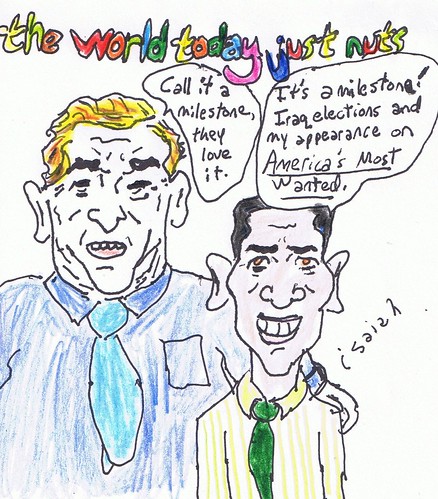
From November 7, 2012, that's "The Second Term."
C.I. noted:
While Barack sleeps, Bill Clinton says, "He doesn't
have a clue." Ronald Reagan adds, "The second term is where they
destroy you." Tricky Dick Nixon adds, "Ain't that the truth." While
Bully Boy Bush says, "Hey guys, you forgot to invite me," causing Nixon
to explain, "This was for the elected, not the selected, George." Isaiah archives his comics at The World Today Just Nuts.
You should pair that with the amazing "Let the fun begin (Ava and C.I.)" which was so great.
Barack's second term?
Not so great.
Here's C.I.'s "Iraq snapshot:"
Saturday, May 2, 2015. Chaos and violence continue, Iraq's Shi'ite leaders (and some Iraqi bloggers and Twitters) need to learn that the US government is not the Iraqi government and that Nouri may have bullied and bossed other branches around but Barack doesn't control the US Congress, the US Congress discusses Iraq and the Islamic State, they also discuss how Baghdad's not keeping its promise to supply Kurds and Sunnis with weapons and equipment, the US State Dept still can't acknowledge the execution of Iraqi journalist Thaer Ali and much more.
Eleven months ago, US President Barack Obama insisted that the only solution to Iraq's multitude of crises was "a political solution."
Eleven months ago.
And yet there is no progress on that.
And there has been no US government focus on that.
Barack has had officials in the administration -- Defense Dept, State Dept, Vice President Joe Biden, etc -- focus on lining up other governments to join in bombing Iraq from the air and 'training' Iraqi forces.
Nothing has been done to aid a political solution or to press for one.
"At the end of the day," Tamara Cofman Wittes declared Thursday, "civil wars end in only end in a couple of ways. Either one side vanquishes and exterminates or expels the other or they fight to the point where an external power can help -- sometimes impose, sometimes negotiate -- a political solution -- and that's guaranteed by outside powers. That's how civil wars typically end. We wouldn't want the first outcome so we should be driving for the second. And I think the extent to which the administration has articulated a longterm vision, that's its vision. The question is: How do we get there?"
Dr. Wittes is with the Center for Middle East Policy at Brookings. She was testifying at the House Foreign Affairs Subcommittee on the Middle East and North Africa. Also appearing before the Subcommittee were the RAND Corporation's Dr. Seth Jones and the Institute for the Study of War's Jack Keane (who is a retired US General). The Subcommittee Chair is Illeana Ros-Lehtinen and the Ranking Member is Ted Deutch.
Some people want to explore issues.
Let's start with one of those.
US House Rep Brian Higgins: We tried to do one thing in Iraq, and I think we could only do one thing in Iraq, and that is through our military involvement to create a place -- a breathing space -- within which Sunni, Shi'ites and Kurds could develop a political contract. And they failed miserably. And the guy that we put in there, Nouri al-Maliki, we put him in there first, Iran put him in there the second time basically created another sectarian divide.
To be clear, Iran did not put Nouri in there for a second term. Iran favored him but he was named prime minister of Iraq on November 11, 2010 -- over a month after Iran got Moqtada al-Sadr to drop his objection to Nouri's second term -- and one day after -- one day after -- the US-brokered Erbil Agreement giving Nouri a second term was signed -- I know Patrick Cockburn's repeated lies have misinformed many but check the archives, it's a day after the US-brokered contract giving Nouri a second term is signed that Nouri gets a second term
In fairness to Patrick Cockburn, in October 2010, he reported on Iran strong arming support for Nouri. And then Patrick did what worthless trash always does -- focus on something else.
When The Erbil Agreement was being finalized and signed?
He was off in Libya reporting on Libya. Seven days later, he hopped over to Syria for two stories before going back to Libya. Then to Iran. He never filed on Iraq the entire month -- though he did make time for Ireland and Greece.
The Parliament meets for the first time, a president is named, a Speaker of Parliament is named, Nouri is named prime minister-designate and Patrick never reports one word on Iraq.
Playing catch up some time later, he invents the lie that that Iran installed Nouri (The Erbil Agreement is what overturns the votes of the Iraqi people, not Iran -- and that was a White House led objective) and people believe him. Largely because his clique -- including the increasingly sad Noam Chomsky (oh, the stories I could tell . . .) -- keeps insisting he's the best reporter on Iraq.
Of course, they don't pay attention to Iraq which is why they think he's so damn good.
Arabs in the region see him as anti-Arab, by contrast, and that's due to the fact that they pay attention to his shoddy and misleading 'reporting.'
None of that is a slam at Higgins but I am so tired, almost five years after The Erbil Agreement, of people still trying to pretend it doesn't exist or not knowing that it does.
Higgins explored.
Another member?
Showed their ass.
Lois Frankel is both a member of the US House of Representatives and a deeply disturbed person whose lack of ethics twist and turn, choking in on itself. We may cover Lois at Third. Hopefully, in the real world, someone will give her the counseling and/or meds she so desperately needs.
The issue is not my disagreeing with her opinion. The issue is her disagreeing with her stated opinion about two minutes after she argues it only to turn around and argue the other side. Not to be philosophical, please understand. Just to try to absolve Barack Obama of any guilt for the state of Iraq currently.
She is a deeply disturbed person and, sadly, deeply dishonest as well.
(Deeply dishonest includes distorting what the general said. She pulled words that he had not said out of thin air and accused him -- falsely -- of blaming America. In his rebuttal, he noted that he had not blamed America but that, yes, American actions in the region were among the contributors to the violence.)
A multitude of opinions were offered throughout the hearing -- by members of the Subcommittee and by witnesses. And you could agree with them or disagree with them or be apathetic. But with Lois Frankel, you couldn't agree with her because, just as soon as you did, she was ripping apart her stated beliefs to argue something else. Her district needs to look very closely at her statements -- which please remember, the last time we covered her, included her calling the American people stupid instead of attacking the media if she believed the American people had received the wrong message.
From the March 26th snapshot:
US House Rep Lois Frankel: I have a couple of questions. First relates to underlying conditions that led to the rise of ISIL. Would you -- would you agree that ISIL is not the cause of the turmoil in the region but a symptom of a deeper problems? And I'd like to get your opinion is it unstable governments, poverty, desperation, radical religion, what? I'd like to get your take on that. And secondly, I think the American public somehow thinks that you can simply get rid of ISIL by bombs or dropping -- or drones. Could you just explain the difficulty of -- of their assimilation into the population, and so forth, the terrain.
Oh, that stupid American public!
A Congressional representative who makes a statement like that is one who should seriously be primary-ied and should she emerge from the Democratic Party primary still standing, let's hope a Green or a Republican can take her out of office because when you're using your soapbox to attack the very people who vote for you, you don't deserve a spot in the US Congress.
We should probably also note shrill and hysterical Gerry Connelly. No doubt, he'll again blame his wife for his performance but he shows up in the final minutes of the hearing and goes on to attack a witness for what he thinks a witness said at the start of the hearing.
Gerry's attack is weak in every way.
But mainly because he yet again almost cried in the midst of it.
Is there a reason he's that unbalanced?
He spoke for maybe two minutes and he had to tear up.
I'm sorry, what's the deal with cry babies in Congress.
Now I've defended any woman or man's right to cry when they're discussing serious issues.
Gerry was not, as one did, noting his parent who had suffered under the VA.
Gerry was just trying to attack.
Maybe he was about to cry because his attack was failing?
Maybe he was about to cry because his tighty-whiteys were crawling up his ass?
Maybe he was crying because his running in to attack meant he missed the end of General Hospital?
I have no idea.
But if he can't hold it together for two minutes without crying, it may be time for his peers to suggest he get some counseling or for him to announce he's retiring from Congress. He clearly has other things on his mind.
Let's go back to Thursday's hearing.
Brian Higgins: The second issue is the panel seemed to be dismissive of the sectarian nature of the conflict in Iraq and in Syria and I don't think it can be dismissed at all. I mean, it amazes me. General, you had made reference to Qaem Soleimani who heads the Quds forces in Iraq. I mean, he's not only a tan -- He's not a tangential player in what's going on in Iraq today and Syria, he's there physically. He's on the ground directing Shia militias to prop up the the Shia government in Iraq. And there not doing that as a goodwill measure, they're doing that to ensure that in the aftermath of ISIS, that Iraq remains Shia. And one could argue that ISIS basically wants their country back, they want to re-establish Sunni dominance in Iraq. And, you know, someone had said here -- it's a fair assertion -- that we should talk less to our enemies and more to our friends. We don't really have friends in that part of the world. You know, there's the discussion when Americans are in the room and the discussion when Americans are not in the room. And typically we count our friends as people whose interests are aligned with ours at any given time but they're not really helping us. And it just seems that given everything that Americans have invested in towards peace in Iraq -- $25 billion dollars to build up, to help them build up an Iraqi army, security force, $25 billion dollars -- and their first test, they ran. They ran from a fighting force of less than 31,000. The Iraqi army at that time was estimated to be anywhere from 180,000 and 240,000 fighters. And then we depend on our allies who have proven to be helpful to us, the Peshmerga, good fighters, experienced fighters, pro-Western, helped us in the early stages of the Iraq War. [. . .] Shi'ite militias? Who are controlled directly by Qasem Soleimani.
I don't make a point to identify "this person is a Democrat!" or "this person is a Republican!" If you're interested in party labels, look it up. I'm more interested in what's being discussed.
But we will note that Higgins is a Democrat.
And we'll note that because, pay attention here, he's commenting on who the US is arming.
Not the Peshmerga, not the Sunnis.
Though certain Shi'ite politicians in Iraq would like to pretend that it is Republicans only who are disgusted with the Shi'ite controlled Baghdad government refusing to adequately share the weapons and equipment the US is supplying, that's not the case.
Higgins is on record in many hearings -- and he's not the only Democrat who is -- expressing dismay over the lack of help to the Sunnis and the Kurds.
The proposal that was voted out of the Armed Services Committee on Thursday -- which will now go to a vote by the full House -- was not about creating three governments in Iraq.
That is a lie.
It could have been a misunderstanding on day one.
But as certain Shi'ite politicians -- not all -- continue to insist that it splits Iraq into three governments, they're now lying. There's been plenty of time to grasp reality.
What it would do is arm the Kurds and the Sunnis in addition to supplying Haider with weapons.
It would guarantee that what was supposed to happen -- the US was supplying all Iraqi forces with weapons to combat ISIS -- actually was happening.
Take it up with Haider al-Abadi who refused to do what he was supposed to.
Those weren't his personal gifts to give to Shi'ites.
Those were supposed to go to Shi'ites, Sunnis and Kurds.
And to certain bloggers and Tweeters in Iraq, you don't the US government.
The Congress can stop all weapons from going to Iraq.
You seem to think -- wrongly -- that Barack Obama is a King.
He is a public servant.
He heads the executive branch which is equal to the legislative branch and to the judicial branch.
Unlike thug Nouri, Barack doesn't control the US Parliament (Congress) or the Supreme Court.
And it is the US Congress that determines how much money (and weapons) Iraq will or will not get from the US.
If that's not clear enough to you, study up on former US President Ronald Reagan and grasp that had he been in better health, he would have been impeached for going around the US Congress to arm a group that the Congress said no to (Iran-Contra).
I grasp that Saddam Hussein did not instill democracy in Iraq.
I also grasp that Nouri al-Maliki bullied the Parliament and the Supreme Court.
But that's not the United States. And the US Constitution makes the three branches co-equal, they are checks and balances written into the system as such.
So you can pout and you can bitch, moan and whine but that's not going to change the fact that the US Congess will decide whether Baghdad gets arms or not.
Chair Ileana Ros-Lehtinen: I'll ask you, do you believe that the current government in Baghdad -- that is certainly a breath of fresh air compared to the previous one -- can work cooperatively with the Kurds and provide them military hardware?
Gen Jack Keane: Yeah and that's a great question. You -- I think you probably know the answer here. The -- It's pretty frustrating what's unfolding. We want to assist the Sunni tribes, we want to assist the Kurds and the Iraqi government is constipating that process. And I know that there's a thought that we should find a mechanism to go around the government. Look it, this government is an improvement and much of the success in Iraq is dependent upon their ability to politically be inclusive -- particularly with the Sunni tribes and the Kurds. The advisors with the training program with the Sunni tribes is inadequate. It's not going to get us there. The arms program is inadequate because they're not reaching them. The same thing with the Kurds. The Kurds have skill and they have will but they need better weapons and that's not getting there either. More pressure needs to be put on -- I would rather go through the government and make that happen then go around the government and find another program to do it. We've got to move the government in the right direction to do that.
Possibly the threat of legislation -- which has so alarmed a few significant Shi'ite officials in Iraq -- will prompt Haider al-Abadi to get off his fat ass and do what he's supposed to have been doing the whole time.
And to those Shi'ites so alarmed -- this means Nouri and his State of Law -- you better let go of the weapon issue and start focusing on the World Bank issue.
Iraq doesn't need funds from the World Bank.
Shi'ites have stolen billions from the Iraqi government. And want to continue to steal billions.
So instead of ending corruption, they want to bring in more money from the World Bank.
You really want Saddam Hussein laughing in his grave?
Because he will.
To bring in the World Bank is to surrender autonomy.
And in 20 years, Iraqis will most likely -- regardless of sect -- remember that Saddam Hussein at least protected Iraq from foreign looters whereas consecutive Shi'ite governments have invited the wolf into the hen house.
Back to the hearing.
Chair Ileana Ros- Lehtinen: Despite the clear and vocal calls for a comprehensive strategy, US policy in Iraq and in Syria, the administration continues to treat the conflicts as separate or at least as situations that should be dealt with one at a time. And this is either a fundamental misunderstanding of the issues at hand or willful ignorance due to a political calculation -- namely the administration's misguided and naive nuclear negotiations with Iran. It must acknowledge that air strikes alone will not be sufficient to defeat ISIL in either Iraq or in Syria, that Assad must be removed from power, and that Iran -- even if it is "the enemy of our enemy" -- it is still an enemy. And hearing yesterday former Ambassador to Syria, Robert Ford testify that if the United States allies with Iran, we are playing into ISIL's narrative and helping it's recruitment, I ask the panelists do you believe that we are cooperating with Iran -- directly or indirectly -- against ISIL? And, if so, is this helpful to our national security interests? Dr. Jones, Gen -- whoever wants to tackle this.
Dr. Seth Jones: Sure. I will start. Look, I think in particular in Iraq, there is and there are areas with Iranian backed militia organizations in various areas. The campaign has involved a complex set of state governments including Iraq and substate actors such as Kurds but also Iranian-backed Shia militias so I think the answer to your questions is: Yes, the US has cooperated somewhat with Iran, particularly at the substate level. There have been discussions about the uh-uh political issues -- Sunni - Shia issues with the Iraqi government that Iran has been involved in. I think ultimately the US is in a very complicated position here but I do agree with your comments that a strong, allied relationship with Iran, if that's the direction we go in, would be very counter-productive and would certainly walk into an anti- -- would certainly help with the ISIL narrative --
Chair Ileana Ros- Lehtinen: Dr. Jones: Thank you, sir.
Dr. Seth Jones: -- exactly what they're saying.
Chair Ileana Ros- Lehtinen: Gen Keane?
Gen Jack Keane: I agree with the doctor about Iraq's level repeated but in Syria -- I think really the elephant in the room with Syria with the administration's reluctance to provide assistance to the Free Syrian Army despite a very credible and experienced national security team recommended that as I pointed out in my testimony I think is Iran, it is the elephant in the room in the sense that we've been -- because the nuclear talks and establishing the deal, I think, is the unstated, foreign policy major objective of the administration. It has handcuffed our ability to do what we should have done in Syria because of a potential setback from the Iranians so de facto our policy decision in Syria have certainly helped Iran's bonafide client-state relationship with Syria, contributes to their expansionist policies and certainly encourages them to do what they are doing right now in Yemen which if they're able to achieve what they want to achieve in Yemen -- political and military control in Yemen -- then they change the strategic balance of power in the region by gaining control of strategic waterway at the Gulf of Aden at the Straights of Bab-el-Mandeb and effect and control and leverage shipping that comes out of the Suez Canal -- a major objective for the Iranians that they would not have though of without the progress that they've made in Syria.
Chair Ileana Ros- Lehtinen: Thank you. And Doctor?
Dr. Tamara Wittes: Thank you. You know, I think part of the challenge I think that our regional partners who are absolutely necessary to any successful outcome in Syria have, until very recently, been pretty divided themselves on the question of what should follow Assad and what kind of political order they would see as a desirable end state. Uh, and in many ways, there elevation of the Iranian threat above the threat of ISIS, above the threat of political Islam, is a product of the last year or so. But up until recently, different Arab States were supporting different factions in the Syrian opposition and I think that vastly complicated any ability we had to forge unity among them. Now there might well have been a time early in the Syrian conflict when a more forward leaning American policy would have created that unified front but I think we're long past that point now unfortunately.
Chair Ros-Lehtinen referenced Ambassador Ford. She's referring to the Wednesday's House Foreign Affairs Subcommittee hearing on Terrorism. In Wednesday's snapshot, we noted the remarks she was referring to (and covered the hearing in greater detail in Thursday's snapshot):
Former Ambassador Robert Ford: We should not fall into the trap, and I've seen this discussed in some policy circles here in Washington, we should not fall into the trap of thinking that working with Iran will help fix our Islamic State problem. The Islamic State rose in part -- not entirely -- but in part from long standing grievances and fears within Sunni communities in the Levant and Iraq about growing Persian and Shia influences. Working with Iran, even indirectly, will feed the Islamic State narrative and will immediately help its recruiting.
These are issues that need to be explored and addressed, not ignored or dismissed without any real consideration given to them.
Back to Thursday's hearing, we'll note the Ranking Member's line of questioning.
Ranking Member Ted Deutch: The Iranian Foreign Minister was on American television the other night, was talking -- when asked about Iranian influence in the region and-and the way that it is perceived pushed back against the argument that anyone could perceive what's happening in the region as a Sunni - Shia conflict -- that there's -- that there's absolutely nothing to that. I'd like to hear from our panelists a response to that. And if you agree with that statement, what roles can the United States play if his assertion is wrong and it is indeed perceived that way among our allies and those who are not.
Dr. Seth Jones: Sure, I'll -- I'll start. I think we're often prone to gross generalizations about the state of sectarianism. Being recently, for example, in Djibouti and looking closely at the situation in Yemen, one can easily gravitate to the argument that this is a Saudi -- because they've been involved -- [and] Iran proxy war. But the reality when you get on the ground in Yemen and look at it is there's a range of tribal politics involved and the Houthis have been battling Saudi Arabia for a long time. They are not an arm of the Iranian government. They do get some assistance. So I would say the answer to your question is there is clearly a-a Iranian grand strategy for the Middle East, for north and east Africa, for other locations, that has caused them to provide assistance to some groups and not others, some governments and not others. But when you actually look on the ground, whether it's Syria or Iraq, or Yemen, or take your pick, I mean I think we do have to understand that we are also then bringing in very localized elements of the dispute. So I would say that there is a combination of both local and these grand strategic issues that is going on in all the conflicts we are talking about here.
Gen Jack Keane: Yeah. I-I agree. One of the things that happens when you look at this region because of the sectarianism that has been there historically, we have a tendency to throw that out as the underlying cause for all the trouble we're having. It's been a contributor but there's a lot of peace between these sectarian groups as well. The Iranians -- I mean, I clearly think this is a geopolitical strategy of theirs to dominate the region, to influence and dominate Shia countries as well as Sunni countries. And I believe that is what is driving them. Like other radical Islamists, they will take advantage and manipulate the sectarian divide as much as they can to their own geopolitical ends.
Ranking Member Ted Deutch: Dr. Wittes?
Dr. Tamara Cofman Wittes: I think both sides of this regional power struggle -- and I would agree it is a regional power struggle -- have found the sectarian narrative useful. It helps them rally around the flag. It helps them mobilize allies. And, unfortunately, they have fed off of one another repeatedly, whether it's in Bahrain or in Yemen or in Syria. Uh, once that narrative takes hold and is advanced by one side, the other side ups the ante. And we've seen this in the regional media. It's been quite vicious and nasty. But I think that the problem with just looking at it through that lens is that it becomes a self-fulfilling process at a certain point. Just as we saw in the Balkans in the 1990s, at a certain point when people have lost the ability to find security through the state or through the government, they're going to fall back on community identities. And if everybody around them is choosing friend or foe -- according to sectarian identity -- they'll be forced to do that too. So the reality for Syrians, sadly today, I think is a reality of sectarian conflict. It didn't have to be that way, but that's where we are.
Ranking Member Ted Deutch: And so then where should it go? And specifically to the point you made about young people who -- particularly those in their teens, early 20s who have now endured four years of this? Many of them displaced or refugees. What's the message from the United States going forward. What do they need to see to counter their understandable -- as you put it -- their understandable decision, in many cases, to fall back on tribal affiliation?
Dr. Tamara Cofman Wittes: Yeah. I think in the Iraqi case, there is a fierce debate going on and an effort to try and demonstrate that there's space within Iraqi politics and the Iraqi state for all of Iraq's people. I don't know, uh, whether the angels will win that argument. I certainly hope so. And I think that both Iran and our Sunni Arab partners have important roles to play in helping to stabilize Iraq by making sure those decisions on behalf of political inclusion like establishing the national guard move forward. Syria, I think, is much harder because the conflict is so severe because half the population has been displaced. But as part of what we need to do, whatever the political architecture, we need to generate within society over the longterm the ability to build dialogue, to build inter communal dialogue, to build mechanisms for conflict resolution so that, while those tensions will always be there, they don't erupt into violence.
Let's stay with the US government before we move over to events in Iraq.
On Friday, the US State Dept held their latest press briefing which was moderated by spokesperson Jeff Rathke.
As we have noted repeatedly this week, Iraqi journalist Thaer Ali was executed in Mosul by the Islamic State this week. Yet in five press briefings, Monday through Friday, while pimping a concern for the press and the shallow "Free the Press" campaign, the State Dept has never once noted Thaer's murder.
Why is that?
Two State Dept friends point out that while the executions of journalists were used by the White House to galvanize support for their operations in Iraq and Syria, advertising that these executions are still taking place is acknowledging to the horrified American public that the White House's plan or 'plan' has not accomplished anything.

Over 300!
Over 300 Yazidis killed in Iraq!!!!
Or maybe just 25.
That's what AP reports and bases it on the numbers supplied to them by Yadizi Mehma Khalil
Who knows?
Margaret Griffis (Antiwar.com) counts at least 65 violent deaths across Iraq on Friday. Jason Ditz (Antiwar.com) has an important piece you should read.
iraq
antiwar.com
margaret griffis
jason ditz
Read on ...
Eleven months ago, US President Barack Obama insisted that the only solution to Iraq's multitude of crises was "a political solution."
Eleven months ago.
And yet there is no progress on that.
And there has been no US government focus on that.
Barack has had officials in the administration -- Defense Dept, State Dept, Vice President Joe Biden, etc -- focus on lining up other governments to join in bombing Iraq from the air and 'training' Iraqi forces.
Nothing has been done to aid a political solution or to press for one.
"At the end of the day," Tamara Cofman Wittes declared Thursday, "civil wars end in only end in a couple of ways. Either one side vanquishes and exterminates or expels the other or they fight to the point where an external power can help -- sometimes impose, sometimes negotiate -- a political solution -- and that's guaranteed by outside powers. That's how civil wars typically end. We wouldn't want the first outcome so we should be driving for the second. And I think the extent to which the administration has articulated a longterm vision, that's its vision. The question is: How do we get there?"
Dr. Wittes is with the Center for Middle East Policy at Brookings. She was testifying at the House Foreign Affairs Subcommittee on the Middle East and North Africa. Also appearing before the Subcommittee were the RAND Corporation's Dr. Seth Jones and the Institute for the Study of War's Jack Keane (who is a retired US General). The Subcommittee Chair is Illeana Ros-Lehtinen and the Ranking Member is Ted Deutch.
Some people want to explore issues.
Let's start with one of those.
US House Rep Brian Higgins: We tried to do one thing in Iraq, and I think we could only do one thing in Iraq, and that is through our military involvement to create a place -- a breathing space -- within which Sunni, Shi'ites and Kurds could develop a political contract. And they failed miserably. And the guy that we put in there, Nouri al-Maliki, we put him in there first, Iran put him in there the second time basically created another sectarian divide.
To be clear, Iran did not put Nouri in there for a second term. Iran favored him but he was named prime minister of Iraq on November 11, 2010 -- over a month after Iran got Moqtada al-Sadr to drop his objection to Nouri's second term -- and one day after -- one day after -- the US-brokered Erbil Agreement giving Nouri a second term was signed -- I know Patrick Cockburn's repeated lies have misinformed many but check the archives, it's a day after the US-brokered contract giving Nouri a second term is signed that Nouri gets a second term
In fairness to Patrick Cockburn, in October 2010, he reported on Iran strong arming support for Nouri. And then Patrick did what worthless trash always does -- focus on something else.
When The Erbil Agreement was being finalized and signed?
He was off in Libya reporting on Libya. Seven days later, he hopped over to Syria for two stories before going back to Libya. Then to Iran. He never filed on Iraq the entire month -- though he did make time for Ireland and Greece.
The Parliament meets for the first time, a president is named, a Speaker of Parliament is named, Nouri is named prime minister-designate and Patrick never reports one word on Iraq.
Playing catch up some time later, he invents the lie that that Iran installed Nouri (The Erbil Agreement is what overturns the votes of the Iraqi people, not Iran -- and that was a White House led objective) and people believe him. Largely because his clique -- including the increasingly sad Noam Chomsky (oh, the stories I could tell . . .) -- keeps insisting he's the best reporter on Iraq.
Of course, they don't pay attention to Iraq which is why they think he's so damn good.
Arabs in the region see him as anti-Arab, by contrast, and that's due to the fact that they pay attention to his shoddy and misleading 'reporting.'
None of that is a slam at Higgins but I am so tired, almost five years after The Erbil Agreement, of people still trying to pretend it doesn't exist or not knowing that it does.
Higgins explored.
Another member?
Showed their ass.
Lois Frankel is both a member of the US House of Representatives and a deeply disturbed person whose lack of ethics twist and turn, choking in on itself. We may cover Lois at Third. Hopefully, in the real world, someone will give her the counseling and/or meds she so desperately needs.
The issue is not my disagreeing with her opinion. The issue is her disagreeing with her stated opinion about two minutes after she argues it only to turn around and argue the other side. Not to be philosophical, please understand. Just to try to absolve Barack Obama of any guilt for the state of Iraq currently.
She is a deeply disturbed person and, sadly, deeply dishonest as well.
(Deeply dishonest includes distorting what the general said. She pulled words that he had not said out of thin air and accused him -- falsely -- of blaming America. In his rebuttal, he noted that he had not blamed America but that, yes, American actions in the region were among the contributors to the violence.)
A multitude of opinions were offered throughout the hearing -- by members of the Subcommittee and by witnesses. And you could agree with them or disagree with them or be apathetic. But with Lois Frankel, you couldn't agree with her because, just as soon as you did, she was ripping apart her stated beliefs to argue something else. Her district needs to look very closely at her statements -- which please remember, the last time we covered her, included her calling the American people stupid instead of attacking the media if she believed the American people had received the wrong message.
From the March 26th snapshot:
US House Rep Lois Frankel: I have a couple of questions. First relates to underlying conditions that led to the rise of ISIL. Would you -- would you agree that ISIL is not the cause of the turmoil in the region but a symptom of a deeper problems? And I'd like to get your opinion is it unstable governments, poverty, desperation, radical religion, what? I'd like to get your take on that. And secondly, I think the American public somehow thinks that you can simply get rid of ISIL by bombs or dropping -- or drones. Could you just explain the difficulty of -- of their assimilation into the population, and so forth, the terrain.
Oh, that stupid American public!
A Congressional representative who makes a statement like that is one who should seriously be primary-ied and should she emerge from the Democratic Party primary still standing, let's hope a Green or a Republican can take her out of office because when you're using your soapbox to attack the very people who vote for you, you don't deserve a spot in the US Congress.
We should probably also note shrill and hysterical Gerry Connelly. No doubt, he'll again blame his wife for his performance but he shows up in the final minutes of the hearing and goes on to attack a witness for what he thinks a witness said at the start of the hearing.
Gerry's attack is weak in every way.
But mainly because he yet again almost cried in the midst of it.
Is there a reason he's that unbalanced?
He spoke for maybe two minutes and he had to tear up.
I'm sorry, what's the deal with cry babies in Congress.
Now I've defended any woman or man's right to cry when they're discussing serious issues.
Gerry was not, as one did, noting his parent who had suffered under the VA.
Gerry was just trying to attack.
Maybe he was about to cry because his attack was failing?
Maybe he was about to cry because his tighty-whiteys were crawling up his ass?
Maybe he was crying because his running in to attack meant he missed the end of General Hospital?
I have no idea.
But if he can't hold it together for two minutes without crying, it may be time for his peers to suggest he get some counseling or for him to announce he's retiring from Congress. He clearly has other things on his mind.
Let's go back to Thursday's hearing.
Brian Higgins: The second issue is the panel seemed to be dismissive of the sectarian nature of the conflict in Iraq and in Syria and I don't think it can be dismissed at all. I mean, it amazes me. General, you had made reference to Qaem Soleimani who heads the Quds forces in Iraq. I mean, he's not only a tan -- He's not a tangential player in what's going on in Iraq today and Syria, he's there physically. He's on the ground directing Shia militias to prop up the the Shia government in Iraq. And there not doing that as a goodwill measure, they're doing that to ensure that in the aftermath of ISIS, that Iraq remains Shia. And one could argue that ISIS basically wants their country back, they want to re-establish Sunni dominance in Iraq. And, you know, someone had said here -- it's a fair assertion -- that we should talk less to our enemies and more to our friends. We don't really have friends in that part of the world. You know, there's the discussion when Americans are in the room and the discussion when Americans are not in the room. And typically we count our friends as people whose interests are aligned with ours at any given time but they're not really helping us. And it just seems that given everything that Americans have invested in towards peace in Iraq -- $25 billion dollars to build up, to help them build up an Iraqi army, security force, $25 billion dollars -- and their first test, they ran. They ran from a fighting force of less than 31,000. The Iraqi army at that time was estimated to be anywhere from 180,000 and 240,000 fighters. And then we depend on our allies who have proven to be helpful to us, the Peshmerga, good fighters, experienced fighters, pro-Western, helped us in the early stages of the Iraq War. [. . .] Shi'ite militias? Who are controlled directly by Qasem Soleimani.
I don't make a point to identify "this person is a Democrat!" or "this person is a Republican!" If you're interested in party labels, look it up. I'm more interested in what's being discussed.
But we will note that Higgins is a Democrat.
And we'll note that because, pay attention here, he's commenting on who the US is arming.
Not the Peshmerga, not the Sunnis.
Though certain Shi'ite politicians in Iraq would like to pretend that it is Republicans only who are disgusted with the Shi'ite controlled Baghdad government refusing to adequately share the weapons and equipment the US is supplying, that's not the case.
Higgins is on record in many hearings -- and he's not the only Democrat who is -- expressing dismay over the lack of help to the Sunnis and the Kurds.
The proposal that was voted out of the Armed Services Committee on Thursday -- which will now go to a vote by the full House -- was not about creating three governments in Iraq.
That is a lie.
It could have been a misunderstanding on day one.
But as certain Shi'ite politicians -- not all -- continue to insist that it splits Iraq into three governments, they're now lying. There's been plenty of time to grasp reality.
What it would do is arm the Kurds and the Sunnis in addition to supplying Haider with weapons.
It would guarantee that what was supposed to happen -- the US was supplying all Iraqi forces with weapons to combat ISIS -- actually was happening.
Take it up with Haider al-Abadi who refused to do what he was supposed to.
Those weren't his personal gifts to give to Shi'ites.
Those were supposed to go to Shi'ites, Sunnis and Kurds.
And to certain bloggers and Tweeters in Iraq, you don't the US government.
The Congress can stop all weapons from going to Iraq.
You seem to think -- wrongly -- that Barack Obama is a King.
He is a public servant.
He heads the executive branch which is equal to the legislative branch and to the judicial branch.
Unlike thug Nouri, Barack doesn't control the US Parliament (Congress) or the Supreme Court.
And it is the US Congress that determines how much money (and weapons) Iraq will or will not get from the US.
If that's not clear enough to you, study up on former US President Ronald Reagan and grasp that had he been in better health, he would have been impeached for going around the US Congress to arm a group that the Congress said no to (Iran-Contra).
I grasp that Saddam Hussein did not instill democracy in Iraq.
I also grasp that Nouri al-Maliki bullied the Parliament and the Supreme Court.
But that's not the United States. And the US Constitution makes the three branches co-equal, they are checks and balances written into the system as such.
So you can pout and you can bitch, moan and whine but that's not going to change the fact that the US Congess will decide whether Baghdad gets arms or not.
Chair Ileana Ros-Lehtinen: I'll ask you, do you believe that the current government in Baghdad -- that is certainly a breath of fresh air compared to the previous one -- can work cooperatively with the Kurds and provide them military hardware?
Gen Jack Keane: Yeah and that's a great question. You -- I think you probably know the answer here. The -- It's pretty frustrating what's unfolding. We want to assist the Sunni tribes, we want to assist the Kurds and the Iraqi government is constipating that process. And I know that there's a thought that we should find a mechanism to go around the government. Look it, this government is an improvement and much of the success in Iraq is dependent upon their ability to politically be inclusive -- particularly with the Sunni tribes and the Kurds. The advisors with the training program with the Sunni tribes is inadequate. It's not going to get us there. The arms program is inadequate because they're not reaching them. The same thing with the Kurds. The Kurds have skill and they have will but they need better weapons and that's not getting there either. More pressure needs to be put on -- I would rather go through the government and make that happen then go around the government and find another program to do it. We've got to move the government in the right direction to do that.
Possibly the threat of legislation -- which has so alarmed a few significant Shi'ite officials in Iraq -- will prompt Haider al-Abadi to get off his fat ass and do what he's supposed to have been doing the whole time.
And to those Shi'ites so alarmed -- this means Nouri and his State of Law -- you better let go of the weapon issue and start focusing on the World Bank issue.
Iraq doesn't need funds from the World Bank.
Shi'ites have stolen billions from the Iraqi government. And want to continue to steal billions.
So instead of ending corruption, they want to bring in more money from the World Bank.
You really want Saddam Hussein laughing in his grave?
Because he will.
To bring in the World Bank is to surrender autonomy.
And in 20 years, Iraqis will most likely -- regardless of sect -- remember that Saddam Hussein at least protected Iraq from foreign looters whereas consecutive Shi'ite governments have invited the wolf into the hen house.
Back to the hearing.
Chair Ileana Ros- Lehtinen: Despite the clear and vocal calls for a comprehensive strategy, US policy in Iraq and in Syria, the administration continues to treat the conflicts as separate or at least as situations that should be dealt with one at a time. And this is either a fundamental misunderstanding of the issues at hand or willful ignorance due to a political calculation -- namely the administration's misguided and naive nuclear negotiations with Iran. It must acknowledge that air strikes alone will not be sufficient to defeat ISIL in either Iraq or in Syria, that Assad must be removed from power, and that Iran -- even if it is "the enemy of our enemy" -- it is still an enemy. And hearing yesterday former Ambassador to Syria, Robert Ford testify that if the United States allies with Iran, we are playing into ISIL's narrative and helping it's recruitment, I ask the panelists do you believe that we are cooperating with Iran -- directly or indirectly -- against ISIL? And, if so, is this helpful to our national security interests? Dr. Jones, Gen -- whoever wants to tackle this.
Dr. Seth Jones: Sure. I will start. Look, I think in particular in Iraq, there is and there are areas with Iranian backed militia organizations in various areas. The campaign has involved a complex set of state governments including Iraq and substate actors such as Kurds but also Iranian-backed Shia militias so I think the answer to your questions is: Yes, the US has cooperated somewhat with Iran, particularly at the substate level. There have been discussions about the uh-uh political issues -- Sunni - Shia issues with the Iraqi government that Iran has been involved in. I think ultimately the US is in a very complicated position here but I do agree with your comments that a strong, allied relationship with Iran, if that's the direction we go in, would be very counter-productive and would certainly walk into an anti- -- would certainly help with the ISIL narrative --
Chair Ileana Ros- Lehtinen: Dr. Jones: Thank you, sir.
Dr. Seth Jones: -- exactly what they're saying.
Chair Ileana Ros- Lehtinen: Gen Keane?
Gen Jack Keane: I agree with the doctor about Iraq's level repeated but in Syria -- I think really the elephant in the room with Syria with the administration's reluctance to provide assistance to the Free Syrian Army despite a very credible and experienced national security team recommended that as I pointed out in my testimony I think is Iran, it is the elephant in the room in the sense that we've been -- because the nuclear talks and establishing the deal, I think, is the unstated, foreign policy major objective of the administration. It has handcuffed our ability to do what we should have done in Syria because of a potential setback from the Iranians so de facto our policy decision in Syria have certainly helped Iran's bonafide client-state relationship with Syria, contributes to their expansionist policies and certainly encourages them to do what they are doing right now in Yemen which if they're able to achieve what they want to achieve in Yemen -- political and military control in Yemen -- then they change the strategic balance of power in the region by gaining control of strategic waterway at the Gulf of Aden at the Straights of Bab-el-Mandeb and effect and control and leverage shipping that comes out of the Suez Canal -- a major objective for the Iranians that they would not have though of without the progress that they've made in Syria.
Chair Ileana Ros- Lehtinen: Thank you. And Doctor?
Dr. Tamara Wittes: Thank you. You know, I think part of the challenge I think that our regional partners who are absolutely necessary to any successful outcome in Syria have, until very recently, been pretty divided themselves on the question of what should follow Assad and what kind of political order they would see as a desirable end state. Uh, and in many ways, there elevation of the Iranian threat above the threat of ISIS, above the threat of political Islam, is a product of the last year or so. But up until recently, different Arab States were supporting different factions in the Syrian opposition and I think that vastly complicated any ability we had to forge unity among them. Now there might well have been a time early in the Syrian conflict when a more forward leaning American policy would have created that unified front but I think we're long past that point now unfortunately.
Chair Ros-Lehtinen referenced Ambassador Ford. She's referring to the Wednesday's House Foreign Affairs Subcommittee hearing on Terrorism. In Wednesday's snapshot, we noted the remarks she was referring to (and covered the hearing in greater detail in Thursday's snapshot):
Former Ambassador Robert Ford: We should not fall into the trap, and I've seen this discussed in some policy circles here in Washington, we should not fall into the trap of thinking that working with Iran will help fix our Islamic State problem. The Islamic State rose in part -- not entirely -- but in part from long standing grievances and fears within Sunni communities in the Levant and Iraq about growing Persian and Shia influences. Working with Iran, even indirectly, will feed the Islamic State narrative and will immediately help its recruiting.
These are issues that need to be explored and addressed, not ignored or dismissed without any real consideration given to them.
Back to Thursday's hearing, we'll note the Ranking Member's line of questioning.
Ranking Member Ted Deutch: The Iranian Foreign Minister was on American television the other night, was talking -- when asked about Iranian influence in the region and-and the way that it is perceived pushed back against the argument that anyone could perceive what's happening in the region as a Sunni - Shia conflict -- that there's -- that there's absolutely nothing to that. I'd like to hear from our panelists a response to that. And if you agree with that statement, what roles can the United States play if his assertion is wrong and it is indeed perceived that way among our allies and those who are not.
Dr. Seth Jones: Sure, I'll -- I'll start. I think we're often prone to gross generalizations about the state of sectarianism. Being recently, for example, in Djibouti and looking closely at the situation in Yemen, one can easily gravitate to the argument that this is a Saudi -- because they've been involved -- [and] Iran proxy war. But the reality when you get on the ground in Yemen and look at it is there's a range of tribal politics involved and the Houthis have been battling Saudi Arabia for a long time. They are not an arm of the Iranian government. They do get some assistance. So I would say the answer to your question is there is clearly a-a Iranian grand strategy for the Middle East, for north and east Africa, for other locations, that has caused them to provide assistance to some groups and not others, some governments and not others. But when you actually look on the ground, whether it's Syria or Iraq, or Yemen, or take your pick, I mean I think we do have to understand that we are also then bringing in very localized elements of the dispute. So I would say that there is a combination of both local and these grand strategic issues that is going on in all the conflicts we are talking about here.
Gen Jack Keane: Yeah. I-I agree. One of the things that happens when you look at this region because of the sectarianism that has been there historically, we have a tendency to throw that out as the underlying cause for all the trouble we're having. It's been a contributor but there's a lot of peace between these sectarian groups as well. The Iranians -- I mean, I clearly think this is a geopolitical strategy of theirs to dominate the region, to influence and dominate Shia countries as well as Sunni countries. And I believe that is what is driving them. Like other radical Islamists, they will take advantage and manipulate the sectarian divide as much as they can to their own geopolitical ends.
Ranking Member Ted Deutch: Dr. Wittes?
Dr. Tamara Cofman Wittes: I think both sides of this regional power struggle -- and I would agree it is a regional power struggle -- have found the sectarian narrative useful. It helps them rally around the flag. It helps them mobilize allies. And, unfortunately, they have fed off of one another repeatedly, whether it's in Bahrain or in Yemen or in Syria. Uh, once that narrative takes hold and is advanced by one side, the other side ups the ante. And we've seen this in the regional media. It's been quite vicious and nasty. But I think that the problem with just looking at it through that lens is that it becomes a self-fulfilling process at a certain point. Just as we saw in the Balkans in the 1990s, at a certain point when people have lost the ability to find security through the state or through the government, they're going to fall back on community identities. And if everybody around them is choosing friend or foe -- according to sectarian identity -- they'll be forced to do that too. So the reality for Syrians, sadly today, I think is a reality of sectarian conflict. It didn't have to be that way, but that's where we are.
Ranking Member Ted Deutch: And so then where should it go? And specifically to the point you made about young people who -- particularly those in their teens, early 20s who have now endured four years of this? Many of them displaced or refugees. What's the message from the United States going forward. What do they need to see to counter their understandable -- as you put it -- their understandable decision, in many cases, to fall back on tribal affiliation?
Dr. Tamara Cofman Wittes: Yeah. I think in the Iraqi case, there is a fierce debate going on and an effort to try and demonstrate that there's space within Iraqi politics and the Iraqi state for all of Iraq's people. I don't know, uh, whether the angels will win that argument. I certainly hope so. And I think that both Iran and our Sunni Arab partners have important roles to play in helping to stabilize Iraq by making sure those decisions on behalf of political inclusion like establishing the national guard move forward. Syria, I think, is much harder because the conflict is so severe because half the population has been displaced. But as part of what we need to do, whatever the political architecture, we need to generate within society over the longterm the ability to build dialogue, to build inter communal dialogue, to build mechanisms for conflict resolution so that, while those tensions will always be there, they don't erupt into violence.
Let's stay with the US government before we move over to events in Iraq.
On Friday, the US State Dept held their latest press briefing which was moderated by spokesperson Jeff Rathke.
MR RATHKE: Hello, good afternoon.
QUESTION: Happy Friday.
MR RATHKE: And likewise. I have a couple of things to mention at the top. So first is press freedom – which, as you know, we’ve been talking about all this week at the top of the briefing. Today, we wrap up the Free the Press campaign with two final cases.
The first comes from Uzbekistan, where a newspaper editor named Muhammad Bekjanov has remained in prison since 1999, the longest ongoing incarceration of a journalist in the world, by some accounts. His newspaper, Erk, which means freedom, published articles advocating for democratic reform. And he is thought to have been arrested for his public criticism of President Karimov’s administration and for his affiliation with a peaceful political opposition party. We call on the Government of Uzbekistan to release Mr. Bekjanov and to take the steps necessary to create space for independent journalists to work without fear of violence. We also urge the Government of Uzbekistan to allow international observers to visit prisons and to grant all citizens access to full due process in accordance with international commitments.
And for our last Free the Press campaign case, we are highlighting the country of Nicaragua. Nicaragua suffers from a restricted media environment that includes censorship, self-censorship, and examples of harassment. We urge the Government of Nicaragua to recognize and support the vital role of independent media and the free exchange of ideas as critical components of a free and democratic society.
And one additional note, although it’s unrelated to that campaign. I also want to express on behalf of the United States our sympathy to the family of Somali journalist Daud Ali Omar and his wife, who we understand were killed by gunmen in Somalia on Wednesday. Somalia remains one of the world’s most dangerous places to be a journalist.
As we have noted repeatedly this week, Iraqi journalist Thaer Ali was executed in Mosul by the Islamic State this week. Yet in five press briefings, Monday through Friday, while pimping a concern for the press and the shallow "Free the Press" campaign, the State Dept has never once noted Thaer's murder.
Why is that?
Two State Dept friends point out that while the executions of journalists were used by the White House to galvanize support for their operations in Iraq and Syria, advertising that these executions are still taking place is acknowledging to the horrified American public that the White House's plan or 'plan' has not accomplished anything.
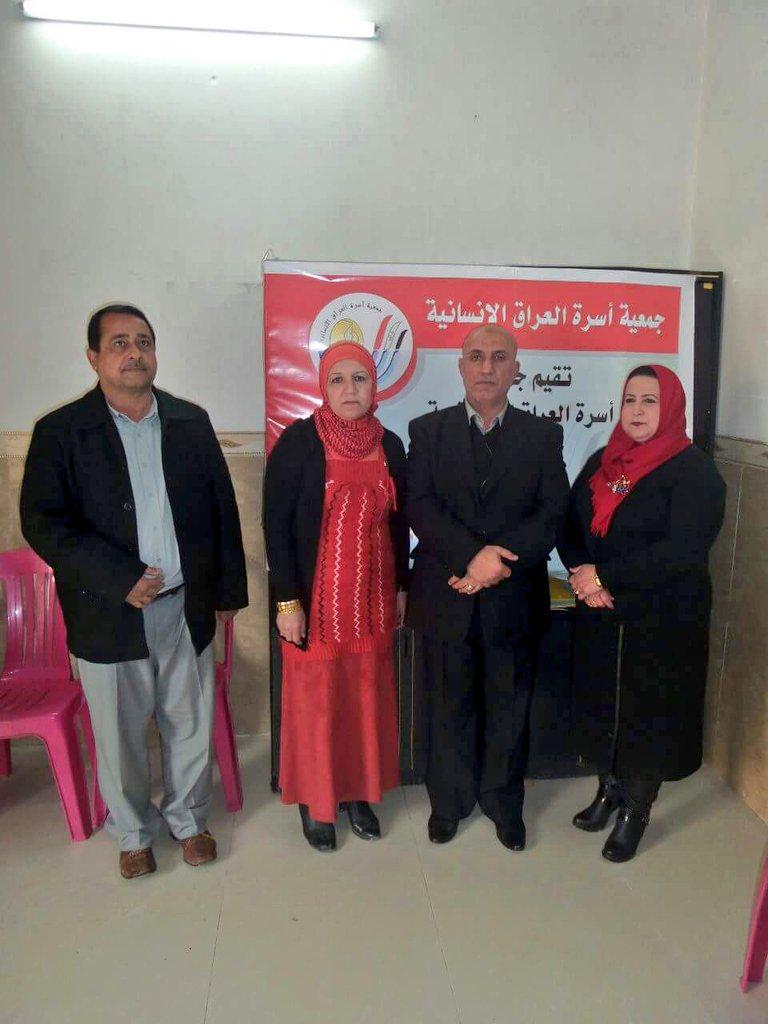
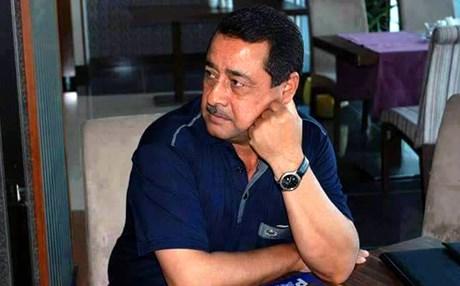
Methaq Al -fayydh @AlFayth
Iraq: Stato islamico giustizia giornalista e attivista Musli Thaer Ali https://shar.es/1pdRRp عبر @sharethis
Over 300 Yazidis killed in Iraq!!!!
Or maybe just 25.
That's what AP reports and bases it on the numbers supplied to them by Yadizi Mehma Khalil
Who knows?
Margaret Griffis (Antiwar.com) counts at least 65 violent deaths across Iraq on Friday. Jason Ditz (Antiwar.com) has an important piece you should read.
iraq
antiwar.com
margaret griffis
jason ditz


 Ammar karim

 Liz Sly


