Showing posts with label Hillary Clinton. Show all posts

Friday, May 6, 2022

Ridin With Biden

biden gals


From April 29, 2020, that's "Ridin With Biden."  C.I. noted:

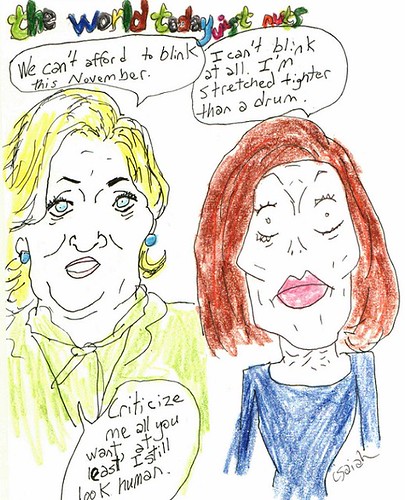
Isaiah's latest THE WORLD TODAY JUST NUTS "Ridin With Biden."  A zaftig Hillary Clinton stands next to mortal enemy Nancy Pelosi.  Hillary insists, "We can't afford to blink this November."  Nancy offers, "I can't blink at all.  I'm stretched tighter than a drum."  Hillary counters, "Criticize me all you want, at least I still look human." Isaiah archives his comics at THE WORLD TODAY JUST NUTS. 

I think that was the first time I noted Nancy's massive plastic surgery in a comic. 

The woman's addicted to plastic surgery and she's a politician, it surprises me that more people don't question that.

Contrast her with Hillary Clinton who is 8 years younger than Nancy and seems far more comfortable in her own skin.


Here's C.I.'s "Iraq snapshot:"

 Friday, May 6, 2022.  Another severe sandstorm hits Iraq as it still struggles with the political stalemate, Margaret Kimberley and Ajamu Barack ask serious questions about intent and purpose in their latest commentaries, and much more.


Let's open with this from Margaret Kimberley's latest at BLACK AGENDA REPORT:


On April 4, 1967 Dr. Martin Luther King, Jr. gave one of the most significant speeches of his career. In “Beyond Vietnam - Time to Break Silence ” King declared his unequivocal opposition to the war in Vietnam. His very public break with Lyndon Johnson was greeted with derision, including from his own allies, who believed that the president was an ally who should not be attacked. The NAACP board passed a resolution calling King’s statement a “serious tactical mistake” that would neither “serve the cause of civil rights nor of peace.” The media joined in the condemnation, with the New York Times characterizing his comments as “facile” and “slander.” Even Black newspapers such as The Pittsburgh Courier judged his remarks to be “tragically misleading.”

It is important to remember this speech in which he declared that the United States was “the greatest purveyor of violence in the world today.” There are individuals and organizations who routinely claim King’s mantle until they fall prey to the war propaganda promoted by the present day purveyors of violence.

The Rev. Dr. William Barber is sadly one such person. In an April 30, 2022 email on the subject Moral Clarity About Our Own Atrocities he made many specious arguments on the issue of war as it pertains to U.S. policy in Ukraine.

“To see the butchery at Bucha or the massacre at Mariupol and do nothing would be to forfeit any claim to moral authority. We know this instinctively. It is why, despite the political gridlock on Capitol Hill, Republicans and Democrats have acted swiftly to approve historic military aid to Ukraine. In the face of such a moral imperative, it would be anathema for either party to ask, “How are we going to pay for it?”

There is no independent investigation of what the Biden administration and corporate media label as “massacres.” No one who claims to act in the interests of humanity should praise the historic levels of military aid to Ukraine, an oligarchic kleptocracy under U.S. control which depends upon military and police support from openly neo-Nazi formations. So blatant are the connections that in past years members of congress have moved to ensure that these groups are denied U.S. aid .

Furthermore, Rev. Barber ought to know that questions of funding for domestic needs must always be raised. Joe Biden is requesting $33 billion in aid to Ukraine, which means money for the military industrial complex, after ending stimulus payments and other support for struggling people in this country. Barber opens his email with the story of a woman who lost children in her care to a child welfare agency after the termination of the child tax credit program plunged her into poverty. It is disturbing to see Barber’s attempt to have it both ways, demanding help for the poor while also supporting the system that keeps them in their condition.

The child tax credit which kept families afloat disappeared, along with enhanced unemployment benefits, anti-eviction protection, and free covid related treatments to the uninsured. The much vaunted Build Back Better bill is dead and Biden seems uninterested in resurrecting it. It is reasonable to ask the Biden administration for a monetary accounting  and for an explanation of how their actions led to a humanitarian disaster for the Ukrainian people, mass theft from Americans’ public resources, and a risk of hot war with the Russian Federation.

Barber and the Poor People’s Campaign are preparing for a  Poor People’s and Low-Wage Workers Assembly and Moral March on Washington and to the Polls taking place on June 18, 2022. His ill conceived email was meant to bring attention to this event but instead he brought attention to the deep connections that liberal politics has with right wing forces. 


Another severe sandstorm has hit Iraq.


There have already been two severe sandstorms in Iraq in the last five weeks -- see "AFP needs to learn to count -- over 429 is not 'dozens'"  and "Iraq snapshot."   Their frequency is on the rise and this is not by chance but an effect of climate change. Sandstorms "increased from 243 to 272 days per year over the past two decades, and is expected to reach 300 dusty days annually in 2050."  Louise Franco (NATURE WORLD NEWS) notes:


Although sand storms are common in Iraq, they have become more frequent over the years due to various weather and climatic factors, such as declining rainfall, desertification, and drought, according to Amer al-Jabri, director of Iraq's meteorological office, as cited by France 24 news.


And PHYS.ORG adds, "In November, the World Bank warned that Iraq could suffer a 20 percent drop in water resources by 2050 due to climate change."

BBC notes:


One person has died and more than 5,000 people have been admitted to hospitals with breathing problems in Iraq after a seventh severe dust storm in a month.

A health ministry spokesman said 2,000 of the cases of "suffocation" had been reported in Baghdad province, according to the official Iraqi News Agency.

He advised people with asthma and other chronic diseases to stay indoors.


AFP observes, "Residents of six of Iraq's 18 provinces, including Baghdad and the vast western region of Al-Anbar, awoke once again to a thick cloud of dust blanketing the sky.  As the storm swept across Iraq, it shrouded the capital Baghdad and the holy city of Najaf in ghostly orange clouds of choking dust."  Click here for a photo essay.  Australia's ABC adds, "State media reported Thursday's sandstorm was the seventh to hit the country in the past month."  Isabella Kwai files a report for THE NEW YORK TIMES which includes:


Although it is difficult to directly link individual weather events with climate change, experts say it is one driver behind sandstorms that are growing in frequency and intensifying. And climate change will likely compound the challenges ahead for a country like Iraq, which is already facing water shortages after low rainfalls and increasing temperature.

Twenty years ago, Iraq could expect about two sandstorms each year, said Professor Jaafar Jotheri, a geoarcheologist at the University of Al-Qadisiyah. This year, it is expected that about 20 sandstorms will hit Iraq, he said.

Visibility was so poor during a sandstorm this week that flights from the Baghdad and Najaf airports had to be grounded, according to the Iraqi Civil Aviation Authority.

“It is a disaster,” Professor Jotheri said, adding that sandstorms were becoming a regular feature of TV weather forecasts in Iraq. The increase in sandstorms could cause respiratory problems, road accidents and changes to the economy — pushing people to consider migrating away from the country’s drier west, he said. “The sandstorms are changing the Iraqi way of life.”


Mary Gilbert (ACCUWEATHER) explains:


In April, environment ministry official Issa al-Fayad warned Iraq could face "272 days of dust" per year in the coming decades, according to INA, the Iraqi state news agency.

This projected increase in the overall number of dusty days is due to Iraq and much of the surrounding areas becoming hotter and drier over time due to climate change. A lack of rainfall has led to a lack of moisture in the area soils and sands for Iraq. 


And PRESS TV points out, "The World Bank has already warned that Iraq - a country of 41 million people - could suffer a 20 percent drop in water resources by 2050. "


Iraq is no different from most countries in the world when it comes to not dealing seriously with climate change.  Around the world, citizens lives are devalued and the earth destroyed by faux actions and outright ignorance on the part of their so-called representatives.

In Iraq, a country still at war and still occupied by the US, it may be a little worse because (a)  they are predicted to be one of the fie most harmed countries in the world by climate change over the coming decades and (b) they really don't have a government.


October 10th.  That's when the country held elections.  Since then, the only high level position filled was Speaker of Parliament with the same person who held the office before the election).  They have yet to name a president or a prime minister-designate.


In four days, it will be seven months since the election.  As we speak to students, they ask how does this not get huge coverage?


The answer can be found in 2010.  The western press bent over backwards to ignore what was taking place.  In the US that was to protect the administration.  A cable news friend explained at the time that they couldn't cover it too prominently because it would look like they were attacking Barack Obama, the sitting president.


In march 2010, Iraqis had voted.  The western press had whored for Nouri al-Maliki who was the incumbent seeking a second term.  They did that despire the fact that it was already known he was running secret prisons and torture chambers and despite the fact that it was clear the CIA's projection that Nouri's paranoia would make him easy to control was not the case.  


That political stalemate lasted eight months with Nouri refusing to tep down and Barack -- on the advice of Samantha Power and Susan Rice -- deciding that demoncracy sidn't matter, toss out the Iraqi votes and give Nouri a second term.  He lost the election.  But the US government crafted a contract, The Erbil Agreement, that they got various political parties and blocs to sign off on which gave Nouri a second term.  The day after that contract was signed, Parliament held a session and named a president who immediately named a prime minister-designate (which was Nouri).


Now when THE GUARDIAN did an editorial calling out the comments by Barack about what a success the election was, a cable network finally felt that they could seriously cover what was gongon.


That's who a 'free' press works in the US.


As bad as the coverage in the US was prior to THE GUARDIAN editorial, it did get a tiny bit of attention.  Thats really not the case with this stalemate which, again, hits seven months in four days.


The Iraqi people are suffering and there is no government assembled all this time later.  That's a detail that the western press  is normalizing -- again normalizing.


Harry Istepanian Tweets:


#Iraq - The local media reports: the name of Abdul Latif Rashid, the former Minister of Water Resources is emerging as compromise candidate for Iraq presidency.


Another topic the western press loves to ignore is the way Turkey is committing Acts of War in northern Iraq as they continue to bomb the Kurdistan, continue to maintain ground troops and bases in the Kurdistan and continue to violate Iraq's national sovereignty.   PERSECUTION.ORG notes:


As a result of the Turkish offensive and conflict with the PKK, at least eight predominantly Christian villages in the Amedi region of Duhok province have been completely abandoned. Turkey announced its latest air and ground offensive, Operation Claw Lock on April 18, which follows twin offensives in 2021 and 2022.

Though the PKK is also dubbed a terrorist group by the United States and the European Union, Turkey’s indiscriminate bombing of Iraqi Kurdistan has led to the displacement of residents of many Christian villages. As reported by Rudaw, more than 500 villages have been emptied in the Kurdistan Region in the past three decades of Turkey-PKK fighting.

Simultaneously, the Iraqi army is combatting the Kurdistan Workers’ Party (PKK) and its affiliates, resulting in the displacement of over three thousand residents as of earlier this week from Sinjar. The majority of the displaced fled to Duhok. The army later declared control of a Sinjar village that had been controlled by armed groups post-Islamic State.


We'll wind down with this from Ajamu Baraka's latest column (BLACK AGENDA REPORT):


Rev. William Barber, an indisputable champion of the poor and a consistent voice demanding an end to poverty, may have made a serious moral and ethical error that effectively placed him outside of the “Kingian” framework that informed Dr. King’s work especially during the last year of his life.  

In an attempt to make a point about the flawed priorities of the duopoly, Dr. Barber wrote in an email to the “movement family” on Saturday, April 30, 2022 that, “despite the political gridlock on Capitol Hill, Republicans and Democrats have acted swiftly to approve historic military aid to Ukraine. In the face of such a moral imperative, it would be anathema for either party to ask, “How are we going to pay for it?”

He then went on to suggest that the “moral clarity” that informed the decision to provide military support to Ukraine was contradicted by the lack of moral clarity or support for addressing the pressing needs of the poor. He identified those two contradictory policy orientations – money for war but no money to pass “Build Back Better” legislation, for example, as representing the moral and ethical contradiction at the heart of U.S. politics.

I will give our dear brother the benefit of the doubt. He was making the point that the duopoly will support in a bipartisan manner those items that it deems a priority. For Rev. Barber and the Campaign, the issue of poverty and its devastating social consequences should be a priority for the U.S. state. However, in trying to make that point Rev Barber seemed to support the Biden’s administration’s war policies which as a follower of Dr. King would seem like a major contradiction. It would seem that to equate a moral imperative for providing military aid to Ukraine to wage war, no matter if it is claimed to be defensive, would be a dramatic departure from the non-violence ethos at the center of Dr. King's worldview.

Dr. King said himself that it was his silence on the war that presented a moral contradiction that could only be ultimately resolved by him speaking out in opposition to the Vietnam war . It is unimaginable that Dr. King would give his blessings to a military aid package that Rev. Barber’s language appears to do while simultaneously not demanding an end to the conflict as Rev Barber clearly failed to do in his communication to the movement family. We must now ask Rev Barber if his characterization of the military aid package as a moral imperative was just a clumsy use of words or does he actually support the ultimate expression of violence – war?  

We all know the history. After the student Non-Violent Coordinating Committee (SNCC) and all the radical Black liberation and socialist organizations had condemned the war in Vietnam, Dr. King finally broke his silence, as he framed it, and began to speak out against the war in early 1967 with the most extensive and important speech on April 4, 1967, at the Riverside Church in New York. The capitalist rulers understand symbols and so on April 4, 1968, Dr. King was murdered in Memphis where he was supporting a strike of Black sanitation workers against the Memphis city government.

Rev. Barber claims that “King was gunned down for his efforts to build a Poor People’s Campaign.” There is no doubt that the poor people’s campaign was a significant factor. The rulers understood the danger of Dr. King venturing into class politics, especially with his social democratic positions becoming more evident. But what Barber glosses over is that while the poor people’s campaign was seen as a threat, it was King’s break with the democratic party establishment, and at that time the majority position of the U.S. public who supported the war effort, that made Dr. King the most hated man in the country.


Isaiah's THE WORLD TODAY JUST NUTS "The Experts" went up last night and his "21 DUMPSTER" the night before.  He's planning on posting one tonight and one Saturday as well. The following sites updated:


Read on ...

Friday, June 11, 2021

I Like Being A Doormat

doormat


From December 8, 2019, that's "I Like Being A Doormat."  C.I. noted:


Isaiah's latest THE WORLD TODAY JUST NUTS "I Like Being A Doormat."  Hillary Clinton explains, "A lot of lesbians are mad at me for calling them man-haters.  Sorry, gals, I like the mens. I like the mens who cheat on me and humiliate me in public.  Being walked on like a rug gets Mama all hot and bothered."  Isaiah archives his comics at THE WORLD TODAY JUST NUTS.


Hillary is a doormat who lives for men who cheat on women, men who abuse women, there's her buddy Philippe and there's Tony Weiner and his wife Humana and she just loves the worst men -- don't forget to put Bill Clinton on that list.


Here's C.I.'s "Iraq snapshot:"


 Friday, June 11, 2021.  The Kurds, the PKK, Turkey, we walk through a lot of history


Kurdistan Junis Tweets:


"The population of Afrin was once at least 96 % Kurdish. Following the Turkish occupation, most of them were displaced, & the proportion of the Kurdish population fell to around 25 %. ". If this isn't genocide, what is it then ?!!!!


"In south Kurdistan, they have established tens of military and intelligence bases and outposts to be used against the interests of our people," Elyana Elyan remarked this week regarding Turkey's illegal actions in the semi-autonomous Kurdistan Region of Iraq. 


The Kurdish People's Assembly Tweets:


The Turkish military is attempting genocide against Kurds in South Kurdistan, targeting civilians and a large refugee camp. Ask your MP to sign an Early Day Motion condemning Turkey’s actions, and to speak up in favour of an arms embargo on Turkey:


What is going on?  Insisting that they must defend themselves from the PKK, the government of Turkey is violating international law by sending troops into Iraq on raids and other missions and bombing the Kurdistan Region with war planes and drones.  PKK?  The what?  The PKK is one of many Kurdish groups which supports and fights for a Kurdish homeland. Aaron Hess (International Socialist Review) described them in 2008, "The PKK emerged in 1984 as a major force in response to Turkey's oppression of its Kurdish population. Since the late 1970s, Turkey has waged a relentless war of attrition that has killed tens of thousands of Kurds and driven millions from their homes. The Kurds are the world's largest stateless population -- whose main population concentration straddles Turkey, Iraq, Iran, and Syria -- and have been the victims of imperialist wars and manipulation since the colonial period. While Turkey has granted limited rights to the Kurds in recent years in order to accommodate the European Union, which it seeks to join, even these are now at risk." The Kurdistan Regional Government in Iraq has been a concern to Turkey because they fear that if it ever moves from semi-autonomous to fully independent -- such as if Iraq was to break up into three regions -- then that would encourage the Kurdish population in Turkey. For that reason, Turkey is overly interested in all things Iraq. So much so that they signed an agreement with the US government in 2007 to share intelligence which the Turkish military has been using when launching bomb raids. However, this has not prevented the loss of civilian life in northern Iraq. Aaron Hess noted, "The Turkish establishment sees growing Kurdish power in Iraq as one step down the road to a mass separatist movement of Kurds within Turkey itself, fighting to unify a greater Kurdistan. In late October 2007, Turkey's daily newspaper Hurriyet accused the prime minister of the KRG, Massoud Barzani, of turning the 'Kurdish dream' into a 'Turkish nightmare'."


While Turkey pretends the problems started with the emergence of the PKK, they are lying.  The PKK is not an initiating incident.  It is a response to Turkey's long persecution of the Kurds -- perscuetion of the Kurds in Turkey and elsewhere. 


Sirwan Renas (Washington Kurdish Institute) offers his take:

The foundations of Kurdish nationalism in contemporary history can be traced back to the historical transition from pre-modern empire political system to the modern state-building order in the Middle East. In regard to Islamism, what makes Kurdish nationalism different from its rival nationalisms is the contemporary historical context through which it emerged. 

The Arab, Turkish, and Persian/Iranian nationalisms are state nationalisms that were constructed in opposition to Western colonialism — namely, British and France — at the beginning of the twentieth century and the domination of the United State in the aftermath of World War II. In contrast, Kurdish nationalism is a stateless nationalism aimed at the creation of the state of Kurdistan, and, thus, it emerged in opposition to the domination of Turkish, Iranian, Iraqi, and Syrian states — not the domination of Western powers. While for Turks, Arabs, and Persians, Western powers were seen as interventionists and occupiers, for Kurds the Turkish, Iranian, Iraqi, and Syrian states were perceived as occupiers. Even though Britain and France played a major role in dividing Kurdistan, for Kurds, it was their occupying authoritarian states that suppressed almost every Kurdish liberation movement throughout the twentieth century— a brutal suppression that led to all kinds of violations of human rights, from denying their fundamental rights to practice their language and culture and the possession of their homeland to mass killings, chemical bombings, ethnic cleansings, and genocides. The fact that the Kurdish national rights have been violated by the occupying states (not Western colonialists) made a significant difference in how Kurds perceive Islamism. 

Kurds do not have any state of their own to identify themselves with, nor do they identify themselves with any of the pre-modern Islamic empires or with any of the modern occupying states. That is not to say that Kurds have played no active role in the Islamic empires. Saladin Ayyubi, the founder of the Ayyubid dynasty, for example, led the Muslim military campaign against the Crusaders in the Levant. However, Kurds do not identify themselves with the Ayyubid dynasty and it has not become a basis for Kurdish nationalism. On the contrary, Turks identify themselves with the Ottoman Empire, Persians with the Safavid Empire, and Arabs with many Islamic dynasties since the birth of Islam. 

The transitional period from pre-modern empires to modern states in the Middle East is a crucial moment that helps us to understand how Kurdish nationalism and Islamism were affected by this historical context. It is widely believed that nationalism as a political ideology is a modern phenomenon.


Zooming in on recent events, Washington's Kurdish Institute notes the following for Iraq:


  • Turkey’s ongoing incursion into Iraqi Kurdistan stoked tensions between the Kurdish Democratic Party’s (KDP) Peshmerga forces and the Kurdistan Workers’ Party (PKK) last week. On Saturday, the Peshmerga accused the PKK of ambushing one of its convoys traveling to Metina in an attack that killed five Peshmerga, wounded five more, and was denounced by Kurdish and Iraqi officials and US and European envoys. The PKK responded by denying involvement and calling for an “independent investigation.” That said, unidentified assailants killed another Peshmerga member near Zakho on Tuesday, and a joint federal and regional parliamentary group is set to conduct a fact-finding mission in the region soon. Meanwhile, Turkish forces conducted additional airstrikes, plundered more trees from the region, and appear poised to exploit KDP-PKK tensions by launching additional incursions into Iraqi Kurdistan.  
  • Turkish forces made good on a threat from Turkish President Recep Tayyip Erdogan and ignored US warnings by launching an airstrike on the Makhmour refugee camp and killing three civilians. Erdogan continues to claim the camp, which houses thousands of Kurds who fled Turkish military operations during the 1990s, is providing a safe haven to PKK members. 
  • The first joint Peshmarga-Iraqi operation targeting ISIS (Da’esh) took place east of Tuz Khurmatu on Sunday. The Iraqi Security Media Cell announced Iraqi forces also launched five airstrikes on Da’esh positions during the operation. Likewise, a senior Peshmerga commander told Rudaw 13 Da’esh tunnels were destroyed during the operation. Iraq’s “Disputed Territories” have remained plagued by Da’esh since Iraqi forces and Iranian-backed militias removed the Peshmerga in October 2017.  
  • Anti-government protests continued in Kirkuk Governorate due to ongoing shortages of water, electricity, gas, and waste collection. Dozens of taxi drivers launched a demonstration to protest the lack of fuel, and even non-Kurdish demonstrators praised former governor, Dr. Najmaldin Karim, for his successes in providing services while bashing the current acting governor, Rakan Saed al Jabouri, who was imposed on the governorate on October 16, 2017. 


On the sixth of this month, Hunar Rasheed (RUDAW) reported:


Harmin Waheed, 19, is afraid she will miss out on this year's classes as she has fled home and sought shelter in another village with her family because of the ongoing conflict between Turkey and the Kurdistan Workers' Party (PKK).

Waheed, a grade 12 student, and her family left the village of Kesta along with dozens of other families in late April. She says instead of going to school, she now just does housework. They have taken shelter in Dargalka village.

"They [Turkey] fired missiles plenty of times causing huge bangs, not letting us study. They did not let us continue our studies. Nobody was in the mood to study," she recalls of the misery they faced back home in Kesta.

Waheed and her family took shelter at Begova Highschool in the village of Dagalka.

"The aftermath leaves us terribly frightened. Although the fight is a little far from our village, we can still hear it. The loud bangs sound so close, they terrify us," Warshin Hassan, a student, told Rudaw on Monday.

Teachers have warned that the number of students is declining year by year thanks to the decades-long impact of warfare in the mountainous border region.

According to data from the Amedi Education Department, 22 schools and 800 students have been affected by Turkish airstrikes and bombings.


The government of Turkey's actions are destroying lives.  On the eight of this month, Khazan Jangiz (RUDAW) reported:


Members of the Kurdistan Region and Iraqi parliaments visited Duhok province on Tuesday to speak with villagers displaced from border areas where Turkey is conducting an operation against alleged Kurdistan Workers’ Party (PKK) positions, a Kurdish MP has told Rudaw.

“A parliamentary delegation of the Kurdistan Region’s parliament, with some members of the Iraqi council of representatives … is investigating the tension at the border areas in Duhok province, in addition to losses created by this tension between both Turkey and the PKK forces, as well as the PKK and Peshmerga forces,” Shno Shahid Ashqi, a Patriotic Union of Kurdistan (PUK) MP said on Tuesday.

“We are sitting with some of the village chiefs, we are listening to their complaints. They are the ones who have evacuated their villages,” he added.

Ashqi, who is also a member of the Health, Environment and Consumer Rights committee in the Kurdistan Region parliament, said the villagers have said suffered great losses in a number of areas.

Not only “have their trees been cut but all of their lands has been burned and destroyed. They have suffered great losses, more than what is talked about in the media and on social media. Their houses are looted, their electricity destroyed, their livestock is being stolen.”


Yesterday, Yousif Musa (RUDAW) reported:

Six months after they fled their homes in northern Duhok because of clashes between the Turkish army and the Kurdistan Workers’ Party (PKK), a group of villagers returned and found their homes had been looted, their belongings stolen or destroyed.

"I saw all the doors were broken. The house supplies have been taken out into the streets, there was a mess," said Mahdi Naif, one of three men who snuck back to visit their village Roisy in the Batifa district. “The whole village was looted.”

"We found that they had left our houses in shambles," said Omer Ali, another villager who visited their homes. "The doors were smashed, no supplies were left for the people. What's left is not usable."

Roisy village has been abandoned for six months because of conflict between Turkey and the PKK. Eighteen families fled the community for safer areas in December. Four Turkish military bases have been established within close proximity of the village.

The PKK is an armed group fighting for greater rights for Kurds in Turkey. It has bases in the Kurdistan Region's mountains and the Turkish army frequently carries out cross-border operations against the group. Local civilians are victims of the conflict. They are targeted in bombing campaigns and driven from their homes. More than 500 villages have been emptied in the Kurdistan Region over three decades of Turkey-PKK conflict.


Let's also not forget the outrageous attack that took place last weekend when Turkey bombed a UN refugee camp.  Here is AFP's report on that bombing.


Where did Turkey get the drones?  The US has been supplying them with drones and other weapons for years.  In exchange, Turkey has provided spying intel on Kurdistan and other areas in Iraq.  Also, Turkey agreed to host a CIA outpost close to the border they share with Iraq.


We noted Elyana Elyan's statement earlier.  You can find her remarks in the video below.


She was speaking Tuesday at the webinar hosted by the Washington Kurdistan Institute.  The webinar was moderated by Sierwan Najmaldin Karim and Philip Kowalski.  The guests included analsts Hiwa Osman, Nilufer Koc, Dr. Henri Barkey and form US Ambassador Peter Galbraith.  (Dislcosue, I know Peter and have for several decades.)   The Institute issued a statement that included:


For a century, the Turkish state has persecuted the Kurds, denying their very existence, committing countless massacres, and seeking to eliminate the Kurdish identity. Since 2015, the current Turkish regime led by Erdogan has committed countless acts of military aggression against the Kurdish people in Turkey, Syria, and Iraq, openly pursing a campaign of ethnic cleansing.
The Turkish military has occupied areas in the Kurdistan Region of Iraq for many years and is actively seeking to expand its presence – at present, there are tens of Turkish military bases and posts throughout South Kurdistan. This most recent act of unprovoked aggression is part of a larger plan to broaden Turkey’s zones of occupation in the Kurdistan Region of Iraq, prevent any type of self-determination for the Kurdish people, and eventually eradicate the Kurdish identity.
We condemn these attacks in the strongest terms and call upon the United States government and the international community to take immediate action to bring Erdogan’s campaigns of military aggression to an end and sanction his regime for systematic violations of international law and global human rights conventions.
We reaffirm once again a solution to the Kurdish question will only be achieved through dialogue between the Turkish state and the PKK, and the United States and international community could play an integral role in encouraging and facilitating this dialogue to achieve just peace for all peoples of the region.


That statement was issued in April.  It could have been issued any day of any month of any recent year.  That's how long Turkey's illegal actions have been carried out.  That's how long the world has largely looked the other way.

The government of Iraq has also not offered a strong response.  Though various officials have spoken out, there has been no leadership on this issue and the current prime minister has no clear stance.  In addition, Andam Aso Aziz notes:


The Iraqi president and foreign minister are Kurds. We have several Kurdish diplomats and parliamentarians in Iraq and the KRG. If we are not working effectively to throw Turkey out of the KRG now, when are we going to do it?


Also rather silent has been the US government.  But the attack over the past weekend did prompt one public remark from a US official who was quoted in a REUTERS report:


U.S. ambassador to the United Nations Linda Thomas-Greenfield visited Ankara last week and said she told officials that "any attack targeting civilians at Makhmour refugee camp would be a violation of international and humanitarian law".


Elyana Elyan noted of the most recent wave of attacks, "The Turkish state's choice of this date, April 24th for the initiation of operations is no coincidence as it is the anniversary of the Armenian genocide.  This is a clear message, an open threat of genocide."


Changing topics, kidnappings continue in Iraq.  Persecution.org notes:


 Assyrian activist, Husam Alkass, was abducted and later released by the Kurdish Democratic Union Party (PYD), according to the Assyrian Policy Institute. Alkass, who was a member of the Assyrian Human Rights Network, was captured in Derik (Al-Malikiyah), located in northeastern Syria near the Turkish border.

Alkass was abducted on June 3 and later released on June 4. His whereabouts were unknown during his capture. Prior to his abduction, he was known for documenting human rights violations committed by the de facto Kurdish authorities. According to Anadolu Agency, Alkass was kidnapped and beaten by a group of masked men while he was returning to his car from shopping that afternoon.

Al-Malikiyah has a rich history of Assyrian heritage, with its indigenous inhabitants fleeing to Syria the Assyrian Christian genocide from Turkey. The city is now occupied by the terrorist group. The PYD has links to the perhaps more well-known Kurdistan Workers Party (PKK), which operates in Turkey and Iraq. The terrorist group closed all Syriac-Assyrian schools in Al-Malikiyah in August 2018, claiming they did not have the correct licenses. The closure was widely seen as repression of the Assyrian minority groups.

For interviews, please contact Addison Parker: press@persecution.org. 


Earlier this month, the Assyrian Policy Institute had Tweeted:


The Assyrian Policy Institute is deeply concerned by reports that Assyrian activist Husam Alkass, a member of the Assyrian Human Rights Network, has been abducted in Derik (al-Malikiyah), Syria by militiamen affiliated with the Kurdish Democratic Union Party (PYD).
Image


We include that Tweet to put a face to Husam's name.  Again, he has been released. 

Yesterday, UNAMI issued the followig:


Baghdad, 10 June 2021 – A Memorandum of Understanding (MoU) has today been signed between the General Secretariat of the Iraqi Council of Ministers’ (GSCOM) Women Empowerment Directorate and the United Nations Development Programme (UNDP) to advance gender equality and women empowerment in Iraq.

Building upon existing structures and ongoing gender mainstreaming efforts, the new partnership will strengthen the institutional and analytical capacity of relevant Iraqi stakeholders to advance gender equality, focusing on the specific needs of women and girls in Iraq. It will help Iraq achieve its gender equality commitments under the Sustainable Development Goals (SDGs) by integrating gender perspective in governmental policies and plans.

One of the priority activities under the MoU is to assist the government’s Central Statistical Organization to establish an e-platform that aims at bridging the gender classified data gap by facilitating the flow of reliable, gender-specific data across different institutions in the country that will help shape government policies.

The Secretary General of the Council of Ministers, His Excellency Mr. Hamid Al-Ghizi said: “Whereas women around the world are seen as powerful agents of change towards advanced, sustainable and inclusive societies, Iraqi women have played a strong role in addressing the crises and challenges that Iraq has experienced and have had an effective role and contribution in establishing inclusive society. Hence, we believe that this MoU is an important step towards strengthening these roles”
“While Iraq still grapples with the impacts of the COVID-19 pandemic, it has disproportionately affected women and girls, exacerbating numerous existing social, economic and political challenges. This calls for increased gender responsive efforts towards achieving gender equality. UNDP Iraq will continue support the government to mainstream gender equality and fulfil its national obligations under the SDGs. This MoU with GSCOM will further strengthen inclusive and gender sensitive policies, as well as our efforts to achieve gender equality in Iraq,” says Resident Representative of UNDP in Iraq, Zena Ali Ahmad.

Media contact:
Mohammed Al-Bahbahanee, Communications Specialist | mohammed.al-bahbahanee@undp.org | +964770 439 9222


The following sites updated:


Read on ...
Creative Commons License
This work is licensed under a Creative Commons Attribution-Share Alike 3.0 Unported License.