Thursday, February 18, 2010

The Bully & Tony Review


"The Bully & Tony Revue" from May 28, 2006.

Tony Blair and Bully Boy led the world into an illegal war.


Were they in the news that week? I had to think about it. Bully Boy was always in the news back then, of course. But Tony and Bully were doing a hard press on lying about the Iraq War and claiming it was worth it and blah, blah, blah.

If you're 13 or so today, it may be hard to believe it but as late as 2006 there were still near weekly attempts to sell the illegal war as 'needed' and 'good.'
Now here's C.I.'s "Iraq snapshot:"

Thursday, February 18, 2010. Chaos and violence continue, Ramadi is slammed with a bombing, the UN offers 'hopes' for the upcoming elections, Chris Hill spins as well, Basra sees a increase in childhood leukemia, and more.

"After eight long years of bloodshed, and who knows how many more to come, we're still not sure why we fight, and our understanding of war is only growing more blood-dimmed and confused,"
writes Stephen Marche (Esquire). Marche's point is a solid one. Why did the US go into Iraq, the truth not the many discredited lies? Why does the US remain in Iraq? Those are questions that are never answered and really aren't even raised by the bulk of the press these days.

Today Ramadi was slammed with a bombing.
Steven Lee Myers (New York Times) reports it was a suicide bombing and that the death toll has reached at least 12. Ali al-Mashhadani, Waleed Ibrahim, Mohammed Abbas, Jack Kimball and Louise Ireland (Reuters) note twenty-one are wounded, that a hospital source says 13 corpses have been received with 26 people injured, and "A restaurant worker in Ramadi, capital of Anbar province, said that bodies littered the scene, close to a complex housing provincial government buildings. Blood stained the ground, and gutted police and army vehicles smouldered nearby." Mu Xuequan (Xinhua) quotes Khalaf Mahmoud who was wounded in the bombing, "I was heading to the government compound when the blast took place some 50 meters away from me. I remember I saw one of the civilian cars with two men inside approached to the checkpoint and blew up. It was a terrible blast, thanks God, I am lucky to survive." Al Jazeera adds:Mohammed Dulaimi, the owner of a restaurant that was badly damaged in the blast, said the attackers were "trying to undermine the political process and prevent us from taking part in the election"."They want us to miss the opportunity to vote, as we did before," he said, referring to a boycott of 2005 general elections by Sunni-led political parties.Yousif Bassil and CNN report that the attack took place at a security checkpoint "close to the provincial council office." In addition, Reuters notes a Mosul bombing injured "a former police officer and a tribal chief" and a Mosul car bombing left twenty-four people injured.

Turning to the elections, Swarthmore College's
War News Radio is a weekly show and the most recent program (first began airing last Friday) covered the elections. From the headlines, we'll note this for background.

Emily Hager: One day before campaigns are due to start, Iraqi judges released a list of previously banned candidates who will be allowed to run in next month's elections. But two of the most prominent Sunni candidates, both current Parliament members, still haven't been cleared to campaign. In January, Iraq's de-Ba'athifcation committee banned more than 500 candidates from competing for seats because of alleged connections to Saddam Hussein's Ba'ath Party. The decision was appealed to an Iraqi court where judges have been considering the issue. At first, the court announced that all of the challenged candidates would be able to run and that they would be reviewed after they won seats. Prime Minister Nouri al-Maliki pushed to have the review before the elections. Official campaigning begins this week for the March 7 vote.

Earlier today at the United Nations in New York,
Ad Melkert (the Secretary-General's Special Representative to Iraq) declared, "Generally speaking, I should say that the elections are on track in terms of their technical preparation. Still a lot needs to be done. Security remains a big challenge to all, to the Iraqis in the first place, but also to the international community." Melkert sounds a great deal like US spinner Chris Hill. He went on to add, "Elections is not only about politics but requires a lot of hard work on the ground. The UN electoral team has continued to play a key role in advising and technically support the Independent High Electoral Commission (IHEC). As a result of a huge collective effort the infrastructure is in place in order to allow approximately 18.9 million Iraqi voters to visit 48,000 polling stations on election day." Today the Los Angeles Times offered the editorial "Baath-bashing in Iraq."

Iraq's upcoming parliamentary elections should be about jobs, public services and government competence. Candidates should be focused on the country's security and on reconciliation among Shiites, Sunnis and Kurds. Instead, the national vote once again is turning into a sectarian brawl in which Shiite parties jockeying with one another for dominance are stirring populist fears of a return of Saddam Hussein's Sunni-led Baath Party. Never mind that Hussein was executed in 2006 or that the discredited Baath Party already is outlawed. The Accountability and Justice Committee, led by Ahmad Chalabi, the Shiite politician and onetime darling of the George W. Bush administration, has been purging candidates who were members of the Baath Party and, in the process, fueling minority Sunnis' suspicions that the real motive is to further reduce their power.

Jane Arraf (Christian Science Monitor) adds, "Although a significant number of Shiites as well as Sunnis have been barred from running because of alleged Baathist ties, the move has been seen as furthering a Shiite agenda because the heads of the commission are prominent Shiite members of parliament. Adding fuel to the controversy over the ban, the top US general in Iraq, Ray Odierno, and other US officials, have accused the two men, Ahmed Chalibi, and Ali Faisel al-Lami of ties to Iran" Along with the bannings, many political parties are finding their candidates Yesterday's snapshot noted Michael Hastings (The Hastings Report, True/Slant) report on the attacks on the Ahrar political party -- Saturday, four were held for 24 hours in Sadr City where they were attempting to put up campaign visuals and Tuesday a group of worker were attacked leading up to today where an Ahrar Party candidate was attacked in Maysan Province with at least one body guard killed in the attack. The Ahrar Party has released the following statement on the attacks:

Amid increasing signs that the Maliki government has completely lost control of the security situation in Iraq, violence and sectarian intimidation have increased in spite of a non-violence pact, signed by some parties. As a non-sectarian party, Ahrar has been singled out for special treatment.
Over the past five days, Ahrar has had campaign workers shot at, captured and even killed, for the 'crime' of putting up our election posters.
In Maysan on Wednesday, an Ahrar candidate was the victim of a carefully-planned ambush, narrowly escaping capture. One of his team was murdered at gun-point.
Ahrar Party leader Ayad Jamal Aldin said: "These politicians are all talk. It is their weakness that has allowed outsiders and corrupters who are intent on dividing and destroying Iraq to take control of our country. Ahrar stands for a united and peaceful Iraq. For jobs, security and electricity for the Iraqi people."
"Now ask yourself, who would oppose this? These corrupt outsiders are scared because they know that the people of Iraq can make a change for the better. Ahrar will not be intimidated because Ahrar is the party of Iraq's people, and on March 7 it is they who have the power to end this intimidation."
For further information, contact:
Ahrar Media Bureau Tel: +964 (0)790 157 4478 / +964 (0)790 157 4479 / +964 (0)771 275 2942
press@ahrarparty.com

About Ayad Jamal Aldin:
Ayad Jamal Aldin is a cleric, best known for his consistent campaigning for a new, secular Iraq. He first rose to prominence at the Nasiriyah conference in March 2003, shortly before the fall of Saddam, where he called for a state free of religion, the turban and other theological symbols. In 2005, he was elected as one of the 25 MPs on the Iraqi National List, but withdrew in 2009 after becoming disenchanted with Iyad Allawi's overtures to Iran. He wants complete independence from Iranian interference in Iraq. He now leads the Ahrar party for the 2010 election to the Council of Representatives, to clean up corruption and create a strong, secure and liberated Iraq for the future.

Robert Dreyfuss (The Nation) declares Iraq "once again on the brink of a civil conflict" and offers this:

Starting last spring, at the urging of top officials in Iran--including Ali Larijani, the conservative, Iraqi-born speaker of the Iranian Parliament, and Brig. Gen. Qassem Suleimani, commander of the Quds Force of the Iranian Revolutionary Guard Corps--a group of sectarian Shiite religious leaders patched over their differences to establish the Iraqi National Alliance (INA), linking ISCI with the forces of rogue cleric Muqtada al-Sadr; former Prime Minister Ibrahim al-Jaafari of a renegade Dawa faction; and Ahmad Chalabi, the former darling of US neoconservatives, who has long maintained close ties to Iran's hardliners.
The creation of the INA was widely seen, inside and outside Iraq, as an Iranian project. Reidar Visser, a close observer of Iraqi affairs at the Norwegian Institute of International Affairs, says efforts to rebuild the Shiite sectarian alliance began last spring, after a visit to Baghdad by Larijani. Soon afterward, a stream of Iraqi officials made pilgrimages to Tehran, where a deal between the Hakim family (the founders of ISCI) and Sadr was brokered by Iran. "Part of the Iranian strategy has been to put politics in Iraq back on the sectarian track," says Visser. Both Iran and the new Shiite alliance pressured Maliki to join, but at that time the prime minister felt strong enough to run independently.
Then, this past January 14, Iraq's electoral overseers ratified a decision by the so-called Accountability and Justice Commission, an unelected body controlled by Chalabi and one of his cronies, Ali al-Lami, to ban more than 500 candidates for Parliament. They were barred from running, said the commission, on vague charges of ties to the deposed Baath Party. Among those banned were current members of Parliament and Iraqi officials, including Defense Minister Abdul-Kader Jassem al-Obeidi and Mutlaq, who'd joined forces with Allawi. The commission's action was a bomb thrown into the center of Iraqi politics and sparked talk of a boycott and even a new antigovernment insurgency.

Chris Hill is the US Ambassador to Iraq. We'll note
this exchange between him and CNN's Elise Labott from yesterday at the State Dept (link has text and video): Elise Labott: Can we go back to the idea of the Ba'athists and the election -- on the banned candidates? You spoke earlier this morning about the sensitivities about the Ba'athist issue, but more from the kind of whole Iraqi population. I was wondering if you think that there's any danger of not a resurgence of the Ba'athists, but a kind of backlash by pro-Ba'athists in terms of, you know, more violence or anything like that as a result of this. Chris Hill: Well, the country, there's no question there are Ba'athist elements in the country and there's no question that some of these Ba'athist elements are very unhappy with the current state of affairs. I will say that the -- in terms of violence, we have a government that is increasingly capable of handling violence, and we did not see any signs of insurgency of the kind that we saw back in the wake of the '05 -- Elise Labott: Right. Chris Hill: -- elections. So what we see are acts of terror that are – have already happened; in many cases, in our judgment, happened because of al-Qaida elements. But we don't see that this issue of excluding Ba'athist candidates is one that is leading to violence. Frankly, they were able to come together and work out a solution, and I think it's a solution that most people are living with. Elise Labott: But-but if I could just quickly follow up, I mean, some of these banned candidates were, if I'm correct, previous -- some of them were even in parliament previously; is that right? Chris Hill: Yeah. Elise Labot: And so, I mean, do you think that there's a danger that they feel like they used to have the political process and now they feel disenfranchised and -- Chris Hill: Well -- Elise Labott: -- and that's a kind of, you know, formula for, you know, being bored and not having a lot to do and being kind of bitter and, you know, turning back? Chris Hill: Well, being bored is not a formula for getting elected, but -- Elise Labott: Well, you know I'm being -- well, but you know what I'm saying. Chris Hill: I think it's important to understand that there are candidates who are unhappy at having been on the list, but there was a process by which they were able to appeal, there was a sequestered panel of judges from the cassation court that looked at these cases. In some cases, they ruled that the people should be able to stand for office; in others, they ruled against it. We know that some of the candidates who were disallowed or not permitted to run, they have accepted the result and they've called on their -- on people to vote. So we don't see a sign that this type of dissatisfaction is of the quality that would cause an outbreak of an insurgency. But obviously, we track these issues very closely. We're in very -- we really follow these things. We're in touch with all the politicians. And this is going to -- this is, to be sure, a rocky road, but I think we can -- we have every reason to believe that we'll get through this election process. For those paying close attention, the US has thrown in the towel re: elections. They word now is that it doesn't matter if some candidates are excluded or not, it's not big deal. And with that nonsense, the US attempts to paint a pretty picture. Sami Moubayed (Asia Times) notes that elections might take place but . . . "Another scenario is that the elections will be called off altogether, due to rising violence and Sunni resentment with Maliki's handling of the pre-election process. The controversy of disqualifying candidates, which has rocked the Iraqi scene for more than three weeks, is ongoing as 145 candidates are now officially confirmed as ineligible to run for office, due to their alleged ties to the outlawed Ba'ath Party." Mohammed A Salih (Asia Times) adds, "The ban on high-profile Sunnis who have been part of Iraqi politics after the war is considered a significant blow to Washington's efforts to bring back the moderate elements of the mostly Sunni-led Ba'ath Party into Iraq's political process and reintegrate Sunnis into the country's politics."

Chris Hill delivered a lengthy opening statement before taking questions ('or abuse' he joked). We'll not note it all. On the elections, he stated:We're here really to report on where things stand with three weeks to go. I think anyone who follows Iraq knows that there are twists and turns to any destination in Iraq. Certainly, de-Baathification was a major issue and a very tough issue, a very emotional issue, but I think we've gotten through that issue. The campaign has really started in earnest. There are campaign placards all over every surface in the country, it seems, right now. There are some 6,172 candidates. There are 18.9 million registered voters. There are 300,000 poll station workers. There are 50,000 polling stations spread over 9,000 polling centers. There will be out-of-country voters and they're prepared to handle that in 16 different countries, voting that will actually start on March 5th. We are working very closely with the UN and with the U.S. forces to help secure having 26 four-person monitoring teams. These are actually just U.S. monitoring teams to be spread out over 18 provinces, including four in Baghdad and 22 in other provinces. We'll have extra teams in some of the sensitive areas in Anbar, Basra, Diyala, Kirkuk, Ninawa. There will be nine diplomatic missions who are represented in the overall monitoring, including from -- those from Turkey, UK, Denmark, Canada, Czech Republic, Netherlands, Poland. The European Union will have five or six journalistic embeds. We'll also have special needs voting that begins on March 9th -- March 4th, rather. And our teams will be deployed about March 1st and return March 9th. So this is a major undertaking. It is an election that in many respects will determine the future of Iraq, the future of the U.S. -- and also the future of the U.S. relationship with Iraq. For us, this is a very important election because it's an important election that will enable us to continue to develop what we see as a long-term and very important relationship, strategic relationship, with the Republic of Iraq.He wanted to talk about many things in his opening statement and oil was at the top of his list. Oil and 'progress'. Chris Hill insisted, "Iraq has made important strides in its economy in recent months. They've reached some oil lease deals with many of the major oil companies in the world. So if all of these go well in the next some 10 years, we will see a country producing some 10 million barrels of oil per day. I mean, this is a substantial amount. This will put Iraq in the category of or in the sort of orbit of a country like Saudi Arabia. It will make Iraq an oil exporter to the tune of some four times what Iran is currently exporting. So all of these developments are happening as we speak. There are more and more oil infrastructure companies coming in to get ready for this, and I think we can see that Iraq is really taking its rightful place on the world stage.""Ten years," Chris?"Ten more years"?
Geoff Kelly (Art Voice) interviews US House Rep Brian Higgins who states, "In Iraq, do you remember [President Bush] said he was going to do the surge in late 2006? The war wasn't going well. He puts Petraeus in charge and they commit 20,000 more troops. The surge was supposed to give breathing room for the political parties -- Shia, Sunni, and Kurd -- to resolve their differences. The surge succeeded militarily by tamping down the violence, but all the existential issues, all the standout issues, are still unresolved -- and will very likely be resolved violently. The sharing of oil revenues, the disputed areas in the north, Kirkuk, political reconciliation between the three major factions -- they're still not resolved."They're still not resolved, says Higgins.Important strides, crows Hill . . . before adding . . . ten more years.


Can Iraq survive the damage of ten more years?
US News and World Reports notes that in Basra the rate of childhood leukemia has doubled in the last 15 years and offers that one reason for this may be due to chemical exposures as a result of fires. The University of Washington issued a news release today noting the study and that there of their professors wrote it:

The study documents 698 cases of leukemia for children aged 0-14 during the 15-year period, with a peak of 211 cases in 2006. Younger children had higher rates than older ones.
"By using a hospital cancer registry, we were able to measure a jump in leukemia rates from 3 per 100,000 youngsters in the first part of our study period, to a rate of almost 8 and a half in the final three years," said UW Department of Global Health faculty member Amy Hagopian, the paper's lead author.
By comparison, Hagopian said, the European Union and the United States report rates of 4 and 5 per 100,000, respectively. She also noted Kuwait reports a rate of approximately 2 per 100,000 and Oman reports rates between 2 and 3, depending on the gender of the child (boys typically have higher rates, as do children from higher socio-economic classes).
"Studying childhood diseases in war situations is difficult," Hagopian noted. "Aside from the normal difficulties of controlling for referral patterns changes caused by war-time conditions, the political situation is also challenging. We were constantly worried about the political risks our medical colleagues were taking by collecting and reporting these data."

One way chemicals are exposes is the use of burn pits to burn off left overs -- medicine, trash, waste, military equipment -- and they have been used in Iraq and in Afghanistan.
David Zucchino (Los Angeles Times) tackles the issue of the burn pits:The noxious smoke plumes that wafted over the military base in Balad, Iraq, alarmed Lt. Col. Michelle Franco. The stench from a huge burn pit clung to her clothing, skin and hair. "I remember thinking: This doesn't look good, smell good or taste good," Franco said recently. "I knew it couldn't be good for anybody." She wheezed and coughed constantly. When Franco returned to the U.S., she was diagnosed with reactive airway dysfunction syndrome. She is no longer able to serve as an Air Force nurse. Other returning veterans have reported leukemia, lymphoma, congestive heart problems, neurological conditions, bronchitis, skin rashes and sleep disorders -- all of which they attribute to burn pits on dozens of U.S. bases in Afghanistan and Iraq. Burn pits are not safe. Everything is burned off in them including medicines. These toxins are released into the air and get into the soil and water supply. There are many people quoted in the article saying the military needs to step up but it's not just the military. Congress needs to. Zucchino notes that US House Rep Carol Porter-Shea has introduced legislation in the House for a federal registry (as there is with Agent Orange). That's great. But there's similar legislation in the Senate. Evan Bayh introduced it last year. Since October, when he appeared before the Senate Veterans Affairs Committee, that legislation has been held up by the Committee which should have long ago released it for a floor vote.

Dennis Bartok (Variety) observes, "The year 2009 was the one that saw Iraq War-themed movies finally connect with Academy voters, as Oscar-nominated scripts The Hurt Locker [Mark Boal] and The Messenger [Alessandro Camon and Oren Moverman] resonated in ways that earlier efforts didn't." It's a shame that film interest increases as the interest from the news media decreases. But at least some people are paying attention.


We noted Marc Hall in the
February 9th snapshot, Pamela E. Walck (Savannah Now) reports that Hall was in Chief Federal District Court yesterday where Judge William T. Moore Jr. refused to grant his appeal to remain in the US and he is expected to be sent to Kuwait shortly for a court-martial:
"The more I worked on this case, the more persuaded I am that we were right on the law," said David Gespass, Hall's civilian attorney. "... There is no one else to appeal to at this point. The intent of the Army is clear. They could have tried him any time between July and December, before anyone left here (for Iraq)."And the idea that all of a sudden, it's imperative they try him over there, outside of the light of day and the scrutiny of the public, shows they are so resistant to trying him here. It reinforces the idea they don't want the case to be scrutinized."Gespass said it wouldn't be fiscally possible for him to travel to Iraq for the court-martial proceedings and that his client would have to rely on the military-appointed attorney."I have confidence in his military lawyer," Gespass said. "But ... the problem with getting witnesses there is a more serious one."The civilian attorney said one witness stepped forward, but said she wouldn't travel to Iraq for a court proceeding.Why is Marc Hall facing a court-martial?
Russia Today interviewed Iraq Veterans Against the War and World Can't Wait's Matthis Chiroux about the case.Matthis Chiroux: Marc Hall has demonstrated (a) a lot of courage in-in writing this song. I mean the army suppressing soldiers is so widespread, the stop-loss policy destroys so many lives anyway. The fact that Marc Hall had the courage to-to speak up and to address that in his rap song in the first place is quite impressive. Second, I think very important, something that we need to call attention to in this case, is Marc Hall is not being jailed for writing the stop-loss song, Marc Hall is being jailed because he expressed to his command that he would not deploy to Iraq with his unit. And this happened during the time he wrote the song in July and he wasn't jailed until December. He was, in fact, undergoing counseling and serving with his unit. It wasn't until Specialist Hall told his command that he wasn't comfortable deploying to Iraq that they took these measures against him. IVAW's updates page for Marc Hall is here. Asked if the military is concerned that the song might bring attention to the stop-loss policy, Matthis responds, "Well, ma'am, I think there is already enormous attention on this policy and, in fact, this is one of the many Bush era policies that Obama has failed to make good on his promises to end. Obama said he would end stop-loss, yet it continues. Marc Hall is a victim of that. His song is an expression of-of what it's like to feel robbed by the military, what it's like to be the victim of a backdoor draft. And he put that out there and subsequently told his unit that he wasn't going to abide by those orders to deploy to Iraq and that's when they took these measures against him. There's a clear, clear history of resistance within the units in the military history spreading and we in Iraq Veterans Against the War are convinced that the command recognized this and sought to remove Marc Hall using this rap song as an excuse before others in his unit could find out that he wasn't going to deploy and could do the same thing. I mean in recent history at Fort Hood, we have Victor Augusto who refused to deploy to Afghanistan and then, after he did that, other soldiers stood up. One, in fact, flat out refused as well and also was tried by the miltiary for it. This jailing of Marc Hall is clearly the military's attempt to shut down any resistance in this unit that could come from Marc Hall's courageous stance, not just in opposing stop-loss but in opposing the war."


TV notes.
NOW on PBS begins airing Friday on most PBS stations (check local listings):


From the raucous tea party rallies to the painful sacrifices families are making behind closed doors, voter angst and anger are sweeping the country like a storm. Directly in its path: the 2010 midterm elections. On February 19 at 8:30 pm (check local listings), NOW examines the strong impact this groundswell has already had on electoral politics, and what we can expect in November. Our investigation uncovers what motivates people who've come together under the tea party banner, and how a larger dissatisfaction among voters spells trouble for incumbents in both parties, some of whom have decided to avert the storm by leaving Congress altogether.


iraqthe los angeles times
cnnelise labott
the asia timessami moubayedmohammed a. salihxinhuaal jazeeracnnthe new york timessteven lee myersyousif bassilart voicegeoff kelly
the christian science monitorjane arrafsavannah nowpamela e. walckrussia todayiraq veterans against the warmatthis chirouxthe world cant waitdavid zucchino
pbsnow on pbs


Read on ...

Thursday, February 11, 2010

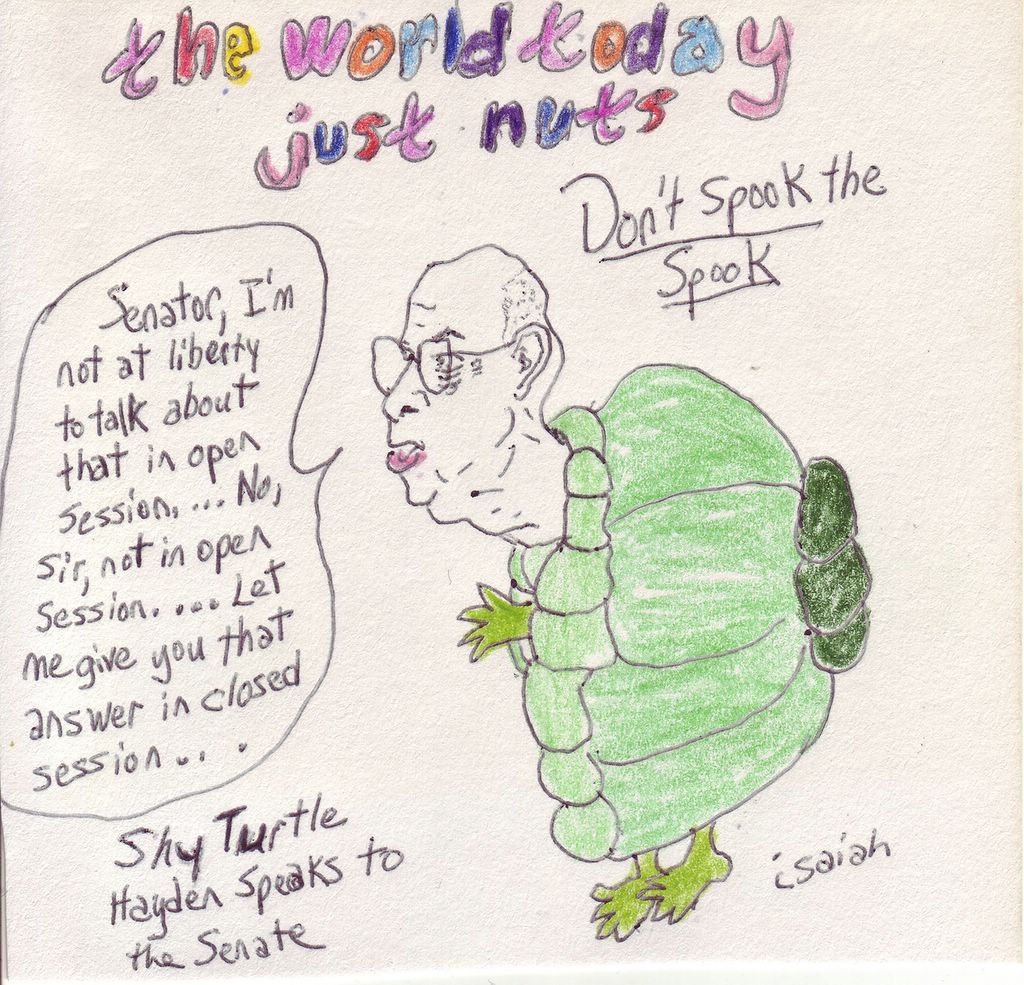
Don't Spook the Spook


Some people are like animals.

With Michael Hayden, I thought as I saw him on TV, "He's like a turtle." So I grabbed some lines he really said and drew him as a turtle.

When people remind you of animals, it can be easy. Unless it's an aligator. I'm lousy drawing those.

That's "Don't Sppok the Spook" from May 21, 206.


Here's C.I.'s "Iraq snapshot:"

Thursday, February 11, 2010. Chaos and violence continue, the press thinks they've caugh Joe Biden in an embarrassing moment, the press ignores a public lie told by Robert Gibbs, the US military announces a death, Saleh al-Mutlaq is announced banned, and more.

In one of the more suprising domestic war developments, Chicago Mayor Richard Daley has called out the apathy on the part of the peace movement.
WBEZ provides audio clips.

We always believe America is number one. If you start the first World War, the Second World War, then you take Korea and Vietnam and Iraq I and II and Afghanistan -- just think of all the money that we spend on wars to save the world. Today we can't save America. What is this? Why do we always have to go to war continually? Why can't we rebuild America? Why is it we have to take three hundred, four hundred billion dollars and tell people we're only going to be there for a year and we're coming home and we declare victory. What is it? What is it about America? How did we start this century of ten years of war? Ten years of war. We started it and we continue to move forward. Where are the anti-war people? "I looked down at the [. . .] center" -- where are they? Where are they? They've disappeared. What happened? I thought war was evil. Where are the people who believed in their heart against George W. Bush? 'We have to organize and walk down Michigan Avenue and Clark Street.' What happened? I thought they believed in their heart. Oh! It became a political issue. 'Barack won the election, now we go home.' What happened to America?

Cate Cahan (WBEZ) notes "that his son Patrick is being redeployed in the U.S. Army. War looms large when it looms close." Earlier this week, Fran Spielman (Chicago Sun Times) quoted Daley stating, "My son had a responsibility. He served four years in the military, and he's re-deployed. He will serve his country just like evry other son and daughter in this country does the same thing." And Spielman added, "The mayor made it clear that his son did not re-enlist, but was summoned back to active duty."
Staying with US politicians, Jake Tapper, you're sleeping on the job. Robert Gibbs pulled his usual song and dance today. Suprisingly Jake Tapper fell for it. The most recent start point is last night when US Vice President Joe Biden appeared on
Larry King Live (CNN -- here for transcript). Asked by Larry about Pakistan, Biden included the following in his answer:

I am very optimistic about -- about Iraq. I mean, this could be one of the great achievements of this administration. You're going to see 90,000 American troops come marching home by the end of the summer. You're going to see a stable government in Iraq that is actually moving toward a representative government. I spent -- I've been there 17 times now. I go about every two months -- three months. I know every one of the major players in all of the segments of that society. It's impressed me. I've been impressed how they have been deciding to use the political process rather than guns to settle their differences.

Andrew Malcolm (Los Angeles Times) noted (this morning, one of the first) that Biden was calling something a 'success' that may not have been what he originally advocated for with Malcolm reminding that Biden advocated for the region to split into three areas -- Sh'ite, Sunni and Kurds. In fairness to Biden (I know Joe but I'm not playing 'rescue' here), he saw it as federaslim and also he dropped this before he dropped out of the Democracy Party primary (in his bid for the presidential nomination). This came to the Senate floor and he had stated publicly before the vote that if it didn't pass, it didn't pass. When it didn't pass, he was done advocating for that plan barring some change and he's made no public statement of any change taking place. Malcolm notes Barack pushed a measure to end the Iraq War -- a meaningless measure and Barack knew it, which Malcolm leaves out -- and that Barack opposed the so-called 'surge' -- Barack opposed it so did many Democrats. Malcolm gives the surge credit for ending the genocide but the surge didn't do that -- not in any helpful way. By the time the surge starts, you already have a refugee population of 4 million and many, many dead. The surge backed up the Shi'ite government. It didn't end the genocide (popular known as a civil war). Malcolm observes, "Now, the Obama-Biden pair that opposed the Iraq war and its tactics and predicted their failure is prepared to accept credit for its success." Joe made a dumb statement. I think of the world of him and I do understand where he's coming from when he says that. I happen to disagree with the statement but it was a dumb statement just because so many would seize upon it. And should. Andrew Malcolm and others in the press aren't behaving unfairly or cruel. And they are asking about the statements.

Now let's go to
Jake Tapper's take. Tapper covers what Malcolm has -- including a link to this statement from about Barack being opposed to the 'surge' (and I'm not a Barack fan, by any means, but Barack was correct in 2007 and it's too bad that, in 2008, he wasn't able to stick to that and explain why the surge was a failure when interviewed by Katie Couric). Now here's Tapper on the White House press briefing today by Robert Gibbs and community members should grasp what Tapper doesn't:

Gibbs said the achievement was "putting what was broken back together and getting our troops home, which we intend to do in August of this year."
A reporter pointed out that the Status of Forces Agreement to bring troops home was signed before the president took office.
Gibbs called that agreement "something I think that the political pressure that the president, as a then-candidate, helped to bring about."

Did you catch it because Jake Tapper didn't. And it's the sort of thing that really makes me scream but we'll be kind. Gibbs said Barack's campaign "as a then-candidate, helped to bring about" the SOFA. (So-called SOFA.) For that to be true, candidate Barack would have had to have supported the SOFA.

But Barack didn't support it. Barack opposed the Status of Forces Agreement as a senator and as a presidential candidate. So did Joe Biden. So did every, EVERY, senator on the Senate's Foreign Affairs Committee. This is public record and should be well known. Should be.

Robert Gibbs is a damn liar. Robert Gibbs damn well knows Barack opposed it and CAMPAIGNED on his opposition to it. We can go through all of this if the press can't do their own work but hopefully they'll catch their error and we can just note
November 18, 2008 -- after the US presidential election -- when Barack suddenly changed his mind:

During the election, the Obama-Biden campaign website revealed their stance on the so-called SOFA in "
Plan for Ending the War in Iraq:"["] The Status-of-Forces-AgreementObama and Biden believe any Status of Forces Agreement, or any strategic framework agreement, should be negotiated in the context of a broader commitment by the U.S. to begin withdrawing its troops and forswearing permanent bases. Obama and Biden also believe that any security accord must be subject to Congressional approval. It is unacceptable that the Iraqi government will present the agreement to the Iraqi parliament for approval--yet the Bush administration will not do the same with the U.S. Congress. The Bush administration must submit the agreement to Congress or allow the next administration to negotiate an agreement that has bipartisan support here at home and makes absolutely clear that the U.S. will not maintain permanent bases in Iraq. ["]

Post election,
Change.gov was set up as the official website for the Barack-Biden transition and if you pull up "The Obama-Biden Plan," you will find:["] The Status-of-Forces AgreementObama and Biden believe it is vital that a Status of Forces Agreement (SOFA) be reached so our troops have the legal protections and immunities they need. Any SOFA should be subject to Congressional review to ensure it has bipartisan support here at home. ["]

I like Joe so I'll stop there (and also note that Joe didn't refer to the SOFA on Larry King). But Barack opposed the SOFA -- the SOFA doesn't end the illegal war and it should have been opposed, it was another move by Bush to do an executive power-grab and render the legislative branch obsolete.

Robert Gibbs lied to the press and claimed candidate Barack allowed the SOFA to come to be. No, he didn't. He opposed the SOFA as it was rammed through by Bush (and he was right to oppose it). Only after the election did the SOFA suddenly become 'okay' with Barack. Had Barack campaigned in 2008 honestly and stated, "We want to end the war now! But I'm going to follow Bush's plan" you can rest assured that even some of his whores -- maybe even Tom Hayden -- would have either rejected him or have to learn to kiss their own asses a little deeper. Tom-Tom, of course, can toss his own salad and does so frequently. The difference between Bush's 'plan' and Barack's is why
Jennifer Loven and Liz Sidoti (AP) can note Barack's "big calls for change are unfulfilled in almost every way. . . . America is still at war in Iraq. U.S. combat troops are supposed to be out by this August by the latest presidential deadline -- later than candidate Obama had planned."

Ryan Grimm made an ass out of himself on MSNBC insisting that the right-wing was being a hypocrite for refusing to give Barack credit on Iraq while insisting he was responsible for the economy, unemployment, deficits and the Big Business bail out. Ryan Grim's a damn fool and a damn liar. He works at Huffington Post which pretty much tells you all you ever need to know about his 'qualifications.' Barack is responsible for the Big Business bail out -- after the election, he strong-armed the Black Caucus into supporting it. He is president, that makes him responsible for the unemployment rate, the deficit and everything else. Sorry if that's too damn hard for little Ryan to grasp. As for Iraq? Bush implemented the 'plan' and Barack's following it. It's not a good 'plan' and if you're going to praise it, you better explain why all the sudden George W. Bush is the man to praise on Iraq? Ryan Grimm's a damn idiot -- and a smelly one at that. (Note to Arianna, speak to your people about public hygiene.)

Things are not wonderful for Iraqis.
World Focus offers a video report by Charity Tooze:

Ali Katheem: All those who are hearing me, I wish you could remove me and my family from the situation. I can't sustain this and I hope this year something happens.

Charity Tooze: Ali Katheem and his family live in Syria. There one of the thousands of Iraqi families that have been displaced by violence. Ali said he would have been killed if they'd stayed in Iraq. In 2006, a milita group moved into the Katheen's neighborhood and began threatening the family.

Ali Katheem: They said you're sectarian, you're Shi'ite, you're done, you cannot live near us. This week, if you don't leave, we'll kill you.

Charity Tooze: After the initial threats Ali said gunmen began trespassing on his property. He said they heard gunshots all the time.

Ali Katheem: When this happened, I would put my children and wife in a closet and lock them in. I would sit with two machine guns on either side of me in case they came in, so they wouldn't kill my family.

Charity Tooze: When the family decided to flee to Syria, their quality of life quickly went from comfortable to poor and Ali, like all Iraqi refugees, is not legally allowed to work. This is not the first time Ali has experienced adversity. As a young man, he fought in the Iran-Iraq War. When a bomb hit him, he lost his left forearm. Yet Ali went on to become a champion. He trained as a professional runner and in 1990 was the first Iraqi to win a Gold and Silver medal in the Holland . . . [Olympic Festival].

Ali Katheem: Champion of the world. In handicap. Gold medal, 400 meter. Silver medal, 200 meter.

Charity Tooze: But now Ali feels powerless. The country receives the equivalent of 200 US dollars monthly in cash assistance from the UNHCR. Their rent alone is approximately $250. In order to make the rest of their rent, they sell half their food rations. Not only are the Katheen's living in poverty but their children continue to struggle to make sense of their past.

Daughter: Once we were traveling, someone died. Me and my mother went and saw him. He was dead in front of us, so I still remember it and I kept dreaming about it.

Charity Tooze: In addition to psychological trauma, the children have struggled with school. This year Hussein dropped out to help the family pay the rent.

Things are not wonderful in Iraq. Today the
International Press Institute released their latest report on press freedom and they found the first decade of the 21st journalist had claimed the lives of 735 journalists with 170 of those having been "killed in Iraq, making it the most dangerous country in the world for journalists in the last ten years." This comes as Iraq continues to crack down on journalism. Alsumaria TV reports that the Ministry of Industry and Minerals is insisting it did not shut down a paper in Basra.

Turning to some of today's reported violence . . .

Bombings?

Reuters notes a Mosul roadsdie bombing claimed 1 life, a Baghdad roadside bombing left two people injured

Shootings?

Reuters notes an attack on a Mosul security checkpoint resulted in the death of 1 police officer and, dropping back to Wednesday for both incidents, an armed clash in Haditha resulted in three police officers and two assailants being injured and 1 imam was shot dead in Baghdad.

Today the
US miltiary announced: "A United States Forces-Iraq Soldier died Feb. 10 of non-comabt related injuries. The name of the deceased is being withheld pending notification of next of kin and release by the Department of Defense. The names of service members are announced through the U.S. Department of Defense official website at http://www.defenselink.mil/releases/. The announcements are made on the Web site no earlier than 24 hours after notification of the service member's primary next of kin. The incidnet is under investigation." The announcement brings to 4376 the number of US service members killed in Iraq since the start of the illegal war.

Layla Anwar (An Arab Woman Blues) writes:

Yesterday, 10th February 2010 in various districts of Baghdad, 25 Baathists have been gunned down with silencers, silent guns by the Badr Brigades of Ammar Al-Hakeem (ISCI) of Iran.Sunni areas in Baghdad are being evacuated.: Amiriya is practically empty now, people are getting very scared because a lot of the men are being arrested.Again yesterday at 6.30 pm, 12 Baathists have been arrested in Sammara by Badr Brigades.Warning : A massive campaign of liquidation and/or arrest has started by the Iranian trained, backed and funded Shiite death squads. As promised by Nouri Al-Maliki.when he said " any Baathist will be meeting his/her black fate ". We are expecting more bloodshed of Sunnis/and seculars under the pretext of a Baathist witch hunt.

UPI reports, "The Iraqi Independent High Electoral Commission moved forward with preparations for March parliamentary elections by printing ballots in January despite the objections. IHEC has now released the names of 6,172 approved candidates for the March elections, reports historiae.org, a Web site devoted to Iraqi analysis." Qassim Abdul-Zahra (AP) reports the list does not include Sunni's Salah al-Mutlaq and Dhafir al-Ani. Quoted in the article is Ali al-Lami who never admits to being Ahmed Chalabi's lover, boyfriend, boytoy, sexpot or friend with benefits. Thus far.

al-Mutlaq was running as part of the nationalist party the National Dialogue Movement, a non-sectarian party and a strong rival to Liltte Nouri.
Tom McGregor (Dallas Blog) informs that neocon Michael Rubin is a strong cheerleader for Chalabi. Ali al-Lami, watch your back. The UN today issued a statement which included:

The top United Nations envoy to Iraq today called on the country's political leaders to step up their efforts to ensure that next month's Council of Representatives election is free and fair, with campaigning for the polls set to start tomorrow.
Calling on them to safeguard the integrity of the democratic process, Ad Melkert, the Secretary-General's Special Representative, underscored that each institution involved in the 7 March elections must operate free of political interference.
"The consolidation of democracy in Iraq will depend on the willingness of Iraq's political leaders to collective ensure a transparent, peaceful election," he
stressed.


It's a little late in the day for that announcement.
Trudy Rubin (Post Bulletin), whom no one could ever accuse of flying off the handle or jumping to conclusions, offers, "Iraq is holding elections in March that will test whether it has moved beyond the vicious sectarian divisions of the past. Prime Minister Maliki claims that is what he wants. U.S. officials are holding their breath." Meanwhile at Gulf Daily News, Finian Cunningham observes:

While Obama makes a big deal about earmarking $100 billion to tackle unemployment, a much understated but much bigger deal is the allocation of $160bn for America's wars in Iraq, Afghanistan and Pakistan. Combined with the regular Pentagon annual budget, that puts US total spending on "defence" (meaning aggression) at $710bn over the next year - 700 per cent more than what it will spend on creating jobs.
To put this largesse in another perspective, US military spending compares with a federal education budget of some $220bn - that is, three times more of the taxpayers' money is spent every year on invading countries, expanding global bases, blowing up villages, testing missile interceptors etc, than developing the talents of young Americans.
What these figures show is not just that the infamous US military-industrial complex is alive and well; they show that the American economy is fundamentally a war economy. While its people are struggling to maintain some modicum of livelihood - jobs, homes, healthcare, education - what is evident more than ever to them is that the year-on-year inordinate US government spending on its military is far from "discretionary". It is compulsory.

Radio notes,
Scott Horton of Antiwar Radio interviews professor Francis Boyle:

Francis Boyle, Professor at the University of Illinois College of Law, discusses his legal Complaint demanding the prosecution of Bush administration officials for crimes against humanity, the International Criminal Court's (ICC) jurisdiction over crimes committed by the US in ICC-member countries, the "Marty" report that catalogs the US practice of "extraordinary rendition" and how a less-desirable international prosecution is the result of the Obama administration's failure to uphold the rule of law.
MP3 here. (20:59)
Francis Boyle is a Professor and scholar in the areas of international law and human rights. He is the author of
Tackling America's Toughest Questions: Alternative Media Interviews, BREAKING ALL THE RULES: Palestine, Iraq, Iran and the Case for Impeachment and many other publications.
Professor Boyle received a J.D. degree magna cum laude and A.M. and Ph.D. degrees in political science from Harvard University. Prior to joining the faculty at the College of Law, he was a teaching fellow at Harvard and an associate at its Center for International Affairs. He also practiced tax and international tax with Bingham, Dana & Gould in Boston.
He has written and lectured extensively in the United States and abroad on the relationship between international law and politics. His Protesting Power: War, Resistance and Law (Rowman & Littlefield Inc. 2007) has been used successfully in anti-war protest trials. In the September 2000 issue of the prestigious The International History Review, Professor Boyle's Foundations of World Order: The Legalist Approach to International Relations (1898-1922) was proclaimed as "a major contribution to this reinterrogation of the past" and "required reading for historians, political scientists, international relations specialists, and policy-makers." That book was translated into Korean and published in Korea in 2003 by Pakyoungsa Press.
As an internationally recognized expert, Professor Boyle serves as counsel to Bosnia and Herzegovina and to the Provisional Government of the State of Palestine. He also represents two associations of citizens within Bosnia and has been instrumental in developing the indictment against Slobodan Milosevic for committing genocide, crimes against humanity, and war crimes in Bosnia and Herzegovina.
Professor Boyle is Attorney of Record for the Chechen Republic of Ichkeria, conducting its legal affairs on a worldwide basis. Over his career, he has represented national and international bodies including the Blackfoot Nation (Canada), the Nation of Hawaii, and the Lakota Nation, as well as numerous individual death penalty and human rights cases. He has advised numerous international bodies in the areas of human rights, war crimes and genocide, nuclear policy, and bio-warfare.
From 1991-92, Professor Boyle served as Legal Advisor to the Palestinian Delegation to the Middle East Peace Negotiations. He also has served on the Board of Directors of Amnesty International, as well as a consultant to the American Friends Services Committee, and on the Advisory Board for the Council for Responsible Genetics. He drafted the U.S. domestic implementing legislation for the Biological Weapons Convention, known as the Biological Weapons Anti-Terrorism Act of 1989, that was approved unanimously by both Houses of the U.S. Congress and signed into law by President George H.W. Bush. That story is told in his book Biowarfare and Terrorism (Clarity Press: 2005).
In 2001 he was selected to be the Dr. Irma M. Parhad Lecturer by the Faculty of Medicine at the University of Calgary in Canada. In 2007 he became the Bertrand Russell Peace Lecturer at McMaster University in Canada. Professor Boyle is listed in the current edition of Marquis' Who's Who in America.
Currently Professor Boyle lectures on international law at the
University of Illinois College of Law.


TV notes.
NOW on PBS begins airing Friday on most PBS stations (check local listings):


Even with the recent outpouring of support for earthquake victims inHaiti, Americans' attention span for global crises is usually veryshort. But is there a way to keep American audiences from tuning outimportant global issues of violence, poverty, and catastrophe far beyondtheir backyards? On Friday, February 12 at 8:30 pm (check locallistings), NOW talks with filmmaker Eric Metzgar about "Reporter," hisdocumentary about the international reporting trips of New York Timescolumnist Nicholas Kristof. In the film, Metzgar provides fascinatinginsight into how Kristof breaks through and gets us to think deeplyabout people and issues half a world away.

iraq
wbazcate cahan
the los angeles timesandrew malcolmjake tapper
francis a. boyle
pbsnow on pbs

Read on ...

Thursday, February 4, 2010

Bully Boy Just Like Dick


That's from May 14, 2006. "Bully Boy Just Like Dick" is interesting for one reason.


It was news back then that Bush had bad polls. It's easy now, when the whole world loathes Bush for people to think he was always loathed. But he had the media behind him, pushing him, pimping him and just promoting him like crazy. The same way they do Barack today.


You'd think, as much as Bush is hated today, that he always was but the media protected him as long as they could and that's what they did (like they do for Barack today).

The comic points out that Bush is now down where Dick Cheney is in the polls which is also a take on Cheney's remark to Powell before Powell's UN speech that he could afford to lose some polling points like the rest of them.

And here's C.I.'s "Iraq snapshot:"

Thursday, February 4, 2010. Chaos and violence continue, Little Nouri attacks the press, Little Nouri tries to reinstate banning of political opponents, the Iraq Inquiry forgets the "Iraq" part, and more.
The Times of London notes this week's bombings resulting in mass fatalties and that "Nouri al-Maliki, the Prime Minister, has made security a central theme in his re-election campaign." And that, in response to the latest wave of bombings, Nouri made the usual move: "He called on security forces to offer greater protection." This as Leila Fadel (Washington Post) reports that Nouri's "accidental rise to power" has not brought him a huge number of supporters -- leaving him "politically isolated and regionally estranged" and she explains:

Iraq has a multiparty parliamentary system. Lawmakers choose the president, who in turn gives the largest coalition in the parliament the first opportunity to choose the prime minister and form the government. If Maliki's bloc can win the largest number of seats, a majority in the parliament will still be needed to endorse his government. Without alliances, that could prove impossible.
"He has to manage to get alliances with others or he's done," said Askari, the independent Shiite politician.
Erstwhile allies say they will not support Maliki this time around.

Fadel goes on to note that Moqtada al-Sadr supporters are among those who feel burned by Little Nouri. No surprise there after his assault on Basra which also added an assault on Sadr City at the same time (2008) when protests began there against the Basra assault. Distanced from many Shi'ite sects, never embraced by Sunnis and no friend to the Kurds, time for Nouri to stomp his feet and again reveal his nasty side.
Shortly after being installed, the first thing Nouri al-Maliki (thug of the occupation) did was begin floating notions of curtailing media freedoms. When the Green Zone was stormed in June of 2006 (stormed but not breached), the 'crackdowns' became a regular feature of daily life and Little Nouri worked on a 'plan' that the media repeatedly misrepresented -- US media repeatedly misrepresented. It applauded the various planks -- including the neighborhood patrols which were already taking place and were neither an idea of Nouri's nor something that needed to be implemented. In addition, considering the ethnic cleansing that would soon take place (what some dub the civil war of 2006 and 2007), maybe armed militias really weren't something to applaud? But if they weren't giving Nouri credit for things he didn't do, the US press might have to call out the plank attacking journalism. The BBC called it out. Foreign outlets called it out. It was in the US reporting that you never heard about it. Nouri had been installed only months prior and had already made repeated anti-media remarks publicly, but his plank attacking journalism, his plank that required registration and more, it didn't register in the US media.
Considering all the waves of attacks on journalism that have followed under Nouri (most infamously when a New York Times reporter was 'fired' on by a member of the Iraqi military who then laughed because there was no bullet . . . this time), maybe the post-war mea culpa that's needed is the one for refusing to loudly and vocally defend the rights of the press? Nouri's at it again. From the Committee to Protect Journalism:

New York, February 4, 2010 -- An Iraqi government plan to impose restrictive rules on broadcast news media represents an alarming return to authoritarianism, the Committee to Protect Journalists said today. CPJ denounced the rules and called on Prime Minister Nouri al-Maliki and his government to abandon their repressive plan.

CPJ's review of the plan found rules that fall well short of international standards for freedom of expression and that appear to contravene the Iraqi constitution, which provides for a free press. The new rules would effectively impose government licensing of journalists and media outlets, a tool that authoritarian governments worldwide have long used to censor the news.

The rules would also bar coverage that the government vaguely describes as incitement to violence. CPJ research shows that such broad and unspecified standards are often used by repressive governments to silence critical coverage.

A copy of the plan, obtained by CPJ, can be downloaded here as a PDF (9 MB, Arabic).

"The regulations suggest either a lack of understanding of the news media's role in a democratic society, or a deliberate attempt to suppress information and stifle opposing views," said CPJ‎ Executive Director Joel Simon . "Either way, the rules should be rescinded immediately so that the media can do its job free of government intimidation."

The new regulations were drafted by the Iraqi Communications and Media Commission (CMC), a government body that does not appear to have legal authority to draft such rules, CPJ research shows. The CMC was created with a narrow mandate to administer broadcast frequencies and other technical issues.

CPJ's review found that the rules are replete with broad and vaguely expressed restrictions. While demanding that all local and international broadcast media be licensed and that all individual journalists be accredited by the CMC, the rules provide little information on the criteria the government would use in issuing such licenses. (All equipment must also be registered with the government.) The plan also states that news media must abstain from "incitement to violence," but it does not define what would constitute a violation.

Media deemed to violate the rules could face closure, suspensions, fines, and confiscation of equipment.

CPJ found other alarming aspects to the rules. They stipulate, for example, that media organizations submit lists of their employees to the government. While the clause raises privacy concerns, it is particularly ominous in light of the recent history of journalist murders in Iraq . Of the 140 journalists killed in Iraq since 2003, at least 89 were targeted for murder, CPJ research shows. Another 43 media support workers, such as drivers and interpreters, were also murdered. In case after case, CPJ research shows, these journalists were targeted because of sectarian or work affiliations; many have gone to great lengths to conceal their profession for fear of reprisal.

In discussions with foreign reporters in Iraq, CMC representatives made it clear that media organizations would have to reveal confidential sources if they sought to challenge a determination made by the agency. If the CMC finds that a media organization has published information it deems inaccurate or inflammatory, the identification of sources would be central to any challenge to CMC findings, journalists who attended the meetings told CPJ.

"The regulations themselves, and the explanations provided by CMC officials, suggest that sources could be compromised, reporting could be censored, and Iraqi staff could be intimidated," Simon added.

Michael Christie (Reuters) observes, "It remains risky for Iraqis to be associated with foreign companies and Western media fear that handing over staff lists places them at risk from militia, insurgents like al Qaeda, or kidnap gangs. Many reporters working for foreign media do not tell their neighbors what they do. [. . .] Reuters and other media are already routinely threatened by officials with lawsuits or expulsion because of disparities between the number of bomb victims reported by their police and interior ministry sources, and official death tolls."
Yesterday came news of a decision reached by a ruling body in Iraq on the elections issue. Already Nouri is striking back at the decision. To recap, we'll note this from yesterday's snapshot:

On Al Jazeera's Riz Khan yesterday, the issue of the elections were addressed with Riz Khan asking, "How free and fair is an election when a government bans certain people from running? Iraq goes to the polls on March the 7th but has barred more than 500 candidates which could ultimately plunge the country into chaos, even civil war." Steven Lee Myers (New York Times) reports today that the government has managed to avert "a political crisis of its own making" as a result of the ban being overturned today "by a panel of seven judges". The Economist calls it "Best news in weeks." Margaret Coker (Wall St. Journal) explains, "The decision now opens the way for full-fledged campaigning to begin, as scheduled, on February 7. It wasn't immediately clear how many of the banned candidates would accept the compromise decision, or how the decision might affect the election outcome itself." Scott Peterson (Christian Science Monitor) adds, "But if the ruling stands, there's a catch: those blacklisted will still be subject to investigation after the vote for past ties to the regime of Saddam Hussein." And what would happen then? Caroline Alexander and Kadhim Ajrash (Bloomberg News) observe, "Election Commission official Hamdia al-Husseini told Agence France-Presse that those later found to have links to the Baath Party would be 'eliminated.'" Martin Chulov (Guardian) reports, "The ruling enraged the architect of the blacklist, Ali Faisal al-Lami, who is a close aide of the head of the former ­de-Ba'athification Commission, Ahmed Chalabi. That commission, which was a signature body of the post-Saddam Coalition Provisional Authority (CPA), evolved into a contentious group known as the Accountability and Justice Commission." And to clear up a nasty rumor, there is no known sex tape of Ahmed Chalabi and his boy pal Ali al-Lami being distributed in Basra. Absolutely not. Nasty, hurtful rumors. Unless a tape should surface. Ammar Karim (AFP) notes, "Chalabi, who has close ties to Iran, was appointed deputy prime minister after the invasion but intelligence he provided in support of those claims in the run-up to war later turned out to be flawed and he subsequently fell out of favour with Washington." The decision is still being studied and Al Jazeera notes Saleh al-Mutlaq, of the sectarian National Dialogue Party and who was one of the banned, "declined to give an immediate comment."

Reuters reported this morning that Nouri's mouthpiece, Ali al-Dabbagh, posted to his website the following: "Postponing implementing the law of the Justice and Accountability Commission till after the election is illegal and not constitutional." Anne Tang (Xinhua) notes the cries of "illegal!" as well while Margaret Corker (Wall St. Journal) adds, "Faraj Al Haidari, the head of the electoral body running the election, says he has asked the Supreme Federal Court to weigh in on the political controversy to quell the mounting accusations among political parties that the closely watched poll set to take place on March 7 has been tainted by sectarianism." Corker explains that Al Haidari doesn't believe that this would delay elections but if elections are scheduled for March 7th and it's February 4th, exactly when would candidates campaign? While they were 'banned,' they couldn't campaign. Now with the question mark Nouri's throwing on them, they may not be able to campaign -- and certainly some of their time will be taken up with this mess even if they are campaigning. How do you have fair and free elections when candidates aren't even sure they're going to be on next month's ballot? How do you have fair and free elections when Iraqi voters are using their own limited time (just as limited as any American voter or any voter in any other country) to study up on the issues and deciding, "Well, if I have to cut back somewhere, maybe I just won't look into these candidates who might not even make the ballot"? That's not speculation, BBC News reports, "Iraq's electoral commission has said it will delay the start of campaigning for next month's parliamentary elections."
And it is apparently not enough to toss the matter to the courts -- or rather, back to the courts again. Scott Peterson (Christian Science Monitor via Gulf News) reports, "Baghdad: Iraq's premier has convened parliament for Sunday to debate what his government branded an 'illegal' decision to reinstate candidates with alleged links to ousted dictator Saddam Hussain in next month's election, state television said." So the decision to allow ALL candidates to run is being targeted by Nouri with a court appeal and an appeal to Parliament. And if the two are in conflict? Or if the two both shoot Nouri down? Where does it end? And when does it end? March 5th when candidates are left to scramble? This is nonsense and it's turning the entire elections into a joke. (Or, if you prefer, a bigger joke.) Gulf News, after yesterday's decision, was editorializing in praise of it and noting, "Elections serve no purpose if they are seen to be manipulated, since the government that emerges from a corrupt process will not have a popular mandate. Elections must have transparent rules that are published well in advance and do not change. This allows parties to form, adopt political positions, campaign for support and form electoral alliances. Any last-minute shift in the rules necessarily corrupts this complex process." Instead, those who are seen as threats to Nouri are left to scramble.
Jomana Karadsheh and Yousif Bassil (CNN) note, "While U.S. Gen. Raymond Odierno, the top U.S. military official in Iraq, said about 55 percent of the group were Shiite with alleged links to the Baathist party, the most prominent politicians on the list were Sunni Arabs. Members of that community swiftly deplored the move and even threatened an election boycott." Liz Sly (Los Angeles Times) reminds, "Ali Lami, executive director of the separate Accountability and Justice Commission, which ordered the disbarments, condemned the judges' decision as representing 'American interference' in Iraqi politics, and vowed to fight it in the courts. U.S. officials have charged that Lami has close ties to Iran. The chairman of the accountability commission is Ahmad Chalabi, who was once a Pentagon favorite but fell from grace after he was suspected of passing information to Iran." NPR's Lourdes Garcia-Navarro (All Things Considered -- link has audio and text) reports:
According to Human Rights Watch, the Supreme National Commission for Accountability and Justice -- a body without clear authority that compiled the list -- mainly targeted candidates from the two largest secular coalitions. They are both expected to do well on March 7.
Veteran Sunni politician Salah al-Mutlak, who had been on the banned list, told NPR in a interview this week that the commission targeted him because the current crop of elected officials are afraid losing power.
"They are scared because most of them, they don't even have the qualifications to be a parliamentary member or they are corrupted financially, or their hands are not clean from the Iraqi blood. So they know that the coming government is going to go after them, and there will be a law if there is a decent government, and the law will follow them," Mutlak says.
The above and more has resulted in a letter to the White House, House Reps William Delahunt, Howard Berman, Gary Ackerman, Donald Payne, Russ Carnahan, John Tanner, Lynn Woolsey, Barbara Lee, Brad Miller, Keith Ellison, Jim Moran, Dennis Kucinich, Edward Markey, Steve Cohen, David Price, Maruice Hinchey, John Conyers, Earl Blumenauer, Bob Filner, Jan Schakowsky, John Tierney, Jim McGovern, Rosa DeLauro, John Olver, Niki Tsongas, Stephen Lynch and Richard Neal have [PDF format warning} written President Barack Obama:
We are writing to express our strong support for a continued focus by your Administration on the upcoming general elections in Iraq. These elections, currently scheduled for March 7, 2010, will determine Iraq's political future -- and America's relationship with that nation.
If elections are accepted by the Iraqi people and the world as free, fair and successful, they will deepen Iraq's democracy and provide a basis for a stable, respectful relationship between our countries. But -- as we have already seen in Afghanistan and Iran -- if the elections are seen as fraudulent, they could inflame tensions inside and outside the country and undermine efforts to strengthen democracy. In the worst case, they could even lead to a civil conflict and a resumption of wide-scale violence.
The impact on the U.S.-Iraqi relationship of a failed or fraudulent election would be equally disastrous, particularly as U.S. troops continue to withdraw from Iraq as mandated under the U.S.-Iraq bilateral agreement which entered in to force on January 1, 2009.
With regard to that agreement, we commend your commitment to it and support your plan to bring our troop levels down to 50,000 by August 2010 and to withdraw all U.S. force by the end of 2011. We believe that it is important that your Administration deliver a clear message to the Iraqi government and people that, while we are committed to helping Iraqis stabilize their country, we will not change our withdrawal plans based on the date or outcome of the elections. Our continued presence in Iraq -- even after the successful June 30, 2009 withdrawal of our combat forces from Iraqi cities -- is already an issue in Iraqi politics. To explicitly tie our withdrawal to the elections or their outcome would only further exacerbate existing tensions.
We believe that, as part of our commitment to helping Iraqis stabilize their country and strengthen their democracy, the U.S. should encourage Iraqi leaders to comply with the recently agreed-to election date of March 7, 2010. As you well know, the elections have already been postponed from the original target in January. Further delays will only undermind the confidence of the Iraqi people in the elections and will have a correspondingly negative impact on the U.S.-Iraq bilateral relationship.
Furthermore, it is critical that all political parties can field candidates in the elections. Rather than banning politicians from participation, the Iraqi authorities should trust the Iraqi people to decide who they want to elect. Otherwise, the appearance of manipulation of the ballot -- even before votes are cast -- could compromise the legitimacy of the election. We ask you to work with Iraqi authorities to ensure the Iraqi people have a full range of options on the ballot.
We also strongly urge your Adminstration to assist Iraq in ensuring the elections are free and fair. The Iraqi Independent High Electoral Commission (IHEC) has repeatedly called for international organizations to send monitors to Iraq. However, to the best of our knowledge, few have responded. We urge you to allocate emergency funding for U.S. NGOs and encourage them to go to Iraq to observe the election. We also suggest that your Administration increase its cooperation with the United Nations in supporting Iraqi domestic observers. And we recommend you explore other avenues -- perhaps through regional organizations -- to encourage non-U.S. international observers.
Finally, we commend your Administration's assistance to Iraq in its efforts to end the UN Chapter VII mandates still pertaining to that country, and urge you to make this a priority over the next year. We also urge you to fully implement the Strategic Framework Agreement agreed to on November 17, 2008 to enable more non-military collaboration between our two countries. Taken together, these efforts will demonstrate to the Iraqi people our continued commitment to their nation's stability and our desire for a realtionship based on mutual respect and support.
In conclusion, Mr. President, we believe the upcoming elections in Iraq will be the most improtant in that nation's history. We urge your Administration to do all it can to ensure that they are successful and viewed as free and fair. And we commit to working with you toward that goal.
If you control who runs, if you intimidate the press, how are you different from Saddam Hussein? That's a question that might be asked in the near future if this issue isn't resolved. Turning to some of today's reported violence . . .
KUNA reports a suicide car bombing in Mosul which claimed the life of the driver as well as the lives of 2 Iraqi soldiers while leaving eight people injured. Reuters notes 1 man was shot dead as he departed a mosque in Mosul.
Today in the US, the House Veterans Affairs Committee held a hearing on the Fiscal Year budget request for 2011. Comittee Chair Bob Filner noted voting would mean they had to get the first panel started quickly so that the members could then go off an vote. Ranking Member Steve Buyer would use his opening statement to ask a series of questions -- questions, he himself pointed out, he'd be unable to hear the answers to because he was rushing off to a Comcast hearing. That more than set the tone for the hearing.
Chair Bob Filner: Mr Secretary, you and the President have requested a VA budget of $125 billion roughly including a total discretionary request of $60 plus billion. And the VA medical care represents 86% of the total discretionary budget. Also for FY2011, the administration is requesting $51. and a half billion in resources for this VA medical care. Appropriated resources for FY2011 have already been provided in last year's consodlidated approriations act and the funding level is an increase 4.1 billion or 8.6% over FY2010 levels. Rest assured that this committee will be working closely with our counterparts in the administration and the Senate to make sure the process moves forward to ensure that veterans have the medical care resources they need when fiscal year 2012 begins in 2011.
VA Secretary Eric Shinseki would deliver a lengthy statement supposedly taking accountability for various misteps and repeatedly insisting (such as when it came to processing medical claims) that the VA's actions were not 'good enough' and needed to improve. But for someone supposedly interested in accountability, the issue of the 2009 fall sememster checks that should have gone out in August under the GI Bill was not addressed, this depsite the fact that as of January 1, 2010, over a thousand veterans were still waiting for the checks they should have received over four months prior. When the VA steps forward this year to suddenly claim they need addtional funds for the GI Bill remember that Shinseki ignored addressing that program (a program which VA has clearly failed at thus far) when delivering his request for Fiscal Year 2010 funding.
That really summarizes the entire hearing. Yesterday's snapshot addressed a House Armed Services Committee hearing on sexual assault in the military, Wally, filling in for Rebecca, covered it last night with "House Armed Services' Military Personnel Subcomittee," Trina covered it with "Niki Tsongas asks the question" and Kat with "Defense Task Force on Sexual Assault in the Military Services." If any cover today's hearing, we'll note it tomorrow. (Wally may cover a joke told in the hearing, I'm not aware of anyone else expressing great interest in the hearing for the reasons outline above. Trina may do an overview.)
The Iraq Inquiry held hearings in London yesterday and will hold its next scheduled public hearing on Monday. Of yesterday's hearing, the Yorkshire Post notes Kevin Tebbit's testimony that the military "had to cut projects for helicopters, warships and Nimrod spy planes" due to then-Chancellor Gordon Brown cutting military spending. Brendan O'Neill (Guardian) focuses on Ann Clwyd's testimony and offers:
Clwyd is Labour MP for Cynon Valley and head of Indict, a group that campaigned for many years for the arrest and punishment of Saddam Hussein and his cronies under international law. On the eve of the Iraq War – 18 March 2003 to be precise – Clwyd wrote an article for the Times in which she claimed that Saddam had a people-shredding machine.
Apparently the Ba'athists would dump their opponents into a machine "designed for shredding plastic", and later put their minced remains into "plastic bags" so they could eventually be used as "fish food".
It gets worse: apparently these unfortunate men were put into the shredder feet first so that they could briefly behold their own mutilation before death.
Not surprisingly, Clwyd's shocking claims spread around the world like a virus. The then prime minister of Australia, John Howard, talked of Saddam's "human-shredding machine" in a speech justifying his decision to send troops to Iraq. Paul Wolfowitz, the Bush administration's hawkish deputy defence secretary, expressed his admiration for Clwyd's article and a link to it was posted on the US state department's website. Numerous pro-war journalists repeated Clwyd's claims.
There was only one problem: there was no strong evidence, and there still isn't, that Saddam had anything like a people-shredding machine.
When I investigated this story for the Spectator and the Guardian in early 2004, I found no convincing evidence that such a medieval-sounding contraption ever existed.
Meanwhile, the Inquiry is being watched by the world. Neil Berry (Al Arabiya News Channel) offers this take on how some may be seeing it:

The objective of the Chilcot inquiry is to examine how Britain came to be involved in the Iraq war and identify what lessons may be learned. The official hope is that it will achieve "closure" by demonstrating to the British public and the wider world, and not least to the grieving relatives of dead British servicemen, that, however unhappy its consequences, Britain undertook military action in good faith. What is now overwhelmingly apparent, following Blair's testimony before the inquiry and the testimonies of fellow politicians, diplomats and civil servants, is that "closure" is not in prospect.
For many in the Arab world, its very personnel is bound to make it hard to respect the inquiry's bona fides. The fact is that two of its five members, Sir Martin Gilbert and Sir Lawrence Freedman, are Jews who supported the war. Yet the question of the propriety of including two such figures without any corresponding representation of the Arab point of view can hardly be raised in Britain without inviting the charge of anti-Semitism. The BBC reported that Sir Martin Gilbert told an online Israeli settlement radio station of his hurt at being named as a Jew by "anti-Semite" writing in British newspapers. Gilbert was referring among others to the former British diplomat, Sir Oliver Miles, whose manifest concern was not with Gilbert's Jewishness but the counterproductive consequences of including Jewish supporters of the war in the panel of an inquiry that is surely meant to command international respect. Not that you would have understood Miles' qualms from the BBC's tendentious report.
Among others, the Inquiry has refused (thus far) to call Hans Blix (who's made clear he's willing to testify). Gulf Daily News points to others who are being excluded:
Why have no Iraqis, or Americans for that matter, been asked to testify about an event that affected them more than anyone?
If, as so many people believe, the war was about oil, why not call Hussein Al Sharistani to testify? He was a prisoner in Abu Ghraib under Saddam, escaped, resettled in London and returned to become oil minister.
Or what about Ahmad Chalabi, the former leader of the Iraqi opposition in exile?
He was accused of providing misleading intelligence on weapons of mass destruction that helped make the case for the invasion.
He is now regarded as an Iranian ally. He was certainly at the centre of events leading up to the war.
So too was Ayad Allawi, the Surrey-based opposition figure, openly supported by the British government and now a candidate in next month's elections.
All three had front-row seats in the run-up to the war, its conduct and the aftermath.
Iraqis could also help establish whether this war was justified, not in the narrow legal sense that has obsessed politicians in Britain, but morally.
Meanwhile This Is Somerset notes, "Relatives of Radstock soldier Corporal Gordon Pritchard, pictured -- who was the 100th serviceman to die in the Iraq war -- say they are disgusted that former Prime Minister Tony Blair did not say sorry or that he regretted the loss of life when he appeared at the Chilcot Inquiry into the Iraq war last week. The 31-year-old soldier who lived in Radstock with his wife Julie-Ann and their three children, was killed by a roadside bomb on January 31, 2006." Still for some it's all about the elections in England and specifically about whether or not Labour will be harmed. Deborah Orr (Guardian) threw a text tantrum over the matter and we called her out here. Chris Ames (Iraq Inquiry Digest) does a better job of taking on her agument here and observes, "If the effect on voters is an important test of the Inquiry's usefulness – and I am not saying that it is -- it may prove to be very useful. Despite Sir John Chilcot's best efforts, it is giving the opposition a stick with which to beat the government and could -- as many Labour MPs are said to fear -- have a significant impact on the coming election. So a comparison between a pre-Inquiry election and a post-Inquiry one would not support Orr's thesis."

TV notes. NOW on PBS begins airing Friday on most PBS stations (check local listings):

Has the Democratic Party abandoned support of reproductive rights? Next on NOW.
To gain their historic control of Congress, Democrats fielded moderate candidates who didn't always follow the party line, especially when it came to abortion. Now that the Democratic Party has the legislative upper hand, are they willing to negotiate away reproductive rights for other political gains? On Friday, February 5 at 8:30 pm (check local listings), NOW goes to Allentown, Pennsylvania to ask: Are abortion rights now in jeopardy at the very hands of the party that has historically protected them? Among those interviewed are pro-life Democratic U.S. Representative Bart Stupak and former DNC Chairman Howard Dean.
"If there was a bill on the floor to reverse Roe vs Wade, and says 'life begins at conception,' I would vote for it." Congressman Stupak tells NOW.
Jen Boulanger, director of the often-protested Allentown Women's Center, says, "I would expect more from the Democratic Party, to stick to their ideals, not just throw us to the curb."
Has the Democratic Party traded principles for power? Next on NOW.


Read on ...
Creative Commons License
This work is licensed under a Creative Commons Attribution-Share Alike 3.0 Unported License.