Thursday, April 15, 2010

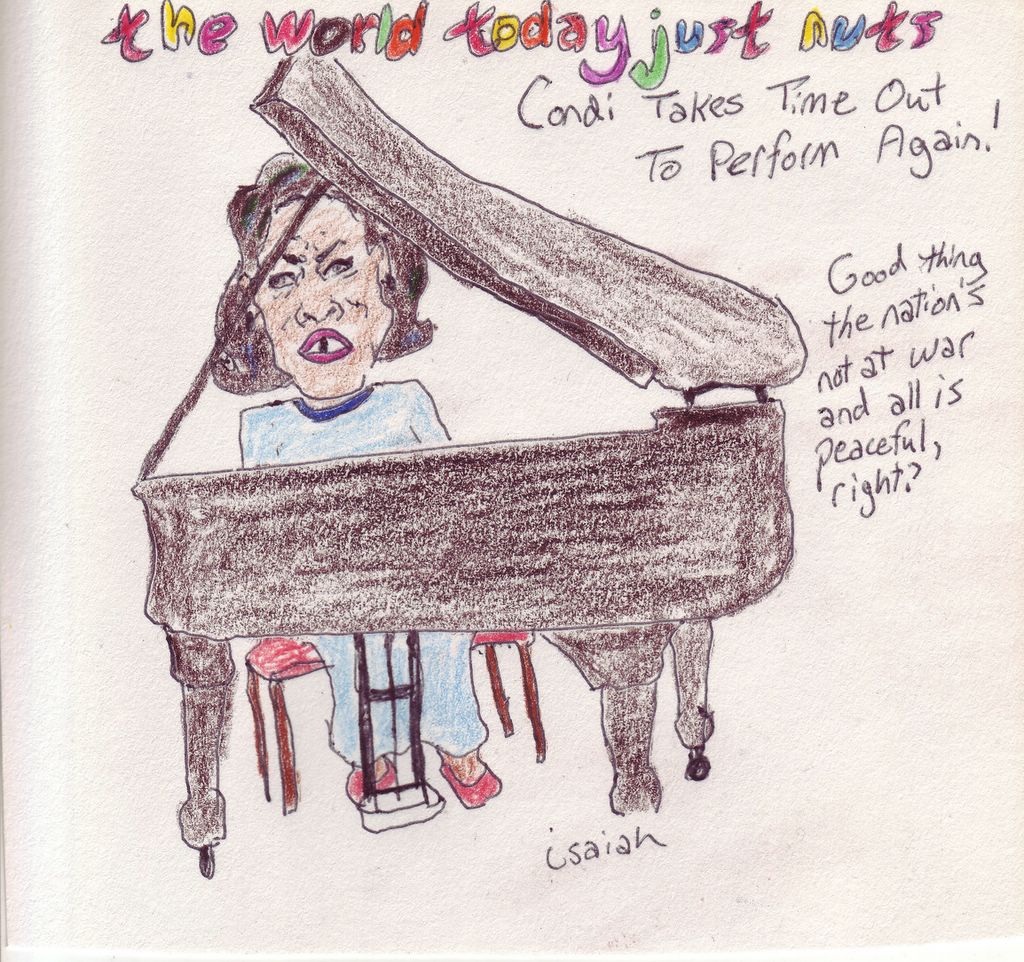
Condi Takes Time Out To Perform Again!


That's from July 30, 2006, "Condi Takes Time Out To Perform Again!" and the point there was that the nation was engaged in two wars and a big deal was made of Condi Rice -- then Secretary of State -- yet again entertaining a room by playing the piano.


It was like during Katrina, how in the aftermath she was shopping for shoes and playing tennis.
She never really seemed to grasp what was what but some of that is the press fault. They built her up in a way that wasn't fair. The same as with Michelle Obama today. Because both women are Black and firsts, they were treated patronizingly by the press in a "Oh, look, It talks! It walks!" I don't believe in giving blanket respect, respect is earned. And I made fun of Condi and I make fun of Michelle in the comics I do today.

But I don't think I've been patronizing. My jokes may be insulting but they are as insulting as my jokes to any man or any White man.

Isaiah's latest The World Today Just Nuts: "Condi Takes Time Out To Perform Again!" Good thing the nations not at war all is peaceful, right?


Here's C.I.'s "Iraq snapshot:"

Thursday, April 15, 2010. Chaos and violence continue, rumors swirl about alliances in building Iraq's next government, a Congressional hearing demonstrates how institutionally screwed up (by all means, use a stronger word) the US government is, and more.

This morning the US House Armed Services Committee held a hearing. They were taking testimony from an "independent" panel on the Quadrennial Defense Review. Chair Ike Skelton called the hearing to order and moved to welcome members of the 'independent' panel who were present but would not be giving testimony. He declared, "Congress created the independent panel in the Fiscal Year 2007 National Defense Authorization Act. It was charged with conducting an assessment of the QDR [Quadrennial Defense Review] and presenting its findings to Congress. Last year, we expanded the panel by adding eight additional members appointed by the Chairmen and Ranking Members of the House and Senate Armed Services Committee."

And behind the curtain, waiting to provide testimony were William J. Perry and -- drum roll and possibly serial killer theme from a slasher movie -- Stephen J. Hadley.

Can someone explain that? Nancy Pelosi, you took impeachment "off the table." The country, the world didn't get the needed impeachment of Bully Boy Bush. You were a coward and put your own personal interests ahead of what the country and the Constitution needed -- what the Constitution demanded. But did you have to allow the criminals to be appointed by Congress to 'independent' panels?

Hadley's not the only one. In fact, the gossip girl Hadley's partner in crime in outing CIA agent Valerie Plame's on the panel. Explain HOW THE HELL THAT HAPPENS?

It happens because we have an INEFFECTIVE and INEPT Congress. They created this panel in 2007. If you're mind's functioning, you grasp that Democrats controlled both houses of Congress then (and now). There are 20 members on the panel. Congress only appoitns 8. They forked over 12 to the Secretary of Defense. With him/her selecting the majority of the members, it will never be independent and Congress needs to stop insulting the American people.

Nancy can at least take comfort in the fact that Stephen Hadley and his roll dog weren't appointed by Congress. Robert Gates appointed Hadley. He's also the one who appointed Richard Armitage. (
Click here for DoD press release.)

Richard Armitage. The Hedda Hopper of the DC set stepped forward, for those who don't remember or never knew, after an investigation was opened into the outing of CIA undercover agent
Valerie Plame. Dick revealed he was a real Chatty Cathy and, WOOPSIE!, he's the one who told journalist Robert Novak that Valerie Plame was CIA. After that, you really should be off the government payroll, after that you really are done. You shouldn't be trusted with any information at all. It's as though Dick burned down the White House while playing with matches and, shortly afterward, the US government decided to make him a ranger in charge of Sequoia National Forest.
Why does the country have so many problems? Your answer is found in that 'independen't panel. Be a government employee who outs a CIA agent and you get to continue doing government work, being paid for by the government? Congress creates an 'independent' panel but gives the Secretary of Defense the power to select the bulk of the committee members. It's nonsense and it's why DC runs in circles chasing its own tail. There is no accountability and you can do the most vile and disgusting thing and continue to receive the US tax payer money instead of having to get a real job. And that's Dick Armitage and Stephen Hadley both. Throughout 2005, at this site and at Third, we were noting Hadley's role in the outing (
click here for a July 2005 piece at Third). From SourceWatch:

National Security Adviser Stephen Hadley was "the senior administration official" who told Washington Post Assistant Managing Editor
Bob Woodward that Valerie Plame Wilson was a CIA officer, attorneys close to the investigation and intelligence officials" told Raw Story reporters Larisa Alexandrovna and Jason Leopold November 16, 2005.
Identified by the Washington Post as Rice's "top lieutenant", Hadley, "along with
CIA Director George J. Tenet -- took responsibility for allowing into Bush's State of the Union 2003 address a dubious and ultimately inaccurate claim about Saddam Hussein's efforts to obtain nuclear materials." [2]

Hadley not only outed Valerie Plame, he also couldn't properly vet a speech? And he's chairing a panel today -- with his salary paid for by the US tax payers?

There's no accountability and Congress rushes to turn over their own powers to flunkies in the executive branch. And it's there in the fact that Robert Gates remains Secretary of Defense when he should have been replaced long ago. How many scandals do you get to have on your watch before you are asked to step down? At the end of January,
Kevin Baron (Stars & Stripes' Stripes Central blog) called out the 'independent' panel:

Independent? In this town? You can't throw a lobbyist into DC without hitting a former government official somewhere. Last week the president of the left-leaning Center for a New American Security trumpeted his own selection to the panel. By the way, the Pentagon's policy chief in charge of the QDR, Michele Flournoy, was the last president of CNAS.
Maybe "bipartisan revolving door panel" is a better term.

"Prevailing in today's wars will also help our military prepare to defeat adversaries and succeed in a wide range of contingencies," Hadley prattled on after noting that losing "today's wars" would create further conflict. Could it? If so, maybe Hadley doesn't need to be on the panel?

If you sold the Iraq War, should you really be advising anything at this point? Hadley served on the White House Iraq Group.
From SourceWatch:


The White House Iraq Group (aka, White House Information Group or WHIG) was the marketing arm of the White House whose purpose was to sell the 2003
invasion of Iraq to the public.
[. . .]
Barton Gellman and Walter Pincus, in the
August 10, 2003 Washington Post, seem to have broken the story of the White House Iraq Group, [. . .]:
The escalation of nuclear rhetoric a year ago, including the introduction of the term "mushroom cloud" into the debate, coincided with the formation of a White House Iraq Group, or WHIG, a task force assigned to "educate the public" about the
threat from Saddam Hussein, as a participant put it.
Systematic coordination began in August 2002, when Chief of Staff
Andrew H. Card, Jr. formed the White House Iraq Group, or WHIG, to set strategy for each stage of the confrontation with Baghdad. A senior official who participated in its work called it "an internal working group, like many formed for priority issues, to make sure each part of the White House was fulfilling its responsibilities."
"In September 2002, the White House was beginning a major press offensive designed to prove that Iraq had a robust
nuclear weapons program. That campaign was meant to culminate in the president's Oct. 7 speech in Cincinnati." [1]

Why are we allowing anyone with these issues to advise -- on the tax payer dime -- what's needed and not needed?

I know Ike Skelton and like him, but he made a real fool of himself today patting himself and the Committee on the back as he claimed that they worked really hard to be not just bi-partisan but non-partisan. While appointing criminals to a panel? You want to brag about that? In fairness, repeating, Congress itself did not appoint Hadley and Armitage; however, when it surrendered the right to appoint all the members, they invited it, when they surrendered their own powers, they courted it. It's on them.

And Hadley couldn't stop mentioning Iran and he was far from the only one bringing it up in the hearing. That too is on the Democratically controlled Congress.

Today
Hannah Allam (McClatchy's Miami Herald) reports that the last five months have seen at least $4 million counterfeit US dollars circulating in Iraq: "In recent weeks, the officers said, Iraqi and U.S. forces have launched an anti-counterfeiting push that involves educating merchants and bankers, as well as gathering intelligence on whether the money is linked to Iran's attempt to influence Iraq's March 7 parliamentary elections and to launder money for militia activity in Iraq's southern Shiite heartland." It is thought (or spun) by unnamed US officials that the fake money entered as a way to influence the March 7th elections and that Iran was in some way involved. (Thought, not sourced, not backed up.) Today Leila Fadel (Washington Post) reported on her interview with Ayad Allawi who declared he is warning other Iraqi political groups:

I told them, 'Don't embark on this course. It's going to be very dangerous, it's going to be counterproductive, and the backlash will be severe. The whole foundation of whatever infant democracy we've built will be ruined.

Allawi's political slate came out with 91 seats in the Parliament. The second biggest seat winner was Nouri al-Maliki's slate. Nouri continues to insist that there was voter fraud. Fadel reports that Allawi (rightly) points out that none of the benchmarks have been met. Those benchmarks were set by the White House with the US Congress and Nouri al-Maliki signing off. Bully Boy Bush's gone. Those benchmarks are still the Congress' duty and they're Barack's now as well. For those who've forgotten, 'tough talking' Nance Pelosi and others were going to pull war funding if Iraq didn't show 'progress' by meeting 'benchmarks.' Never met and the illegal war is still fully funded. I guess Nancy took benchmarks "off the table." Fadel offers that Allawi could be shut out if the National Alliance teams with State Of Law. Yeah, if that happens. If. But that's not the big rumor coming out of Iraq these days regarding the next prime minister. Yesterday, the biggest was that Irbrahim al-Jaafari has secured some sort of guarantee from a number of groups including the Kurds. That's a rumor. And it's one the US State Dept has heard. If true, it'll be known soon enough since the Kurdish delegation goes into Baghdad next week to start official talks.
Waleed Ibrahim (Reuters) reports:

President Jalal Talabani, a Kurd, said the Kurdistan list consisting of his Patriotic Union of Kurdistan and Kurdish President Masoud Barzani's Kurdistan Democratic Party, stood ready to back a tie-up between Prime Minister Nuri al-Maliki's State of Law bloc and the Iraqi National Alliance (INA).
Talabani made his comments after a meeting on Wednesday night with former Iraqi prime minister Ibrahim al-Jaafari, whose faction is part of the INA.


Rahmat al-Salaam (Asharq Alawsat Newspaper) reports that the alliance is just waiting for the big announcement and:

As to choosing the next prime minister, the SLC spokesman said "the method will be within the framework of a mechanism that the two sides agree on and this allows all the parties inside this alliance to present their candidates. The person who will lead the next government will be chosen under this mechanism." Regarding the INA's conditions for having an alliance with the SLC, Al-Husni said "no conditions were imposed. The talk is about the government program, the mechanism for forming it, and making the decisions through it", adding that "there are no conditions and no concessions between the parties that will forge an alliance to form the largest parliamentary bloc."

Alsumaria TV reports, "Al Iraqiya LIst spokeman Haidar Al Mulla affirmed that the alliance between the State of Law Coalition and Iraq's National alliance is not clear yet. Al Iraqiya List has many chances to ally with other parties, Al Mulla noted. The Federal Court stipulates that to form a new government, both coalitions should be merged not allied, he argued. Al Iraqiya List will withdraw from the political process if the State of Law Coalition and Iraqi National Alliance merges." If the alliance takes place and if all members of both blocs are in the reported alliance, that would bring Nouri, et al 2 seats short of the needed 163. As noted some time ago, Iraq's religious minorities could end up being "king makers." Should they announce their merger and have no additional seats (or have a few from their two blocs bail), Allawi's slate could still be a winner. There are 325 people who were elected to Parliament. 161 (or less) going to the new alliance would still leave 164 seats.

82 of those seats,
Quil Lawrence (NPR's Morning Edition) reported today, are held by women.


Quil Lawrence: Afaf Abdel-Razzak would only be interviewed by phone. She's effectively gone into hiding since she won. Groups like al-Qaida still operate in Anbar and might target a female politician. She's been moving between Anbar and Baghdad, until the new parliament opens and she gets her official guard detail. Afaf is a teacher, and as a lawmaker, she's hoping to promote education along with women's rights. At the beginning, it wasn't conceivable that a woman could run, she says. But now, even in Anbar province, people will get used to the idea of having women be their voice in parliament.

An
online poll at Aswat Al Iraq asks: "How far did the Independent High Electoral Commision (IHEC) succeed in organizing and guaranteeing the integrity of the legislative elections?" The biggest vote getter is "No success" with 61% (1,220 votes), followed by (29%, 584 votes) "Great success," then "Medium Success" (7%, 149 votes) and "Limited succes" (3%, 52 votes). That is a non-scientific poll and is 'limited' to anyone who visits their website.

"Iraqi politicians insist they're forming a coalition government through a truly Iraqi process of consulation. It may seem strange then that the most substanitive meetings should happen in neighboring countries,"
declared NPR's Quil Lawrence (All Things Considered). Lawrence noted Nouri's strong criticism of 'outsiders' and states it was clear that Nouri was referring to Saudi Arabia. Furthermore, he reports that Nouri wasn't invited to visit Riyadh and that this was seen by some as a "snub" to Nouri. Meanwhile Alsumaria TV reports that Rafea al-Isaawi represented Iraqiya in Tehran yesterday while meeting with Ali Larijani, Speaker of Iran's Parliament, and with Saeed Jalili, Secretary of the Supreme National Security Council and they note that he was "expected as well to meet with Sayyed Moqtada Al Sadr over government formation talks and the possibility of new alliances" according to Iranian television.

Turning to some of today's reported violence . . .

Shootings?

Reuters notes a Baghdad drive by in which 1 Iraqi soldier was wounded and 3 suspected assailants were killed, 1 person was shot dead in a Mosul drive-by and a Mosul home invasion left 4 people shot dead (three were women).
Corpses?

Reuters notes 14 corpses were discovered in Samarra. Aswat Al Iraq reports that 1 corpse was discovered in Kut, a "decaying body, belongs to a 20-year-old man, bore signs of torture".

Salah Hemeid offers a think piece at Al-Ahram Weekly which includes the following:

US president Barack Obama, who swept into office on an anti-Iraq war ticket and has since claimed that the war is winding down, has signaled his determination to pull all US forces out of the country by the end of 2011. Commentators are nevertheless sceptical that Obama's pledge to remove "combat troops" by 1 September, leaving about 50,000 troops in "non-combat" roles, will bring about a real end to the war. If the violence in the country continues to soar, as has been threatened by last week's bombings, and goes on to spark another sectarian chain reaction, then, they argue, the United States will be forced to keep its troops in the country longer than has been promised.
In recent weeks there has been much speculation in the US media that the military might indeed try to slow down the withdrawal. Head of the US Central Command, General David Petraeus, had said the US may leave stronger-than-expected forces in northern Iraq if the situation requires it, even as it acts to reduce troops elsewhere in the country to targeted levels. Testifying before a Senate panel, Petraeus confirmed plans to meet Obama's target of 50,000 US troops in the country by the end of August, down from about 97,000 today. He also noted that the situation in Iraq remains fragile, despite declining levels of violence and the high turnout in the recent national elections, and said that the US military was still tinkering with plans on how best to administer the drawdown.
Last month General Ray Odierno, the top US general in Iraq, made international headlines when his request to keep a military combat unit in the contentious northern city of Kirkuk after next September was leaked to the media. Pentagon officials have made clear that US troops remaining in Iraq after 1 September, although technically on an "advise and assist" mission, will still be capable of conducting military operations.
And even as regular forces are withdrawn, many observers expect that the level of Special Operations forces will remain constant. Some have also argued that the designation of non-combat status is "a false dichotomy," since it implies that "everyone in the military is a combat soldier."
No matter what detailed conclusions one might draw, it remains clear that the US is in a serious situation that might force the Obama administration into rethinking its plans in Iraq. Is it time to start bringing the troops home, or is more time needed to complete US goals in the country?

Though vague while playing the rainmaker in those tent revivals throughout 2007 and 2008, Barack was very clear to the press that if things got 'worse' in Iraq, he wasn't opposed to halting a withdrawal schedule (which was then 1 brigade a month -- a broken promise) or sending in MORE troops.

In
yesterday's snapshot, this appeared: Earlier this week, Nouri al-Maliki was throwing public fits over the fact that Iraq's neighbors were expressing interest. Thankfully few listen to him. (We're not noting his "I stopped a major bombing!" spin.) At the time 'terrorism plot foiled!' was the story being pushed hard. Many gladly embraced it and made fools of themselves. Nouri the hero! Preventing terrorist attacks! Foiling plots to attack with planes! 9-11 style! Prima facie, it was laughable. But, again, some ran with it. 'Najaf! And maybe Baghdad! Almost the targets of planes!' CNN reports today: "Sheikh Fayyad al-Shimari, head of the Najaf provincial council, and other officials downplayed reports of a security threat. 'There were talks concerning some security threats in Najaf,' he said. 'Those threats are not new to the province'." Reuters notes, "A Defence Ministry spokesman today denied reports a plot to crash a passenger jet into the Imam Ali shrine in Najaf, in southern Iraq, had been foiled while local Iraqi officials said reports like that had circulated for up to a year." It then goes on to cite a US official insisting it is true. And like most 'truth tellers,' the US official goes . . . unnamed.

Monday April 5th, WikiLeaks released US military video of an assault in Iraq. Lamar W. Hankins (San Marcos Mercury) weighs in: As a longtime member of Military Families Speak Out, I don't write about war atrocities easily. But I believe that the American people as a whole have an unrealistic view about war and an unwillingness to accept that committing atrocities during war is inevitable. My conclusion is that engaging in war is morally justified only in self-defense or defense of another. Neither the Iraq nor Afghan war qualifies as justified under that standard. The US military (like virtually all other militaries in the world) train our troops using propaganda and psychological techniques from the ancient to the modern. We use these techniques to manipulate our troops into becoming a part of an operation whose primary purpose is to kill other human beings for purposes fancied by our political leaders. We tell our soldiers that they are serving their country, that they are protecting it, but too often they are merely carrying out some politically inspired or economically desired purpose that has nothing to do with serving and protecting the American people. Teba Mohammad (Independent Florida Alligator) also weighs in: I was outraged by the video -- not necessarily shocked -- because the U.S. Army has a history of slaying innocents and has always labeled it as "collateral damage." Since the war started in Iraq, civilians -- including journalists, farmers, doctors and children, to name a few -- have been ambushed and caught in the line of fire by military forces. Among the 12 Iraqis killed on that tragic day was Namir Noor-Eldeen, a prominent photojournalist who worked for Reuters. Though he was only 22 when he was killed, friends and coworkers describe him as a well-respected, brave human being who left behind an incredible body of work that documents the reality of war in Iraq. Another victim was Saeed Chmagh, a Reuters driver and assistant. He was 40 years old and left behind a wife and four children. Along with the dozen deceased Iraqis, two children were wounded.I could not help but think about these two human beings who had nothing to do with insurgency and did not even have weapons. They were normal, hardworking men with families, values and passion for their profession. How come these acts of murder are not covered by the U.S. media? Why do so many Iraqi victims get killed this way and their stories go untold?


In the US, Binghamton, New York may be getting a counter/cost ticker at City Hall which would detail the financial costs of the wars in real time. WBNG reports that the counter is scheduled to go up next week and that the city's mayor, Matt Ryan, "says it's needed so people realize the toll federal spending is taking on local budgets."
George Basler (Press & Sun-Bulletin) adds, "Ryan emphasized not one penny of taxpayer money is going to pay for the electronic sign, which will go up next week. The cost, set at about $6,000, is being funded entirely by private contributions from the Broome County Cost of War (COW) Project, a local peace action group that has been demonstrating against the two wars. The group also will pay for the sign's upkeep." USMC Combat veteran Nicholas Legos writes the Press & Sun-Bulletin to remind that the cost of war includes the dead and wounded as well as the financial cost. IPA issued the following press release yesterday: The Philadelphia Inquirer wrote Tuesday: "A group called the National Priorities Project has a popular web site that keeps a running tally of the cost of the wars in Iraq and Afghanistan. It even breaks down the cost per city and suggests what could have been purchased in a year with that tax money. ... "Matt Ryan, the mayor of Binghamton, N.Y., population 47,000, was so impressed with the numbers for his town that he plans to attach a digital cost-of-war counter to the facade of City Hall. By September, Binghamton taxpayers will have contributed $138 million to fund the wars." SUE McANANAMAA member of the Broome County Cost of War Project, McAnanama is speaking at a news conference Wednesday with Mayor Ryan. McAnanama said today: "People need to be aware of the simple facts about where our money is going. This year our Pentagon budget is $700 billion while our community and so many others around the nation are facing cutbacks and crises. ... "Binghamton taxpayers have spent $140 million for the Iraq and Afghanistan wars since 2001, which is more than enough to cover ALL local property tax bills for the next FOUR years. ... New York taxpayers have already spent $67 billion for the seven years of war in Iraq. Compare that to New York State's 2009 High Speed Rail Plan, announced in March of 2009, which aims to spend $10.7 billion to 'transform' and upgrade our transportation systems -- over the next 20 years. ... Private sources paid for the sign and even the electricity for it; no taxpayer funds were used for this project." For further information, see the Binghamton Bridge web site. JO COMERFORD CHRIS HELLMAN Comerford is executive director and Hellman is communications liaison for the National Priorities Project. This year their web site has a tax calculator where taxpayers can put in the amount of federal taxes they paid in 2009 (or 2008) and take stock of how the federal government spent each of their income tax dollars. It also provides localized information that community groups are using to create flyers that some are passing out in front of post offices as many people mail their tax forms tomorrow. Comerford wrote the piece "Tax Day and America's Wars: What the Mayor of One Community Hard Hit by War Spending Is Doing," which states: "A construction crew will soon arrive to install Binghamton's 'cost of war' counter which will overlook the city's busiest intersection and spur conversation around tax day. During the three minutes local motorists wait at the nearby traffic light, they can join Mayor Ryan in waving good-bye to $100. And Binghamton as a whole can grapple with spending $49,650 in war costs every day of 2010." For more information, contact at the Institute for Public Accuracy: Sam Husseini, (202) 347-0020; or David Zupan, (541) 484-9167

Time and space won't permit more than a link to
Zeina Khodr (Al Jaezeera) on Iraqi security (link has text and video) but hopefully we can pick it up tomorrow and we may cover another hearing from today in tomorrow's snapshot.

iraq
mcclatchy newspapershannah allam
the washington postleila fadel
the san marcos mercurylamar w. hankinsthe independent florida alligatorteba mohammad
nprmorning editionquil lawrence
alsumaria tv
wbngipapress and sun bulletingeorge basler
all things considered

Read on ...

Thursday, April 8, 2010

Bully Boy Tapes a Dating Service Video


That's "Bully Boy Tapes A Dating Service Video" from July 23, 2006. I need to credit my cousin with the above.


She called and asked me what I was doing? I said trying to figure out what to draw for a comic for Common Ills.

"Oh, George Bush is just an ass," she said. "It shouldn't be too hard to draw."

The minute she said, "George Bush is just an ass," the above is what I saw in my head.

Also, last Thursday, I was whining here about wishing I could do more Iraq comics. Sunday, I actually had an idea for one. You can decide whether it was a good or a bad one.


Here's C.I.'s "Iraq snapshot:"


Thursday, April 8, 2010. Chaos and violence continue, the US military announces two deaths, neighborhood raids take place in Baghdad (where's the press?), actions seen in the US military video WikiLeaks released continues to be debated, Iraq Veterans Against the War asks for your online vote, and more.

Today the
US military announced: "CONTINGENCY OPERATIONS BASE SPEICHER, Iraq -- Two United States Division - North Soldiers died of injuries sustained in combat operations while conducting a patrol in northern Iraq, April 7. Five other Soldiers were injured and evacuated to a military medical facility where they are currently being treated. The names of the deceased are being withheld pending notification of next of kin and release by the Department of Defense. The names of service members are announced through the U.S. Department of Defense official website at http://www.defenselink.mil/releases/. The announcements are made on the Web site no earlier than 24 hours after notification of the service member's primary next of kin. The incident is under investigation." The deaths bring the total number of US service members killed in the Iraq War to 4390. In all, three US service members have died in Iraq this week.

Namir Noor-Eldeen and Saeed Chmagh were two journalists for Reuters killed by US troops July 12, 2007.
Monday WikiLeaks released US military video of the assault. Today on Talk Of The Nation (NPR), Neal Conan spoke with Columbia Journalism Review's Clint Hendler. We'll note some background on WikiLeaks first.

Neal Conan: And how new is this organization [WikiLeaks] and what does it consist of

Clint Hendler: A couple of years old. Founded, I think, in 2006, 2007. What it consists of is a good question because it's a little -- they kind of run on the edge financially and personnel wise. There are two primary spokespeople. A man named Julian Assange, an Australian national, another man Daniel Schmitt, who's German. Assange has said that the prime group of people who really make WikiLeaks run are about five people or so and then there's an additional quadron of volunteers that they can bring in project to project to help them out with analysis and decription and what have you.

Neal Conan: Well we'll get to all of those in a minute. Who funds it?

Clint Hendler: That's a good question too. They take donations from online readers They also apparently have a group of more deep-poketed donors.

They took calls to get listeners reactions to the video.

Neal Conan: Reed, what did you learn from it?

Reed: What did I learn from the video?

Neal Conan: Yeah.

Reed: Well I guess I-I what I think mostly is how far we removed we are [from Iraq,] how far off our radar and basically how we've buried our heads in the sand and when something like this comes out, it's very clear that things are going on that we're not made aware of.

A caller from San Antonio took offense to Conan referring to the video as "disturbing" and Conan responded, "It is disturbing -- It is disturbing to see a group of men standing around -- and I believe that some of them were armed and I believe that some of them were journalist and, clearly, some of them were unarmed. I understand what the Rules of Engagement were at that time and they were operating within those Rules of Engagement and that it's difficult for us sitting here in Washington, DC or San Antonio, Texas to put ourselves in the postion of those men in the helicopter or know what the situation was with those US troops who were under fire not far away. Nevertheless, the loss of life is disturbing." At
Lens Blog (New York Times), Michael Kamber remembers Namir:


Namir made his name with harrowing photos of the insurgency in the northern city of Mosul in 2006, when it was among the most dangerous places in Iraq. His photo of a masked insurgent carrying a looted bulletproof vest marked "Police" in large letters, was one of the seminal images of the war -- a single photo that captured Iraq's descent into chaos and the inability of the Iraqi and American governments to protect resources, or pretty much anything else at that point. Namir repeatedly got to the scene of attacks while vehicles and buildings still billowed flames and bodies lay in the street. The danger in such coverage is hard to express in words: firefights broke out spontaneously, unseen snipers fired on civilians at will, insurgents killed journalists who they accused of working for the "Western invaders." And the American forces -- sometimes invisible a mile or more away -- fired through thermal sights at individuals they believed to be insurgents as they gathered around damaged coalition vehicles in the midst of a combat zone. Namir was 21 years old when he did his groundbreaking work in Mosul. By the age of 22, he had seen as much death as many hardened combat veterans. As threats against his life mounted -- from Iraqi insurgents unhappy with the truths his photos revealed -- Reuters moved him to Baghdad for his own security. There, he quickly became one of the most beloved members of the Reuters staff, a cheerful, funny, smart young man who loved motorcycles, staff members recall. On July 12, 2007, Namir set out with Saeed, his driver, to do a story on weightlifting. Hearing of nearby violence, he changed routes and went to the neighborhood of New Baghdad, where fighting was taking place.


Amnesty International issued the following today: The 39-minute video released on Monday by WikiLeaks, appears to show a helicopter gunsight video with an audio track of conversation among the crew opening fire on a group of men, two of whom appear to be armed, moving about a square in eastern Baghdad. It also shows further firing on a van which arrives, apparently to evacuate the wounded and the dead. Two children were wounded in the incident. Amnesty International Middle East and North Africa Director Malcolm Smart said:"This highly disturbing video appears to show that after the initial attack, US troops opened fire on people seeking to assist a wounded man, injuring two children, and killing several more people. "These troubling images can not be viewed or judged in isolation and must be put into the context of what else was happening in the vicinity. The US authorities must disclose any further information or footage that will shed light on this and they must conduct a proper investigation to determine whether US forces adhered to the rules of international humanitarian law and took necessary precautions to spare civilians." Amnesty is calling for the incidents depicted in the video to be independently investigated and for reparation, including compensation, to be made available to victims of violations of international humanitarian law. A US military investigation into the attack concluded that correct rules of engagement were followed, although those killed and injured included civilians.WikiLeaks said the men in the square included Reuters photographer Namir Noor-Eldeen, 22, and his assistant and driver Saeed Chmagh, 40, who were both killed in the incident. The only thing that will provide clarity to the confusion between what is shown on the video and the military's initial report is a new investigation. BBC News quotes Reuters' David Schlesinger stating, "I would welcome a thorough new investigation. Reuters from the start has called for transparency and an objective inquiry so that all can learn lessons from this tragedy." Last night, Adam Entous (Reuters) reported that CentCom was stating there were no "plans to reopen an investigation into" the assault. Michael Sheridan (New York Daily News) quotes CentCom spokersperson Jack Hanzlik stating on television yesterday, "The video only tells you a portion of the activity that was happening that day." Deutsche Welle offers a roundup of some press reactions including Berliner Zeitung ("The leaked WikiLeaks material shows bloodthirsty soldiers coldly pursuing their business.") and Sueddeutsche Zeitung ("There is only one word to describe what happened that day: murder."). Lauren Crothers (Toronto Star) notes, "War has become nothing more than a video game." At World Can't Wait, Elaine Brower wonders: "Why are these occurences such a 'shock' to those who are paying attention? Does anyone really think that these are unusual circumstances?" Benedict Carey (New York Times) notes some of the intercom comments made by US service members during the assault and reactions to it, including former military psychologist Bret A. Moore who states, "You don't want combat soldiers to be foolish or to jump the gun, but their job is to destroy the enemy, and one way they're able to do that is to see it as a game, so that the people don't seem real." Laura Essig (True/Slant) terms Carey's article an "apologia" and states that she "must weigh in on the utter and complete lack of journalistic integrity at the Times." Among the radio programs covering the story is The Takeaway (we'll note another radio program tomorrow that we don't have room for today) which today offered responses from their listeners.


Caller: This is Tim, in New Beford, Mass. The United States media has a responsibility to show military confrontations in their entirety. and you can't make decisions about United States' policy in other countries unless you have the entire truth. The media has to show these kinds of videos.

In addition to listeners reactions, Takeaway producer Noel King spoke with Centcom which provided multiple photos they said showed weapons at the scene but in only one image could King make out an image. Request for further supporting evidence was met with the assertion that they couldn't release anything else, that photos which would offer stronger proof had been redacted, etc. For those whom streaming doesn't beneift, King has written up her interaction with CentCom
here. Dahr Jamail will cover tomorrow, in terms of radio. But click here for his (text) report regarding the US military video. I meant to include Dahr's upcoming speaking events last week and there wasn't space. So we'll put his radio discussion of the military video on hold and note them here. The first event on the list is tomorrow evening, so I really can't push it back another day and into another snapshot:


Santa Fe, NMApril 9, 2010 -- 6:30 pm WELCOME TO HELL Life Under Siege in Gaza MOHAMMED OMER Award-winning independent journalist from the Gaza Strip, and author of the Rafah Today blog Followed by a conversation withDAHR JAMAIL Journalist,author and co-recipient with Mohammed of the 2008 Martha Gellhorn Prize for Journalism Unitarian Congregation 107 West Barcelona Rd Santa Fe, NM Suggested Donation $5 Sponsored by Another Jewish Voice Santa Fe and the Middle East Peace and Justice Alliance Endorsed by Veterans for Peace Santa Fe Chapter, Santa Fe Women in Black----Portland, Oregon April 10, 2010– 6:00 pm to 9:00 pm Oregon Physicians for Social Responsibility Annual Awards Dinner 2010 with Keynote Speaker, Dahr Jamail Independent Journalist, author of Beyond the Green Zone: Dispatches from an Unembedded Journalist in Occupied Iraq and The Will to Resist: Soldiers Who Refuse to Fight in Iraq and Afghanistan Honoring the High School Student Winners of the Greenfield Peace Writing Contest Music by Retta and the Smart Fellas The Oregon Zoo 4001 SW Canyon Road Portland, Oregon Please RSVP by March 26th To purchase by check, or for more information including how to place a congratulatory message or ad in the keepsake book, become a table captain or sponsor of the event, contact Kelly Campbell at 503-274-2720. ----Moscow, Idaho April 29, 2010 -- 7:00 pm to9:00 pm Kenworthy Performing Arts Center 508 S. Main St., Moscow, Idaho Empire, Occupation, Resistance, and Independent Media:A Fund Raiser for Radio Free Moscow with Dahr JamailSnacks and drinks served.**
Dahr Jamail's MidEast Dispatches **** Visit Dahr Jamail's website http://dahrjamailiraq.com/ **Dahr Jamail's new book, The Will to Resist: Soldiers Who Refuse to Fight in Iraq and Afghanistan, is now available.Order the book here http://tinyurl.com/cnlgyuAs one of the first and few unembedded Western journalists to report the truth about how the United States has destroyed, not liberated, Iraqi society in his book Beyond the Green Zone, Jamail now investigates the under-reported but growing antiwar resistance of American GIs. Gathering the stories of these courageous men and women, Jamail shows us that far from "supporting our troops," politicians have betrayed them at every turn. Finally, Jamail shows us that the true heroes of the criminal tragedy of the Iraq War are those brave enough to say no. Order Beyond the Green Zonehttp://dahrjamailiraq.com/bookpage "International journalism at its best." --Stephen Kinzer, former bureau chief, New York Times; author All the Shah's MenWinner of the 2008 Martha Gellhorn Award for Journalism

If you attend any of the events, you can be sure Dahr will be discussing the WikiLeaks story at some point in the exchange.

Elections were held March 7th and today the attempts at creating a power-sharing coalition presumably continue.
Simon Jenkins (Guardian) notes that the West at least exported elections to Iraq and Afghanistan, if nothing else, and:

For the time being, Baghdad's government has been in abeyance. The Sunni militias, reportedly backed by al‑Qaida, have returned to the streets, and the death rate is again soaring. Kurdistan is all but a separate country, and the odds are on the Sunnis being forced back into a semi-autonomous region. Tens of thousands of Iraqis have died and millions been driven from their homes – including almost all Iraq's ancient population of Christians. The import of democracy has so far just inflamed local tension and fuelled fundamentalism. Like precious porcelain, elections were exported without instructions on their care. In the absence of adequate security, they are little more than tribal plebiscites.

But what is going on in Baghdad?
An Iraqi correspondent for McClatchy Newspapers reports neighborhood raids at Inside Iraq as she details attempting to get home after work on Tuesday where her two children are. She encounters masked men at one check point and they refuse to let her pass. She encounters another checkpoint at the other entrance and the same refusal. But, she's told, if she really lives in the neighborhood, she'll know a third way in. That's apparently driving through a school parking lot which she attempts but is stopped and surrounded. Finally, she's told she can enter that way . . . on foot. She'll need to park her car in someone's garage or it will be mistaken for a car containing a bomb. After doing that and taking a cab back to the school, she's allowed to proceed on foot, arriving home, finally, at 8:45 p.m. That's Tuesday. She wakes up Wednesday and:

As I started to walk out my house, a soldier at the far end of the road indicated to me to go back inside. I knew then that it was a raid and search operation, and that the search was the next step. Indeed, as the day progressed it became evident that a military convoy was conducting a search. They knocked on the door, we let them in. They asked if we had weapons, searched the rooms and asked how many people lived in the house. "Three" For some reason, that bothered them. "Only three?? You and your two children? That's all? No-one else? Only you three???"
A little more than 15 minutes later they moved on. But for 24 hours, since the evening before, we had absolutely no phone-net coverage. And the other thing is that although there were a few Americans with the convoy, they did not seem to be leading, and they did not participate in the search.
Today, I found out that our neighbourhood wasn't the only one being searched. Mansour and Yarmouk witnessed searches and some detentions; and farther west, Abu Ghraib district witnessed the detention of hundreds of young men.
Is this a security operation based on sound intelligence -- or a blind lash-out as a reaction to the bombings in the last few days -- a futile attempt to quell the outcry against bad security..

As Nouri's forces have imprisoned some political opponents causing others to go into hiding, why are search missions taking place in Baghdad and why is it that her report is the first time it's being reported?


NPR's Deborah Amos is the author of the just released
Eclipse of the Sunnis: Power, Exile, and Upheaval in the Middle East. Her book addresses the refugee population and notes early on (introduction): "An estimated 60 percent of the refugees are Sunni Arabs. Fifteen percent are Iraqi Christians. Secular Shiites, Mandaeans, Yazidis and Kurds are adrift, too, the losers in a brutal civil war that sealed the power of Shiite nationalists." Further into the book, she writes:The collapse of multicultural Iraq had begun with the Christians. The first indications of the politics of displacement came not with the Sunnis but with the oldest community in Iraq, the Christians: Their experience of persecution, which began almost immediately after the U.S. invasion, was a model for the much larger Sunni crisis that would follow.
[. . .]
Many Iraqi Christians had supported that invasion and hoped life might improve for them with the colapse of the Baath regime. But with the rise of militant Islam in Iraq, Christians were more directly associated with the hated West and therefore linked to the American presence. They became particular targets. It did not help that the muscular American evangelical movement arrived in Iraq Along with American tanks. Samaritan's Purse, the global relief organization led by the Reverend Franklin Graham, who called Islam an "evil and wicked" religion, mobilized missionaries and relief supplied in the months after the invasion, which in turn mobilized Islamists to target Iraqi Christians.
As a result, Iraq's Christians were among the first to leave after Saddam's deposition. Their departure was the beginning of the cleansing of Iraq's historically diverse sectarian landscape. Some fo the wealthiest Christian families crossed the borders within months of the arrival of American troops, and even more packed up after churches across the country were firebombed in coordinated attacks in 2004. Iraq's Christian exiles expected to qualify more easily for resettlement in the West and they could count on temporary shelter in the established Chrstian communities in the Middle East in Lebanon, Jordan, and Syria.
But the resettlment process was agonizingly slow and the long wait was taking a toll. On a winter morning in Damascus, the basement kitchen of Ibrahim Khalil Church had been turned into a feeding center for Iraqi Christians sliding into destitution. Three times a week, stern Syrian nuns in stiff white habits ladled out fragrant lamb and rice from large aluminum pots. The church also opened a free medical clinic with volunteer Syrian doctors who doled out medicine for many chronically ill Iraqis who could no longer afford private care. Counseling for the vast number of rape cases and services for trauma victims, especially children, were very limited, but these were the only services available.
More than a hundred bedraggled Iraqis, most of them women, silently inched up the food line, their pans and plastic containers ready for a hot handout that was a welcome addition to a survival diet of bread and heavily sugared tea. Some told me, quietly, that their husbands had worked as translators for the U.S. military and had to leave the country when the family was threatened by neighborhood militias. They had packed quickly. Most said they had exhausted the family savings and now depended on food handouts. Muslims were welcome here, too. The common denominators were hunger and humiliation for people who had been part of Baghdad's middle class, which had considered itself the Arab world's urban elite.

Staying with the refugee population, Tuesday BBC Radio 4 aired Iraq's Forgotten Conflict, a news special from Edward Stourton on the religious minorities in Iraq. (You have four more days to access it.
Click here and scroll down to the bottom of the page.) Stourton notes that there are now 8 Jews in all of Iraq. Jews are not the focus of the special -- and that's their only mention -- but Christians, Yazidis and Mandaens. Because we've focused less on the Mandaens over the years, we'll emphasize them from the documentary.

Edward Stourton: Christianity isn't the only religion that flourished in Iraq during that period. A group called the Mandaens put down roots too. The Mandaens believe that John the Baptist was the last of the prophets. They see themselves as Christianity's close cousins and, like Iraq's Christians, they've been targeted since the invasion. Salman Sada is one of the Mandaens who, again, like so many Christians, have taken safety in the refuge of Erbil.

Salman Sada: Mandaens have suffered as a targeted people. And they have suffered from killing and persecutions and kidnaps. And for that they escape and flee out of Iraq, most of them, to Syria and Jordan. And they have immigrate to third countries such as UK, Sweden, Germany, Holland, Australia, America, Canada.

Edward Stourton: How many of the Mandaens have left and how many remain in the country?

Salman Sada: Less than 5,000 remain inside Iraq. 85% of community are either refugee or are seeking refugee [status].

Edward Stourton: Do you think the Mandaens will survive in Iraq?

Salman Sada: I doubt it.

Edward Stourton: In Baghdad, I met the second most senior priest in the Mandaen hierarchy, Sheikh Alaa, and he explained to me why members of the religion are so vulnerable in today's Iraq.

Edward Stourton: Can you explain to me the Mandaen view of violence?

Sheikh Alaa: [Translated] The Mandaens always emphasize on peace and peaceful living in society. We are absolutely opposed and against any acts of violence against a fellow human being of whatever sect or religion.

Edward Stourton: So, to be clear, it's forbidden to use any sort of violence even in an army or something of that kind? You can't carry weapons, you can't perform any kind of violence at all, is that right? You're pacificists.

Sheikh Alaa: We cannot. But for compulsary service -- and there you will be executed in the dictatorship if not. But our religion forbids carrying arms and using acts of violence. Especially when it comes to unjustified wars. The truth -- not necessarily all with you, or all with me -- it could be somewhere in the middle. Thus there's always a dialogue and keeping bridges of communications.

Edward Stourton: Tell me what's happened to Mandeans since the invasion of 2003 because they've had many difficulties, haven't they?

Sheikh Alaa: This exodus and fleeing of the country -- this has caused us a lot of difficulties. This has led to the diminishing numbers of Mandaens in Iraq which is heart breaking. But we have felt marginalized in Iraq. We felt being set aside. Despite all the sacrifices and our role in society which has been an honorable role throughout. Only three days ago, a very honorable and [. . .] gentleman was a goldsmith in an area in Saydiyah in central Baghdad was murdered in and all of his belongings were stolen. The occurence of these criminal acts -- there are tens and hundreds of other examples in there. These are robberies which very few follow up in catching the perpetrator. Moreover in each and every single incidnet of such heinious attacks, the families of the victims were threatened not to pursue any legal action.

Edward Stourton: The Mandaens perform all their religious rites in water and they're required to go through a new river baptisim every Sunday. It's one thing to do that in southern Iraq, quite another to do that in Sweden where so many of them have fled. The group leaders feel their traditions will simply get lost in the diaspora life. Dr. Layla al Roomi is campaigning to attract international attention to the plight of the Mandaens, fearing that the religion really could soon become extinct. She's been interviewing exiled Mandaens about what drove them away from their historical home.
Dr. Layla al Roomi: Women told me their stories, that were raped. A woman who was raped by four men, all night alone with her husband watching, for no reason other than being a Mandaen. She's not covering her hair because we don't cover our hair. She was wearing jeans, they told her. So for this 'reason,' that gave them 'the right' to go and rape her. She was pregnant. She lost the baby. She is traumatized. I saw a 17-year-old boy who was in an art college. Some of his colleagues abducted him. They circumsized him by force without any anesthetic. Because the Mandean religion prohibits circumsion. And to become a Muslim, you have to be circumcized. They were reading part of the Suras from the Koran on his head while he was forced with two men to his arms and legs and circumsized that way. The Mandean feel it is targeted. The Christians feel it is targeted. The reason why it is targeted is that some of al Qaeda have sworn that Iraq will become an entirely Muslim country and that they will rid Iraq of what they call the "infidel." And the first infadel are the Mandean.


Online currently, a $25,000 grant is up for grabs and the winner will be decided by the number of online votes.
Iraq Veterans Against the War notes:

Warrior Writers Project is applying for a $25,000 grant from the Pepsi Refresh program and we need your vote!
Starting April 1, Pepsi will post all the proposals it has received so the public can
vote.
The top ten proposals in the $25,000 range win. Grants will be used to fund three 2010 Warrior Writers retreats for veterans throughout the country, so vote early and vote every day!
If you are really motivated to help, plan an event or house party so you can get people to vote. All you need is a laptop and friends willing to offer their votes.
At every event you attend/organize in April, please make this announcement and set up a laptop to ask folks to
vote for us. We can do this!!
(IVAW is the fiscal sponsor of the Warrior Writers Project. Application for this grant does not constitute endorsement of the Pepsi Cola Corporation or any of its products.)

"Yes, folks, it's true,"
writes NOW on PBS executive producer John Siceloff, "NOW on PBS has come to the end of its broadcast run. The last episode will air on April 30, 2010. PBS announced last fall it was canceling NOW and providing funding for a new public affairs show called Need to Know." Click here for the rest of his essay. The program begins airing each week on Fridays on most PBS stations (check local listings) and this week they look at the economy:
The national economic disaster hit the city of Braddock Pennsylvania like a wrecking ball. But Braddock Mayor John Fetterman -- dubbed "America's Coolest Mayor" by The New York Times -- is taking very unconventional approaches to reinventing the town and re-inspiring its residents. Home to the nation's first A&P supermarket and Andrew Carnegie's first steel mill, Braddock is being revitalized with new youth and art programs, renovations of abandoned real estate, and bold plans to attract artists and green industries. On Friday, April 9 at 8:30 pm (check local listings), NOW sits down with Mayor Fetterman to learn how the 6'8" 370-pound political novice is trying to turn his town around, and if other devastated communities can and should follow his large footsteps.


iraq
the new york timesmichael kamberbbc newsbenedict careyreutersadam entousthe new york daily newsmichael sheridan
the toronto starlauren crothersthe world cant waitelaine brower
dahr jamail
deborah amos
edward stourtonbbc news
pbsnow on pbs


Read on ...

Thursday, April 1, 2010

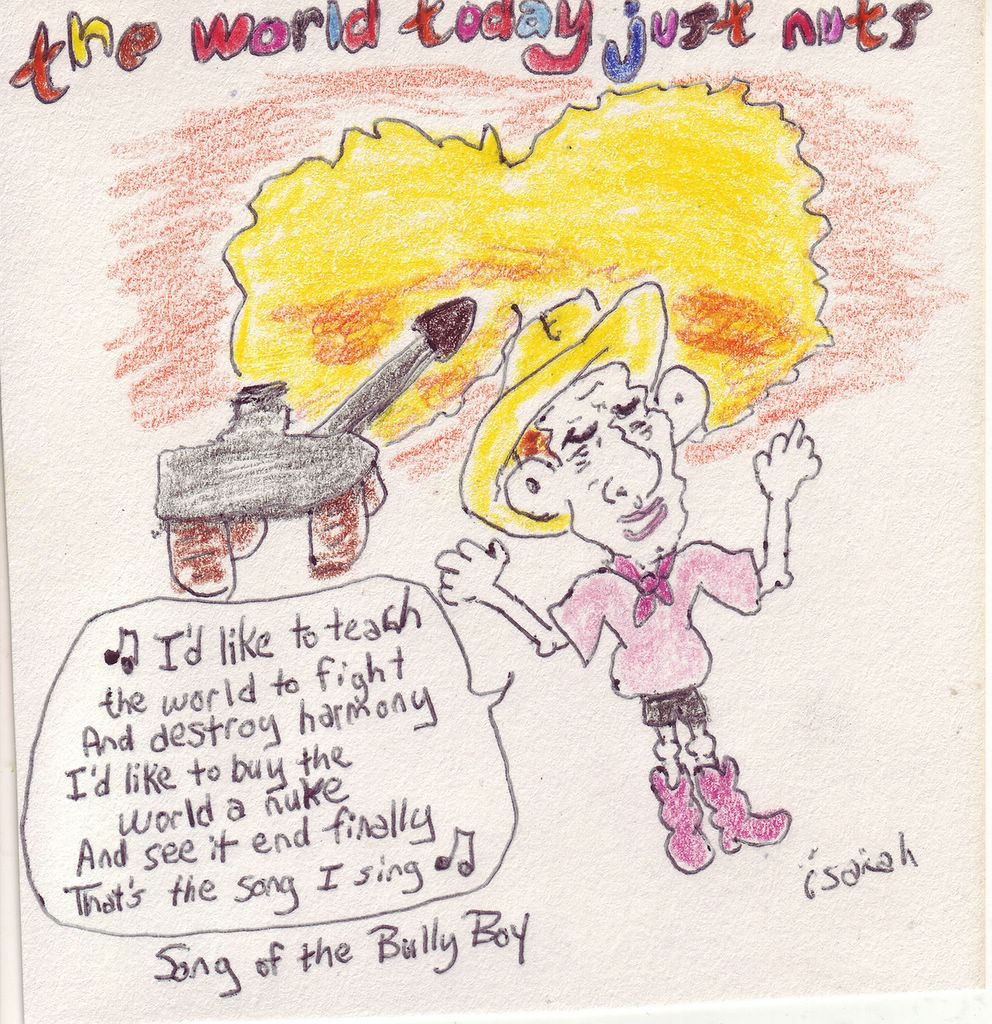
Song of the Bully Boy


That's "Song of the Bully Boy" from July 16, 2006.

Here's the story on that comic.


I wanted to do more on the war and aware that Doonesbury, et al do. I had the visual. I had nothing for it. Then I was drinking a Coke. That's the song, the old Coke theme.

Does it work?

It works for me because I wanted a comic that acknowledged the illegal war.

Here's C.I.'s "Iraq snapshot:"

Thursday, April 1, 2010. Chaos and violence continue, Chris Hill flat-out lied (and the press covered for him), 6 elected candidates end up banned in Iraq, the Red Cross reports on conditions in Iraq, a US study focuses on veterans and service members, the Justice Dept files charges against KBR, and more.

Tuesday, the International Committe of the Red Cross released their latest report on Iraq, entitled "
Iraq: coping with violence and striving to earn a living." The report noted the continued violence so far this year, the families in Mosul who have fled as a result of violence (these were largely Iraqi Christians) and that, internally and externally, the refugee crisis continues. Potable water remains a dream for the bulk of the people with "only 45 per cent of the population, on average, hav[ing] clean drinking water and 20 per cent proper sewage disposal." The ICRC has worked on water projects in Iraq and has also assisted with the health care. Their duties also include visiting prisoners.

The ICRC notes that the decline in agriculture (which began before the start of the illegal war) continues and that drought and lack of an adequate water supply have increased the problem. In addition, the violence has led many house holds without "their main wage earner." The repeated attack on the subsidies program was always very disgusting, but in the current climate, it's especially disgusting.
IRIN reports that the already slashed Iraqi food aid program is facing even more cuts. The rations program began in 1995 and has been repeatedly slashed since the start of the Iraq War at the repeated request of the US government which frowns upon aid to the poor and struggling. Attempts to outright kill the program have been repeatedly met with a strong pushback from Iraqis so the US has pushed for incremental cuts until there is little left. IRIN notes that the packages will now only offer "flour, rice, sugar, cooking oil and milk." Milk for some, of course. Milk for all was cut sometime ago. Gone are the days of tomato paste, tea, chicken, soap, beans, detergent, cheese, etc. In a population of less than 30 million (US government estimates vary between 26 million and 28 million -- of course, Nouri 'forgot' to conduct the census he was supposed to do in 2007), over eight million Iraqis are dependent upon the program to meet basic dietary needs as a result of the extreme poverty in Iraq.

Yesterday, the
United Nations Security Council offered this press release:The following Security Council press statement on the Iraq elections was read out today by Council President Emmanuel Issoze-Ngondet (Gabon):The members of the Security Council welcome the Independent High Electoral Commission of Iraq's (IHEC) 26 March announcement of the provisional results of the Iraqi parliamentary election and look forward to the certification by the Supreme Court. The members of the Security Council congratulate the Iraqi people and Government, including the Iraqi security forces, and IHEC for holding this successful election. The members of the Security Council express their support for IHEC's work, particularly its established mechanisms to ensure all political entities can register complaints and appeals in accordance with IHEC procedures and Iraqi law. They also commend the United Nations Assistance Mission for Iraq (UNAMI) and the role played by the Secretary-General's Special Representative for Iraq, Ad Melkert, in providing technical assistance and support throughout the electoral process.The members of the Security Council recognize the assistance provided by Iraqi domestic observers and civil society organizations and by the international community, including the European Union, Arab League, Organization of the Islamic Conference, as well as the support of United Nations Member States in providing electoral assistance and observation missions. The members of the Security Council take note of the findings of these international and independent Iraqi observers, who affirmed their confidence in the overall integrity of the election.The members of the Security Council call for the political entities to respect the certified election results and the choices of the Iraqi people. The members of the Security Council also urge Iraq's political leaders to avoid inflammatory rhetoric and actions. The members of the Security Council look forward to the formation of the new Government in a spirit of cooperation and respect for national unity.Having attempted to hijack the process, Nouri al-Maliki is now presenting a new face. Alsumaria TV reports he's calling for people to respect the process -- even as he continues attacking the process and the results. NPR's Deborah Amos reports (at Pakistan Observer), "The prime minister has shown he will use the tools of incumbent power. He has reportedly released long-held prisoners loyal to the Sadrist political movement. The Sadrists ran for office in a rival Shia bloc and Maliki will need their support to challenge Allawi's victory. In addition, the McClatchy newspapers report that at least four Sunni Muslim candidates on Allawi's ticket are under investigation by the prime minister's security forces. This is hardball politics, Iraqi style." Deborah Amos is the author of the just released Eclipse of the Sunnis: Power, Exile, and Upheaval in the Middle East. Monday, April 5th, Amos appears on The Exchange with Laura Knoy, New Hampshire Public Radio which first broadcasts at 9 a.m. EST. Meanwhile, The Hindu's editorial board explains of the post-announced-results period:


The initial problems have to do with the conduct of Prime Minister Nouri al-Maliki, whose first response to the result was to demand a recount. A day before the results were announced, he persuaded Iraq's Supreme Court to rule that the government would be formed by the leader of the bloc that has the largest number when parliament convenes, which will probably be in June. In a manoeuvre that smacked of electoral fraud, officials of the Accountability and Justice Commission, who are involved in removing former members of Saddam Hussein's Baath Party from public posts, banned six candidates, including three from Mr. Allawi's party, on the eve of the March 7 election. Iraqiya will appeal the bans in the courts.
They join the
Los Angeles Times' editorial board in using their voice to call out abuses that threaten the entire process. It's a small chorus, but hopefully a growing one. Again, Iraqis are watching, they are paying attention to what the foreign press does and does not call out and silences will send a message.

At OpEd News, Hamma Mirwaisi examines some of the Iraqi players rushing to and from Iran for various reasons:Iraqi President Jalal Talabani is in Iran for Nowruz celebrations. He wants very badly to be President of Iraq for another term. He runs to his master the Iranian president Mahmoud Ahmadinejad for help. He is helping PM al-Maliki indirectly. He is very close friend of Iranian President Mahmoud Ahmadinejad they do share a secret. The Kurds are speculating that President Talabani helped President Mahmoud Ahmadinejad with the plan to kill Dr. Abdul-Rahman Ghassemlou the leader of the Iranian Kurd in 1989 in Vienna. What other secrets are there between both Presidents? What kind of secrets are they sharing to be so close to one another? May be the CIA knows the answer better. The US forces arrested one of the killers of Dr. Abdul-Rahman Ghassemlou in Arbil-Iraq and then they released him after integrations for long time without extraditing him to Austria to face justice. President Jalal Talabani for sure is sharing many secret with Iranian president Mahmoud Ahmadinejad they are old friends from during the Iran-Iraq war. Just likewise he was sharing many secrets with Iraqi President Saddam Hussein for many years before the war. President Jalal Talabani is the survivor. He is kind of master spy, one can make many movies about his work; he is dealing with so many intelligent services around the world in the same time without getting implicated.

Meanwhile
Rod Nordland (New York Times) adds, "The ink was hardly dry on the polling results when three of the four major political alliances rushed delegations off to Tehran. Yet none of them sent anyone to the United States Embassy here let alone to Washington." Mohammed Tawfeeq, Yousif Bassil and Mohammed Jamjoom (CNN) report on Moqtada al-Sadr's tossing the issue to the people in a referendum now scheduled for tomorrow and Saturday and notes that Ayad Allawi has expressed concerns that Iran is interfering with the post-election events. We'll also highlight this from their report, on the Justice and Accountability Commission's attempt to ban members of Allawi's slate after the election (and after Allawi's slate was ruled the winner):

The U.N. special representative in
Iraq, Ad Melkert, said the United Nations in February declared that the accountability panel is "perfectly legitimate" and "it is the Iraqi choice to draw a line under the responsibility of the people under the Saddam regime."
He added, "There many parallels in the other countries in the past as well, but the process has had some flaws and we were concerned by that. We have expressed those concerns" but in the end the Iraqis must make the ultimate decision.

Chris Hill lied. We said so in the
March 30th snapshot:

If not, it's probably because you're thinking of the actions of the Justice and Accountability Commission (and for those who keep e-mailing about that commission, that is it's English translation -- for some reason some press outlets want to go alphabetical, it's Justice and Accountability). Reuters' Susan Cornwell immediately raised that issue.

Chris Hill: Well, let me just say that certainly political commentators here in Iraq sort of look at a challenge like that and wonder to what extent it reflects a political challenge. Certainly, I think the UN has made very clear that this is no time to be challenging people who have won seats. But I think the UN has also made very clear that the proper place for any such challenges is to the courts. If they want to sue the IHEC, they can do that and let the courts take this up. I think going forward, certainly for the next election, certainly for the next period of Iraq's history, they're going to have to deal with this whole issue about accountability and justice. They're going to have to deal with the issue of what to do with people who have ties to the Baathist regime in the past, how they're going to deal with this, whether a South African model or some other model. But certainly, what we want to see in the future is something that is transparent and something that does not appear to many people to have politics written all over it.

Oops, the manic half of his manic-depression appears to be fading. Like a
Joyce Carol Oates character, he's going lethargic leading all to wonder, "What is he saying? What does he mean?" (Nod to JCO's "Where Are You Going? Where Have You Been?")

Chris Hill appears to be saying that without UN approval no candidates will be banned. And that if an Iraqi official doesn't like that, he can take the UN to court. That's what he appears to be saying.

But I've been on the phone with two friends at the UN and they say that's news to them. Not only is that news to them, Hill establishes that as 'reality' one minute and then appears to forget what he just said.

That and more appeared in the March 30th snapshot. You need to ask why news outlets didn't feel the need to include in their reports -- and everyone filed within 24 hours on Hill's press conference -- that Hill was lying or at least that the UN denied it. (Two asked me while I was in the midst of calling friends at the UN if it was true and I said I had one saying it wasn't but I was calling another. That should have prompted them to call their sources.) Chris Hill lied. He flat out lied. And it's an indictment of the US press that they refused to tell you that this week. Even now, they avoid telling you it. The press appears to think it's worse to have an embarrassment like Hill as an ambassador but many would argue it's worse to have a press that refuses to tell you that.

Al Jazeera reports that "six winning candidates" from Ayad Allawi's slate have been banned by the Justice and Accountability Committee led by Ahmed Chalabi and his boy-pal Ali al-Lami. Adam Roston (The Nation) explains that Ahmed's found a way to increase his power in Iraq while waiting on the sidelines:

After all the damage done by Chalabi, who has virtually no constituency in Iraq, why does he have any influence at all? True, there is his sheer skill as a political fixer and influence peddler. He continues to wield power as chairman of the Accountability and Justice Commission (the new name for his old De-Baathification committee, set up soon after the US invasion). And as American officials have acknowledged, he has close ties with Iran and its Revolutionary Guard.
But according to several Iraqi businessmen and American officials, another key to Chalabi's resurgent influence -- one that has received far less attention from the news media--is his connection to Iraq's banking sector. The man whose organization, the Iraqi National Congress, received tens of millions of US taxpayers dollars in the run up to the Iraq war--and who was convicted in a massive bank fraud case in Jordan -- is believed to have immense influence over banking in Iraq today.


Legal challenges by Maliki's party (alleging voter fraud — charges raised only after Maliki slipped out of first place) remain. At least five of Allawi's winning candidates still face the possibility of losing their appeals after disqualification by the election screening committee (led by pre-war Pentagon favorite Ahmad Chalabi). The Kurdish coalition will try to play kingmakers.
Phyllis Bennis (IPS) uses the elections as a jumping off point:
Regardless of the final legality, there's no question that months of political jockeying -- with the potential for significant election-driven and sectarian violence rising -- lie ahead. Iraq's election was held, once again, under the military occupation of 98,000 U.S. troops and more than 100,000 U.S.-paid contractors. Obama is committed, by his own promises and the U.S.-Iraq security agreement signed by Bush, to the withdrawal of all U.S. combat troops by the end of this July, and to complete withdrawal of all U.S. troops by the end of 2011.
Whether Obama plans to use the inevitable election instability as an excuse to postpone those troop withdrawals -- either by re-missioning combat troops by re-naming them "trainers" or "logisticians," or by simply renegotiating the U.S.-Iraq agreement to extend the December 31, 2011 withdrawal deadline, depends on how much political pressure can be brought to bear on the administration. Pressure to demand a much faster withdrawal just might help ensure that at least the existing deadlines -- already far too lengthy -- are rigidly respected.

Eric Ruder (US Socialist Worker) speaks with Michael Schwartz who offers the following possiblities re: Nouri's statements currently:

On the other hand, his rhetoric may reflect behind-the-scenes maneuvering by the United States. This could be the first -- or really a continuing -- effort to justify continued U.S. military intervention, beyond the December 2011 deadline, when all the U.S. troops are supposed to be out.
We know that the leadership in the Obama regime is not interested in removing all the U.S. troops. They want to have about 50,000 troops there, which was the original goal from before the war. They want to have five enduring bases, which are already built and functioning with no sign of decline. They want to have 2,000 diplomats inside Iraq, housed in the billion-dollar embassy located in the Green Zone, running the headquarters of the American Empire in the Middle East. And so maybe this is going to be the occasion when the promise to fully withdraw is officially reversed.
All along, when the question was put to American military commanders about whether U.S. troops in Iraq were more needed in Afghanistan, the answer was, "No, they can't leave yet. We have to wait until we see that the election aftermath doesn't create a new crisis."
To me, the subtext to that was that the election might produce a result that was going to be unacceptable to the U.S., and they might need the military to reverse the result. So it may be that when we hear Maliki say, "I'm going to have to declare martial law," and "Allawi is so unruly," and "He can't control his people," and "The Sunnis are going to start fighting again," it may be the expression of Obama administration anxiety about the negative result they had always feared.

Turning to some of today's reported violence . . .

Bombings?

Sahar Issa (McClatchy Newspapers) reports a Baghdad roadside bombing injured two people, a Baghdad stun bombing created chaos among shoppers and, dropping back to yesterday, a Baghdad roadside bomging wounded one person (both today and yesterday's roadside bombings appear to have targeted alcohol vendors in Baghdad). Reuters notes that a US helicopter fired a missle in Basir at two suspects killing both while a Mosul roadside bombing wounded one person and a Baghdad sticky bombing wounded three people.

Shootings?

Sahar Issa (McClatchy Newspapers) reports that 1 man was shot dead in Baghdad and that the Ministry of Health's Director General Muhammed Chillab was shot dead yesterday outside his Baghdad home.

Corpses?

Sahar Issa (McClatchy Newspapers) reports that the corpse of 1 woman and the corpse of her daughter were discovered in Baghdad.

"Many men and women return from the war zone successfully and adjust to their lives out of theater, but others have had difficulty in readjusting or transitioning to family life, to their jobs, and to living in their communities after deployment." That statement appears on page one of the 192 page report issued yesterday by the Committee on the Initial Assessment of Readjustment Needs of Military Personnel, Veterans, and Their Families; Board on the Health of Selected Populations; Institute Of Medicine. The report is entitled
Returning Home from Iraq and Afghanistan: Preliminary Assessment of Readjustment Needs of Veterans, Service Members, and Their Families. The Institute Of Medicine defined the task as (a) "identify preliminary findings regarding the physical and mental health and other readjustments needs for members and former members of the armed forces who were deployed to OEF or OIF and their families as a result of such deployment" and (b) "determine how it would approach [. . .] a comprehensive assessment of the physical, mental, social and economic effects and to identify gaps in care for members and former member of the armed forces who were deployed" in the Iraq and Afghanistan Wars. Among other things, IOM found many programs had been created to help the veterans of both wars; however, little evaluation of the programs had been done. The report states that little attention has been paid to either the costs or helath condition needs in long-term care for TBI. In addition, it notes that there "is the critical shortage of health-care professionals -- especially those specializing in mental health -- to meet the demands of those returning from theater in Iraq and Afghanistan and their family members."

The report refers to all levels of care. Last week, US House Rep Michael Michaud chaired a hearing of the House Veterans Subcommittee on Health and US House Rep Gabrielle Giffords spoke of the bills she is sponsoring
HR 2698 and 2699 -- both of which are concerned with treatment for PTSD. The first would provide a scholarship to train VA workers and allow veterans to access PTSD health care at the VAs even if -- especially if -- the PTSD is newly emerging/manifesting. The first bill would put more and better trained workers in the VA and allow the veterans greater access to treatment. The second bill would create pilot pograms that would provide treatment but also track feedback from the veterans and their families in order to devise better treatments. The bills she is sponsoring are both in keeping with the recommendations of the 192-page report. HR 2698 currently has 48 co-sponsors including the Chair of the House Veterans Affairs Committee Bob Filner. At least 13 of the co-sponsors are Republicans; however, the Committee's Ranking Member, Steve Buyer, has not signed on as a co-sponsor.

The report notes a barrier to receiving help: "Stigma, real or imagined, is perceived by military personnel who are (or are considering) seeking care for mental health or substance-abuse problems. And active-duty military and veterans fear that vistis to a mental health provider will jeopardize their careers because of the military's long-standing and understandable policy of reporting mental health and substance-abuse problems to the chain of command."

They will argue that they recommended "a review" of confidentiality policies. Yes, they did. And I will turn around and argue that Deborah Mullen (wife of Joint Chief of Staff Mike Mullen) made stronger remarks on this topic (stigmas as barriers to treatment) in her speech at the DoD-VA Suicide Prevention Conference in DC last January.

As you read through the report, it becomes obvious that there are few solutions offered, just calls for more study. If you doubt that, check out the section on "Identify policy remedies" which reads:

Implicit in much of what the committee has found and has written is that dealing with the population-level consequences of OEF and OIF will require policy changes. The scope of the potential policy rememdies will be targeted at preventing, minimizing, or addressing the impacts, gaps, and needs identified during the committee's work. It is anticipated that this work will generate specific recommendations that may require statutory changes to implement.

They may feel they have met their mission's mandate but what it reads like is "there are problems, we recommend further study." In other words, kick the can. Or maybe hot potato. Though weak on solutions, the study does provide interesting raw data such as the fact that 1.9 million members of the service have been deployed to either Afghanistan or Iraq for over 30 days since 2001. That these 1.9 million have been deployed "in 3 million tours of duty". 7,944 women served in Vietnam while "over 200,000 women" have served and are serving in Iraq and Afghanistan (accounting for 11% of the personnel). Non-reserve personnel? Nearly half the officers "are over 35 years old" compared to the reserve officers figure of 73.6% "are over 35 years old." Well over half the reserve, non-officer members are 30 or less while in the non-reserve category, 85% are under the age of 35 with the greatest number being between the ages of 20 and 24. That group makes up 43.9% of the Army (non-officers, remember), 45.9% of the Navy, 39.1% of the Air Force and 65.6% of the Marine Corps. For the non-officers in the reserves, there is no one age group that consistently tracks across the branches. In the Army national Guard, the largest portion (30%) are between the ages of 20 and 24 and that is true also for the Army Reserve (32.1%) and the Marine Corps Reserve (58.1%); however, for the Navy Reserve, most members (24.3%) are between the ages of 35 and 39 (with the second highest being the ages 40 to 44), ages 40 to 44 make up the largest percent of the Air Force Reserve (18.4%). That's all the reserve branches except for the Air National Guard and their highest percentage is 16.6% which is the percentage of their deployed members ages 20 to 24 but it is also the percentage of their deployed members age 35 to 39.

With no distinction made between officers and non-officers, service members deployed to Iraq and Afghanistan have been "66% [. . .] white, 16% black, 10% Hispanic, 4% Asian, and 4% other race." That's reserve and non-reserve. Of the non-reserve, 55.2% are married and that number is 49% for the reserves. Children? 43% non-reserves are a parent and reserves? They aren't tracked. Which appears to echo the RAND Corporation critieria for their recent study which
Anita Chandra discussed with Congress last month. Reserves and non-reserves (the report calls it "active component" but I've heard too many reserves note that they are active and have been active month after month) share one thing in common, for both over 60% of the Navy branches have been deployed to either Iraq or Afghanistan. For non-reserves, that is the highest of any branch. For the reserves, the Air Force Reserve has deployed even more with over 80% of their members have been deployed to either Iraq or Afghanistan. [See Figure 2.5 and 2.6 of the report for more on that breakdown.] The report notes:

The rate of domestic violence is higher in military couples than in civilian couples. Marshall et al. (2005) reported that wives of Army servicemen reported significantly higher rates of husband-to-wife violence than demographically matched civilian wives. Although it has bee nreported that spousal abuse has declined over the last few years, domestic violence still affects 20% of military couples in which the service member has been deployed for at least 6 months (Booth et al., 2007).

On the topic of families:

The conflicts in Iraq and Afghanistan have taken a toll on the children of US troops deployed there. Children of US troops deployed to Iraq and Afghanistan reportedly sought outpatient mental health services 2 million times in 2008 (Andrews et al, 2008). Impatient visits by military children have increased by 50% since 2003. Additionally, an increase in the rate of child maltreatment has been reported since the start of the conflict. Rentz et al (2007) conducted a time-series analysis from 2000 to 2003 to investigate the effect of deployment on the occurrence of child maltreatment in military and nonmilitary families. They reported a statisically significant two-fold increase in substantial maltreatment in military families in the 1-year period after Septemeber 11, 2001, compared with the period before then. A recent study of over 1,700 military families (Gibbs et al, 2007) found that the overall rate of child maltreatment, especially child neglect, was higher when the soldier-parents were deployed than when theyw ere not deployed. Because of the demographics of those who are serving in Iraq and Afghanistan (older service members who are married and have children), the number of children who have been affected by these conflicts is clearly larger than in past conflicts.

Julie Sullivan (Oregonian) examines the report with a focus on Oregon service members, "Nearly 51 percent of the returning soldiers told commanders they have no job waiting. More than 170 have no permanent address. And, an exhaustive new national report finds that the most challenging transition for their families will come after they arrive." Gregg Zoroya (USA Today) boils the report down to the VA "has no way of determining long-range health care costs for the veterans of the war in Iraq and Afghanistan".

Monday's snapshot covered the Commission on Wartime Conracting in Iraq and Afghanistan in DC which heard about abuses and problems to do with KBR and also heard from KBR. Kat covered the hearing in "Commission on Wartime Contracting," Ava covered it at Trina's site with "Fraud and waste" and Wally covered it at Rebecca's site with "The arrogance and waste of KBR." The Commission's attention isn't the only negative attention KBR is receiving this week. The US Justice Dept issued the following today:


WASHINGTON -- The United States has filed a lawsuit against Kellogg Brown & Root Services (KBR) alleging that the defense contractor violated the False Claims Act, the Justice Department announced today. The suit, filed in U.S. District Court in Washington, alleges that KBR knowingly included impermissible costs for private armed security in billings to the Army under the Logistics Civil Augmentation Program (LOGCAP) III contract. The LOGCAP III contract provides for civilian contractor logistical support, such as food services, transportation, laundry and mail, for military operations in Iraq.
The government's lawsuit alleges that some 33 KBR subcontractors, as well as the company itself, used private armed security at various times during the 2003-2006 time period. KBR allegedly violated the LOGCAP III contract by failing to obtain Army authorization for arming subcontractors and by allowing the use of private security contractors who were not registered with the Iraqi Ministry of the Interior. The subcontractors using private security are alleged to have also violated subcontract terms requiring travel only in military convoys. The government's lawsuit further alleges that at the time, KBR managers considered the use of private security unacceptable and were concerned that the Army would disallow any costs for such services. KBR nonetheless charged the United States for the costs of the unauthorized services.
"Defense contractors cannot ignore their contractual obligations to the military and pass along improper charges to the United States," said Tony West, Assistant Attorney General for the Civil Division of the Department of Justice. "We are committed to ensuring that the Department of Defense's rules are enforced and that funds so vital to the war effort are not misused."
This case is being brought as part of a National Procurement Fraud Initiative. In October 2006, the Deputy Attorney General announced the formation of a National Procurement Fraud Task Force designed to promote the early detection, identification, prevention and prosecution of procurement fraud associated with the increase in government contracting activity for national security and other government programs. The Procurement Fraud Task Force is chaired by the Assistant Attorney General for the Criminal Division and includes the Civil Division, U.S. Attorneys' Offices, the FBI, the U.S. Inspectors General community, and a number of other federal law enforcement agencies.
Along with the Justice Department's Civil Division, the Defense Criminal Investigative Service, Army Criminal Investigation Division and FBI participated in the investigation of this matter. This case, as well as others brought by members of the task force, demonstrates the Department of Justice's commitment to helping ensure the integrity of the government procurement process.

NOW on PBS begins airing on most PBS stations Friday night (check local listings) and this week's program:The number of inmates in American prisons is outpacing the system's ability to hold them all. In one startling example, California prisons hold well over 50,000 more inmates than they're designed for, even though the state has built a dozen new prisons in the last 15 years. One of the biggest reasons is rampant recidivism. On Friday, April 2 at 8:30 pm (check local listings), NOW goes inside an Illinois prison that may have the answer to California's problems. With its innovative plan to keep released inmates from coming back, the Sheridan Correctional Center is trying to redefine "tough on crime" by being the largest fully dedicated drug prison in the country. The approach involves aggressive counseling, job training, and following the convicts after they get out. Can their novel approach keep convicts out of jail for good?

And we'll close with this from
Tom Over (OpEd News) report on the activities of World Can't Wait and speaks with Debra Sweet, national director of World Can't Wait:Sweet said that during the Bush presidency, protests against the wars in Afghanistan and Iraq had a lot more people participating. "A Presidential candidate and then a president was brought forward who represented on the surface something very different. This was change we were supposed to believe in and huge numbers of people, including anti-war leaders, put all their energy into electing Obama, regardless of the fact that he was promising to expand the war in Afghanistan," Sweet said. Perhaps interestingly, as Sweet and I spoke, Public Enemy's "Don't Believe The Hype" played on the PA system. Also interesting was that Sweet uttered a combination of words-- 'hoodwinked and bamboozled ' -- Malcolm X used to famous effect, which was made more famous by way of Spike Lee's film about the civil rights leader. "A lot of people have been hoodwinked and bamboozled. Many of us weren't, but we need to be all that much more visible and protesting now, because even more than ever, we need a movement that says 'no' to this whole package of continuing the Bush direction," Sweet said.

iraq
irin
the los angeles times
the new york timesrod nordland
cnnmohammed tawfeeq
yousif bassil
mohammed jamjoom
phyllis bennis
eric ruder
mcclatchy newspaperssahar issa
the oregonian
the world cant waitdebra sweet
oped newshamma mirwaisiirintom overdeborah amosjulie sullivan
usa todaygregg zoroya
pbsnow on pbs


Read on ...
Creative Commons License
This work is licensed under a Creative Commons Attribution-Share Alike 3.0 Unported License.