Thursday, July 15, 2010

Quality Time


I like this because it has Bully Mama in it. Bully Mama and her corns.


Here's C.I.'s "Iraq snapshot:"


Thursday, July 15, 2010. Chaos and violence continue, Lt Dan Choi and Capt James Pietrangelo II face no charges, a US service member in Iraq is wounded in a roadside bombing, Turkey wants to put together a private military to fight the PKK and the US government wants to 'contribute' weapons, the political stalemate continues, the US Army releases the most recent suicide data, and more.


Starting in the United States.

Victory for truth today! Government drops case against us.
#DADT #LGBT via Twitterrific
That's Lt Dan Choi yesterday on
his Twitter feed. Yesterday Lt Dan Choi and Capt James Pietrangelo II went on trial for peaceful demonstrations on the sidewalk in front of the White House March 18th and April 20th calling for the White House to end the policy of Don't Ask, Don't Tell and allow gays and lesbians to serve openly in the military. They were charged with failing to obey a lawful order (to disperse). Yusef Najafi (Metro Weekly) reports both men were in the DC court yesterday prepared for the start of the trial only to be told by DC Superior Court Judge Fredrick J. Sullivan, "Your cases are dismissed." South Florida Gay News adds, "Although the prosecution was ready to move forward and the arresting officers were present in courtroom 120 of DC Superior Court this morning, the government decided at the last minute today to drop the charges against Lt. Dan Choi and Cpt. James Pietrangelo II. Apparently, Prosecutor Christine Chang was unaware of the government's decision as she stated, 'I was ready,' and wasn't able to explain the last-minute decision not to prosecute." Eve Conant (Newsweek) reports, "Both men have faced criticism for continued acts of civil disobedience designed to fight the 'don't ask, don't tell' policy, including a short hunger strike, as the Obama administration and Congress have recently begun steps toward repealing the 17-year-old ban. Choi has repeatedly told NEWSWEEK that any movement short of full and immediate repeal is welcome, but that without repeal the 'injustice' remains in force and he will continue to fight it. (Last week many gay-rights groups widely criticized a Pentagon survey on the repeal that they said was biased and could produce skewed results.)" Zachary Wilson (Queer Sighted) offers this evaluation, "Congrats to Choi, now a gay right icon, on his victory for truth. And congrats to the movement." Today he spoke to Neal Broverman (The Advocate) on the charges being dropped and other topics including Don't Ask, Don't Tell, "You've heard the Pentagon spokesperson say some ridiculous thinks about segregation. They're being so careful and 'lawyerly' about the repeal. You get the feeling that they're incompetent as far as showing real leadership." Appearing Tuesday on Patt Morrison's self-titled Soutchern California Public Radio show, Dan addressed the lack of leadership.

Lt Dan Choi: People who serve in the military -- the soldiers, the sailors, the marine, the air men, the people all throughout and any veteran -- knows very clearly education in the military does not start from a survey or a poll. Education starts from a commander laying down the law saying, "This is the right thing to do. Period. You will do this, you will not discriminate under my command." And anybody with any kind of moral or professional authority -- from the newest corporal all the way up to the commander in chief, the president of the United States -- has a moral responsibility to say, "This is the way that we are going" -- clearly, unambiguously. Discrimination of any sort is not only against the military codes and our traditions and our values but it's against America. This survey is absolutely anti-American.

Patt Morrison: So if this had happened, say, when [President Harry] Truman issued his order to [racially] integrate the armed forces?

Lt Dan Choi: Big if because it did not happen when Truman took the courageous step of just saying, "You know whatever the consequences to my political career, I am the commander in chief and the buck stops here with me. And I know the right thing to do so I am steering this ship and if you don't want to fall in line with the way that America has promised we will not discriminate, then go ahead and quit." And when he did that -- and the same thing when women entered West Point and the service acadamies, the same thing that happened when my particular Army National Guard unit allowed [. . .] the integration of Irish Catholics, the same thing that happened with Asians and all throughout our history: The military says, "This is the way we do business. We do not discriminate here." And we don't need polls to educate. It's the job, it's the duty of every commander.


GetEQUAL issued the following statement on the dismissal of charges:

WASHINGTON -- Although the prosecution was ready to move forward and the arresting officers were present in courtroom 120 of DC Superior Court this morning, the government decided at the last minute today to drop the charges against Lt. Dan Choi and Cpt. James Pietrangelo II. Apparently, Prosecutor Christine Chang was unaware of the government's decision as she stated, "I was ready," and wasn't able to explain the last-minute decision not to prosecute.
"Today, truth was the victor against a demeaning, discriminatory law known as 'Don't Ask, Don't Tell,'" said Lt. Dan Choi. "We won't stop pressing for repeal and pressuring those standing in the way until the day comes when not one more gay or lesbian servicemember is fired. And, as of today, the President refuses to tell us when that day will actually come."
"It is clear that the government was embarrassed and we were prepared to make them defend this antiquated and homophobic law. The government is afraid of having to defend this issue," said Cpt. James Pietrangelo II. "The subpoena was an embarrassment for them, 'Don't Ask, Don't Tell' is an embarrassment for them and, after three months of discovery and preparation, the government dropped the case because they know it's an embarrassment."
"Civil disobedience won today," said Robin McGehee, co-founder and co-director of GetEQUAL. "We're thrilled today that Dan and Jim's actions have been validated and that non-violent civil disobedience has been proven again to be effective in combating prejudice. We are proud to stand shoulder-to-shoulder with Dan, Jim and other LGBT active-duty servicemembers who are taking action to end this discriminatory policy."
Lt. Choi and Cpt. Pietrangelo were both facing two charges each of Failure to Obey a Lawful Order, pursuant to DC Municipal Regulations (18 DCMR 2000.2 (1995). The charges stemmed from the two men's arrests on March 18th and April 20th when they chained themselves to the White House gate, in an act of non-violent civil disobedience, to protest the President's lack of leadership on repealing "Don't Ask, Don't Tell."
"We were ready to put 'Don't Ask, Don't Tell' on trial today, but it was clear the government was embarrassed to defend an indefensible policy," said Mark Goldstone, lawyer for Lt. Choi's and Cpt. Pietrangelo's defense team. "Did the White House make a last-minute call to prevent this embarrassment from continuing? Clearly, someone did."
Goldstone continued, "ll fair-minded people should continue to agitate for actual and immediate repeal of this unjust, unfair policy. This is a big win for non-violent resistance to unjust policies and proves if you speak truth to power, good things can happen."
"They declined to prosecute because the case would embarrass the government," said Ann Wilcox, lawyer for Lt. Choi's and Cpt. Pietrangelo's defense team. "The President said it was important to pressure leaders like himself, and that is exactly what Lt. Choi and Cpt. Pietrangelo did before and intended to do again today."
GetEQUAL is a national, direct action lesbian, gay, bisexual and transgender civil rights organization. Emphasizing direct action and people power, the mission of GetEQUAL is to empower the LGBT community and its allies to take action to demand full legal and social equality, and to hold accountable those who stand in the way. For more information on GetEQUAL, please visit
http://www.getequal.orghttp://www.getequal.org/ . You can follow GetEQUAL on Twitter at http://www.twitter.com/getequal, on Facebook at http://www.facebook.com/GetEQUAL, or on YouTube at
http://www.youtube.com/getequal.


Chris Geidner (Metro Weekly) reveals that GetEQUAL is already gearing up for a focus on ENDA, "The organization sent an email to its mailing list on Wednesday morning, asking 'Which Democratic leader should we hold accountable next for workplace protections for LGBT people?'"

There is no protection for the people of Iraq and among the groups targeted are LGBT member, presumably straight women, Iraqi Christians and other religious minorities, Sahwa, professors and just about any other group you can think of. Margaret Hassan met several criteria. She was an Irish, British and Iraqi citizen. She worked for CARE International in Iraq. October 19, 2004, Margaret was kidnapped and she was murdered at the start of November.
Peter Cave (Australia's ABC) notes, "Margaret Hassan had lived in Iraq for more than 30 years and had worked there for Care International for 12 years before she was pulled from her car on the way to work in October 2004." Andy Winter (Sky News) reminds, "Her body has never been found and the family have been counting on Jassar al Rawi to reveal where it is so she can be given a proper burial." Only one person has been convicted in the crimes. Michael Jansen (Irish Times) reports, "Hassan's sister Geraldine Fitsimonds Riney said the family had been notified by their Iraqi lawyer that Ali Lutfi Jassar al-Rawi, sentenced to life imprisonment in June 2009, will not appear at his appeal today because he cannot be traced." The Mirror notes, "Ali Lutfi Jassar got life for the 59-year-old's abduction and murder in Iraq 2004." BBC News reports, "An Iraqi court has ordered a search for a man convicted of the 2004 kidnap and murder of British aid worker Margaret Hassan, amid fears he has escaped." Is he in another prison, is he in that prison but 'misfiled' or has he been released? No one's telling the family. Mark Tran (Guardian) quotes another sister of Margaret's, Deirdre Manchanda stating, "Jassar is known to be part of the gang that kidnapped and killed my sister. We have fought for justice for six years only to find that not one member of this gang can be brought to justice.


A poll won't tell you where Margaret Hassan's body is but it can be of some value.
Gary Langer (US" ABC News) notes, "Reports based on a pair of ABC News polls in Afghanistan and Iraq last year were nominated today for an Emmy award for outstanding continuing coverage of a news story." Earlier this week, Stephanie Condon (CBS News) reported on the latest Iraq and Afghanistan Wars poll, "On Iraq, Americans continue to hold more positive views of the war- 55 percent say things are going well for the U.S. there." Are they optimistic because the only one convicted in the murder of Margaret Hassan is nowhere to be found? No, they're 'positive' because the network media abandoned Iraq. And they get crap churned out by bad writers like Dimiter Kenarov.

So what makes a man a man
In these tough times
As druglords buy up the banks
And warlords radiate the oceans
Ecosystems fail
Snakes and snails and puppy tails
Are wagging in the womb
Beneath the trampled moon
Tire skids and teethmarks
What happened to this place?
Lawyers and loan sharks
Are laying America to waste
-- "No Apologies," written by
Joni Mitchell, first appears on her Taming The Tiger

Having bungled his own country's literature repeatedly (though few catch on -- possibly revealing their own ignorance when it comes to world lit) revealing his weak education and pushing centrist programs (and publications) while writing for The Nation, et al,
Dimiter Kenarov shops his latest b.s. to Esquire and it's crap from the get go. The US military is pulling out of Iraq! They are! And Dmiter 'proves' it by focusing on two . . . Oops, Dumb Ass Dimiter, those aren't US soldiers, they aren't US service members. They are DynCorp employees. CorpWatch describes DynCorp as, "The world's premier rent-a-cop business runs the security show in Afghanistan, Iraq, and the US-Mexico border. They also run the coca crop-dusting business in Columbia, and occasional sex trafficking sorties in Bosnia. But what can you expect from a bunch of mercenaries?" Dumb Ass Dimiter thinks readers can expect 'honesty' from DynCorp. What an idiot and it just against demonstrates what I've long said: The Nation magazine needs real standards because they lower their own brand over and over by publishing these jerk-off neoliberals who then trade on the magazine's names to pass off their non-left programs and ideas. So Esquire readers -- Oh, I'm not in the mood, I'm so not in the mood. Closet cases who've yet to buy their first gay porn magazine (as Esquire internal surveys have demonstrated) will be greeted with the bad article and, when not pleasuring themselves to photos of scantily clad men (Oh, look! The designers are using hairy chested men again!), they can be spun into believing that things are good, good and great in Iraq! (For cheesy X-Treme factor, check out Dimiter's single-sentence paragraph that closes the article. It is too poetry what Bo Derek is to acting.) For those in the real world, violence continues in Iraq.

Sahar Issa (McClatchy Newspapers) reports a Baghdad sticky bombing which claimed one life (three people wounded), a Baghdad mortar attack, a Tikrit suicide bomber who took his own life, dropping back to Wednesday for the next events: a Baghdad grenade attack which wounded two police officers, a Baghdad grenade attack which injured three people (including two Iraqi soldiers), a Bahgdad roadside bombing which claimed 2 lives and left two people injured, a Baghdad sticky bombing which wounded one person, a Baghdad sticky bombing which wounded Sahwa commander Salih Mizhir, a Mosul roadside bombing which wounded four people and a Mosul store bombing which injured three, and a Tuesday Baghdad roadside bombing which claimed the life of Judge Hasen Aziz Abdurahman.

Shootings?

Sahar Issa (McClatchy Newspapers) reports a Wednesday attack on a Baghdad check point in which two police officers and one by-stander were wounded in shootings.

And
Kevin Lloyd tells Iowa's KTIV that his son, Private First Class Kyle Lloyd, has been injured in a roadside bombing and will "be transferred to a military hospital in Germany."

Still with violence, Saturday
AFP reported that the Turkish government has informed the governments of the US, Iraq and the KRG that it wants it to hand over rebels in nothern Iraq which they number at 248 and one official (unnamed) is quoted stating, "The net is tightening." Press TV added, "The list included senior PKK chiefs such as Murat Karayilan, Cemil Bayik, and Duran Kalkan. The call was made shortly after military and civilian leaders in Turkey voiced growing frustration with Baghdad and the Iraq-based US military over their inaction in confronting the PKK." Umit Enginsoy (Hurriyet Daily News) reported Tuesday that unnamed sources say the US has increased it's "cooperation" with Turkey: "The U.S. and Turkish militaries have been sharing intelligence about the PKK since November 2007, when President George W. Bush agreed to Prime Minister Recep Tayyip Erdoğan's request in the wake of stepped-up attacks by the outlawed group, which is listed as a terrorist organization by both countries as well as the European Union. Stronger U.S. support for Turkey's fight against the PKK has been reflected in a number of recent developments, sources said Monday, citing increased Turkish access to Iraqi airspace, an agreement to transfer attack helicopters and the ramping up of intelligence sharing." Today's Zayman reports Turkey is attempting to team up with Syria and Iran to fight the PKK: "Preliminary signs of this cooperation have already emerged with Iran capturing and executing 29 PKK members in the past six months. Seventeen PKK militants were extradited to Turkey. Syria launched a military campaign against the group, killing 185 terrorists and arresting 400 others. Some 160 of these will be extradited to Turkey, while Germany returned three PKK members to Turkey very recently in what was a first in that country's history." Today's Zaman also notes a proposal that's meeting with some opposition in Turkey for Turkey to put together a professional army to fight 'terror' [PKK]. That proposed 'professional army' comes just as Aras Coskuntuncel (Hurriyet Daily News) reports that US Ambassador to Turkey (now nominated to be the US Ambassador to Iraq) James Jeffrey has stated that the United States government is looking for "additional ways that we can provide assistance to Turkey, including weapons platforms."

Meanwhile
Alsumaria TV reports that Ali Al Dabbagh, apparently speaking on behalf of the State of Law slate of which he is a member, has stated that the next prime minister of Iraq must be a member of the National Alliance (State of Law slate or Iraqi National Alliance). March 7th, Iraq concluded Parliamentary elections. Three months and two days later, still no government. 163 seats are needed to form the executive government (prime minister and council of ministers). When no single slate wins 163 seats (or possibly higher -- 163 is the number today but the Parliament added seats this election and, in four more years, they may add more which could increase the number of seats needed to form the executive government), power-sharing coalitions must be formed with other slates, parties and/or individual candidates. (Eight Parliament seats were awarded, for example, to minority candidates who represent various religious minorities in Iraq.) Ayad Allawi is the head of Iraqiya which won 91 seats in the Parliament making it the biggest seat holder. Second place went to State Of Law which Nouri al-Maliki, the current prime minister, heads. They won 89 seats. Nouri made a big show of lodging complaints and issuing allegations to distract and delay the certification of the initial results while he formed a power-sharing coalition with third place winner Iraqi National Alliance -- this coalition still does not give them 163 seats. They are claiming they have the right to form the government. It's four months and five days and, in 2005, Iraq took four months and seven days to pick a prime minister. Today it is four months and eight days. Progress? They couldn't even meet the 2005 standard. UPI reports that the stalemate finds most participants objecting to "a second term for" Nouri and quotes Iraqi National Alliance member Ali Shubar stating today, "Prime Minister Nouri al-Maliki has consumed his full chances in performing his constitutional duties during the last four years and should be replaced by another figure who would be approved by political entities." And Jackson Diehl (Washington Post) reports that Iraq's Foreign Minister Hoshyar Zebari met with the Washington Post editorial board yesterday and took questions from them and Post reporters. On the White House, he declared, "Their role has not been active, to be honest wit you."


Turning to England,
BBC News reports that Paul Boateng is stating that the Blair cabinet (he was a member of it) "should have seen all the arguments on the legality of the Iraq war." As the Iraq Inquiry has already established then-British Attorney General Peter Goldsmith was of the opinion that -- without a second UN resolution -- a war with Iraq would be illegal. Goldsmith repeatedly advised Blair of that (leading Blair to scribble on one memo, "I just don't understand this"; while his underling scribbled that Blair had "specifically said we did not need further advis [on] this matter"). Days before the illegal war started, Goldsmith was finally pressured into changing his legal opinion. Goldsmith denied being pressured. He said it was more a case of choosing whether or not you wanted to be on the winning side. I believe that's peer pressure when we're speaking of youths. I think it falls under (politely) group-think when you're an adult or (truthfully) cowardice. The cabinet was not informed of any doubts and were only informed that Goldsmith was stating that the Iraq War would be legal. BBC News also notes:Separately, the inquiry published a newly declassified document showing that Treasury officials urged ministers to "step back" from taking a leading military role in post-invasion Iraq.An internal paper - written by senior Treasury official John Dodds - warned that Britain could be "sucked into" costly wider responsibilities if it took on security duties after the overthrow of Saddam Hussein.But the briefing note, sent to then Chancellor Gordon Brown, observed it was unlikely Prime Minister Tony Blair and other ministers would want to "walk away" from a leadership role in Iraq.Peter Mandelson was in Blair's cabinet -- in and out of the cabinet. He resigned twice. His memoirs are due out shortly and sections are being serialized in the Times of London. One section is especially gathering attention. Nicholas Watt (Guardian) reports on Mandelson's assertion that he challenged Blair on going to war with Iraq and Blair replied, "For God's sake, have you been spending all your time with George Galloway?" Mehdi Hasan (New Statesman) adds of that quote:Amazing. Is any more insight needed into what Mandelson refers to as Blair's "tunnel vision" on Iraq? Is any more proof needed that our former prime minister had no intention of debating the rights or wrongs of invading Iraq, not even with close colleagues and friends like Mandelson, but had instead made up his mind long before the March 2003 invasion and refused to seek out alternatives? "As military preparations intensified. those who had reservations of the sort I had raised were lumped together in his mind with anyone who felt he wasn't 100% on board," writes Mandelson. "The distinction between the two became blurred in Tony's mind."On the Iraq Inquiry, Carne Ross testified Monday (see that day's snapshot) and Colum Lynch (Foreign Policy) reports on the testimony including zooming in on Ross' testimony about leaking to Lynch.

In the US,
the Army today released the latest month of suicide data:

The Army released suicide data today for the month of June. Among active duty soldiers, there were 21 potential suicides: one was confirmed as a suicide, and 20 remain under investigation. For May, the Army reported 10 potential suicides among active duty soldiers. Since the release of that report, four have been confirmed as suicides, and six remain under investigation.
During June 2010, among reserve component soldiers who were not on active duty, there were 11 potential suicides: one was confirmed as suicide, and 10 remain under investigation. For May, among that same group, there were 13 total suicides. Of those, two were confirmed as suicides and 11 are pending determination of the manner of death.
For reference, the Army's total for the first half of calendar year 2009 was 88 for active duty and 42 for reserve component soldiers who were not on active duty. For the first half of 2010, the totals were 80 for active duty and 65 for reserve component soldiers who were not on active duty.
"Our suicide prevention efforts must continue to be directed at all members of the Army family -- our soldiers, Department of the Army civilians and families -- during the busy summertime transition period," said Col. Chris Philbrick, director, Army Suicide Prevention Task Force. "The crucial elements are still caring, concern and decisive leadership. There will never be a substitute for a noncommissioned officer, first-line supervisor or friend who knows when a person is suffering and has the moral courage to act and get that individual the help they need. That ability to make a positive difference is the best method to render effective suicide prevention in the Army," Philbrick said.
Soldiers and families in need of crisis assistance can contact Military OneSource or the Defense Center of Excellence (DCoE) for Psychological Health and Traumatic Brain Injury Outreach Center. Trained consultants are available from both organizations 24 hours a day, 7 days a week, and 365 days a year.
The Military OneSource toll-free number for those residing in the continental United States. is 1-800-342-9647; their Web site address is
http://www.militaryonesource.com . Overseas personnel should refer to the Military OneSource Web site for dialing instructions for their specific location.
The Army's comprehensive list of Suicide Prevention Program information is located at
http://www.armyg1.army.mil/hr/suicide/default.asp .
Army leaders can access current health promotion guidance in newly revised Army Regulation 600-63 (Health Promotion) at:
http://www.army.mil/usapa/epubs/pdf/r600_63.pdf and Army Pamphlet 600-24 (Health Promotion, Risk Reduction and Suicide Prevention) at http://www.army.mil/usapa/epubs/pdf/p600_24.pdf .
Suicide prevention training resources for Army families can be accessed at
http://www.armyg1.army.mil/hr/suicide/training_sub.asp?sub_cat=20 (requires Army Knowledge Online access to download materials).
The DCoE Outreach Center can be contacted at 1-866-966-1020, via electronic mail at
Resources@DCoEOutreach.org and at http://www.dcoe.health.mil .
Information about the Army's Comprehensive Soldier Fitness Program is located at
http://www.army.mil/csf .
American Foundation for Suicide Prevention:
http://www.afsp.org.
Suicide Prevention Resource Council:
http://www.sprc.org/index.asp.

Yesterday, the US House Veterans Affairs Subcommittee on Oversight and Investigations held a hearing on preventing suicides. In addition to
yesterday's snapshot, Marcia reported on it in "House Veterans Affairs suicide hearing," Ann in "Dr. Robert Jesse," and Trina in "It's about respect and self-respect" (Trina's covering the Republican committee member in the hearing who came off looking like a real ass) and yesterday also noted the Senate Veterans Affairs Committee's hearing on claims processing which Mike also reported on in "Senate Veterans Affairs Committee."

Meanwhile US House Rep Loretta Sanchez
weighs in at Politico on the issue of women in the military. This is the opening, use the link:

Imagine you have enlisted in the U.S. armed forces. You've gone through basic training, overcoming the same challenges as your peers. You have proved you have the strength and determination to defend our country, at whatever cost.
You're deployed to Afghanistan, where your first assignment is providing technical support for a combat unit. You are exposed regularly to enemy fire, roadside bombs and other threats. You may even be injured while fulfilling your duties. In and out of combat, you perform bravely and capably.
Unfortunately, your combat service means little -- because you are a woman.
More than 29,000 women are now serving in Iraq and Afghanistan. But official policy prevents them from joining ground units engaged in direct combat or support units that travel to the front lines.


iraqdan choiyusef najafisouth florida gay newsnewsweekeve conantqueer sightedzachary wilsonchris geidner
bbc newsthe guardiannicholas wattthe new statesmanmehdi hasanforeign policycolumn lynchthe irish timesmichael jansenthe mirrorthe washington postjackson diehl


Read on ...

Thursday, July 8, 2010

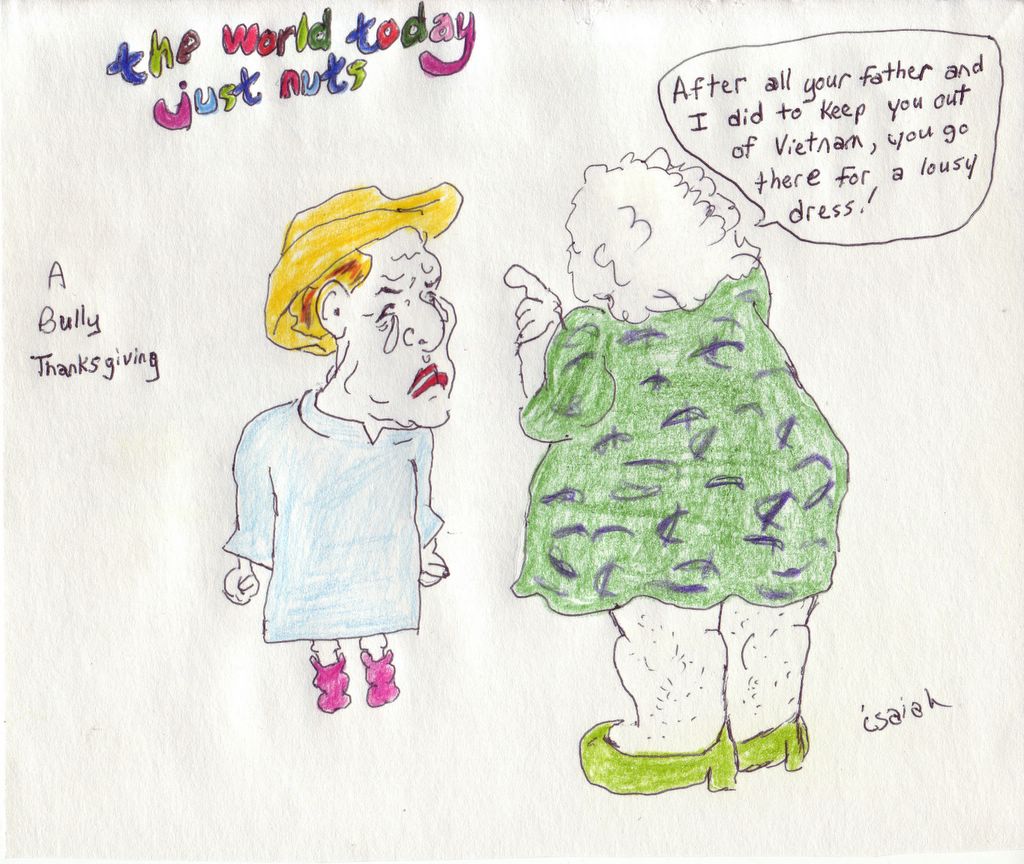
A Bully Thanksgiving


That's A Bully Thanksgiving.


From November 23, 2006.

The thing about Barbara Bush was that when she was interacting with George the Bully Boy, I never showed her face.

There's a comic of that ugly face out there. I did a Mother's Day one with her.

But when she's interacting with Bully Boy, we usually see her from the back.

That's so she can tower and be intimidating and underscore what a child he is.

And here's C.I.'s "Iraq snapshot:"


Thursday, July 8, 2010. Chaos and violence continue, the targeting of pilgrims continues, the stalemate continues, England has a partner in shame (Australia -- which is also deporting Iraqi refugees), the United Nations releases a new report on Iraq, US House Rep Charlie Rangel calls for a draft, did the US Justice Dept refuse to prosecute theft of over $100,000 in US tax payer monies, and more.

In Iraq this week, the big target has been pilgrims.
Sahar Issa (McClatchy Newspapers) explained Tuesday that the pilgrimage is "to commemorate the martyrdom of Iman Musa al Kathim on July 8." Pilgrims were targeted on Tuesday, on Wednesday and today. Leila Fadel (Washington Post) reports, "On Thursday, more than 4 million people had gathered in the city to commemorate the death of the revered Shiite figure Imam Moussa al-Kadhim. Pilgrims had walked from all across the country to reach the Shiite shrine, despite attacks in the previous days. The attackers hit as tens of thousands of security forces patrolled the streets and most roads were blocked to allow pedestrians." Jomana Karadsheh (CNN) explains, "Security measures included using vehicles to transport pilgrims; thousands of deployed troops; security cameras in and around the shrine; aerial surveillance; and 500 personnel to combat the threat of female suicide bombers." Timothy Williams and Omar al-Jawoshy (New York Times) reported this morning, "Less than a day after a suicide bomber killed more than 50 people in a crowd of Shiite pilgrims at a police checkpoint in Baghdad, more explosions struck worshipers on Thursday, killing seven and wounding about 60 despite intensive efforts by Iraqi security forces to foil such attacks." Sahar Issa counts the pilgrims death toll (by Thursday afternoon) for Tuesday, Wednesday and Thursday to be 68 with 449 wounded. Scott Peterson and Sahar Issa (Christian Science Monitor) note, "Regardless of the death toll, pilgrims were defiant as they completed their march on Thursday and headed back home." And they quote a woman named Hussein stating, "It is like a treasure. I am not the loser by going on this pilgrimage. I am the winner. Security forces can secure the streets. They cannot cleanse intentions and hearts." Nizar Latif (UAE's National Newspaper) offers details that others haven't reported:


While the huge pilgrimages undertaken by Iraq's Shiite community are a reflection of powerful religious sentiment, the significance of poverty is a commonly overlooked factor in the willingness of so many to endure gruelling hardships and to face the bombers. Hospitality tents, paid for by wealthy businessmen, political parties or foundations, line the roads used by pilgrims, who come from as far away as Basra, 550 km south of the capital. Meals are provided free of charge to the walkers, and sometimes cash handouts or food supplies are given to the needy.
It is a massive incentive for the likes of Abu Abdullah. Unemployed and painfully thin -- like his sons -- he said he was unable to provide for his family and used the opportunity of religious celebrations for a practical purpose -- to eat. "At home, we have little food," he said. "When we walk, we get better meals than I could dream of getting; there is rice and meat and vegetables and Pepsi in the tents, we can eat three times a day."

Turning to today's actual numbers,
Sahar Issa (McClatchy Newspapers) reports a Baghdad roadside bombing claimed 3 lives and left twenty-one injured, a second one which claimed 4 lives and left twenty injured, a Baghdad car bombing wounded ten people, a Baghdad roadside bombing claimed 2 lives and wounded twenty, a Baquba roadside bombing wounded three people and Ramadi house bombings which claimed 3 lives and left four wounded (the homes belonged to police officers). Reuters adds that 5 pilgrims were shot dead in Baghdad and a Kirkuk sticky bombing claimed 1 life and left another person wounded.

Today the
United Nations condemned the attacks on pilgrims:

Ad Melkert, the Secretary-General's Special Representative for Iraq, described the attacks as "horrific crimes committed against defenceless civilians who were practicing their faith."
The formation of a broad-based government will be the most effective response in the face of insurgents who are aiming at destabilizing the country, added Mr. Melkert, who is also head of the UN Assistance Mission for Iraq (
UNAMI).

Gabriel Gatehouse (BBC News) offers this opinion, "By targeting Shia pilgrims, it seems clear that the bombers are intent on reigniting that sectarian violence which nearly tore the country apart." [For video of Gatehouse on the bombings, click here and scroll down.] Liam Stack (Christian Science Monitor) offers another opinion, "The attacks highlight fears that insurgents may try to take advantage of Iraq's political uncertainty to destabilize the country, four months after elections in March failed to produce a government and just weeks before a US troop drawdown is set to begin." Usama Redha and Ned Parker (Los Angeles Times) stick to context, "Since 2003, Shiite religious festivals have been marred by bombing attacks. This year's ceremonies for Imam Musa Kadhim were no different."

March 7th, Iraq concluded Parliamentary elections. Three months and two days later, still no government. 163 seats are needed to form the executive government (prime minister and council of ministers). When no single slate wins 163 seats (or possibly higher -- 163 is the number today but the Parliament added seats this election and, in four more years, they may add more which could increase the number of seats needed to form the executive government), power-sharing coalitions must be formed with other slates, parties and/or individual candidates. (Eight Parliament seats were awarded, for example, to minority candidates who represent various religious minorities in Iraq.) Ayad Allawi is the head of Iraqiya which won 91 seats in the Parliament making it the biggest seat holder. Second place went to State Of Law which Nouri al-Maliki, the current prime minister, heads. They won 89 seats. Nouri made a big show of lodging complaints and issuing allegations to distract and delay the certification of the initial results while he formed a power-sharing coalition with third place winner Iraqi National Alliance -- this coalition still does not give them 163 seats. They are claiming they have the right to form the government. It's four months and one day and,
in 2005, Iraq took four months and seven days to pick a prime minister. If Iraq's the 'success' so many want the world to believe, then surely it will take less time this go round, right?

US Vice President Joe Biden just wrapped up a three-day visit to Iraq (Saturday, Sunday and Monday -- see Tuesday's snapshot for details) and the outreach didn't stop there.
Alsumaria TV reports that he and Kurdistan President Massoud Barazani spoke on the phone yesterday about "a number of issues" and that he also spoke with Iraq President Jalal Talabani over the phone Wednesday: "Biden praised the application of President Talabani seeking to reach agreement over the next government and enhance the political process and democracy in the country."


Meanwhile theUnited Nations Assistance Mission for Iraq (UNAMI) issued their latest [PDF format warning] "
Human Rights Report" covering Iraq from July 31st through December 2009. In the 26 page report, even the most casual reader will see, there is no 'success' in Iraq. In Iraq, all but the thugs elevated by the US government to 'rulers' are targeted regularly. Pick the targeted segment you follow most closely and, chances are, the report's covered it. For example, "Situation of Women" covers many, many issues but we'll zoom in on this, "During a visit to a female detention centre in Dahunk on 3 August, UNAMI observed that nine women were being detained there for their 'own safety'. The authorities argued that detention was the only safe solution due to threats on grounds of family honour. According to the investigating judge, the women may be released with a written guarantee for their safety from a male family member. The likelihood of such a guarantee is remote, as many of them are facing threat to life from their families for honour-related issues." It further notes that 'new Iraq' has many laws on the books unfair to women and that, "The laws are inherently discriminatory as men may effectively by exonerated from punishment for crimes such as murder and assault. They criminalise adultery committed by women while granting to men broad exemptions from punishment for the same act."

The report provides a breakdown on the 2009 Parliament Committees. Guess which committee had the most female members? Human Rights. Eight women serve on that comittee (five men also serve). On the Women's Committee, the seven members are all women. Which committees do women serve the least on? Security and Defence and Oil & Gas. No woman sits on those committees. After that, the worst is, no surprise, the Legal Committee and the Finance Committee (one women serves on each committee).

The targeting of the disabled and challenged continues. Among the things noted in the report is: "Structures have been established to support the disabled community, for example, the Ministry of Labour and Social Affairs runs various programmes for the disabled community, including a modest monthly stipend to approximately 50,000 disabled Iraqis. ICR operates at least 12 physical rehabilitation centres but accessibility is an issue due to security reasons and lack of transporation."

On refugees, UNHCR estimaed that there were 2,764,111 internally displaced refugees. But moving to external refugees,
Paige Taylor (The Australian) reports that the Australiang government "'has sent an an Afgan and an Iraqi asylum-seeker home for the first time in five years,' Immigration Minister Chris Evans revealed yesterday." This move puts Australia on the same level as England (among others) which elected to force people out of England in some perverse 'response' to World Refugee Day. And it makes a mockery out of the speech Evans delivered on World Refugee Day in 2008:

The Australian Government works closely with UNHCR on a number of fronts to promote and support the protection rights of refugees. So it is only appropriate that today we stand under the same banner of 'Refugee Protection'.
This is a perfect theme for World Refugee Day, but it inevitably leads us to ask: how is Australia's role in providing refugee protection understood? What does it mean to average Australians?
It is no secret that under the previous government, the issue of refugee protection was the subject of a deeply divisive debate. Australia's international reputation was tarnished by the way the previous government sought to demonise refugees for its own domestic political purposes. This is unfortunate, since it overshadowed some of the positive work on refugee protection that continued during those years.
The Rudd Labor Government brings a different approach to refugee and humanitarian issues.

In fairness to Rudd, it should be noted that Julia Gillard is Australia's new prime minister and that it was feared she would attempt to use the immigration issue (specifically 'crackdown' on immigration) to drive up support within Australia.
Peter Boyle (Green Left) reports:

What a difference a month and a change of leadership makes. In late May this year Julia Gillard said that Liberal-National opposition leader Tony Abbott's call for a return to the "Pacific solution" on refugees was just a
"slogan not a solution" but now she's PM (with the blessing of mining giants BHP, Rio Tinto and Xstrata), it has once again become a "solution".
In a
July 6 speech to the Lowy Institute Gillard announced that her government was pursuing a regional agreement for offshore processing of "unauthorised arrivals".

Turning to England where the Iraq Inquiry held no public hearing today but
did release a statement:

The Iraq Inquiry has now heard from 35 witnesses in private. This means that by the end of the this round of public hearings, the Inquiry will have heard from more than 140 witnesses. Sir John Chilcot made clear at the start of the Inquiry that whilst the Committee is determined to hold as many of its proceedings in public as possible, there were circumstances where a private hearing would be necessary. These were laid out in the
Inquiry's protocols.
Iraq Inquiry Chairman Sir John Chilcot, said:
"These hearings have given the Inquiry valuable evidence which could have not be heard in public session without damaging national security or international relations. They have supplemented the Inquiry's understanding as it takes forward its public work."
Some witnesses gave evidence in private because the evidence concerned matters which, if revealed in public, could damage national security or other vital national interests. In some cases, sessions took place in private because of the personal circumstances of the witnesses, either because of the organisations for whom they worked, or because they were relatively junior officials at the time that they served in Iraq or were giving evidence as part of a group with other people who were junior officials at the time.


The statement goes on to list the names of those offering private testimony.
BBC News counts 35 names on the list and notes, "They include two former heads of the Secret Intelligence Service M16 -- Sir Richard Dearlove and Sir John Scarlett. Former UK ambassador David Manning and UK special representative to Iraq Sir Jeremy Greenstock have given evidence in both public and private." Iraq Inquiry Digest's Chris Ames writes a column for the Guardian on the news of the secrety testimony:


A few new transcripts involving junior officials will be published, but most of what we really need to know will remain secret.
Are the old excuses of national security and international relations being used to hide personal and national embarrassment?
Like most people, I have always accepted that at least some of the Iraq inquiry would have to take place in secret session, if the inquiry is to find out all of what happened and, hopefully, tell us about it. It's a necessary trade-off and we have to trust that when Sir John Chilcot says that as much as possible will take place in public, he really means as much as possible. But, as
Tory MP Andrew Tyrie has noted, the inquiry doesn't entirely command public confidence. The trouble is that even the inquiry and the government can't agree about what really needs to be secret, so how can the rest of us have confidence?


Turning to the US where the Justice Dept issued a press release on US Maj Charles Sublett who has copped a plea "to making false statements to a federal agency" and, as you read through, ask the obvious (the obvious isn't dealt with in the press release):WASHINGTON - U.S. Army Major Charles E. Sublett, 46, of Huntsville, Ala., pleaded guilty today in federal court in Memphis, Tenn., to making false statements to a federal agency, announced Assistant Attorney General Lanny A. Breuer of the Criminal Division. Sublett was charged in an indictment, returned by a federal grand jury on Jan. 5, 2010, following his arrest in Huntsville. According to the indictment, Sublett smuggled more than $100,000 in currency, concealed in a shipping package, into the United States from Iraq in January 2005. According to the indictment, Sublett was deployed to Balad Regional Contracting Center on Logistical Support Area (LSA) Anaconda in Iraq from August 2004 through February 2005. LSA Anaconda is a U.S. military installation that was established in 2003 to support U.S. military operations in Iraq. According to the indictment, Sublett served as a contracting officer while deployed to LSA Anaconda. As a contracting officer, Sublett was responsible for, among other things, evaluating and supervising contracts with companies that provide goods and services to the U.S. Army. Sublett admitted that, on Jan. 11, 2005, he sent a package from Balad, Iraq, to Killeen, Texas, which was seized by U.S. Customs and Border Protection officers in Memphis. Sublett admitted that, on the international air waybill, he falsely described the contents of the package as books, papers, a jewelry box and clothes with a total declared customs value of $140 when, in fact, Sublett knew the package contained $107,900 in U.S. currency and 17,120,000 in Iraqi dinar. Sublett also admitted that he failed to file a currency or monetary instruments transaction report (CMIR) as required by federal law when transporting currency in amounts of more than $10,000 into or out of the United States. During the plea hearing, Sublett admitted to making false claims to investigators regarding his attempt to bring the currency into the United States in an effort to impede their investigation.The maximum penalty for making false statements to a government agency is five years in prison, and a $250,000 fine, to be followed by a term of up to three years of supervised release. Sublett is scheduled to be sentenced on Oct. 8, 2010. As part of the plea agreement, Sublett also consented to the forfeiture of the $107,900 and the 17,120,000 Iraqi dinar that he concealed in the package. This case is being prosecuted by Trial Attorneys Daniel A. Petalas and Justin V. Shur of the Criminal Division's Public Integrity Section. This case is being investigated by Army Criminal Investigation Command; Defense Criminal Investigative Service; the FBI; Internal Revenue Service - Criminal Investigation; the Special Inspector General for Iraq Reconstruction; and U.S. Immigration and Customs Enforcement. The package contained $107,900 US dollars (in addition to Iraqi dinars)? Where did the money come from? Why isn't that in the press release. Why is he being allowed to cop a plea to a minor charge when most likely we're dealing with theft/embezzlement of US government money?
Lawrence Buser (Commercial Appeal) reports, "There was no allegation that the money was stolen and prosecutors would not say why the case took five years to be indicted." Where'd the money come from? The major was someone over supply contracts in Iraq.Are these CERP funds? For those late to the party, DoD Inspector General Thomas F. Gimble described Commander's Emergency Response Program (CERP) to the Commission on Wartime Contracting (CWC) on February 2, 2009:CERP funds are appropriated through the DoD and allocted through each major command's sector of operations in Iraq and Afghanistan. Up to $500,000 can be allocated to individual CERP projects, and CERP beneficiaries often receive payments in cash. We have also identified occasions where soldiers with limited contracting experience were responsible for administering CERP funds. In some instances, there appeared to be scant, if any, oversight of the manner in which funds were expended. Complicating matters further is the fact that payment of bribes and gratuities to government officials is a common business practice in some Southwest Asia nations. Taken in combination, these factors result in an environment conducive to bribery and corruption.
CERP was an issue during the
September 10, 2008 House Armed Services Committee hearing (and see this entry by Mike). This is Committe Chair Ike Skelton's exchange with DoD's Under Secretary of Defense for Policy Eric S. Edelman:
Skelton: The issue raises two serious questions of course. Number one is they have a lot of money of their own. And number two the choice of the type of projects that are being paid for. I would like to ask Mr. Secretary if our committee could receive a list of expenditures of $100,000 or more within the last year. Could you do that for us at your convience please?
Edelman: We'll work with our colleagues in the controller's office and - and . . . to try and get you --
Skelton: That would be very helpful.Was the list provided?Who is providing oversight?Shouldn't be the Dept of Justice via charges and plea bargains.How did someone over contracts end up with $179,000 dollars -- sequentially numbered, one-hundred dollar bills, by the way? How did he end up with that money? Does it matter that
Adrian Sainz (AP) reports, "According to the indictment, the disbursement office where he worked provided payment in sequentially numbered $100 bills."

So let's put it together. The guilty tried to hide $179,000 dollars from the US government. The same government he was working for, by the way. He attempted to send it to the US and not be detected doing this. His $179,000 was in sequentially numbered one-hundred dollar bills and his office "provided payment in sequentially numbered $100 bills." Anyone seeing a problem and wondering why the Justice Dept didn't attempt to go for theft or embezzlement?

He may get two years or just one behind bars. But, in the real world, Deshawn Lamont Thomas is in trouble "for robbing and beating former NFL player Javon Walker,"
AP informs us but, more to the point, Thomas "was sentenced in April in Las Vegas in another case to five years in Nevada prison for the theft of a tourist's designer watch." Stealing a watch -- a designer watch -- resulted in five years prison -- state prison. Stealing over $100,000 of US tax payer money gets you what?And here's a better question: Where's his court-martial?He's an officer. A US major. He's supposed to be upholding certain standards and he's not, he's clearly not. Think of the way the military brass has gone after war resisters. Think of the way they tried to subvert the US Constitution in order to go after Lt Ehren Watada. But theft of over $100,000 and the man's still a US major? Not "a former US major today entered a plea . . ." War resisters are routinely stripped of any benefits by the military brass. So why hasn't Maj Charles Sublett been stripped of his rank, his benefits and been given dishonorable discharge?
Or does the code of conduct only to apply to those with a conscience?

In other news,
Jack Phillips (Epoch Times) reports, "Representative Charles Rangel said no more tax dollars should be spent on 'hunkering down in Iraq and Afghanistan' and if the people in the United States really support the conflicts, then Congress should be willing to set up a draft." John Del Signore (Gothamist) reports Rangel made his position public yesterday outside a Time Square recruiting station. US House Rep Charlie Rangel's office released the following statment by Rangel:


In Congress, we will soon be voting to provide additional funding to support wars in the Middle East that seem to have no end. Going on eight years, the war in Afghanistan is the nation's longest military conflict, shifting from Iraq to Afghanistan where it all started after Nine-eleven.
I strongly support President Obama's policies, particularly his historic initiative to expand health care coverage to millions of Americans, an effort which I helped design and move to passage in Congress. The President's economic stimulus not only saved the country from a total collapse into a depression, it created and saved millions of jobs and started the beginnings of a recovery. Nearly $300 million has been funneled by the program into my Congressional district alone.
The oil spill in the Gulf, which the President has handled as well as anyone could, has highlighted our need for a new energy policy, as pointed out earlier by President Obama. It also points up the nation's vulnerability with respect to alternative petroleum sources, including those in the Middle East.
I cannot challenge the President's handling of the war in Iraq, where he was left with few options after inheriting the conflict from the previous administration. I support his intentions to withdraw, but I'd like to see it happen sooner. In my view, no additional tax dollars should be appropriated for hunkering down in Iraq and Afghanistan, where taxpayers have already spent over $1 trillion. From here on, all expenditures should be for one purpose: to safely bring our brave and exhausted troops home.
In the two Middle East conflicts, more than 5,400 of our young men and women have been killed, over 4,400 in Iraq, and 1,000 in Afghanistan, where monthly casualties are climbing fast. Troop shortages have caused multiple deployments, up to six tours. Incidences of head injuries, PTSD and suicides have increased dramatically.
Again in this war, troops recruited from the lower income groups, from the large urban communities and economically depressed small towns, are carrying the heaviest burden of service. Financial incentives to enlist have reached as much as $40,000 which, combined with the economic recession, has made for record recruiting results.
While the longest in our history, the Iraq and Afghan wars are far from the bloodiest. In Vietnam, 58,000 of our sons and daughters were slaughtered in in a months less time. Maybe that's why the television cameras long ago left the battlefields of Afghanistan and Americans stopped caring about the war. Not bloody enough.
For those 5,400 families who've lost loved ones, this war is as painful as any of the others that came before it. And I believe every family would feel that way if one of its sons or daughters were at risk -- or subject to be in harm's way.
Whether in Afghanistan, or any future conflict, the test is whether Congress -- in supporting a war policy --is willing to require all eligible residents of this great country to make a contribution -- to put their own children at risk.
In other words, in order to fulfill one's moral responsibility to this democracy, anyone who supports this, or any war, should also support a compulsory military draft.


iraq
mcclatchy newspaperssahar issa
the washington postleila fadel
the new york times timothy williams omar al-jawoshy bbc news gabriel gatehouse cnn jomana karadsheh
the los angeles timesned parkerusama redha
the national newspapernizar latifthe epoch times jack phillips
iraq inquiry
iraq inquiry digestchris ames


Read on ...

Friday, July 2, 2010

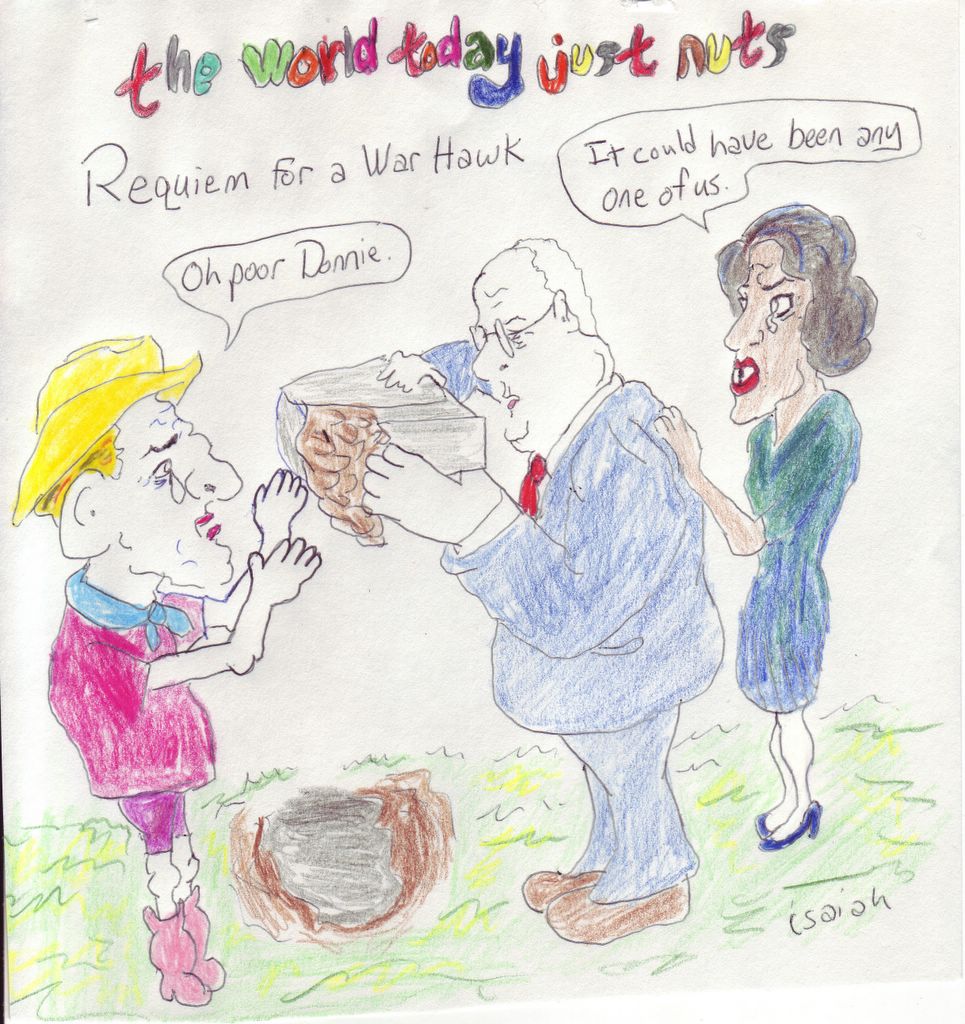
Requiem for a War Hawk


"Requiem for a War Hawk" ran November 19, 2006 and it was about one of the first crooks to leave the administration: Donald Rumsfeld.


Bush kept insisting, leading up to the midterms, that no one was leaving but as soon as Republicans lost (and they lost big in the 2006 mid-terms, they lost control of both houses of Congress, if you've forgotten), it was time for Rummy to be sent packing.

The absence of Colin Powell should remind you that he was the first rat to bail and was already gone by this point.

Here's C.I.'s "Iraq snapshot:"

Thursday, July 1, 2010. Chaos and violence continue, everyone's a target in Iraq, but China sees economic opportunities, the US Congress explores who is in what military grave, and more.
Starting with Iraq's economy. The Economist weighs in with an opinion:
On tightly packed shelves in Iraqi shops it is usually surrounded by rows of imports: Iranian noodles, Turkish milk, German detergent, and so on. With violence receding a bit (but by no means entirely) in the past two years, traders are finding a growing number of customers eager for foreign-made wares, especially without real competition from local ones. Hopes of a spurt in industrial growth rose a year ago when Americans stopped patrolling Iraqi streets, but the much-touted peace dividend has failed to materialise. Most Iraqi factories that functioned before the American invasion, albeit often badly, are still closed. The road to a durable peace and rising prosperity is still blocked.
Adnan al-Reqabi, Hello's general manager, complains he is pumping out only slightly more sauce now than last year and his staff of 90 has not grown. Production slowed but never stopped in the bad old days when looters and militias lurked outside the metal front gate, he says, "and we're still stuck."
Meanwhile Leila Fadel and Ernesto Londono (Washington Post) report that China is taking the Iraqi investment plunge "[. . .] China and a handful of other countries that weren't part of the so-called coalition of the willing are poised to cash in. These countries are expanding their foothold beyond Iraq's oil reserves -- the world's third largest -- to areas such as construction, government services and even tourism, while American companies show little interest in investing here."
Sahar Issa (McClatchy Newspapers) reports two Baghdad roadside bombings claimed 1 life and left seven people wounded, another Baghdad roadside bombing left three people injured, another Baghdad roadside bombing claimed one life and wounded twelve people -- the target was Albu Aitha a Nineveh Province sticky bombing wounded a 12-year-old girl and, dropping back to yesterday, an armed clash in Kirkuk led to police Capt Muhammed Ahmed being killed.
Albu Aitha is a Sahwa leader -- also known as "Awakenings" and "Sons Of Iraq." Today Timothy Williams and Zaid Thaker (New York Times) report on the continued targeting in Iraq, focusing on those attacked for their paid positions: "Some 150 politicians, civil servants, tribal chiefs, police officers, Sunni clerics and members of Awakening Councils have been assassinated throughout Iraq since the election -- bloodshed apparently aimed at heightening turmoil in the power vacuum created by more than three months without a national government." The political stalemate.
March 7th, Iraq concluded Parliamentary elections. Three months and two days later, still no government. 163 seats are needed to form the executive government (prime minister and council of ministers). When no single slate wins 163 seats (or possibly higher -- 163 is the number today but the Parliament added seats this election and, in four more years, they may add more which could increase the number of seats needed to form the executive government), power-sharing coalitions must be formed with other slates, parties and/or individual candidates. (Eight Parliament seats were awarded, for example, to minority candidates who represent various religious minorities in Iraq.) Ayad Allawi is the head of Iraqiya which won 91 seats in the Parliament making it the biggest seat holder. Second place went to State Of Law which Nouri al-Maliki, the current prime minister, heads. They won 89 seats. Nouri made a big show of lodging complaints and issuing allegations to distract and delay the certification of the initial results while he formed a power-sharing coalition with third place winner Iraqi National Alliance -- this coalition still does not give them 163 seats. They are claiming they have the right to form the government. Yesterday Zahraa Alkhalisi, Caroline Alexander and Kadhim Ajrash (Bloomberg News) reported that the State Of Law and Iraqi National Alliance are stating they have decided on a candidate for prime minister . . . they just aren't sharing with anyone who they've selected. Previous similar statements have been made since March and they haven't panned out. This one may or may not but, at present, there's nothing further than the announcement Alkhalisi, Alexander and Ajrash reported on.
In the elections, Iraqi Christians won five seats. UPI reported Tuesday on a Christian conference held in Mosul hoping "to strengthen the rights of the minority religious community" and those attending "issued an eight-point referendum calling for constitutional amendments in Iraq to strengthen minority rights and for peaceful dialogue between religious and ethnic groups." Al Bawaba lists the eight points:
1) Constitutional amendments to stregthen minority rights and legislation for the implementation of constitutional guarantees;
2) Adequately financed and rationally conceived programs designed to facilitate the voluntary return of the country's refguees;
3) National Commission for Minority Affairs to promote peaceful dialogue between religious and ethnice groups;
4) A University in Nineveh Province;
5) Security for vulnerable minority communities;
6) Fulfillment of Iraq's obligation to respect international human rights instruments;
7) Increased representation of Christians in the federal and state parliaments; and
8) Increased investment in the infrastructure of previously marginalized areas populated mainly by minorities.
The conference took place Saturday, a press release sent to the public e-mail account notes, and was entitled the 2nd All-Iraqi Christian Leadership Conference. From the press release:
Dr. John Eibner, CEO of CSI's U.S. affiliate warned that the prospect of extinction still faces Iraq's ancient Christian community, and would do so until violent persecution ceases and basic human rights are guaranteed in word and deed.
In an interview with Iraq's Mosuli TV, Eibner noted that the considerable progress providing security in Mosul and surrounding Nineveh Province during the past year is reversible.
Since the overthrow of Saddam Hussein in 2003, nearly half of Iraq's approximately one million Christians have been forced by violence to flee the country, while many other remain in Iraq as destitute Internally Displaced People.
The Governor of Nineveh Province, Athil Al-Najifi, in his role as Conference Patron, announced that outside interference and instrumentalization of minorities in Nineveh is coming to an end, and expressed willingness to establish a mechanism, including all elements of civil society, to defend minority rights.
William Warda, President of the Hammurabi Human Rights Organization (HHRO) claimed that neither the Iraqi nor the American governments are acting with sufficient energy and foresight to end the violent persecution of Iraq's Christians and to create conditions for the return of refugees.
The Chaldean Catholic Archbishop of Kirkuk, Louis Sako, urged Christians not to leave Iraq, emphasizing the need for an enduring Christian witness in the country.
The Conference was co-sponsored by CSI and by HHRO.
Meanwhile Catholic Culture notes, "The Iraqi government is asking Western governments not to grant asylum to Christians seeking to leave the country. While the government hopes to discourage emigration in order to "preserve the ethnic and religious diversity of the country," Church leaders argue that the government could better serve that policy by providing security for the Christian minority." Bassel Oudat (Al-Ahram) notes that Syria has "the third largest number of refugees in the world" and that 1948 was when Syria received "the first wave of refugees [. . .] after the creation of of the State of Israel." In terms of Iraq, Syria began hosting Iraqi refugees during the rule of Saddam Hussein and this, of course, increased as a result of the current and ongoing war. Today's wave can "own property and invest in the economy, but they are not given permanent residency and they are required to renew their stay every three months and in some exceptional cases once a year. Iraqi students can attended Syrian schools for free, and are eligible for free healthcare in government hospitals. However, they need work permits for employment. The UNHCR has opened special offices to assist them in all aspects of life. In fact, the UNHCR opened the largest refugee camp in the world in Duma in eastern Damascus." Syria, Lebanon and Jordan have taken in the bulk of Iraqi refugees. Western nations have been especially poor (to put it mildly) in responding to the refugee crisis. Thea Garland (Global Post) reports, "Amid growing controversy over the treatment of refugees, the British government plans to begin forcibly returning child asylum seekers to Afghanistan, possibly as early as August, according to government officials." And if you're thinking, "That's appalling -- but what does she mean about 'growing controversy'" -- what she's referencing is England's decision to 'celebrate' World Refugee Day by forcibly returning Iraqi refugees to Iraq -- between 90 and 120 by some estimates. Not only were they forced to return, but their interviews conducted in England? An Iraqi government official sat in on the questioning. Last month on on Inside Story (Al Jazeera), Iraqi refugee Arevan Mohammed explained what his experience at the United Kingdom Border Agency (Arevan remains in England at present). Excerpt:
Mike Hanna: Let me go back to Arevan Mohammed and we understand that when you had your interview about deportation, there were Iraqi members present during that interview. Is that correct?
Arevan Mohammed: Is that correct? Yes. Basically when I had an interview, an immigration officer denied me access to my representative -- legal representative. I pleaded with him to just let me bring my legal representative with me because you are forcing me to be interviewed with some peoples which you are putting my life in danger with. But basically he denied that. After when I went to the interview I basically told them I live in the UK and I would prefer the interview has to run with an English language. The [Iraqi] Interior Minister diplomat, he became annoyed in some point in the interview and he shouted at me [. . .] "I know what I'm going to do with you by the time you're returning back home and I will put you -- I know where I will put you and how I will treat you." So don't you think that's a threat? In the middle of a democracy, like the country of UK, Iraqi diplomats threatening me by the time I will return back to Iraq, he's simply telling me, I will put you in hidden prison or secret prison and I will kill you later on."
That's appalling and England got away with it. Very few bothered to call out. The UNHCR did call it out. Many others stayed silent. It's not at all surprising that having gotten away with that, England's not wanting to dump -- that is the term -- refugee children into war zones. NPR's Deborah Amos is the author of Eclipse of the Sunnis: Power, Exile, and Upheaval in the Middle East which addresses the refugee crisis. She's written a new piece on another issue, "Iraq's TV Screens Reflect Sectarian Divide" (Vermont Public Radio):
Television has become essential to reaching Iraqi audiences. More than half the population, nearly 16 million viewers, turns to TV for information, more than any other medium, including newspapers, radio or the Internet.
Iraqis watch television at home, while smoking hubbly-bubbly in Baghdad cafes, while gazing up from plates of lamb and blackened tomatoes over lunch, and on small screens behind the grocery shop cashier.
Which channels are they watching? The choice is often an indication of sectarian identity.
The sectarian divide that drove the country to devastating violence from 2005 to 2007 has evolved into a political struggle, with satellite television ownership representing the power players.
There are Sunni TV, Shiite TV and Kurdish TV, with editorial policies that reflect the biases of each group. Even state television, modeled after the U.S. Public Broadcasting Service, has evolved into a news outlet that reflects the views of Prime Minister Nouri al-Maliki and is known in Iraq as "Maliki TV."
"I'm angry. Period," declared US House Rep Ike Skelton yesterday. "Anger is usually not a useful emotion -- particularly here on Capitol Hill; however, in light of the recent revelations about the management of Arlington National Cemetery, I am just downright angry. Arlington Cemetery is our nation's most hallowed ground. It is reserved as the final resting place of our heroic warriors. Management ineptitude and neglect have resulted in a web of errors. How in the world could this tragedy be allowed to happen?"
Skelton was bringing to order the US House Armed Services Committee, which he chairs, for a full hearing into the problems at Arlington. What problems? We'll drop back to the June 11th snapshot:
In the United States, the Arlington National Cemetery scandal continues to garner (deserved) attention. Richard Sisk (New York Daily News) sums it up very well in two sentences, "They didn't arrive at Arlington National Cemetery as unknown soldiers. The Army just treated them that way." Julian E. Barnes (Los Angeles Times) offers this overview, "The inspector general, Lt. Gen. R. Steven Whitcomb, found one case involving personnel killed in Iraq or Afghanistan. In that instance, two grave markers had been switched. Other cases involved areas of the cemetery used to inter personnel from earlier conflicts. [. . .] The extent of the problems at one of the nation's most venerated memorials was not entirely clear. In some cases, grave markers had been knocked over and not properly replaced, the report said. Other reported cases involved poor record-keeping. Whitcomb said there was no indication of mistakes at the point of burial." Michael E. Ruane (Washington Post) adds, "The investigators found that these and other blunders were the result of a 'dysfunctional' and chaotic management system at the cemetery, which was poisoned by bitterness among top supervisors and hobbled by antiquated record-keeping." Those looking for a strong audio report on the story should refer to The Takeaway where Salon's Mark Benjamin is one of the guests and Dorothy Nolte (her sister is buried into Arlington Cemetery).
That's the most recent problem. And apparently we're supposed to pretend this is the first problem of that kind in recent times. It's not. Dropping back to the September 24, 2009 snapshot for that day's US House Veterans Committee's Subcommittee on Disability Assistance and Memorial Affairs hearing chaired by US House Rep John Hall. That hearing, US House Rep Steve Buyer provided a visual display of various national cemeteries and noted the good and the very, very bad such as dingy, dirty headestones of which he commented, "This should not matter that this is the marker of someone who died in the Civil War. It shouldn't matter. It shouldn't matter if it was someone who died in the Revolution or someone who died that's interned in Mexico City." The weeds, the lack of appropriate care to the grounds, the appalling conditions were all in the visuals projected for all to see by Buyer in that hearing. This is from his exchanged with the Dept of Interior's Katherine Stevenson.
US House Rep Steve Buyer: Let me ask you something, Ms. Stevenson, tell the committee here, what are your needs? What do you believe your needs are to raise the standard within the Dept of Interior?
Katherine Stevenson: The report that I just mentioned [in opening statement] will have some recommendations for funding and it will have recommendations for increased treatment of, uh, cleaning and so on.
US House Rep Steve Buyer: What are your goals?
Katherine Stevenson: Our goals are the same as the goals set by the National Cemetery Administration. We have the same three standards, height and alignment, clean stones and level grave sides as they do.
US House Rep Steve Buyer: How many cemeteries did you go to in the review?
Katherine Stevenson: Four.
US House Rep Steve Buyer: How many do you have in your system?
Katherine Stevenson: Fourteen.
US House Rep Steve Buyer: Why wouldn't you go to all fourteen cemeteries?
Katherine Stevenson: We wanted to do it as quickly as we could and get some sense of uh what was going on -- in the ones that you mentioned, for example, Andersonville was one of them. So we took ones that were fairly close to Andersonville.
US House Rep Steve Buyer: Did you go to -- what are the four that you went to?
Katherine Stevenson: Andersonville, Andrew Johnson, Fort Donaldson and Stones River.
US House Rep Steve Buyer: Andrew Johnson? Is that the -- that's the one in Tennessee? That's the one in Tennessee? [Stevenson nods.] Have you sent inquiries out to the other ten?
Katherine Stevenson: No, sir. No more than usual. I mean, we-we talk to them a fair amount.
US House Rep Steve Buyer: Alright. You've got fourteen. Alright, there's a disconnect here. I'm not going -- I'm not in a fight with you here, okay? I want us to raise the standards, so when this review -- this report -- comes out, I'm going through it.
Katherine Stevenson: Good.
US House Rep Steve Buyer: The light's on you, okay? So what I -- what I -- My immediate sense here is is when I think the Secretary tells me he's going to do a review, that it's going to be of all 14 cemeteries. I don't want something done quick and easy. Alright? I want this to be done correctly. And if your sense is and your counsel to us is that four is going to be sufficient well [shrugs] that's fine but is what you're asking me is, "Steve, just pause here. When you get the report, you're going to be satisfied?"
Katherine Stevenson: [speaking very slowly] You know, you can choose a photograph in any of these cemeteries and [picking up speed] any, I bet, of the veteran cemeteries that are managed by other people and we will have some scenes that are perfect and some scenes that are not. And I know that that's true in the cemeteries that we manage. We are trying to do our very best for the veterans and for their burial places.
US House Rep Steve Buyer: Alright. Well your standard of very best doesn't meet the standards established by others. So we're going to take your standard of very best and we're going to raise it. We're going to raise your very best even higher. Okay? And, uh, I didn't go out and selectively choose to find what I think would be the worst photograph. It's easy to go out there and take that photo. And I was extremely upset the day I saw a veteran being buried in a cemetery like I saw. It's one thing -- it's one thing, you know, we've all been to cemeteries and we've seen the conditions of some of them but to think that this was an active cemetery under the stewardship of the federal government was extremely disheartening. I-I-I'm going to pause here, Mr. Chairman, give it back to you under the time.
That the committee yesterday was angry was not doubtful. But the Committee was never going to go to rough. Secretary of the Army John McHugh was the main witness. McHugh is not only a former member of Congress, he's only been on the job since September. So less than a year later he's appearing before the Congress that knows where he was before he was the Secretary and that he stepped forward with the information on the problem very early on and did not attempt to bury it. This exchange was fairly typical in terms of the cordial relations between the Committee and the witness but it did also bring up some larger issues.
US House Rep Solomon Ortiz: Secretary McHugh, so good to see you again and I want to welcome you to your old committee. And with you at the helm there, I know that things are going to work out. [Lt] General [Steven] Whitcomb, it's always a pleasure to have you back here. And thank you for your honest and frank dialogue. You know with a significant number of mismarked and unmarked graves, what is the Army doing to reach out to the families of these deceased warriors, service members? And what is the Army doing to properly account for this unmarked or mismarked graves to accurately mark the sites? And the report only focuses on portions of the Arlington National Cemetery. Do you think that this problem exists in other areas of the cemetery? And, you know, I know we focus on Arlington. But you know we have cemeteries many places: Moroco, Africa, Belgium and I'm just wondering. I hope this is not a widespread problem that we have but, if it does, I know that you're going to look at it and take care of it. So maybe you can respond to my question. Thank you, thank you so much.
Sec of the Army John McHugh: Thank you, Congressman. As I -- As I tried to lay out beforehand, I appreciate the chance to expand upon it a bit. Our first objective is the 211 graves that are identified with map discrepancies. And we are currently working through those, as I believe I mentioned earlier, we have resolved 27 of those. Those will continue and they have to this point of errors and mismarking on the so-called "master map." We will each and every day match records through parent record system -- the map, the burial cards that record the funeral and the soldier, sailor, marine, coast guard or family member involved against headstones where they exist. And where, for example, the map shows a grave and yet there's no record or headstone. What we have done is actually unearthed, through a set procedure and determined in each one of those thus far that indeed the map was in error, that there were no remains in those graves and those graves will be reclaimed and used for appropriate purposes and a fallen hero sometime in the future. After that, we intend to proceed in all likelihood chronologically most recent [to] back. I think those who have lost loved ones in recent years are more concerned and aware of this. But at the end of the day, I should tell you, that it is our intent upon implementation of a truly viable computer and IT system to run matches on all 330,000 of those graves, and where we find similar discrepancies, begin the process of validating or finding out what the issues are with each-each one of those discrepancies. As to reaching out to the loved ones, on the first day we established -- first day of the announcement, when I released the Inspector General's report, we established a call center, we announced the number for that call center and, as of the last count I had available, we've had 867 calls into that center -- of those we have resolved 169 of those cases. And as we go forward, we are contacting each and every one of those -- of those persons who called and expressed concern to update them. And we'll continue to do that until we can work through the entire -- the entire list. We are not at this time calling people who have not expressed concern to revalidate that, indeed, they don't have an issue. For the vast majority of family members, they feel -- our conjecture is -- that they feel confident. But where we do have expressions of concern, we work with those people directly and we will continue to do that until we've answered every concerned loved one's question.
US House Rep Solomon Ortizi: My time is up now, but my other question was going to be: As soon as you finish with this, you don't think that the other cemeteries that we have in other foreign countries have any such problems like we encountered here at Arlington?
Secretary of the Army John McHugh: Well I can't possibly know that. I can tell you this, they'd be -- those graves and cemeteries are operated by and large by the Veterans Administration's National Battle Monuments Commission. I can guarantee you they will take lessons learned from our experiences and also apply them. The Chairman of the Battle Monuments Commission Max Cleland has agreed to support us -- as I mentioned in my opening statement -- in creating an advisory and oversight committee. So he will be actually part of our procees. Being the great leader that he is I know that he will take our experiences and utilize them to whatever end is necessary within their purview.
US House Rep Mac Thornberry asked a question that's popped up in several e-mails to this site since the scandal broke. Thornberry wanted to know about an unearthing. How did you identify the remains? McHugh testified that the outside of the coffins are marked with the names of the fallen. And, in addition, this can be tested with DNA. "We have not ruled out the possibilty of opening caskets."
Stying with the topic of the US Congress, US House Rep Biill Delahunt's office released the following Tuesday:

WASHINGTON, D.C. -- U.S. Rep. Bill Delahunt announced today that he would oppose further funding for military operations in Afghanistan.
Delahunt, who serves as the Chairman of the House Foreign Affairs Subcommittee on Europe, said the following:
I believe that the time has come for a new approach in Afghanistan. Rather than the massive military and nation-building endeavor currently underway -- that continues to produce dubious results, according to the latest report by the Special Inspector General for Afghanistan Reconstruction -- the United States and its allies should focus our energy on combating al Qaeda and its ideology. Most importantly, emphasis should be placed on refuting al Qaeda's twisted perversion of Islam through public diplomacy, development, and other changes in policy that encourage ordinary Muslims to reject the fanatics who are trying to hijack their religion.
Until there is such a shift in strategy, I cannot support any further funding for the war in Afghanistan.
I have not come to this decision easily. For years, I supported the effort in Afghanistan. It was one of my reasons for opposing the Iraq war. That conflict undeniably distracted from Afghanistan, as I predicted at the time. The previous Administration took its eye off the ball, prioritizing its obsession with Saddam Hussein over the pursuit of al Qaeda. The invasion of Iraq actually strengthened al Qaeda by convincing many in the Muslim world that the U.S. is – as Osama bin Laden falsely claims – at war with Islam. That further undermined our efforts to defend America and bring to justice those who actually attacked us on 9/11.
Furthermore, there is the painful reality that our economy is still in serious trouble, and the wars in Afghanistan and Iraq come at an enormous cost to the American taxpayer – close to $1 trillion, according to some estimates. And of course, we have already lost over 1,000 Americans in the war in Afghanistan. Thousands more have been injured, many so badly that they will require care for the rest of their lives. There will never be an appropriate price tag for the suffering they and their families have had to go through. But if we are to be serious about fiscal discipline, we must reconsider the costs of this war and whether this is the best way to use our military in the defense of our nation.
I want to be clear: I am not proposing that the United States abandon the Afghan people. We have a moral obligation to help them. I am particularly concerned about the fate of women in Afghanistan, and believe that we cannot allow them to suffer as they did underneath the Taliban. But the fact of the matter is that our current policy is not succeeding in bettering their lives.
Likewise, I am not naïve about the dire threat to the United States posed by al Qaeda. Unlike Saddam Hussein, al Qaeda really are out to kill us, and simply withdrawing from Afghanistan will not appease their hatred. Osama bin Laden and his cohorts must be brought to justice – or destroyed. But we have to be smarter in how we combat them. Our highest priority must be convincing the Muslim world that al Qaeda is a cancer that Muslims themselves need to eradicate. We should redouble our efforts to that end.
As I said, I have not come to this decision lightly. I continue to support President Obama's overall foreign policy approach, because I am convinced that he is succeeding in changing global perceptions of America in ways that will ultimately make our country safer and more prosperous. But I no longer believe that his current strategy in Afghanistan will be successful. President Obama must use the opportunity presented by the change of commanders in Afghanistan – a move that I support wholeheartedly – to adjust course. Until that happens, I will oppose further funding for the war in Afghanistan.


Read on ...
Creative Commons License
This work is licensed under a Creative Commons Attribution-Share Alike 3.0 Unported License.