Thanks to all that have checked on my health . I did fell sick this morning and had to cancel several meetings. UNICEF doctor diagnosed the cause as water pollution. I did not intended to take my solidarity with the people of Basra that far, but certainly now share how you feel.
The drinking water is poison. And where's the Iraqi government?
For that matter, where are the international oil companies?
The Rumaila oil field has not helped drinking water, not when pipes leak
hundreds of barrels a day and the oil pools on either side of the
highway. There is no effort to stop the leaks, there is no effort to
clean up the spills. Luke Mitchell noted it in his December 2007 report for HARPER'S MAGAZINE.
There are no protections for the people of Iraq. The same government
that steals from the Iraqi treasury turns an eye as problems fester and
increase, issues that harm the very safety of the Iraqi people.
A functioning or even just semi-functioning (and partially independent)
Iraqi government would have long ago brought a law suit against the US
government and various weaponmakers for the use of Depleted Uranium,
White Phosphorus, etc in Iraq in the early years of the Iraq War. They
would note the birth defects that followed.
But Iraq's government is largely puppets and they are more interested in
stealing from the Iraqi people. They don't even have the strength to
try to leverage the US government to build and fund up to date
facilities to treat those effected by the various weapons used in Iraq.
Fallujah
is one of the most forgotten contemporary US battlefields. In that
battle to defeat the popular insurgency against the American occupation,
the United States used chemical (white phosphorus) and radioactive (DU)
weapons with great abandon. The fierceness of the war destroyed three
quarters of the city and sent most of its population to the grave or
into flight. At this time, General Mattis headed the 1st Marine Division
that was key to the Fallujah war.
Ironically,
the United States went into Iraq in 2003 with the claim that it wanted
to destroy weapons of mass destruction. In turn, it was the United
States that used weapons of mass destruction inside Iraq.
The
United States dropped at least 116,000 kgs of DU ammunition during the
bombing campaign of the 2003 Iraq War. At that time, A-10 fighter jets
were used for these missions, the same planes used in Syria. Strike logs
released to George Washington University in 2013, shows that in the
early months of the war (March-April 2003), DU ammunition was used
against cars and trucks as well as buildings of all kinds.
The
widespread use of these radioactive weapons across Iraq contaminated
large swathes of the country. What transpired in Fallujah the next year
was merely the continuation of what had become normal policy. The data
from that war has not been released as of yet. It would show that DU
weapons were fired not only from A-10 jets, but also from tanks and
other ground-based devices. These not only contaminated the soil, but
also endangered US troops.
It
is not as if the US military did not know that DU weapons are
dangerous. The US Environmental Protection Agency calls these weapons ‘a
radiation health hazard when inside the body’. A 1975 US Air Force
review suggested that these weapons not be used against troops, but only
against ‘tanks, armored personnel carriers or other hard targets’.
This
prohibition was routinely violated during the US War on Iraq. In 2003,
the UK’s Royal Society of Medicine and the UN Environment Program warned
against the use of such weapons. None of these warnings were heeded.
People like Mattis and Kelley had their fingers on the trigger. There is
no available evidence that they cautioned against what is tantamount to
a war crime.
Last Friday, we noted the death of Tara Fares. Her murder continues to resonate.
Three well-known women involved in the beauty industry were reported murdered in #Iraq in last 30 days:
Today: Tara Fares, 22, blogger and model
Wednesday: Suad al-Ali, human rights activist
4 Weeks ago: Rafeef al-Yaser, surgeon and beauty expert.
“I’M not afraid of the one who denies the
existence of God, but I’m really afraid of the one who kills and chops
off heads to prove the existence of God.”
That’s
what Tara Fares wrote on Instagram to her 2.8 million followers in
July. Two months later she was murdered in a brazen, daylight attack. The
model known for her risque posts was shot several times by a man who
leaned in to the window of her white Porsche as she drove through
Baghdad last week. Her death is the latest in a string of attacks
on popular women and activists who dare to speak up for change in
Muslim-majority Iraq.
It follows the death of a woman known as “Iraq’s Barbie”, plastic
surgeon Dr Rafeef al-Yassiri, who many believe was poisoned over her
work offering cosmetic surgery victims of war. Soad al-Ali,
another prominent female activist, was gunned down in the southern Iraqi
city of Basra in what police described as a “purely personal” attack. The Baghdad Post reports a
former Miss Iraq, Simaa Qasim is so concerned she’s “next” on the hit
list that she’s leaving social media. Ms Qasim, who was “close” with Ms
Fares, said she had received death threats.
The ongoing Iraq War destroyed the rights of women in Iraq. What bombs
didn't destroy, the US government did by installing thugs as part of the
shock therapy that was supposed to silence Iraqis and allow for an
easier takeover and occupation. The 'brain drain' that first took place
led to many technocrats and doctors and other professionals fleeing
Iraq -- little noted by the press during this wave or others was how
many fleeing were women. That's because women are targets in Iraq. Baria Alamuddin (DAILY TRIBUNE) explains that the women being targeted go beyond the beauty industry: A grainy video showed a motorcyclist
fatally pumping bullets into the car of 22-year-old Iraqi model and
social media star Tara Fares last week. This horrifying attack was the
latest in a succession of murders of prominent Iraqi women; including
others from the beauty industry, Basra activist Suad AlAli, and the
killings of protesters by sectarian militants.
That's Cat Power (with Lana Del Rey) with her video "Women." It's from
her just released album WANDARER ("Horizon" is my favorite song off the
album currently).
The following community sites -- plus PACIFICA EVENING NEWS and DISSIDENT VOICE -- updated:
Barack had plenty of scandals. Anyone who says otherwise is lying.
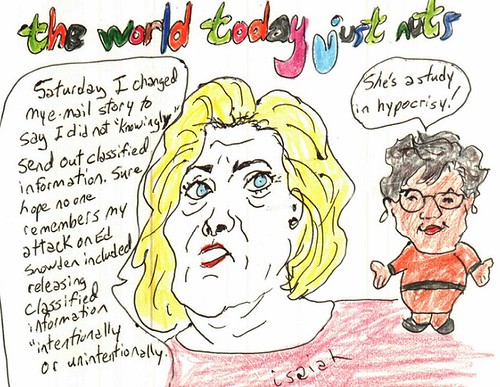
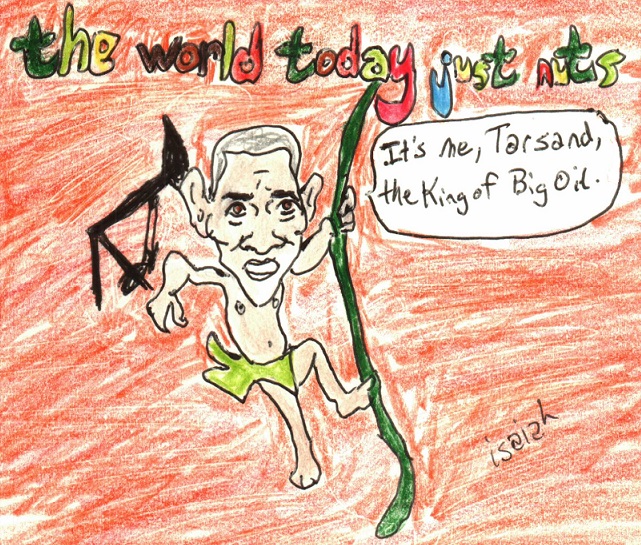
By the way I've got a new comic up at THE COMMON ILLS this morning. I'll probably have a second one up later today. I'm toying with a third one but not sure it's worth an entire cartoon.
Margaret Kimberley: It
means they don’t like him. That’s all it means. “Worst” based on what?
Did he invade another country? I mean, look at what they’ve done. How
they’ve rehabilitated George Bush. Depending on which number you
believe, he killed a minimum of half a million people in Iraq. Maybe one
million. But Trump is worse? Now maybe before he leaves office he’ll do
something equally as horrible, but he’s certainly not worst right now.
It's called perspective and it's lacking when the likes of Barbra
Streisand take time out from shopping in their own personal malls and
cloning their dogs to try to be 'political.' They say stupid things that reveal how shallow and pathetic their lives are, stupid things like Colin Powell is "decent people."
Sorry, I'm not in the mood for some ugly bitch like Barbra Streisand --
who has no formal education and no practical education (go back to
speaking of Zen Buddhism, Babsie), thinking she can rewrite history.
While she was doing MEET THE FOCKERS or whatever other abortion she
called a film, the rest of us were dealing with the liar Colin Powell. Here's Norman Solomon in 2005:
Powell’s televised U.N. speech exuded great confidence and
authoritative judgment. But he owed much of his touted credibility to
the fact that he had long functioned inside a media bubble shielding him
from direct challenge. It might puzzle an American to read later, in a
book compiled by the London-based Guardian,
that Powell’s much-ballyhooed speech went over like a lead balloon.
“The presentation was long on assertion and muffled taped phone calls,
but short on killer facts,” the book said. “It fell flat.” Fell flat? Well it did in Britain, where a portion of the mainstream
press immediately set about engaging in vigorous journalism that ripped
apart many of Powell’s assertions within days. But not on the western
side of the Atlantic, where Powell’s star turn at the United Nations
elicited an outpouring of media adulation. In the process of deference
to Powell, many liberals were among the swooners. In her Washington Post column the
morning after Powell spoke, Mary McGrory proclaimed that “he persuaded
me.” She wrote: “The cumulative effect was stunning.” And McGrory, a
seasoned and dovish political observer, concluded: “I’m not ready for
war yet. But Colin Powell has convinced me that it might be the only way
to stop a fiend, and that if we do go, there is reason.” In the same edition, Post columnist
Richard Cohen shared his insight that Powell was utterly convincing:
“The evidence he presented to the United Nations — some of it
circumstantial, some of it absolutely bone-chilling in its detail — had
to prove to anyone that Iraq not only hasn’t accounted for its weapons
of mass destruction but without a doubt still retains them. Only a fool — or possibly a Frenchman — could conclude otherwise.” Inches away, Post readers found Jim Hoagland’s column with this lead:
Colin Powell did more than present the world
with a convincing and detailed X-ray of Iraq’s secret weapons and
terrorism programs yesterday. He also exposed the enduring bad faith of
several key members of the U.N. Security Council when it comes to Iraq
and its “web of lies,” in Powell’s phrase.
Hoagland’s closing words sought to banish doubt: “To continue to say
that the Bush administration has not made its case, you must now believe
that Colin Powell lied in the most serious statement he will ever make,
or was taken in by manufactured evidence. I don’t believe that. Today,
neither should you.” On the opposite page the morning after Powell’s momentous U.N. speech, a Washington Post editorial was figuratively on the same page as the Post
columnists. Under the headline “Irrefutable,” the newspaper laid down
its line for rationality: “After Secretary of State Colin L. Powell’s
presentation to the United Nations Security Council yesterday, it is hard to imagine how anyone could doubt that Iraq possesses weapons of mass destruction.” Also smitten was the editorial board of the most influential U.S.
newspaper leaning against the push for war. Hours after Powell finished
his U.N. snow job, the New York Times
published an editorial with a mollified tone — declaring that he
“presented the United Nations and a global television audience yesterday
with the most powerful case to date that Saddam Hussein stands in defiance of
Security Council resolutions and has no intention of revealing or
surrendering whatever unconventional weapons he may have.” By sending Powell to address the Security Council, the Times
claimed, President Bush “showed a wise concern for international
opinion.” And the paper contended that “Mr. Powell’s presentation was
all the more convincing because he dispensed with apocalyptic
invocations of a struggle of good and evil and focused on shaping a
sober, factual case against Mr. Hussein’s regime.” Later, in mid-September 2003, straining to justify Washington’s
refusal to let go of the occupation of Iraq, Colin Powell used the
language of a venture capitalist: “Since the United States and its
coalition partners have invested a great deal of political capital, as
well as financial resources, as well as the lives of our young men and
women — and we have a large force there now — we can’t be expected to
suddenly just step aside.” Now, after so much clear evidence has emerged to discredit the entire
U.S. war effort, Colin Powell still can’t bring himself to stand up and
account for his crucial role. Instead, he’s leaving it to a former aide
to pin blame on those who remain at the top of the Bush administration.
But Powell was an integral part of the war propaganda
machinery. And we can hardly expect the same media outlets that
puffed him up at crucial times to now scrutinize their mutual history.
It is hilarious that the cross-eyed Barbra is pimping a song about
hating lies and liars while she's also insisting that Colin Powell is a
decent person. He's a f**king liar who is responsible for the deaths of
millions. He lied to the United Nations, he knew he was lying. He
lied to get the country into war. You can also check out Ava and my "TV Review: Barbara and Colin remake The Way We Were"
from 2005 and I'd suggest you look into the late Robert Parry's work on
this topic as well (there should be at least one link to Parry in Ava
and my piece). There's no need for lies and if Barbra wants to fight
lies she can start by stop lying herself. Cheap whore, that's all she
ever was, it's all she's ever been. She's molested her own talent in
such a way that she's produced the most mediocre career anyone could
imagine. That's bad. But pimping Colin Powell as "decent"? After that
lying speech? Babs needs to go back to cloning her dead dog and other
things that fat-assed, ridiculous and wealthy women do when they've got
no real life or connection to one.
COLIN POWELL DELIVERED his presentation making the case for war with Iraq at the United Nations 15 years ago, on February 5, 2003.
As much criticism as Powell received for this — he’s called it “painful”
and something that will “always be a part of my record” — it hasn’t
been close to what’s justified. Powell, who was secretary of state under
President George W. Bush, was much more than just horribly mistaken: He
fabricated “evidence” and ignored repeated warnings that what he was
saying was false.
Unfortunately, Congress never
investigated Powell’s use of the intelligence he was given, so we don’t
know many of the specifics. Even so, what did reach the public record in
other ways is extremely damning. While the corporate media has never
taken a close look at this record, we can go through Powell’s
presentation line by line to demonstrate the chasm between what he knew
and what he told the world. As you’ll see, there’s quite a lot to say
about it.
Jon goes through the speech point by point. If you're stupid enough to
believe a hagged out fool who is so addicted to fillers that she now has
chipmunk cheeks, you really should read through Jon's report. And you
should grasp that Colin Powell is a War Criminal and that pre-dates
Iraq.
Colin Powell: This Man is a War Criminal! http://nblo.gs/gnqg2
Barbra doesn't like liars? She keeps forgetting to note that she has a
financial interest in the remake of A STAR IS BORN. Her ex-lover Jon
Peters can't promote the film. Too many women have come out to talk
about how he harassed and raped them. So Warner Brothers really needs
Barbra to talk it up. She doesn't like liars? All these interviews
praising A STAR IS BORN that never manage to mention that Babs has a
financial interest in the project? That's called deception. There's no
whore like an old whore.
B-b-b-ut Barbra's a defender of women.
She's a defender of herself. She's a self-promoter. She practices the
same Me-ism as Hillary Clinton and tries to pass it off as feminism.
Real feminists care aren't cloning their pets. Real feminists speak out
for women. The women in Iraq who have taken part in the protests have
risked a great deal.
Barbra doesn't care about them. They don't buy her bad albums or see her tacky films.
They risk everything and Barbra can't highlight them.
Four women. Killed in broad daylight. For the 'crime' of protesting.
For the 'crime' of demanding drinkable water that doesn't land you in
the hospital, electricity (150 degrees Fahrenheit was not uncommon in
Basra this summer) and jobs.
Hayder al-Abadi, still prime minister of Iraq at this point, shut down
the internet in July to try to keep the world from finding out what was
going on.
Why did he even bother?
In a world of cross-eyed Barbras, there's no need. They will waste our
time with tacky and banal topics, distracting us from what matters.
How many lives have been lost since the start of the bombing campaign in Iraq and Syria?
The Iraqi people are suffering -- they are suffering in the 15th year of
an illegal war. But 'activist' Barbra Streisand doesn't care. She's
never cared. She's wasted her talents and she's wasted the world's
time. If the rumors are true that James Brolin is using a 'high class'
service to cheat on her are true, no one's going to shed a tear for
Barbra. The world has passed her by. She's obsolete and soon to be
forgotten. Real issues matter, fat cats like Babs, not so much.
Just in a month #Iraqis show their new national unity. Few days ago political class shocked by protests acts in #Basra, yesterday Iraqis are unite against killer & instigator of Iraqi female model Tara Faris, while political class still ignore these developments of society (1)
AL ARABYIA reports: An Iraqi social media star became the latest woman victim of a spate of murders across the country this week by unknown gunmen.
Tara Fares
was shot dead in her car in the capital Baghdad on Thursday, just a day
after she was voted one of Iraq's most popular social media stars.
She
was murdered by unknown gunmen in the Kam Sara neighbourhood of
Baghdad, with the ministry of interior saying they are investigating the
killing
The model and journalist had a huge following on Istagram, with over 2 million followers.
The Iraqi people suffer. In part, they suffer because the US government
did not intend to ever provide democracy. They wanted disorder and
chaos. See Naomi Klein's "Baghdad Year Zero" (HARPER'S):
The fact that the boom never came and Iraq continues to tremble under
explosions of a very different sort should never be blamed on the
absence of a plan. Rather, the blame rests with the plan itself, and the
extraordinarily violent ideology upon which it is based.
Torturers believe that when electrical shocks are
applied to various parts of the body simultaneously subjects are
rendered so confused about where the pain is coming from that they
become incapable of resistance. A declassified CIA "Counterintelligence
Interrogation" manual from 1963 describes how a trauma inflicted on
prisoners opens up "an interval – which may be extremely brief - of
suspended animation, a kind of psychological shock or paralysis ... At
this moment the source is far more open to suggestion, far likelier to
comply." A similar theory applies to economic shock therapy, or "shock
treatment," the ugly term used to describe the rapid implementation of
free-market reforms imposed on Chile in the wake of General Augusto
Pinochet's coup. The theory is that if painful economic "adjustments"
are brought in rapidly and in the aftermath of a seismic social
disruption like a war, a coup, or a government collapse, the population
will be so stunned, and so preoccupied with the daily pressures of
survival, that it too will go into suspended animation, unable to
resist. As Pinochet's finance minister, Admiral Lorenzo Gotuzzo,
declared, "The dog's tail must be cut off in one chop."
That, in essence, was the working thesis in Iraq, and in
keeping with the belief that private companies are more suited than
governments for virtually every task, the White House decided to
privatize the task of privatizing Iraq's state-dominated economy. Two
months before the war began, USAID began drafting a work order, to be
handed out to a private company, to oversee Iraq's "transition to a
sustainable market-driven economic system." The document states that the
winning company (which turned out to be the KPMG offshoot Bearing Pint)
will take "appropriate advantage of the unique opportunity for rapid
progress in this area presented by the current configuration of
political circumstances." Which is precisely what happened. L. Paul
Bremer, who led the U.S. occupation of Iraq from May 2, 2003, until he
caught an early flight out of Baghdad on June 28, admits that when he
arrived, "Baghdad was on fire, literally, as I drove in from the
airport." But before the fires from the "shock and awe" military
onslaught were even extinguished, Bremer unleashed his shock therapy,
pushing through more wrenching changes in one sweltering summer than the
International Monetary Fund has managed to enact over three decades in
Latin America. Joseph Stiglitz, Nobel laureate and former chief
economist at the World Bank, describes Bremer's reforms as "an even more
radical form of shock therapy than pursued in the former Soviet
world."
The tone of Bremer's tenure was set with his first major
act on the job: he fired 500,000 state workers, most of them soldiers,
but also doctors, nurses, teachers, publishers, and printers. Next, he
flung open the country's borders to absolutely unrestricted imports: no
tariffs, no duties, no inspections, no taxes. Iraq, Bremer declared two
weeks after he arrived, was "open for business."
One month later, Bremer unveiled the centerpiece of his
reforms. Before the invasion, Iraq's non-oil-related economy had been
dominated by 200 state-owned companies, which produced everything from
cement to paper to washing machines. In June, Bremer flew to an economic
summit in Jordan and announced that these firms would be privatized
immediately. "Getting inefficient state enterprises into private hands,"
he said, "is essential for Iraq's economic recovery." It would be the
largest state liquidation sale since the collapse of the Soviet Union.
But Bremer's economic engineering had only just begun.
In September, to entice foreign investors to come to Iraq, he enacted a
radical set of laws unprecedented in their generosity to multinational
corporations. There was Order 37, which lowered Iraq's corporate tax
rate from roughly 40 percent to a flat 15 percent. There was Order 39,
which allowed foreign companies to own 100 percent of Iraqi assets
outside of the natural-resource sector. Even better, investors could
take 100 percent of the profits they made in Iraq out of the country;
they would not be required to reinvest and they would not be taxed.
Under Order 39, they could sign leases and contracts that would last for
forty years. Order 40 welcomed foreign banks to Iraq under the same
favorable terms. All that remained of Saddam Hussein's economic policies
was a law restricting trade unions and collective bargaining.
If these policies sound familiar, it's because they are
the same ones multinationals around the world lobby for from national
governments and in international trade agreements. But while these
reforms are only ever enacted in part, or in fits and starts, Bremer
delivered them all, all at once. Overnight, Iraq went from being the
most isolated country in the world to being, on paper, its widest-open
market.
At first, the shock-therapy theory seemed to hold:
Iraqis, reeling from violence both military and economic, were far too
busy staying alive to mount a political response to Bremer's campaign.
Worrying about the privatization of the sewage system was an
unimaginable luxury with half the population lacking access to clean
drinking water; the debate over the flat tax would have to wait until
the lights were back on. Even in the international press, Bremer's new
laws, though radical, were easily upstaged by more dramatic news of
political chaos and rising crime.
Some people were paying attention, of course. That
autumn was awash in "rebuilding Iraq" trade shows, in Washington,
London, Madrid, and Amman. The Economist described Iraq under Bremer as
"a capitalist dream," and a flurry of new consulting firms were launched
promising to help companies get access to the Iraqi market, their
boards of directors stacked with well-connected Republicans. The most
prominent was New Bridge Strategies, started by Joe Allbaugh, former
Bush-Cheney campaign manager. "Getting the rights to distribute Procter
& Gamble products can be a gold mine," one of the company's partners
enthused. "One well-stocked 7-Eleven could knock out thirty Iraqi
stores; a Wal-Mart could take over the country."
Soon there were rumors that a McDonald's would be
opening up in downtown Baghdad, funding was almost in place for a
Starwood luxury hotel, and General Motors was planning to build an auto
plant. On the financial side, HSBC would have branches all over the
country, Citigroup was preparing to offer substantial loans guaranteed
against future sales of Iraqi oil, and the bell was going to ring on a
New York-style stock exchange in Baghdad any day.
In only a few months, the postwar plan to turn Iraq into
a laboratory for the neocons had been realized. Leo Strauss may have
provided the intellectual framework for invading Iraq preemptively, but
it was that other University of Chicago professor, Milton Friedman,
author of the anti-government manifesto Capitalism and Freedom, who
supplied the manual for what to do once the country was safely in
America's hands. This represented an enormous victory for the most
ideological wing of the Bush Administration. But it was also something
more: the culmination of two interlinked power struggles, one among
Iraqi exiles advising the White House on its postwar strategy, the other
within the White House itself.
As the British historian Dilip Hiro has shown, in
Secrets and Lies: Operation 'Iraqi Freedom' and After, the Iraqi exiles
pushing for the invasion were divided, broadly, into two camps. On one
side were "the pragmatists," who favored getting rid of Saddam and his
immediate entourage, securing access to oil, and slowly introducing
free-market reforms. Many of these exiles were part of the State
Department's Future of Iraq Project, which generated a thirteen-volume
report on how to restore basic services and transition to democracy
after the war. On the other side was the "Year Zero" camp, those who
believed that Iraq was so contaminated that it needed to be rubbed out
and remade from scratch. The prime advocate of the pragmatic approach
was Iyad Allawi, a former high-level Baathist who fell out with Saddam
and started working for the CIA. The prime advocate of the Year Zero
approach was Ahmad Chalabi, whose hatred of the Iraqi state for
expropriating his family's assets during the 1958 revolution ran so deep
he longed to see the entire country burned to the ground - everything,
that is, but the Oil Ministry, which would be the nucleus of the new
Iraq, the cluster of cells from which an entire nation would grow. He
called this process "de-Baathification."
Goons were put in place by the US government to sew chaos and
destruction so that the shocked people couldn't fight back. Not just by
the US. Basra was fighting back -- and would win concessions. Around
this time, we had what happening? Oh, those Muslim fanatics, remember?
The ones who attacked on September 19, 2005?
Remember?
Those Mulsim fanatics who were, in fact, British. They were British
citizens, not Iraqis. British Special Air Service soldiers, remember?
They just dressed up to try to pass themselves off as Arabs when they
launched the attack on Basra.
Two British soldiers working under cover were arrested Monday in
the southern city of Basra and then freed as a British armored vehicle
blasted through the wall of their jail after an angry crowd began
rioting outside, an Interior Ministry official said. The
official said that the soldiers were undercover officers dressed as
Iraqis and that Iraqi police officers had arrested them after the men
fired at a traffic police officer. A British military spokesman in
Basra confirmed that "two U.K. military personnel" had been detained
early on Monday "in a shooting incident" and that troops had used an
armored fighting vehicle "to gain entry" to the police station to
release them. He said that more than one vehicle had been in the area
and that the police inside the station had refused to obey orders from
the Interior Ministry to release the men. The incident came a day
after British forces in Basra arrested three members of the Mahdi Army,
the militia loyal to the rebellious Shiite cleric Moktada al-Sadr, on
suspicion of terrorism.
For those who marvel over the fact that THE TIMES covered it -- and that
others did as well -- please note that the occupying forces --
including the British -- were whispered to be part of the campaign
killing journalists in Basra. Was it true, was it paranoia? I have no
idea. But THE NEW YORK TIMES losing one of their own (Fakher Haider) at
exactly the same time -- a murder that has never been solved -- was
said to have motivated Tavernise's piece making it into print.
Attacking journalists in Iraq was never a minor issue. Recently, the
'resistance' and its ilk have insisted that journalists risk their lives
in Iraq and should be supported. Huh? The Debra Messings want you not
to call their beloved "fake news." But here's reality, the US attacked
journalists publicly on April 8, 2003 when they attacked the Palestine
Hotel. Enough time -- and enough administrations -- have passed that
you'd think the us press could be as honest as the world's press about
what actually happened there.
This was never about democracy or liberation. This was an illegal war
that remains illegal. The US government doesn't want to help Iraq, it
wants to control it. And they're okay -- the US government -- with
Iraqis dying and thugs being in charge.
But, look, over there, it's Barbra Streisand's fat ass distracting us all again.
The following community sites -- plus DISSIDENT VOICE -- updated: