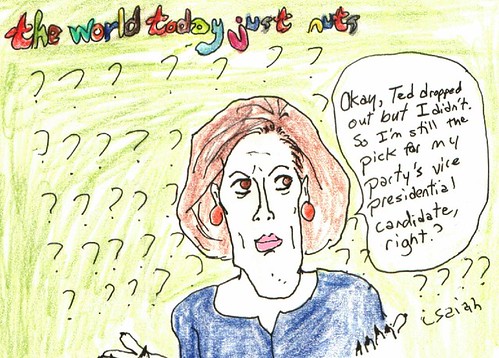
From May 11, 2016, that's "Hillary's Reaction To Losing West Virginia To Bernie." C.I. noted:
Hillary [Clinton] has drawn a picture of Bernie Sanders hanging from a noose. She turns to us and says, "It's my right to get hellish. I still get jealous." Isaiah archives his comics at The World Today Just Nuts.
That comic resulted from a woman at work playing Nick Jonas' "Jealous" for me. I'd never heard him sing before -- I'd heard of the Jonas Brothers but never heard them. She loved "Jealous" and it grew on me so I worked it into a comic.
Here's C.I.'s "Iraq snapshot:"
Saturday, July 20, 2019. Another VA scandal, the US State Dept 'honors'
a murdered person by forgetting to name them, and we look some more at
the Senate's Iraq hearing.
Yesterday on NPR's ALL THINGS CONSIDERED, Ari Shapiro explained the latest VA scandal, "The Department of Veterans Affairs has spent more than $25 million to help people with spina bifida, a debilitating spinal cord disease. Now, prosecutors say nearly 20 million of that money went to one fraudulent scheme led by a man who coordinated seven shell companies."
THE DAILY BEAST's Seamus Hughes joined the program to discuss the VA's Joseph Prince who ran a Denver call center.
HUGHES: And families of kids with spina bifida would call, and they would request services and reimbursement. And he would direct them towards the right folks. The right folks in this scenario were seven companies that he set up with his wife, his half-sister and a bunch of friends.
SHAPIRO: They were, in fact, the wrong folks.
HUGHES: Absolutely.
SHAPIRO: And what happened to the families of children with spina bifida once they were directed to these shell companies?
HUGHES: So what they would do is get paid about $15 to $16 an hour for taking care of their sick children, and then these companies would charge the VA $146. Allegedly, they would pocket the rest of the money, and then they would kick back Joseph Price something north of $1.5 million.
SHAPIRO: Has anyone other than Price been charged in this case?
HUGHES: One other individual - he's going to plead out next week.
SHAPIRO: And yet, with seven shell companies, you would have to think this must not be over.
HUGHES: Yeah. I think you're talking about a massive investigation. In fact, they've filed 40 seizure notices to seven different companies and a bunch of different bank accounts. I think it's still ongoing.
SHAPIRO: Did this affect the people who are struggling with this debilitating spinal cord disease?
HUGHES: You know, they thought that when they called Joseph Price, they would get someone who would help them. And in many ways, he directed them - he said, you know, here's a form. Here's the company you should use. It made it easy for them, but in actuality, he's - you know, it's basically a scheme. He used these individuals and tricked them and made something that should've been an easy thing in their life a lot harder.
[. . .]
SHAPIRO: Almost $20 million - that's a lot of money. How did Joseph Prince spend this?
HUGHES: So if you look at the seizure notice that's been filed in court records, you know, you had some folks of part of this scheme spending $120,000 on furniture, another $30,000 in plastic surgery, paying off student loans, buying houses, beachfront property.
SHAPIRO: Tell me about where the VA sits in all of this because the Veterans Affairs Department has had a lot of scandals, and this is yet another.
HUGHES: It is yet another. Now, we should note that this was investigated with the VA inspector general's office. The concern here is that this scheme went on for at least a year, and so the tripwires didn't happen until $18 million had already left the stables. And so you would hope that they set up some sort of system so that they don't have to wait 365 days till they figure out what's happening.
SHAPIRO: The question is, if somebody like Joseph Prince was allegedly able to do this, is somebody else doing it with a different fund for a different disease?
HUGHES: Exactly. I mean, it raises questions about oversight. It raises questions about whether there is enough checks and balances in the system.
SHAPIRO: He allegedly did that, according to prosecutors.
Click here for the report Hughes did with Lachlan Markay for THE DAILY BEAST.
Yet another VA scandal.
Congress is supposed to provide oversight. Supposed to.
Wednesday, we noted some of the hearing entitled "Iraq: A Crossroads of US Policy." The hearing was held by the Near East Subcommittee of the Senate Foreign Relations Committee. Senator Mitt Romney is the Subcommittee Chair and Senator Chris Murphy is the Ranking Member. Appearing before the Subcommittee was the State Dept's Joan Polaschik (Acting Principal Deputy Assistant Secretary, Bureau of Near Eastern Affairs) and the Defense Dept's Michael P. Mulroy (Deputy Assistant Secretary of Defense for the Middle East).
Mitt Romney spent his time largely noting -- and lamenting -- Iraq's oil and other "significant natural resources" and the failure "to exploit them." He also moaned over a $53 billion deal ExxonMobil had that had been "placed on hold."
The hearing existed to pivot for continued war yet again. Even ISIS isn't enough to justify US troops for the Senate these days so they have a new rationale to keep US troops on the ground in Iraq -- to neutralize the influence from neighboring Iran.
I'd noted that we'd cover the amount of State staffers in Baghdad next time so let's pick up there.
Ranking Member Chris Murphy: . . . something that I want you to address which is a report over the weekend -- a really disturbing report suggesting that the Embassy in Baghdad is down to 15 functional, political staffers. Help me understand the conundrum that I laid out in my opening remarks which is how do we maintain our political mission in Baghdad if we have pulled so many of our personnel out of Baghdad if we are down to 15 functioning, political staffers in Baghdad. And if we were able to maintain a full diplomatic corp there during the height of the Iraq War in the 2000s, why can't we do the same today? The report from this weekend suggests that this is a permanent decision that we -- that State has made a decision that they are going to keep these low level staff for a -- for a time uncertain. So given that report, I was wondering if you could clarify some of that for the Committee today?
Joan Polaschik: Of course. First, I'd like to go back a couple of months to early May where we faced a very serious, specific, credible threat stream against US personnel in Iraq and that threat stream has not diminished. It's still there. So that was the reason that Embassy Baghdad requested authorization to go to go to ordered departure status and the Secretary of State approved that on May 14th. This is a temporary situation. Ordered departure is something that is done in thirty day increments. We constantly evaluate the situation looking closely at the threat information that we have and the personnel on the ground to make sure that we've got the right-right fit. And the Secretary just renewed the ordered departure status on July 12th for another thirty days. I would prefer not to into specific numbers of personnel that we have on the ground in this open setting but I would be very, very happy to brief you later. I would note again though that this is just a temporary decision. We have not made any decisions to permanently withdraw our staff. We are constantly evaluating the situation. And it is certainly the hope that we are able to have a maximum presence on the ground in order to achieve all of the important objectives that we have.
Senator Chris Murphy: Without -- Certainly, without getting into the classified threat assessment, I think it's -- I think it's hard to suggest that the threat is higher today than it was during the height of the insurgency and the fighting in and around Baghdad. And so while I would never second guess security decisions, I would hope that if there is a long term decision made to have lower levels of staffing there that we start to think about how to increase security so that we can return to some level of political functionality. Because if we don't, if we maintain a dozen or two dozen political staffers there, it is an invitation for ISIS to re-emerge because we are not there helping Iraqis do the hard lift of political reconciliation that ultimately protects our interests against the future rise of ISIS or a follow on organization. So I-I-I understand how sensitive this is because you're talking about the lives of American personnel there but the risk of a longterm political withdrawal from Baghdad could, in the end, cost as many American lives as we are saving in the short run. And that's just something that I hope the State Dept is contemplating. Thank you, Mr. Chairman.
The State Dept and the Defense Dept are trying yet again to do what they've tried for 16 years now and counting -- have the puppet government put down roots. It's not supported by the people. That's the real reason that US troops remain in Iraq. The puppet government remains unpopular and it also remains corrupt and ineffective which only increases its unpopularity.
But that's who the US government has elected to get into bed with.
"I would say that we're partners," insisted Joan Polaschik to Senator Tim Kaine. Of course, she also said with a straight fact that "This Iraqi government in particular has made it very clear that it's -- it is intent upon, uh, ensuring Iraq's sovereignty, it's independence, uh, it's unified democratic status."
Wow. They're clear on that, are they? But then we've heard that every four years about each of the puppet governments. It's never come to fruition because they really don't want a unified democrat nation. They are Shi'ite cowards who fled Iraq and only returned after the US invaded. The US government keeps putting these cowards in charge and these cowards come with a huge chip on their shoulder and are unable to move Iraq forward because, among other things, they are out for vengeance, determined to settle old scores -- real and imagined.
Senator Tim Kaine: And the current government continues to want US engagement as they pursue that strategy, correct?
Joan Polaschik: Absolutely. We are there at the invitation of the Iraqi government.
Senator Tim Kaine: Mr. Mulroy, how would you describe the relationship?
Michael P. Mulroy: I completely agree, sir, it's a partnership. And I think -- I think they would actually say the same thing specific to the government of Iraq. If you look at the president, Barham Salih, used to be the chairman of the, uh, American University in Salahuddin and I think most of my colleagues have known him for 10 or 15 years in the Dept of Defense. The prime minister is very similar relationships. Uh, the Speaker of the House, [Mohamed] al-Halbousi, he worked very closely with us when he was the governor of Anbar and many of us know him. So it's, uh, I think they talk to us pretty bluntly and I think we know what they're saying when they're saying it and I think that we both view this as a longterm partnership because we have been together so long.
Let's move over to another continuing problem, the Turkish government's violation of Iraqi sovereignty. This has taken place over and over, year after year. From time to time, an Iraqi official, usually the Foreign Affairs Minister, will speak out against Turkey bombing northern Iraq or Turkey's military entering northern Iraq. Turkey doesn't care and the US government sticks its head in the dirt.
Wednesday's snapshot noted that a Turkish diplomat and two other people were killed at an Erbil restaurant. The diplomat was Osman Kose. The Turkish government is attempting to use this killing to justify even bolder violations of Iraq's sovereignty. ALJAZEERA reported, "Turkey on Thursday launched an air attack on the Kurdish region in northern Iraq in response to the killing of a Turkish diplomat in the region, the country's defence minister said." DEUTSCHE WELLE noted:
Turkey carried out an airstrike on Iraqi Kurdistan on Thursday in retaliation for the killing of a Turkish diplomat in the region, the Defense Ministry said Friday.
Defense Minister Hulusi Akar said the airforce had "launched the most comprehensive air operation on Qandil," a difficult-to-reach area of Northern Iraq where the Turkish separatist Kurdistan Workers' Party (PKK) has its headquarters, according to the AFP news agency.
Retaliation? Don't we just love governments that act like the mafia?
Back and forth, back and forth, no one breaks the cycle because apparently there are no grown ups in the room.
Yesterday on NPR's ALL THINGS CONSIDERED, Ari Shapiro explained the latest VA scandal, "The Department of Veterans Affairs has spent more than $25 million to help people with spina bifida, a debilitating spinal cord disease. Now, prosecutors say nearly 20 million of that money went to one fraudulent scheme led by a man who coordinated seven shell companies."
THE DAILY BEAST's Seamus Hughes joined the program to discuss the VA's Joseph Prince who ran a Denver call center.
HUGHES: And families of kids with spina bifida would call, and they would request services and reimbursement. And he would direct them towards the right folks. The right folks in this scenario were seven companies that he set up with his wife, his half-sister and a bunch of friends.
SHAPIRO: They were, in fact, the wrong folks.
HUGHES: Absolutely.
SHAPIRO: And what happened to the families of children with spina bifida once they were directed to these shell companies?
HUGHES: So what they would do is get paid about $15 to $16 an hour for taking care of their sick children, and then these companies would charge the VA $146. Allegedly, they would pocket the rest of the money, and then they would kick back Joseph Price something north of $1.5 million.
SHAPIRO: Has anyone other than Price been charged in this case?
HUGHES: One other individual - he's going to plead out next week.
SHAPIRO: And yet, with seven shell companies, you would have to think this must not be over.
HUGHES: Yeah. I think you're talking about a massive investigation. In fact, they've filed 40 seizure notices to seven different companies and a bunch of different bank accounts. I think it's still ongoing.
SHAPIRO: Did this affect the people who are struggling with this debilitating spinal cord disease?
HUGHES: You know, they thought that when they called Joseph Price, they would get someone who would help them. And in many ways, he directed them - he said, you know, here's a form. Here's the company you should use. It made it easy for them, but in actuality, he's - you know, it's basically a scheme. He used these individuals and tricked them and made something that should've been an easy thing in their life a lot harder.
[. . .]
SHAPIRO: Almost $20 million - that's a lot of money. How did Joseph Prince spend this?
HUGHES: So if you look at the seizure notice that's been filed in court records, you know, you had some folks of part of this scheme spending $120,000 on furniture, another $30,000 in plastic surgery, paying off student loans, buying houses, beachfront property.
SHAPIRO: Tell me about where the VA sits in all of this because the Veterans Affairs Department has had a lot of scandals, and this is yet another.
HUGHES: It is yet another. Now, we should note that this was investigated with the VA inspector general's office. The concern here is that this scheme went on for at least a year, and so the tripwires didn't happen until $18 million had already left the stables. And so you would hope that they set up some sort of system so that they don't have to wait 365 days till they figure out what's happening.
SHAPIRO: The question is, if somebody like Joseph Prince was allegedly able to do this, is somebody else doing it with a different fund for a different disease?
HUGHES: Exactly. I mean, it raises questions about oversight. It raises questions about whether there is enough checks and balances in the system.
SHAPIRO: He allegedly did that, according to prosecutors.
Click here for the report Hughes did with Lachlan Markay for THE DAILY BEAST.
Yet another VA scandal.
Congress is supposed to provide oversight. Supposed to.
Wednesday, we noted some of the hearing entitled "Iraq: A Crossroads of US Policy." The hearing was held by the Near East Subcommittee of the Senate Foreign Relations Committee. Senator Mitt Romney is the Subcommittee Chair and Senator Chris Murphy is the Ranking Member. Appearing before the Subcommittee was the State Dept's Joan Polaschik (Acting Principal Deputy Assistant Secretary, Bureau of Near Eastern Affairs) and the Defense Dept's Michael P. Mulroy (Deputy Assistant Secretary of Defense for the Middle East).
Mitt Romney spent his time largely noting -- and lamenting -- Iraq's oil and other "significant natural resources" and the failure "to exploit them." He also moaned over a $53 billion deal ExxonMobil had that had been "placed on hold."
The hearing existed to pivot for continued war yet again. Even ISIS isn't enough to justify US troops for the Senate these days so they have a new rationale to keep US troops on the ground in Iraq -- to neutralize the influence from neighboring Iran.
I'd noted that we'd cover the amount of State staffers in Baghdad next time so let's pick up there.
Ranking Member Chris Murphy: . . . something that I want you to address which is a report over the weekend -- a really disturbing report suggesting that the Embassy in Baghdad is down to 15 functional, political staffers. Help me understand the conundrum that I laid out in my opening remarks which is how do we maintain our political mission in Baghdad if we have pulled so many of our personnel out of Baghdad if we are down to 15 functioning, political staffers in Baghdad. And if we were able to maintain a full diplomatic corp there during the height of the Iraq War in the 2000s, why can't we do the same today? The report from this weekend suggests that this is a permanent decision that we -- that State has made a decision that they are going to keep these low level staff for a -- for a time uncertain. So given that report, I was wondering if you could clarify some of that for the Committee today?
Joan Polaschik: Of course. First, I'd like to go back a couple of months to early May where we faced a very serious, specific, credible threat stream against US personnel in Iraq and that threat stream has not diminished. It's still there. So that was the reason that Embassy Baghdad requested authorization to go to go to ordered departure status and the Secretary of State approved that on May 14th. This is a temporary situation. Ordered departure is something that is done in thirty day increments. We constantly evaluate the situation looking closely at the threat information that we have and the personnel on the ground to make sure that we've got the right-right fit. And the Secretary just renewed the ordered departure status on July 12th for another thirty days. I would prefer not to into specific numbers of personnel that we have on the ground in this open setting but I would be very, very happy to brief you later. I would note again though that this is just a temporary decision. We have not made any decisions to permanently withdraw our staff. We are constantly evaluating the situation. And it is certainly the hope that we are able to have a maximum presence on the ground in order to achieve all of the important objectives that we have.
Senator Chris Murphy: Without -- Certainly, without getting into the classified threat assessment, I think it's -- I think it's hard to suggest that the threat is higher today than it was during the height of the insurgency and the fighting in and around Baghdad. And so while I would never second guess security decisions, I would hope that if there is a long term decision made to have lower levels of staffing there that we start to think about how to increase security so that we can return to some level of political functionality. Because if we don't, if we maintain a dozen or two dozen political staffers there, it is an invitation for ISIS to re-emerge because we are not there helping Iraqis do the hard lift of political reconciliation that ultimately protects our interests against the future rise of ISIS or a follow on organization. So I-I-I understand how sensitive this is because you're talking about the lives of American personnel there but the risk of a longterm political withdrawal from Baghdad could, in the end, cost as many American lives as we are saving in the short run. And that's just something that I hope the State Dept is contemplating. Thank you, Mr. Chairman.
The State Dept and the Defense Dept are trying yet again to do what they've tried for 16 years now and counting -- have the puppet government put down roots. It's not supported by the people. That's the real reason that US troops remain in Iraq. The puppet government remains unpopular and it also remains corrupt and ineffective which only increases its unpopularity.
But that's who the US government has elected to get into bed with.
"I would say that we're partners," insisted Joan Polaschik to Senator Tim Kaine. Of course, she also said with a straight fact that "This Iraqi government in particular has made it very clear that it's -- it is intent upon, uh, ensuring Iraq's sovereignty, it's independence, uh, it's unified democratic status."
Wow. They're clear on that, are they? But then we've heard that every four years about each of the puppet governments. It's never come to fruition because they really don't want a unified democrat nation. They are Shi'ite cowards who fled Iraq and only returned after the US invaded. The US government keeps putting these cowards in charge and these cowards come with a huge chip on their shoulder and are unable to move Iraq forward because, among other things, they are out for vengeance, determined to settle old scores -- real and imagined.
Senator Tim Kaine: And the current government continues to want US engagement as they pursue that strategy, correct?
Joan Polaschik: Absolutely. We are there at the invitation of the Iraqi government.
Senator Tim Kaine: Mr. Mulroy, how would you describe the relationship?
Michael P. Mulroy: I completely agree, sir, it's a partnership. And I think -- I think they would actually say the same thing specific to the government of Iraq. If you look at the president, Barham Salih, used to be the chairman of the, uh, American University in Salahuddin and I think most of my colleagues have known him for 10 or 15 years in the Dept of Defense. The prime minister is very similar relationships. Uh, the Speaker of the House, [Mohamed] al-Halbousi, he worked very closely with us when he was the governor of Anbar and many of us know him. So it's, uh, I think they talk to us pretty bluntly and I think we know what they're saying when they're saying it and I think that we both view this as a longterm partnership because we have been together so long.
Let's move over to another continuing problem, the Turkish government's violation of Iraqi sovereignty. This has taken place over and over, year after year. From time to time, an Iraqi official, usually the Foreign Affairs Minister, will speak out against Turkey bombing northern Iraq or Turkey's military entering northern Iraq. Turkey doesn't care and the US government sticks its head in the dirt.
Wednesday's snapshot noted that a Turkish diplomat and two other people were killed at an Erbil restaurant. The diplomat was Osman Kose. The Turkish government is attempting to use this killing to justify even bolder violations of Iraq's sovereignty. ALJAZEERA reported, "Turkey on Thursday launched an air attack on the Kurdish region in northern Iraq in response to the killing of a Turkish diplomat in the region, the country's defence minister said." DEUTSCHE WELLE noted:
Turkey carried out an airstrike on Iraqi Kurdistan on Thursday in retaliation for the killing of a Turkish diplomat in the region, the Defense Ministry said Friday.
Defense Minister Hulusi Akar said the airforce had "launched the most comprehensive air operation on Qandil," a difficult-to-reach area of Northern Iraq where the Turkish separatist Kurdistan Workers' Party (PKK) has its headquarters, according to the AFP news agency.
Retaliation? Don't we just love governments that act like the mafia?
Back and forth, back and forth, no one breaks the cycle because apparently there are no grown ups in the room.

Turkish citizens attack tourists wearing Kurdistan scarves
Nine tourists from northern Iraq were attacked by residents of Turkey’s north-eastern province of Trabzon while having their photo taken with scarves on which the word Kurdistan is written, Gazete Duvar news portal …

The US government Tweeted about the attack. We'll note that and the only response the Tweet has received.

.@SecPompeo spoke with Turkish Foreign Minister @MevlutCavusoglu, expressed condolences regarding July 17 attack in Erbil, which resulted in the death of a Turkish diplomat, and reaffirmed commitment to addressing Turkish security concerns along the Turkey-Syria border.


It was just a set up so Turkey could attack Iraq again which they did.
There's something really sad and embarrassing when the US State Dept's spokesperson -- currently Morgan Ortagus -- Tweets to express sympathy over a death and can't even name the person who was killed. Did no one notice that? Did no one ask, "Hey, Morgan, you're Tweeting a sympathy Tweet on Saturday, three days after the man was shot dead, and you're not even going to include his name in the Tweet?" Again, his name was Osman Kose.
ALJAZEERA reports:
The main suspect in the killing of a Turkish
diplomat in the Iraqi city of Erbil has been arrested, authorities in
semi-autonomous Kurdish region have announced.
"The Kurdistan
Region announced on Saturday the arrest of a man who planned the
assassination of a Turkish diplomat in a restaurant in Erbil, less than a
week after the attack," the Asayish internal security service said in a
statement.
The following sites updated:
-
Meenakshi Bewtra isn't too smart1 minute ago
-
-
STUBER1 hour ago
-
Today's the Day5 hours ago
-
-
-
Roberta Flack and the Beatles9 hours ago
-
-
Fake guacamole22 hours ago
-
In Defense of Ilhan Omar23 hours ago
-
Swiss Steak in the Kitchen1 day ago
-
-
-
-


Read on ...