Thursday, January 7, 2010

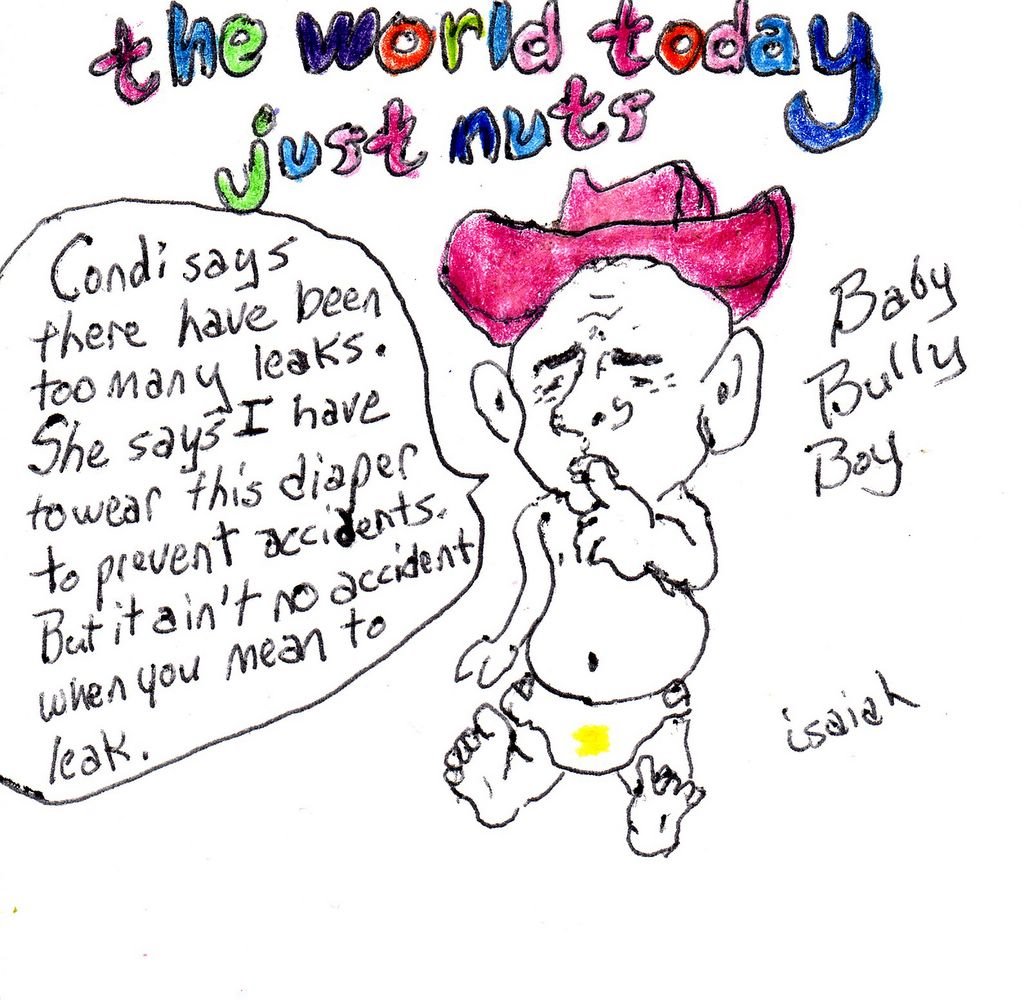
Baby Bully Boy


That's "Baby Bully Boy" from April 9, 2006.


I did not remember the balloon of dialogue or what the comic was about until I read it tonight; however, I do remember the drawing.

The dialogue ties it into the issue of leaks which were big at the time.

The drawing?

I found Bully Boy Bush to be the most infantile White House occupant in my memory and long wanted to draw him as an infant but I'm really not good at that. So I was really pleased with the way that this drawing turned out. So pleased that I remembered it even before I saw it again tonight. That's not me saying, "It's wonderful!!!" That's me saying that knowing how bad I am at infants, I really like the way it turned out. So I'm grading it highly but doing so on a curve.

Here's C.I.'s " Iraq snapshot:"

Thursday, January 7, 2009. Chaos and violence continue, another US service members is dead, bombings rock Iraq, Nouri goes after political rivals, Blackwater agrees to pay victims, and the Iraq Inquiry in London hears from a military officer who states, "We were asked at time in those very chaotic early days to do some things by the Iraqis, which, if we had agreed to, I would be sitting in front of a very different tribunal now, and the American -- American rules of engagement were slightly easier, not hugely, slightly, which meant they were able to do some things that we weren't. "

Starting in London where the
Iraq Inquiry continued public hearings. Today the committee heard from Lt Gen Barney White-Spunner, Nigel Haywood and Keith Mackiggan (link goes to video and transcript options). The news came during White-Spunner's testimony. He focused on Nouri al-Maliki's assault on Basra (which began in March 2008) and, as has previously been noted (including by Gen David Petraeus to the US Congress), Nouri gave the US and the UK little-to-no heads up when he started the assault. The British call the assault the Charge of the Knights. He testified that, as was reported in real time, many Iraqi security forces ended up fighting with militias (not against them). White-Spunner stated that, prior to the assault, Moqtada al-Sadr's influence was declining (and that he believed al-Sadr was in Iran during this time). He estimated that "the population of Basra is but 2.5 probably 3 million" -- an important point to remember. White-Spunner declared at one point, "Now, far be it for me to divine Prime Minister's Maliki's motives, but I have described the political situation in Basra at the beginning" -- and he did. The governor of the province was of another party and was of the opinion (a popular opinion in the province) that the province should split away (in a way similar to the KRG and less under the control of Baghdad). Nouri jumped the timeline for the assault and it was likely due to political reasonings on his part.

Committee Member Lawrence Freedman: Let's just pause and be clear where we are. What you have described is a situation in which there was evident tension between Baghdad and Basra politically --

Lt Gen Barney White-Spunner: Yes.

Committee Member Lawrence Freedman: -- and a degree of urgency, therefore, that attached to that situation with Prime Minister Maliki.

Lt Gen Barney White-Spunner: Yes.

Committee Member Lawrence Freedman: That the Americans were -- had different priorites elsewhere still, that they were looking at Mosul and Baghdad and that the general agreement, which included the Iraqi military contingent or military leadership was for June.

Lt Gen Barney White-Spunner: Yes.

Committee Member Lawrence Freedman: So that was the assumptions. So now, all of a sudden, Prime Minister Maliki decides that this timetable is presumably too relaxed, too gradual.

Lt Gen Barney White-Spunner: Yes.

The US-installed thug Nouri likely jumped an attack by months due to political reasoning, in an effort to quash a political rival. That's especially pertinent today when Nouri's launched an assault on political rivals. What else did Nouri do in that assault?

Lt Gen Barney White-Spunner: We were asked at time in those very chaotic early days to do some things by the Iraqis, which, if we had agreed to, I would be sitting in front of a very different tribunal now, and the American -- American rules of engagement were slightly easier, not hugely, slightly, which meant they were able to do some things that we weren't. I have to say which I think quite correctly we weren't.

Committee Member Lawrence Freedman: I think it would be helpful to have some examples of what you are talking about, I think we can guess.

Lt Gen Barney White-Spunner: We were invited to drop aerial ordnance on areas which we considered not to have been throroughly enough vetted and which could have caused considerable civilian casualties.

Committee Member Lawrence Freedman: This was both from the Iraqi commanders, but the Americans somewhere in between where we --

Lt Gen Barney White-Spunner: No, it is too far to say the Americans somewhere in between. This is the lack of planning, because you know, we had done the planning throroughly for this. If we had had the time, we would have known what the targets were, we would have studied them and we had very clear rules as to the amount of acceptable damage. They are very, as you would expect, in an operation like that, extremely restrictive in a city like Basra. But it is inaccurate to say the Americans were somewhere in the middle. The American rules were very similar to ours. There were occasions when they could use aerial weapon systems when we could not, but it would be going too far to say --

Committee Member Lawrence Freedman: This was quite an important issue in terms of the potential tensions, going back to what I was asking before about civil/military relations. In all Multi-National operations these issues arise, but we have encouraged the Iraqis to be in the lead and in control, but that you don't -- you don't want to be seen to be attacking civilians. So how do you handle these releations with the Iraqis?

Lt Gen Barney White-Spunner: It causes some misunderstanding and there are some -- there are some moments when the Iraqis are irritated with us because we haven't done exactly what they ask, but, as we got this [. . . C.I. note: He does not finish that thought and we're jumping ahead in the testimony, still on this topic] There was no western media in Basra at the time. Indeed, there wasn't for some months afterwards. There was the odd -- one visit. But there was very -- we were aware that the Iraqis were asking us to do some things, as I have described, we didn't want to do and wouldn't do, but generally, on the ground, the sort of -- the relationship between us and the corps and General Mohan's headquarters was incredibly close, as indeed it had to be, because we were prosecuting daily operations with all our soldiers in danger.


Nouri is being allowed to stockpile weapons -- spending billions on them while doing nothing to improve Iraqi lives -- and the Inquiry is informed he wanted areas of Basra targeted and was not concerned with civilian deaths? That was probably the most important revelation because Nouri has no plans to step down as prime minister and today began outlawing various political parites prior to the expected elections.

Channel 4 News' Iraq Inquiry Blogger gives a preview of tomorrow's hearings:

Tomorrow's the last day of the 'narrative' session of the Inquiry, wherein the panel have tried to patch together what happened. From Monday we move onto why -- the then-PM, his inner ring and the upper echelons who actually formulated the policies these soldiers, diplomats and civil servants then had to enact. Chilcot's team took a knocking back at the start for being insufficiently inquisitorial (I mentioned in the Tweets but iraqinquirydigest.org spotted
a particularly good piece yesterday by top barrister Michael Mansfield QC on this). It'll be interesting to see if there's a change of style with with the new witnesses.

From Michael Mansfield's "
Iraq inquiry: we have every right to know why we went to war" (Times of London) referred to above:

The Iraq inquiry has resumed this week, promising crucial witnesses -- Tony Blair, Jack Straw, Lord Goldsmith and possibly Gordon Brown.We have been told repeatedly what it is not: a trial, an inquest, an inquisition, a court, a statutory inquiry. Nevertheless, however its investigative format is described, none of this fancy terminological footwork can evade the central expectation for a thorough, transparent and impartial quest for the truth about the way decisions and actions were carried out. What remains is not clear. Neither a judge nor a lawyer is on the panel, which is bizarre given that one of the main questions raised by most victims and their families relates to the illegality of the war.

In Iraq,
Nada Barki (New York Times) reports an al-Anbar Province bombing which has claimed multiple lives and "struck the houses of an anti-terrorism official and his relatives" -- with three being planted in around the homes and a fourth hitting "a police convoy" attempting to take the wounded to a hospital. Hamid Ahmed (AP) identifies the official as Lt Col Walid Sulaiman al-Hiti (his father's home was also targeted). BBC News counts 8 dead and six wounded in four exposions. Fadhel al-Badrani, Ali al-Mashhdani, Jim Loney and Andrew Dobbie (Reuters) count seven dead including the father and mother of Waleed al-Hiti, his two sisters, 1 brother and sister-in-law and attorney Qais Hamoodi. Mohammed Al Dulaimy (McClatchy Newspapers) reports 8 dead and identifies them as Lt Col Waleed "Hammoudi's wife, children, his brother (and his wife), sister and other members of the family". Anne Tang (Xinhua) informs, "Authorities in the town imposed traffic ban and blocked the entrances of the town, as dozens of Iraqi security forces were deployed on main streets and intersections while dozens others were carrying out search operations in the town, he added. " From yesterday's snapshot:Meanwhile Uthman al-Mukhtar (Asia Times) reports that al Anbar Province residents are "alarmed" by the recent increase in violence in the province and quotes Noor Saadi stating, "The police can't even protect themselves." The violence is causing her to keep her son at home and not let him attend school while other people are refusing "to return to their businesses or open their shops."

Jomana Karadsheh (CNN) notes last week's bombing in Ramadi resulted in at least 23 deaths. Leila Fadel and Uthman al-Mokhtar (Washington Post) explain, "After last week's bombings, police chief Tariq al-Aasal -- widely viewed as incompetent -- was forced out and replaced with a temporary commander from the Iraqi Army in Baghdad. The appointment of Bahaa al-Azzawi was made directly by Prime Minister Nouri al-Maliki, angering tribal chiefs who saw the move as an affront to their power." Karadsheh, Fadel, al-Mokhtar as well as BBC New's Jim Muir note that violence in Anbar really only decreased when the Sahwa movement took hold "Sahwa" also known as "Awakenings" and "Sons Of Iraq" -- Sunnis put on the US payroll so they would stop attacking US military equipment and US service members. In 2008, Nouri was supposed to take over the monthly payments (US tax payers were paying approximately 92,000 Sahwas $300 a month) but he couldn't get it together. Still couldn't in Februrary. In the summer he reported finally managed to absorb all the payments (unless the rumors are true that CERP funds have been partially paying for Sahwa). In addition, Arab media last month was reporting Nouri planned to drop Sahwa from the payroll in the new year. Michael Gisick (Stars and Stripes) reported attacks on Sahwa are on the rise with the US military estimating an average of ten attacks a week in the last two months which "has underscored the increasing weakness of groups widely credited with helping turn the tide of the Iraq war." Monday Karim Zair (Azzaman) reported mass arrests were taking place "in Sunni Muslim-dominated neighborhoods of Baghdad and towns and cities to the north and west of the capital".

In other reported violence . . .

Mohammed Al Dulaimy (McClatchy Newspapers) reports a Mosul home bombing which claimed the lives of 2 children and left a third injured, a Mosul roadside bombing which wounded two police officers, a Mosul car bombing which left four people wounded, a Mosul grenade attack which wounded five people and a Khaniqn roadside bombing which claimed the life of 1 police officer and left thirteen more wounded. On the last bombing, Anne Tang (Xinhua) reports that 3 people died in the bombing and fifteen were injured in the bombing apparently targeting a Shi'ite mosque. Reuters drops back to yesterday to note a Balad suicide bomber who took his/her own life and left eight Sahwa wounded and a Tuz Khurmato roadside bombing which claimed the life of 1 child and left four more injured.
AP reports the 1 American soldier "has died in northern Iraq" and since USF can't do their job (which is to announce deaths, DoD identifies the dead) there may be confusion but northern Iraq is not Baghdad so this is not the death in Baghdad reported yesterday. ICCC's count is 4374 for the number of US service members killed in Iraq since the start of the Iraq War. CORRECTION TO SNAPSHOT E-MAILED A FEW MINUTES AGO. USF announces: "CONTINGENCY OPERATING BASE SPEICHER, Iraq -- A Soldier assigned to United States Division-North died of non-combat related injuries, Jan. 6. The incident is under investigation and release of the Soldier's identity is being withheld pending notification of the next of kin. The name of the deceased service member will be announced through the U.S. Department of Defense Official Web site at http://www.defenselink.mil/. Task Force Marne is deeply saddened by this loss and will provide more information on this incident following next of kin notification." They posted that late today and missing that announcement is my fault for not returning a phone call until after I dictated the snapshot. My apologies. They did announce today's death this evening. Again, my error, my apologies. And my apologies to a friend at USF who left a voice mail for me that I didn't return until after dictating the snapshot.

War is big business. Turning to Blackwater (now known as "Xe") and KBR. Last week Judge Ricardo Urbina handed down a decision (
announced last Thursday) to toss out the case against Blackwater for the September 2007 massacre as a result of the Justice Department basing much of their case on statements the contractors gave to the US State Dept -- statements given after the men were told anything they said would not be used against them -- has the Baghdad based government or 'government' enraged. Al Jaezeera reports that Blackwater has agreed to settle with the victims and their families which has led Burke O'Neil LCC to drop their cases against Blackwater, "Susan Burke, the lawyer for the firm, filed for the cases to be dismissed in court late on Wednesday." Chris McGreal (Guardian) adds, "Today's legal settlement amounts to an implicit admission by the highly secretive company that some of its guards were responsible for a series of unjustifiable killings. Blackwater appears to have reached the deal to avoid a court hearing that threatened to force the company to lay bare what critics contend was a policy of shooting first, as well as the involvement of its employees in an array of criminal activities." (Blackwater has new charges related to Afghanistan, read McGreal's article for more on that.)

Burke LLC is also representing US soldiers and contractors in 22 lawsuits filed against KBR. And doing so a time when the American people feel the US government is not doing enough for US service members. Brian Montopoli (CBS News, Political Hotsheet) reports on a new CBS poll which finds, not surprisingly, that respondents say the US military is spread too thin and: "They also say the U.S. is not doing enough for veterans of the wars in Iraq and Afghanistan. Seventy-one percent of those surveyed say the government has fallen short when it comes to addressing the needs and problems of troops returning from those conflicts. Just 22 percent say the government is doing enough." Dionne Searcey (Wall St. Journal) reports on the National Guard members in Indiana who are suing for their exposure to a known cancer causing agent while serving in Iraq:In a lawsuit filed in federal court in Indiana, the Guardsmen allege that oil company KBR Inc. "disregarded and downplayed" the fact that the site at Qarmat Ali was coated with the hazardous chemical sodium dichromate. They were exposed, they say, to the chemical that is used as an industrial anti-corrosive agent to protect pipes. As a result, the soldiers suffered "unprotected, unknowing, direct exposure to one of the most potent carcinogens and mutagenic substances known to man," alleges the suit, which seeks monetary compensation for health problems the soldiers say they have suffered.The lawsuit was filed last month and has to do with the Qarmat Ali water plant. December 3rd, Sgt Mark McManaway told Scott Bronstein and Abbie Boudreau (CNN), "The worst part is that the military has only just recently advised us that the stuff we were exposed to was much worse than they thought while we were out there. It's in our bodies, but we don't know how bad it is. Maybe within the next five years cancers could start showing up. You've got a ticking time bomb in you -- and when's it going to go off?"Evan Bayh is one of Iraq's two US Senators. Bayh has introduced a bill that would create a federal registry similar to the one for Agent Orange exposure during Vietnam -- the bill, if passed, would allow those exposed to avoid the long struggle Agent Orange victims had to go through attempting to establish their exposure at a time when the US government was denying exposure and minimizing it. The bill was referred to the Senate Veterans Affairs Committee months ago and is currently buried there. (Bayh does not serve on the Veterans Affairs Committee.) Today the Wall St. Journal reports KBR is predicting its stocks will be at $1.60 to $1.80 a share in Fiscal Year 2010. As Kat's noted last night and Tuesday ("Not a good day" and "Thoughts on Byron Dorgan and more") and Mike noted last night ("Dems retiring, NOW wants action, Ann Talbot gives a warning"), Senator Byron Dorgan has decided not to run for re-election in 2010. Kelley Beaucar Vlahos (Antiwar.com) observes:

What I do know is that Sen. Dorgan held over 21 hearings in the Senate on private contractor fraud and abuse, including war profiteering, the physical and mental harassment of whistle-blowers in-theater,
and most recently on Nov. 6, the constantly burning open-air pits of waste in Iraq and Afghanistan that have made countless veterans sick and looking to the Pentagon for answers. Kellogg, Brown and Root, a former subsidiary of Halliburton, is being charged in 22 different class action lawsuits with purposefully burning toxic waste in the open-air pits to save a buck on not installing incinerators. There are now more incinerators at U.S bases today than there were a year ago, but the alleged victims contend that KBR, which has the contract for waste management services, plus practically everything else in its multi-billion LOGCAP contract, could have installed more incinerators years ago (a charge KBR officials vociferously deny).
But even aside from burn pits, Dorgan was one of those rare members of Congress who actually gave a flying fig about exposing not only the abuse that private contractors were perpetuating in the war zone, but the over-use of private contractors in the war zone, period. Aside from Rep. Henry Waxman, D-CA, on the House side, Dorgan, as chairman of the Democratic Policy Committee, was the only one to use his leadership post as a bully pulpit against abuses -- even when there weren't cameras on to report it -- from very early on in the post-invasion occupation(s).

Turning to Iraqi politics. Elections were supposed to take place in December 2009 but Nouri kicked it back with the promise they'd take place in January 2010 which . . . didn't happen. Now elections are supposed to take place in March.
An Iraqi correspondent for McClatchy Newspapers reports: "The speaker of the Iraqi parliament urged the heads of the political blocks to push the members of their blocks to attend the parliament sessions in order to approve some important laws that deal with the daily life of Iraqis. The meetings came after the parliament failed in approving any law during many sessions because of the non sufficient quorum. That means more than 138 out of 275 lawmakers were absent and they did not do their national duties, which they were elected for." Today Inside Iraq reports:

Iraqi De-Baath commission banned Sunni politicians and their political blocs from participating in Iraq's national elections due in March.
Ali Al Lami, head of the De-Baath commission, told Arab news televisions that Saleh Al Mutlak is banned from participating in the next elections and said this decision is "final".
The commission name was changed to justice and accountability commission and its main job is to ensure that high ranking or active Baath party members will not be part of Iraq's new political regime or military.
The ban included Nihro Mohamed, Saad Al Janabi and Saleh Al Mutlak, a lawmaker and a former Baathi and to include 14 political blocs and its 400 candidates. The commission said that banning the head of a political bloc will extend to his bloc and its members.

Are we still pretending on behalf of Crazy? Are we still pretending he's a 'leader' or anything but the new Saddam -- who, like the previous one, was US installed?

In the US, it seems more and more the only coverage most newspapers carry on Iraq takes place in the how-to. Martha Stewart joins Hints for Heloise in awarness on the Iraq War -- an awareness lacking in the bulk of the national press corps.
From her latest nationally syndicated column Ask Martha (link goes to Boston Globe):Q. I'd like to send cookies to my nephew, who is serving in Iraq. What types will survive the journey, and how should I package them?
A. Home-baked cookies are a wonderful way to give your nephew (and undoubtedly his friends) a taste of home. Transit time may take more than two weeks, so look for cookies with a long shelf life. Shortbread is a good bet, and you can add variety with flavors such as chocolate or lemon. Oatmeal-raisin also has staying power, because dried fruit helps the cookies stay moist. Gingerbread men are a sturdy choice around the holidays. Steer clear of chocolate chips, which are likely to melt; candy-coated M&M's are a good substitute. Also, label any baked goods that contain nuts. For maximum freshness, freeze the cookies until the day you're ready to send them. An efficient and economical way to mail them is in a Priority Mail Army Post Office/Fleet Post Office flat-rate box, which is 12 by 12 by 5 inches; it costs $11.95 to ship. Wrap the cookies individually if you like, for easier distribution. Place them in a cushioned airtight container, and fit that inside the flat-rate box. (You can pad the space between the two containers with extra socks for your nephew.) Then seal the edges with packing tape. If you want to send a package but don't have someone in mind, skip the baked goods: Soldiers are required to throw away homemade foods unless they know the sender. But prepackaged treats, as well as magazines and toiletries (packed separately), are certainly welcome. For soldiers' requests and addresses, go to
www.anysoldier.com/wheretosend. For more nonprofit organizations that help those in the armed services, visit www.ourmilitary.mil/help.shtml.

Lastly Friday night on most PBS stations,
NOW on PBS begins airing (check local listings) and this week's program explores the Afghanistan War:
President Obama is sending as many as 30,000 more troops to combat Taliban and al Qaeda forces in Afghanistan this year, but are we missing the true target? On Friday, January 8 at 8:30 pm (check local listings), NOW reports directly from Pakistan's dangerous and pivotal border with Afghanistan, where Pentagon war planners acknowledge many of the enemy fighters and their leaders are based. The U.S. has been relying on Pakistan to act against Taliban militants there, but the Pakistani army's commitment is in question. NOW takes you to the true front lines for an eye-opening, inside lookyou haven't seen before, and won't soon forget.

And
NOW on PBS has posted video online of Pakistan forces fighting the Taliban as a preview for Friday's show.


iraq
channel 4 newsiraq inquiry bloggerthe times of londonmichael masnfield
the new york timesnada bakrihamid ahmedbbc news
xinhuaanne tang
mcclatchy newspapersmohammed al-dulaimy
cnn
jomana karadsheh
the washington post
leila fadel
jim muir
stars and stripesmichael gisick
cbs newsbrian montopolithe wall street journaldionne searceyscott bronsteinabbie boudreau
the boston globemartha stewart
pbsnow on pbs


Read on ...

Thursday, December 31, 2009

Bad Moments of Bully Boy Bluster


So that's April 2, 2006's "Bad Moments of Bully Boy Bluster." I was revisiting Bully Boy's infamous "Bring 'em on!" remarks (he made them July 2, 2003).


What stands out most though is going through the archives and grasping that between the comic I re-posted last week and the one above, I took two weeks off.

I used to do that all the time. Now I worry that C.I. will get stuck doing everything. So I hate to take a Sunday off. If I'm going to, I usually try to line up someone else to do a text post so C.I.'s not feeling like she has to do her own work and then double it to make up for me. I'm doing two comics for the New Year right now. I haven't colored in either one. One I've inked the other's still a rought sketch. So I've really got nothing on my mind but finishing those two comics. That's how it goes.
Here's C.I.'s "Iraq snapshot:"

Thursday, December 31, 2009. Chaos and violence continue, questions are being raised in Iran and England about the release of a British hostage, questions in the US seemingly don't exist, can you be commander in chief while sending the message that you don't take seriously the loss of US troops, a new poll finds the bulk of Americans see no improvement in Iraq in the coming year, and more.

Peter Moore is alive. Alan McMenemy's status is unknown. The same as it was during
yesterday's snapshot. May 29, 2007, the two men were kidnapped at the Ministry of Finance in Baghdad along with three other British citizens: Jason Crewswell, Jason Swindlehurst and Alec Maclachlan. The League of Righteous staged the kidnapping using official vehicles of the Baghdad security forces and using official uniforms of the Baghdad security forces. Moore was released yesterday, Alan McMenemy's status remains unknown and the other three men are dead.

July 29th, the families and loved ones of the five held a press conference. The bodies of the two Jasons had been turned over and there were rumors that Alan and Alec were dead as well.

Haley Williams: These reports are the worst possible news for us but we continue to hope that they cannot be true. But whatever Alec's condition, he no longer should remain in Iraq. We appeal to those holding him to please send him home to us. I speak to you as the mother of Alec's son. We are not the people holding your men but I do understand your feelings cause you're going through the same pain we are going through. If we had any influence over the release of your men, we would release them to you but we don't. Please send him home because as a family we can't cope with this anymore.

That is what Haley Williams stated. But, as noted in the
July 29th snapshot, American audiences didn't get to hear all of Haley's statement. Most outlets ignored it and CNN cesnored it, stripping out this section: "We are not the people holding your men but I do understand your feelings cause you're going through the same pain we are going through. If we had any influence over the release of your men, we would release them to you but we don't." American audiences couldn't be told that the five British citizens were being used as barganining chips by the League of Righteousness. [See Deborah Haynes (Times of London link has text and also has video of the press conference) report for the families statements.]

Now that's really important. And it's important to what's happening right now and it's important to understanding how the whole thing played out. The British government never wanted publicity. They told the families -- they LIED to the families -- that going public would risk the lives of the five. They weren't trying to save the five. They never managed to, in fact. If Alan's alive and they save him, he'll be the first one they saved.

The British government was inept and it may have been criminally negligent. The kidnapping was high profile and the British government -- already being run out of parts of southern Iraq with their base destroyed and used as lumber by the Iraqi resistance -- had enough embarrassments on its hands. The government's request for a media blackout was never about the five men, never about saving them. It was always about saving Tony Blair and Gordon Brown from any further embarrassments. That's why Gordon Brown, current prime minister of England, could grand stand yesterday and speak of "Peter" yet only weeks before he refused to meet with Peter Moore's father.

They never wanted to talk about it to the media or to the families but when they think they have a photo op Brown and his administration are all over the press bragging and self-congratulating. For what? They didn't accomplish a damn thing and shouldn't be allowed to use Peter Moore as a shield to hide behind. Three British citizens are dead and on one knows Alan's state.

When the families held their press conference at the end of July, they did so over the objections of the British government. Why CNN elected to censor what was said is a question that everyone needs to be asking and part of the answer goes to the fact that few want to talk about how Peter Moore and three corpses were released. From the
June 9th snapshot:


This morning the New York Times' Alissa J. Rubin and Michael Gordon offered "
U.S. Frees Suspect in Killing of 5 G.I.'s." Martin Chulov (Guardian) covered the same story, Kim Gamel (AP) reported on it, BBC offered "Kidnap hope after Shia's handover" and Deborah Haynes contributed "Hope for British hostages in Iraq after release of Shia militant" (Times of London). The basics of the story are this. 5 British citizens have been hostages since May 29, 2007. The US military had in their custody Laith al-Khazali. He is a member of Asa'ib al-Haq. He is also accused of murdering five US troops. The US military released him and allegedly did so because his organization was not going to release any of the five British hostages until he was released. This is a big story and the US military is attempting to state this is just diplomacy, has nothing to do with the British hostages and, besides, they just released him to Iraq. Sami al-askari told the New York Times, "This is a very sensitive topic because you know the position that the Iraqi government, the U.S. and British governments, and all the governments do not accept the idea of exchanging hostages for prisoners. So we put it in another format, and we told them that if they want to participate in the political process they cannot do so while they are holding hostages. And we mentioned to the American side that they cannot join the political process and release their hostages while their leaders are behind bars or imprisoned." In other words, a prisoner was traded for hostages and they attempted to not only make the trade but to lie to people about it. At the US State Dept, the tired and bored reporters were unable to even broach the subject. Poor declawed tabbies. Pentagon reporters did press the issue and got the standard line from the department's spokesperson, Bryan Whitman, that the US handed the prisoner to Iraq, the US didn't hand him over to any organization -- terrorist or otherwise. What Iraq did, Whitman wanted the press to know, was what Iraq did. A complete lie that really insults the intelligence of the American people. CNN reminds the five US soldiers killed "were: Capt. Brian S. Freeman, 31, of Temecula, California; 1st Lt. Jacob N. Fritz, 25, of Verdon, Nebraska; Spc. Johnathan B. Chism, 22, of Gonzales, Louisiana; Pfc. Shawn P. Falter, 25, of Cortland, New York; and Pfc. Johnathon M. Millican, 20, of Trafford, Alabama." Those are the five from January 2007 that al-Khazali and his brother Qais al-Khazali are supposed to be responsible for the deaths of. Qassim Abdul-Zahra and Robert H. Reid (AP) states that Jonathan B. Chism's father Danny Chism is outraged over the release and has declared, "They freed them? The American military did? Somebody needs to answer for it."
The League of Righteous conveyed to the British government (which should be asked about those 'channels' of communication) that as long as their leader, his brother and other members of the League of Righteous were held in US-run prisons in Iraq, the five British hostages would remain hostages. That was their demand, that was the kidnapper's ransom. It's awfully silly for CNN to leave that out when the families of the kidnapped are making an appeal to the kidnappers. It explains to CNN viewers what the kidnappers want. But it got censored right out of the story at the request of the White House. CNN needs to explain that. They need to explain, first of all, why they're allowing the White House or any government body to determine what they broadcast when the First Amendment exists to make sure that doesn't happen. Then they need to explain specifically why they were told they couldn't air any reference to release of prisoners?

In ten years, you'll probably read the whys to both in a New York Times column because that's how CNN works. The British government never wanted press coverage of the kidnappings (until the poll challenged Gordon Brown could hide behind Peter Moore like he did yesterday) and the US government didn't want coverage after Barack Obama became president. The Bush White House never gave 'notes' to CNN on this story. Not when the kidnapping took place, not any time after. But CNN took notes from the Obama White House including from Barack himself. Anyone going to get honest about that?

For the British, it was an embarrassment. Under Bush, the following was conveyed to the British government (through various channels including the State Dept and the White House itself): US forces will patrol and look, special forces can be deployed for search missions, but NO Iraqi prisoners will be traded for the British hostages. That was the policy under Bush. And the weak and inept British government couldn't do a thing to save their own citizens. With Barack, who fancies himself President of the World and not President of the United States, an appeal was made.

The appeals started before Barack was sworn in and there's confusion as to the dead. It's thought, in retrospect, that when the talks began that only one was known/assumed dead (although two on Barack transition team state it may have been known/assumed that two were dead) but before the June release of prisoners, it was known that three were dead and a fourth was assumed. Before the US released the prisoners in June, it was known that only Peter Moore might be alive.

Peter Moore is a British citizen. It was the responsibility of the British government to work to secure his release. That can include asking other governments for help. In Barack's case? The prisoners were responsible for a raid on a US base and the deaths of 5 US service members. The Iraq War had not ended nor had the Afghansitan War. Meaning, you still have boots on the ground, you're still sending people over there. As President of the United States, his first duty was to the American people. That includes the five US service members who died and it includes their families and their friends. It also includes all of the men and women he is deploying to war zones.

Barack Obama's actions spit on the military. There's no way to pretty that up. The scheme/scam never should have been entered into. George W. Bush was, by no means, the brightest bulb in the lamp, but even he grasped the issues on this.

Barack Obama is commander of chief of the US military. The military's commander made 2009 about saying that the lives of US troops do not matter. The actions he took state that 1 British citizen is more important than 5 dead Americans. He was elected to be president of the United States, it was a job he wanted and it was a job he said he was up for. He's clearly failed throughout 2009 at his job. But how do you, as commander in chief, now ask any other service member to deploy?

How do you do it? You've just 1 British life trumps five American soldiers. How do you do it? How you earn their trust now? How do you tell him the crap about fight with honor when everyone knows that the US military held the ringleader of the attack on the US base in prison and you ordered his release?

In the US, the media's largely avoided the story. Despite this, when we speak to the military or military families about the Iraq War, since July, this topic has regularly been raised by them. This under-reported issue of the US release is known and discussed.

Barack Obama has falsely accused the left of spitting on soldiers after Vietnam. Barack has a habit of accusing others of what he does. It's called projection and this habit became obvious during the 2008 primary campaign. While he was making that statement this year, he had already engaged in spitting on the troops.

Last night, Alice Fordham's "
Peter Moore freed after US hands over Iraqi insurgent" (Times of London) reported:The British hostage Peter Moore was dramatically set free yesterday after the United States handed over an Iraqi insurgent suspected of planning the deaths of five American servicemen. Mr Moore, an IT consultant, was freed by League of the Righteous, or Asaib al-Haq (AAH) -- an extremist Shia group allied to Iran -- after 31 months and spent his first night of freedom at the British Embassy in Baghdad. He is expected to fly home today. David Miliband, the Foreign Secretary, said that officials had worked tirelessly to secure his release but strongly denied that the British Government had given ground to his captors. He said: "There were no concessions in this case. There was no -- quote, unquote -- deal." Foreign and Commonwealth Office sources confirmed, however, that the transfer from US custody a few days ago of Qais al-Khazali, a cleric and commander of AAH, helped to pave the way for Mr Moore's release. They also admitted that British diplomats had been pressing the US to hand over al-Khazali to the Iraqi administration. Today Suadad al-Salhy, Mohammed Abbas, Khalid al-Ansary, Missy Ryan, Mohammed Abbas and David Stamp (Reuters) report, "Iraq said on Thursday its judges could soon free the leader of a Shi'ite group believed to be behind the 2007 kidnapping of Briton Peter Moore if they found no criminal evidence, only a day after the hostage was released." Mona Mahmood, Maggie O'Kane and Guy Grandjean (Guardian) report:The men -- including Peter Moore, who was released yesterday after more than two years in captivity -- were taken to Iran within a day of their kidnapping from a government ministry building in Baghdad in 2007, several senior sources in Iraq and Iran have told the Guardian. They were held in prisons run by al-Quds Force, a Revolutionary Guard unit that specialises in foreign operations on behalf of the Iranian government.
[. . .]
One of the kidnappers told the Guardian that three of the Britons – Jason Creswell, Jason Swindlehurst and Alec Maclachlan – were killed after the British government refused to take ransom demands seriously.Part of the deal leading to the release of Moore involved
the handing over of the young Shia cleric Qais al-Khazali, a leading figure in the Righteous League.Let's zoom in on the Iranian issue. First, some question the Guardian story. BBC News' Fred Gardner (link has text and video) offers, "The findings in the Guardian's year-long investigation into alleged Iranian involvement in kidnapping Britons in Iraq are being disputed by both British and Iraqi government officials. A senior Foreign Office official said that while it was 'not impossible' that the British hostages had, at some stage, been taken across the border into Iran, that did not mean the Iranian authorities themselves were behind the kidnapping. The British government view remains that there is no firm evidence to suggest Iranian government involvement." Second, whether or not the Iranian government was involved, it shouldn't be used to push for war on Iran from the US. Though war on Iran is wanted by the White House, the reality is that the Obama administration was not forced into the deal. This deal has nothing to do with the United States until Barack made the call to release the prisoners. That decision was idiotic and stupid. But he wasn't forced into it and it's not a reflection on Iran or a reason for war with them. That's why we're stressing the White House deal right now and stressing it firmly. What was a few remarks in passing to many has now become a steady drip and as more and more talk about the deal, some in the press will report it and some factions will seize upon it saying, "We must go to war with Iran!" No, that's not what it says. Iran had nothing to blackmail the US with, had nothing to force the US. Barack made the decision to release the prisoners. Don't mistake his weak actions for an attack on the US by Iran. While the government of England and Iran are in denial about what took place, notice that in the US no one's even forcing the White House to go on record.

Meanwhile the world gets ready for a new year and that's true in Iraq as well.
Jamal Hashim (Xinhua) notes wishes of some Iraqs such as school teacher Ali Abbas, "I wish the new year will bring peace and security improvement to my people, and I wish that all Iraqis will take part in the vital parliamentary election which we hope it will draw better future. I wish my people will elect the right people for the coming parliament because we have suffered enough by the existing politicians. The ball is in my people's field, hopefully we will have for better future." That wish could be heard in any country. Ali Abbas isn't an enemy of anyone. The US government declared war on Iraq and it's the Iraqis who suffer. And the American citizens. The US government doesn't really suffer, now does it? Yesterday on KPFA's Flashpoints Radio Nora Barrows-Friedman spoke with the program's Iraq correspondent Ahmed Habib and we'll note a section of that (this broadcast is archived at KPFA and Flashpoints Radio).


Ahmed Habib: The bombings, the violence, that we witnessed today, of course, is another chapter in the destruction of Iraq for the last seven years. We've seen over one million people die. Five million people have become refugees in a record time. We see that the infrastructure of the country has not only not been rebuilt but in fact been destroyed. The systematic theft of Iraq by American military contractors, by a corrupt government, has really left the Iraqi people in a situation where survival is their upmost priority. And of course, in contrast to that, we see an Iraqi government that seems adament at trying to project itself as a democratic institution. We just now, of course in the last few months of the year the Iraqi Parliament was able to get itself together and pass an election law and really these elections, what they're going to translate in terms of reality and people's lives in Iraq is that there's going to be an increase in violence. The way that politics under -- sort of unfolds itself in Iraq -- as perhaps not what our listeners in the United States are used to, you know, in terms of expensive television commercials or boring debates. But in Iraq, unfortunately, these sort of differences are dealt with through violence, bombings, car bombings. And, you know, in the last few months of the year, we saw bombings that ripped through the heart of Baghdad and I think that's a real sign that the election campaign in Iraq is under way. And the Iraqi Parliament? Last week there was a session held in the Iraqi Parliament that was going to discuss the budget for Iraq in 2010 and a whopping number of 12 members of Parliament showed up so I think it's really indicative of how serious the Iraqi government is about governing Iraq. Again the most important indicators of success in Iraq unfortunately are ones perhaps that aren't found only in the number of people killed but acts of violence are also buried in the chronic failure of the Iraqi govenrment to provide for its people. In the city of Baghdad, the capitol city of Iraq, the city of five million people, there is still a shortage of electricity, some areas of the city get only up to five or six hours a day of power, there is a complete lack of health care in a country that has already been destroyed by over a decade of genocidal sanctions that killed over one million people. And the lack of basic services and education and of course we've seen that Iraqi youths wander the streets of Baghdad searching for bread crumbs, searching for dignity and employment. And those are the real indicators that we should be looking at -- not election dates, not how many members of Parliament are running for which party. That is the kind of language and discourse that the Iraqi government, in conjunction with their American occupiers, are very busy trying to push but the people of Iraq are very cognitive of what the reality on the ground is. It's corruption, it's killing, it's chaos. And although people that have been reporting from outside of Baghdad are sort of trying to portray, have been trying to portray, an image of relative calm and improvement in the situation with security -- and that might be the case compared to the horrifying conditions that Iraqis lived in at the peak of the so-called sectarin violence in 2007 but that is not a reason or an accurate descrition that should lead us into a state of complacency thinking things in Iraq are heading in the right direction. The Constitution, which is sectarian in its most fundamental ethos, is still at the heart of the decisions in the way that political power is being divided. We seethe sell off of Iraq resources in the absence of legal mechanism to measure the transparnacye of such decision is now really being highlighted with the dozens of oil contracts that have either been signed or about to be signed . And I think that it important for people in the west, particularly to our listeners in the United States to hold their government accountable for their war profiteering and the destruction of Iraqi society that we're seeing. And, of course,the way to look at Iraq is not to look at it in a vaccum but to look at it within the context of Israeli apartheid, within the context of the occupation of Afghanistan, within the contest of the war mongering -- the beating of the war drums with countries we're seeing like Iran, with countries like Yemen. And I think it's important to look at it as another tragic episode in this so-called war on terror which is really a war of terror itself.

Nora Barrows-Friedman: That's the voice of our special correspondent Ahmed Habib speaking to us from Doha. Ahmed, let's talk more about the Obama administration's agendas over the past year. Obama inherited this occupation and has only sought to expand the war budget, continue the occupation, continue the policies of his predecessor, hire more private contractors. What are your biggest concerns and also what are your wildest dreams for your country, for Iraq, as 2009 draws to a close? Talk about the concept of revolution in a time of great suffering and deep despair in your country. Talk about that.

Ahmed Habib: There is no doubt that the Iraqi people have a great tradition and history of revolution. And the people of Iraq hold an immense ability to be resisting in the face of this violence and brutality that has gone hand-in-hand with the American occupation -- an extension, of course, of the kind of genocide Iraqis experienced under the sanctions and of course an extension of the genocide that they experienced under the American-sponsored dictorship of Saddam Huseein as well. So there is no doubt that the Iraqi people will be able to overcome these conditions and will talk later about some of the tremendous things that are happening in Iraqi communities and the diaspora. But I think it's important for our listeners to sort of dispell many of the myths that had been promoted by the Obama adminstration with regards to their attempts to "end the war in Iraq." The Obama administration has not only inherented many of the same policies that were adopted by the Bush administration and we saw early on in the year the Obama administration's refusal to publish images of people that had been tortured and de-humanized and bases that had become prisons throughout Iraq and of course in Afghanistan as well. But we also saw the emergence and sort of the truth unveiled about the Status Of Force Agreement -- known as SOFA in the American media. And this agreement was, of course, was supposed to be the agreement that would embody the withdraw of American troops from Iraq and subsequently lead to the end the occupation. What many people didn't know is that within this agreement there are clauses that will not only keep permanent military bases in Iraq but will give the America the ability to conduct military operations without the permission of the Iraqi government, that America will control air space above a certain altitude in Iraq, and, of course, America's political strangle-hold on the Iraqi government through, as you were mentioning, the ascent of thousands of military contractors in Iraq, through the privatization of the most fundamental sectors of Iraqi economy are the real elements of the American occupation here. We see, for example in Iraq, fundamental sectors such as agriculture and education -- ironically in a country that invented both agriculture and education -- now being sold off to American corporations under the guise of of American occupation. We also heard early on in 2003, Colin Powell speak about how NGOs are part of the American occupation and, in fact, on the front line. And this has become very true in Iraq as well. And the American occupation of Iraq is perhaps no longer constituted by American soldiers on the ground raping, killing and maiming Iraqi civilians but now has really taken on a much scarier and more longterm identity in terms of the strangle-hold it has on many of Iraq in terms of all the things I have mentioned but also in terms of how Iraqi politics and the day to day running of the government also unfolds.

Meanwhile a new Associated Press-GfK poll [PDF format warning,
click here] found that 65% of respondents rate the Iraq War as "extremely/ver important" -- the same number who stated they oppose the Iraq War. (5% said the illegal war was "not at all important"), only 49% approve of Barack's handling of the Iraq War (40% disapprove). Asked if they thought conditions in Iraq would improve in 2010, get worse or stay the same, 53% stated things would stay the same.

In other news, 5 Blackwater mercenaries received news today that there would be no prosecutions for the September 16, 2007 massacre in Baghdad.
BBC News reports that Judge Ricardo Urbina reviewed the evidence submitted by the prosecution and found it was built around statements the five made to US State Dept staffers -- despite the five being told that any statements to the State Dept would not be used against them. There will be a lot of disgust over Urbina's decision; however, Urbina's not the problem. If that was the agreement with the State Dept and that's what the prosecution relied upon, the charges had to be tossed aside (and, like it or not, it was fair). The problem has to do with the decision to grant immunity to begin with -- a decision that was called out in real time. So Donald Ball, Dustin Heard, Evan Liberty, Nick Slatten and Paul Slough walk. And the judge's decision was a fair and accurate one. After blaming Condi and others at the top of State in 2007, the blame should then go to the current Justice Dept which damn well should have known not to use those statements. Ball, Heard, Liberty, Slatten and Slough start the new year with this legally behind them.

iraq
alice fordham
the times of londonreuterssuadad al-salhymohammed abbaskhalid al-ansarymissy ryanmohammed abbasdavid stampthe guardianmona mahmoodmaggie o'kaneguy grandjean
jamal hashimxinhua

Read on ...

Thursday, December 24, 2009

The tyranny of the 'independents'


From March 12, 2006, that's "Bully Boy Negotiates with 'independent' Republicans Olympia Snowe & Chuck Hagel." And Snowe, of course, was important to the plan Barack's decided to force on the American people (legislating that we all by insurance, not providing with insurance, understand).


It's weird to think of how Olympia Snowe has such oversized importance. She's one senator. Everybody courts her. I don't think Hagel's even in the Senate anymore, is he?

Does it matter thought? Bush supposedly left the White House Jan. 21, 2009 but, to look at any of the 'new' policies, it's as though Bush never left.


Here's C.I.'s "Iraq snapshot:"

Thursday, December 24, 2009. Chaos and violence continue, Gen Ray Odierno shows leadership many below him lack, there's no 'safe' religion in Iraq, Congress is going to hold the VA accountable when?, and more.
The Ashura pilgrimage is ongoing in Iraq and so is the violence. Shi'ite Muslims head to Krbala for rememberance and mourning. As with all pilgrimages in Iraq -- and despite Nouri al-Maliki's claims of having brought 'security' to Iraq -- the pilgrims are targeted. AP reported 11 dead and seventy wounded in bombing attacks on the Pilgrims today in Babil Province -- AP has now updated the 11 to 13 dead and the number may continue to rise throughout the day. Li Xianzhi (Xinhua) explains, "An explosive charge went off at a parking lot in the center of Hilla, some 100 km south of Baghdad, detonated at about 1:30 p.m. (1030 GMT), the source told Xinhua on condition of anonymity. Minutes later, a car bomb parked at the site went off after Iraqi security forces and onlookers gathered at the scene, the source said." Al Jazeera notes yesterday's attacks which led to the deaths of 4 pilgrims in Baghdad and twenty-eight more injured. CNN adds, "Ashura commemorates the martyrdom of Hussein, grandson of the Prophet Muhammad. Hussein was killed in battle in Karbala in 680, one of the events that helped create the schism between Sunnis and Shiites, the two main Muslim religious movements." Michael Hastings (Washington Post) provides this context, "The Shiite festival, commemorating the death of Imam Hussein in 680 AD, has been marred over the past six years by sectarian violence." Along with Shi'ite pilgrims, Iraqi Christians are also being targeted. Catholic News Service provides some of the recent history of targeting:


In July, a series of church bombings in Mosul left at least four dead and more than 30 injured. A flare-up in violence in October 2008 claimed the lives of 13 Christians and forced thousands to flee the city.
In February 2008 Chaldean Archbishop Paulos Faraj Rahho of Mosul was kidnapped, and his driver and two bodyguards were killed. Two weeks later his body was recovered after kidnappers revealed where it was buried.
His replacement, Archbishop-elect Emil Shimoun Nona of Mosul, is scheduled to be ordained in January. Pope Benedict XVI confirmed his election in November.

Alsumaria reports, "Iraqis are celebrating Christmas discretely due to deteriorated security and because of mounting attacks against Christians. Christmas ornament is decorating timidly Iraqi streets and Christian families are staying home after Mass." AFP explains, "Since the US-led invasion of 2003, hundreds of Iraqi Christians have been killed and several churches attacked. Around 800,000 Christians lived in Iraq at the time of the invasion, but their number has since shrunk by a third or more as members of the community have fled abroad, according to Christian leaders." Muhanad Mohammed and Suadad al-Salhy, Mustafa Mahmoud, Aref Mohammed, Missy Ryan, Alison Williams and David Stamp (Reuters) report 1 Iraqi Christian was shot dead in Mosul today along with another man (who may or may not have been an Iraqi Christian). Tuesday AFP reported that the Iraqi military was on high "alert" according to the Minister of Defense, Mohammed al-Askari, who stated, "We have put our forces on alert in Baghdad, the provinces of Kirkuk and Nineveh, including its capital Mosul, where our Christian brothers will be celebrating their holidays, because we have intelligence indicating they could be attacked during this period." Shi'ite Pilgrims and Iraqi Christians haven't seen any evidence of "high" alert. Saturday, noting the various high-level bombings in Baghdad, an Iraqi correspondent for McClatchy asked a question about the government's 'security strategy' that applies here as well, "After four bloody and brutal explosions, I wonder who has a strategy. Does our government have a security strategy or the enemy has a killing and destroying strategy????"
Reuters notes 1 man shot outside his Mosul home. AP notes a Sadr City which claimed 9 lives and left 33 people injured -- they were participating in a funeral process, while a Baghdad bombing resulted in the deaths of 4 pilgrims and ten being injured. Mohammed Al Dulaimy (McClatchy Newspapers) reports today on Wednesday violence: 3 police officers shot dead in Baghdad, a Baghdad roadside bombing injured two Shi'ite pilgrims, a Baghdad mortorcyle bombing claimed 1 life and left seven people wounded, a Falluja roadside bombing targeting Sawha leader Efan Sadoun and leaving two of his bodyguards injured (Sadoun is not reported harmed), and a Baghdad car bombing which claimed the life of 1 Iraqi soldier and wounded "a candidate to the coming national election" as well as relative accompanying the candidate. (I believe the other incidents Al Dulaimy reports on were noted in yesterday's snapshot.)
Now let's switch topics to the US military. First off, the top US commander in Iraq, Gen Ray Odierno, continues to demonstrate common sense (if you doubt that, you were not paying attention when David Petraeus was top US commander in Iraq). Mohammed Abbas, Missy Ryan and Jon Hemming (Reuters) report he stated that, starting January 1st, there will be no criminal punishments for soldiers in Iraq over the non-crime of pregnancy. If you're lost, consider yourself fortunate. Tuesday ABC World News Tonight with Diane Sawyer covered the issue of Gen Tony Cucolo playing God an issuing an order that pregnancy was now a crime for any soldiers serving in northern Iraq. Thankfully, Diane Sawyer has a great deal more on the ball than Kate Snow who presented a one-sided 'report' that found time to quote Cucolo at length, to quote anonmyous internet chatters (misquote actually) who agreed with Cucolo's policy, to quote a military 'expert' (forever wrong) who agreed with Cucolo's policy and the only noted objection in her report was 47 words from NOW president Terry O'Neill -- or as Snow wrongly called them "National Organization of Women" (it's the National Organization for Women). Snow did note, "A group of female senators today also sent a protest letter to the Secretary of the Army." She failed to identify the senators or to quote from their letter. The letter was in the Tuesday's snapshot and we'll note it again:

December 22, 2009

The Honorable John McHugh

Secretary of the Army

101 Army Pentagon

Washington, DC 20310-0101

Dear Secretary McHugh:

It has come to our attention that Major General Anthony Cucolo III -- the Commander of Multi-National Division-North, Iraq -- has implemented a stricter policy that criminalizes pregnancy for members of the United States Armed Forces under his command and for others "serving with, employed by, or accompanying" the military. While we fully understand and appreciate the demands facing both commanders and service members in Iraq, we believe this policy is deeply misguided and must be immediately rescinded.

Under the policy, it is possible to face punishment, including imprisonment, for "becoming pregnant, or impregnating a Soldier, while assigned to the Task Force Marne" Area of Operations. The policy even extends to married couples jointly serving in the warzone.

Although Major General Cucolo stated today that a pregnant soldier would not necessarily be punished by court-martialunder this policy, we believe the threat of criminal sanctions in the case of pregnancy goes far beyond what is needed to maintain good order and discipline. This policy could encourage female soldiers to delay seeking critical medical care with potentially serious consequences for mother and child.

This policy also undermines efforts to enhance benefits and services so that dual military couples can continue to serve. We can think of no greater deterrent to women contemplating a military career than the image of a pregnant woman being severely punished simply for conceiving a child. This defies comprehension.

As such, we urge you to immediately rescind this policy. Thank you for your prompt consideration of this most important request, and for your continued commitment to our men and women in uniform.

Sincerely,

Barbara Boxer

United States Senator

Jeanne Shaheen

United States Senator

Kirsten E. Gillibrand

United States Senator

Barbara A. Mikulski

United States Senator

If you need more background on this story, Feminist Wire Daily has a comprehensive item that they posted yesterday (so they don't note that Odierno has now killed the policy). We've covered this since Saturday and I'm assuming most reading are fully aware of this issue -- and I know the many service women e-mailing to complain about the policy know it very well -- including the issue that women who were sexually assaulted wouldn't be punished . . . after they'd proven their sexual assault. As if sexual assualt has ever been easy to prove in the military. Back to ABC where Snow quoted women from chat pages and Facebook who stated they were for the policy. She cherry-picked in order to just present women supporting the policy. But in terms of some women feeling that this policy punishing pregnancy was a good thing, why would women say that? Because there's a stereotype that women get pregnant to get out of service. That's a false stereotype and, in reality, it's no more common than straight males announcing they are gay in the hopes of being discharged. Instead of exploring that stereotype, Kate Snow just endorses it. (It's a sexist stereotype like the sexist and racist stereotype of the so-called "Welfare Queen" that Ronald Reagan always 'saw' -- remember he suffered from dementia.) Now there are women who say yes to the policy and women who say no and you can go through this American Women Veterans Facebook thread and find both. (Or you can be like Kate Snow and just pick the ones you agree with.) But what the policy plays into is a lot of hostility towards women and what you're hearing in what Kate Snow quoted is frustration women have with the system and their mistaken belief that it's "all" these women getting pregnant to get out of the military who are hurting their own chances to advance. No, girls, you're being lied to yet again. You're accepting a false stereotype that exists to turn you against other women and to blame other women instead of blaming a command culture that refuses -- despite multiple Senate investigations -- to move into the 20th Century even now as we are in the 21st one.
Let's note the end of Snow's 'report' (and you can stream video here at Sarah Netter and Luis Martinez's ABC news story which was much more balanced than anything Snow offered):
Diane Sawyer: But you're not saying that there was no criticism from inside --

Kate Snow: I'm certainly not saying that.

Diane Sawyer: -- the military?

Kate Snow: No, no. We scanned online, there is both. There are men and women in the military thinking this is a bad policy.

Diane Sawyer: But if he is the only general in Iraq with this policy is he going to be forced to back down?

Kate Snow: Not so far.
Kate Snow, with a straight face, insisted that she wasn't saying there was no objection -- when her entire report was built around that premise. (For full transcript, click here.) She then lied and said "Not so far," when Diane asked her if Cucolo was backing down. Uh, yeah, he was backing down. He'd declared Saturday he'd court-matial and imprison and on Tuesday he was rushing to say he'd decided not to do that. That's backing down, Kate Snow.

Repeating, Gen Ray Odierno has common sense. The order dies January 1st. Good for Ray Odierno. Thank you for having common sense, Ray Odierno, and showing leadership on the issue. No one else stepped up to the plate.
Okay so Odierno steps up to the plate, what about the US Congress? We have to ask that question because yesterday Kimberly Hefling (AP) broke the story that the GI Bill payments due at the start of the fall semester? Some still haven't received them. "Thousands" still wait. For the checks that should have been cut no later than the first day of the fall semester last August or September (depending on when the semester started which differed for some campuses). It is now the end of December. It is now Christmas in fact. And veterans are still waiting. The year will end with them still waiting. Now let's be really clear, the rent doesn't wait, the food doesn't wait, the bills don't wait. Veterans have to take care of all of those things. While waiting for the VA to get off it's happy and bloated ass and do what it should have done months ago.
October 14th, VA Secretary Eric Shinseki appeared before the US House Committee on Veterans Affairs. At that point, veterans across the country were struggling as they waited for the VA to make good on the payments they were led to believe would start with the fall semester. And the Committee should have focused on that but they didn't. They fretted that Shinseki kept his "light under a bushel" (that's a direct quote from a member of Congress) and that he needed to hire a PR person so that everyone would know what a wonderful job he was doing. What wonderful job? The scandal had broken, the press was all over it and the committee was kissing Shinseki's ass instead of holding him accountable. They all played dumb when he volunteered that the VA always, ALWAYS, knew this would happen, that a huge number of veterans would wait and wait and wait for checks. The Committee should have exploded with righteous indignation over the fact that (a) this was done to veterans and (b) the VA failed to inform Congress of what they knew.
Of course, they didn't. They weren't holding him accountable. It was embarrassing in real time and it's only more embarrassing today as we now know the problem that Shinseki said was fixed has not, HAS NOT, been fixed. Here's the money quote from Shinseki, here's what he told Congress:
I'm looking at the certificates of eligibility uh being processed on 1 May and enrollments 6 July, checks having to flow through August. A very compressed timeframe. And in order to do that, we essentially began as I arrived in January, uh, putting together the plan -- reviewing the plan that was there and trying to validate it. I'll be frank, when I arrived, uh, there were a number of people telling me this was simply not executable. It wasn't going to happen. Three August was going to be here before we could have everything in place. Uh, to the credit of the folks in uh VA, I, uh, I consulted an outside consultant, brought in an independent view, same kind of assessment. 'Unless you do some big things here, this is not possible.' To the credit of the folks, the good folks in VBA, they took it on and they went at it hard. We hired 530 people to do this and had to train them. We had a manual system that was computer assisted. Not very helpful but that's what they inherited. And we realized in about May that the 530 were probably a little short so we went and hired 230 more people. So in excess of 700 people were trained to use the tools that were coming together even as certificates were being executed. Uhm, we were short on the assumption of how many people it would take.
He knew. He knew when he came into office. He was told it and he confirmed it with an outside consultant. But he never told Congress. No one ever told Congress and no one told the veterans waiting for the checks. "Thousands" of whom are still waiting all this time later.
The October 16th snapshot covers the October 15th appearance of the VA's Keith Wilson appearing before the Subcommittee that US House Rep Stephanie Herseth Sandlin chairs. We'll note one exchange from that hearing:
US House Rep Harry Mitchell: Mr. Wilson, this is not your first appearance before this subcommittee. You have appeared before it several times since the GI Bill was signed into law to keep the committee members apprised of the VA's efforts to implement the GI Bill. And you offered assurances that the VA would be ready by August 1st. You even brought in a detailed timeline to show us how the VA would be ready by August 1st. In February, [John] Adler of this Committee asked if the VA needed more tools to accomplish the goal of program implementation and you responded by stating, "This legislation itself came with funding. This funding at this point has adequately provided us with what we need for implementing payments on August 1, 2009." If this legislation provided you with what you needed then why did you go to the VA -- or then where did you and the VA go wrong in meeting the implementation goal? So I'd like to ask two questions. How are we supposed to believe the assurances you're offering today? And, two, knowing how interested Congress is in implementing the GI Bill, once you knew you were running into problems, why didn't you let us know? Why did we have to first hear about it from veterans and read about it in the Army Times?
Keith Wilson: You rightly call us out in terms of not providing timely service to all veterans. We acknowledge that and uh are working as hard as humanly possible uh to make sure that we are meeting those goals. Uh the timeline that we provided to the subcommittee uh I believe was largely met uh in terms of our ability to generate payments on the date that we were required to deliver the first checks -- first payments did go out August 3rd. Uh there were a couple of significant challenges uh that we had not anticipated. One was uh the volume of work created by the increase in applications for eligibility determinations that did not translate into student population dropping off other programs. But we had significantly more work in our existing programs than we would have expected to have to maintain going into the fall enrollment. One of the other primary challenges that we have responded to is uh when we began our ability to use the tools that were developed uh to implement the program in the short term. Uh May 1st is when we began using those tools and it was very clear to us from the get-go that even accounting for our understanding that they weren't perfect, we underestimated the complexity and the labor-intensive nature of what needed to be done. We responded by hiring 230 additional people to account for that.
US House Rep Harry Mitchell: And I read all of that in your testimony. My point is, once you knew you were running into problems, why didn't you come back to us? We heard it first by veterans and through the Army Times that you were having problems.
Keith Wilson: [Heavy, audible sigh] It has been our desire from the get-go to make sure that the subcommittee has been informed all along. If we did not meet those expectations, then we need to be held accountable for that. We provided information that we had at each of the hearings and we have had a long standing mechanism by which we have provided updates to staff on a regular basis. Uh we did notify the Subcommittee at the time of the hiring of the 230 additional people.
In that hearing, Stephanie Herseth repeatedly asked if he needed additional staff at the call center for educational benefits. She also underscored that "we need to be made aware of the problems immediately if there's any complications that arise" and "if you start anticipating problems or start experiencing problems" then let the Committee know. She wasn't alone in stating that. US House Rep John Adler also touched on this repeatedly such as asking Wilson "are there any other tools you need from Congress" and reminding him that "we would like to hear from you as needs arise, before the crisis arise" and "tell us what you need from us." Congress hasn't been informed of these problems and if the checks still aren't out, then obviously the VA needed additional staff. Obviously. Another VA witness lies to Congress (or doesn't know the status) and veterans are again waiting. And when does Congress intend to take the VA to task? This is nonsense. No veteran who enrolled for the fall 09 semester should still be waiting for the monies owed to them from the new GI Bill. That is ridiculous, that is insulting and until Congress gets ready to hold the VA accountable, there won't be any improvement.
The next hearing on this issue should get to when a problem was known and why Congress was not immediately notified. The next hearing should probe whether a decision was made to keep Congress out of the loop. Congress is supposed to offer supervision and thus far the VA has thwarted that by repeatedly providing the Congress with false information -- and a good portion of the false information was provided intentionally.
It is outrageous that as so many use tomorrow to celebrate with families or reflect, veterans continue waiting for fall '09 checks. It is outrageous that the New Year will begin with these veterans still waiting. If the Congress doesn't pursue this and do so strongly, then their behavior will be outragoues. Right now, it's just sad.
In other news, Black Agenda Report is not on 'holiday' this week (many sites are). Among their new offerings is a commentary by Glen Ford (link is text and audio) which includes):
It is now beyond question that civilian military contractors -- mercenaries -- are permanently embedded in the structure and longterm planning of the United States Armed Forces. In recent years, about half the U.S. personnel in the combined South Asia theaters of war -- Afghanistan and Pakistan -- have been civilians, according to Pentagon figures. The one-to-one ratio of military to civilians -- a percentage that would have been unthinkable prior to the invasion of Iraq -- may become even more lopsidedly mercenary with President Obama's troop escalation in Afghanistan. The Congressional Research Service estimates that as many as 56,000 civilian contractors may accompany the 30,000 uniformed troops scheduled for deployment to Afghanistan. That's a ratio of almost two-to-one civilian to military. The Afghanistan/Pakistan theater has become the modern world's first large scale corporate/civilian war.
In an update to that, Walter Pincus (Washington Post) reports on a new proposal by the Dept of Defense to replace contractors with "full-time federal personnel" as a cost-cutting measure. The only thing to add to his article is that such a shift would carry with it the belief (right or wrong) that accountability would be easier since these would be government employees with codes of conduct.
Turning to England, the Iraq Inquiry concluded public hearings for the year December 17th. They resume public hearings January 5th. In the new year, they will hear from former prime minister Tony Blair and current prime minister Gordon Brown. Helene Mulholland (Guardian) reports that the latter "has been called to give evidence to the Iraqi Inquiry" as have David Miliband (disclosure, I know Miliband) and Douglas Alexander, but all will testify after England's upcoming elections. Mulholland also notes: "Alastair Campbell, Tony Blair's former chief spin doctor, is included on the list alongside the former prime minister hemself, who recently caused controversy by telling the BBC he would still have thought it right to remove Saddam Hussein if he had known he had no weapons of mass destruction." In addition, Miranda Richardson (Sky News) adds, "Lord Goldsmith, the former Attorney General whose advice on the legality of the 2003 invasion has been at the centre of controversy, will give evidence in January or February." Yesterday the Liberal Democrats released the following statement:

"Gordon Brown signed the cheques for the Iraq war, and he should explain that decision before polling day," said the Liberal Democrat Shadow Foreign Secretary.

Commenting on today's statement from Sir John Chilcott which reveals that Gordon Brown, David Miliband and Douglas Alexander will not appear before the Iraq inquiry until after the election, Edward Davey said:
"Giving special treatment to Labour ministers not only undermines the perception of independence of the inquiry but will damage the public's trust in politics further still.
"This looks like a deal cooked up in Whitehall corridors to save Gordon Brown and his ministers from facing the music.
"Gordon Brown signed the cheques for the Iraq war, and he should explain that decision before polling day.
"British soldiers will not be impressed by a Prime Minister unwilling to step into the firing line."
William Hague has accused Gordon Brown of "the very opposite of open and accountable government" after it emerged that he will not give evidence to the Iraq Inquiry until after the General Election.
The Shadow Foreign Secretary said that the public will rightly ask why it is that numerous officials have given evidence to the Inquiry about their role in carrying out the Government's policy on Iraq, but not a single Minister has had to face questioning.
William said that it was becoming "clearer and clearer" why Gordon Brown delayed setting up the Inquiry for so long after it should have begun its work, and he added:
"His intention throughout has been to ensure that the Inquiry won't report until after the coming General Election -- and now we have the added effect of Ministers not having to give evidence at all before the election."
That the political establishment in Britain and the US have no interest in conducting an honest inquiry into the war is not surprising, given its legacy. Iraq is a fractured country with a wrecked economy and simmering sectarian and ethnic tensions that threaten to engulf society in violence.
George Bush and Tony Blair's war, supported by the Tories and the rest of the political establishment in Britain, is the cause of this.
When the allied occupation - "Operation Iraqi Freedom" - began, Iraq was thrown into chaos. Widespread looting broke out and millions of Iraqis were cut off from electricity and water supplies. But the main priority for the occupying forces was not to prevent Iraq's social collapse but to secure oil fields and ministries.
US and UK multinationals immediately began a lucrative contract carve-up of the Iraqi oil industry, and the supplies of arms and military equipment - the least priority being rebuilding the shattered infrastructure and supplying the Iraqi people with essential services.
For the US capitalist class "regime change" in Iraq meant unchallenged control and profits from an abundant oil supply.
Oil wasn't the only reason for going to war. The war was part of a wider agenda of strengthening US imperialism's prestige - a message to third world leaders and imperialist rivals that any opposition to US hegemony would not be tolerated.
This inquiry will be used as a PR tool by the political establishment to attempt to appear to be listening to the public, particularly those directly affected, such as military families.
But in the eyes of millions who opposed the Iraq war and continue oppose the war in Afghanistan, they are guilty and should be tried as war criminals.
We need 'regime change' of the rotten political establishment in Britain, who conducted the war on behalf of big business and imperialism, by building a mass socialist opposition.
Francis Elliott (Times of London) reports, "But the evidence of Mr Brown, Mr Miliband and Mr Alexander will be saved until the inquiry resumes its public sessions next summer, after the election." Michael Savage (Independent of London) continues, "However, Jack Straw, who was the Foreign Secretary at the time of the Iraq invasion and remains in the Cabinet, will be questioned before the election. Tony Blair, the former Prime Minister, Alastair Campbell, his former spokesman, and Jonathan Powell, Mr's Blair's former chief of staff, will also give evidence before the start of any election campaign." Olivia Midgley (Spenborough Guardian) reports Pauline Hickey wants Blair to answer questions: "Her son, Christian, a sergeant with the 1st Battalion Coldstream Guards, was killed by a roadside bomb during a foot patrol in Basra - just three days before he was due to return home, in 2005." Meanwhile Joe Murphy (London Standard) reveals, "A letter by Jack Straw asking Tony Blair to consider alternatives to invading Iraq is set to be revealed at the official war inquiry." Dmitry Babich (Russia's RIA Novosti via the Telegraph of London) reports that M16 head John Sawers is insisting that Russia -- by refusing to go along with sanctions as a member of the UN Security Council -- forced England into the Iraq War but that Andrew Billigan's response is, "I would say to John Sawers: 'Nice try.' but I don't think there is any truth in what he said at all."
Today, Chrismas Eve, Free Speech Radio News examines the costs to Iraqis of the Iraq War in a special half-hour broadcast:

Iraqis make up the world's largest population of refugees. The 2003 US-led invasion of Iraq released a wave of violence and economic instability and brought with it the destruction of key infrastructure and the near-collapse of basic services. More than 2.7 million Iraqis have been displaced within their borders and another two million have fled their country, largely to Syria and Jordan. Today we bring you a special FSRN documentary called, "Guests in the Waiting Room: Iraqi refugees in Jordan," produced by Hanan Tabbara and Salam Talib.
Next snapshot, which will probably be Monday, will note this article by David Price. Closing with this from Sherwood Ross' "Federal War Spending Exceeds State Government Outlaws" (Veterans Today):

The U.S. spends more for war annually than all state governments combined spend for the health, education, welfare, and safety of 308 million Americans.
Joseph Henchman, director of state projects for the Tax Foundation of Washington, D.C., says the states collected a total of $781 billion in taxes in 2008.
For a rough comparison, according to Wikipedia data, the total budget for defense in fiscal year 2010 will be at least $880 billion and could possibly top $1 trillion. That's more than all the state governments collect.
Henchman says all American local governments combined (cities, counties, etc.) collect about $500 billion in taxes. Add that to total state tax take and you get over $1.3 trillion. This means Uncle Sam's Pentagon is sopping up nearly as much money as all state, county, city, and other governmental units spend to run the country.
If the Pentagon figure of $1 trillion is somewhat less than all other taxing authorities, keep in mind the FBI, the various intelligence agencies, the VA, the National Institutes of Health (biological warfare) are also spending on war-related activities.
A question that describes the above and answers itself is: In what area can the Federal government operate where states and cities cannot tread? The answer is: foreign affairs---raising armies, fighting wars, conducting diplomacy, etc. And so Uncle Sam keeps enlarging this area. His emphasis is not on diplomacy, either.


Read on ...
Creative Commons License
This work is licensed under a Creative Commons Attribution-Share Alike 3.0 Unported License.