Thursday, March 4, 2010

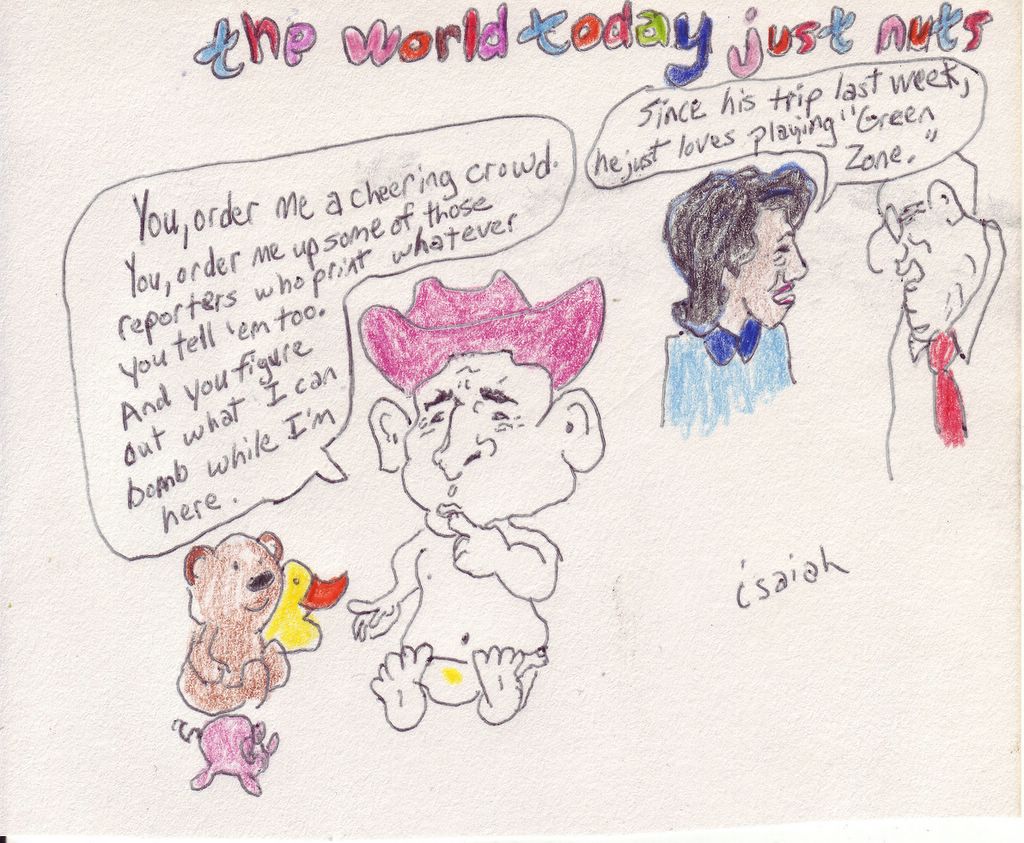
Playful Bully Boy


That's "Playfull Bully Boy" from June 18, 2006.


What I like about the drawing? The kids toys. Condi and Dick in the background.

What I dislike? I think I'm going to need to get the original saved draft versions and upload them to Flickr. How come? I remember that comic. And it's not supposed to be so blurry. I'm thinking now that "Hello" (the program I was using back then) is going to eventually just stop displaying the pictures.
And here's C.I.'s "Iraq snapshot:"


Thursday, March 4, 2010. Chaos and violence continue, lies continue about Iraq (so we unpack the days when David Corn couldn't stop screaming), only one network made time for the bombings in Iraq yesterday, and more.

Starting with the
CBS Evening News with Katie Couric from yesterday:

Katie Couric: Now turning to Iraq which holds Parliamentary elections on Sunday and insurgents are doing everything they can to disrupt them. Today there were three suicide attacks in Baquba, northeast of the capital. At least 32 people were killed, 55 others injured. From Baghdad tonight, here's Elizabeth Palmer.

Elizabeth Palmer: With three days to go before the Iraqi election, this is the violence everyone was dreading. Two suicide bombers detonated their explosive packed cars outside Baquba's police stations wrecking lives, buildings, cars and water mains. Then authorities say a third bomber rode in an ambulance to the hospital and waited until he was surrounded by the wounded before blowing himself up. Almost 19 million voters are eligible to head to the polls on Sunday to elect a 325 member Parliament but election fever here is tempered by election fear. Everyone remembers the huge truck bombs last fall in the heart of Baghdad that killed more than 150 people. Extremists have promised more violence to disrupt the political process so the government is running TV ads warning that so-called criminals are plotting mass murder and asking people to be hyper-vigilant. And on the street, security forces with extra patrols and check points are working hard to set the stage for an election that if it goes smoothly will reinforce Iraq's indepedence and stability. Not only that, if all goes well and a new Iraqi governemnt takes power in a peaceful transition that will allow 46,000 US combat troops to begin their pull-out almost immediately. Elizabeth Palmer, CBS News, Baghdad.

You can click here to watch the segment. NBC Nightly News had time for "Comic Relief" -- 'reporting' on a web video. A video which they refused to air. They reported on it, refused to air it. It advocates for something (consumer rights), Brian Williams explained. But, having wasted all of our time with the report, he then went on to plug the Nightly News website. Nightly News didn't think they should broadcast it . . . on TV but they were happy to broadcast it online. So Brian Williams used air time to self-promote while Diane Sawyer, over at ABC's World News had time to plug for Dominos. It only takes a second to note Domino's 4th quarter but if you're also doing an advetorial for them, you include plenty of shots of pizza and claims that their new ad campaign was responsive to the people and . . . Well, it doesn't leave you much time for actual news. For more on yesterday's bombings, you can see this article by Marc Santora (New York Times).

Bombings targeted Iraq again today.
BBC News reports two voting centers in Iraq were targeted with suicide bombings. BBC's NewsHour states it is believed that the bombings were attempts at targeting soldiers who were voting today (early voting which means voting began on the 4th and not ont he 5th as I had repeatedly stated -- my error and my apologies). Khalid al-Ansary, Waleed Ibrahim, Fadhel al-Badrani, Mohammed Abbas, Khaled Farhan, Sherko Raouf, Mustafa Mahmoud, Ayla Jean Yackley, Jack Kimball, Aref Mohammed, Alistair Lyon and Andrew Roche (Reuters) note 12 dead in the two bombings and a third explosion with 35 police and soldiers left injured and 22 civilians wounded.

Sahar Issa (McClatchy Newspapers) reports a fourth Baghdad bombing, a sticky bombing, which left one person injured and a Nineveh Province home bombing which injured two women and the home belonged to "Nawaf Saadoun Zaid, head of Unity of Iraq Coaltion in Nineveh (the coalition is headed by incumbent interior minister Bolani)".


This morning on the first hour of NPR's
The Diane Rehm Show, USA Today's Susan Page (guest host) spoke with Nancy A. Youssef (McClatchy Newspapers), Lawrence Korb (Center for American Progress) and former reporter Thomas E. Ricks about Iraq elections.

Susan Page: You know, here's an e-mail we've gotten from Tommy from Raleigh, North Carolina. He writes us, "For all my hope in 2008, I'm becoming disillusioned. Senator Obama campaigned against the war in Iraq. He promised that if he were elected, he would end the war and bring home the troops. More than a year into his presidency, he's failed to keep his promise. Since he hasn't kept even easy promises with easy time frames -- such as closing Gitmo within a year -- why should we believe his currently promised timetable for pulling out of Iraq?" You know, I'm not sure closing Gitmo was such an easy promise but, Tom, you know this message from Tommy is one I expect we would hear from any number of Obama voters.
Thomas E. Ricks: Well, Tommy, I would say you shouldn't believe cause I don't think it's going to happen. I think we're going to have several thousands, several tens of thousands US troops in Iraq on the day President Obama leaves office.

Susan: And --

Lawrence Korb: Let me say something about Obama. He promised to get the combat troops out so I think evidently a lot of people didn't read the platform and he also said he was going to increase the presence in Afghanistan. Those were part of his campaign promises --

Susan: Well he did say combat troops but I don't think that was the message that people heard.

Lawrence Korb: I understand. A lot of people thought "Elect Obama, you're out of Iraq and wind down in Afghanistan, we can get back to dealing with the problems at home." There's no doubt about that. But, again, I think that he did say combat troops.So far --

Thomas E. Ricks: I hate that phrase combat troops. There is no pacifist wing of the Marine Corps or the 101st Airborne. And I think it's effectively a lie to the American people. When they hear "I'll get combat troops out," what they hear is "No more American troops will die" -- and that is blatantly untrue. And I think the sooner the president addresses that, the better for him.

Susan Page: And we had Vice President [Joe] Biden say just the other day that while we're going to withdraw combat troops, the troops that we leave behind are guys who will be able to shoot straight -- in other words, people who could instantly be made into combat troops if the circumstances require that. What do you think about that, Nancy?

Nancy A. Youssef: Well I think it has to -- the broader question becomes: If Iraq does break into some level of violence, what is the role of the 50,000 troops there? Do they sit idly by? Do they let -- do they intervene? Do they put themselves in harm's way? And what can 50,000 troops do? We -- At the peak, there were 172,000 troops to bring down the sectarian violence. What can 50,000 troops, who aren't supposed to be doing combat, really do? It's going to be a difficult predicament at that point if-if in fact some level of violence returns.

Lawrence Korb: I think Vice President Biden was also trying to say that we can protect our own troops because, again, you get back to the question of casulties, yes, we have 50,000 but this not, you know, a group of people who can't do anything so if anything happens and they come after us we can protect ourselves.

We included Korb's crap and that last statement by him above was nothing but crap. He needs to stick to reality and now what he wishes would be said. That's a huge problem for Korb. Asked a direct question by a caller who said she'd take her answer off the air, Korb declared, "I do think the real question she was raising . . ." Her question was basic: Iraq currency. She most likely asked it because of the currency switch prior to the Iraq War. But Korb always knows best and ignored her question. Korb's a damn idiot.

Helene Cooper and Mark Lander (New York Times) are the reporters Biden spoke to:

But administration officials also acknowledged that the bigger worry for the United States was not who would win the elections, but the possibility that the elections -- and their almost certainly messy aftermath -- could ignite violence that would, at the least, complicate the planned withdrawal.
In part for that reason, "we're not leaving behind cooks and quartermasters," Vice President Joseph R. Biden Jr. said Wednesday in a telephone interview. The bulk fo the remaining American troops, he said, "will still be guys who can shoot straight and go get the bad guys."
Gen. Ray Odierno [. . .]

Nancy Youssef and Susan Page were interpreting it correctly. Lawrence Korb is the idiot who can't listen. Which is rather telling, isn't it? Freud wrote of the criminal's compulsion to confession and when you combine that with projection, you understand a passage excerpted above that we'll again note:

Lawrence Korb: Let me say something about Obama. He promised to get the combat troops out so I think evidently a lot of people didn't read the platform and he also said he was going to increase the presence in Afghanistan. Those were part of his campaign promises --

Susan: Well he did say combat troops but I don't think that was the message that people heard.

Lawrence Korb: I understand. A lot of people thought "Elect Obama, you're out of Iraq and wind down in Afghanistan, we can get back to dealing with the problems at home." There's no doubt about that. But, again, I think that he did say combat troops.So far --

Lawrence Korb is blaming the American people. They're just too stupid, he politely says, to know what's what. Barack said "combat troops." Did he, Larry? Did he you piece of s**t, Reagan reject?

Ava, Kat and I were speaking on campuses to groups truly opposed to the illegal war and we would have to unpack that lie daily. And we caught him saying it at two events: "We want to end the war now!" At his little praise tent circuses, his little "Oh Come Let Us Adore Me" events, he would say that. And the crowd would go crazy. Men and women would tear up. Barack damn well knew what he was doing and Larry Korb needs to stop lying. I know that's hard for Larry, but he needs to stop.

We're not even at the distinction of "combat troops" right now. We're at the reality. And Larry wanted to 'correct' the listener didn't do much of a 'correction' did he? Did Barack break his campaign promise:All together: "YES HE DID!"

The campaign promise was one brigade a month out of Iraq on his first day in office. That was the promise and that promise was broken. Larry's a damn liar. And I'm damn well not in the mood. In the
Friday, March 7, 2008 snapshot, we noted:

Obama still lacks the leadership to take control of his campaign -- that would have required firing Power. Instead she resigned indicating that he's unable to run a campaign as well as unable to tell the truth. Power -- who also went to work for Obama in 2005 when he was first elected to the US Senate (November 2004) -- also had to deal with
the BBC interview she'd given. Barack Obama has not promised to pull ALL troops out of Iraq in 16 months. He has promised the American people that "combat" troops would be removed. But promises, promises (as Dionne Warwick once sang) . . .

Stephen Sackur: "You said that he'll revisit it [the decision to pull troops] when he goes to the White House. So what the American public thinks is a commitment to get combat forces out within sixteen months, isn't a commitment is it?"

Samantha Power: "You can't make a commitment in whatever month we're in now, in March of 2008 about what circumstances are going to be like in January 2009. We can'te ven tell what Bush is up to in terms of troops pauses and so forth. He will of course not rely upon some plan that he's crafted as a presidential candidate or as a US Senator."

Which would mean Mr. Pretty Speeches has been lying to the American people. (Add the "AGAIN!")
Her rise was swift, her fall even faster. Our Modern Day Carrie Nations took part in the "Bring the troops home and send them to Darfur" nonsense. [For more on that nutso crowd, see Julie Hollar's "
The Humanitarian Tempatation" (Extra!).] Despite presenting herself recently as against the Iraq War from the start, the public record has never backed that up. But it is true that she wanted wars in Africa and was selling them under "humanitarian" guise. "Stop the killing!" she cried but if she really wanted to stop the killing, she might have tried to speak out against the ongoing genocie in Iraq (which has also produced the largest refugee crisis in the world). She didn't care about that. Probably because it demonstrates that sending armed forces in is not an answer. Again, if Barack Obama had any leadership abilities, he would have announced today that he fired his longterm advisor. He did not, she resigned. (She foolishly doesn't grasp that this is her Alexander Haig moment and there is no comeback.) Power was not a campaigner, she was a high level, longterm foreign policy advisor being groomed to be the next Secretary of State. As Krissah Williams (Washington Post) notes, Senator Clinton's response to Power's BBC interview was to note Power's agreement that Obama's pledge to have "combat" troops out in 16 months was never more than a "best-case scenario". Hillary Clinton: "Senator Obama has made his speech opposing Iraq in 2002 and the war in Iraq the core of his campaign, which makes these comments especially troubling. While Senator Obama campaigns on his [pledge] to end the war, his top advisers tell people abroad that he will not rely on his own plan should he become president. This is the latest example of promising the American people one thing on the campaign trail and telling people in other countries another. You saw this with NAFTA as well."

An explosive bit of news in the middle of a campaign. The Washington Post reported on it, the Boston Globe as well. And the rest? Two days later at Third we offered, "
Editorial: The Whores of Indymedia" which noted:

So determined to not only avoid the reality but also smear Hillary Clinton, Air Berman (The Nation) spent Friday digging through Meet The Press transcripts. The allegedly anti-war Nation magazine has yet to tell their online readers of the revelations broadcast on BBC. Truthout, so quick to editorialize that Hillary Clinton should drop out of the race, has no story up about the revelation. BuzzFlash is working overtime to smear Hillary Clinton but has nothing to say about Bambi's Iraq realities. Common Dreams is avoiding the subject as is The Progressive, CounterPunch, Truthdig, go down the list. All have time to smear Hillary, none have time to tell the truth about Bambi's 'pledge.' Where is Tom Hayden! Remember when Americans Against the Escalation (or whatever the name of that faux grassroots 'movement') imploded? There was Tommy, mere second later, writing about it online at The Nation. A call to the magazine got the story pulled but it resurfaced a day later, on Sunday, in a slightly different form with an additional note tacked on. Certainly Bambi's non-pledge is as important as the implosion of a non-peace group.

They ignored it. In fairness to Tom Hayden, July 4, 2008, he suddently discovered the Samantha Power BBC interview and wrote about it for the first time. And then he claimed the media ignored it (Boston Globe and Washington Post covered it) and that Hillary's campaign ignored it. Tom-Tom's a damn liar. Hillary's campaign called it out the day of, they issued press releases the following Monday (BBC aired the interview on a Friday), they talked about in conference calls with the press. Do you know the reaction? Andrea Mitchell laughed. Now maybe she was laughing at David Corn who exploded and started yelling and called it dirty politics for the Hillary campaign to bring it up. There was no doubt in anyone's mind who 'reporter' David Corn was supporting. His tantrums, his attacks, his threats, his non-stop errors made it very, very clear. If Tom-tom wants to blame-blame, he can take it up with David Corn who did more than anyone to kill that story. He shrieked like a banshee. No one was ever more shrill. David Corn turned every press conference into a performance piece and it was appalling.

Why does it matter? It matters because that's how reality got buried by the press -- especially Panhandle Media which Korb's organization is a part of. (Panhandle Media has to beg for money -- Pacifica, for example -- because they can't make it any other way. They're the bums on the street corner.) Don't you dare blame the voters. The voters were never told about Power's interview. Panhandle Media wouldn't allow it. (Amy Goodman, the Queen of Beggar Media, never covered it on Democracy Now!) Those liars, passing themselves off as objective and truth tellers, are the ones who deceived the American people. It's why they ignore the Iraq War now. Because there's lots of blood on their hands.

Don't you dare blame the voters when the press -- All Things Media Big And Small -- worked overtime to give Barack one excuse after another. And when they could join thousands of others in the Cult of St. Barack and hear the Christ child proclaim, "We want to end the war now!" At his revival meetings, he said "NOW!" No, he thundred, "NOW!" Speaking to the New York Times, he said "combat troops" -- and like Ricks, Michael Gordon called that nonsense out and did so to Barack's face. Ricks' finest moment was the section excerpted. Nancy A. Youssef had many fine moments (and we may grab another tomorrow). Lawrence Korb was a non-stop embarrassment including his ridiculous claim on Afghanistan that "they" wanted "us" to invade. Did they? That's not how I remember and I really doubt that's how history will.

Before we move on to the elections, Susan Page noted on air that The Diane Rehm Show had won the Shorty Award for brief news for
their Twitter Account and that Diane thanked all the show's Twitter followers. So congratulations to Diane and her crew on their award.

Voting began today in Iraq. It concludes on Sunday with the official day for elections. In addition to voting in Iraq, 16 other countries will have polling stations due to Iraq's refugee crisis.
Stephen Starr (Asia Times) reports on the voting in Syria (which starts tomorrow) and notes that "candidates see rich pickings both there and in Jordan." Tuesday's snapshot included, "Iraq's Sunni vice president Tarek al-Hashemi is in Syria. For those who have forgotten, al-Hashemi vetoed (as a member of the presidency council) an early election law in late 2009 citing the fact that it did not take into account Iraq's large refugee population. Alsumaria TV reports that he 'thanked Syria for its 'historic' stand of embracing refugees despite bilateral political rows.' Iran's Press TV notes that he 'is also expected to meet with representatives of his country's expatriates' while in Syria." AP notes that this is the first visit by an Iraqi government official (senior) since the August 19th Baghdad bombings (which Nouri and others have blamed on al Qaeda in Iraq, Ba'athists and the Syrian government -- excepting only Wile E. Coyote due to the belief that the Road Runner had him too busy to join that day's coalition of violence).Meanwhile Marc Santora and Michael R. Gordon (New York Times) report that Hakim al-Zamili is one of the candidates despite charges that he ran "death squads" and that his campaign "runs the risk that Shiite leaders will be seen as taking steps against only those who persecuted Shiites, not Sunnis." Middle East Online focuses on Sunni voters and candidate Sheikh Ayfan Saadoun al-Ayfan, noting: "The sheikh is part of the Iraqi Unity Alliance (IUA), led by Interior Minister Jawad al-Bolani, a secular Shiite, as well as Sunni tribal leaders who formed militias and turned against Al-Qaeda. This time around, around 800,000 voters are registered to vote in Anbar, according to the Independent High Electoral Commission in Ramadi, the provincial capital." Charles Levinson (Wall St. Journal) adds of Sunni voters in Iraq, "Many of Iraq's predominantly Sunni parties have accused the Iraqi High Election Commission, which is overseeing the election, of bias. They have accused the government of arresting their candidates, harassment, and using government institutions for campaign purposes." Ian Black (Guardian) observes, "Arab media coverage of the campaign has been intense, with daily special reports on satellite channel al-Jazeera and its Saudi-owned rival, al-Arabiyya. News of bombings, shootings and assassinations is drearily familiar. The novelty is that the election is being treated as a genuine contest between competing parties: that is a rarity in an area ruled by presidents-for-life and token or co-opted opposition groups. The stakes are correspondingly higher than in 2005." The Ahrar Party is vying for votes and they issued the following:

Ayad Jamal Aldin: 'I will amend the Iraqi Constitution'
In a final press conference before Sunday's election, Ayad Jamal Aldin recognised the sacrifice that the Iraqi security forces are making during this important time and thanked them for their efforts on their day of voting.
He went on to discuss disappointment, if not surprise, that Ahrar had had a large number of their billboards vandalized and decimated.
Q and A:
Q: You talked about the sabotage of your billboards being linked to other political parties, who in particular do you think is responsible for this?
A: We received information yesterday that 4WD government cars were driving around Baghdad at midnight and sabotaging the billboards. We couldn't say exactly who these cars belong to; however, the IHEC has an obligation to find out and should disqualify any party that is not conforming to the strict law set out by the IHEC.
Q: One week before the election, a rumor started that the government will arrest Muqtada al-Sadr if he ever comes back to the country, what is your opinion on that matter?
A: Muqtada al-Sadr is a true Iraqi patriot and a religious leader, and it's disgraceful for such rumours to touch this person.
Q: You have mentioned that you would reverse the de-Ba'athication law. How will you justify this to the thousands of people who have been victims in the past of the Ba'ath Party, and how will you guarantee they will not try to take the power back in their hands?
A: We've said before if we won the election and formed the new government, we would form special courts that will only prosecute the Ba'ath party members who committed crimes against the Iraqi people and they will be dealt extremely severely, but that doesn't mean that all Ba'ath Party members are criminals.
Q: Are you against the current constitution?
A: Yes. The Iraqi constitution was written without thought and under the intimidation of foreign influences. We will set about rewriting this immediately.
Q: Voting has already started for the security forces. Have you been made aware of any violations so far?
A: We've been informed that some of the security forces did not have their names on the list of voters in their local polling stations. This has resulted in them not having the chance to exercise their vote.


On Ayad Jamal Aldin,
Alex Kingsbury (US News & World Report) adds:

Sitting on a couch in a penthouse hotel suite just blocks from the White House, Ayad Jamal al-Din lets cigar smoke curl in lazy trails around his head as he considers the fate of his nation. "I am not hopeful that Iraq can yet fly alone," he says. It is a familiar refrain that the 49-year-old cleric, a fiercely secular Shiite, conveys to anyone in Washington who is willing to listen.

At this NYT webpage, on the left is an audio link (4 minutes, 38 seconds) of Stephen Farrell discussing Iraqi elections with Marc Santora yesterday after the Baquba bombings. Here's an excerpt:Stephen Farrell: Marc you've been covering this election for several months now. What's the feel out on the streets? Marc Santora: I think there's the campaign that you see and then the campaign that you feel and hear expressed by ordinary Iraqis. Visibly, you see the campaign everywhere mainly in the banners that now shroud the landscape but under that, if you talk to people, it's really a feeling of both exasperation and fear because with these elections, there's always the undercurrent of violence. Stephen Farrell: We did see some of that today in Baquba. Can you tell us some of what happened there? Marc Santora: It was a series of coordinated attacks aimed both at government buildings and at inflicting the most damage possible -- similar to the kind of attacks we've seen throughout the country, mainly in Baghdad, since August, that have left hundreds of Iraqis dead. Stephen Farrell: There's been much talk of security progress, does it seem evident on the streets to you? Do Iraqis seem to be comfortable at the moment? Marc Santora: Well Iraq is about to go into almost complete lockdown. Around 48 hours around the election, all the-the traffic will start to clear off the streets. And on election day itself, people won't be able to drive at all. And you'll have tens of thousands of security officers blanketing the country and check points set up.


Back to NPR's
The Diane Rehm Show where Susan Page spoke with Kubalt Talabani who is in DC as a Kurdish representative.

Susan Page: So tell us, what is the Kurdish perspective on this election? What do you think Kurdish voters will be doing?

Kubat Talabani: We're expecting a very high turnout as usual in the Kurdistan region and I think the competition nation-wide is-is far more fierce than it has been in previous elections. I think that's a testament to how important these elections are for Iraq and for the Kurdistan Region.
Susan Page: And how's this -- how is this different from the last election five years ago?

Kubat Talabani: Well, uhm, some technical differences in that previously voters voted for just a slate of candidates whereas this time around voters will actually vote for the slate but also the-the individual candidates on those slates so hopefully we'll have a far more accountable Parliament because people will actually be specifically voting for those candidates. And I think, just generally, the 2005 Shi'ite political parties formed one big coalition, the Kurdish political parties came into the election under one big umbrella and we all saw the general boycott from the Sunni Arab community. This time around this is a very different situation. We're expecting a very broad turnout from across the country and there is competition within the Shi'ite parties for the vote, there are competions with the Kurdish parties for the Kurdish vote. So the stakes are very high and the candidates have embraced the art of electioneering and conducted some negative campaigns which has obviously resulted in some tensions boiling over on a few occasions.


Susan Page: What do you mean by negative campaigns?

Kubalt Talabani: Well as we see here in the United States and around the world, people are targeting others credibility, others' reputations, so the negative ad campaigns are going on which is, I think, a sign of the maturity of the Iraqi political process where it's becom -- it's becoming an issues based election rather than just relying on votes based on party patronage.

Not noted, the DC rep Kubalt Talabani is also the son of Iraqi President Jalal Talabani. Reporting from the KRG,
Patrick Martin (Globe and Mail) adds, "Since the U.S.-led invasion in 2003, Kurds have progressed even faster. There was little of the fighting that gripped the South, except around the cities of Kirkuk and Mosul that straddle the Kurdish-Arab divide (and remained disputed territory, claimed by both sides). And where once they coped with a meagre income, these days they receive 17 per cent of the revenue Iraq derives from oil. That's enough to fund the fancy new buildings (though much work needs to be done on the basics of life such as education)." The Ahrar Party issued the following:


Ayad Jamal Aldin, leader of Ahrar 374, has urged all Iraqis to vote with their heads, as well as their hearts, in this weekend's election.
He said today: "Right now, the current crop of politicians who have got us into this sectarian-fueled mess are out there trying to bribe the Iraqi people into voting for them. You are being offered free chickens, rice, even sports equipment! I am not able to offer you such gifts, but I am able to offer you something more precious: The future of an Iraq, united, independent and strong.
On March 7, we - the proud Iraqi people - get to make a choice between more of the same, or a change for the better. I urge you not to give in to the corrupt, the weak and the outsiders. Instead, imagine what our country could be. Imagine an Iraq where there are jobs, electricity and water and where we can walk down the street without fearing for our children's safety. That is the future that we can have, but it is up to the Iraqi people to have the strength to choose change. On Sunday, you will vote; and it is only by voting that your voice will be heard.
"The ballot box brings us together as Iraqis, with shared values, beliefs and aspirations. Together, as Iraqis, we can make a postive change for a prosperous, united and secure future. And that is what Ahrar stands for. That is what my party - Ahrar 374 - continues to fight for."
"You should vote for the party that you really believe will make you safe, and bring jobs and electricity. Your vote is secret, so nobody will ever know who you voted for. You have nothing to fear, except fear itself. If you want change, you can make it happen tomorrow. Vote for Ahrar 374."

For further information, contact:

Ahrar Media BureauTel: +964 (0)790 157 4478 / +964 (0)790 157 4479 / +964 (0)771 275 2942
press@ahrarparty.com

About Ayad Jamal Aldin:

Ayad Jamal Aldin is a cleric, best known for his consistent campaigning for a new, secular Iraq. He first rose to prominence at the Nasiriyah conference in March 2003, shortly before the fall of Saddam, where he called for a state free of religion, the turban and other theological symbols. In 2005, he was elected as one of the 25 MPs on the Iraqi National List, but withdrew in 2009 after becoming disenchanted with Iyad Allawi's overtures to Iran. He wants complete independence from Iranian interference in Iraq. He now leads the Ahrar party for the 2010 election to the Council of Representatives, to clean up corruption and create a strong, secure and liberated Iraq for the future.

Yesterday the Military Personnel Subcommittee of the US House Veterans Affairs Committee held a meeting, I discussed it with
Marcia last night for her site:

Marcia: So today, was it the full committee? Or was it a subcommittee?C.I.: It was a subcommittee, it was the Military Personnel Subcommittee. "When it comes to repeal, the question is not whether but how and when," Susan Davis declared at the start of the meeting she chaired.Marcia: I was just going to ask you about that. Susan Davis is from California. Is she really a yes vote on repeal?C.I.: Yes, she is. I'm not going to go through everyone, okay? There are some that are on the fence and that people are advocating with and I hope it's successful -- and I'm advocating to two on the House Armed Services Committee, trying to explain why repeal is so important and so important now. But Susan Davis is a firm "yes" on this issue. Marcia: Can I get one more strong yes and then I won't ask again.C.I.: Sure. Loretta Sanchez, also from California, is a firm yes. Her vote is not in question. This is a military service member and readiness issue for her as well as a dignity and rights issue.Marcia: Was she at the hearing? And what did she say?C.I.: She did attend the hearing. Marcia: I know I said I'd just ask once but can I ask one other thing: Are all Republicans opposed to this?C.I.: No. How many will stand by that in a vote, however, I don't know. See, I agree with you completely that if you want to repeal, you do it. You don't need to study a year. But Dems will lose seats in Congress in the elections this year if the normal pattern holds. They may lose control of one of the two houses. They may not but they, historically, will lose seats, historical pattern. So what does that mean? Super-majority has become the Democratic Party's mantra. When they lose seats, a year from now, and this study comes back, what happens? I think we'll hear from some leadership, "We can't do this. We don't have the votes." Now if they lose control of one house, they may very well not have the votes. But that's why you can't wait a year on this. If it's going to be repealed it needs to take place now.
Marcia: Does anyone seem aware of that?C.I.: The Democrats on the subcommittee are very aware of that. Chair Susan Davis asked specifically what was being studied. I'm quoting her asking about this year-long study, "Do you anticipate that focusing on whether or how? Or a combination of both?" General Carter F. Ham responded that they would use "a survey instrument of the force and of their family" as well as "focus groups some of them specifically trageted to specialzied groups and families" in the military and, last one, outreach through social media to people in and out of the Defense Department.Marcia: So that sounds good.C.I.: It does. Too bad it didn't end there.Marcia: Okay.C.I.: Joe Wilson, from South Carolina, is the Ranking Member on the Subcommittee. Now we've discussed Susan Davis' question. She hands off to Wilson and he asks if the study can look to see if "current law threatens or undermines readiness in any significant way" and also would it significantly improve the readiness. Marcia: That's not a 'how,' that's a 'should we repeal'?

TV notes.
NOW on PBS begins airing Friday on most PBS stations (check local listings):

Americans have a longstanding love affair with food -- the modern supermarket has, on average, 47,000 products. But do we really know what goes into making the products we so eagerly consume? On Friday, March 5 at 8:30 PM (check local listings), David Brancaccio talks with Robert Kenner, director of the Oscar-nominated documentary Food, Inc., which takes a hard look at the secretive and surprising journey food takes on the way from processing plants to our dinner tables. The two discuss why contemporary food processing secrets are so closely guarded, their impact on our health, and another surprising fact: how consumers are actually empowered to make a difference.


iraq
abc world news tonight with diane sawyerdiane sawyercbs evening news with katie courickatie couricnbc nightly news with brian williamsbrian williamsnprthe diane rehm showalsumaria tvpress tvthe asia timesstephen starrthe new york timesmarc santoramichael r. gordonstephen farrellmiddle east onlinebbc news
the wall street journalgina choncharles levinson
the globe and mailpatrick martin
pbsnow on pbs


Read on ...

Thursday, February 25, 2010

Bully Boy Makeover


That's "Bully Boy Makeover" from June 11, 2006.


Zarqawi was killed in Iraq -- or someone they labeled as him. And they kept showing this photo -- the one I've drawn next to Bully Boy over and over in the news. It was more than grotesque. You kept waiting for the news that Bush had him stuffed and mounted on a wall in the Oval Office.

It was supposed to be 'big' news and great news and the end of that pesky war. As you should know, the Iraq War didn't end then. It still continues today.

The other thing about this cartoon. Sometimes Bully Boy Bush was such a priss that it was fun to draw him. In this one, I was going for a little bit of Disney and a little bit of demonic for the way I drew Bully Boy.


Here's C.I.'s "Iraq snapshot:"

Thursday, February 25, 2010. Chaos and violence continue, an inquiry is told that England's JFIT participated in torture and abuse, a Congressional committee is told Eli Lilly disguised suicide attempts in anti-depressant clinical trials, the draw down appears to be moving towards "slow down" at present, a political leader announces he wants to end a boycott, 3 Iraqi women are informed they will be hanged before elections take place and more.


Yesterday, the House Committee on Veterans Affairs held a full committee hearing whose purpose, Chair Bob Filner explained at the start, was "to look at the potential relationship between psychiatric medicines and suicides. Not a lovely topic but one that I think we have to address." Filner noted that the suicide rate within the military "continues to increase at an alarming rate, far exceeding the comparable suicide rates among the general population." The committee had four panels. The first panel was composed of Dr. Peter Breggin (Ithaca, NY) and Andrew Leon (Weill Cornell Medical College), the second of Drs. M. David Rudd (University of Utah) and Annelle Primm (John Hopkins School of Medicine) and retired Commander Donald J. Farber, panel three was composed of the VA's Iraq Katz with other VAs as background singers and panel four was Dr. Bart Billings.

Dr. Breggin detailed Eli Lilly's efforts to disguise suicide as related to anti-depressants. He first came across paperwork of the German government's equivalent of the US FDA "in the late 80s" where they expressed their concern to Eli Lilly over suicide rates and asked the drug maker to check their clinical trials.


Dr. Peter Breggin: Lilly found, depending on how you count it, a 6 to 12 to 1 ratio of suicide attempts -- not just thinking, attempts -- in the control group compared to placebo. Lilly never made it public. They never gave this report that I found to the Germans, they never made it available to the FDA. I also found memos inside Lily explaining guilt and shame on the part of some German investigators for Lilly that the company was classifying suicides and suicide attempts reported by doctors to them as "no drug effect." or other harmless kinds of entities; thereby disgusing the suicide attempts and the completed suicides. In one of these memos, the gentleman declared, uhm, 'How am I going to explain this to my family?' It was a genuine shame.

Dr. Breggin testified about various reactions and various ways of monitoring in clinical trials where a great deal more monitoring will take place than in real life use. As he was detailing some of these, the chair asked a question.

Chair Bob Filner: Dr. Breggin, I don't want to interrupt but if an active duty soldier is given these medications, they may not even see that warning, right? I mean --

Dr. Breggin: Well, my experience, last year I spoke at the oldest military stress conference given -- Bart Billings, whom you know, retired army officer and psychologist, runs that -- and I talked to generals and I talked to mental health professionals and they all agreed that these warnings were hardly ever presented to the soldiers and that the army was, in a sense, acting as if it was unaware. And some of these people gave me estimates, not of the 15% on pyschiatric drugs that we often hear but up to 30% of soldiers in some sections -- marines in particular, was one that was mentioned to me.

Chair Bob Filner: So they're not even informed of the risks?

Dr. Breggin: No, no. And as we go on further, we'll see that the FDA tells doctors you should -- and the word "should" is in the label -- you should share this information with the patient and the family and make sure they understand it. It's not just you repeat it to them. You sort of, "Hey, this is, I want you to understand, this is what may happen to you." It's what I do in my clinical practice. I don't say, "By the way, the drug may cause this or that," you know, I just make sure over a period of many sessions that the person understands the risks.

We're not interested in Leon's testimony which was inaccurte in many parts. He was urged to come to a point by the Chair but couldn't or wouldn't, he and Breggin were asked questions by House Rep Ciro D. Rodriguez and Leon jumped all over Breggin for answering and implied that the question was only for him when Rep Rodriguez was not only asking them both, Rodriguez has made clear he was asking them both the same question by using "you both" in his question.

At one point, Leon insulted Breggin in what may end up the rudest moment in Congress for the year. "You don't know what you're talking about," Leon snapped at Breggin. Rodriguez redirected with another question. He also snapped at Rodriguez. Not concerned about tone here but including his rudeness to convey just how unprofessional Andrew C. Leon was. And to be clear, he attempted to give 'expert' testimony on psychiatry when he is not a psychiatrist. Myself, I prefer psychologists to psychiatrists (for historical reasons including the ingrained sexism to be found in psychiatry). So I don't say that as a sneer or to suggest the Leon, being a psychologist, is not a real doctor. But he is not a psychologist either. Translation, he's not a doctor. But he is not qualified to speak of what psychiatry does or does not do. (Breggin, for any wondering is a psychiatrist.) He was so offensive in his remarks that Chair Filner felt compelled to note, "Just your last sentence, Dr. Leon, I don't think anybody was ever suggesting not to treat people. I mean, you're setting up a false straw man there."

I'll leave our focus on the first panel or we'll get lost in this hearng. Yesterday's snapshot covered a House Foreign Affairs subcommittee hearing on Iraq chaired by Russ Carnahan. Kat covered it last night in "Subcommittee on Oversight hears about Iraq," Wally filled in for Rebecca and covered it in "Congress advances technology today via Carnahan" and Ava filled in for Trina and covered it in "The 'powerless' Stuart Bowen." Kat will be emphasizing some aspect of the Veterans Affairs Committee hearing at her site tonight. And Rebecca's just invited Wally to blog at her site tonight on the hearing so he's grabbing a rare moment that took place -- one that should take place in every hearing.

Well over a million Iraqis have died since the start of the illegal war. One is Baha Mosua whose 'crime' was going to work. The 26-year-old was arrested in a dragnet at the hotel -- arrested by British forces and he went on to die in their custody. As Adrian Shaw (Daily Mirror) reminds, Baha died of 93 injuries -- all while in British custody -- in September 2003. The ongoing inquiry into Baha Mosua's death is taking place in England. Today is day 66, we last noted it in the November 16th snapshot when Donald Payne testified that he and others repeatedly kicked and hit -- for over 48 hours -- a hooded and restrained Baha and Payne pinned some of his previous lying down to "self-preservation."

Today the inquiry heard from a retired British military colonel (retired in April 2006) who is identified as witness "S009." Gerald Elias began the questioning by noting a statement S009 signed August 17, 2009 and reviewing some basics from it such as S009 was "commission in 1981," immediately "attached to the Queen's Dragoon Guards," "served in Northern Ireland and in Bosnia . . . Kosovo," etc. Among 2009's duties in Iraq were building and running a Theatre of war Internment Facility (TIF).

He was asked about the "shock of capture."

S009: My understanding of "shock of capture" is that feeling of dislocation, of -- I think it is a spiritual thing more than anything else. You have just been captured by the enemy, you feel profoundly uncomfortable, you feel dislocated from your normal systems and hierarchies and processes and, as a result, my understanding is that produces a vulnerability in you. I mean a bit like me sitting here today, I wish you to like me to remove some of my stress. I would put it in those terms.

Gerald Elias: Were you given any training prior to your deployment to Iraq in relation to the maintenance of the shock of capture, for example?

S009: No. My understanding of the maintenance of shock of capture is really all about speed. You know, there is a window when the human psyche wishes to be loved and wanted and cosseted and, after a while, most people get used to new circumstances reasonably quickly. So the point of maintenance of shock of capture is to get the person that you have detained to the person who is going to question them as fast as possible -- no more than that.

Gerald Elias: So speed of delivery. But you didn't understand that there were any other techniques that might be used to maintain the shock of capture?

S009: No, and indeed if you are referring to things like sleep deprivation and all that, I would say that those would be inappropriate.


S009 testified that interrogations took place at the camp he was in charge of (April 2003) but he was prevented from observing them when they were carried out by Joint Forward Intelligence Teams (JFIT). JFIT is a mixture of military and civilians and is considered part of military intelligence.

Gerald Elias: Mr S009, may I move on, please, to your concerns about what was going on in the JFIT. First of all, in general terms, can you tell us briefly what it was that you saw or experienced which concerned you?

S009: Yes. I witnessed a number of prisoners of war, kneeling in the sun with what I believed to be plastic hoods over their heads and with their hands handcuffed behind their backs, in two rows, facing each other.

Gerald Elias: You considered that treatment to be wrong?

S009: Yes.

Gerald Elias: Unlawful?

S009: Yes.

Gerald Elias: Just before going into the detail of that and what you did about it and the conversations you may have had about it, was that the extent -- the full extent -- of what you saw that concerned you in the JFIT?

S009: Yes, pretty much. I mean I felt that the organisation was not running well, so I had concerns about the general efficiency of that unit and its effectiveness as well.

Staying with violence, Layla Anwar (An Arab Woman Blues) notes that Muslim Woman Org has announced that three Iraqi women -- Wassan Talib, Zainab Fadhil and Liqa Muhammad -- are now scheduled to be hanged on March 3rd. On the latest installment of Inside Iraq (Al Jazeera) Shatha al-Obosi -- deputy chair of the Iraqi Parliament's Human Rights Committee -- declared to host Jasim al-Azzawi, "We want to delay the execution orders after the elections because I receive many claims from people that they take their speech, their -- and they sign them under the torture. So many of them are innocent. We are afraid if there is a few number of them are innocent so we must protect all of them and make another investigation with them to guarantee if they are innocent or not." Apparently, the three women won't be protected. In some of today's reported violence . . .

Bombings?

Reuters notes, dropping back to Wednesday, a Mosul grenade attack which injured two people. An Iraqi corresondent for McClatchy Newspapers reports that "1.5 ton of TNT" was seized before it could enter Falluja today and that Falluja police also detonated a car bomb and a roadside bomb. The police are claiming the seized bomb material was to be used March 7th (during the elections).


Shootings and other?

Reuters notes 2 people killed in a Mosul "car workshop," 1 woman killed in a Mosul home invasion (killed apparently by blows to the head), 1 man killed in a Mosul drive-by.

Corpses?

Alsumaria TV reports a young woman's corpse was discovered in a Khales orchard.

Iraqis are gearing up for another election -- March 5th to March 7th. Yesterday's snapshot included:

Marc Lynch (Foreign Policy) explains today, "So you thought that Ahmed Chalabi and Ali al-Lami's Accountability and Justice (De-Ba'athification) Committee had done all they could to wreck Iraq's elections and advance their political agendas? Not even. Yesterday, in what al-Hayat calls a surprise move, Lami announced that the AJC had named 376 military, police and intelligence officers for de-Ba'athification. The list includes a number of important people in senior positions."

Xinhua (link has text and audio) reports
the newly banned "included 58 officers from the Defense Ministry, 10 of whom held senior posts, including Aboud Qanber, former commander of the Baghdad operations. [. . .] The list also featured 125 officers from the national intelligence agency, including 10 high-ranking officers who were in charge of political assassinations and tracking down the opposition". This week's banning comes as Nouri al-Maliki announces he's bringing some people back into the government. Marc Santora (New York Times) reports that Nouri's mouth piece announced 20,000 officers who served in Iraq's army during the Saddam Hussein era will be brought back into the military. The National Dialogue front's spokesperson Mayson al-Damalogi states, "This is purely a means of trying to gain more votes" on the part of al-Maliki. In other election news, Qassim Abdul-Zahra (AP) reports that Saleh al-Mutlaq and Ayad Allawi held a press conference today in which al-Mutlaq retracted his announced boycott. al-Mutlaq is not running. He remains banned and he is part of the National Dialogue Front. Rebecca Santana and Qassim Abdul-Zahra (AP) express the belief that this "effectively lifts the lingering threat that minority Sunnis would boycott the vote". No, it doesn't. That's a belief but it's not based in any reality. It's a hope, maybe. It's not factual. A leader of a political party can call a boycott or not. It's the people who boycott though. al-Mutlaq can call a boycott and no one may go along with it. The people decide if there's a boycott or not. An individual doesn't make the decision -- not even with a call for a boycott or a call not to boycott. You can say al-Mutlaq withdrew his call for a boycott and be factual. You can even say this may erase the threat of a boycott. You cannot, however, be factual and also declare that the threat of a boycott is now gone. You can't do that unless you're a pyschic and I was under the impression that the "P" in "AP" stood for "Press," not "Psychics." Middle East Online explains of the announcement that the the bloc "urged its followers to turn out in numbers." The urging is needed because people will decide what they want to do and what they don't want to do. If that weren't the case, the bloc would have only announced, "We're back in." Charles Levinson (Wall St. Journal) gets it correct: "The announcement by National Dialogue Front leader Saleh al-Mutlaq could ease fears voiced by U.S. officials that a Sunni boycott would sap the vote of legitimacy and possibly lead to violence after the poll, as happened after the previous national elections in December 2005."


Watch Ahrar Party Leader Ayad Jamal Aldin on al-Baghdadiya tonight
On the back of polls showing a surge in support, Ahrar Leader Ayad Jamal Aldin will take to the airwaves tonight to make the case for radical, popular change in Iraq.
He will use a prime time interview on Baghdadiya at 10:00pm AST to take questions on Ahrar's comprehensive plans on delivering water, jobs, electricity and security under the next Iraqi parliament.
Speaking from Baghdad tonight, Jamal Aldin said, "The people want change - real change. The corrupters and outside agents can use all the tricks they like, we are strong enough to prevail. One group has the power in Iraq right now, and that is the Iraqi people."
Watch the interview here.

For further information, contact:
Ahrar Media Bureau
Tel: +964 (0)790 157 4478 / +964 (0)790 157 4479 / +964 (0)771 275 2942
press@ahrarparty.com
About Ayad Jamal Aldin:
Ayad Jamal Aldin is a cleric, best known for his consistent campaigning for a new, secular Iraq. He first rose to prominence at the Nasiriyah conference in March 2003, shortly before the fall of Saddam, where he called for a state free of religion, the turban and other theological symbols. In 2005, he was elected as one of the 25 MPs on the Iraqi National List, but withdrew in 2009 after becoming disenchanted with Iyad Allawi's overtures to Iran. He wants complete independence from Iranian interference in Iraq. He now leads the Ahrar party for the 2010 election to the Council of Representatives, to clean up corruption and create a strong, secure and liberated Iraq for the future.


On the elections and the targeting, Rhonda Shafei (Columbia Spectator) offers:


America cannot afford the fallout that is bound to result from the injustices being committed by the Iraqi government.
The most notable injustice is the disqualification of 511 candidates by the Iraqi Accountability and Justice Commission, a subset of the Iraqi Elections Committee. The board is run by two dubious politicians, Ahmad Chalabi and Ali al-Lami, both prominent Shiites who have been accused by top U.S. commander Raymond Odierno of having intimate ties with Iran. But their suspect backgrounds don't end there: Al-Lami was arrested in 2008 for alleged ties to a Baghdad bombing that killed four Americans and six Iraqis, and Chalabi is the man accused of providing the Bush administration with faulty information on Iraq's weapons program.
It's no surprise, then, that the commission would bar the 500-odd candidates, the vast majority of whom are Sunni politicians with former ties to the Baath party of Saddam Hussein. Both Chalabi and al-Lami acted as key figures on the 2003-2004 Supreme National De-Baathification Commission created by Paul Bremer. It wouldn't be a stretch to say that the current justice commision is a continuation of the McCarthyite de-Baathification procedure -- McCarthyite for its arbitrary firing of 30,000 ex-Baath politicians, thousands of intelligence officials, and all military officers above the rank of colonel. There exists no constitutional basis for the disqualification of candidates by the election board. If the elections are to move forward with a substantial number of Sunnis missing from the ballots, how could results possibly be representative of Iraqi society?


Monday Gen Ray Odierno, the top US commander in Iraq, declared at a DC press briefing that the rate of draw down could be slowed. Patrick Martin (WSWS) words it this way, "In an apparent effort to prepare US and Iraqi public opinion for a change in policy, the top US commander in Baghdad announced Monday that he had briefed the Pentagon on plans to keep combat troops in Iraq after an upcoming August 31 deadline for their withdrawal." Martin goes on to note "Stratfor [Global Intelligence] noted that Odierno's appearance at the Pentagon was carefully choreographed by the Obama administration. Odierno 'came to Washington publicize the plan: He did not do this without direction, authorization and coordination with the White House'." David Riedel (CBS News) reported that former journalist (current counter-insurgency cheerleader) Thomas E. Ricks announced today -- in a scoop worthy of Hedda Hopper which is apparently Ricks' new online role -- that the possibility of slowing down a draw down was in fact an official request submitted to the administration by Odierno. Dahr Jamail (via CounterCurrents) notes that the US government appears to be using the election unrest as an excuse to prolong the war and he provides this background on the players who now concern the US government:

The US government and corporate media prefer to focus on Iran's "meddling" in Iraq; yet, the key players responsible for most of the political discord in Iraq are US-installed and -backed men who have always had clear links to Tehran.


Maliki is a case in point.

Maliki was an Iraqi in exile in Tehran from 1982-1990, and then remained in Syria before returning to Iraq after the US invasion of 2003. Maliki worked as a political officer for the Dawa Party while in Syria, developing close ties with Hezbollah and Iran.

The Dawa party backed the Iranian Revolution, as well as backing Ayatollah Ruhollah Khomeini during the Iran-Iraq War. The group continues to receive financial support from Tehran. Maliki is the secretary general of the Dawa Party.

In April 2006, then US Secretary of State Condoleeza Rice and her UK counterpart, Jack Straw, flew to Baghdad in order to replace then Iraqi Prime Minister Ibrahim al-Jafaari with Nouri al-Maliki. There was no democratic process involved in the decision.

Another US-backed Iraqi ex-patriot with ties to Iran is Ahmed Chalabi.

Recently the US Ambassador to Iraq, Christopher Hill, along with General Odierno, referred to Chalabi as Tehran's leading agent in Iraq. Chalabi, who leads Iraq's Justice and Accountability Committee that has been banning certain candidates from the upcoming vote, was said to be "clearly influenced by Iran" last week by General Odierno.

Chalabi played a major role in providing the Bush administration with information it wanted in order to justify invading Iraq. He is responsible for having Mutlaq, along with hundreds of other candidates, eliminated from the election on the mostly fraudulent grounds that they are or were loyalists of Saddam Hussein's Baath party.

Along with Sunni leaders, his targets also include secular nationalists, and the two most important candidates who have been banned are leading members of cross-sectarian alliances, which raises fears that Iraq could be drifting toward a Shiite autocracy.


Tunring to the US . . .

Now it all begins
Or continues to
Spiral down
Spiral down

Look upon the self
Look upon the other
We need a better understanding
Or we'll spiral down

Spiral down
Continue to spiral down
I'm no where near my peace
As you spiral down
Now it all begins
Or continues to
Spiral down
Spiral down

Look upon the self
Look upon the other
We need a better understanding
Or we'll spiral down

Spiral down
Continue to spiral down
I'm no where near my peace
As you spiral down
-- "Spiral Down" written by Michael Timmins, recorded by the Cowboy Junkies on their album at the end of paths taken


Peace takes action and A.N.S.W.E.R. and other organizations are sponsoring March 20th marches in DC, San Francisco and Los Angeles. The march is to demand the withdrawal of all US and NATO troops from Iraq and Afghanistan. Students for a Democratic Society are another organization that will be participating and they note:
While the U.S. occupation of Afghanistan is growing ever larger, the occupation of Iraq is still raging, nearing its seventh anniversary. With over 4,300 US soldiers and over 1.3 million Iraqi civilians estimated dead, something has to be done to stop this senseless slaughter.
This year Students for a Democratic Society will hold a national week of action March 15th to 20th where students will organize protests and direct actions at campuses across the country in opposition to the ongoing, brutal occupations.
The need for a vibrant anti-war movement has rarely been felt more than this very moment, while the United States drops trillions of dollars into unjust wars in Iraq and Afghanistan, during the worst economic crisis in 80 years. Students are struggling to pay for school while tuition skyrockets, and states lose billions of dollars to two continuing occupations.
On Saturday, March 20th, SDS will participate in a massive National March & Rally in D.C. hosted by A.N.S.W.E.R. to finish the week of action with tens of thousands of people in the street!
We're calling on students and youth from across the country to join us the week of March 15-20th in demanding: Fund Education, Not Occupation!
For more information visit: http://sdsantiwar.wordpress.com/


Radio, radio, as Elvis Costello once sang. Lila Giggles? Elaine covered her in "Lila Giggles and her worthless Connect the Dots." Chris Hedges is a guest on this week's Law & Disorder and Mike covered that in "'Health' 'care' 'reform' and Law & Disorder." Cindy Sheehan Soapbox is the radio program Peace Mom Cindy Sheehan does and her guest this week is John Pilger. They discuss many topics including Brand Obama and his war machine. In addition, Pilger offers that there was more than one gunman at the RFK assassination. Next week, Cindy interviews FBI whistle blower Colleen Rowley, FYI. (Hugo Chavez is her guest March 14th.) Remember that Ann is covering NPR's Fresh Air and her posts this week so far are "Miss Terry (Gross) 'forgets,' "Realities about Barack's Big Pharma Give Away" and "Fresh what?". Lastly, TV notes. NOW on PBS begins airing Friday on most PBS stations (check local listings):
In 1995 and 1996, 66 gray wolves were relocated from Canada to
Yellowstone National Park and central Idaho to help recover a wolf
population that had been exterminated in the northern Rockies. The
gray
wolf relocation
is considered one of the most successful wildlife
recovery projects ever attempted under the Endangered Species Act; today
there are more than 1,600 wolves in the region. But a debate has erupted
between conservationists and ranchers over the question: how many wolves
are too many?

Last year, the Obama Administration entered the fray by removing
federal
protection
for some of these wolves, paving the way for controversial
state-regulated wolf hunts. The move has wolf advocates fuming, with
more than a dozen conservation groups suing the Interior Department to
restore federal protections. On February 26 at 8:30 pm (check local
listings), NOW reports on this war over wolves and implications for the
area.


Read on ...

Thursday, February 18, 2010

The Bully & Tony Review


"The Bully & Tony Revue" from May 28, 2006.

Tony Blair and Bully Boy led the world into an illegal war.


Were they in the news that week? I had to think about it. Bully Boy was always in the news back then, of course. But Tony and Bully were doing a hard press on lying about the Iraq War and claiming it was worth it and blah, blah, blah.

If you're 13 or so today, it may be hard to believe it but as late as 2006 there were still near weekly attempts to sell the illegal war as 'needed' and 'good.'
Now here's C.I.'s "Iraq snapshot:"

Thursday, February 18, 2010. Chaos and violence continue, Ramadi is slammed with a bombing, the UN offers 'hopes' for the upcoming elections, Chris Hill spins as well, Basra sees a increase in childhood leukemia, and more.

"After eight long years of bloodshed, and who knows how many more to come, we're still not sure why we fight, and our understanding of war is only growing more blood-dimmed and confused,"
writes Stephen Marche (Esquire). Marche's point is a solid one. Why did the US go into Iraq, the truth not the many discredited lies? Why does the US remain in Iraq? Those are questions that are never answered and really aren't even raised by the bulk of the press these days.

Today Ramadi was slammed with a bombing.
Steven Lee Myers (New York Times) reports it was a suicide bombing and that the death toll has reached at least 12. Ali al-Mashhadani, Waleed Ibrahim, Mohammed Abbas, Jack Kimball and Louise Ireland (Reuters) note twenty-one are wounded, that a hospital source says 13 corpses have been received with 26 people injured, and "A restaurant worker in Ramadi, capital of Anbar province, said that bodies littered the scene, close to a complex housing provincial government buildings. Blood stained the ground, and gutted police and army vehicles smouldered nearby." Mu Xuequan (Xinhua) quotes Khalaf Mahmoud who was wounded in the bombing, "I was heading to the government compound when the blast took place some 50 meters away from me. I remember I saw one of the civilian cars with two men inside approached to the checkpoint and blew up. It was a terrible blast, thanks God, I am lucky to survive." Al Jazeera adds:Mohammed Dulaimi, the owner of a restaurant that was badly damaged in the blast, said the attackers were "trying to undermine the political process and prevent us from taking part in the election"."They want us to miss the opportunity to vote, as we did before," he said, referring to a boycott of 2005 general elections by Sunni-led political parties.Yousif Bassil and CNN report that the attack took place at a security checkpoint "close to the provincial council office." In addition, Reuters notes a Mosul bombing injured "a former police officer and a tribal chief" and a Mosul car bombing left twenty-four people injured.

Turning to the elections, Swarthmore College's
War News Radio is a weekly show and the most recent program (first began airing last Friday) covered the elections. From the headlines, we'll note this for background.

Emily Hager: One day before campaigns are due to start, Iraqi judges released a list of previously banned candidates who will be allowed to run in next month's elections. But two of the most prominent Sunni candidates, both current Parliament members, still haven't been cleared to campaign. In January, Iraq's de-Ba'athifcation committee banned more than 500 candidates from competing for seats because of alleged connections to Saddam Hussein's Ba'ath Party. The decision was appealed to an Iraqi court where judges have been considering the issue. At first, the court announced that all of the challenged candidates would be able to run and that they would be reviewed after they won seats. Prime Minister Nouri al-Maliki pushed to have the review before the elections. Official campaigning begins this week for the March 7 vote.

Earlier today at the United Nations in New York,
Ad Melkert (the Secretary-General's Special Representative to Iraq) declared, "Generally speaking, I should say that the elections are on track in terms of their technical preparation. Still a lot needs to be done. Security remains a big challenge to all, to the Iraqis in the first place, but also to the international community." Melkert sounds a great deal like US spinner Chris Hill. He went on to add, "Elections is not only about politics but requires a lot of hard work on the ground. The UN electoral team has continued to play a key role in advising and technically support the Independent High Electoral Commission (IHEC). As a result of a huge collective effort the infrastructure is in place in order to allow approximately 18.9 million Iraqi voters to visit 48,000 polling stations on election day." Today the Los Angeles Times offered the editorial "Baath-bashing in Iraq."

Iraq's upcoming parliamentary elections should be about jobs, public services and government competence. Candidates should be focused on the country's security and on reconciliation among Shiites, Sunnis and Kurds. Instead, the national vote once again is turning into a sectarian brawl in which Shiite parties jockeying with one another for dominance are stirring populist fears of a return of Saddam Hussein's Sunni-led Baath Party. Never mind that Hussein was executed in 2006 or that the discredited Baath Party already is outlawed. The Accountability and Justice Committee, led by Ahmad Chalabi, the Shiite politician and onetime darling of the George W. Bush administration, has been purging candidates who were members of the Baath Party and, in the process, fueling minority Sunnis' suspicions that the real motive is to further reduce their power.

Jane Arraf (Christian Science Monitor) adds, "Although a significant number of Shiites as well as Sunnis have been barred from running because of alleged Baathist ties, the move has been seen as furthering a Shiite agenda because the heads of the commission are prominent Shiite members of parliament. Adding fuel to the controversy over the ban, the top US general in Iraq, Ray Odierno, and other US officials, have accused the two men, Ahmed Chalibi, and Ali Faisel al-Lami of ties to Iran" Along with the bannings, many political parties are finding their candidates Yesterday's snapshot noted Michael Hastings (The Hastings Report, True/Slant) report on the attacks on the Ahrar political party -- Saturday, four were held for 24 hours in Sadr City where they were attempting to put up campaign visuals and Tuesday a group of worker were attacked leading up to today where an Ahrar Party candidate was attacked in Maysan Province with at least one body guard killed in the attack. The Ahrar Party has released the following statement on the attacks:

Amid increasing signs that the Maliki government has completely lost control of the security situation in Iraq, violence and sectarian intimidation have increased in spite of a non-violence pact, signed by some parties. As a non-sectarian party, Ahrar has been singled out for special treatment.
Over the past five days, Ahrar has had campaign workers shot at, captured and even killed, for the 'crime' of putting up our election posters.
In Maysan on Wednesday, an Ahrar candidate was the victim of a carefully-planned ambush, narrowly escaping capture. One of his team was murdered at gun-point.
Ahrar Party leader Ayad Jamal Aldin said: "These politicians are all talk. It is their weakness that has allowed outsiders and corrupters who are intent on dividing and destroying Iraq to take control of our country. Ahrar stands for a united and peaceful Iraq. For jobs, security and electricity for the Iraqi people."
"Now ask yourself, who would oppose this? These corrupt outsiders are scared because they know that the people of Iraq can make a change for the better. Ahrar will not be intimidated because Ahrar is the party of Iraq's people, and on March 7 it is they who have the power to end this intimidation."
For further information, contact:
Ahrar Media Bureau Tel: +964 (0)790 157 4478 / +964 (0)790 157 4479 / +964 (0)771 275 2942
press@ahrarparty.com

About Ayad Jamal Aldin:
Ayad Jamal Aldin is a cleric, best known for his consistent campaigning for a new, secular Iraq. He first rose to prominence at the Nasiriyah conference in March 2003, shortly before the fall of Saddam, where he called for a state free of religion, the turban and other theological symbols. In 2005, he was elected as one of the 25 MPs on the Iraqi National List, but withdrew in 2009 after becoming disenchanted with Iyad Allawi's overtures to Iran. He wants complete independence from Iranian interference in Iraq. He now leads the Ahrar party for the 2010 election to the Council of Representatives, to clean up corruption and create a strong, secure and liberated Iraq for the future.

Robert Dreyfuss (The Nation) declares Iraq "once again on the brink of a civil conflict" and offers this:

Starting last spring, at the urging of top officials in Iran--including Ali Larijani, the conservative, Iraqi-born speaker of the Iranian Parliament, and Brig. Gen. Qassem Suleimani, commander of the Quds Force of the Iranian Revolutionary Guard Corps--a group of sectarian Shiite religious leaders patched over their differences to establish the Iraqi National Alliance (INA), linking ISCI with the forces of rogue cleric Muqtada al-Sadr; former Prime Minister Ibrahim al-Jaafari of a renegade Dawa faction; and Ahmad Chalabi, the former darling of US neoconservatives, who has long maintained close ties to Iran's hardliners.
The creation of the INA was widely seen, inside and outside Iraq, as an Iranian project. Reidar Visser, a close observer of Iraqi affairs at the Norwegian Institute of International Affairs, says efforts to rebuild the Shiite sectarian alliance began last spring, after a visit to Baghdad by Larijani. Soon afterward, a stream of Iraqi officials made pilgrimages to Tehran, where a deal between the Hakim family (the founders of ISCI) and Sadr was brokered by Iran. "Part of the Iranian strategy has been to put politics in Iraq back on the sectarian track," says Visser. Both Iran and the new Shiite alliance pressured Maliki to join, but at that time the prime minister felt strong enough to run independently.
Then, this past January 14, Iraq's electoral overseers ratified a decision by the so-called Accountability and Justice Commission, an unelected body controlled by Chalabi and one of his cronies, Ali al-Lami, to ban more than 500 candidates for Parliament. They were barred from running, said the commission, on vague charges of ties to the deposed Baath Party. Among those banned were current members of Parliament and Iraqi officials, including Defense Minister Abdul-Kader Jassem al-Obeidi and Mutlaq, who'd joined forces with Allawi. The commission's action was a bomb thrown into the center of Iraqi politics and sparked talk of a boycott and even a new antigovernment insurgency.

Chris Hill is the US Ambassador to Iraq. We'll note
this exchange between him and CNN's Elise Labott from yesterday at the State Dept (link has text and video): Elise Labott: Can we go back to the idea of the Ba'athists and the election -- on the banned candidates? You spoke earlier this morning about the sensitivities about the Ba'athist issue, but more from the kind of whole Iraqi population. I was wondering if you think that there's any danger of not a resurgence of the Ba'athists, but a kind of backlash by pro-Ba'athists in terms of, you know, more violence or anything like that as a result of this. Chris Hill: Well, the country, there's no question there are Ba'athist elements in the country and there's no question that some of these Ba'athist elements are very unhappy with the current state of affairs. I will say that the -- in terms of violence, we have a government that is increasingly capable of handling violence, and we did not see any signs of insurgency of the kind that we saw back in the wake of the '05 -- Elise Labott: Right. Chris Hill: -- elections. So what we see are acts of terror that are – have already happened; in many cases, in our judgment, happened because of al-Qaida elements. But we don't see that this issue of excluding Ba'athist candidates is one that is leading to violence. Frankly, they were able to come together and work out a solution, and I think it's a solution that most people are living with. Elise Labott: But-but if I could just quickly follow up, I mean, some of these banned candidates were, if I'm correct, previous -- some of them were even in parliament previously; is that right? Chris Hill: Yeah. Elise Labot: And so, I mean, do you think that there's a danger that they feel like they used to have the political process and now they feel disenfranchised and -- Chris Hill: Well -- Elise Labott: -- and that's a kind of, you know, formula for, you know, being bored and not having a lot to do and being kind of bitter and, you know, turning back? Chris Hill: Well, being bored is not a formula for getting elected, but -- Elise Labott: Well, you know I'm being -- well, but you know what I'm saying. Chris Hill: I think it's important to understand that there are candidates who are unhappy at having been on the list, but there was a process by which they were able to appeal, there was a sequestered panel of judges from the cassation court that looked at these cases. In some cases, they ruled that the people should be able to stand for office; in others, they ruled against it. We know that some of the candidates who were disallowed or not permitted to run, they have accepted the result and they've called on their -- on people to vote. So we don't see a sign that this type of dissatisfaction is of the quality that would cause an outbreak of an insurgency. But obviously, we track these issues very closely. We're in very -- we really follow these things. We're in touch with all the politicians. And this is going to -- this is, to be sure, a rocky road, but I think we can -- we have every reason to believe that we'll get through this election process. For those paying close attention, the US has thrown in the towel re: elections. They word now is that it doesn't matter if some candidates are excluded or not, it's not big deal. And with that nonsense, the US attempts to paint a pretty picture. Sami Moubayed (Asia Times) notes that elections might take place but . . . "Another scenario is that the elections will be called off altogether, due to rising violence and Sunni resentment with Maliki's handling of the pre-election process. The controversy of disqualifying candidates, which has rocked the Iraqi scene for more than three weeks, is ongoing as 145 candidates are now officially confirmed as ineligible to run for office, due to their alleged ties to the outlawed Ba'ath Party." Mohammed A Salih (Asia Times) adds, "The ban on high-profile Sunnis who have been part of Iraqi politics after the war is considered a significant blow to Washington's efforts to bring back the moderate elements of the mostly Sunni-led Ba'ath Party into Iraq's political process and reintegrate Sunnis into the country's politics."

Chris Hill delivered a lengthy opening statement before taking questions ('or abuse' he joked). We'll not note it all. On the elections, he stated:We're here really to report on where things stand with three weeks to go. I think anyone who follows Iraq knows that there are twists and turns to any destination in Iraq. Certainly, de-Baathification was a major issue and a very tough issue, a very emotional issue, but I think we've gotten through that issue. The campaign has really started in earnest. There are campaign placards all over every surface in the country, it seems, right now. There are some 6,172 candidates. There are 18.9 million registered voters. There are 300,000 poll station workers. There are 50,000 polling stations spread over 9,000 polling centers. There will be out-of-country voters and they're prepared to handle that in 16 different countries, voting that will actually start on March 5th. We are working very closely with the UN and with the U.S. forces to help secure having 26 four-person monitoring teams. These are actually just U.S. monitoring teams to be spread out over 18 provinces, including four in Baghdad and 22 in other provinces. We'll have extra teams in some of the sensitive areas in Anbar, Basra, Diyala, Kirkuk, Ninawa. There will be nine diplomatic missions who are represented in the overall monitoring, including from -- those from Turkey, UK, Denmark, Canada, Czech Republic, Netherlands, Poland. The European Union will have five or six journalistic embeds. We'll also have special needs voting that begins on March 9th -- March 4th, rather. And our teams will be deployed about March 1st and return March 9th. So this is a major undertaking. It is an election that in many respects will determine the future of Iraq, the future of the U.S. -- and also the future of the U.S. relationship with Iraq. For us, this is a very important election because it's an important election that will enable us to continue to develop what we see as a long-term and very important relationship, strategic relationship, with the Republic of Iraq.He wanted to talk about many things in his opening statement and oil was at the top of his list. Oil and 'progress'. Chris Hill insisted, "Iraq has made important strides in its economy in recent months. They've reached some oil lease deals with many of the major oil companies in the world. So if all of these go well in the next some 10 years, we will see a country producing some 10 million barrels of oil per day. I mean, this is a substantial amount. This will put Iraq in the category of or in the sort of orbit of a country like Saudi Arabia. It will make Iraq an oil exporter to the tune of some four times what Iran is currently exporting. So all of these developments are happening as we speak. There are more and more oil infrastructure companies coming in to get ready for this, and I think we can see that Iraq is really taking its rightful place on the world stage.""Ten years," Chris?"Ten more years"?
Geoff Kelly (Art Voice) interviews US House Rep Brian Higgins who states, "In Iraq, do you remember [President Bush] said he was going to do the surge in late 2006? The war wasn't going well. He puts Petraeus in charge and they commit 20,000 more troops. The surge was supposed to give breathing room for the political parties -- Shia, Sunni, and Kurd -- to resolve their differences. The surge succeeded militarily by tamping down the violence, but all the existential issues, all the standout issues, are still unresolved -- and will very likely be resolved violently. The sharing of oil revenues, the disputed areas in the north, Kirkuk, political reconciliation between the three major factions -- they're still not resolved."They're still not resolved, says Higgins.Important strides, crows Hill . . . before adding . . . ten more years.


Can Iraq survive the damage of ten more years?
US News and World Reports notes that in Basra the rate of childhood leukemia has doubled in the last 15 years and offers that one reason for this may be due to chemical exposures as a result of fires. The University of Washington issued a news release today noting the study and that there of their professors wrote it:

The study documents 698 cases of leukemia for children aged 0-14 during the 15-year period, with a peak of 211 cases in 2006. Younger children had higher rates than older ones.
"By using a hospital cancer registry, we were able to measure a jump in leukemia rates from 3 per 100,000 youngsters in the first part of our study period, to a rate of almost 8 and a half in the final three years," said UW Department of Global Health faculty member Amy Hagopian, the paper's lead author.
By comparison, Hagopian said, the European Union and the United States report rates of 4 and 5 per 100,000, respectively. She also noted Kuwait reports a rate of approximately 2 per 100,000 and Oman reports rates between 2 and 3, depending on the gender of the child (boys typically have higher rates, as do children from higher socio-economic classes).
"Studying childhood diseases in war situations is difficult," Hagopian noted. "Aside from the normal difficulties of controlling for referral patterns changes caused by war-time conditions, the political situation is also challenging. We were constantly worried about the political risks our medical colleagues were taking by collecting and reporting these data."

One way chemicals are exposes is the use of burn pits to burn off left overs -- medicine, trash, waste, military equipment -- and they have been used in Iraq and in Afghanistan.
David Zucchino (Los Angeles Times) tackles the issue of the burn pits:The noxious smoke plumes that wafted over the military base in Balad, Iraq, alarmed Lt. Col. Michelle Franco. The stench from a huge burn pit clung to her clothing, skin and hair. "I remember thinking: This doesn't look good, smell good or taste good," Franco said recently. "I knew it couldn't be good for anybody." She wheezed and coughed constantly. When Franco returned to the U.S., she was diagnosed with reactive airway dysfunction syndrome. She is no longer able to serve as an Air Force nurse. Other returning veterans have reported leukemia, lymphoma, congestive heart problems, neurological conditions, bronchitis, skin rashes and sleep disorders -- all of which they attribute to burn pits on dozens of U.S. bases in Afghanistan and Iraq. Burn pits are not safe. Everything is burned off in them including medicines. These toxins are released into the air and get into the soil and water supply. There are many people quoted in the article saying the military needs to step up but it's not just the military. Congress needs to. Zucchino notes that US House Rep Carol Porter-Shea has introduced legislation in the House for a federal registry (as there is with Agent Orange). That's great. But there's similar legislation in the Senate. Evan Bayh introduced it last year. Since October, when he appeared before the Senate Veterans Affairs Committee, that legislation has been held up by the Committee which should have long ago released it for a floor vote.

Dennis Bartok (Variety) observes, "The year 2009 was the one that saw Iraq War-themed movies finally connect with Academy voters, as Oscar-nominated scripts The Hurt Locker [Mark Boal] and The Messenger [Alessandro Camon and Oren Moverman] resonated in ways that earlier efforts didn't." It's a shame that film interest increases as the interest from the news media decreases. But at least some people are paying attention.


We noted Marc Hall in the
February 9th snapshot, Pamela E. Walck (Savannah Now) reports that Hall was in Chief Federal District Court yesterday where Judge William T. Moore Jr. refused to grant his appeal to remain in the US and he is expected to be sent to Kuwait shortly for a court-martial:
"The more I worked on this case, the more persuaded I am that we were right on the law," said David Gespass, Hall's civilian attorney. "... There is no one else to appeal to at this point. The intent of the Army is clear. They could have tried him any time between July and December, before anyone left here (for Iraq)."And the idea that all of a sudden, it's imperative they try him over there, outside of the light of day and the scrutiny of the public, shows they are so resistant to trying him here. It reinforces the idea they don't want the case to be scrutinized."Gespass said it wouldn't be fiscally possible for him to travel to Iraq for the court-martial proceedings and that his client would have to rely on the military-appointed attorney."I have confidence in his military lawyer," Gespass said. "But ... the problem with getting witnesses there is a more serious one."The civilian attorney said one witness stepped forward, but said she wouldn't travel to Iraq for a court proceeding.Why is Marc Hall facing a court-martial?
Russia Today interviewed Iraq Veterans Against the War and World Can't Wait's Matthis Chiroux about the case.Matthis Chiroux: Marc Hall has demonstrated (a) a lot of courage in-in writing this song. I mean the army suppressing soldiers is so widespread, the stop-loss policy destroys so many lives anyway. The fact that Marc Hall had the courage to-to speak up and to address that in his rap song in the first place is quite impressive. Second, I think very important, something that we need to call attention to in this case, is Marc Hall is not being jailed for writing the stop-loss song, Marc Hall is being jailed because he expressed to his command that he would not deploy to Iraq with his unit. And this happened during the time he wrote the song in July and he wasn't jailed until December. He was, in fact, undergoing counseling and serving with his unit. It wasn't until Specialist Hall told his command that he wasn't comfortable deploying to Iraq that they took these measures against him. IVAW's updates page for Marc Hall is here. Asked if the military is concerned that the song might bring attention to the stop-loss policy, Matthis responds, "Well, ma'am, I think there is already enormous attention on this policy and, in fact, this is one of the many Bush era policies that Obama has failed to make good on his promises to end. Obama said he would end stop-loss, yet it continues. Marc Hall is a victim of that. His song is an expression of-of what it's like to feel robbed by the military, what it's like to be the victim of a backdoor draft. And he put that out there and subsequently told his unit that he wasn't going to abide by those orders to deploy to Iraq and that's when they took these measures against him. There's a clear, clear history of resistance within the units in the military history spreading and we in Iraq Veterans Against the War are convinced that the command recognized this and sought to remove Marc Hall using this rap song as an excuse before others in his unit could find out that he wasn't going to deploy and could do the same thing. I mean in recent history at Fort Hood, we have Victor Augusto who refused to deploy to Afghanistan and then, after he did that, other soldiers stood up. One, in fact, flat out refused as well and also was tried by the miltiary for it. This jailing of Marc Hall is clearly the military's attempt to shut down any resistance in this unit that could come from Marc Hall's courageous stance, not just in opposing stop-loss but in opposing the war."


TV notes.
NOW on PBS begins airing Friday on most PBS stations (check local listings):


From the raucous tea party rallies to the painful sacrifices families are making behind closed doors, voter angst and anger are sweeping the country like a storm. Directly in its path: the 2010 midterm elections. On February 19 at 8:30 pm (check local listings), NOW examines the strong impact this groundswell has already had on electoral politics, and what we can expect in November. Our investigation uncovers what motivates people who've come together under the tea party banner, and how a larger dissatisfaction among voters spells trouble for incumbents in both parties, some of whom have decided to avert the storm by leaving Congress altogether.


iraqthe los angeles times
cnnelise labott
the asia timessami moubayedmohammed a. salihxinhuaal jazeeracnnthe new york timessteven lee myersyousif bassilart voicegeoff kelly
the christian science monitorjane arrafsavannah nowpamela e. walckrussia todayiraq veterans against the warmatthis chirouxthe world cant waitdavid zucchino
pbsnow on pbs


Read on ...
Creative Commons License
This work is licensed under a Creative Commons Attribution-Share Alike 3.0 Unported License.