Thursday, January 21, 2010

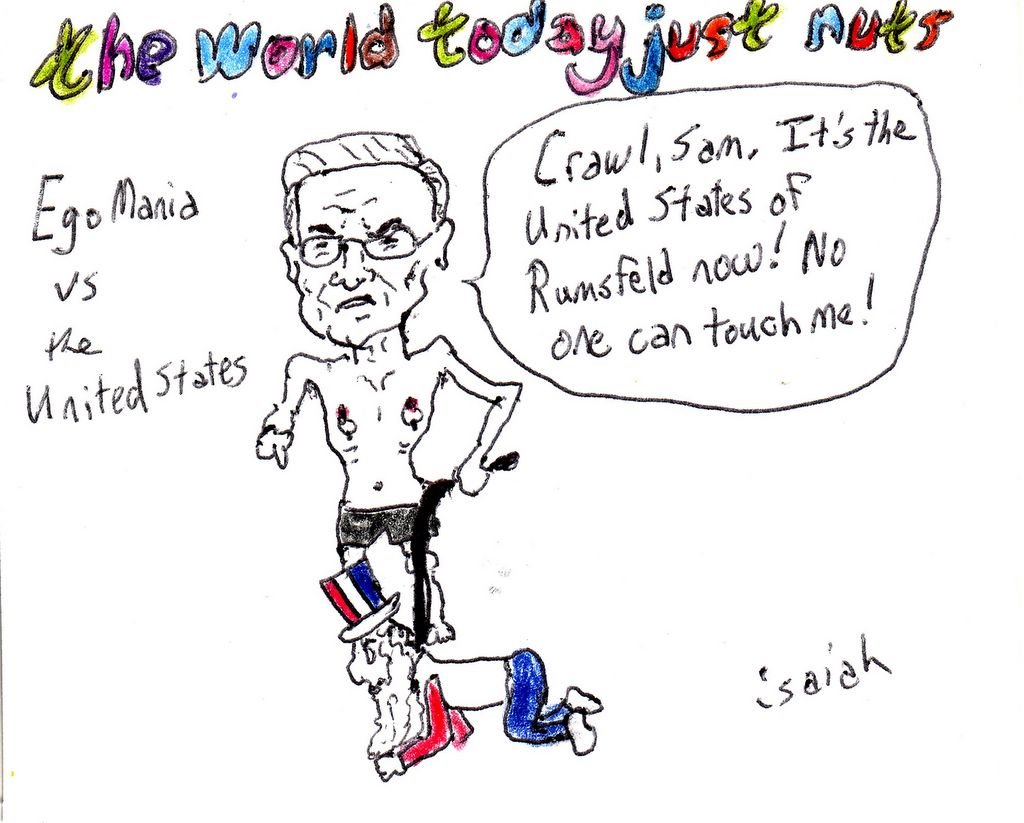
Ego Mania vs. the United States


The above is "Ego Mania vs. the United States." The out of control Donald Rumsfeld tortures Uncle Sam, April 23, 2006.


Donald Rumsfeld really was something. I don't know the man so I have no idea whether he was heartless or just dense but under his watch a lot of evil and criminal things took place. And when someone would point out, for example, that these 'stress positions' were torture, he would assert that he doesn't even use a chair, he stands at his desk, for hours, and if he can hold that position . . .

The man is either a sociopath or he is incredibly stupid.

Since ignorance of the law is no excuse, he's a criminal either way.

I was fine with Condi cartoons and honestly enjoyed doing them. She was probably my favorite to run with. But Donald? I only did a few with him and it's because he so freaked me out. Dick Cheney? He's just evil. I can get that. I can draw it. I could never figure out if Rumsfeld was pure evil or pure stupid. Even now he creeps me out.


Here's C.I.'s "Iraq snapshot:"


Thursday, January 21, 2010. Chaos and violence continue, the US military announces a death, the VA does another song and dance before Congress (as approximately 1,000 veterans still wait for their FALL 2009 checks), the Senate explores the Fort Hood shootings (in which 13 people died and over forty were wounded), the Iraq election 'process' remains in crisis, and more.

Today the
US military announced: "CAMP VICTORY, Iraq -- A U.S. Soldier assigned to United States Forces - Iraq died of non-combat related injuries as a result of a vehicle accident, Jan. 20. The Soldier's name is being withheld pending notification of next of kin. The names of service members are announced through the U.S. Department of Defense official website [. . .] The announcements are made on the Web site no earlier than 24 hours after notification of the service member's primary next of kin. The incident is under investigation." The announcement brings to 4374 the number of US service members who have died in Iraq since the start of the illegal war.

RTE News is the only one filing on violence today and they note a Kirkuk bombing targeting the Health Dept director general (who survived) today and, dropping back to yesterday, they note that 1 Iraqi colonel was shot dead in Mosul, while 2 police officers were shot dead in Mosul and a third was killed in a Mosul bombing.

In DC today, US Senator Carl Levin declared, "Today's open hearing is on the panel's unrestricted report. A restricted annex to their report entitled 'Oversight of the Alleged Perpetrator' focuses on information which, in the judgment of the Department of Defense could prejudice a criminal prosecution if it was discussed in public. So our committee will have a closed session after this open hearing is concluded." Levin is the chair of the Senate Armed Services Committee which was hearing from former Secretary of the Army Togo West and retired Adm Vernon Clark, both of whom were tasked by US Secretary of the Defense Robert Gates to examine procedures and policies leading up to the November 5th Fort Hood shootings. John McCain is the Ranking Member on the committee and he noted, in his opening remarks, that "your report is devoted to personnel policies and emergency shooting response procedures. The report concentrates on actions and effects rather than the motivations but it was motives that led to the Fort Hood killings and that should have been examined." McCain called it an "omission" to not identify specific threats of potential violence to servicemembers.

In reading his opening remarks, Clark broke away to insist that "behaviors" were addressed in the report ("that's what we're talking about") and "self-radicalization" was in there. He also broke away to say there was "no single" answer to ensuring the protection of servicemembers from these threats but the threats really weren't identified in the public report. I'm less interested in West and Clark's opening remarks today because we covered them in
yesterday's snapshot when they appeared before the House and the basics remained the same. One difference was Clark's delivery which was brusque at best and defensive in regards to issues McCain raised. His irritation was also noted by his repeated praise for "Mr. Chairman" and his pointed refusal to praise the "Ranking Member" or "Senator McCain." He offered praise for Levin not once but mulitple times and there were several times when he offered an "I want to thank you, Mr. Chairman" for something that Levin had noted in his opening remarks . . . but it had also been noted by McCain who, again, was pointedly not mentioned. (At one point he did thank "Mr. Chairman and all the members".)

Chair Carl Levin: The panel found that: "Department of Defense policy regarding religious accomodation lacks the clarity necessary to help commanders distinguish appropriate religious practices from those that might indicate a potential for violence or self-radicalization." And I think what you're saying is that obviously this country believes in religious tolerance, tolerance of others' religions, but it can never be tolerant of violent, radical views that are dressed up in religious garb. I think that's that point reworded. I couldn't agree with you more. Sometimes the views that are clearly inherently violent, promote violence are dressed up in religious clothing and that automatically means that people who are sensitive to others' religious views then are kind of put on the defensive right away or reluctant right away to point out what is underneath the claim of religion. So the line has got to be there obviously. We want to continue our tolerance but we've got to be much harder and much more intolerant of views that are radical, promote violence, or encourage violence. And so my first question to you is that the policy of the Department which is limited to and addresses only active participation in groups that pose threats to good order and discipline is far too narrow a policy because of the self-radicalization point. You don't have to participate in a group that poses that kind of a threat to be a threat yourself. And so I guess my first quesiton is: How would you -- and I know you're not here to provide remedies and that wasn't your job -- but I assume that you agree that it's not just that that policy should be examined but that in your judgment, at least, it's simply too limited a policy. And I'm wondering whether or not for instance, you would agree that communication with a radical cleric who promotes violence is the kind of conduct that should raise real questions? Would you agree with that? Even though it's not active participation at that point it's just simply communication -- asking someone for their recommendations and views. Would you agree that that ought to be raising great suspicion without getting into this particular case?

Sec Togo West: Yeah. Mr. Chairman, I would certainly agree -- I think we both would. And I think your larger point that this is an example of, we would agree with as well. And that is: Yes, in the past perhaps, membership alone in a group may have been less looked upon than the actual act of doing things but, in this environment, we have to look at the group, we have to understand its purposes. And it is already considered by some that there is a tool that enables a commander to declare certain kinds of action including that a threat to his immediate area'ss order and discpline. But we think the Department of Defense can just simply strengthen the ability of commanders to look at and examine exactly what kind of activity they are permitting and whether or not we can better define it. Group membership in a group of that sort that has a record of active advocation of violence and as well as your point communication --especially repeated communication -- again, not referring to any particular case -- with those who advocate violence? Those are all signals that we need to be able to indicate in our publications and in our regulations commanders are authorized to look and be react to.

Chair Carl Levin: And even if there weren't active communication, excuse me, active participation or communication, with radical persons who are promoting violence, even if there's simply the expression of views which promote violence without any information about participation in a group or communication with radical extremists -- if somebody gets up and says, 'I believe that the Constitution comes in second and that my religious views come in first,' would that not be that kind of a signal which ought to indicate some real genuine concern? Would you agree with that?

Adm Vernon Clark: I certainly do agree with it and it goes without saying that where we draw our redlines is a very, very important point. But if you look at our history, we as a people, as Americans have always been very careful working about where we draw those lines. I so appreciate, your introduction to this question by your [. . .]

And we're done. Salem Witch trials are only one historical example in the US of religious intolerance. That is a flavor of the hearing a number of service members are concerned with what is going on in these hearings and wanting to be sure that care is being taken. Levin covered that at the top. Whether you think it is or is not will be your call but the issue was raised and those are some of the responses. Due to space limitations and too much else to cover, that's it on that.

Yesterday the US House Armed Services Committee heard from West and Clark. Last night Kat weighed in on US House Rep Loretta Sanchez' exchange. Sanchez noted a colonel who called into a radio program that she happened to catch and how he stated that there were warning signs and he just wanted to retire before the guy 'blew'. West told Sanchez he believed they spoke to the (left unnamed) colonel but they never heard the radio broadcast or of it. Kat: "How does that inspire confidence? You've got a public conversation out there that you can now apply to the testimony a colonel is giving you. Shouldn't you have made the comparison? Shouldn't you have been aware of the radio broadcast?" Filling in for Rebecca last night, Wally noted US House Rep Todd Akin was the one to ask a question about the issue of the suspect being Muslim and he also noted that although over sixty representatives serve on the committee, he counted 14 at one point and one of those wasn't on the committee, US House Rep Michael Burgess who was allowed to sit in.

And we're back to service members. Today the US House Veterans Affairs Subcommittee on Economic Opportunity held a hearing. We'll start by noting some of the chair's opening remarks (as delivered, slightly different from the prepared text).

Chair Stephanie Herseth Sandlin: Some of those in attendance may recall that our first hearing of 2009 was on the implementation of the post-9/11 GI Bill. This was followed up by supplemental hearings that sought to ensure VA's progress on the short and long-term information techonology solutions. I hope that it is clear to our panelists before us today that by making this our first hearing of 2010, we demonstrate the continued importance of the subject at hand. I'm sure my colleagues will agree that the current delays in processing education claims are simply unacceptable. A number of my colleagues not on this committee have spoken to me directly or have written to me documenting experiences of student veterans that they represent who have suffered some of the consequences of the delays in processing these claims. While the administration, I know, shares my concerns regarding these shortcomings,more has to be done. However, the blame doesn't rest solely with the VA. The processing of a single claim requires multiple steps involving multiple parties and computer systems, all of which must work in-sync with one another in order for a veteran to receive his or her benefits in a timely manner. These computer difficulties demonstrate the need for a fully-functional long-term solution.

The Chair then noted that the Subcommittee staff had visited Muskogee, Oklahoma's VA Regional Processing Center and Education Call Center wher ethey discovered the Education Call Center was being shut down on Thursdays and Fridays. Veterans calling were not able to speak to anyone and the staff was working on claims. It was noted by Herseth Sandlin that the Call Center can and should be open five days via better time management. Ranking Member John Boozman noted the visit as well and how the staff were the ones who told them time could be better managed and that, "As a result of that discussion, local VA management forwarded a request to the VA's Office of Field Operations to make the changes suggested and therein lies my concer: Why does it take a suggestion from Congressional staff to raise such a common sense issue and why do those responsible at the local level need to get permission from central office?" He furher noted that seven a.m. to five p.m. on the call center (from Monday through Friday) limits the opportunities for those "living outside the continental US" to speak to someone.

The VA sent Capt Mark Krause (Program Manager) and Roger W. Baker (Asst Sec for Information and Technology) to testify. I'm really not interested in their excuses or self-strokes. Nor are the service members complaining that they still haven't received their fall 2009 checks. So I'm not interested in Rober Baker's bulls**t for example where he refers (past tense) to 2009 enrollees that did not receive their checks and "I believe it is important to convey, on behalf of Secretary Shinseki and every member of the VA team, our apologies for those delays and our understanding that the impacts of those delays on Veterans are unaccpetable."

It's nonsense. And the committe heard "accountability" from Shinseki and others who followed him in October. Someone needs to explain to the VA that merely tossing around the word "accountability" (while the cameras are rolling) is not demonstrating "accountability." And the VA has yet to demonstrate that it has taken any accountability for its poor job. A congo lline of VA employees have repeatedly appeared before the committee all claiming that the delays were "unacceptable" but the VA has shown no improvements. Following a lengthy slideshow, this exchange took place.


Chair Stephanie Herseth Sandlin: Let me start with a statement, Mr. Wilson, that you made. On slide four, the long-term release II scheduled for June 30, 2010 that sort of allows for the automated data feeds for the schools, DoD, that this is a game changer from the user point of view. You know, for Mr. Baker, Mr. Wilson, I assume that the goal for the long-term release II is to have that operatational for processing fall 2010 semester claims. Is that correct?

Keith Wilson: Yes, that's correct.

Chair Stephanie Herseth Sandlin: That being the case, Mr. Baker, according to your testimony, release I has been modified to reduce its functionality because of this software requirement that you recently --

Roger Baker: Yes. The increased complexity, yes.

Chair Stephanie Herseth Sandlin: So why did it take until just recently to identify the need for the new software requirement?

Roger Baker: Actually . . . uhm . .. what-what occured is as the subject matter experts and the software people were sitting down together to walk through what does an amended reward really mean? What are the intracricies, the decision trees required for an amended reward . . . uhm . . . They kept uncovering , if you will, more and more depth of what was required on software of amended awards and it went beyond the estimates they had originally had for what it was going to take to do amended awards. Uh, so as we determined that the amount of work to make that March 31st date exceeded the amount possible to accomplish, we had to determine what would come out of that release?

Chair Stephanie Herseth Sandlin: And how confident are you then that the June 30th deadline can be met --

Roger Baker: We're --

Chair Stephanie Herseth Sandlin: In light of how important that deadline is to the fall semester?

Roger Baker: We're -- we're pretty confident in that. We-we, as you can imagine, we've had some significant focus on that as well. And we've talked about what is it possible to do in the June 30th timeframe. We know that we can get everything in that was originally scheduled for release I and release I was intended to be the replacement for the current system so -- functional replacement. If we had delayed release I until about mid-May , we'd have had a fully functional release. There's about that much additional work that was added. Uh, so we know that will come in. And we will be releasing that functionality in incremental pieces along the way to mid-May and if VBA determines it's appropriate allowing the users to work with the increased functionality in that time frame. And then adding those automated feeds that are critical as we ramp up to June 30th. So we-we have a reasonably good confidence in the June 30th -- and if you don't mind, I'll elaborate on that just a little bit further. The-the thing that I have to tell you that I'm pleased with in the slip -- and I know this is going to sound a little strange -- is that in December, this project team was able to tell us that they had a problem with meeting the March 31st date. That's not a usual thing inside of VA projects. Usually, you hear about it March 30th. Uh, you know, that's going to happen on March 31st. That gave us time to make rational decisions about: Do we want to allow the slip or do we want to force the delivery date so that we see the software and what is the impact of that on subsequent releases? And so that's why we have a reasonable degree of confidence that we're going to have what we need on June 30th for a more automated system going into the fall semester. That's exactly been our focus with that June 30th release.


Chair Stephanie Herseth Sandlin: Well I would just request that as that team -- you know, you've got a lot of internal milestones you're trying to meet and you've been very helpful to our committee and our committee staff in sharing information at every step of this process but in light of the problems that we've had with the interum solution, in light of the importance of this long-term solution, we-we need to stay on top of this, day-by-day, week-by-week. And if there is any other problem that is revealed to your project team, uh, we just need to be made aware of some of that ongoing work because of the importance of these deadlines in meeting the benefits for these students and-and understanding what more you might need from us because it's a high priority not only among this committee but the colleagues we hear from who have student veterans who are experiencing problems. You know, we want to make sure that we're able to answer questions immediately.

Herseth Sandlin wanted to know how long it will take to train the veterans claims examiners in each of the releases?

"We haven't done this before," said Krause. "I don't know that we have a feel for it," he added after some stumbling and hand gesturing. Wilson stated the training would be different blah blah blah. Which means, we don't know. But Wilson couldn't tell the truth and instead went into "that will be a more efficient process." The chair noted that after release one, the committee needed to be informed of what the time figure for training was.

Wilson stated approximately 1,000 veterans are still waiting for their fall 2009 checks ("no payments have gone out on those"). Wilson also insisted that the VA is in contact with all veterans who are waiting. No, they aren't. And as the chair pointed out, service verification from DoD is not the student's responsibility. That's the government's issue and that's their delay.

If it seemed to repeat from past hearings, that's because it did. Boozman repeated that the committee needed to know when there was a problem and that they needed to know if additional resources were need: "We have to understand what's going on." And the Ranking Member and the Chair both care about this issue but this is getting to be a joke where the committee gets informed of a problem in the midst of hearing or right before a scheduled hearing. The VA did not, DID NOT, inform Congress, that over a thousand veterans were still waiting for fall checks. That broke right before Christmas -- AP's Kimberly Hefling broke that story. Now grasp that this might have been tuition and/or housing checks. Tuition? You may say, "Well the college can wait." Many veterans -- talk to them, not the VA -- will tell you they had to take short-term loans. With interest rates. In order to cover the VA's delayed tuition payment, they had to take out short-term loans. I think the issue of money that would have gone to housing is self-explantory but I do know there is a perception (a mistaken one) that if the veteran's just waiting for a tuition check, it's no big deal. It is a big deal. And it's really past time that the committees in Congress started hearing from veterans in a public form so that all the citizens can know what they've had to go through as they've waited and waited for this promised benefit. They've waited and waited. And then, when problems emerged, they were treated rude. "It was," to quote one attending today's hearing, "as if the attitude was, 'Well we're giving it to you so you should just be grateful and stop complaining about it being late. We'll get to you when we have time.'" It has been offensive and it's been awkward. And especially so for those veterans with children. Whether they are the primary caregiver or not, many had to juggle money that was not there -- because the VA couldn't get the checks out -- to try to pull off a Christmas for their children. There's no excuse for that. There is no excuse for months and months of delays and it is very upsetting to veterans to continue to see Congress ask, "What do you need? Now you're going to tell us -- this time -- when a problem comes up, right?" Veterans at the hearing today felt like if they made that kind of mistake it would be all on them but when the VA makes it, the VA gets patted on the back and told, "Just try next time." It needs to stop and there needs to be accountabilty, There is none now and that goes to a lack of real leadership at the VA currently.

Let's move to Iraq quickly.
Nizar Latif (The National) notes Iraq is now "locked in a deep constiutional crisis" as a result of the continued targeting of Iraqi politicians who might prove popular with voters. The banning is being done through a post-legal (or pre-legal) body. Jason Ditz (Antiwar) adds, "The bannings effectively destroy the third largest political alliance in Iraq just months ahead of the election, and are seen by many as an attempt by the Maliki government to cement its hold on power." Robert Dreyfuss (The Nation) explains of the body:The Justice and Accountability Commission is heir to the old, circa-2003 de-Baathification Commission, a McCarthyite blacklisting body set up by the neocon-domination occupation authorities after the US invasion of Iraq and headed by Ahmed Chalabi, the wheeler-dealer who was the chief proponent of the war in the 1990s and beyond and who was an intimate confidante of leading neoconservatives such as Richard Perle, Paul Wolfowitz, Douglas Feith, and various American Enterprise Institute apparatchiks such as Michael Rubin, Danielle Pletka, et al. Today, Chalabi -- who spends a lot of his time in Iran, and who US military authorities believe is essentially an agent of Tehran -- is still the titular leader of the Justice and Accountability Commission, which is run day-to-day by Ali Faysal al-Lami. Lami is a sectarian Shiite politician who is running on the same Shiite religious alliance in the March 7 election that was put together by Chalabi, with the support of Iran and the backing of Islamic Supreme Council of Iraq (ISCI), Iran's chief Iraqi ally. The commission is no more. Iraq is supposed to have implemented de-de-Ba'athification measures and, in addition, the Parliament refused to appoint people to the so-called Justice and Accountability Commission. The presidency council didn't sign off on the committee. It has no power, it has no authority. So why is it being listened to?On the most recent Inside Iraq (Al Jazeera -- excerpt in Tuesday's snapshot), a supporter explained that it exists in bits and pieces stitched together. That's what his meandering response stated and, for those paying attention, this is the same lie/excuse supporters use to justify Parliament being cut out of the process for awarding oil contracts. Nouri's people pick and choose which laws to listen to and which laws not to, ignore this aspect or that, ignore the Constitution and do Nouri's bidding. The two situations really are identical. In both cases the Constituion is being ignored as are other laws. In both cases, a cobble together pre- or post-legal argument is being made -- one with no actual legal foundation -- to justify doing what Nouri wants done. Al Arabiya reports on a document Iraq's Sunni Vice President, Tariq al-Hashimi, has passed to Jalal Talabani, current president of Iraq which goes to the lack of authority for the commission, noting it's not been "approved by the presidency, cabinet, and paliamentary councils." Waleed Ibrahim, Khalid Al-Ansary, Muhanad Mohammed, Michael Christie and Ralph Boulton (Reuters) report the presidency council is asking for a court ruling on whether or not the committee making these decisions is even legitimate and quotes Talabani stating, "We have asked our brother Medhat al-Mahmoud (head of the Iraqi Supreme Judicial Council) whether the commission called justice and accountability really exists. As we know, parliament has not voted it into existence yet." Leila Fadel (Washington Post) reports US Vice President Joe Biden is being dispatched to Iraq and quotes Talabani stating, "We are an independent country and will not receive orders from anyone, whether it is a brotherly Arab country, a neibhoring country or a friend. Mr. Biden made proposals, but we are committed to safeguard and uphold this constitution."

In London, the
Iraq Inquiry continues and today's witness was Jack Straw (link goes to video and transcript options) who was the Secretary of State for Foreign and Commonwealth Affairs from 2001 to 2006. In the lead up to his testimony, correspondence and family drew press attention. Starting with the latter, the Daily Mirror quotes his son Will Straw stating, "My father's eventual support for Tony Blair over the war was the biggest mistake of his political life." David Cohen profiles Will Straw for London's Evening Standard: and quotes him stating, "Gordon Brown and Tony Blair have been a huge disappointment and let down the Laobur Party. I am especially deeply angry with Blair for being duplicitous about his reasons for taking us to war with Iraq, hiding behind WMDs when he was content to prosecute a war for regime change. And also for the unbelievably shoddy way he betrayed my father, demoting him from Foreign Secretary to Leader of the House, especially after my dad had been so loyal." Now to the correspondence issue, Sunday Richard Norton-Taylor (Guardian of London) reports on a letter Straw wrote Blair ten days before Blair met with Bush at the latter's Crawford ranch (April 2002): "Jack Straw privately warned Tony Blair that an invasion of Iraq was legally dubious, questioned what such action would achieve, and challenged US claims about the threat from Saddam Hussein, it was revealed today ." Let's note this excerpt from today's hearing:

Committee Member Lawrence Freedman: Let's just go through the very interesting issues you have raised there. Let's go through a couple of them. First, the missiles, and this had always been the strongest part of the intelligence picture, and the missiles were found. The point Mr Blix made was that it was destroying -- that is, here was something that could be found and there was a way of dealing with them through the provisions of UNMOVIC. You didn't need to do anything else thereafter. He had found them. He had made the point. He dealt with them. The other question on the intelligence was that the issue that you were saying about going to war, not going to war, depended very much on a political understanding in the Security Council, indeed in this country, so that, though you may well have been right about what the resolution required and what was needed, nonetheless you were dealing with a political perception, within the Security Council, that something more was required and this was a difficulty all the way through, that the people were expecting to see more.

Jack Straw: Sir Lawrence, everybody was expecting to see more. Leave President Putin out of it, but the level of the international consensus that Iraq had weapons of mass destruction was very broad, and as I record in my memorandum, Dr Blix himself says after the war that he thought they continued to have stocks -- his assumption all the way through had been that. But there was a -- there was no war party on the Security Council -- I mean, we can say maybe on the part of the United States administration, but I certainly, in the UK government -- I certainly didn't want war and I say, if Dr Blix had said -- and Dr El-Baradei, but if Dr Blix -- because this was where the focus was -- "This regime is complying with and it fulfils, as it were, the test in OP4", that would be the end of it from our point of view. I don't know what the United States would have done, but there would have been no case whatever for us taking part in any military action, and the strategy of 1441, which was to resolve this by peaceful means would have succeeded.

That's reflective of all the jumble of distortions that came out of Straw's mouth. Let's deal with the above. 1441 is the first UN resolution. There was no second resolution. There was no UN resolution giving the go-ahead for the invasion of Iraq. 1441 was about weapons inspectors going into Iraq and searching for weapons. Does Straw think the whole world is stupid? He wants to say that if the weapons inspectors had said Iraq was in compliance that there would have been no war. At least not for England, he quickly added.

2003 was some time ago, it was not, however, before the advent of recorded history.
Click here for AP's real time story where the inspectors have to flee Iraq -- before finishing their mission -- because Bully Boy Bush is declaring war. Everything Straw stated was questionable. Including that he went to Tony Blair and stated the UN had to mediate or be given the chance to because otherwise the war would be illegal -- if England and the US just invaded, it would be illegal. But that's exactly what happened. Chris Ames (Iraq Inquiry Digest) attempts to travel through the maze of Straw's making. Louise Nousratpour (Morning Star) notes the vanity in Straw's statements as he declared if he'd told Blair he wouldn't support the war, it wouldn't have taken place. Well there you go. Now we know who to blame. As soon as he climbs off the cross, we can all proceed to the Hague.

Straw also attempted to insist that the 45-minute claim used to sell the illegal war in England (Iraq has WMD! and Iraq can attack England with them in 45 minutes!) was a mistake -- not because it was a lie (it was a lie) but, golly, that wasn't WMD, that was missiles. Missiles, Straw insisted, was what Tony Blair meant with the 45-minute claim. Not that WMD would hit England in 45 minutes, but missiles. Straw really thinks the world is stupid. The man appears unhinged when speaking, whether he was that nervous or suffering from some mental or physical issue, I have no idea.
Channel 4 News' Iraq Inquiry Blogger best captured one of the strangest moments, "Odd too when Straw appeared to suggest that the panel take evidence from the late Robin Cook to confirm how he -- Straw -- had always insisted the war only proceed after parliamentary debate." At the Guardian, Chris Ames has a detailed analysis of Straw's testimony and we'll note the opening:

Thanks to Gordon Brown, the Iraq inquiry has become largely an exercise in reading between the lines against a government strategy of the selective release of information and selective quotation. From that perspective, we learnt this afternoon, in spite of Jack Straw's best efforts, that in a letter to George Bush in July 2002, Tony Blair gave a pretty unconditional undertaking that Britain would join in the US-led invasion of Iraq. The government has blocked publication of that letter. Jack Straw, who also blocked publication of the pre-war cabinet minutes, agrees with that suppression.
The reason you have to read between the lines is that –
as I first wrote in November – by virtue of the Cabinet Office protocol on information, the government can control both what the inquiry can publish and what it can directly quote in public sessions. The inquiry is increasingly kicking against this restriction and today said out loud that it is being restricted.
But,
as I have also observed, government witnesses have also learnt to play the game of putting their own spin on the evidence we have not been allowed to see. In pursuit of this strategy, Straw today submitted a lengthy memorandum justifying his approach to a war that he says he never wanted. The inquiry dutifully published it on its website.


In response to Straw's testimony today, the
Liberal Democrats issued the following statements:

"Given his central role and all we know about Blair's support for Bush's regime change plans, Straw's claim seems implausible," said the Liberal Democrat Shadow Foreign Secretary.
Commenting on Jack Straw's appearance at the Iraq Inquiry, Edward Davey said:
"Jack Straw's insistence that he used his 'judgement' rather than solid proof of the existence of WMD is a weak defence of his role in this disastrous war.
"Given his central role and all we know about Blair's support for Bush's regime change plans, Straw's claim seems implausible.
"It is clear that he is desperate to distance himself from Tony Blair's unrepentant belief that he would have got rid of Saddam whatever it took.
"Jack Straw's testimony today also shows that there is no problem with serving Cabinet ministers appearing before the Iraq Inquiry. There is no obstacle to Gordon Brown appearing before the General Election to talk about his role as Chancellor in the run up to and during the Iraq War."

Finally, BB
C News is reporting that Gordon Brown will testify to the Iraq Inquiry before elections are held.

iraq
the daily mirrorthe london evening standarddavid cohen
the nationalthe nationrobert dreyfuss
jason ditzal arabiya
the washington posternesto londonoleila fadel
the guardianiraq inquiry blogger
chris ames


Read on ...

Thursday, January 14, 2010

A Bully Boy Easter


That's "A Bully Boy Easter." That's from April 16, 2006. And this is a bad drawing but I like it.

I wish it were better but I think the fact that it's badly drawn actually makes it funnier.

I didn't intend to draw it badly. I was trying to get done and that's how it turned out.

Here's C.I.'s "Iraq snapshot:"

Thursday, January 14, 2010. Chaos and violence continue, Najaf is rocked by bombings, Nouri targets more political opponents, more Iraqi executions announced, exploring the opposition to Avatar, Pig gets arrested (again!) for being a sexual predator (again!), and more.

Starting in Iraq where
Hannah Allam and Sahar Issa (McClatchy Newspapers) reported that any hopes last week's announcement of parties and politicians banned from Iraq's elections (expected to be held in March) would be overturned appear to be over as it now appears that an additional 100 candidates may be announced banned shortly. Faraj al Haidari (Independent High Electoral Commission) attempts to spin frantically insisting that the efforts to disenfranchise are not aimed only as Sunnis. In 2005, a large number of Sunnis boycotted the national elections and hopes of higher participation this go round appear in doubt. Salam Faraj (AFP) reports a banning has been announced and quotes IHEC's Hamdia Husseini stating, "We have decided this afternoon to exclude around 500 names and political entities from the list of candidates." Michael Jansen (Middle East Views) sees no attempts at equality or protecting the public, only efforts to target Sunnis and eliminate them from the process: Whether this proposal is accepted or not by the election commission, it is clear that the US-installed Shiite-Kurdish rulers of Iraq do not intend to share power with anyone else. The de-Baathification committee -- renamed the Justice and Accountability Board - made this recommendation although its chief target, Saleh Mutlaq, was cleared to stand in Iraq's 2005 election and his National Dialogue Front won 11 seats in the 275-member assembly. Ali Lami, head of the panel, claims new information reveals that Mutlaq "is a Baathist and nominated himself as a Baathist." Mutlaq dismissed the allegation as "rubbish". He left the Baath party in 1977 before Saddam seized power, established a large farming business in the south, and made a great deal of money. His supporters point out that Lami has close relations with pro-Iranian factions and only retained his post because there was no agreement on a replacement. It may be significant that the new charge against Mutlaq surfaced after Iran's Foreign Minister Manouchehr Mottaki paid a visit to Baghdad. Afif Sarhan (IslamOnline.net) notes, "Experts believe the ban would also stir a political storm for the Nuri Al-Maliki government" and quotes Ibrahim Suwa'id stating, "A ban like this, a couple of months before parliamentary elections, can bring a chaotic situation that the government will feel hard to succeed." Zainab Naji and Ali Kareem (Global Arab Network -- backed by US funds, FYI) note an emerging opinion that Nouri's worried that Ayad Allawi (who was prime minister before Nouri) could replace him and they quote Iraqi Organization for Media Development's Wathiq al-Hashemi stating, "Allawi's alliance poses a threat to other political powers, so any ban on one of his leaders [al-Mutlaq] is in the best interests of those powers [in power currently]. If Allawi withdraws from the elections, the political process will be in serious danger." Rebecca Santana (AP) interviewed Allawi today and he calls out the targeting of Sunnis: "This is a process of severe intimidation and threats. It's clear that they want to get rid of their opponents."

Yesterday,
Leila Fadel and Aziz Alwan (Washington Post) were observing, "Another major attack would have been particularly damaging to members of Maliki's coalition running in parliamentary elections. The coalition's candidates are campaigning on a security platform." Nouri's grandstanding for elections, as he tries desperately to regain his (false) image as the person who gave Iraq security, coincides with the announcement of executions. Al Jazeera reports that 11 men have been sentenced to death for the August 19th Baghdad bombings ("Black Wednesday") and quotes the judicial body's spokesperson Abdul Sattar al-Birqdar stating, "Today an Iraqi criminal court imposed a death sentence against 11 criminals who have been convicted of implementing, planning and funding the bomb events that targeted the finance and foreign ministries." Nada Bakri (New York Times) states al-Beeraqdar declared that an investigation into the August bombings were conducted for over three weeks -- turning up 'evidence' on the men -- and then the 11 men faced a trial. A two-week trial. A two-week trial. And all are convicted to death by execution? How very fortunate for Nouri's efforts to hang on as prime minister (the prime minister is selected by Parliament, FYI). The 11 sentenced to die join a long, long list of other guilty or 'guilty' persons in Iraq facing execution. Last month, Amnesty International issued the following:

Iraq is preparing to execute hundreds of prisoners, including 17 women, warned Amnesty International today, as it issued an 'urgent action' appeal to try to prevent the deaths. The 900-plus prisoners have exhausted all their appeals and their death sentences are said to have been ratified by the Presidential Council, meaning that they could be executed at any time. Amnesty supporters are contacting Iraqi embassies around the world, including that in London, in a bid to stop the executions. The condemned prisoners have been convicted of offences such as murder and kidnapping, but many are likely to have been sentenced after unfair trials. The 17 women are thought to include a group known to have been held on death row at the 5th section (al-Shu'ba al-Khamissa) of Baghdad's al-Kadhimiya Prison. Amnesty International UK Campaigns Director Tim Hancock said: 'This is a staggering number of people facing execution and the fact that the government may be playing politics over these cases is truly frightening. 'Wholesale use of the death penalty was one of the worst aspects of Saddam Hussein's regime and the present government should stop aping his behaviour. 'Instead of sending nearly a thousand people to a grisly death by hanging, the Iraqi authorities should halt all executions and impose an immediate death penalty moratorium.'Iraqi media reports suggest that the Iraqi government is currently trying to present itself as 'tough' on crime ahead of national elections scheduled for January. Iraqi opposition politicians have expressed concern that executions may be carried out to give the ruling party a political advantage ahead of the elections, and there have been calls for the government to temporarily suspend all executions. Amnesty is warning that Iraq's use of capital punishment is already spiralling. At least 120 people are known to have been executed in Iraq this year, greatly up on the 34 executions recorded during 2008. Iraq is now one of the world's heaviest users of the death penalty. After the US-controlled Coalition Provisional Authority suspended the death penalty following the toppling of Saddam Hussein's government in 2003, Iraq's subsequent reintroduction of capital punishment led to a rapid acceleration in death sentences and executions. Despite this, and contrary to some claims made by the Iraqi authorities, use of the death penalty has not seen a drop in crime levels in the country, with rises and falls in insurgency violence having no discernible relation to execution rates.

Violence begats violence?
Qassim Zein and Hannah Allam (McClatchy Newspapers) report Najaf was rocked by three bombings -- one right after the other -- as the day ended with 25 dead. Vendor Mohammed Sami was wounded in the bombings and he tells Adam Schreck, Sameer N. Yacoub and Hamid Ahmed (AP), "Many people came to save me. But after a few minutes the second explosion occurred and we all ran to the nearest alley to hide." The Hindu explains, "One of the blasts targeted a street leading to an important Shiite Muslim shrine, and two others hit a crowded vegetable market, together killing at least 12 people and wounding 20 more." Press TV's Wisam al-Bayati adds, "The market placed was packed with people when the explosion took place and most of the casualties were women and children." Leila Fadel and Saad Serhan (Washington Post) describe "body parts, broken glass and metal scrap from the car littered the street". Xinhua reminds, "Najaf is home to the mausoleum of Iman Ali, the cousin of the Prophet Mohammed. It attracts thousand of pilgrims every year."

In other reported violence . . .

Bombings?

Reuters notes a Mosul roadside bombing injured one Iraqi soldier. Zhang Xiang (Xinhua) reports a Baquba cart bombing has claimed 2 lives with ten more people wounded in a market and six shops destroyed.

Shootings?

Reuters notes 1 man was shot dead in Mosul and a drive-by shooting claimed the lives of 1 man and 1 woman in Mosul. Zhang Xiang (Xinhua) reports high schooler Sameer Aziz was shot dead in Khalis ("Aziz's Sunni family was displaced for two years from their home during the sectarian strife in the past years and his family has just returned home as the city witnessed a relative calm in recent few months, the source said.") and, dropping back to Wednesday night, Sahwa leader Khalid Hardan was shot dead in Edhaim (his uncle was also wounded).

All last month, we had to endure a bunch of liars or idiots insisting the US was so 'noble' or uninterested in Iraq oil (hard to tell which assertion produces more laughs) and that was demonstrated by the US not being involved in recent biddings. You had to be really stupid not to notice the board of directors of those companies (identified as 'foreign' by the US press, they sure had a lot of Americans on their boards). Apparently all the laughs that could be have been wrung out of that so today
Timothy Williams (New York Times) reports, "A wave of American companies have been arriving in Iraq in recent months to pursue what is expected to be a multibillion-dollar bonanza of projects to revive the country's stagnant petroleum industry, as Iraq seeks to establish itself as a rival to Saudi Arabia as the world's top oil producer."

Meanwhile in the US former journalist Thomas E. Ricks has taken to huffing publicly about James Cameron's box office smash
Avatar. (Disclosure, I know Cameron and consider him a friend.) What could make a pudgy former journalist so angry? The answer is staring everyone in the face. Last week, Ruth noted WBAI's The Arts Magazine (airs each Tuesday from two in the afternoon until three in the afternoon) when Louis Proyect was the guest for the first half-hour.

Louis Proyect: And even though it's set some time in the distant future and on a distant planet, it's very obvious that it's about what's happening now in Iraq and Afghanistan. It just amazes me that anybody you know could think otherwise about this movie.

Prairie Miller: Yeah and then there's this attitude of rejecting this film outright because there's money behind it, there's Rupert Murdoch and whatever happened to the notion, the Marxist notion, of seizing the means of production? In this case of cultural production, you know, for other means. I mean this is amazing. He, Cameron has said about his film that there's a sense of e -- "There's a sense of entitlement. 'We're here, we're big, we've got the guns and, therefore, are entitled to every damn thing on the planet'." And incidentally, Cameron, who's a Canadian, he admirably dropped his application for American citizenship after Bush was elected in 2004 so there's much more than meets the eye concerning the attacks on this film.

Louis Proyect: Yeah. I'm glad we're in 100% agreement on this one because I thought we would be, Prairie.

Prarie Miller: Now you came up with some study about anthropological imperialist invasions. What was that about?

Louis Proyect: Yeah, right now, you have people working in Afghanistan -- and I think they were in Iraq as well -- who were anthropology professors who agreed to work with the military to win the hearts and minds of 'the natives.' And there's a huge controversy about this. They just had a convention of the American Anthropological Association where they-they went on record as being opposed to that. The idea is that what they want to use are what you might call professional techniques to figure out how to control a population combining measures that might improve their life somewhat but at the same time soften them up to accept a military occupation. And quite frankly, the-the anthropologists who are involved in this business are, you know, I don't think they have the right to teach. I mean, what they're doing, I think it's a kind of war crime. And Avatar deals with this because Sigorney Weaver, who's one of the major characters, is an anthropologist trying to pacify the local population. Well, I think your listeners would want to see the movie. I don't want to give too much away, too much of the plot. But it just has to do with how the professions in the United States, including psychologists by the way, who worked in Guantanamo, to-to get -- to make sure that torture was being carried out in such a way that people wouldn't be completely broken and capable of giving information. I mean, this is just horrible.


That edition of The Arts Magazine is
available at the WBAI archives for 80 more days.
To refresh, from the
December 3rd snapshot:

The
American Anthropological Association's annual meeting started yesterday in Philadelphia and continues through Sunday. Today the association's Commission on the Engagement of Anthropology with the US Security and Intelligence Communities issued their [PDF format] "Final Report on The Army's Human Terrain System Proof of Concept Program." The 74-page report is a blow to War Criminals and their cheerleaders who have long thought that the social science could be abused or that the social sciences were pseudo sciences.

Only a small number of outlets have covered the AAA's findings. First up were
Patricia Cohen (New York Times), Dan Vergano (USA Today), Yudhijit Bhattacharjee (Science Magazine) and Steve Kolowich (Inside HigherEd). Another wave followed which included Tom A. Peter (Christian Science Monitor) reporting, "Today the program enjoys a core of supporters, but it's done little to address the concerns of anthropologists and, now, rising military complaints that the program has slowed the growth of the military's ability to train culturally sensitive warriors." Christopher Shay (Time magazine) added:

Two years ago, the AAA condemned the HTS program, but this month's 72-page report goes into much greater detail about the potential for the military to misuse information that social scientists gather; some anthropologists involved in the report say it's already happening. David Price, a professor of anthropology at St. Martins University in Washington and one of the co-authors of the AAA report, says the army appears to be using the anthropological information to better target the enemy, which, if true, would be a gross violation of the anthropological code. One Human Terrain anthropologist told the Dallas Morning News that she wasn't worried if the information she provided was used to kill or capture an insurgent. "The reality is there are people out there who are looking for bad guys to kill," she said. "I'd rather they did not operate in a vacuum." Price and other critics see this as proof that the anthropologists don't have full control over the information they gather and that commanders can use it to kill. "The real fault with Human Terrain is that it doesn't even try to protect the people being studied," says Price. "I don't think it's accidental that [the Pentagon] didn't come up with ethical guidelines."

David Price is a member of AAA and with
Network of Concerned Anthropologists. He reviewed Avatar:


Fans of Avatar are understandably being moved by the story's romantic anthropological message favoring the rights of people to not have their culture weaponized against them by would be foreign conquerors, occupiers and betrayers. It is worth noting some of the obvious the parallels between these elements in this virtual film world, and those found in our world of real bullets and anthropologists in Iraq and Afghanistan.
Since 2007, the occupying U.S. military in Iraq and Afghanistan have deployed Human Terrain Teams (HTT), complete with HTT "social scientists" using anthropological-ish methods and theories to ease the conquest and occupation of these lands. HTT has no avatared-humans; just supposed "social scientists" who embed with battalions working to reduce friction so that the military can get on with its mission without interference from local populations. For most anthropologists these HTT programs are an outrageous abuse of anthropology, and earlier this month a lengthy report by a commission of the American Anthropological Association (of which I was a member and report co-author) concluded that the Human Terrain program crossed all sorts of ethical, political and methodological lines, finding that:
"when ethnographic investigation is determined by military missions, not subject to external review, where data collection occurs in the context of war, integrated into the goals of counterinsurgency, and in a potentially coercive environment -- all characteristic factors of the HTT concept and its application -- it can no longer be considered a legitimate professional exercise of anthropology." The American Anthropological Association's executive board found Human Terrain to be a "mistaken form of anthropology". But even with these harsh findings, the Obama administration's call for increased counterinsurgency will increase demands for such non-anthropological uses of ethnography for pacification.

Thomas E. Ricks hates Avatar (and huffs and blogs to be sure we all know). Here's what those paying attention know: Ricks is this century's Walter Lippmann and that's not a compliment. He left journalism to whore for counter-insurgency. He has no ethical training and he thinks that general studies major (journalism degree) qualifies him for something. It doesn't qualify him for humanity and he's unable to address ethics. (Don't forget his stamping of feet at the AP last year.) He's a joke. He's a War Criminal now and he's joke.
Kelley B. Vlahos (Antiwar) addressed Ricks most recently earlier this week:In high school, there are always the Cool Kids. In the Washington military establishment, there are always the Cool Kids. Walking conflict ofinterest Tom Ricks loves to write breathlessly about Washington's prevailing Gang with the Name -- the COINdinistas -- most of whom now roost in the Pentagon or at the Center for a New American Security, which hired Ricks away from a full-time job at the Washington Post to do just what he's doing now: shamelessly promoting the Center for a New American Security (CNAS).But even the cool kids will eventually fall out of style. Like haughty Heidi Klum says, "In fashion, one day you're in, the next day you're out!" Perhaps that's why Ricks' latest Foreign Policy panegyric to his friends seems even more cringe-worthy and awkward than usual, mainly because this gushing yearbook entry -- dated December 2009 -- could have been written a year ago. Today, it tastes like slightly overdone steak. Stick a fork in it… you get the picture. Under the subheading, "Who knows everything there is to know and more about counterinsurgency and its current role in U.S. military strategy? These guys," Ricks effuses: "Pushed and prodded by a wonky group of Ph.D.s, the U.S. military has in the last year decisively embraced a Big Idea: counterinsurgency. Not everyone in uniform is a fan, but David Petraeus and the other generals in charge of America's wars are solidly behind it. Here are the brains behind counterinsurgency's rise from forgotten doctrine to the centerpiece of the world's most powerful military…"No. 1 on the list: Petraeus, or "King David," "who rules the roost," according to Ricks. He's followed by John Nagl, the former Army officer and Rumsfeld aide who now "beats the COIN drum" and might find himself in a "top Pentagon slot in a year or two"; Australian COIN-whisperer David Kilcullen, currently one of McChrystal's key eggheads, whom Ricks calls "the Crocodile Dundee of counterinsurgency"; Janine Davidson, a Pentagon policy-pusher who Ricks says is "now sitting at the adult table"; Dave Dilegge, editor of Small Wars Journal, which is "avidly read by everyone from four-star generals to captains on the ground in Iraq"; and Andrew Exum, another CNAS wonk, Iraq vet, and blogger, who "in his spare time has been known to play paintball against Hezbollah – no joke."

Little lesson today in: You are who you get in bed with. You are everything they were exposed to. So when someone's already has two arrests -- pay attention, Amy Goodman -- for attempting to have sex with a minor, you avoid them. You don't promote them as 'good' people. We've gone over that repeatedly but have to hit on it again today because Pig got busted and charged again.
Laura Rozen (Politico) notes it here. If we had a working left, a functioing one, Pig would have been shunned long ago. But see, when the victims would be female, so much of the left doesn't give a damn. That includes women, we've named Amy Goodman. There's Laura Flanders as well. Rachel Maddow. All these 'strong' women who couldn't say no to Pig and kept booking him on their shows. We've called it out repeatedly here while so many women have WHORED themselves and others. That's not to let the men off. But it's especially disgusting when women -- hey, Lila Garrett -- we're talking about your WHORING ASS too -- give space for sexual predators. From the February 5, 2008 snapshot:

What the election cycle has demonstrated on the Democratic side is how much women are still devalued and hated. Don't kid that it's not so. Like Laura Flanders has no problem bringing the Pig (twice busted for attempting to set up sex with an underage female online) onto her radio program, Common Dreams has no problem posting him. They've got him up today. But they didn't post Steinem and they didn't post Morgan. With Pig, we're supposed to overlook the busts. It's more important that his 'voice' be heard than that he's a predator and, thing is, women know that argument because we've heard it over and over, decade after decade. Gender is the greatest barrier. All women are told to wait -- over and over. Ask Flanders why she was so offended about Gary Glitter but thought nothing of repeatedly booking Pig on her program? Ask her to explain that. Ask Amy Goodman to. Ask Katrina vanden Heuvel why she, the mother of a teenage daughter, thinks his rambles are worth carrying at The Nation? Big media had the sense to wash their hands of him when the arrests came out. Not little media. Because you've got a lot of queen bees who won't use their voices, they don't want to look 'bitchy' or 'assertive' or 'demanding.' How's that working out for you?

For those who don't know, Laura wouldn't join us in protesting Pig. She kept bringing Pig on air. But in the dying days of her bad radio show, she wanted to insist that a sports team stop using a Gary Glitter song because . . . Gary was a sexual predator. It offends her . . . at sporting events. Apparently. Lila Garrett, Laura Flanders, Katrina vanden Heuvel, Amy Goodman and a host of others better be willing to note Pig's latest arrest -- this would be his third sexual predator arrest for those paying attention -- and maybe explain why they continued to publish him or bring him on as a guest? They also never called him out when he attacked
Cindy Sheehan. From the May 29, 2007 snapshot:

Now here's how polite society worked once upon a time, when someone was reported to have been twice busted for pedophilia, that was really it for them. They didn't get write ups, they didn't pen op-eds. They weren't invited on programs to chat. But for some reason, Pig Ritter is seen as a voice the 'left' needs to adopt. Scott Ritter was allowed to repeatedly attack Cindy Sheehan on his joint-tour in 2006 (The Sky is Falling Tour -- DVD set retails for $19.99 unless you're going for the NC-17 version) and everyone looked the other way and most of the press (big and small) just chuckled. That's why he felt brave enough to issue the nonsense in an interview proper (and one that didn't require him to be handcuffed -- how novel that must have been for him).The peace movement needs to be inclusive, no question, but that doesn't translate as: "Because we have the Peace Mom, we need to have the Pedophile Man." That's not inclusion, that's stupidity on ever level (including legal liabilities should anything happen to an underage female). We washed our hands of him a long time ago in this community. He is "pig" when noted here for any reason. His name is being mentioned here (for the first time since he went public in attacking Sheehan) only because there are some who seem unable to believe it could be true. Well it is. And it's equally true that you need to ask your outlets why they have repeatedly featured a man who will not explain his criminal busts and allows to stand the mainstream media's reporting that they were for attempting to hook up with young (underage) girls online. It is amazing that the same independent media that wants to scream 'crackpot' and 'crazy' to make sure they are not associated with certain groups is perfectly happy to break bread with a pedophile. Repeatedly.

The Sky Is Falling Tour? He did that with Sy Hersh. And I'd love for Hersh to claim he had no idea about Pig's history. He knew all about Pig's history and I'm laughing, Sy, because a lot of us warned you Pig would get arrested again. It's on you, Seymour, it's on your reputation now. We've noted this topic too many times to count and there's good chance we'll return to it tonight for "I Hate The War."

Wrapping up with two other things. First, independent journalist
David Bacon reports on the San Francisco Hotel Arrests (link goes to IATSE Local 477):


AFL-CIO President Richard Trumka and UNITE HERE President John Wilhelm joined 1400 hotel workers and their supporters last week, as they rallied and marched to the San Francisco Hilton demanding a fair contract. Over 100 protesters, including Trumka and Wilhelm, were then arrested for sitting in and blocking the doors. The action culminated in the launch of a boycott of the hotel, one of the city's most luxurious.The Hilton march and arrests are a preview of a spring of growing conflict between workers and the giant chains that now own and operate the city's Class A hotels. Although San Francisco has seen more of that conflict over the last six months than other cities, it is now spreading around the country. By the summer, it may involve a confrontation between the hotels and over 40,000 workers in at least nine cities.

The contract with San Francisco's hotel union, UNITE HERE Local 2, expired on August 14. Since then, Local 2 has been trying to bargain a new agreement in the middle of an economic depression. Last fall Local 2 members struck, and then began boycotts, at three other Class A hotels - the Grand Hyatt, the Palace and the St. Francis.
San Francisco's largest hotels are demanding cuts in health and retirement benefits, and increased workloads, saying that the economic crisis has reduced tourism in the city. The luxury chains want workers to begin paying for their healthcare premiums -- $35/month this year, $115/month next year, and $200/month the year after. A typical San Francisco hotel worker earns $30,000 per year, and many can't work a full 40-hour week.


David Bacon's latest book is Illegal People -- How Globalization Creates Migration and Criminalizes Immigrants (Beacon Press) which just won the CLR James Award. Bacon can be heard on KPFA's The Morning Show (over the airwaves in the Bay Area, streaming online) each Wednesday morning (begins airing at 7:00 am PST).

Lastly, the
Detroit Green Party issued the following:For Immediate Release: January 10, 2010For More Information Contact:----------------------------Name: Derek GrigsbyCell Phone: 313-706-2985E-mail: dereknjck@yahoo.comDetroit Green Party calls for outlawing of utility shutoffs===========================================================Stop the killing of our innocent sisters and brothers!Outlaw utility shut-offs now!Detroit, MI January 10, 2010 – In the week that ushered in the New Year, at least eight people died in four Detroit fires.Why does this happen every winter in Detroit, over and over again?"Detroit is a city with poor people often unable to pay their utilities. If they get behind in their payments; it's pretty difficult to get caught up. So when water or gas or electricity is turned off, they have a choice of doing without or rigging something up. This kind of access to power leads to fires every winter," stated Detroit Green Party spokesperson Derek Grigsby. "DTE should be prevented from shutting-off electricity in the middle of winter. We should put the needs of ordinary people before the profits of a wealthy few."'In the latest case, the three people who died were using walkers. They weren't nimble enough to exit the house. By the time firefighters pulled two of the three out of the house and rushed them to nearby hospitals, they were pronounced dead.While the immediate cause of the fire remains under investigation, the underlying cause is that in the midst of a deep economic crisis, where effectively half the city's adult residents are unemployed, utilities are shut off for non-payment. Instead of a business-as-usual approach to people's needs, we need to adopt a strategy of saving people's lives by having a moratorium on the shut off of utilities and foreclosures.In the latest case, Marvin Allen, 62, and his brother Tyrone Allen, 61, both handicapped, along with Tyrone's girlfriend, Lyn Grier, 59, died without any insurance. The family asked that donations be made for funeral services to the Allen Memorial Fund at any Comerica Bank Branch. The Detroit Greens has made a contribution, and encourages others, including DTE, to do so.Detroit Green Party, a local of the Green Party of Michigan


iraq
mcclatchy newspaperssahar issahannah allemmiddle east viewsmichael jansenafif sarhanal jazeera
the washington post
leila fadel
aziz alwan
antiwarkelley b. vlahos
rebecca santana
wbai
nada bakri
timothy williamsthe new york times
zhang xiangxinhua
david baconkpfathe morning show


Read on ...

Thursday, January 7, 2010

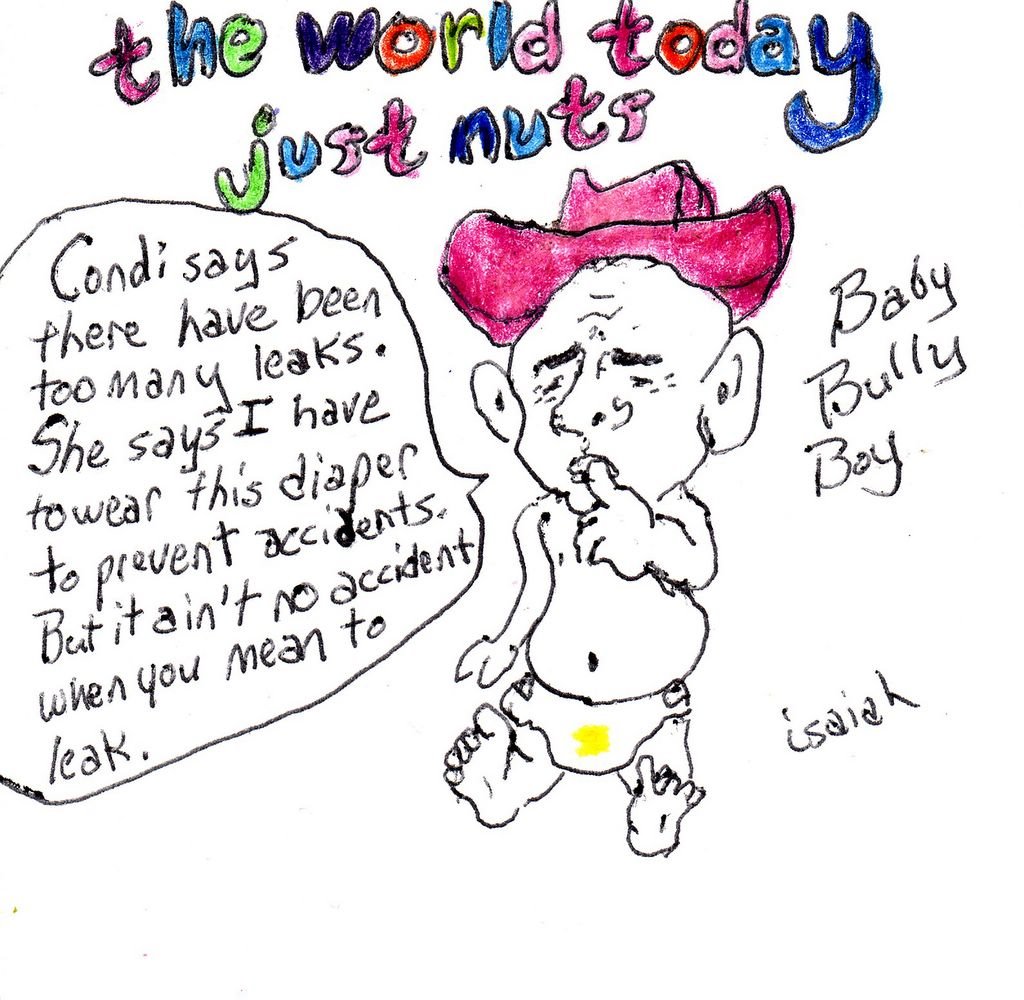
Baby Bully Boy


That's "Baby Bully Boy" from April 9, 2006.


I did not remember the balloon of dialogue or what the comic was about until I read it tonight; however, I do remember the drawing.

The dialogue ties it into the issue of leaks which were big at the time.

The drawing?

I found Bully Boy Bush to be the most infantile White House occupant in my memory and long wanted to draw him as an infant but I'm really not good at that. So I was really pleased with the way that this drawing turned out. So pleased that I remembered it even before I saw it again tonight. That's not me saying, "It's wonderful!!!" That's me saying that knowing how bad I am at infants, I really like the way it turned out. So I'm grading it highly but doing so on a curve.

Here's C.I.'s " Iraq snapshot:"

Thursday, January 7, 2009. Chaos and violence continue, another US service members is dead, bombings rock Iraq, Nouri goes after political rivals, Blackwater agrees to pay victims, and the Iraq Inquiry in London hears from a military officer who states, "We were asked at time in those very chaotic early days to do some things by the Iraqis, which, if we had agreed to, I would be sitting in front of a very different tribunal now, and the American -- American rules of engagement were slightly easier, not hugely, slightly, which meant they were able to do some things that we weren't. "

Starting in London where the
Iraq Inquiry continued public hearings. Today the committee heard from Lt Gen Barney White-Spunner, Nigel Haywood and Keith Mackiggan (link goes to video and transcript options). The news came during White-Spunner's testimony. He focused on Nouri al-Maliki's assault on Basra (which began in March 2008) and, as has previously been noted (including by Gen David Petraeus to the US Congress), Nouri gave the US and the UK little-to-no heads up when he started the assault. The British call the assault the Charge of the Knights. He testified that, as was reported in real time, many Iraqi security forces ended up fighting with militias (not against them). White-Spunner stated that, prior to the assault, Moqtada al-Sadr's influence was declining (and that he believed al-Sadr was in Iran during this time). He estimated that "the population of Basra is but 2.5 probably 3 million" -- an important point to remember. White-Spunner declared at one point, "Now, far be it for me to divine Prime Minister's Maliki's motives, but I have described the political situation in Basra at the beginning" -- and he did. The governor of the province was of another party and was of the opinion (a popular opinion in the province) that the province should split away (in a way similar to the KRG and less under the control of Baghdad). Nouri jumped the timeline for the assault and it was likely due to political reasonings on his part.

Committee Member Lawrence Freedman: Let's just pause and be clear where we are. What you have described is a situation in which there was evident tension between Baghdad and Basra politically --

Lt Gen Barney White-Spunner: Yes.

Committee Member Lawrence Freedman: -- and a degree of urgency, therefore, that attached to that situation with Prime Minister Maliki.

Lt Gen Barney White-Spunner: Yes.

Committee Member Lawrence Freedman: That the Americans were -- had different priorites elsewhere still, that they were looking at Mosul and Baghdad and that the general agreement, which included the Iraqi military contingent or military leadership was for June.

Lt Gen Barney White-Spunner: Yes.

Committee Member Lawrence Freedman: So that was the assumptions. So now, all of a sudden, Prime Minister Maliki decides that this timetable is presumably too relaxed, too gradual.

Lt Gen Barney White-Spunner: Yes.

The US-installed thug Nouri likely jumped an attack by months due to political reasoning, in an effort to quash a political rival. That's especially pertinent today when Nouri's launched an assault on political rivals. What else did Nouri do in that assault?

Lt Gen Barney White-Spunner: We were asked at time in those very chaotic early days to do some things by the Iraqis, which, if we had agreed to, I would be sitting in front of a very different tribunal now, and the American -- American rules of engagement were slightly easier, not hugely, slightly, which meant they were able to do some things that we weren't. I have to say which I think quite correctly we weren't.

Committee Member Lawrence Freedman: I think it would be helpful to have some examples of what you are talking about, I think we can guess.

Lt Gen Barney White-Spunner: We were invited to drop aerial ordnance on areas which we considered not to have been throroughly enough vetted and which could have caused considerable civilian casualties.

Committee Member Lawrence Freedman: This was both from the Iraqi commanders, but the Americans somewhere in between where we --

Lt Gen Barney White-Spunner: No, it is too far to say the Americans somewhere in between. This is the lack of planning, because you know, we had done the planning throroughly for this. If we had had the time, we would have known what the targets were, we would have studied them and we had very clear rules as to the amount of acceptable damage. They are very, as you would expect, in an operation like that, extremely restrictive in a city like Basra. But it is inaccurate to say the Americans were somewhere in the middle. The American rules were very similar to ours. There were occasions when they could use aerial weapon systems when we could not, but it would be going too far to say --

Committee Member Lawrence Freedman: This was quite an important issue in terms of the potential tensions, going back to what I was asking before about civil/military relations. In all Multi-National operations these issues arise, but we have encouraged the Iraqis to be in the lead and in control, but that you don't -- you don't want to be seen to be attacking civilians. So how do you handle these releations with the Iraqis?

Lt Gen Barney White-Spunner: It causes some misunderstanding and there are some -- there are some moments when the Iraqis are irritated with us because we haven't done exactly what they ask, but, as we got this [. . . C.I. note: He does not finish that thought and we're jumping ahead in the testimony, still on this topic] There was no western media in Basra at the time. Indeed, there wasn't for some months afterwards. There was the odd -- one visit. But there was very -- we were aware that the Iraqis were asking us to do some things, as I have described, we didn't want to do and wouldn't do, but generally, on the ground, the sort of -- the relationship between us and the corps and General Mohan's headquarters was incredibly close, as indeed it had to be, because we were prosecuting daily operations with all our soldiers in danger.


Nouri is being allowed to stockpile weapons -- spending billions on them while doing nothing to improve Iraqi lives -- and the Inquiry is informed he wanted areas of Basra targeted and was not concerned with civilian deaths? That was probably the most important revelation because Nouri has no plans to step down as prime minister and today began outlawing various political parites prior to the expected elections.

Channel 4 News' Iraq Inquiry Blogger gives a preview of tomorrow's hearings:

Tomorrow's the last day of the 'narrative' session of the Inquiry, wherein the panel have tried to patch together what happened. From Monday we move onto why -- the then-PM, his inner ring and the upper echelons who actually formulated the policies these soldiers, diplomats and civil servants then had to enact. Chilcot's team took a knocking back at the start for being insufficiently inquisitorial (I mentioned in the Tweets but iraqinquirydigest.org spotted
a particularly good piece yesterday by top barrister Michael Mansfield QC on this). It'll be interesting to see if there's a change of style with with the new witnesses.

From Michael Mansfield's "
Iraq inquiry: we have every right to know why we went to war" (Times of London) referred to above:

The Iraq inquiry has resumed this week, promising crucial witnesses -- Tony Blair, Jack Straw, Lord Goldsmith and possibly Gordon Brown.We have been told repeatedly what it is not: a trial, an inquest, an inquisition, a court, a statutory inquiry. Nevertheless, however its investigative format is described, none of this fancy terminological footwork can evade the central expectation for a thorough, transparent and impartial quest for the truth about the way decisions and actions were carried out. What remains is not clear. Neither a judge nor a lawyer is on the panel, which is bizarre given that one of the main questions raised by most victims and their families relates to the illegality of the war.

In Iraq,
Nada Barki (New York Times) reports an al-Anbar Province bombing which has claimed multiple lives and "struck the houses of an anti-terrorism official and his relatives" -- with three being planted in around the homes and a fourth hitting "a police convoy" attempting to take the wounded to a hospital. Hamid Ahmed (AP) identifies the official as Lt Col Walid Sulaiman al-Hiti (his father's home was also targeted). BBC News counts 8 dead and six wounded in four exposions. Fadhel al-Badrani, Ali al-Mashhdani, Jim Loney and Andrew Dobbie (Reuters) count seven dead including the father and mother of Waleed al-Hiti, his two sisters, 1 brother and sister-in-law and attorney Qais Hamoodi. Mohammed Al Dulaimy (McClatchy Newspapers) reports 8 dead and identifies them as Lt Col Waleed "Hammoudi's wife, children, his brother (and his wife), sister and other members of the family". Anne Tang (Xinhua) informs, "Authorities in the town imposed traffic ban and blocked the entrances of the town, as dozens of Iraqi security forces were deployed on main streets and intersections while dozens others were carrying out search operations in the town, he added. " From yesterday's snapshot:Meanwhile Uthman al-Mukhtar (Asia Times) reports that al Anbar Province residents are "alarmed" by the recent increase in violence in the province and quotes Noor Saadi stating, "The police can't even protect themselves." The violence is causing her to keep her son at home and not let him attend school while other people are refusing "to return to their businesses or open their shops."

Jomana Karadsheh (CNN) notes last week's bombing in Ramadi resulted in at least 23 deaths. Leila Fadel and Uthman al-Mokhtar (Washington Post) explain, "After last week's bombings, police chief Tariq al-Aasal -- widely viewed as incompetent -- was forced out and replaced with a temporary commander from the Iraqi Army in Baghdad. The appointment of Bahaa al-Azzawi was made directly by Prime Minister Nouri al-Maliki, angering tribal chiefs who saw the move as an affront to their power." Karadsheh, Fadel, al-Mokhtar as well as BBC New's Jim Muir note that violence in Anbar really only decreased when the Sahwa movement took hold "Sahwa" also known as "Awakenings" and "Sons Of Iraq" -- Sunnis put on the US payroll so they would stop attacking US military equipment and US service members. In 2008, Nouri was supposed to take over the monthly payments (US tax payers were paying approximately 92,000 Sahwas $300 a month) but he couldn't get it together. Still couldn't in Februrary. In the summer he reported finally managed to absorb all the payments (unless the rumors are true that CERP funds have been partially paying for Sahwa). In addition, Arab media last month was reporting Nouri planned to drop Sahwa from the payroll in the new year. Michael Gisick (Stars and Stripes) reported attacks on Sahwa are on the rise with the US military estimating an average of ten attacks a week in the last two months which "has underscored the increasing weakness of groups widely credited with helping turn the tide of the Iraq war." Monday Karim Zair (Azzaman) reported mass arrests were taking place "in Sunni Muslim-dominated neighborhoods of Baghdad and towns and cities to the north and west of the capital".

In other reported violence . . .

Mohammed Al Dulaimy (McClatchy Newspapers) reports a Mosul home bombing which claimed the lives of 2 children and left a third injured, a Mosul roadside bombing which wounded two police officers, a Mosul car bombing which left four people wounded, a Mosul grenade attack which wounded five people and a Khaniqn roadside bombing which claimed the life of 1 police officer and left thirteen more wounded. On the last bombing, Anne Tang (Xinhua) reports that 3 people died in the bombing and fifteen were injured in the bombing apparently targeting a Shi'ite mosque. Reuters drops back to yesterday to note a Balad suicide bomber who took his/her own life and left eight Sahwa wounded and a Tuz Khurmato roadside bombing which claimed the life of 1 child and left four more injured.
AP reports the 1 American soldier "has died in northern Iraq" and since USF can't do their job (which is to announce deaths, DoD identifies the dead) there may be confusion but northern Iraq is not Baghdad so this is not the death in Baghdad reported yesterday. ICCC's count is 4374 for the number of US service members killed in Iraq since the start of the Iraq War. CORRECTION TO SNAPSHOT E-MAILED A FEW MINUTES AGO. USF announces: "CONTINGENCY OPERATING BASE SPEICHER, Iraq -- A Soldier assigned to United States Division-North died of non-combat related injuries, Jan. 6. The incident is under investigation and release of the Soldier's identity is being withheld pending notification of the next of kin. The name of the deceased service member will be announced through the U.S. Department of Defense Official Web site at http://www.defenselink.mil/. Task Force Marne is deeply saddened by this loss and will provide more information on this incident following next of kin notification." They posted that late today and missing that announcement is my fault for not returning a phone call until after I dictated the snapshot. My apologies. They did announce today's death this evening. Again, my error, my apologies. And my apologies to a friend at USF who left a voice mail for me that I didn't return until after dictating the snapshot.

War is big business. Turning to Blackwater (now known as "Xe") and KBR. Last week Judge Ricardo Urbina handed down a decision (
announced last Thursday) to toss out the case against Blackwater for the September 2007 massacre as a result of the Justice Department basing much of their case on statements the contractors gave to the US State Dept -- statements given after the men were told anything they said would not be used against them -- has the Baghdad based government or 'government' enraged. Al Jaezeera reports that Blackwater has agreed to settle with the victims and their families which has led Burke O'Neil LCC to drop their cases against Blackwater, "Susan Burke, the lawyer for the firm, filed for the cases to be dismissed in court late on Wednesday." Chris McGreal (Guardian) adds, "Today's legal settlement amounts to an implicit admission by the highly secretive company that some of its guards were responsible for a series of unjustifiable killings. Blackwater appears to have reached the deal to avoid a court hearing that threatened to force the company to lay bare what critics contend was a policy of shooting first, as well as the involvement of its employees in an array of criminal activities." (Blackwater has new charges related to Afghanistan, read McGreal's article for more on that.)

Burke LLC is also representing US soldiers and contractors in 22 lawsuits filed against KBR. And doing so a time when the American people feel the US government is not doing enough for US service members. Brian Montopoli (CBS News, Political Hotsheet) reports on a new CBS poll which finds, not surprisingly, that respondents say the US military is spread too thin and: "They also say the U.S. is not doing enough for veterans of the wars in Iraq and Afghanistan. Seventy-one percent of those surveyed say the government has fallen short when it comes to addressing the needs and problems of troops returning from those conflicts. Just 22 percent say the government is doing enough." Dionne Searcey (Wall St. Journal) reports on the National Guard members in Indiana who are suing for their exposure to a known cancer causing agent while serving in Iraq:In a lawsuit filed in federal court in Indiana, the Guardsmen allege that oil company KBR Inc. "disregarded and downplayed" the fact that the site at Qarmat Ali was coated with the hazardous chemical sodium dichromate. They were exposed, they say, to the chemical that is used as an industrial anti-corrosive agent to protect pipes. As a result, the soldiers suffered "unprotected, unknowing, direct exposure to one of the most potent carcinogens and mutagenic substances known to man," alleges the suit, which seeks monetary compensation for health problems the soldiers say they have suffered.The lawsuit was filed last month and has to do with the Qarmat Ali water plant. December 3rd, Sgt Mark McManaway told Scott Bronstein and Abbie Boudreau (CNN), "The worst part is that the military has only just recently advised us that the stuff we were exposed to was much worse than they thought while we were out there. It's in our bodies, but we don't know how bad it is. Maybe within the next five years cancers could start showing up. You've got a ticking time bomb in you -- and when's it going to go off?"Evan Bayh is one of Iraq's two US Senators. Bayh has introduced a bill that would create a federal registry similar to the one for Agent Orange exposure during Vietnam -- the bill, if passed, would allow those exposed to avoid the long struggle Agent Orange victims had to go through attempting to establish their exposure at a time when the US government was denying exposure and minimizing it. The bill was referred to the Senate Veterans Affairs Committee months ago and is currently buried there. (Bayh does not serve on the Veterans Affairs Committee.) Today the Wall St. Journal reports KBR is predicting its stocks will be at $1.60 to $1.80 a share in Fiscal Year 2010. As Kat's noted last night and Tuesday ("Not a good day" and "Thoughts on Byron Dorgan and more") and Mike noted last night ("Dems retiring, NOW wants action, Ann Talbot gives a warning"), Senator Byron Dorgan has decided not to run for re-election in 2010. Kelley Beaucar Vlahos (Antiwar.com) observes:

What I do know is that Sen. Dorgan held over 21 hearings in the Senate on private contractor fraud and abuse, including war profiteering, the physical and mental harassment of whistle-blowers in-theater,
and most recently on Nov. 6, the constantly burning open-air pits of waste in Iraq and Afghanistan that have made countless veterans sick and looking to the Pentagon for answers. Kellogg, Brown and Root, a former subsidiary of Halliburton, is being charged in 22 different class action lawsuits with purposefully burning toxic waste in the open-air pits to save a buck on not installing incinerators. There are now more incinerators at U.S bases today than there were a year ago, but the alleged victims contend that KBR, which has the contract for waste management services, plus practically everything else in its multi-billion LOGCAP contract, could have installed more incinerators years ago (a charge KBR officials vociferously deny).
But even aside from burn pits, Dorgan was one of those rare members of Congress who actually gave a flying fig about exposing not only the abuse that private contractors were perpetuating in the war zone, but the over-use of private contractors in the war zone, period. Aside from Rep. Henry Waxman, D-CA, on the House side, Dorgan, as chairman of the Democratic Policy Committee, was the only one to use his leadership post as a bully pulpit against abuses -- even when there weren't cameras on to report it -- from very early on in the post-invasion occupation(s).

Turning to Iraqi politics. Elections were supposed to take place in December 2009 but Nouri kicked it back with the promise they'd take place in January 2010 which . . . didn't happen. Now elections are supposed to take place in March.
An Iraqi correspondent for McClatchy Newspapers reports: "The speaker of the Iraqi parliament urged the heads of the political blocks to push the members of their blocks to attend the parliament sessions in order to approve some important laws that deal with the daily life of Iraqis. The meetings came after the parliament failed in approving any law during many sessions because of the non sufficient quorum. That means more than 138 out of 275 lawmakers were absent and they did not do their national duties, which they were elected for." Today Inside Iraq reports:

Iraqi De-Baath commission banned Sunni politicians and their political blocs from participating in Iraq's national elections due in March.
Ali Al Lami, head of the De-Baath commission, told Arab news televisions that Saleh Al Mutlak is banned from participating in the next elections and said this decision is "final".
The commission name was changed to justice and accountability commission and its main job is to ensure that high ranking or active Baath party members will not be part of Iraq's new political regime or military.
The ban included Nihro Mohamed, Saad Al Janabi and Saleh Al Mutlak, a lawmaker and a former Baathi and to include 14 political blocs and its 400 candidates. The commission said that banning the head of a political bloc will extend to his bloc and its members.

Are we still pretending on behalf of Crazy? Are we still pretending he's a 'leader' or anything but the new Saddam -- who, like the previous one, was US installed?

In the US, it seems more and more the only coverage most newspapers carry on Iraq takes place in the how-to. Martha Stewart joins Hints for Heloise in awarness on the Iraq War -- an awareness lacking in the bulk of the national press corps.
From her latest nationally syndicated column Ask Martha (link goes to Boston Globe):Q. I'd like to send cookies to my nephew, who is serving in Iraq. What types will survive the journey, and how should I package them?
A. Home-baked cookies are a wonderful way to give your nephew (and undoubtedly his friends) a taste of home. Transit time may take more than two weeks, so look for cookies with a long shelf life. Shortbread is a good bet, and you can add variety with flavors such as chocolate or lemon. Oatmeal-raisin also has staying power, because dried fruit helps the cookies stay moist. Gingerbread men are a sturdy choice around the holidays. Steer clear of chocolate chips, which are likely to melt; candy-coated M&M's are a good substitute. Also, label any baked goods that contain nuts. For maximum freshness, freeze the cookies until the day you're ready to send them. An efficient and economical way to mail them is in a Priority Mail Army Post Office/Fleet Post Office flat-rate box, which is 12 by 12 by 5 inches; it costs $11.95 to ship. Wrap the cookies individually if you like, for easier distribution. Place them in a cushioned airtight container, and fit that inside the flat-rate box. (You can pad the space between the two containers with extra socks for your nephew.) Then seal the edges with packing tape. If you want to send a package but don't have someone in mind, skip the baked goods: Soldiers are required to throw away homemade foods unless they know the sender. But prepackaged treats, as well as magazines and toiletries (packed separately), are certainly welcome. For soldiers' requests and addresses, go to
www.anysoldier.com/wheretosend. For more nonprofit organizations that help those in the armed services, visit www.ourmilitary.mil/help.shtml.

Lastly Friday night on most PBS stations,
NOW on PBS begins airing (check local listings) and this week's program explores the Afghanistan War:
President Obama is sending as many as 30,000 more troops to combat Taliban and al Qaeda forces in Afghanistan this year, but are we missing the true target? On Friday, January 8 at 8:30 pm (check local listings), NOW reports directly from Pakistan's dangerous and pivotal border with Afghanistan, where Pentagon war planners acknowledge many of the enemy fighters and their leaders are based. The U.S. has been relying on Pakistan to act against Taliban militants there, but the Pakistani army's commitment is in question. NOW takes you to the true front lines for an eye-opening, inside lookyou haven't seen before, and won't soon forget.

And
NOW on PBS has posted video online of Pakistan forces fighting the Taliban as a preview for Friday's show.


iraq
channel 4 newsiraq inquiry bloggerthe times of londonmichael masnfield
the new york timesnada bakrihamid ahmedbbc news
xinhuaanne tang
mcclatchy newspapersmohammed al-dulaimy
cnn
jomana karadsheh
the washington post
leila fadel
jim muir
stars and stripesmichael gisick
cbs newsbrian montopolithe wall street journaldionne searceyscott bronsteinabbie boudreau
the boston globemartha stewart
pbsnow on pbs


Read on ...
Creative Commons License
This work is licensed under a Creative Commons Attribution-Share Alike 3.0 Unported License.