Showing posts with label Alberto Gonzales. Show all posts

Thursday, January 6, 2011

Alberto's Hospital Rounds

albertoshospitalrounds

That's from May 28, 2007, "Alberto's Hospital Rounds."


I was not and am not a fan of Bush's original AG (or any of his AGs) but even I felt bad for him when he was in the hospital recovering and Alberto barges in and tries to bully him (John Ashcroft) into going along with his opinions.

That story had broken and I did that comic and thought maybe two people would like it. Instead it was huge and I saw it in about 20 different places online. I would see it and think, "What do people like about that?"

I'm guessing it's the real life story that gave it a lift.


Here's C.I.'s "Iraq snapshot:"

Thursday, January 6, 2011. Chaos and violence continue, military suicides increased at Fort Hood in 2010, the Marines saw an increase in attempted suicides, Moqtada al-Sadr scolds his followers, is Turkey the victor in the Iraq War, and more.
The New KPFA Morning Show airs on KPFA from 8:00 a.m. to 9:00 a.m. PST Mondays through Fridays. The show has a rotating set of hosts and Thursdays it's Project Censored. Today's show saw Project Censored's Mickey Huff speak with a number of guests about under-the-radar stories. We'll note this section between Huff and Dave Lindorff.
Mickey Huff: We have a few minutes left in this segment, Dave, and earlier you had mentioned the Church Committee and COINTELPRO and, of course, we could do whole shows on those. The Church Committee, Senator Frank Church, came in after Watergate and did a lot of investigating about these types of counterintelligence programs and infilitratration of groups. And this is exactly the kind of thing you're talking about, we've had this massive return. And I don't know how familiar you are with this but one of Obama's appointees to head the Office of Information and Regulatory Affairs, a Harvard law professor named Cass Sunstein, is calling for a return to infiltrating groups, disrupting groups --
Dave Lindorff: Yeah, he's horrible. He's horrible.
Mickey Huff: It's funny that you don't hear much though. During the Bush years, you heard a lot of the rattling on the left among progressives about this kind of officious behavior and this -- Really it's been legal since the Patriot Act I suppose although it seems fiercely unconstitutional. But do you have something to say about Sunstein or maybe the silence of progressives about people like Sustein?
Dave Lindorff: Well, yeah. I mean actually, I'm working on getting a contract for a bookto do a Case for Impeachment II and make the argument that this administration is committing the same crimes and some new ones that were impeachable under Bush and are now impeachable under Obama. [Laughing] It's hard to get a publisher, frankly.
Mickey Huff: Yeah and that's my -- and that's sad given how much evidence there is to continue that saga from that book. I mean it's just Part II of all of that. And I know a lot of people -- a lot of progressives and people on the left -- don't want to deal with that and they want to say 'Well it's the lesser of two evils' or 'It's better than not' and so forth. And I suppose that's understandable given what Americans went through for eight years. But we can't turn a blind eye to this and, I mean, the media is just disappeared. There's almost no coverage of this whatsoever. They have one faux controversy after another -- whether it's the birth certificate or whether Obama's a Socialist. And here we have things going on right under our noses -- this cognitive infiltraton problem in particular that you mentioned that we have here with Sunstein. And so there's definitely a lot of work to be done and a lot of things that we should be dealing with
Dave Lindorff: Yeah, I know. I mean, people have to realize this isn't a Democrat or a Republican issue. This is the corporate state that is militarized and it is looking at the American public as the enemy. And I think that's the way that we have to view it. And it's not a matter of you know "Do we not do something because this is a Republican or a Democratic administration so it will be better" -- and it's not better. And every -- We're actually in a ratcheting up with every administration of more and more invasiveness into our lives and more monitoring of our activities.
In Tuesday's snapshot, I mentioned this post by Ruth but there was no link -- Ruth's been covering various KPFA issues this week -- also see here and here.
Turning to military suicides, Jim Turpin (The Rag Blog) reported last October:
Even with the spin from the current administration that the "war is over" in Iraq, it is well known that 50,000 combat-ready troops remain in the country. Add to that a recent deployment of 2,000 troops from the 3rd Armored Cavalry Regiment from Fort Hood in Texas. At present almost 100,000 troops remain in Afghanistan.
With the total number of U.S. military personnel cycling through both Afghanistan and Iraq at almost 1.8 million, and with the RAND corporation estimating that 18% have PTSD (which is deemed low by some experts), this would put the returning numbers with PTSD at 324,000.

A recent article in The New York Times confirms what the organizers of the Killeen-based GI coffeehouse Under the Hood Café have been battling at Fort Hood for the last year and a half: suicides are at the highest point since 2008, with 14 confirmed suicides since the beginning of 2010. In one recent weekend, there were three suicides and one murder-suicide at Fort Hood.
With the population at Fort Hood ranging from 46,000 to 50,000 soldiers at any given time, the rate of suicide is four times the national average, based on Center for Disease Control and Prevention estimates of 11.5 suicides per 100,000 people.

Today Bob Grotenhuis (KTSM) reports that there were 22 suicides or suspected suicides at Fort Hood in 2010, "double the number of suicides from 2009 and nearly two-and-a-half times the national average for the same age group." Gregg Zoroya (USA Today) broke the news on the story this morning and noted the record number came "despite a mental health effort aimed at reversing the trend" and, of Fort Hood's population, "Many of the 46,500 soldiers at Fort Hood have returned from war zone or are on their way to them." Fort Hood, in a review of the year 2010 published today, notes, "Deployments, the continual coming and going of military members to and from Fort Hood, remained the 'new normal' at the Great Place in 2010. Just two weeks after the 1st Cavalry Division uncased its colors on Cooper Field announcing the division's return from its third tour of duty in Iraq, III Corps cased its colors Feb. 2 as it became the nucleus of United States Forces - Iraq." On suicide, the year-in-review notes:
Suicide prevention, likewise, remained an important issue for the Army in 2010, as well as here in Central Texas. The key to suicide prevention is engaged leadership, according to senior leaders here.
"We use this term of 'engaged leadership,' in some cases, it requires intrusive leadership to break through some of these little points of insularity that we're finding in our Soldiers and certainly in society," Grimsley told media members at the Resiliency Campus Sept. 29.
"I tell you that every one of these is tragic," he said of the suicides committed in 2010. "The rate is higher than any of us, anybody in a leadership position in the Army wants," he stressed. Grimsley said Fort Hood remains dedicated to the well-being of its force and their families.
"I think we have extraordinary resources at Fort Hood," he said, noting family life onsultants, chaplains, behavioral health specialists and Army Community Services counselors available to Soldiers, civilians and their families, dedicated to the well-being of body, mind and soul.
"The point is," he said, "there are an awful lot of people who are committed to do the right thing."
The Marines also have suicide news this week. Gretel C. Kovach (San Diego Union Tribune) reports, "The number of suicides among active-duty Marines dropped last year for the first time since 2006, plunging 29 percent below 2009's record high, according to preliminary figures released by the Marine Corps. In 2010, 37 Marines committed suicide, compared to 52 in 2009. The latest numbers include nine suspected yet to be confirmed by the Armed Forces Medical Examiner." While the number of suicides has gone down, the Marines saw an increase in 2010 in the number of attempted suicides. The Defense Dept notes, "The military suicide rate has increased steadily over the past five years, exceeding the national average of 11.1 suicides per 100,000 people. The military last year averaged 12.5 suicides per 100,000 according [to] DOD reports." James Coogan (WSWS) offers:
American military personnel are continuing to take their own lives in unprecedented numbers, as the wars in Afghanistan and Iraq drag on. By late November, at least 334 members of the armed forces had committed suicide in 2009, more than the 319 who were killed in Afghanistan or the 150 who died in Iraq. While a final figure is not available, the toll of military suicides last year was the worst since records began to be kept in 1980.
The Army, National Guard and Army Reserve lost at least 211 personnel to suicide. More than half of those who took their lives had served in either Iraq or Afghanistan. The Army suicide rate of 20.2 per 100,000 personnel is higher than that registered among males aged 19 to 29, the gender age bracket with the highest rate among the general population. Before 2001, the Army rarely suffered 10 suicides per 100,000 soldiers.
The Navy lost at least 47 active duty personnel in 2009, the Air Force 34 and the Marine Corp, which has been flung into some of the bloodiest fighting in Iraq and Afghanistan, 42. The Marine suicide rate has soared since 2001 from 12 to at least 19.5 per 100,000.
For every death, at least five members of the armed forces were hospitalised for attempting to take their life. According to the Navy Times, 2 percent of Army; 2.3 percent of Marines and 3 percent of Navy respondents to the military's own survey of 28,536 members from all branches reported they had attempted suicide at some point. The "Defense Survey of Health-Related Behaviors" also found "dangerous levels" of alcohol abuse and the illicit use of drugs such as pain killers by 12 percent of personnel.
Many soldiers, servicemembers and veterans are not receiving the help they need. Many are taking public stands to highlight the issue. Clare Bayard (ZNET) notes:

They also included the public surrender of an injured AWOL soldier, Army Specialist Jeff Hanks, at Ft. Campbell, Kentucky. Hanks went AWOL to resist redeployment to Afghanistan last fall after the military refused to treat him for severe PTSD. Supported by military and civilian allies alike, Hanks and other veterans testified about the military's negligent and often abusive treatment of severely traumatized soldiers seeking care. Hanks decided he wanted to turn himself in publicly to draw attention to these widespread practices. If he is court-martialed, he could face up to two years in prison and a lifetime felony conviction on his record. The Army could also attempt to forcibly deploy him again. At the gates of Ft. Campbell, 25 supporters stood with Hanks as he told his story to reporters. Another AWOL soldier from his unit traveled to join the rally, disclosing similar experiences. One supporter explained that her husband, who is currently deployed, was sent against medical advice.

In the weeks following the November 11 actions, a number of other soldiers gone AWOL from the 101st due to mental health struggles have reached out to Operation Recovery for support.

Visibility and support are important factors influencing not only the morale of traumatized troops and their families, but also the military's treatment of people who go public. Aaron Hughes of IVAW shared with supporters that, "Jeff's command was extremely hostile when he turned himself in on Veterans Day, but after the CBS story aired on Friday, they changed their tune" (Hanks was interviewed by Katie Couric).

Click here for one CBS story (text and video) with links to other CBS coverage of Jeff Hanks. And, like Elaine, let's pair that with an upcoming event by Iraq Veterans Against the War:

February 25, 2011 9:30 - 10:30 am Busboys & Poets, Langston room 14th & V st NW Washington DC This report back will be to answer questions from media and the peace movement about the recent trip back to Iraq by members of Iraq Veterans Against the War. The war is not over but it is not the same as it was in years past. What is the humanitarian situation in Iraq? How can we do reparations and reconciliation work? Speakers are all returning from this delegation and include: Geoff Millard (IVAW) Hart Viges (IVAW) Haider Al-Saedy (Iraqi Health Now)
Richard Rowely (
Big Noise Films)
That's next month and will hopefully help get across that the Iraq War continues.
Sunday, 2 US soldiers were killed in Iraq. Today, DoD released the following: "The Department of Defense announced today the death of two soldiers who were supporting Operation New Dawn. They died Jan. 2 in Taji, Iraq, of wounds suffered when insurgents attacked their unit with an improvised explosive device. They were assigned to the 1013th Engineer (Sapper) Company of the Pureto Rico Army National Guard, Aguadilla, Puerto Rico. Killed were: Sgt. Jose M. Cintron Rosado, 38, of Vega Alta, Puerto Rico; and Spc. Jose A. Delgado Arroyo, 41, of San Juan, Puerto Rico. For more information, media may contact the Puerto Rico National Guard at 787-289-1474." The deaths bring the total number for US military deaths in the ongoing Iraq War to [PDF format warning] 4435.
Tuesday, Jake Armstrong (Pasadena Weekly) notes, was "day 2,817 of the war in Iraq."
AP notes the Illinois National Guard is preparing to send 75 service members to Iraq. Brian Stanley (Herald News) reports on some of the deployed:

Dennis McWherter has been married for 23 years, his youngest child is 17 and he's got enough experience in law enforcement to head the narcotics unit as a lieutenant with the Joliet Police Department.
Rigoberto Garcia is still in college, he and his girlfriend of two years have considered getting married in the next few years and he wants to work for a local fire department when he completes his paramedic training.

In Iraq, they will be assinged to preserve the rule of the likes of Moqtada al-Sadr who returned to Iraq yesterday. Alsumaria TV reports, "Head of Al Sadr Front cleric Moqtada Al Sadr returned to Iraq on Wednesday. Al Sadr returned to Najaf after spending three years outside the country in Qumm, Iran. Al Sadr's visit coincides two weeks after the formation of Iraq's new government." Iraq is nothing but a laughing matter to the US State Dept as evidenced by yesterday's briefing. When spokesperson Philip J. Crowley was asked about al-Sadr's return, he declared, "Well it's not for us to be for or against any particular leader or party in Iraq." A response that was met with disbelief and led to shocked remarks and bringing up Saddam Hussein (whom the US government started an illegal war to topple). Crowley thought he was being amusing by declaring, "In the new Iraq." It wasn't funny. It's an ongoing war and possibly the next time any State Dept spokesperson sees a war as a laughing matter, they can sign up for forty hours a week of community service at Walter Reed. Might seeing the wounded make them take war a little more seriously next time?
The Australian hails al-Sadr's return as "the latest example of waning US influence in Iraq" and they quote Kenneth Katzman of the Congressional Research Service stating, "I don't think the US embassy is at all happy about this. Sadr has made the calculation that US influence is low enough that the US is not going to pressure him, or chase him . . . or pressure Maliki to arrest him." al-Hayat reminds that the Basra 2008 Iraqi-US attack on Basra ("Charge of the Knights") had al-Sadr and Nouri al-Maliki on opposite sides of the fence. Paul McGeough (Sydney Morning Herald) adds, "For months after the election Mr Sadr sat on his hands, leaving would-be prime ministers Mr Maliki and Iyad Allawi without the support they needed to form a coalition government. It was only after the intervention of Tehran that a deal was struck in the seventh month of the post-poll stand-off. [. . .] As recently as last year, Mr Sadr's mouthpieces in Iraq were dismissing Mr Maliki as a successor to Saddam and as an American lackey." Kim Sengupta (Belfast Telegraph) notes the 2008 "intense battle" in Basra as well. Strangely these reports from today are still focusing on Basra only. It was also Sadr City or does no one have longterm memory. Protests against the assault on Basra sprang up in the Sadr City section of Baghdad. From the March 25, 2008 snapshot:
Gina Chon (Wall St. Journal) reports, "Fighting broke out Tuesday on the streets of Sadr City . . . and the Mahdi Army militia announced it had taken over Iraqi army checkpoints in an escalation of tension with Iraqi government security forces. The sound of gunfire could be heard in Sadr City throughout the morning and Mahdi Army members walked down the streets carrying rifles, rocket-propelled grenade launchers and other weapons in what appeared to be a show of force, accodring to two witnesses." AFP reports that fighting was ongoing in Baghdad, Basra, Kut and Hilla with the clash between Sadr's forces and the US in Baghdad being "the first time since last October". Atul Aneja (The Hindu) explains, "The Iraqi government's decision to establish its hold over the oil city of Basra dominated by Shia armed militias has sparked heavy fighting there" and that "field commanders of the Mahdi army in Najaf ordered to the militia 'to strike the occupiers' and their Iraqi allies." Robin Stringer (Bloomberg News) notes 18 dead and forty wounded from the Basra fighting alone and threats that the actions will go "nationwide."
The following day (Wednesday, March 26, 2008), Leila Fadel (then with McClatchy) appeared on The Diane Rehm Show (NPR) via phone to report on the Basra assault. We'll note this section of the discussion:
Diane Rehm: And Leila, you're in Baghdad what's the situation there right now?
Leila Fadel: Well the Medhi army has done a forced sit-in in all Medhi army neighborhoods and so what has happened is that they sealed off neighborhoods where they have large control and, at gun point, told shopkeepers to close, the kids are not allowed to go to school, in one situtation they evacuated the school that was functioning. In Sadr City there have been violent clashes between Iraqi security forces, US forces and the Medhi army in Sadr City. Sadr officials are saying that at least 20 people have died and a hundred were wounded, among them women and children. But it's unclear what's happening there because it's completely sealed off by the militia.
March 28, 2008, Sudarsan Raghavan and Sholnn Freeman (Washington Post) reported, "U.S. forces in armored vehicles battled Mahdi Army fighters Thursday in the vast Shiite stronghold of Sadr City, and military officials said Friday that U.S. aircraft bombed militant positions in the southern city of Basra, as the American role in a campaign against party-backed militias appeared to expand." Today Xinhua notes, "Many Sadrists viewed Maliki's crackdown as a means to weaken his Shiite rivals and to facilitate the political benchmarks set by the U.S. administrations before the country's provincial elections early in 2009." David Kenner (Foreign Policy) observes, "Some analysts also suggested that his return could be motivated by a desire to retain his preeminence over the movement's leaders in Iraq, who have overseen the party's impressive gains in recent years. 'His party is becoming stronger and bigger, and the need for him to preside over it has grown, especially since there is fear that new leaders within the party could surpass him,' wrote Hazem al-Amin in the Arabic daily al-Hayat." Mohamad Bazzi (Council on Foreign Relations) offers:
Now, Sadr has returned home to play a central part in Iraqi politics and to oversee his movement's transition from a militia force to a powerful political group with forty seats in parliament. But Sadr's ascendance threatens to stoke sectarian tensions in Iraq: His followers were responsible for some of the worst atrocities against Sunnis during the country's recent civil war. Sadr's militia, the Mahdi Army, unleashed death squads that assassinated Sunnis and drove them out of Shiite neighborhoods.
Rania El Gamal and Suadad al-Salhy (Reuters) run down possibilities such as whether or not he'll remain in Iraq, if he remains will he attempt to be a political or religious figure, will tensions rise, will sectarian violence return, etc. Anthony Shadid (New York Times) reports that al-Sadr sent a message to his followers today which read, "The lack of discipline of some of you as I performed my religious rituals bothered me and hurt me. Please exercise discipline and refrain from excessive chants and pushing which harms me, others, you, your reputation and the reputation of the Sadr family." This was how he thanked those who greeted him with chants and shout yesterday and today. Leadership's always easier when you don't have to be around your followers. Moqtada al-Sadr seems a little testy for someone who's had years to take a break from his follwers. BBC News adds, "The BBC's Jim Muir in Baghdad says that despite his four-year absence, the charismatic Moqtadr Sadr has lost none of his influence on the largely impoverished Shia population of Iraq. But the situation in Iraq has changed since the cleric fled the country after a warrant was issued for his arrest, our correspondent adds." On All Things Considered today, Kelly McEvers reports from Baghdad:
Kelly McEvers: Many analysts say Sadr is looking to style his group as the next Hezbollah, the Shiite militia that now weilds considerable power in Lebanon's government. The reasoning that both groups give for maintaining an armed wing is resistance. In Lebanon, it's resistance against Israel. Here, says Sadr political adviser Balqis al-Khafaji, it's resistance against American troops.
Reuters reports that a Hawija sticky bombing injured a police officer and that an attack on a Mosul church was prevented by the Iraqi military.
In other Iraq news, the PKK is a rebel group which supports a Kurdish homeland. Turkey, the US and others label the PKK a terrorist organization. (Recent WikiLeaks revelations on the PKK suggest that the US government also backs them from time to time.) The Turkish military regularly bombs the mountains of northern Iraq where the PKK has set up bases. Stephen Farrell, Shiho Fukada and Steven Lee Myers (New York Times -- text, numerous photos and video) report from the mountains:

It is not easy to visit the mountainous borderlands of northern Iraq where the Kurdistan Workers' Party operates, but it is not impossible either.
Such is the peculiar position of a group of committed insurgents against Turkish rule in Kurdish lands -- even as Turkey and Iraq seek deeper and deeper ties, through diplomacy and trade, especially with Iraq's semiautonomous Kurdish region.

A few years back when Oliver August and Deborah Haynes (Times of London) -- among others -- were reporting from the PKK bases in Iraq, Nouri had a meltdown and started threatening to expel any foreign reporters who visited the PKK bases. It's interesting that the New York Times has decided to file this report. This comes as Anthony Shadid files a report on Turkey and its influence in Iraq:

Turkey's influence is greater in northern Iraq and broader, although not deeper, than that of Iran, with its ties to the Shiite leadership, in the rest of the country. While the United States invaded and occupied Iraq, losing more than 4,400 troops there, Turkey now exerts what may prove a more lasting legacy -- so-called soft power, the assertion of influence through culture, education and business.
"This is the trick -- we are very much welcome here," said Ali Riza Ozcoskun, who heads Turkey's consulate in Basra, one of four diplomatic posts it has in Iraq.
Turkey's newfound influence here has played out along an axis that runs roughly from Zakho in the north to Basra, by way of the capital, Baghdad. For a country that once saw the Kurdish region in northern Iraq as a threat, Turkey has embarked on the beginning of what might be called a beautiful friendship.

Shadid's article and other things lead Judah Grunstein to wonder "Did Turkey Win the Iraq War?" (World Politics Review):

The same can't be said for Turkey, which has also benefitted from the dramatic changes in the region's geostrategic landscape wrought by the Iraq War. This N.Y. Times article detailing Turkey's enormous and growing trade ties in the Kurdish north, as well as its political influence in Baghdad, is only part of the story. Ankara's opposition to the war, and the Bush administration's obstinacy in pursuing it, in some ways prepared the way for Turkey's rebalancing of its foreign policy approach from a Western-focused alignment to a Turkey-centric strategic hub. And the power vacuum created by the fall of Saddam Hussein, though initially as destabilizing as Ankara had feared and warned, subsequently helped create the space for Turkey to assume the regional role it aspired to.
Turning to the US where Ron Robins asks, "Can US Bankers and Politicians be Truthful?" And the answer may be found in this from David Swanson (at Euro Atlantic Quarterly):
The two parties scream at each other on television quite a lot and attract supporters who come from two very different cultures. But over half of every dollar of income tax in the United States is spent on the military, and that number reliably increases every single year regardless of who is in power.
The Afghan and Iraq wars were launched with overwhelming support from both parties' officials, and the Iraq War with Democratic control of the Senate. In 2006 U.S. voters told exit-pollsters that their primary motivation for electing Democrats to control both houses of Congress was Iraq war opposition, and Congress proceeded in 2007 to escalate the war on Iraq. War opposition also drove the 2008 elections, after which two Democratic houses and a Democratic president in 2009 escalated the war on Afghanistan.
Americans tell pollsters that ending the wars is their second highest priority after repairing the U.S. economy. (How many understand the close relationship between the two, the wars' negative impact on the domestic economy, is not clear.) Majorities think the Afghan and Iraq wars should never have been launched, but majorities supported launching them at the time in 2001 and 2003. Electing Democrats to act on the will of the new majority has been tried and failed, and now the House is going back to Republican control.
There will be no gridlock on matters of war and foreign relations (two areas that are identical in the understanding of the U.S. government, as made clear by the cables leaked to Wikileaks). To the extent that a minority of Democrats in the House will object to anything on the military's agenda, it will not matter as the President and the Republicans are in complete agreement. In fact, Congress may seek to pass a new "Authorization to Use Military Force" that would strengthen any president's unconstitutional power to wage wars, without any purported connection to the crimes of September 11, 2001, as required by the routinely violated AUMF of 2001. The new bill may also license unconstitutional presidential violations of civil liberties during "war time," a state of affairs that is now understood to be without spatial or temporal limit. Republicans are principled supporters of presidential war powers even when they despise the current president.


Read on ...

Thursday, November 18, 2010

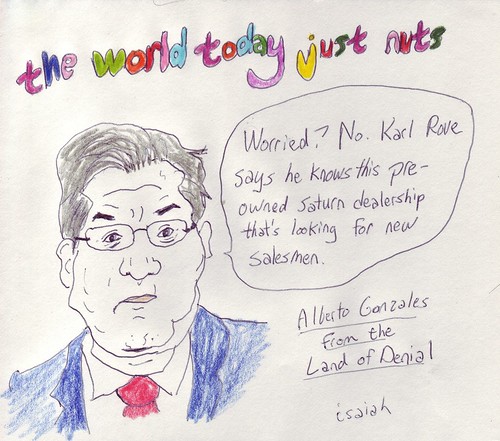
Alberto Gonzales from the Land of Denial

albertog

From April 1, 2007, that's "Alberto Gonzales from the Land of Denial."


I did at least three comics featuring Alberto Gonzales and, for some reason, they were hugely popular.

For whatever reason -- maybe others weren't making fun of Alberto? -- my comics on him attracted so many people who would e-mail and tell me how much they liked it.

It was interesting.


Here's C.I.'s "Iraq snapshot:"

Thursday, November 18, 2010. Chaos and violence continue, stronger analysts (including The Economist) weigh in on Iraq's political issues, Iraqi Christians continue to be targeted, Military Families Against the War calls for all US troops to be brought home from Iraq and Afghanistan, the whores of Beggar Media continue to avoid realites that would make them call out the War Hawk in the White House, and more.
Larry Kaplow (Foreign Policy) has a major essay on Iraq and we'll note the opening:
"Iraq Is a Democracy." In theory, but it doesn't work like one. Yes, it has had three, free national elections and a constitutional referendum and there are elements of democracy. I started covering Iraq in 1998, living there from the start of the war until late 2009, and it certainly feels freer than before. Saddam Hussein held his last election, a plebiscite in 2002, and claimed 100 percent of the vote (and maybe it was true -- who would risk voting against him?). Under the old regime, even when I could slip away from government minders, people were usually too scared of informants among their family and friends to speak openly. You weren't even allowed to keep your mouth shut. Failure to join the chanting crowds at pro-government rallies -- watched closely by neighborhood-level Baathists -- could cost you your job, admission to university, or worse. Now there's lots of open talk, government criticism, and widespread Internet access.
But Iraq is not democratic in a reliable or deep sense, where people can expect equal rights, legal protections, or access to their leaders. Free speech is still a dangerous pursuit. At least seven reporters or their staff have been killed this year in what appear to be direct attacks on news agencies, according to the Committee to Protect Journalists. Most others are afraid to get too specific in their criticisms of the leadership. Regulations are tightening, and the track record of Prime Minister Nouri al-Maliki, who has just maneuvered himself into another term in office, is getting darker. The government has started requiring that news agencies register their staff and equipment. Media regulations ban quotations from anonymous sources. Human Rights Watch recently documented government efforts to ban public demonstrations and encourage security forces to violently disperse attempts at peaceful protest.
Some people, like Kaplow, claim three national elections. We don't. There was the 2005 elections (December 2005) and there was the March elections this year which were national elections. The way they're getting three is they're counting the 2009 elections which were provincial elections. Could they be considered "national elections"?
Most of the time a national election takes place on a set date. Whereas the 2009 provincial elections were held on two different dates, months apart. The KRG voted on their own and were not part of that. January 31, 2009 was election day for 14 of Iraq's 18 provinces. The KRG held their elections July 25, 2009. And Kirkuk wasn't allowed to hold elections -- which is why only 17 of 18 provinces held elections in 2009. In addition, if we were going to count those, it would be four elections because January 30, 2005 saw governorate council elections. National elections, for our purposes here, were the December 2005 and March 2010 parliamentary elections. Only the parliamentary elections result in the creation of a national government so we only count the two parliamentary elections as "national elections" here. Others can count as they want.
Let's stay with the most recent elections. March 7th, Iraq concluded Parliamentary elections. The Guardian's editorial board noted in August, "These elections were hailed prematurely by Mr Obama as a success, but everything that has happened since has surely doused that optimism in a cold shower of reality." 163 seats are needed to form the executive government (prime minister and council of ministers). When no single slate wins 163 seats (or possibly higher -- 163 is the number today but the Parliament added seats this election and, in four more years, they may add more which could increase the number of seats needed to form the executive government), power-sharing coalitions must be formed with other slates, parties and/or individual candidates. (Eight Parliament seats were awarded, for example, to minority candidates who represent various religious minorities in Iraq.) Ayad Allawi is the head of Iraqiya which won 91 seats in the Parliament making it the biggest seat holder. Second place went to State Of Law which Nouri al-Maliki, the current prime minister, heads. They won 89 seats. Nouri made a big show of lodging complaints and issuing allegations to distract and delay the certification of the initial results while he formed a power-sharing coalition with third place winner Iraqi National Alliance -- this coalition still does not give them 163 seats. November 10th a power sharing deal resulted in the Parliament meeting for the second time and voting in a Speaker. And then Iraqiya felt double crossed on the deal and the bulk of their members stormed out of the Parliament. David Ignatius (Washington Post) explains, "The fragility of the coalition was dramatically obvious Thursday as members of the Iraqiya party, which represents Sunnis, walked out of Parliament, claiming that they were already being double-crossed by Maliki. Iraqi politics is always an exercise in brinkmanship, and the compromises unfortunately remain of the save-your-neck variety, rather than reflecting a deeper accord. " After that, Jalal Talabani was voted President of Iraq. Talabani then named Nouri as the prime minister-delegate. If Nouri can meet the conditions outlined in Article 76 of the Constitution (basically nominate ministers for each council and have Parliament vote to approve each one with a minimum of 163 votes each time and to vote for his council program) within thirty days, he becomes the prime minister. If not, Talabani must name another prime minister-delegate. . In 2005, Iraq took four months and seven days to pick a prime minister-delegate. It took eight months and two days to name Nouri as prime minister-delegate. His first go-round, on April 22, 2006, his thirty day limit kicked in. May 20, 2006, he announced his cabinet -- sort of. Sort of because he didn't nominate a Minister of Defense, a Minister of Interior and a Minister of a Natioanl Security. This was accomplished, John F. Burns wrote in "For Some, a Last, Best Hope for U.S. Efforts in Iraq" (New York Times), only with "muscular" assistance from the Bush White House. Nouri declared he would be the Interior Ministry temporarily. Temporarily lasted until June 8, 2006. This was when the US was able to strong-arm, when they'd knocked out the other choice for prime minister (Ibrahim al-Jaafari) to install puppet Nouri and when they had over 100,000 troops on the ground in Iraq. Nouri had no competition. That's very different from today. The Constitution is very clear and it is doubtful his opponents -- including within his own alliance -- will look the other way if he can't fill all the posts in 30 days. As Leila Fadel (Washington Post) observes, "With the three top slots resolved, Maliki will now begin to distribute ministries and other top jobs, a process that has the potential to be as divisive as the initial phase of government formation." Jane Arraf (Christian Science Monitor) points out, "Maliki now has 30 days to decide on cabinet posts - some of which will likely go to Iraqiya - and put together a full government. His governing coalition owes part of its existence to followers of hard-line cleric Muqtada al Sadr, leading Sunnis and others to believe that his government will be indebted to Iran." The stalemate ends when the country has a prime minister. It is now eight months, eleven days and counting.

David Romano (Rudaw) offers his take on the power-sharing arrangements, "A Sunni Iraqiya parliamentarian, Osama Al Nujaifi, became Speaker instead. The Kurds remain weary of Al Nujaifi and his penchant for strident Arab nationalism, reminding them a bit too much of yesterday's Ba'athist discourse. Nujaifi will likely remain a fierce opponent of most of the Kurdistan Bloc's aspirations in the new government. Meanwhile, something clearly had to be done to placate Allawi, so a new 'National Security Council' was created for him to lead. The only problem is that no one seems to know what powers, if any, this new National Security Council will have. Muqtada Al Sadr's group of parliamentarians is also entering this new government, despite their bitterness towards Maliki for the offensive against them in 2008 as well as their abiding distrust of the Iraqiya bloc. They will want some important portfolios which no one trusts them enough to give them. Nuri al Maliki, once again, isn't particularly liked by any of the other groups, but somehow he has managed to engineer his resurrection as Prime Minister for another term. Finally, virtually all the other parties remain deeply suspicious of Kurdish aspirations, especially fearing that implementation of Article 140 could set the stage for eventual Kurdish secession from Iraq." The Economist emphasizes a number of issues -- including the Kurdish issues, "Mr Maliki has agreed to nearly all of the 19 demands made by the Kurds, including a commitment to hold a referendum on who should control the disputed city of Kirkuk. Mr Maliki is also said to have promised some powerful ministries to a Shia group led by a populist anti-Western cleric, Muqtada al-Sadr." Writing today, The Economist also grasps what few other outlets can:
A new government has not yet been born.
Why The Economist has the ability to grasp that and so many others don't is puzzling but credit goes to them for noting reality in their opinion piece when most pieces passing for reporting from news outlets continually hail the 'new' 'government'.
On the issue of the National Security Council, Alsumaria TV reports, "State of Law Coalition senior official Hassan Al Sunaid stated that the political parties have started the legislation of a special law for the national policy council which will play a major advisory role in shaping Iraq's future policies, he said." Bernard Gwertzman (Council on Foreign Relations) interviews Charles W. Dunne (NSC during the previous Bush administration) about the developments. Gwertzman notes of the power-sharing deal, "Allawi is supposed to have an important policymaking role, says Dunne, although it remains to be seen whether Maliki keeps his word and whether the Obama administration will press him to do so." Excerpt.
Bernard Gwertzman: A key question is how important this new National Council for Higher Strategic Policies that Allawi is supposed to head, will be, right?
Charles W. Dunne: This council has not yet been enshrined in Iraqi law. There is a school of thought that believes there will need to be a constitutional amendment to make it serve as an effective check on the prime minister's power. This is all going to be very contentious and the outcome is very uncertain, which is probably one of the reasons why Allawi said, before he departed for London, that the power-sharing deal is dead. In addition, there are very different views among the Iraqi political leadershipr about how this council should function. Maliki clearly sees it as an advisory body, whose advice he can ignore. Allawi and a number of his supporters see it as a venue in which national security decisions by the prime minister, and important economic decisions, can be altered or veteoed. Even if legislation has passed to create a fairly robust council, the concept of this council as it exists right now will require 80 percent consensus within the council in order to implement a decision, which in this political system -- as in any political system -- is going to be difficult.
At Foreign Policy, David Bender offers an analysis of the deal that sees the new council and other efforts themselves as being of little value and noting that the council -- under Allawi or another Iraiqya member -- is not going to have grand powers:
But formally changing the chain of command in Iraq would require a highly unlikely constitutional change, and it seems unlikely that Maliki will ultimately agree to a significant reduction in his powers. He has argued that the new council will function as an advisory panel with no independent authority. If Allawi decides he is powerless in his new position, he could resign and become a forceful leader of the opposition.
Between an unclear Iraqiya role, an uncomfortably large Sadrist contingent, rising Kurdish demands, and no unity of purpose among any of the political groups, the prospects for the next government are not great. But the overall situation in Iraq will probably improve anyway. The next government isn't going to resolve much of Iraq's deep social and political dysfunction, but having it in place will finally allow the oil sector, budget, and infrastructure projects to begin to move ahead.
Was it worth the eight (soon to be nine) month wait? No.
But is it a good thing that there's likely to be a government by the new year? Absolutely.
Meanwhile Currency Newshound reports that the Ministry of Planning declared today that 10 times the current allocation of the investment budget is needed to address issues of operations such as government salaries and the rations card system. Shashank Bengali (McClatchy Newspapers' Middle East Diary) crunches other numbers -- the latest Brookings Institution figures for Iraq -- and notes, among other things, that Iraq is "on track to exceed the 2009 death total of 3,000". Bengali picks many interesting figures. Some he doesn't note include that landlines are down in Iraq as compared to the middle of 2004 -- this may be partly due to the large increase in cellular phones (and there was no cell phone industry prior to the start of the Iraq War according to Brookings). The report finds that an estimated 20,000 Iraqi medical doctors have left the country since the start of the war and only 1,525 of that number have returned -- so (check my math) 18,475 doctors have left and not returned. In addition, 2,000 Iraqi medical doctors have been killed since the start of the Iraq War. So the Iraq War has resulted in the country losing an estimated 20,475 doctors. The most recent estimate finds approximately 16,000 medical doctors remain in Iraq. CIA estimates put the Iraqi population at between 26 and 30 million. Check my math but that should put the number of doctors at 0.053% of the population. The median age in Iraq is 20.6 years-old. In 2008, the official unemployment rate in Iraq was 15.2%. Though there are no figures for this year, there's been no improvement and that official figure is much lower than the actual unemployment figure (the CIA notes that the unofficial estimate is 30%). But in 2009, a number of Iraqis were surveyed and asked if they thought unemployment would improve in 2010? 37% hoped it would "fall slightly" or "fall a lot," 35% thought it would increase -- slightly or a lot) and 24% expected it would remain the same.
Turning to some of today's reported violence, Reuters notes a roadside bombing outside Baiji wounded one Sahwa leader while clashes at Baghdad's al-Tasfirat prison left twenty prisoners injured. Xinhua reports 2 Baquba bombings targeted Sahwa today with Firas Ahmed being killed in one and two other people being killed in the second one.
At Answers For The Faith, Dr. D. explains, "Tuesday a six-year-old girl and her Christian father were killed by a car bomb in Mosul. On Monday in Mosul, gunmen barged into a home and killed two Christian men in their living room. Today on Wednesday the bullet-riddled body of a 20-year-old Christian student was found on a street also in Mosul."
Natasha Dado (Arab American News via New America Media) reports on last week's rally in Detroit to protest the targeting of Iraqi Christians and quotes Patrick Lossia stating, "As a result of the U.S. occupying Iraq, its Christian population has declined from three percent to one percent. If America never invaded Iraq in 2003, we would have stabilization. We're almost less than one percent of the minority in Iraq, but we're the ones dying the most. I didn't like Saddam Hussein, but it's a fact Iraq was safer under his regime." October 31st, Our Lady of Salvation Church in Baghdad was attacked, over 70 people died, over 70 were wounded. Among the dead were two priests, one of which was shot in the back of his head "execution style." That event began the latest wave of attacks on Iraqi Christians.

Leila Fadel and Ali al-Qeisy (Washington Post) report, "The names of the dead are pasted on the floor in the center of the church and surrounded by lighted candles. But the window glass is missing, destroyed by blasts and gunfire, and craters dot the ground - all reminders of the four suicide bombers who carried out the deadly attack along with other gunmen." The response to the latest wave of attacks is no different from earlier responses: many Iraqi Christians attempt to relocate within and outside of Iraq. The government response? When the issue receives global attention, Iraqi politicians make a few public statments and nothing more is done. This has especially been the pattern since Nouri al-Maliki was installed as prime minister in 2006. Alan Holdren (Catholic News Agency) quotes the Syrian Catholic Archbishop Basile Georges Casmoussa of Mosul stating, "In terms of declarations, we are really saturated. What we are asking for are concrete actions. We must find a solution, solutions, effective ways to safeguard the security of Christians." Meanwhile Alsumaria TV reports that Iraqi president Jalal Talabani is whining over France's offer of asylum to victims of the October 31st attacks and their families and saying that Iraqi Christians are welcome in the KRG. But they're not always safe in the KRG. And they don't have all the bodyguards that Jalal does, do they? Jalal is one of the two types of stupid on display of late. The first is someone basically in Iraq but well protected who has a hissy that another nation might offer asylum to the defenseless persecuted. The second is the Iraqi Christian who has fled Iraq at some point and is now safely in another land (often a citizen of that land) and who insists that Iraqi Christians must stay in Iraq. The Detroit rally was made a joke by one of the leaders of the rally insisting that Iraqi Christians must remain in Iraq. The very obvious point is that that leader didn't remain in Iraq nor has he taken it upon himself to go back to Iraq. It's easy to call for someone to make what could be a last stand while you're safe elsewhere.
The latest wave of attacks is one in a series of ongoing attacks. Iraqi Christians have not been protected throughout the war. Anyone who feels they need to leave should have all the resources and support needed. Anyone who feels they want to stay should be encouraged and the Iraqi government should be offering them all the resources and support they need. But what shouldn't happen is for other people to be making the decisions for them. This is life or death and it will be blood on someone's hands if they attempt to make the decision for Iraqi Christians. Repeating, there is something highly offensive about an American-Iraqi who wants Iraqi Christians to remain in Iraq while he sits his happy little ass safe in Detroit. If what he now advocates had been done to him and his family, he'd still be in Iraq. That no one involved in planning the rally saw that rank hypocrisy is rather telling. (As was his cries that the US military must remain in Iraq for years to protect Iraqi Christians. The targeting is not an excuse to continue the illegal war.)

Kevin Menz (The Sheaf) reports on a Saskatoon protest against the violence and quotes Peter Kiryakos stating, "It's genocide, essentially. The Christian people, since the war began, have had no protection and have been targeted by terrorist groups wanting them out of the country." If it's genocide, it's criminal to suggest that Iraqi Christians should be forced to stay in Iraq. (Repeating, some may want to leave, some may want to stay. That is for them to decide and governments world should open their borders to those who make the decision to leave.)
In the US, Military Families Speak Out have started a petition calling for all troops to be brought home from Iraq and Afghanistan and noting that "These Wars Are Costing Us Too Much!":
Over the next several months we want to gather tens of thousands of signatures on the petition, which will also spread the word about the campaign and build participation.
(Text of the petition is below -- click here to sign).
Dear President Obama and Members of Congress:

As of November 2010, the wars in Iraq and Afghanistan have lead to:
• the deaths of over 5,787 American service members
• the deaths of tens of thousands of Afghani and Iraqi civilians
• over 2,000 suicides of American veterans
• over 40,000 injuries to American service members

In financial costs:
• It costs $1 million to keep one soldier on the ground in Afghanistan for one year.
• The operational costs of the wars in Iraq and Afghanistan have already surpassed $1 trillion.
• The total projected costs of the wars in Iraq and Afghanistan is $4 trillion, including an estimated $1 trillion to provide care for returning veterans.

These wars are not making us safer. They are betraying the values that lead many of our young men and women to volunteer for their country and are ransoming the futures of this generation and the next. These funds should be used to take care of the troops when they come home, rebuild our economy, and protect our communities.

Enough is enough! Bring our troops and our tax dollars home NOW!
Action is needed to end the wars. A lot of people are willfully deluding themselves, keeping their heads in the sand, refusing to call out War Hawk Barack.
Sometimes a leader emerges
And is followed for awhile
Doesn't matter what he encourages
As long as he's got style
Young ones conceived in a passion
Of directions we thought enlightened
Grown-up, they follow the mood in fashion
But beneath their bravado
You know they're frightened
I remember a time gone by
When peace and hope and dreams were high
We followed inner visions and touched the sky
Now we who still believe won't let them die
-- "Time Gone By," written by Carole King, first appears on her Touch The Sky album.
"Doesn't matter what he encourages as long as he's got style." Who knew Carole was a prophet? Barack's encouraged war, encouraged drone attacks and so much more. But so many are so damn scared to call the Christ-child out. Supposed life-long peace activists tremble in fear at the notion of pointing out that the emperor sports no peace symbols. They better grow the hell up pretty damn quick because they're not just being played for fools, they're risking lives around the world as they avoid calling out the War Hawk in the White House. This week, Gareth Porter (Dissident Voice) breaks new ground with his monumental scoop detailing how the White House has actively been working to decieve the US voters into believing the Iraq War would end when, in fact, it would not. NSC-er Puneet Talwar was dispatched to offer Iraq 15,000 US troops after the end of 2011 'withdrawal' and to explain that the would simply shove these 15,000 under the US Embassy to hide the remainders. As we've noted for months, Nouri got US-backing to remain prime minister because he promised to allow US forces to remain in Iraq past 2011. From Gareth Porter's article:
The Iraqis also asked whether the 15,000 regular combat troops could be augmented with Special Operations Forces, according to the Iraqi official's account. Talwar said the additional deployment of SOF troops after the withdrawal deadline would be possible, because the United States had never publicly acknowledged the presence of SOF units in Iraq.
The Pentagon signaled last summer that it was assuming the post-2011 U.S. military presence in Iraq would be less than 20,000 troops. In a press briefing last August, Deputy Assistant Secretary of Defense for Middle East, Colin Kahl, said Iraq "is not going to need tens of thousands of [American] forces".
Talwar also told the Iraqis that any deployment of combat troops in Iraq beyond the termination date of the U.S.-Iraqi agreement would require a letter from Prime Minister Nuri al-Maliki. The Iraqi officials said the letter would be sent.
How many times do you have to be lied to before you wake the hell up? How many lies can you stomach in order to avoid keeping your membership in the Cult of St. Barack?
Let's provide context. From the October 25th "Iraq snapshot:"

Philip J. Crowley: Well, we have a Status of Forces Agreement and a strategic framework. The Status of Forces Agreement expires at the end of next year, and we are working towards complete fulfillment of that Status of Forces Agreement, which would include the withdrawal of all U.S. forces from Iraq by the end of next year. The nature of our partnership beyond next year will have to be negotiated. On the civilian side, we are committed to Iraq over the long term. We will have civilians there continuing to work with the government on a range of areas – economic development, rule of law, civil society, and so forth. But to the extent that Iraq desires to have an ongoing military-to-military relationship with the United States in the future, that would have to be negotiated. And that would be something that I would expect a new government to consider. [. . .] Should Iraq wish to continue the kind of military partnership that we currently have with Iraq, we're open to have that discussion.

That should have sent off alarm signals immediately. Yet despite this being declared a press briefing at the US State Dept, Amy Goodman couldn't cover it. Of course, she used Barack's inaugaration to raise funds for her program Democracy Now! To raise big funds for her program -- or maybe you think it's normal to CHARGE $1,000 for a ticket when you're so-called 'independent media'? That's what she did. "For a donation of $1000, you can join this extraordinary celebration" insisted Goodman in her reach-in-your-pockets e-mail (entitled "Last Tickets for 1/20 Inaugural Peace Ball & VIP Reception" and sent out January 8, 2009 at 8:55 pm). This is the woman who makes millions -- in fact, Pacfica Radio would have a lot less economic problems if they still owned Goodman's program but she bullied, blustered and blackmailed in order to get ownership of it. Why? It's not like it does anything unless you need to hear what's going on in Aspen at the conference she and her program used to criticize but now Amy speaks at. She's feathered her nest very well and yet continues to beg non-stop. Pacifica is paying far too much for her middle-of-the-road Charlie Rose style program. And her whoring for the White House knows no end. In a functioning independent media -- as opposed to the Beggar Media we've had for the last years -- Goodman would have been called out for all of her whoring.
As we've long noted, she played a little game (she wasn't the only one, it was very popular in 'independent' circles) where when a Hillary supporter was on her show, they were asked about Hillary's votes for the Iraq War but despite the fact that Hillary supporters were only one when Barack supporters were (by contrast Barack supporters were often the entire show with no effort to balance), no Barack supporter was ever asked to justify his votes for the Iraq War. He wasn't in the Senate in 2002. He was in the Senate in 2005 and he voted repeatedly and consistently to continue the illegal war. But Amy played dumb. Same way she LIED to her audience in January 2008 when she brought LIE FACE Melissa Harris-Lacewell on as a 'college professor' who just happened to catch Barack's speech and compared it to MLK and blah, blah, blah. She never said a word about Hillary Clinton. She couldn't shut up about Barack. And Amy should have informed her audience -- the audience she repeatedly F**KS OVER -- that Melissa was part of the Obama campaign and had been since 2007. A week later, she would bring Melissa on -- back on -- to attack Gloria Steinem in a little bit that was scripted ahead of time by Melissa and Amy -- another 'detail' she forgot to inform viewers of, and Melissa -- in the midst of her Jerry Springer-style theatrics -- would point out that she'd been working for the Obama campaign since 2007. If Melissa hadn't gotten angry and lost it, viewer never would have known the little con Amy pulled on them. Trusted media? Before Melissa ever came on Democracy Now, Amy paired up with Melissa when both guested on Rev Jesse Jackson's radio program. She damn well knew Melissa was part of the Obama campaign but she didn't think her viewers required honesty or deserved it.
She whored and she continues to whore. (Which is why the WikiLeaks revelations were actually ignored on her program. She provided a distraction, she just avoided providing an actual service -- i.e. explaining to her audience that treaties were broken when the current White House turned over prisoners to suspected and/or known torturers.) Her program is useless and until her audience starts demanding accountability, they're not going to see any change. In the meantime, it's past time Pacifica made clear to her that she already has ownership of that program, they're not also going to fork over millions to air it.
People ask: "Where's the peace movement? Why did it flounder?" It floundered because whores in Beggar Media whored to get Barack in the White House and all this time later they still can't take accountability. Hearing the ridiculous Larry Bensky try to pontificate on KPFA two weeks ago about ethical standards was hilarious. Not only is he a sexist pig, he's also the cheating whore who booked a TWO HOUR 'analysis' of a Barack-Hillary debate and booked only people who had endorsed Barack and 'forgot' to inform people of that. He allowed them to present as 'independent' 'analysists' and they were in no hurry to tell KPFA audiences that they'd endorsed Barack. That's how you rig the analysis, that's how you ruin and destroy open debate and free speech. So it needs to be made very clear to Larry Bensky that his tired and whoring ass isn't a respected voice and he can't claim the high ground until he can take accountability for his whoring. For reasons, never clear to me, Howard Zinn decided to whore in the last five months of 2008. Howard Zinn died. For many of us, all his words about elections and politicians were rendered meaningless when he hopped on the Barack Obama wagon. He destroyed his own legacy and you'd think some of the other whores would look at that and think, "Damn, I better take accountability now before my whoring becomes my legacy." But thinking has never been Beggar Media's strong suit.
For those who missed Crowley's remarks, another administration figure soon spoke up. From the November 9th snapshot:
Anne Gearan (AP) breaks the news this morning that US Secretary of Defense Robert Gates stated publicly today in Kuala Lumpur that the US military may stay in Iraq beyond 2011. She quotes him stating, "We're ready to have that discussion if and when they want to raise it with us." Donna Miles (Defense Dept's press department) adds, "But Gates said he wouldn't expect such a request, at least until the Iraqis have selected a president, prime minister and speaker of the council of representatives and made ministerial-level appointments."
Beggar Media's Cult of St. Barack better find its comfort zone to critique Barack from or they better start embracing these illegal wars because their silence allows these wars to continue. Finally, last month, we noted:
Another Times' journalist who has moved on from Iraq is Joao Silva. His photographs have illustrated (and often saved) many a Times' article filed in Iraq -- for example, in the Let's-Meet-The-Awakenings nonsense of 2007, it was Silva's photographs that told the larger truths. Today, the New York Times reports at their blog, Silva -- who has been covering Afghanistan -- was injured after stepping on a land mine.
J.J. Sutherland (NPR) reports this evening, "Joao Silva is the legendary New York Times photographer who stepped on a land mine last month in Afghanistan. He lost both legs among a host of other injuries. Amazingly. because of the incredible battlefield medicine available these days, he's going to live. And like most soldiers in his condition he's ended up at Walter Reed. "


Read on ...

Thursday, March 11, 2010

Bully Boy Finds New Ways To Invade Our Privacy


That's one I remember. How come? Because I laughed when I got the idea and it's one that I will see when I'm trolling the web. This one ended up at other sites. And not like the idiot who reposted my comic without permission in 2005 and wrote that nasty thing about how he didn't usually like my comics but this one he did.


Uh, thanks to you piece of chicken s**t from Australia who wouldn't call out your own ruler (John Howard -- a War Hawk who sent Australian troops to Iraq) but was so 'brave' that, from Down Under, he could call out the US. I hated that guy, I still do.

But this comic was hugely, hugely popular. It went up June 25, 2006 and I still get e-mails on it. It was perfect because it captured how invasive that administration was.


Isaiah's latest The World Today Just Nuts, "Bully Boy Finds New Ways To Invade Our Privacy." Bully


And here's C.I.'s "Iraq snapshot:"

Thursday, March 11, 2010. Chaos and violence continue, counting ballots continues, breast cancer is on the rise in Iraq, the US Congress hears about problems veterans face as small business owners, and more.
This morning, US House Rep Stephanie Herseth Sandlin chaired the House Veterans Affairs' Subcommittee on Economic Opportunity. The hearing revolved around the Center for Veterans Enterprise. CVA, the VA explains, "is solely dedicated to assisting veterans in starting and building businesses."
In her opening remarks, Chair Herseth Sandlin explained, "As many of our witnesses will testify, small businesses are an essential component to a strong economy. This Subcommittee has held several hearings on the challenges faced by our nation's veterans seeking to start and develop a small business. We have also heard from many members of the National Guard and Reserve components who find it challenging to maintain their small businesses when called to active duty. I want to assure our panelists that this Subcommittee will continue to work to remove barriers that prevent veterans from accessing the services that may help them succeed in their small business venture."
Ranking Member John Boozman noted that Herseth Sandlin and he had "worked on creating additional tools for VA to meet and exceed the contracting goals for disabled veteran owned small business in the 109th Congress. The results of our efforts culminated in Sections 502 and 503 of Public Law 109-461. I believe it is fair to say the passage of that law was viewed very favorably by veteran small business owners. Unfortunately, we have a situation where VA appears to be dragging its feet in implementing one of the very important provisions of that law and that is establishing a data base of veteran and veteran-owned small businesses whose status as a veteran-owned small business has been verified by the VA. In other words, the only companies that should be viewed by someone searching the database are those which have been vetted by VA. Unfortunately, that is not the case. As you can see on the monitors -- we're really high tech today -- we've accessed the VA's vendor information pages database of veteran owned businesses. Although the law clearly limits the businesses listed in the database to those whose veteran-owned status has been validated by the VA, the monitor clearly shows businesses that have not been validated. VA staff notes have pointed out that the little reflow notes a veteran-owend business. I don't know about you, but it's hard to view that as satisfactory to separate the verified from the unverified. [If you click here, the "(-)" -- red dash in parenthesis is what he's pointing to.] First of all, there's no legend that identifies the symbol as meaning the company has been verified. For example, in the screen shown here, seven of the ten businesses listed have not been verified."
Boozman noted that it is three years after the passage of the law and VA has not followed it. The database was supposed to allow others to utilize it to ensure support for veteran-owned small busineses and that, unless verified by VA (as the law mandates), no business should be listed. Boozman added, "VA has presented Congress with four budges since this became law and to my knowledge not any of those budgets requested any additional resources to comply with the law." He spoke of the millions that veterans have lost out on due to fraudlent businesses posing as veteran-owned and disabled veteran-owned when they weren't.
The first panel appearing before the Subcommittee was composed of National Veteran-Owned Business Association's Scott Denniston, Paralyzed Veterans of America's Richard Daley, Vietnam Veterans of America's Richard F. Weidman, the American Legion's Joseph C. Sharpe Jr. and American Veterans' Christina M. Roof. Roof noted, in her opening remarks, that their complaints appear to have been ignored, that they haven't been listened to at CVE.
Chair Stephanie Herseth Sandlin: If CVE has become overwhelmed by the verification process, and I think others of you have talked about in terms of resources, training -- can you provide us with more specifics about what you think the requiste resources need to be, what type of contractor support does CVE need to be successful and maybe an overarching question should CVE -- should that office be formalized by statute? I think someone had testified to the importance of a separate line item in the budget but any -- a question for any of you.
Scott Dennison: I don't know that it needs to be necessarily set in statute, the office itself. I do believe that it needs a line item for the budget for the reasons that all of us on the panel have discussed. I think that the issue of resources -- in the beginning, when we started the verification process with CVE, we knew that the initial challenge was going to be to take care of that first bubble of applicants. At that time, I think we had 12,000 people in the database. And we always felt that we needed contractor support for that, to help with the administration of the applicants themselves to do some of the site visits that we had planned. And then the goal always was to be able to maintain that once we got over the initial hump with VA staff. And, as to the resources that were going to be necessary to do that. We didn't really have a firm handle on that because this was new territory to all of us but we did make some projections as to what they should be and, as I think I mentioned in my testimony, some of those resources were in fact approved about 18 months ago. To my knowledge, they haven't been forthcoming and I can't answer that.
Chair Stephanie Herseth Sandlin: And they were approved by the Board of Directors of this --
Scott Dennison: The supply fund, right.
Chair Stephanie Herseth Sandlin; The supply fund, okay.
Richard Weidman: We believe that it should be enacted in the statute. If it's worth doing, it's worth doing formally and it should be a line item. And we would also suggest that while they may be in charge of verification that's not their primary role. If you view the service-disabled veteran program as a program, it needs to be built in and encouraged by VA VOC Rehab and perhaps some changes in that section of Title 38. There's no reason why we can't bring back the old loan fund that's still been on the books since 1994 for start up capital if, in fact, people have a solid business plan. I mean there's -- Mr. Buyers introduced legislation to do that and we strongly support that. And it can become a locus. I believe that Mr. Dennison is absolutely correct: You can't do business development in South Dakota from Washington, DC. But you darn sure can find out who is the people in South Dakota either at the small business development center, at the state economic development work with the County Executive Associations which does have an office in Washington, DC to find out who do they have in economic development that you can send service disabled and other veteran owned businesses too. That should be the primary purpose. In terms of contracting out, as I mentioned before, the veteran verification really only needs to be done once. You can double check if somebody's service connected but even that doens't go away. Since there's no minimum threshold to be declared a service-connected disabled vet, once you're service-connected, you're service-connected. It might go down to zero if your cancer goes into remission but you're still a service-connected disabled vet. So you only need to do that once and frankly you can do that through automated comparisons of that individual to the databases that VA already has or has access to at DoD through the interagency agreement. [. . . -- ]
Christina Roof: If I may I just want to, Rick, you said something that, it's really been bothering me and a lot of our members. The hinderance of the re-certification on an annual basis? We've all sat up here and said "We need tougher certification processes in place." And I -- we still all believe that but this is not the best way to go about it. We already have a backlog of nine to twelve months to get original certification. So when should -- If I was a service disabled veteran -- when should I reapply for my next year's certification? Three months after I apply for the first one? Just so I make sure there's not a gap there. And also, it's almost seems unfair that veterans aren't being provided the equal protections under the law and they're made to do this extra work. So I'm hoping that maybe the next panel can shed a little light on this for us. Of what the thought behind this recertification every year would do and how they plan on handling on it because I know our membership would really like to know. Thank you.
The other panel was the VA's Tim J. Foreman (with backup singers Iris Cooper, Philipa Anderson). For reference, the first panel raised the issue (especially Roof) of how the VA would allow a small business veteran owner to only list one of his/her businesses in the database. They did not feel this was fair or needed. The Chair raises the issue with Foreman.
Chair Stephanie Herseth Sandlin: Thank you, Mr. Foreman. When did you formally take over this position.
Tim Foreman: About seven weeks ago.
Chair Stephanie Herseth Sandlin: And you were with the Department of Defense before that?
Tim Foreman: That is correct, ma'am. I did retire from the Department of Defense but people approached me before I retired and said, "Are you interested?" I said, "I have a passion for this program. I know the vets. I have worked with them. I have many friends. I'm a veteran." So.
Chair Stephanie Herseth Sandlin: So what are your initial thoughts about some of the testimony you heard on the first panel?
Tim Foreman: Well some of them I happen to believe are true.
Chair Stephanie Herseth Sandlin: Do you agree that there may be an unreasonable limit on one business being listed?
Tim Foreman: I'm sorry?
Chair Stephanie Herseth Sandlin: Do you agree with the general sentiment of the first panel that it's an unduly restrictive limit to only allow one business to be listed by a service connected disabled veteran.
Tim Foreman: You know, when I read that, before I ever talked to anybody, it was just by myself, and I went through that and I questioned right then and there because I own a business. I inherited a business and I have seven brothers -- none of them want to do any business with it, so they give it to me. I'm 500 miles away running a golf course. I am not there full time. But I hire, I fire, I do policy, I work with the advertising, I work with the lawyers --
Chair Stephanie Herseth Sandlin: You have effective control and ownership.
Tim Foreman: So I have effective control. and I'm not there. If you want me to be wearing an apron and flipping a burgers out in the eighteenth hole well that's a different issue. I think that's a little bit tight. So that's just a personal opinion. I tell you, I do have a great staff. I mean the energy there, the passion is there, the brains are there. What I think I need to do is bring some things together and I think I can make it happen. We've already started hiring 3 new people for the Center Veterans Enterprise, so that's happened. I brought in one person so far. We've got another one that might come in and I'mt rying to hire a third. So both sides of the house are growing. The limitation at this point is not the people, it's where we're going to put them.
In his testimony, he noted that he had spoken with the Inspector General about fraud that had been outlined but he had been asked not to speak of his testimony.
.
As Ann noted last night, Deborah Amos was a guest on Fresh Air (NPR -- link has audio and text option) yesterday. Ann observed, "Big problem I had with Amos? The Shi'ites were backed by the US. They were put in charge. Sunnis making that claim were not suggesting anything outrageous and I have no idea why she'd want to pretend that they were." That's an important point. Amos blames the 'civil war' (ethnic cleansing to others) on the Sunnis. Why? She has no proof. But that's who she blames it on. She says that Sunnis "started the sectarian war. They felt that the Ameircans had sided with the Shiites when they came into the country." That's exactly what happened -- it's not what Sunnis say happened, it's what happened.
The Americans underscored the split by setting up centers for Iraqis to report to and they divided them by asking, "Are you Sunni or Shia?" Many Iraqis have spoken of that and have spoken of how, for them, it was the first time they remember the question being put to them by some authority type. The split was underlined and underscored by the US. Equally true, who got put in charge by the US?
Deborah knows the answer to that: ". . . the Shias are in the majority in Iraq. And the second thing is they had government institutions. They were the head of the interior ministry, the defense ministry, and so they had militias in government uniforms, in police uniforms, and they went after the Sunni community very seriously as did the militias that were not tied to the government." It is not speculatin that the US sided with the Shia, it is reality. This is a good time to note Qais Nawwaf (CounterCurrents) refuting a column by Paul Craig Roberts:
Even if we were to assume Iraq's Muslims aren't united enough for Roberts' taste, he seems to have ignored the USA's critical divide-and-conquer role in Iraq. He doesn't appear aware of the USA's deployment of Shii and Kurdish troops to battle Sunni cities, such as Fallujah in November 2004. He ignores the USA's political and financial support of sectarian parties, politicians and clergymen.
A stronger section of the interview follows (Terry Gross is the host of Fresh Air):
GROSS: A lot of Iraqi exiles have gone to Syria. You point out in the book it's the only remaining Baathist regime in the world. So there's a lot of Sunni in the country. So Sunni exiles from Iraq have the potential of feeling comfortable there. But for the exiles in Syria, they're not allowed to work. Why aren't they allowed to work?
AMOS: They aren't allowed to work any place they go. This is not just a Syrian rule. It's in Jordan. It's in Lebanon. It's everyplace they go in the Middle East: Egypt, Turkey. Refugees really can't work in those communities because those communities are having their own problems with enough jobs for their own population, although there is plenty to do in the gray economy. Mostly, it's the kids who work. You can get a job putting charcoal on a narguila(ph) at a restaurant. You see little boys doing that in a lot of places. You can put you 14-year-old out to work in a factory. And many, many of the women have turned to what's called survival sex, and I spent plenty of time with Iraqi prostitutes, women who were not prostitutes when they left the country but turned to it because it was one way that you could support your family. And when you arrive as a single, female-headed household - and about one-quarter of the exiles in Damascus are in that category - and you have no skills and your family is not going to support you because you almost - most likely have come from a mixed marriage. You're a Sunni who'd been married to a Shiite, so your family is no longer going to support you and his family is not going to support you - you turn to survival sex.
GROSS: You interviewed one person in particular who admitted that she was into that. You knew other people who did but wouldn't necessarily admit it. And you went with this woman to a club where, basically, men find prostitutes. And I'd like you to describe, first of all, her physical transformation when she went to the club with you.
AMOS: Well, I had met her at her home. We had been - I had an introduction from a translator from Iraq. And the first time I saw her was at 11 o'clock in the morning, and she had on a chartreuse track suit, velour, runny makeup, her hair up in a ponytail, cracked fingernails, and, you know, she looked like she'd had a very hard night. She eventually invited me to come to her favorite nightclub, and we met at midnight, and I didn't recognize Umnor(ph). She looked fabulous. Her hair was as shiny as a horse pelt, tons of mascara, big ruby lips. Her fingernails were long and red and a very black, clingy pair of pants. I would have walked by her in the street.

Deborah Amos is a reporter for NPR, she's written a new book, Eclipse of the Sunnis, and the first chapter is available online and the Fresh Air staff have paired some links to her previous reporting for NPR on Iraq with that. We noted Amos' comments on some Iraqi women and we'll stay with the topic of Iraqi women because the American Association for Cancer Research has issued a release noting that breast cancer rates in Iraq continue to move upwards and, of the group diagnosed with cancer, "Although 90.6 percent of women detected a lump on self-examination, only 32 percent sought medical advice within the first month. Because of this, 47 percent of them presented with advanced stage breast cancer, either stage III or IV cancer."
Turning to elections, Facebook. Really? Maj Gen Anthony Cucolo shares at Facebook:
"It's a little after 2200 hours, we still have QRFs out across the battlespace with some tired Marne Soldiers making sure their Iraqi counterparts get those ballots to the security of the ballot warehouses (where more tired Marne Soldiers are with their Iraqi partners guarding the warehouses -- at the request of the Iraqi government)...
It was a great day -- our most dangerous place -- Ninewa -- was declared by Al Jazeera midday today, "The safest place in Iraq to vote..."; the enemy threw everything they had at our Diyala Province -- 66 different events (IEDs, attacks, indirect fire)...and of 36 direct attacks, only 4 caused any damage or casualties...the Iraqis stepped up, kicked butt, and the citizens walked right thru it...
Voter turnout numbers still coming in, but it looks like 60 - 70 percent overall...and remember, this is the first time they are voting for PEOPLE, individual candidates, and not some party or list...
Democracy lives in the Middle East...I am proud of these people and our Soldiers.
Rock of the Marne!
Marne 6"
Accompanying his post is a photo of an Iraqi male -- are we suprised -- showing his ink-stained finger (indicated he's voted) while a woman is behind him and the photo cuts off her head -- are we surprised? The US military likes to throw a lot out there, don't they? The brass always hopes something sticks. Ernesto Londono (Washington Post) reports that, privately, they are admitting that Sunday was plagued by violence despite attempting to Operation Happy Talk the violence away, "But the military has since concluded that at least 30 of Sunday's attacks, which included bomb blasts, rocket attacks and small-arms fire, killed or wounded people. A U.S. official provided the data to The Washington Post on the condition of anonymity because it is at odds with the public statements of senior military officials."
Ahmed Rasheed, Rania El Gamal, Aseel Kami, Waleed Ibrahim, Jim Loney and Ralph Boulton (Reuters) report ballots continue to be counted in Iraq. Marc Santora (New York Times) notes preliminary results which indicate that it is "an exceedingly close race." Which would normally indicate that it's too close to make calls. So we'll wait until more votes are counted (30% of the vote really shouldn't be released, that's beyond laughable). Santora notes the madcap cut-up Ahmed Chalabi is demanding candidates see the tallies before the public does. No, Chalabi doesn't even pretend to embrace democracy. Leila Fadel (Washington Post) reports some Sunnis are very nervous about the outcome and that one man she spoke with is planning to leave Iraq as a result of the 'early release' or 'early figures' on the voting (which Fadel notes is only a partial count of four provinces in Iraq).
Turning to some of today's reported violence . . .
Reuters notes a Baghdad roadside bombing injured two people and, dropping back to Wednesday for all that follows, 2 Iraqis were shot dead by US and Iraqi forces, a Mosul roadside bombing left two people injured and a police officer was injured in two Mosul roadside bombings.
Figure out the phrase, solve the puzzle and meet B___ C___ P____ Nathan Hodge and his bad article at The Nation. Read it and feel informed if partial truths are what you want. If reality is what you want, grasp that either Hodge is lying to you or The Nation made him lie. Michele Flournoy? I personally know that little War Pusher. We've called her out repeatedly. He identifies her as one of two "former Clinton administration officials" at CNAS and then mentions, much later, that she's number three at the Pentagon. Apparently, she installed herself?
What the chicken s**t Baby C___ P____ can't or won't tell you is that Barack picked her for the position. They're still covering up for War Hawk Barry, the man they lied to install, at The Nation. And they have their own problems so you can't get an honest accounting of Michele and other's entry to Obama -- which started long before 2007. As usual, when there's a foul stench, look to Sarah Sewall and Samantha Power. Obama's installed Hawks and that's only a surprise if you're a Nation reader where Power's always been allowed to present as a voice of peace -- she's even allowed to lie and pretend she was against the Iraq War. The Nation refused to do articles on Barack's inner circle -- despite one attack on Hillary's people after another. Michele supported Barry's presidential campaign and was part of the 'inner sanctum' along with many, many other War Hawks. Not only did The Nation refuse to tell you about it in real time but today they write an article that makes it appear Michele Flournoy ('former Clinton official') either installed herself at the Pentagon or has held that position since the Clinton era. No, Barack gave her that position. But The Nation can't stop lying.
Baby C___ Pants wants to act like he's done something special when all he's done is write yet another cover up for a War Hawk. It's getting really damn old and, truth be told, if Katrina wasn't pissed that she and her father (and the Roosevelt Institution which they run like a private club) were shut out of the administration, Hodges article wouldn't even be running as weak as it is.
Liars like Tom-Tom Hayden want to scratch their heads and appear puzzled when they notice a War Hawk around Barack -- act like it's surprising. It's not surprising at all. When Barack brought War Hawk Samantha Power onto his Senate team in 2005, where he stood on the issues was immediately clear. (Poor Dumb Tom Hayden. Barack kept insisting -- sneering -- that he was't "one of those Tom Hayden Democrats" and even then stupid couldn't buy a clue.) Tom showed a tiny bit of bravery at his blog some time ago when he called out the War Hawk Factory that is the Carr Center at Harvard. In the many, many years since, he's not done a damn thing on the topic nor has The Nation magazine. If half-truths and evasions make you feel informed, pick a copy of The Nation. If reality's what you want, grasp that independent media does not serve you and Ava's saying right now that she and I are addressing that at Third this Sunday, we'll do a piece on Pacifica, a walk-through of how "Peace" Radio ensures that no peace will ever come about. March 20th, many organizations, groups and individuals will be participating in the march for peace in DC, San Francisco and Los Angeles. For more, you can refer to Debra Sweet's "Why Protest on March 20?" (World Can't Wait):

A week from Saturday, protests are scheduled for Washington, DC; LA; San Francisco, and smaller cities around the country. I'll be in DC, helping to surround the White House as the ANSWER coalition notes on March20.org: Anti-War Leaders: "Why I am Marching on March 20"
"Visible protest-marching to stop the crimes of our government-makes a difference because we show what we won't accept, and we learn what we're up against. These wars are not legitimate. People around the world must see that we don't support them, and know that to us, American lives are not more important than their own. Join World Can't Wait Saturday March 20 in protest..." Read more
What about you?
► Publicize and find flyers for your March 20 protests.
► Volunteer for a "We Are Not Your Soldiers!" contingent in the Washington, DC march.

BOSTON -- Senator John Kerry today announced his support for the Military Readiness Enhancement Act (S. 3065).

The Military Readiness Enhancement Act contains three main provisions: it will repeal the law that prevents gay Americans from openly serving in the military, prohibit discrimination against current and prospective service members on the basis of sexual orientation, and promote the ability of college students who wish to serve our country to join Reserve Officer Training Corps units at universities that currently prevent the establishment of ROTC units on campus.

"We're overdue to wipe away the last stain of legal discrimination in our Armed Services," said Senator Kerry. "Gays and lesbians should not have to hide who they are to be able to serve their country. President Obama, Admiral Mullen, Secretary Gates, former Secretary Powell, and -- most importantly -- our troops are speaking out, and it's past time we listened."

The bill was introduced by Senators Joseph Lieberman (I-CT) and Carl Levin (D-MI) and has the support of 22 additional Senators.

Lastly, TV note. NOW on PBS begins airing Friday on most PBS stations (check local listings):
Two men on a remarkable journey high in the Himalayas investigate
threats to global water and food supply. Next on NOW
change will cause some of the world's largest glaciers to completely
melt by 2030. What effect will this have on our daily lives, especially
our water and food supply? With global warming falling low on a national
list of American concerns, it's time to take a deeper look at what could
be a global calamity in the making.

On Friday, March 12 at 8:30 pm (check local listings), David Brancaccio
and environmentalist Conrad Anker -- one of the world's leading
high
altitude
climbers - trek to the Gangotri Glacier in the
Himalayan
Mountains
, the source of the Ganges River, to witness the great melt and
its dire consequences first-hand. The two also visit Montana's Glacier
National Park to see the striking effects of global warming closer to
home and learn how melting glaciers across the world can have a direct
impact on food prices in the U.S.

Along the way, Brancaccio and Anker bathe in the River Ganges, view a
water shortage calamity in India, and see with their own eyes and
cameras the tangible costs of climate change.

"We can't take climate change and put it on the back burner," warns
Anker. "If we don't address climate change, we won't be around as
humans."

Visit
http://www.pbs.org/now/shows/516/ right now to watch an extended
hour-long version of the program, and to access David's 12-day
photo-filled travel journal from their trek.


Read on ...
Creative Commons License
This work is licensed under a Creative Commons Attribution-Share Alike 3.0 Unported License.