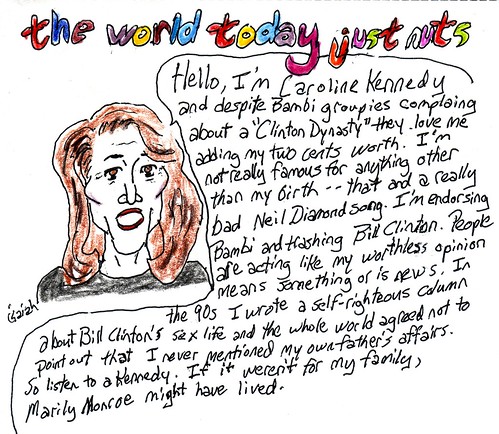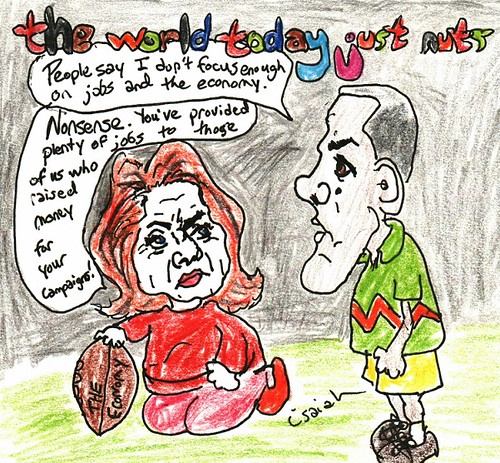
From July 28, 2013, that's "Jobs." C.I. noted:
Barack plays out on the lawn with Caroline Kennedy who holds a
football that reads "THE ECONOMY." He says to her, "People say I don't
focus enough on jobs and the economy." She replies, "Nonsense. You've provided plenty of jobs to those of us who raised money for your campaigns!" Isaiah archives his comics at The World Today Just Nuts.
Caroline Kennedy certainly bought her seat at the table, didn't she?
Here's C.I.'s "Iraq snapshot:"
Saturday, March 26, 2016. Chaos and violence continue, the Islamic
State launches more attacks in Iraq, more US troops will be heading to
Iraq, UN Secretary-General Ban Ki-moon visits the country, and much
more.
AP reports that the death toll has now climbed to 41 with at least one hundred and five more people left injured from a Friday bombing in Iraq. AL JAZEERA reports:
Mobile phone footage widely shared by Iraqis on social media showed players in football kits gathering to collect trophies and footballs as at least one child stood nearby.
One man throws a new football to the crowd, before the camera shakes violently and the footage ends, at what witnesses said was the moment a bomber in the crowd detonated an explosives belt.
NATIONAL IRAQI NEWS AGENCY explains that a bomber blew himself up on the field of a soccer stadium in Iskanderiyah. Abbas al-Ani (AFP) notes, "The mayor, Ahmed Shaker, was among the dead, as was one of his bodyguards and at least five members of the security forces." BBC News reports that burying of the dead began today and "Many of the dead were young boys who were in a trophy ceremony hit by the bomber, himself said to be a teenager." Michael D. Regan (THE NEWSHOUR, PBS) notes that the Islamic State has claimed they orchestrated the attack.
The attack was condemned by the United Nations via Jan Kubis but more talk on Arabic social media revolved around Kubis' inability to find a suit that fits his body than focused on his words regarding "evil doers."
The United Nations Secretary-General Ban Ki-Moon is in Iraq today and has met with KRG President Massoud Barzani.
#Iraq:#UNSG Ban Ki-moon, WB, IDB Presidents in #Erbil #Kurdistan,meet President Masoud Barzani, PM Nechirvan Barzani
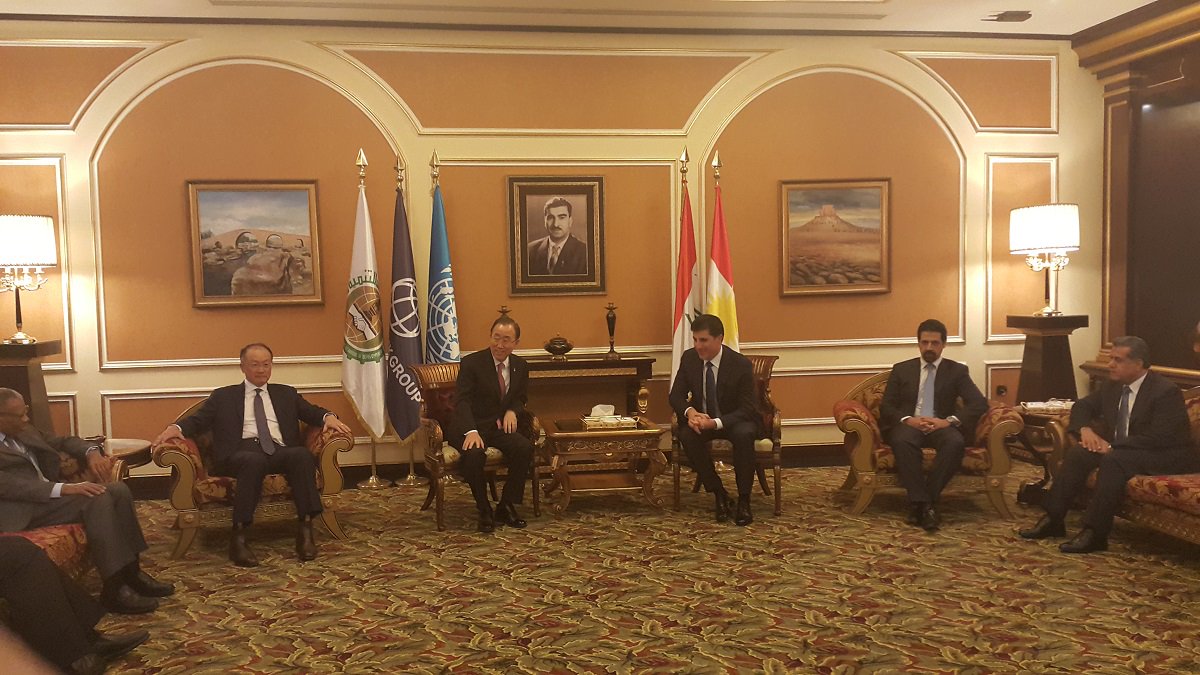
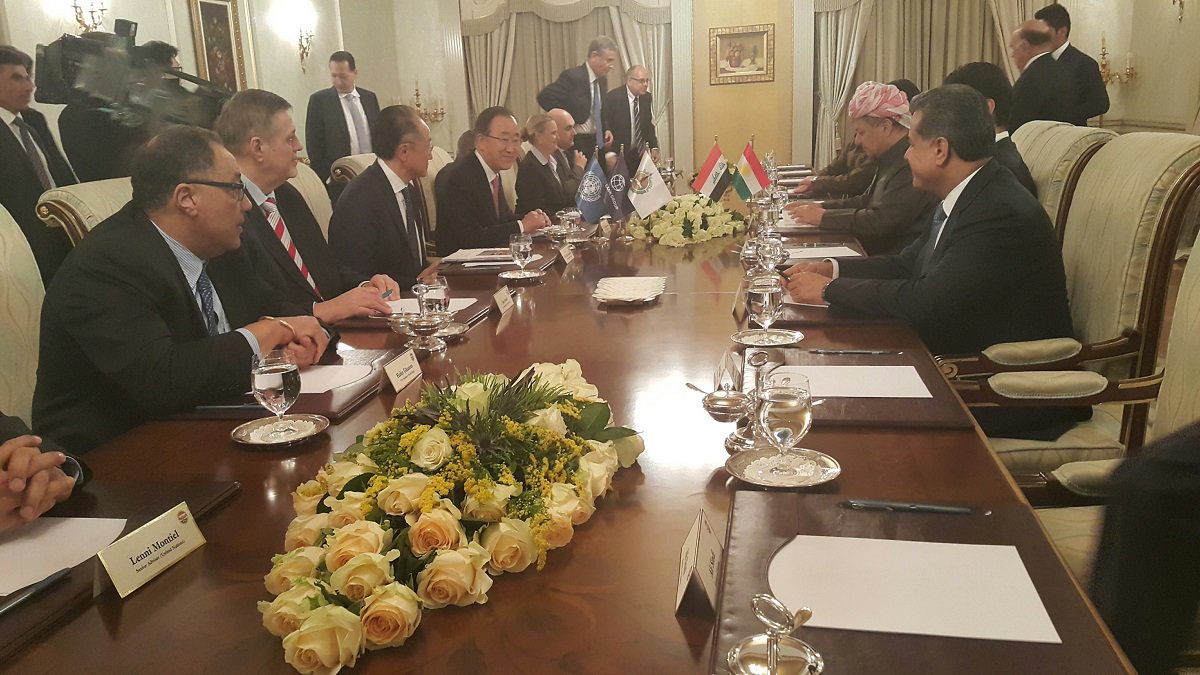
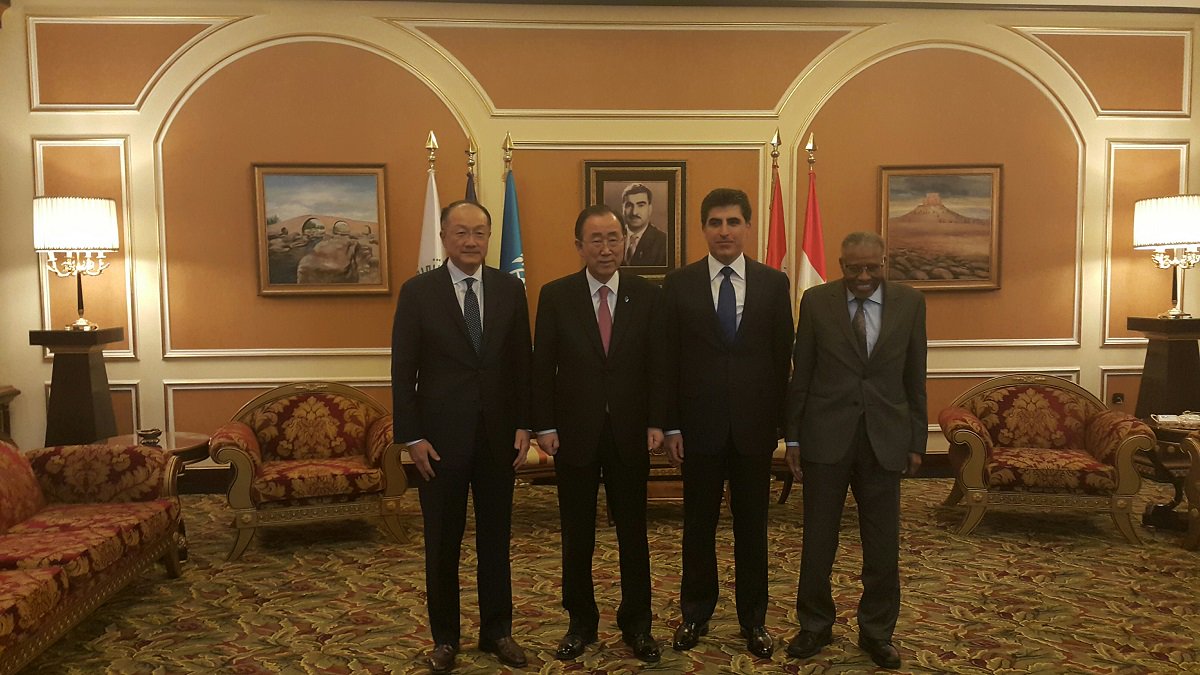
The visit was part of an economic effort -- for Iraq or for those who prey on Iraq? not yet clear -- which also featured Jim Yong Kim, president of the World Bank. The two held a press briefing with Haider al-Abadi, prime minister of Iraq, and Ahmed Mohamed Ali al-Madani, president of the Islamic Development Bank.
Saif Hameed (REUTERS) reports the UN Secretary-General again stressed the need for national reconciliation in Iraq. This go round, he attempted to tie it in with the efforts to defeat the Islamic State but talk, without pressure or incentive, is just talk.
Some of today's violence?
AL JAZEERA reports that the Islamic State sent 10 suicide bombers to attack Ein el-Assad base today resulting in 8 of the bombers being killed by Iraqi forces, 2 of the bombers blowing themselves up and "at least 18 soldiers" being killed. GULF NEWS explains, "Al Assad airbase, located about 180 kilometres northwest of Baghdad in Anbar province, is one of the largest military installations in the country."
Meanwhile, "The secretary and I both believe that there will be an increase to the U.S. forces in Iraq in the coming weeks."
This announcement was made by Gen Joseph Dunford at the press briefing he and Secretary of Defense Ash Cater held on Friday.
Q: The Marines this week in their support of the Iraqi offensive operation, is this something we will see more of, do you think, as time goes on in the fight to get to Mosul? And is -- can you talk about the accelerants that the secretary has talked about before and whether this is a key part of what you want to see the military do more of in Iraq over the next several months?
GEN. DUNFORD: I mean, Lita, we've talked I guess now for some months about setting the conditions for success in Mosul and -- and facilitating the Iraqi forces and staging around Mosul to begin to isolate Mosul, and as the Iraqis have announced, that has begun. These Marines that were there, the artillery battery that were there were in direct support of that. We put the -- we put the battery there to support the Americans that are there advising the Iraqi forces and also in a position to provide support to the Iraqi forces.
And from my perspective, this is no different than aviation fires we've been delivering. This happens to be surface fires -- (inaudible) -- artillery. But certainly no different conceptually than the fire support we've been providing to the Iraqis all along.
And with regard to further accelerants, the secretary and I do expect that there'll be increased capabilities provided to the Iraqis to set the conditions for their operations in Mosul. Those decisions haven't been made yet, but we certainly -- we certainly do expect more of the kinds of things that we saw in Ramadi, albeit a bit different tailored for operations in Mosul. But it's -- but again, the primary force fighting in Mosul will be Iraqi security forces and we'll be in a position to provide advise, assist and enabling capabilities to make them successful.
Q: It appears to be part of a -- more of a ground combat role than we've seen before.
GEN. DUNFORD: No, it's not. I mean, we have -- we have -- we have surface fires in Al Asad and other places, as an example, and we've used those in the past. And so this is not a fundamental shift in our approach to supporting the Iraqi forces. This happens to be what was the most appropriate tool that the commander assessed needed to be in that particular location.
[. . .]
Q: But General Dunford, we've just heard this week that there are actually 5,000 U.S. troops on the ground in Iraq. Why is the Pentagon and senior military leadership reluctant to say that it's more than 3,800?
GEN. DUNFORD: We're not reluctant, Jennifer. What we track is the number that are in our force management level. That's 3,800. But this is nothing that's inconsistent with what's been going on for the last 15 years in terms of people that are in and out on temporary duty less than a certain period of time, people that are in direct support of the embassy. Those have -- those have not been counted. In other words, there's a consistency in the way we've been counting people that's been going on for the last 15 years.
And at any given time, we have 3,800 directly in support of the mission. When units rotate, for example, we don't double-count those numbers, so if there's a unit of 200 that's being replaced by a unit of 200 and they both happen to be on the ground at the same time, we don't count that as 400, we haven't in the past 15 years, because that hasn't -- that hasn't counted against our force management level.
So the accounting of our people has been consistent. We're not denying that there's more people than 3,800; I think you got the numbers from us. But in terms of what we count in the mission, and that's in accordance with the direction that we've been given, the 3,800 is what's against the mission.
SEC. CARTER: Jim.
Q: (Off-mic.)
GEN. DUNFORD: No, I didn't say 5,000 was accurate, I said 3,800 was the force management level and there's some number above that on any given day as a result of people that support the embassy, people at a TDY and people in other categories that don't count against that 3,800.
SEC. CARTER: Jim?
Q: I'd like to follow up, if I could, on Lita's questions about the Marines and that fire base. Unlike the previous U.S. military combat positions and fire support, this is an independent base, these are U.S. military only. And by all indications, they are not just defensive, but in this latest movement by Iraqi forces, they provided fire support for offensive operations against ISIS. So why is this not the first footprint of a U.S. combat ground operation there in Iraq?
GEN. DUNFORD: Jim, the reason they're in a different base is simply a function of geometry. They're designed to support forces in an area called Makhmur. The artillery can't be co-located with the ground forces in Makhmur and provide effective fire support, so this position was selected because of the geometry necessary to support that particular location.
And with regard to providing support to Iraqi offensive capability, once again, I mean, to me, there's no inconsistency between what this artillery unit did and what our aviation support is doing every single day. I don't draw a distinction with it. In other words, we've said that we're providing enabling support to include combined arms capability to Iraqi forces as they conduct operations, which is exactly what this artillery unit was doing.
Q: Well, we have all indications that this is a pretty permanent position right now; that after a short period of time, U.S. Army personnel are going to replace the 26 MEU Marine there. And it still has all indications that the U.S. military is directly involved in the ground operations of -- with the U.S. -- with the Iraqi.
SEC. CARTER: Yes, maybe very quickly just say, even since last week now, as the Iraqis have started to consolidate their positions, the situation on the ground has changed in terms of where the Iraqis are in the relationship to the support, the defense of support they're providing to our artillery unit that's there. So that's already changed, you know, through the course of the week.
But in all honesty, I just cannot see this being inconsistent with everything that we've been doing over the last several months.
SEC. CARTER: And let me just add to that, what we'll be doing in coming months. This is our approach to eliminating ISIL from Mosul. The Iraqi Security Forces are the ones who are carrying out the assault, the envelopment, the assault, but we're helping them.
That's our -- that's been our approach and we'll continue to do that. Started in Ramadi, we'll continue to going up to Mosul. Carla?
Q: When do you anticipate seeing U.S. American ground forces closer to the front lines as the battle towards Mosul looms?
GEN. DUNFORD: Jim, one thing that I probably just need to clarify, this position is behind what is known as the forward line of troops for the peshmerga and Kurds. So it's by no means out in front on its own.
And secondly, what I would say about your question about the future is we have a series of recommendations that we will be discussing with the president in the coming weeks to further enable our support for the Iraqi security forces.
So again, the secretary and I both believe that there will be an increase to the U.S. forces in Iraq in the coming weeks. But that decision hasn't been made.
Nor -- you know, you alluded to decisions that have already been made about Army units replacing the Marine units. All that is pre-decision. There's been no decisions made about what's going to happen to this particular position in the future.
But it is going to be decided in the context of the broader issue that the secretary will bring to the president again, focused on what it is we need to do to maintain a minimum money campaign and what specifically do we need to do to enable operations in Mosul.
"The secretary and I both believe that there will be an increase to the U.S. forces in Iraq in the coming weeks."
So much for Barack Obama's promise of no boots on the ground and of no US troops in combat.
Like every other promise, it was just another lie.
The last time I saw Richard was Detroit in '68
And he told me all romantics meet the same fate someday
Cynical and drunk and boring someone in some dark café
You laugh he said you think you're immune
Go look at your eyes they're full of moon
You like roses and kisses and pretty men to tell you
All those pretty lies pretty lies
When you gonna realize they're only pretty lies
Only pretty lies just pretty lies
-- "The Last Time I Saw Richard," written by Joni Mitchell, first appears on BLUE
Lies and more lies from Barack.
And lies have consequences.
On the 13th anniversary of the start of the Iraq War, March, 19, 2016, another US service member died in Iraq.
Dropping back to Tuesday's snapshot:
Barbara Starr (CNN) reports, "A U.S. Marine stationed at Firebase Bell was killed by an ISIS Katyusha rocket attack on Saturday. Eight U.S. troops were also wounded in the attack. Three were medivaced to Germany where one is described as having serious injuries a defense official told CNN." Spencer Ackerman (GUARDIAN) notes of the attack:
The US marine who was killed in a rocket attack on Saturday died at the first exclusively American base established in Iraq since the Pentagon returned forces to the country in 2014, a spokesman said on Monday.
The base, whose existence had not previously been public, has come under fire from ever closer range over recent days, an indication that Isis knew about the outpost before the Pentagon announced its creation.
Dan Lamothe (WASHINGTON POST) offers a photo essay on the new base.
Barack's sending US troops into Iraq again.
And this as Iraqi soldiers are still deserting. Wladimir van Wilgenburg (DAILY BEAST) reports:
At first, Iraqi soldiers involved in an operation to capture villages close to Mosul on Friday were in good spirits. “Allah Akbar,” Arabic for “God is Great,” they shouted after they hit an alleged Islamic State (ISIS) suicide bomber with US-provided mortars. But just one hour later many of them fled, fearing ISIS would strike back.
Early in the day, there were already signs of trouble. A sergeant named Hussein from the artillery battalion told The Daily Beast, “There has been some delays in what we expected, but it’s mostly because of their heavy use of sniper fire and of IEDS. We have not been really advancing today, but that is not part of our plan as of yet, but in coming hours, we are planning to move forward.”
[. . .]
When their artillery struck something that created a huge explosion inside Nasr, Jibouri and his men shouted with joy. They thought maybe they’d hit an ISIS suicide bomber. General Jibouri looked with his binoculars over the trench to see the result of the artillery, and it seemed he already thought he achieved victory over ISIS militants in the village.
Patrick Cockbun (INDEPENDENT) attempts to address what's going on:
Without any pubic admission or even telling the families of the US soldiers involved, they sent 200 Marines from the Marine Expeditionary Unit with four artillery units to the by now largely abandoned base. Their arrival was wholly contrary to the impression the Pentagon had previously given that US soldiers in Iraq are limited in number and not engaged in front line combat duties. Though the Marines were within rocket range of Isis ten miles away, they were not added to the official US roster of 3,870 troops in Iraq because they were supposedly there on a temporary assignment.
The US public may not have known that their soldiers were back in Iraq defending a fire base, but Isis certainly had observed the arrival of the Marines and the artillery. They began firing rockets at the base, one of which hit a bunker on 19 March, killing Master Sergeant Louis Cardin, a 27-year-old Marine from California, and injuring eight other Marines, three of them seriously. Two days later they made a ground attack in which two Isis fighters were killed. At this point, the Pentagon was forced to become more open about where Sergeant Cardin had been when he died and admit that Marines were not just acting in support of the Iraqi Army and Peshmerga.
The purpose of sending the Marine unit into such as dangerous place was to revive the morale of the 15th Division and to some extent this was successful.
Attempts?
Where's the subject, where's the noun?
He writes an overly long article but never names Barack Obama, the president of the United States. Instead, things just happen, "they" do things.
As opposed to Barack Obama sending "200 Marines" on the mission.
Today, the US Defense Dept announced/bragged/boasted/claimed:
On the topic of US-led coalition bombings, we'll note this:
iraq
cnn
AP reports that the death toll has now climbed to 41 with at least one hundred and five more people left injured from a Friday bombing in Iraq. AL JAZEERA reports:
Mobile phone footage widely shared by Iraqis on social media showed players in football kits gathering to collect trophies and footballs as at least one child stood nearby.
One man throws a new football to the crowd, before the camera shakes violently and the footage ends, at what witnesses said was the moment a bomber in the crowd detonated an explosives belt.
NATIONAL IRAQI NEWS AGENCY explains that a bomber blew himself up on the field of a soccer stadium in Iskanderiyah. Abbas al-Ani (AFP) notes, "The mayor, Ahmed Shaker, was among the dead, as was one of his bodyguards and at least five members of the security forces." BBC News reports that burying of the dead began today and "Many of the dead were young boys who were in a trophy ceremony hit by the bomber, himself said to be a teenager." Michael D. Regan (THE NEWSHOUR, PBS) notes that the Islamic State has claimed they orchestrated the attack.
The attack was condemned by the United Nations via Jan Kubis but more talk on Arabic social media revolved around Kubis' inability to find a suit that fits his body than focused on his words regarding "evil doers."
The United Nations Secretary-General Ban Ki-Moon is in Iraq today and has met with KRG President Massoud Barzani.
The visit was part of an economic effort -- for Iraq or for those who prey on Iraq? not yet clear -- which also featured Jim Yong Kim, president of the World Bank. The two held a press briefing with Haider al-Abadi, prime minister of Iraq, and Ahmed Mohamed Ali al-Madani, president of the Islamic Development Bank.
Saif Hameed (REUTERS) reports the UN Secretary-General again stressed the need for national reconciliation in Iraq. This go round, he attempted to tie it in with the efforts to defeat the Islamic State but talk, without pressure or incentive, is just talk.
Some of today's violence?
AL JAZEERA reports that the Islamic State sent 10 suicide bombers to attack Ein el-Assad base today resulting in 8 of the bombers being killed by Iraqi forces, 2 of the bombers blowing themselves up and "at least 18 soldiers" being killed. GULF NEWS explains, "Al Assad airbase, located about 180 kilometres northwest of Baghdad in Anbar province, is one of the largest military installations in the country."
Meanwhile, "The secretary and I both believe that there will be an increase to the U.S. forces in Iraq in the coming weeks."
This announcement was made by Gen Joseph Dunford at the press briefing he and Secretary of Defense Ash Cater held on Friday.
Q: The Marines this week in their support of the Iraqi offensive operation, is this something we will see more of, do you think, as time goes on in the fight to get to Mosul? And is -- can you talk about the accelerants that the secretary has talked about before and whether this is a key part of what you want to see the military do more of in Iraq over the next several months?
GEN. DUNFORD: I mean, Lita, we've talked I guess now for some months about setting the conditions for success in Mosul and -- and facilitating the Iraqi forces and staging around Mosul to begin to isolate Mosul, and as the Iraqis have announced, that has begun. These Marines that were there, the artillery battery that were there were in direct support of that. We put the -- we put the battery there to support the Americans that are there advising the Iraqi forces and also in a position to provide support to the Iraqi forces.
And from my perspective, this is no different than aviation fires we've been delivering. This happens to be surface fires -- (inaudible) -- artillery. But certainly no different conceptually than the fire support we've been providing to the Iraqis all along.
And with regard to further accelerants, the secretary and I do expect that there'll be increased capabilities provided to the Iraqis to set the conditions for their operations in Mosul. Those decisions haven't been made yet, but we certainly -- we certainly do expect more of the kinds of things that we saw in Ramadi, albeit a bit different tailored for operations in Mosul. But it's -- but again, the primary force fighting in Mosul will be Iraqi security forces and we'll be in a position to provide advise, assist and enabling capabilities to make them successful.
Q: It appears to be part of a -- more of a ground combat role than we've seen before.
GEN. DUNFORD: No, it's not. I mean, we have -- we have -- we have surface fires in Al Asad and other places, as an example, and we've used those in the past. And so this is not a fundamental shift in our approach to supporting the Iraqi forces. This happens to be what was the most appropriate tool that the commander assessed needed to be in that particular location.
[. . .]
Q: But General Dunford, we've just heard this week that there are actually 5,000 U.S. troops on the ground in Iraq. Why is the Pentagon and senior military leadership reluctant to say that it's more than 3,800?
GEN. DUNFORD: We're not reluctant, Jennifer. What we track is the number that are in our force management level. That's 3,800. But this is nothing that's inconsistent with what's been going on for the last 15 years in terms of people that are in and out on temporary duty less than a certain period of time, people that are in direct support of the embassy. Those have -- those have not been counted. In other words, there's a consistency in the way we've been counting people that's been going on for the last 15 years.
And at any given time, we have 3,800 directly in support of the mission. When units rotate, for example, we don't double-count those numbers, so if there's a unit of 200 that's being replaced by a unit of 200 and they both happen to be on the ground at the same time, we don't count that as 400, we haven't in the past 15 years, because that hasn't -- that hasn't counted against our force management level.
So the accounting of our people has been consistent. We're not denying that there's more people than 3,800; I think you got the numbers from us. But in terms of what we count in the mission, and that's in accordance with the direction that we've been given, the 3,800 is what's against the mission.
SEC. CARTER: Jim.
Q: (Off-mic.)
GEN. DUNFORD: No, I didn't say 5,000 was accurate, I said 3,800 was the force management level and there's some number above that on any given day as a result of people that support the embassy, people at a TDY and people in other categories that don't count against that 3,800.
SEC. CARTER: Jim?
Q: I'd like to follow up, if I could, on Lita's questions about the Marines and that fire base. Unlike the previous U.S. military combat positions and fire support, this is an independent base, these are U.S. military only. And by all indications, they are not just defensive, but in this latest movement by Iraqi forces, they provided fire support for offensive operations against ISIS. So why is this not the first footprint of a U.S. combat ground operation there in Iraq?
GEN. DUNFORD: Jim, the reason they're in a different base is simply a function of geometry. They're designed to support forces in an area called Makhmur. The artillery can't be co-located with the ground forces in Makhmur and provide effective fire support, so this position was selected because of the geometry necessary to support that particular location.
And with regard to providing support to Iraqi offensive capability, once again, I mean, to me, there's no inconsistency between what this artillery unit did and what our aviation support is doing every single day. I don't draw a distinction with it. In other words, we've said that we're providing enabling support to include combined arms capability to Iraqi forces as they conduct operations, which is exactly what this artillery unit was doing.
Q: Well, we have all indications that this is a pretty permanent position right now; that after a short period of time, U.S. Army personnel are going to replace the 26 MEU Marine there. And it still has all indications that the U.S. military is directly involved in the ground operations of -- with the U.S. -- with the Iraqi.
SEC. CARTER: Yes, maybe very quickly just say, even since last week now, as the Iraqis have started to consolidate their positions, the situation on the ground has changed in terms of where the Iraqis are in the relationship to the support, the defense of support they're providing to our artillery unit that's there. So that's already changed, you know, through the course of the week.
But in all honesty, I just cannot see this being inconsistent with everything that we've been doing over the last several months.
SEC. CARTER: And let me just add to that, what we'll be doing in coming months. This is our approach to eliminating ISIL from Mosul. The Iraqi Security Forces are the ones who are carrying out the assault, the envelopment, the assault, but we're helping them.
That's our -- that's been our approach and we'll continue to do that. Started in Ramadi, we'll continue to going up to Mosul. Carla?
Q: When do you anticipate seeing U.S. American ground forces closer to the front lines as the battle towards Mosul looms?
GEN. DUNFORD: Jim, one thing that I probably just need to clarify, this position is behind what is known as the forward line of troops for the peshmerga and Kurds. So it's by no means out in front on its own.
And secondly, what I would say about your question about the future is we have a series of recommendations that we will be discussing with the president in the coming weeks to further enable our support for the Iraqi security forces.
So again, the secretary and I both believe that there will be an increase to the U.S. forces in Iraq in the coming weeks. But that decision hasn't been made.
Nor -- you know, you alluded to decisions that have already been made about Army units replacing the Marine units. All that is pre-decision. There's been no decisions made about what's going to happen to this particular position in the future.
But it is going to be decided in the context of the broader issue that the secretary will bring to the president again, focused on what it is we need to do to maintain a minimum money campaign and what specifically do we need to do to enable operations in Mosul.
"The secretary and I both believe that there will be an increase to the U.S. forces in Iraq in the coming weeks."
So much for Barack Obama's promise of no boots on the ground and of no US troops in combat.
Like every other promise, it was just another lie.
The last time I saw Richard was Detroit in '68
And he told me all romantics meet the same fate someday
Cynical and drunk and boring someone in some dark café
You laugh he said you think you're immune
Go look at your eyes they're full of moon
You like roses and kisses and pretty men to tell you
All those pretty lies pretty lies
When you gonna realize they're only pretty lies
Only pretty lies just pretty lies
-- "The Last Time I Saw Richard," written by Joni Mitchell, first appears on BLUE
Lies and more lies from Barack.
And lies have consequences.
On the 13th anniversary of the start of the Iraq War, March, 19, 2016, another US service member died in Iraq.
Dropping back to Tuesday's snapshot:
Barbara Starr (CNN) reports, "A U.S. Marine stationed at Firebase Bell was killed by an ISIS Katyusha rocket attack on Saturday. Eight U.S. troops were also wounded in the attack. Three were medivaced to Germany where one is described as having serious injuries a defense official told CNN." Spencer Ackerman (GUARDIAN) notes of the attack:
The US marine who was killed in a rocket attack on Saturday died at the first exclusively American base established in Iraq since the Pentagon returned forces to the country in 2014, a spokesman said on Monday.
The base, whose existence had not previously been public, has come under fire from ever closer range over recent days, an indication that Isis knew about the outpost before the Pentagon announced its creation.
Dan Lamothe (WASHINGTON POST) offers a photo essay on the new base.
Barack's sending US troops into Iraq again.
And this as Iraqi soldiers are still deserting. Wladimir van Wilgenburg (DAILY BEAST) reports:
At first, Iraqi soldiers involved in an operation to capture villages close to Mosul on Friday were in good spirits. “Allah Akbar,” Arabic for “God is Great,” they shouted after they hit an alleged Islamic State (ISIS) suicide bomber with US-provided mortars. But just one hour later many of them fled, fearing ISIS would strike back.
Early in the day, there were already signs of trouble. A sergeant named Hussein from the artillery battalion told The Daily Beast, “There has been some delays in what we expected, but it’s mostly because of their heavy use of sniper fire and of IEDS. We have not been really advancing today, but that is not part of our plan as of yet, but in coming hours, we are planning to move forward.”
[. . .]
When their artillery struck something that created a huge explosion inside Nasr, Jibouri and his men shouted with joy. They thought maybe they’d hit an ISIS suicide bomber. General Jibouri looked with his binoculars over the trench to see the result of the artillery, and it seemed he already thought he achieved victory over ISIS militants in the village.
Yet
one hour later, his men were not so joyful, when most soldiers ran in
panic, fleeing in their Humvees, fearing ISIS mortar attacks. Just a few
of his men, including the artillery officers, stood their ground.
This seems to be exactly the biggest problem for the Iraqi army: the lack of morale. One week ago Iraqi soldiers abandoned their base, which forced the United States to send in more Marines in support, and one of them was killed. Again this time, Iraqi army soldiers almost completely deserted their positions, fearing an ISIS response to their artillery when, in reality, not one mortar shell or bullet hit close to their positions.
This seems to be exactly the biggest problem for the Iraqi army: the lack of morale. One week ago Iraqi soldiers abandoned their base, which forced the United States to send in more Marines in support, and one of them was killed. Again this time, Iraqi army soldiers almost completely deserted their positions, fearing an ISIS response to their artillery when, in reality, not one mortar shell or bullet hit close to their positions.
Patrick Cockbun (INDEPENDENT) attempts to address what's going on:
Without any pubic admission or even telling the families of the US soldiers involved, they sent 200 Marines from the Marine Expeditionary Unit with four artillery units to the by now largely abandoned base. Their arrival was wholly contrary to the impression the Pentagon had previously given that US soldiers in Iraq are limited in number and not engaged in front line combat duties. Though the Marines were within rocket range of Isis ten miles away, they were not added to the official US roster of 3,870 troops in Iraq because they were supposedly there on a temporary assignment.
The US public may not have known that their soldiers were back in Iraq defending a fire base, but Isis certainly had observed the arrival of the Marines and the artillery. They began firing rockets at the base, one of which hit a bunker on 19 March, killing Master Sergeant Louis Cardin, a 27-year-old Marine from California, and injuring eight other Marines, three of them seriously. Two days later they made a ground attack in which two Isis fighters were killed. At this point, the Pentagon was forced to become more open about where Sergeant Cardin had been when he died and admit that Marines were not just acting in support of the Iraqi Army and Peshmerga.
The purpose of sending the Marine unit into such as dangerous place was to revive the morale of the 15th Division and to some extent this was successful.
Attempts?
Where's the subject, where's the noun?
He writes an overly long article but never names Barack Obama, the president of the United States. Instead, things just happen, "they" do things.
As opposed to Barack Obama sending "200 Marines" on the mission.
Today, the US Defense Dept announced/bragged/boasted/claimed:
Strikes in Iraq
Using rocket artillery along with
ground-attack, attack, fighter, and remotely piloted aircraft, coalition
forces conducted 22 strikes in Iraq, coordinated with and in support of
the Iraqi government:
-- Near Fallujah, two strikes struck two separate ISIL tactical units.
-- Near Hit, five strikes struck
an ISIL improvised weapons factory, an ISIL communications facility, an
ISIL weapons storage facility and two separate ISIL tactical units and
destroyed two ISIL vehicles and an ISIL fighting position.
-- Near Kisik, two strikes
destroyed an ISIL artillery piece and suppressed an ISIL fighting
position and an ISIL mortar position.
-- Near Mosul, four strikes struck
two separate ISIL tactical units, suppressed two ISIL mortar positions,
and destroyed two ISIL supply caches and three ISIL assembly areas.
-- Near Qayyarah, six strikes
struck four separate ISIL tactical units, suppressed an ISIL mortar
position, and destroyed three ISIL mortar positions, an ISIL artillery
piece, an ISIL supply cache, an ISIL vehicle, and five ISIL assembly
areas.
-- Near Sinjar, a strike struck an
ISIL tactical unit and destroyed an ISIL heavy machine gun position and
an ISIL assembly area.
-- Near Sultan Abdallah, two
strikes struck two separate ISIL tactical units, destroyed an ISIL
fighting position and denied ISIL access to terrain.
Task force officials define a
strike as one or more kinetic events that occur in roughly the same
geographic location to produce a single, sometimes cumulative, effect.
Therefore, officials explained, a single aircraft delivering a single
weapon against a lone ISIL vehicle is a strike, but so is multiple
aircraft delivering dozens of weapons against buildings, vehicles and
weapon systems in a compound, for example, having the cumulative effect
of making those targets harder or impossible for ISIL to use.
Accordingly, officials said, they do not report the number or type of
aircraft employed in a strike, the number of munitions dropped in each
strike, or the number of individual munition impact points against a
target.
On the topic of US-led coalition bombings, we'll note this:
 curdistani
Reports confirm that about 30 Iraqi soldiers were hit mistakenly by US led coalition airstrike near Mosul. #Iraq #Twitterkurds
iraq
cnn