Thursday, March 18, 2010

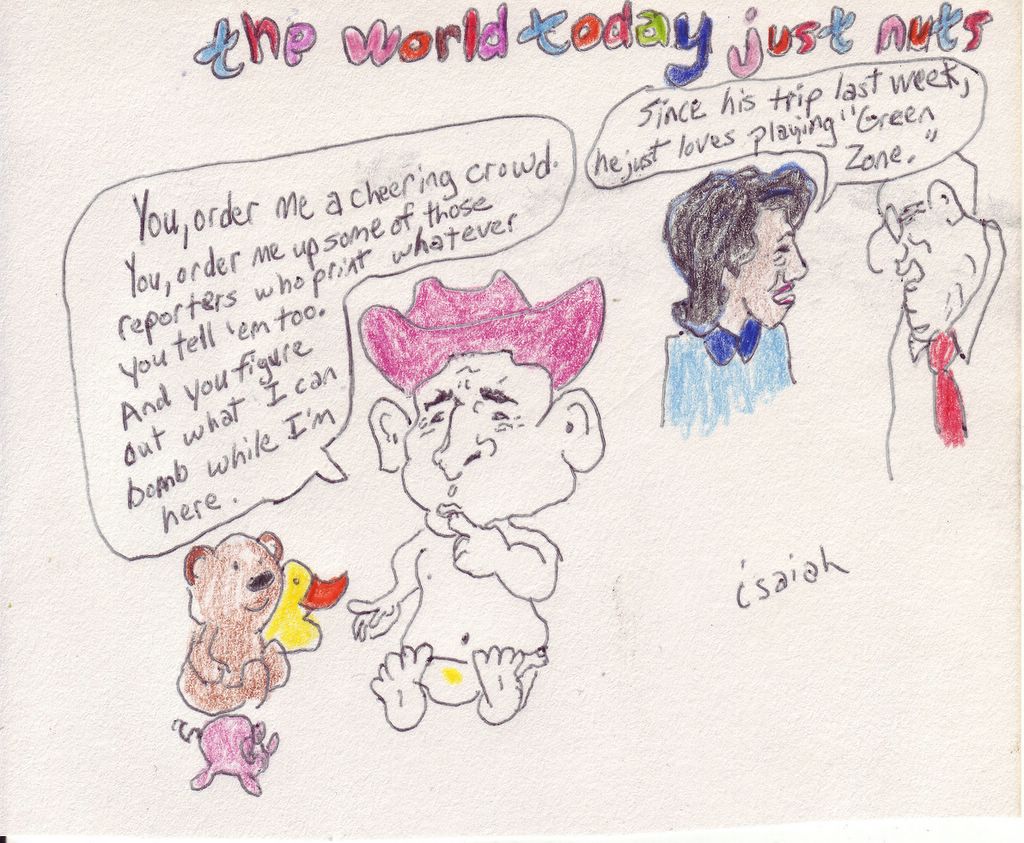
Bully Boy and Koizumi Play Dress Up.


That's "Bully Boy and Koizumi Play Dress Up" from July 2, 2006.

And it still makes me laugh.


That was a Sunday when I had no idea what I was going to draw and I was going through two newspapers looking for ideas when I saw the Japanese Prime Minister in his Elvis pose. I thought, "He loves Elvis and dresses like him for that reason. Who would Bush dress up as? Oh, right. His mother."

It all made sense. :D

And this is C.I.'s "Iraq snapshot:"

Thursday, March 18, 2010. Chaos and violence continue, ballot counting continues, the US military announces another death, the Senate hears from Mr. Crazy, Gordon Brown's error hasn't yet washed away and more.

Starting in the US where Congress saw some honorable moments and a whole lot of crazy. On the former (honorable), Lt Jr Grade Jenny L. Kopfstein shared her experience serving in the military while gay:

It was difficult being on the ship and having to lie, or tell half-truths, to my shipmates. Under Don't Ask, Don't Tell, answering the simplest questions can get you kicked out. If a shipmate asks what you did last weekend, you can't react like a normal human being and say, "Hey, I went to a great new restaurant with my partner. You should try it out." An answer like that would have gotten me kicked out of the Navy. But if you don't interact like that with your shipmates, they think you're weird, and it undermines working together as a team. So after being on the ship for a while, I wrote a letter to my commanding officer and told him I was a lesbian because I felt like I was being forced to lie. I did not want to get out of the Navy. I wanted to stay and serve honorably and to maintain my integrity by not lying about who I was. After I wrote the letter, I continued to do my job on the ship to the best of my ability. We went on a six-month deployment to the Middle East. I qualified as Officer of the Deck and was chosen to be the Officer of the Deck during General Quarters which is a great honor. During all this time, I am proud to say, I did not lie. I had come out in my letter officially and I came out slowly over time to my shipmates. I expected negative responses. I got none. Everyone I talked to was positive and the universal attitude was that Don't Ask, Don't Tell was dumb. I served openly for two years and four months. One thing that happened during that time was the Captain's choosing me to represent the ship in a shiphandling competition. I was the only officer chosen from the ship to compete. My orientation was known to my shipmates by this time. Nobody griped about the captain choosing someone being processed for discharge under Don't Ask, Don't Tell to represent my ship. Instead a couple of my fellow junior officers congratuled me and wished me luck in the competition. I competed by showing the Admiral my shipdriving skills and won the competition.

She was speaking before the Senate Armed Services Committee which is chaired by Senator Carl Levin. The Ranking Member is Senator John McCain. Appearing before the Committee today as they explored Don't Ask, Don't Tell which veered from the moving (such as above) to the outright puzzling. Along with Kopfstein, Maj Michael D. Almy and Gen John Sheehan spoke. Kopfstein and Almy are 'former' because they were drummed out of the service for being gay. They aren't former at this site. They didn't chose to leave, their rank stands in the snapshot. Sheehan is retired. He is not gay but if someone wants to spread a rumor, go for it. You'll understand why I say that shortly.

The hearing moved along nicely during opening statements. It seemed respectful of all and fairly typical for a hearing. There were moving statements made of the losses suffered as a result of being forced out of your chosen profession due to your sexuality. Again, Carl Levin is the Chair and he opened his questions after the prepared remarks.

Committee Chair Carl Levin: Mr. Almy, should somebody be forced to be silent about their sexual orientation in the military?

Maj Michael Almy: In my opinion, no, Senator. I think the Don't Ask, Don't Tell law is inherently in conflict with the service's core value as Adm Mullen reflected in his testimony before this hearing a month ago. The prinicpal core value of the Air Force is integrity first. And Don't Ask, Don't Tell says that gays and lesbians can serve in the military as long as they're not who they are, as long as they lie about who they are. And to me, personally, that was in direct violation of the core values of the Air Force.


Committee Chair Carl Levin: So while you were willing to keep your orientation private, you don't feel it is the right policy or the fair policy. Is that correct?

Maj Michael Almy: Correct, Senator.

Committee Chair Carl Levin: Mike, would you like to return to the military if you could?

Maj Michael Almy: Absolutely. It's my greatest desire. It's my calling in life and I miss the military considerably.

And with that Levin had finished with Almy for the first round. He moved immediately to the retired general and this is where it all went crazy. I have a name "*" starred in the following. I'm guessing at the spelling and will explain why at the end of the exchange.

Commitee Chair Carl Levin: General, you've been the NATO Supreme Allied Commander and I assume that as NATO Commander that you discussed the issue with other military leaders of our allies. Is that correct?

Gen John J. Sheehan: Yes, sir, I have.

Committee Chair Carl Levin: Did you -- did they tell you, those allies who allow open service of gay and lesbian men and women, did they tell you that they had cohesion and morale problems?

Gen John Sheehan: Yes sir they did. If you don't -- l beg the indulgence --

Committee Chair Carl Levin: Sure.

Gen John J. Sheehan: Most of this Committee knows that current militaries are a product of years of development. They reflect societies that they are theoretically paid to protect. The Europen militaries today are a product of the collapse of the Soviet Union. Nations like Belgium, Luxenberg, the Dutch, etc. firmly believed that there was no longer a need for combat capability in the militaries. As a result, they declared a peace dividend and made a concentrated effort to socialize their military. That included the unionization of the militaries. It included open homo - homosexuality demonstrated in a series of other activities. But with a focus on peace keeping missions because they did not believe the Germans were going to attack again or that the Soviets were coming back. That led to a force that was ill-equipped to go to war. The case in point I'm referring to is when the Dutch were required to defend Srebrenica against the Serbs. The battalion was under strength, poorly led and the Serbs came into town, handcuffed the soldiers to telephone poles, marched the Muslims off and executed them. That was the largest massacre in Europe since WWII.

Committee Chair Carl Levin: And did the Dutch leaders tell you it was because there were gay soldiers there?

Gen John J. Sheehan: It was a combination --

Committee Chair Carl Levin: But did they tell you that? That was my question.

Gen John J. Sheehan: Yes. They included that as part of the problem.

That there were gay soldiers among the Dutch --

Gen John J. Sheehan: The combination was the liberalization of the military. A net effect, basically social engineering.

Committee Chair Carl Levin: The -- You said that no special accomdiations should be made for any member of the military.

Gen John J. Sheehan: Sure.

Committee Chair Carl Levin: Are members who are straight, who are heterosexual allowed in our military to say that they are straight and heterosexual? Are they allowed to say that? [Long pause as Levin waits for an answer before adding] Without being discharged?

Gen John J. Sheehan: Are they allowed to say --

Committee Chair Carl Levin: Yeah.

Gen John J. Sheehan: -- sexuality.

Committee Chair Carl Levin: Are they allowed to say "Hey, I'm straight. I'm heterosexual." Can you say that? Without being discharged.
Gen John J. Sheehan: There's no prohibition to my knowledge.

Committee Chair Carl Levin: Is that a special accomidation to them?

Gen John J. Sheehan: [Long pause] I wouldn't consider it a special accomodiation.

Committee Chair Carl Levin: Why would it be a special accomidation then to someone who's gay to say 'Hey, I'm gay.'? Why -- why do you call that special? You don't call it special for someone who's heterosexual or straight. Why do you believe that's a special accomodation to someone who's gay?

Gen John J. Sheehan: I think the issue, Senator, that . . . we're talking about . . . really has a lot to do with the individuals. It has to do with the very nature of combat. Combat is not about individuals, it's about units. We're talking about a group of people who declared openly sexual attraction to a particular segment of the population and insist and continue to live in intimate proximity with them. That allows them to --

Comittee Chair Carl Levin: You allow that for heterosexuals?

Gen John J. Sheehan: Yes.

Committee Chair Carl Levin: You don't have any problem with that?

Gen John J. Sheehan: Don't have any problem. But that --

Committee Chair Carl Levin: You don't have any problem with men and women serving together even though they say they're attracted to each other?

Gen John J. Sheehan: That's correct.

Committee Chair Carl Levin: That's not a special accomidation?

Gen John J. Sheehan: No.

Committee Chair Carl Levin: Okay. But it is special to allow --

Gen John J. Sheehan: It' is because it identifies the group as a special group of people who by law make them ineligiable for further service.
Committee Chair Carl Levin: But the whole issue is whether it ought to be, whether they ought to be ineligable? Whether we ought to keep out of our service.

Gen John J. Sheehan: That's correct. the current debate, the current law clearly says --

Committee Chair Carl Levin: No I know what the law says, the question is should we change the law?

Gen John J. Sheehan: My recommendation is no.

Senator Carl Levin: No, I understand. And can you tell us which Dutch officers you talked to who told you that Srebenica was in part caused because there were gay soldiers in the Dutch army?

Gen John J. Sheehan: Uh, Chief of Staff of the Army who was fired by the Parliament because they couldn't find anybody else to blame.

Committe Chair Carl Levin: And who was that?

Gen John J. Sheehan: Hank van Brummen*.

Committee Chair Carl Levin: Pardon?Gen John J. Sheehan: Hank van Brummen.

Committee Chair Carl Levin: Why is the burden to end the discriminatory policy based on people who would end the discriminatory policy? Why do the people who want to end the policy have to show that it would improve combat effectiveness? If we're satisified it would not harm combat effectiveness and for many who would be allowed to serve they would then be permitted to serve without discrimination and without harm. Why is that not good enough for you?

Gen John J. Sheehan: Because the force that we have today is probably the finest fighting force we have in the world.

Committee Chair Carl Levin: And maybe we could have an equally fine or even better force but if it's equally fine -- if you could be satisified that it's no harm to combat cohesion or effectiveness, would that be satisifactory to you?

Gen John J. Sheehan: No. I think it has to be demonstrated, Senator.

Committee Chair Carl Levin: That there be an actual improvement.

Gen John J. Sheehan: An actual improvement.

Committee Chair Carl Levin: No harm wouldn't be good enough for you?

Gen John J. Sheehan: No. The reason I say --

Committee Chair Carl Levin: Pardon?

Gen John J. Sheehan: The reason I say that, Senator, is we've gone through this once before in our lifetime. You were in the Senate at the time. It was called the Great Society. When it was deemed that we could bring into the military categories fours and fives and help the military out and make it part of a social experiment. Those categories fours and fives almost destroyed the military.

Commitee Chair Carl Levin: I don't know what that has to do with this issue.

Gen John J. Sheehan: Well it has to do with the issue of . . . being able to demonstrate that the . . . change in policy is going to improve things. We were told . . . that this was going to help out combat strength. Combat deployable strength. It didn't. It did just the opposite. It drove people out. So I think the burden has to be on demonstrating that something's going to become better, not hoping that it will become something better.

Committee Chair Carl Levin: Well I think the burden of people -- the burden to maintain a discriminatory policy is on the people who want to maintain the policy. Not on the people who want to end it.

"Hank van Brummen*"? I'm not Dutch. I had to call around until someone said they knew who the general meant: Ad van Baal. Full name: Paulus Adrianus Petrus Maria van Baal. He was the Chief of Staff when he resigned. He resigned in April of 2002. He resigned because of a United Nations' report which found leadership at the top to be responsible for (or contributing to -- I haven't read the report, I'm going by a Dutch diplomat here) the massacre. If that's correct (I have no reason to doubt it), then does General John Sheehan even know who he was speaking to? I asked whether or not there was anyway the names could be pronounced similarly and was told "no."
The above excerpt shows that Levin conducted himself honorably. Almy did as well but he's not really the focus in the snapshot.
Kat will write about this at her site tonight, Wally will write about the hearing at Rebecca's site and Ava's writing about it at Trina's. In addition, Marcia's going to quiz me on a few things at her site tonight.

Turning to Iraq where the ballot counting continues.
Katrina Kratovac and Sameer N. Yacoub (AP) reports that 89% of the ballots have been counted as of today and paint a scene of "chaos" where votes are announced and then pulled back, where votes are no longer displayed for the reporters on screens but instead they're handing compact discs and hustled off elswhere. Martin Chulov (Guardian) reports that the final (unofficial) tally has been postponed "yet again". AP is listing the 89% for the vote counted (Margaret Coker says 86%) but what the vote actually is appears to be changing regularly. For example, AINA reports that Iraq's Independent High Electoral Commission has issued an announcement via Sardar Abdul Karim (who serves on the commission) "that IHEC will reconsider its decision to exclude votes from Iraqi expatriates." If the ballots allowed are being increased, the percentage of counted may be off. AFP says the 89% "includes 70 per cent of special voting, conducted three days before the election, for the security forces, hospital patients and staff, and prisoners." If accurate, the big remaining votes to be counted are among the refugee populations. As noted in yesterday's snapshot, the security forces and the refugees were the two categories that were thought to then be uncounted. Ned Parker (Los Angeles Times) notes various thoughts and whispers on the potential outcomes. Stephen Sackur (BBC News' HARDtalk) interviews Ayad Allawi regarding the elections (a clip is available at link, interview airs later). Hannah Allam and Laith Hammoudi (McClatchy Newspapers) explore the terrain for Nouri al-Maliki:

Maliki has no outright majority, no mandate and precious little support from factions that would be the key to his survival. The campaign against him is so robust that members of his own State of Law coalition haven't ruled out dumping him as the prime minister nominee in order to lure partners that would give them a dominant voice in the next government, according to interviews with Maliki's allies, opponents and independent observers.Even if Maliki pulls off a second term over the objections of rival parties, his opponents have said privately that they'd block his efforts in parliament and open up potentially embarrassing corruption inquiries, strategies that could lead to an even weaker and more violent Iraq just as U.S. forces prepare for a full withdrawal by the end of next year.

Margaret Coker (Wall St. Journal) notes in the unofficial count thus far, it "is still razor-thin" which Nouri having a slight edge however, "Analysts expect Mr. Allawi to benefit from expatriate votes, especially among the large numbers of Iraqis living in Jordan and Syria. Mr. Allawi made re-establishing ties with Arab allies such as Jordan and Syria a key part of his campaign."

And no one from State of Law went to Syria to get out the vote; however, Tariq al-Hashimi did visit Syria a few weeks ago in part to encourage the refugee community to vote. Tariq al-Hashimi is one of the current vice presidents of Iraq (they have two) and a member of Allawi's political party. Allawi is also thought to be hugely popular among the Iraqi refugee community in Jordan.
Duraid al Baik (Gulf News) observes, "The advance of the Iraqiya bloc of Eyad Allawi against the State of Law bloc led by incumbent Prime Minister Nouri Al Maliki has surprised Iraqis and analysts." Though Allawi is expected to do well in the refugee community in countries neighboring Iraq, that won't be true of all the refugee communities or 'refugee' communities. We've already called out the nonsense of allowing Iraqis who left Iraq in the seventies, eighties and nineties, were granted asylum and became US citizens -- and vote in the US -- to vote in the Iraq elections. But that did happen. And in Michigan, that population is said to be firmly for Nouri's State of Law and it's said to be true in California as well. Is it true? I don't know. I'm going by members of those communities. And we're including it because it appears that there are a few votes outstanding from provinces and the rest is the refugee population. You need to factor in that with Iraqis who left long before the invasion, there appears to be (for some) a tie to Nouri. So if that's the big remainder on vote counting, State of Law will benefit from some refugee communities and it should not automatically be seen as "They won't support Nouri!" (Why might someone see it? They're labeled "refugees." Most of us, rightly, consider a refugee to be of a recent period of time. Going back three and four decades? Most of us don't consider that to be a "refugee." Current refugees would, if they supported Nouri, be more likely to move back to Iraq. They'd feel he'd made it 'safer' whereas actual refugees know better.)

One of the political parties in the Ahrar Party and they issued the following today:

Conditions to apply for a scholarship from Ahrar Party

According to the promise made by Ahrar Party to the Iraqi youth and graduates from Iraqi or foreign colleges, Ahrar Party agreed with the American General Motors Company to provide scholarships for Iraqi cadres for a period of six months outside of Iraq for study and training on the latest means and methods of management and leadership and granting a Master's degree. The graduate of this course will be qualified to do administrative and leadership work in jobs assigned to him at a very high standard. Acceptance will be in accordance with the following conditions:
General Conditions:
The applicant should:
Be an Iraqi national.
Be a graduate from an Iraqi or foreign university and have a bachelor's degree or equivalent.
Have no fewer than two years of practical experience.
Be between 25 and 40 years old.
Have good conduct and behavior.
Pledge to work in the place commensurate with his capabilities for no fewer than ten years after graduation from the course.
Agree to be subjected to the preferences and testing determined by the admissions committee.
Required Documents:
Original Civil Affairs ID card + colored replica photocopy.
Original Iraqi citizenship certificate + colored replica photocopy.
Housing card or housing confirmation letter from the Office of Information for the residents of Baghdad and other provinces. This paragraph does not apply to Iraqis living abroad.
A colored replica photocopy of the ration card for the year 2009-2010, this paragraph does not apply to Iraqis living abroad.
Original graduation certificate, certified by the University he or she graduated from and his or her scientific degrees should be listed on it.
A colored replica photocopy of the passport.
(2) personal photos.
Note: Apply to the following email:
a7rar_jamalalden@yahoo.com
For further information, contact:
Ahrar Media Bureau Tel: +964 (0)790 157 4478 / +964 (0)790 157 4479 / +964 (0)771 275 2942
press@ahrarparty.com
About Ayad Jamal Aldin:
Ayad Jamal Aldin is a cleric, best known for his consistent campaigning for a new, secular Iraq. He first rose to prominence at the Nasiriyah conference in March 2003, shortly before the fall of Saddam, where he called for a state free of religion, the turban and other theological symbols. In 2005, he was elected as one of the 25 MPs on the Iraqi National List, but withdrew in 2009 after becoming disenchanted with Iyad Allawi's overtures to Iran. He wants complete independence from Iranian interference in Iraq. He now leads the Ahrar party for the 2010 election to the Council of Representatives, to clean up corruption and create a strong, secure and liberated Iraq for the future.

On the topic of Iraqis, what do they think about their elections?
Today on The Takeaway (PRI), Celeste Headlee spoke with Iraqis Lubna Naji and Waria Salihi about the elections.

Celeste Headlee: It's almost 7 years since the United States led invasion of Iraq began. And the country is now awaiting the results of its March 7th Parliamentary elections. We felt it was a good time to check in with Iraqis on the state of their country and how far it's come in the past seven years. We're joined again by Waria Salihi. He's with us from Kirkuk. He's president of the Salihi Group, the company involved in reconstruction in Iraq. And also Lubna Naji joins us from Baghdad this morning, a 24-year-old medical student from Baghdad Medical School. Good morning. Lubna, I'm wondering if you could kind of compare that day before -- the feeling in Iraq before the invasion and what it's like now?

Lubna Naji: Well look, you know, at the beginning of the invasion, you know, we had -- as young people, we had such great hopes for the future of our country. We thought that Iraq was going to be like a prosperous, peaceful nation -- powerful nation -- and that we are going to get rid from one of the most dicatators on the face of the earth, Saddam Hussein, as you know. But the trouble is that, you know, there has been lots and lots of disappointments over the way. But I can tell you that the news of the moment is much better than it used to be in 2006 and 2007. There is much hope. There is much faith in the future. But there is still a lot to be done and a lot of unsolved problems that seem to make such, you know -- so it's kind of difficult to compare if you ask me to compare the period under Saddam Hussein. But at least, you know, life used to be stable. You know things used to be predictable. But after the invasion, life has become, you know, bad as well but the problem is that there's the element of surprise and, you know, most of the time the surprises weren't good. We would hear that a loved one of yours had gotten killed or you know injured or receive threats or whatever. So the element of stability and predictability, that's the element we used to suffer from. But I can tell you that things are a little bit better than they used to be before. As I said there's still a lot that must be done. Yes.

Celeste Headlee: Okay. Waria Salihi, you actually -- things were bad enough in Iraq that you actually left the country and came to the United States and returned after the invasion. Is that correct?

Waria Salihi: Yes, that's correct.

Celeste Headlee: And you started a non-profit which does microfinance projects for business people in Iraq now.

Waria Salihi: Yeah. Actually for poor people who have no access to conventional funds or the banks.

Celeste Headlee: So with your clients that come in to get financing for their businesses, what kind of sense do you get from them? Do you -- o you get --as you heard from Lubna that there's less stability but a better country now?

Waria Salihi: Well, yes, to be fair. There is less stability but it's a better country and people like us, we believe that the country has a chance to become a good country down the road when at the time, prior to 2003, there was no such a feeling or chance for Iraq ever transformed to an open society, open market, open media and so on. So we have a chance but also, to be fair, in the last seven years a lot more progress should have been done which has not been done, in my view. The government could be much more transparent and more institutional rather than a lot of corruption and so on.

Celeste Headlee: So you were in the United States for awhile and you've had a chance to see elections as they work here and the elections as they worked in Iraq recently. Do you feel like there's a burgeoning, fair democracy in Iraq? Your own version there in your country?

Waria Salihi: I-I think this one was much better if you compare them and use them as a measurement to the last one. This one was much fairer than the past one, however, there's no way to compare the Iraqi elections which happened 2 weeks ago to the US elections because there's a lot of mismanagement, no system in place and, to some extent, there is corruption and playing with ballots and playing with people's votes. But I think if I personally compare to the last one, there's a bit of of progress and we are going toward hopefully an open, fair election.

Lubna Naji's remarks hint at something
Abdu Rahman and Dahr Jamail (IPS) reported on earlier:Under Saddam Hussein, women in government got a year's maternity leave; that is now cut to six months. Under the Personal Status Law in force since Jul. 14, 1958, when Iraqis overthrew the British-installed monarchy, Iraqi women had most of the rights that Western women do.Now they have Article 2 of the Constitution: "Islam is the official religion of the state and is a basic source of legislation." Sub-head A says "No law can be passed that contradicts the undisputed rules of Islam." Under this Article the interpretation of women's rights is left to religious leaders – and many of them are under Iranian influence."The U.S. occupation has decided to let go of women's rights," Yanar Mohammed who campaigns for women's rights in Iraq says. "Political Islamic groups have taken southern Iraq, are fully in power there, and are using the financial support of Iran to recruit troops and allies. The financial and political support from Iran is why the Iraqis in the south accept this, not because the Iraqi people want Islamic law."With the new law has come the new lawlessness. Nora Hamaid, 30, a graduate from Baghdad University, has now given up the career she dreamt of. "I completed my studies before the invaders arrived because there was good security and I could freely go to university," Hamaid tells IPS. Now she says she cannot even move around freely, and worries for her children every day. "I mean every day, from when they depart to when they return from school, for fear of abductions."


From lawlessness to violence . . .

Bombings?

Reuters notes a Mosul bombing which injured two boys, two Baghdad roadside bombings left six people injured and a Mosul grenade attack left two people injured.

Shootings?

Reuters notes 1 truck driver shot dead in Mosul (his son was injured in the shooting), a Mosul home invasion left a 24-year-old woman dead and 1 man was shot dead in Baghdad.

Corpses?

Reuters notes 2 decapitated corpses were discovered in Shirqat (police officer and Iraqi solider).

In addition,
Reuters notes, "A U.S. soldier was killed in combat operations in Baghdad, the U.S. military said in a statement." That would be at least the second US service member killed in combat this month. We don't draw that distinction the press does. If you're the family or loved one and lose someone in Iraq to a 'vehicle rollover' or whatever, it doesn't hurt less and doesn't make your loved one 'less dead.' But we're noting that because Gen David Petraeus was so highly inventive this week -- or maybe just selective -- when appearing before the Senate Armed Services Committee and the next day before the House Armed Services Committee. In both instances, he raised the combat deaths statistics. Bragging about how there hasn't been one since blah, blah, blah. Reality, when he gave that testimony, it was already known by the military that Pfc Erin L. McLyman had died Saturday, March 13th during an attack on the US military base in Balad.

Meanwhile Tony Blair told Bully Boy Bush that Bush made he feel sensual? What? For recap for the next item we'll note this from
yesterday's snapshot:Still in England, Gordon Brown testified to the Iraq Inquiry March 5th. Miranda Richardson and Ruth Barnett (Sky News -- link has text and video) report that while taking questions on Wednesday Gordon Brown's claim to the Inquiry that when he was Chancellor (under Tony Blair) defense spending rose each year ("in real terms") and confronted, with it today, Brown admitted he had mispoken. [PDF format warning] Sky News has posted the letter from Brown here. Richardson and Barnett point out, "The four-page document does not acknowledge that the Prime Minister made an error in the way he described defence spending." Chris Ames (Iraq Inquiry Digest) gets the last word on Brown's letter, "It is typical Brown -- no admission of error, no apology, a lot of spin. It may be Brown's way of limiting the political damage, but to puff such a letter out with so much spin must have seriously alienated the Inquiry." Polly Curtis and Richard Norton-Taylor (Guardian) explain, "The prime minister was forced to correct his official evidence to the Chilcot inquiry -- which he repeated just last week in the commons -- after Ministry of Defence figures revealed that once inflation was accounted for, the budget declined in 1998, 1999, 2000, 2002 and 2007. The revelations are particularly damning because some of the real-term cuts spanned years when the armed forces were at war in Afghanistan and Iraq." James Kirkup (Telegraph of London) terms the incident "an embarrassing retreat". Quentin Letts (Daily Mail) observes, "The truth was extracted by Tony Baldry (Con, Banbury), who put his question in an unhysterical but assertive manner. Mr Baldry spoke along the lines of 'come on now, there's a good boy, say you're sorry, then we can all start afresh and nothing more will be said of the matter'. Mr Brown hated admitting it. Shades of a child drinking its spoonful of cod liver oil." Cathy Newman (Channel 4 News) quotes MP David Cameron offering his thanks to Brown, "In three years of asking the prime minister questions I don't think I've ever heard him make a correction or retraction." Nico Hines and Philippe Naughton (Times of London) note that Brown's correction still wasn't accurate since he claimed that it was only one or two years that his statements were incorrect: "In fact, it fell in three separate years, according to figures compiled by the House of Commons library -- four years if 1997/98 is included, although the financial year had already started when Labour came to power." Jon Craig (Sky News) wonders what other things Brown might "own up to between now and election day?"
Jason Groves (Daily Mail) reports, "Gordon Brown is under more pressure to return to the Chilcot inquiry today after he was forced into an humiliating admission that he had slashed defence spending while British troops were at war in Iraq and Afghanistan." Emma Alberici (Australia's ABC) observes, "The mistake is a blow to Mr Brown, coming just weeks before a general election is due to be held." Staying on the topic of the Iraq Inquiry, Andrew Sparrow was among the reporters covering the Inquiry for the Guardian and he notes today:
Andrew Rawnsley should have been put in charge of the
Iraq inquiry. I've only just started his 800-page book, The End of the Party, but I've already picked up three key facts about Tony Blair's relationship with George Bush that haven't emerged from the Iraq inquiry hearings. Many of the figures interviewed by Rawnsley also gave evidence to Sir John Chilcot and his team. But Rawnsley seems to have asked the more searching questions.
Here are the revelations that struck me.
1. Blair told Bush: "Whatever you decide to do, I'm with you."
The inquiry has heard about the private letters that Blair sent to Bush in 2002. Alastair Campbell told
Chilcot that the letters were "very frank" and that the central message was, in Campbell's words: "We share the analysis, we share the concern, we are going to be with you in making sure that Saddam Hussein is faced up to his obligations and that Iraq is disarmed." But the letters have not been published and the precise contents remain a secret.

So basically, Tony Blair sang
Tina Turner's "Whatever You Want (Me To Do)" (from Tina's Wildest Dreams album) to Bush?

Whatever you want me to do, I will do it for you
Whatever you want me to be, I will be what you need
Because it's love that I feel whenever you're really near
I'm feeling sensual
I can't rely on myelf, I'm wanting you and no one else
You've got me wrapped up

In the US, individuals, organizations and groups are gearing up for the demonstrations Saturday. DC, Los Angeles and San Francisco have scheduled demonstrations. Those are three national actions, there will be actions in many communities.
Michelle Rindels (The Union) reports on the action in Nevada City on Saturday:This year's event starts at 11 a.m. Saturday, March 20, with a rally in the parking lot at the intersection of Nevada and Broad streets and will feature music and speakers. Local musicians include The Shreds, Cool Hand Uke, Luke Wilson and Maggie McKaig, and Anytime Band.Marchers will continue up the sidewalks of Broad Street and end with a reception at the Peace Center, 216-B Main St., next to the South Yuba River Citizens League building. "It's not just for people to come out and express feelings about the war. It's about protesting the state of our economy," [Lorraine] Reich said. "We encourage everyone that has concerns about the economy to come out and demonstrate their democracy."


iraqthe guardianmartin chulovthe los angeles timesned parker
mcclatchy newspapershannah allamlaith hammoudi
the takeaway
ipsdahr jamailabdu rahman
the daily mailjason grovesabc newsemma alberici
the guardianandrew sparrow
the unionmichelle rindels


Read on ...

Thursday, March 11, 2010

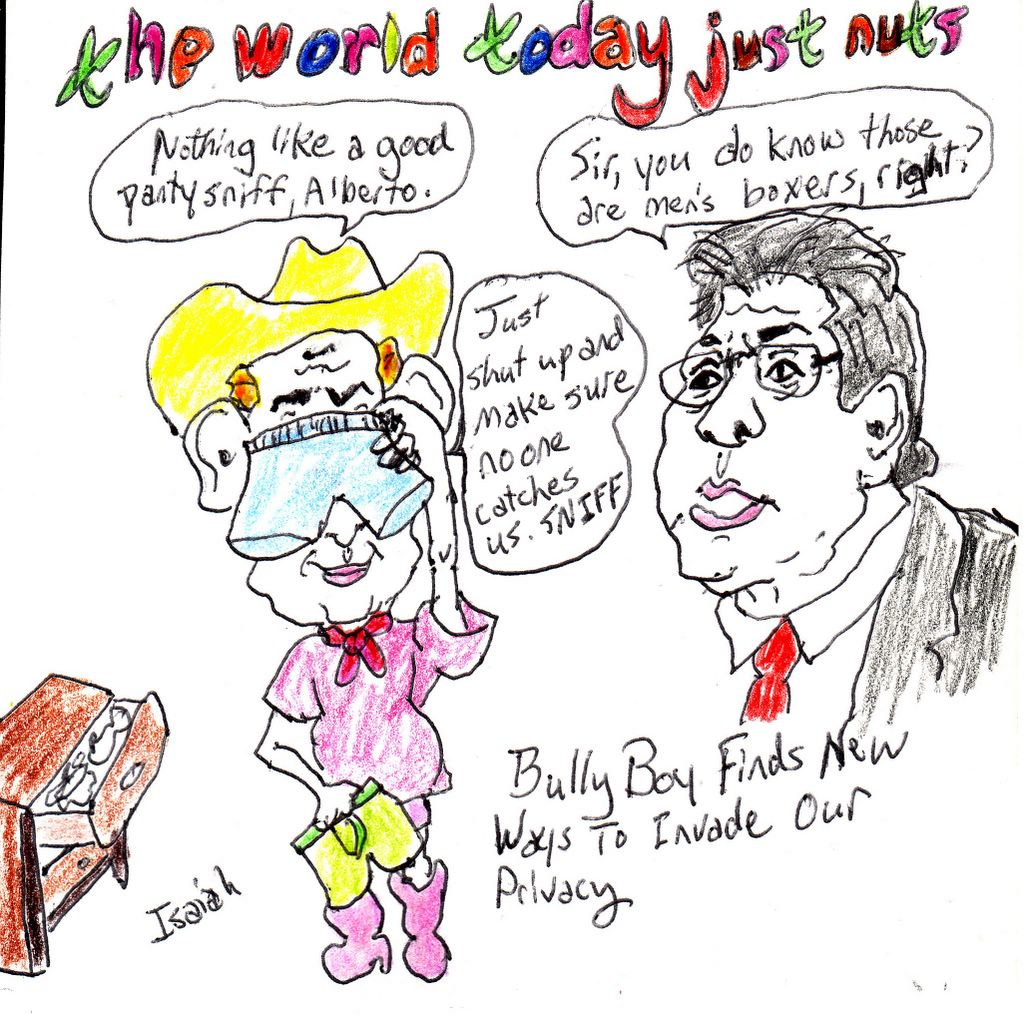
Bully Boy Finds New Ways To Invade Our Privacy


That's one I remember. How come? Because I laughed when I got the idea and it's one that I will see when I'm trolling the web. This one ended up at other sites. And not like the idiot who reposted my comic without permission in 2005 and wrote that nasty thing about how he didn't usually like my comics but this one he did.


Uh, thanks to you piece of chicken s**t from Australia who wouldn't call out your own ruler (John Howard -- a War Hawk who sent Australian troops to Iraq) but was so 'brave' that, from Down Under, he could call out the US. I hated that guy, I still do.

But this comic was hugely, hugely popular. It went up June 25, 2006 and I still get e-mails on it. It was perfect because it captured how invasive that administration was.


Isaiah's latest The World Today Just Nuts, "Bully Boy Finds New Ways To Invade Our Privacy." Bully


And here's C.I.'s "Iraq snapshot:"

Thursday, March 11, 2010. Chaos and violence continue, counting ballots continues, breast cancer is on the rise in Iraq, the US Congress hears about problems veterans face as small business owners, and more.
This morning, US House Rep Stephanie Herseth Sandlin chaired the House Veterans Affairs' Subcommittee on Economic Opportunity. The hearing revolved around the Center for Veterans Enterprise. CVA, the VA explains, "is solely dedicated to assisting veterans in starting and building businesses."
In her opening remarks, Chair Herseth Sandlin explained, "As many of our witnesses will testify, small businesses are an essential component to a strong economy. This Subcommittee has held several hearings on the challenges faced by our nation's veterans seeking to start and develop a small business. We have also heard from many members of the National Guard and Reserve components who find it challenging to maintain their small businesses when called to active duty. I want to assure our panelists that this Subcommittee will continue to work to remove barriers that prevent veterans from accessing the services that may help them succeed in their small business venture."
Ranking Member John Boozman noted that Herseth Sandlin and he had "worked on creating additional tools for VA to meet and exceed the contracting goals for disabled veteran owned small business in the 109th Congress. The results of our efforts culminated in Sections 502 and 503 of Public Law 109-461. I believe it is fair to say the passage of that law was viewed very favorably by veteran small business owners. Unfortunately, we have a situation where VA appears to be dragging its feet in implementing one of the very important provisions of that law and that is establishing a data base of veteran and veteran-owned small businesses whose status as a veteran-owned small business has been verified by the VA. In other words, the only companies that should be viewed by someone searching the database are those which have been vetted by VA. Unfortunately, that is not the case. As you can see on the monitors -- we're really high tech today -- we've accessed the VA's vendor information pages database of veteran owned businesses. Although the law clearly limits the businesses listed in the database to those whose veteran-owned status has been validated by the VA, the monitor clearly shows businesses that have not been validated. VA staff notes have pointed out that the little reflow notes a veteran-owend business. I don't know about you, but it's hard to view that as satisfactory to separate the verified from the unverified. [If you click here, the "(-)" -- red dash in parenthesis is what he's pointing to.] First of all, there's no legend that identifies the symbol as meaning the company has been verified. For example, in the screen shown here, seven of the ten businesses listed have not been verified."
Boozman noted that it is three years after the passage of the law and VA has not followed it. The database was supposed to allow others to utilize it to ensure support for veteran-owned small busineses and that, unless verified by VA (as the law mandates), no business should be listed. Boozman added, "VA has presented Congress with four budges since this became law and to my knowledge not any of those budgets requested any additional resources to comply with the law." He spoke of the millions that veterans have lost out on due to fraudlent businesses posing as veteran-owned and disabled veteran-owned when they weren't.
The first panel appearing before the Subcommittee was composed of National Veteran-Owned Business Association's Scott Denniston, Paralyzed Veterans of America's Richard Daley, Vietnam Veterans of America's Richard F. Weidman, the American Legion's Joseph C. Sharpe Jr. and American Veterans' Christina M. Roof. Roof noted, in her opening remarks, that their complaints appear to have been ignored, that they haven't been listened to at CVE.
Chair Stephanie Herseth Sandlin: If CVE has become overwhelmed by the verification process, and I think others of you have talked about in terms of resources, training -- can you provide us with more specifics about what you think the requiste resources need to be, what type of contractor support does CVE need to be successful and maybe an overarching question should CVE -- should that office be formalized by statute? I think someone had testified to the importance of a separate line item in the budget but any -- a question for any of you.
Scott Dennison: I don't know that it needs to be necessarily set in statute, the office itself. I do believe that it needs a line item for the budget for the reasons that all of us on the panel have discussed. I think that the issue of resources -- in the beginning, when we started the verification process with CVE, we knew that the initial challenge was going to be to take care of that first bubble of applicants. At that time, I think we had 12,000 people in the database. And we always felt that we needed contractor support for that, to help with the administration of the applicants themselves to do some of the site visits that we had planned. And then the goal always was to be able to maintain that once we got over the initial hump with VA staff. And, as to the resources that were going to be necessary to do that. We didn't really have a firm handle on that because this was new territory to all of us but we did make some projections as to what they should be and, as I think I mentioned in my testimony, some of those resources were in fact approved about 18 months ago. To my knowledge, they haven't been forthcoming and I can't answer that.
Chair Stephanie Herseth Sandlin: And they were approved by the Board of Directors of this --
Scott Dennison: The supply fund, right.
Chair Stephanie Herseth Sandlin; The supply fund, okay.
Richard Weidman: We believe that it should be enacted in the statute. If it's worth doing, it's worth doing formally and it should be a line item. And we would also suggest that while they may be in charge of verification that's not their primary role. If you view the service-disabled veteran program as a program, it needs to be built in and encouraged by VA VOC Rehab and perhaps some changes in that section of Title 38. There's no reason why we can't bring back the old loan fund that's still been on the books since 1994 for start up capital if, in fact, people have a solid business plan. I mean there's -- Mr. Buyers introduced legislation to do that and we strongly support that. And it can become a locus. I believe that Mr. Dennison is absolutely correct: You can't do business development in South Dakota from Washington, DC. But you darn sure can find out who is the people in South Dakota either at the small business development center, at the state economic development work with the County Executive Associations which does have an office in Washington, DC to find out who do they have in economic development that you can send service disabled and other veteran owned businesses too. That should be the primary purpose. In terms of contracting out, as I mentioned before, the veteran verification really only needs to be done once. You can double check if somebody's service connected but even that doens't go away. Since there's no minimum threshold to be declared a service-connected disabled vet, once you're service-connected, you're service-connected. It might go down to zero if your cancer goes into remission but you're still a service-connected disabled vet. So you only need to do that once and frankly you can do that through automated comparisons of that individual to the databases that VA already has or has access to at DoD through the interagency agreement. [. . . -- ]
Christina Roof: If I may I just want to, Rick, you said something that, it's really been bothering me and a lot of our members. The hinderance of the re-certification on an annual basis? We've all sat up here and said "We need tougher certification processes in place." And I -- we still all believe that but this is not the best way to go about it. We already have a backlog of nine to twelve months to get original certification. So when should -- If I was a service disabled veteran -- when should I reapply for my next year's certification? Three months after I apply for the first one? Just so I make sure there's not a gap there. And also, it's almost seems unfair that veterans aren't being provided the equal protections under the law and they're made to do this extra work. So I'm hoping that maybe the next panel can shed a little light on this for us. Of what the thought behind this recertification every year would do and how they plan on handling on it because I know our membership would really like to know. Thank you.
The other panel was the VA's Tim J. Foreman (with backup singers Iris Cooper, Philipa Anderson). For reference, the first panel raised the issue (especially Roof) of how the VA would allow a small business veteran owner to only list one of his/her businesses in the database. They did not feel this was fair or needed. The Chair raises the issue with Foreman.
Chair Stephanie Herseth Sandlin: Thank you, Mr. Foreman. When did you formally take over this position.
Tim Foreman: About seven weeks ago.
Chair Stephanie Herseth Sandlin: And you were with the Department of Defense before that?
Tim Foreman: That is correct, ma'am. I did retire from the Department of Defense but people approached me before I retired and said, "Are you interested?" I said, "I have a passion for this program. I know the vets. I have worked with them. I have many friends. I'm a veteran." So.
Chair Stephanie Herseth Sandlin: So what are your initial thoughts about some of the testimony you heard on the first panel?
Tim Foreman: Well some of them I happen to believe are true.
Chair Stephanie Herseth Sandlin: Do you agree that there may be an unreasonable limit on one business being listed?
Tim Foreman: I'm sorry?
Chair Stephanie Herseth Sandlin: Do you agree with the general sentiment of the first panel that it's an unduly restrictive limit to only allow one business to be listed by a service connected disabled veteran.
Tim Foreman: You know, when I read that, before I ever talked to anybody, it was just by myself, and I went through that and I questioned right then and there because I own a business. I inherited a business and I have seven brothers -- none of them want to do any business with it, so they give it to me. I'm 500 miles away running a golf course. I am not there full time. But I hire, I fire, I do policy, I work with the advertising, I work with the lawyers --
Chair Stephanie Herseth Sandlin: You have effective control and ownership.
Tim Foreman: So I have effective control. and I'm not there. If you want me to be wearing an apron and flipping a burgers out in the eighteenth hole well that's a different issue. I think that's a little bit tight. So that's just a personal opinion. I tell you, I do have a great staff. I mean the energy there, the passion is there, the brains are there. What I think I need to do is bring some things together and I think I can make it happen. We've already started hiring 3 new people for the Center Veterans Enterprise, so that's happened. I brought in one person so far. We've got another one that might come in and I'mt rying to hire a third. So both sides of the house are growing. The limitation at this point is not the people, it's where we're going to put them.
In his testimony, he noted that he had spoken with the Inspector General about fraud that had been outlined but he had been asked not to speak of his testimony.
.
As Ann noted last night, Deborah Amos was a guest on Fresh Air (NPR -- link has audio and text option) yesterday. Ann observed, "Big problem I had with Amos? The Shi'ites were backed by the US. They were put in charge. Sunnis making that claim were not suggesting anything outrageous and I have no idea why she'd want to pretend that they were." That's an important point. Amos blames the 'civil war' (ethnic cleansing to others) on the Sunnis. Why? She has no proof. But that's who she blames it on. She says that Sunnis "started the sectarian war. They felt that the Ameircans had sided with the Shiites when they came into the country." That's exactly what happened -- it's not what Sunnis say happened, it's what happened.
The Americans underscored the split by setting up centers for Iraqis to report to and they divided them by asking, "Are you Sunni or Shia?" Many Iraqis have spoken of that and have spoken of how, for them, it was the first time they remember the question being put to them by some authority type. The split was underlined and underscored by the US. Equally true, who got put in charge by the US?
Deborah knows the answer to that: ". . . the Shias are in the majority in Iraq. And the second thing is they had government institutions. They were the head of the interior ministry, the defense ministry, and so they had militias in government uniforms, in police uniforms, and they went after the Sunni community very seriously as did the militias that were not tied to the government." It is not speculatin that the US sided with the Shia, it is reality. This is a good time to note Qais Nawwaf (CounterCurrents) refuting a column by Paul Craig Roberts:
Even if we were to assume Iraq's Muslims aren't united enough for Roberts' taste, he seems to have ignored the USA's critical divide-and-conquer role in Iraq. He doesn't appear aware of the USA's deployment of Shii and Kurdish troops to battle Sunni cities, such as Fallujah in November 2004. He ignores the USA's political and financial support of sectarian parties, politicians and clergymen.
A stronger section of the interview follows (Terry Gross is the host of Fresh Air):
GROSS: A lot of Iraqi exiles have gone to Syria. You point out in the book it's the only remaining Baathist regime in the world. So there's a lot of Sunni in the country. So Sunni exiles from Iraq have the potential of feeling comfortable there. But for the exiles in Syria, they're not allowed to work. Why aren't they allowed to work?
AMOS: They aren't allowed to work any place they go. This is not just a Syrian rule. It's in Jordan. It's in Lebanon. It's everyplace they go in the Middle East: Egypt, Turkey. Refugees really can't work in those communities because those communities are having their own problems with enough jobs for their own population, although there is plenty to do in the gray economy. Mostly, it's the kids who work. You can get a job putting charcoal on a narguila(ph) at a restaurant. You see little boys doing that in a lot of places. You can put you 14-year-old out to work in a factory. And many, many of the women have turned to what's called survival sex, and I spent plenty of time with Iraqi prostitutes, women who were not prostitutes when they left the country but turned to it because it was one way that you could support your family. And when you arrive as a single, female-headed household - and about one-quarter of the exiles in Damascus are in that category - and you have no skills and your family is not going to support you because you almost - most likely have come from a mixed marriage. You're a Sunni who'd been married to a Shiite, so your family is no longer going to support you and his family is not going to support you - you turn to survival sex.
GROSS: You interviewed one person in particular who admitted that she was into that. You knew other people who did but wouldn't necessarily admit it. And you went with this woman to a club where, basically, men find prostitutes. And I'd like you to describe, first of all, her physical transformation when she went to the club with you.
AMOS: Well, I had met her at her home. We had been - I had an introduction from a translator from Iraq. And the first time I saw her was at 11 o'clock in the morning, and she had on a chartreuse track suit, velour, runny makeup, her hair up in a ponytail, cracked fingernails, and, you know, she looked like she'd had a very hard night. She eventually invited me to come to her favorite nightclub, and we met at midnight, and I didn't recognize Umnor(ph). She looked fabulous. Her hair was as shiny as a horse pelt, tons of mascara, big ruby lips. Her fingernails were long and red and a very black, clingy pair of pants. I would have walked by her in the street.

Deborah Amos is a reporter for NPR, she's written a new book, Eclipse of the Sunnis, and the first chapter is available online and the Fresh Air staff have paired some links to her previous reporting for NPR on Iraq with that. We noted Amos' comments on some Iraqi women and we'll stay with the topic of Iraqi women because the American Association for Cancer Research has issued a release noting that breast cancer rates in Iraq continue to move upwards and, of the group diagnosed with cancer, "Although 90.6 percent of women detected a lump on self-examination, only 32 percent sought medical advice within the first month. Because of this, 47 percent of them presented with advanced stage breast cancer, either stage III or IV cancer."
Turning to elections, Facebook. Really? Maj Gen Anthony Cucolo shares at Facebook:
"It's a little after 2200 hours, we still have QRFs out across the battlespace with some tired Marne Soldiers making sure their Iraqi counterparts get those ballots to the security of the ballot warehouses (where more tired Marne Soldiers are with their Iraqi partners guarding the warehouses -- at the request of the Iraqi government)...
It was a great day -- our most dangerous place -- Ninewa -- was declared by Al Jazeera midday today, "The safest place in Iraq to vote..."; the enemy threw everything they had at our Diyala Province -- 66 different events (IEDs, attacks, indirect fire)...and of 36 direct attacks, only 4 caused any damage or casualties...the Iraqis stepped up, kicked butt, and the citizens walked right thru it...
Voter turnout numbers still coming in, but it looks like 60 - 70 percent overall...and remember, this is the first time they are voting for PEOPLE, individual candidates, and not some party or list...
Democracy lives in the Middle East...I am proud of these people and our Soldiers.
Rock of the Marne!
Marne 6"
Accompanying his post is a photo of an Iraqi male -- are we suprised -- showing his ink-stained finger (indicated he's voted) while a woman is behind him and the photo cuts off her head -- are we surprised? The US military likes to throw a lot out there, don't they? The brass always hopes something sticks. Ernesto Londono (Washington Post) reports that, privately, they are admitting that Sunday was plagued by violence despite attempting to Operation Happy Talk the violence away, "But the military has since concluded that at least 30 of Sunday's attacks, which included bomb blasts, rocket attacks and small-arms fire, killed or wounded people. A U.S. official provided the data to The Washington Post on the condition of anonymity because it is at odds with the public statements of senior military officials."
Ahmed Rasheed, Rania El Gamal, Aseel Kami, Waleed Ibrahim, Jim Loney and Ralph Boulton (Reuters) report ballots continue to be counted in Iraq. Marc Santora (New York Times) notes preliminary results which indicate that it is "an exceedingly close race." Which would normally indicate that it's too close to make calls. So we'll wait until more votes are counted (30% of the vote really shouldn't be released, that's beyond laughable). Santora notes the madcap cut-up Ahmed Chalabi is demanding candidates see the tallies before the public does. No, Chalabi doesn't even pretend to embrace democracy. Leila Fadel (Washington Post) reports some Sunnis are very nervous about the outcome and that one man she spoke with is planning to leave Iraq as a result of the 'early release' or 'early figures' on the voting (which Fadel notes is only a partial count of four provinces in Iraq).
Turning to some of today's reported violence . . .
Reuters notes a Baghdad roadside bombing injured two people and, dropping back to Wednesday for all that follows, 2 Iraqis were shot dead by US and Iraqi forces, a Mosul roadside bombing left two people injured and a police officer was injured in two Mosul roadside bombings.
Figure out the phrase, solve the puzzle and meet B___ C___ P____ Nathan Hodge and his bad article at The Nation. Read it and feel informed if partial truths are what you want. If reality is what you want, grasp that either Hodge is lying to you or The Nation made him lie. Michele Flournoy? I personally know that little War Pusher. We've called her out repeatedly. He identifies her as one of two "former Clinton administration officials" at CNAS and then mentions, much later, that she's number three at the Pentagon. Apparently, she installed herself?
What the chicken s**t Baby C___ P____ can't or won't tell you is that Barack picked her for the position. They're still covering up for War Hawk Barry, the man they lied to install, at The Nation. And they have their own problems so you can't get an honest accounting of Michele and other's entry to Obama -- which started long before 2007. As usual, when there's a foul stench, look to Sarah Sewall and Samantha Power. Obama's installed Hawks and that's only a surprise if you're a Nation reader where Power's always been allowed to present as a voice of peace -- she's even allowed to lie and pretend she was against the Iraq War. The Nation refused to do articles on Barack's inner circle -- despite one attack on Hillary's people after another. Michele supported Barry's presidential campaign and was part of the 'inner sanctum' along with many, many other War Hawks. Not only did The Nation refuse to tell you about it in real time but today they write an article that makes it appear Michele Flournoy ('former Clinton official') either installed herself at the Pentagon or has held that position since the Clinton era. No, Barack gave her that position. But The Nation can't stop lying.
Baby C___ Pants wants to act like he's done something special when all he's done is write yet another cover up for a War Hawk. It's getting really damn old and, truth be told, if Katrina wasn't pissed that she and her father (and the Roosevelt Institution which they run like a private club) were shut out of the administration, Hodges article wouldn't even be running as weak as it is.
Liars like Tom-Tom Hayden want to scratch their heads and appear puzzled when they notice a War Hawk around Barack -- act like it's surprising. It's not surprising at all. When Barack brought War Hawk Samantha Power onto his Senate team in 2005, where he stood on the issues was immediately clear. (Poor Dumb Tom Hayden. Barack kept insisting -- sneering -- that he was't "one of those Tom Hayden Democrats" and even then stupid couldn't buy a clue.) Tom showed a tiny bit of bravery at his blog some time ago when he called out the War Hawk Factory that is the Carr Center at Harvard. In the many, many years since, he's not done a damn thing on the topic nor has The Nation magazine. If half-truths and evasions make you feel informed, pick a copy of The Nation. If reality's what you want, grasp that independent media does not serve you and Ava's saying right now that she and I are addressing that at Third this Sunday, we'll do a piece on Pacifica, a walk-through of how "Peace" Radio ensures that no peace will ever come about. March 20th, many organizations, groups and individuals will be participating in the march for peace in DC, San Francisco and Los Angeles. For more, you can refer to Debra Sweet's "Why Protest on March 20?" (World Can't Wait):

A week from Saturday, protests are scheduled for Washington, DC; LA; San Francisco, and smaller cities around the country. I'll be in DC, helping to surround the White House as the ANSWER coalition notes on March20.org: Anti-War Leaders: "Why I am Marching on March 20"
"Visible protest-marching to stop the crimes of our government-makes a difference because we show what we won't accept, and we learn what we're up against. These wars are not legitimate. People around the world must see that we don't support them, and know that to us, American lives are not more important than their own. Join World Can't Wait Saturday March 20 in protest..." Read more
What about you?
► Publicize and find flyers for your March 20 protests.
► Volunteer for a "We Are Not Your Soldiers!" contingent in the Washington, DC march.

BOSTON -- Senator John Kerry today announced his support for the Military Readiness Enhancement Act (S. 3065).

The Military Readiness Enhancement Act contains three main provisions: it will repeal the law that prevents gay Americans from openly serving in the military, prohibit discrimination against current and prospective service members on the basis of sexual orientation, and promote the ability of college students who wish to serve our country to join Reserve Officer Training Corps units at universities that currently prevent the establishment of ROTC units on campus.

"We're overdue to wipe away the last stain of legal discrimination in our Armed Services," said Senator Kerry. "Gays and lesbians should not have to hide who they are to be able to serve their country. President Obama, Admiral Mullen, Secretary Gates, former Secretary Powell, and -- most importantly -- our troops are speaking out, and it's past time we listened."

The bill was introduced by Senators Joseph Lieberman (I-CT) and Carl Levin (D-MI) and has the support of 22 additional Senators.

Lastly, TV note. NOW on PBS begins airing Friday on most PBS stations (check local listings):
Two men on a remarkable journey high in the Himalayas investigate
threats to global water and food supply. Next on NOW
change will cause some of the world's largest glaciers to completely
melt by 2030. What effect will this have on our daily lives, especially
our water and food supply? With global warming falling low on a national
list of American concerns, it's time to take a deeper look at what could
be a global calamity in the making.

On Friday, March 12 at 8:30 pm (check local listings), David Brancaccio
and environmentalist Conrad Anker -- one of the world's leading
high
altitude
climbers - trek to the Gangotri Glacier in the
Himalayan
Mountains
, the source of the Ganges River, to witness the great melt and
its dire consequences first-hand. The two also visit Montana's Glacier
National Park to see the striking effects of global warming closer to
home and learn how melting glaciers across the world can have a direct
impact on food prices in the U.S.

Along the way, Brancaccio and Anker bathe in the River Ganges, view a
water shortage calamity in India, and see with their own eyes and
cameras the tangible costs of climate change.

"We can't take climate change and put it on the back burner," warns
Anker. "If we don't address climate change, we won't be around as
humans."

Visit
http://www.pbs.org/now/shows/516/ right now to watch an extended
hour-long version of the program, and to access David's 12-day
photo-filled travel journal from their trek.


Read on ...

Thursday, March 4, 2010

Playful Bully Boy


That's "Playfull Bully Boy" from June 18, 2006.


What I like about the drawing? The kids toys. Condi and Dick in the background.

What I dislike? I think I'm going to need to get the original saved draft versions and upload them to Flickr. How come? I remember that comic. And it's not supposed to be so blurry. I'm thinking now that "Hello" (the program I was using back then) is going to eventually just stop displaying the pictures.
And here's C.I.'s "Iraq snapshot:"


Thursday, March 4, 2010. Chaos and violence continue, lies continue about Iraq (so we unpack the days when David Corn couldn't stop screaming), only one network made time for the bombings in Iraq yesterday, and more.

Starting with the
CBS Evening News with Katie Couric from yesterday:

Katie Couric: Now turning to Iraq which holds Parliamentary elections on Sunday and insurgents are doing everything they can to disrupt them. Today there were three suicide attacks in Baquba, northeast of the capital. At least 32 people were killed, 55 others injured. From Baghdad tonight, here's Elizabeth Palmer.

Elizabeth Palmer: With three days to go before the Iraqi election, this is the violence everyone was dreading. Two suicide bombers detonated their explosive packed cars outside Baquba's police stations wrecking lives, buildings, cars and water mains. Then authorities say a third bomber rode in an ambulance to the hospital and waited until he was surrounded by the wounded before blowing himself up. Almost 19 million voters are eligible to head to the polls on Sunday to elect a 325 member Parliament but election fever here is tempered by election fear. Everyone remembers the huge truck bombs last fall in the heart of Baghdad that killed more than 150 people. Extremists have promised more violence to disrupt the political process so the government is running TV ads warning that so-called criminals are plotting mass murder and asking people to be hyper-vigilant. And on the street, security forces with extra patrols and check points are working hard to set the stage for an election that if it goes smoothly will reinforce Iraq's indepedence and stability. Not only that, if all goes well and a new Iraqi governemnt takes power in a peaceful transition that will allow 46,000 US combat troops to begin their pull-out almost immediately. Elizabeth Palmer, CBS News, Baghdad.

You can click here to watch the segment. NBC Nightly News had time for "Comic Relief" -- 'reporting' on a web video. A video which they refused to air. They reported on it, refused to air it. It advocates for something (consumer rights), Brian Williams explained. But, having wasted all of our time with the report, he then went on to plug the Nightly News website. Nightly News didn't think they should broadcast it . . . on TV but they were happy to broadcast it online. So Brian Williams used air time to self-promote while Diane Sawyer, over at ABC's World News had time to plug for Dominos. It only takes a second to note Domino's 4th quarter but if you're also doing an advetorial for them, you include plenty of shots of pizza and claims that their new ad campaign was responsive to the people and . . . Well, it doesn't leave you much time for actual news. For more on yesterday's bombings, you can see this article by Marc Santora (New York Times).

Bombings targeted Iraq again today.
BBC News reports two voting centers in Iraq were targeted with suicide bombings. BBC's NewsHour states it is believed that the bombings were attempts at targeting soldiers who were voting today (early voting which means voting began on the 4th and not ont he 5th as I had repeatedly stated -- my error and my apologies). Khalid al-Ansary, Waleed Ibrahim, Fadhel al-Badrani, Mohammed Abbas, Khaled Farhan, Sherko Raouf, Mustafa Mahmoud, Ayla Jean Yackley, Jack Kimball, Aref Mohammed, Alistair Lyon and Andrew Roche (Reuters) note 12 dead in the two bombings and a third explosion with 35 police and soldiers left injured and 22 civilians wounded.

Sahar Issa (McClatchy Newspapers) reports a fourth Baghdad bombing, a sticky bombing, which left one person injured and a Nineveh Province home bombing which injured two women and the home belonged to "Nawaf Saadoun Zaid, head of Unity of Iraq Coaltion in Nineveh (the coalition is headed by incumbent interior minister Bolani)".


This morning on the first hour of NPR's
The Diane Rehm Show, USA Today's Susan Page (guest host) spoke with Nancy A. Youssef (McClatchy Newspapers), Lawrence Korb (Center for American Progress) and former reporter Thomas E. Ricks about Iraq elections.

Susan Page: You know, here's an e-mail we've gotten from Tommy from Raleigh, North Carolina. He writes us, "For all my hope in 2008, I'm becoming disillusioned. Senator Obama campaigned against the war in Iraq. He promised that if he were elected, he would end the war and bring home the troops. More than a year into his presidency, he's failed to keep his promise. Since he hasn't kept even easy promises with easy time frames -- such as closing Gitmo within a year -- why should we believe his currently promised timetable for pulling out of Iraq?" You know, I'm not sure closing Gitmo was such an easy promise but, Tom, you know this message from Tommy is one I expect we would hear from any number of Obama voters.
Thomas E. Ricks: Well, Tommy, I would say you shouldn't believe cause I don't think it's going to happen. I think we're going to have several thousands, several tens of thousands US troops in Iraq on the day President Obama leaves office.

Susan: And --

Lawrence Korb: Let me say something about Obama. He promised to get the combat troops out so I think evidently a lot of people didn't read the platform and he also said he was going to increase the presence in Afghanistan. Those were part of his campaign promises --

Susan: Well he did say combat troops but I don't think that was the message that people heard.

Lawrence Korb: I understand. A lot of people thought "Elect Obama, you're out of Iraq and wind down in Afghanistan, we can get back to dealing with the problems at home." There's no doubt about that. But, again, I think that he did say combat troops.So far --

Thomas E. Ricks: I hate that phrase combat troops. There is no pacifist wing of the Marine Corps or the 101st Airborne. And I think it's effectively a lie to the American people. When they hear "I'll get combat troops out," what they hear is "No more American troops will die" -- and that is blatantly untrue. And I think the sooner the president addresses that, the better for him.

Susan Page: And we had Vice President [Joe] Biden say just the other day that while we're going to withdraw combat troops, the troops that we leave behind are guys who will be able to shoot straight -- in other words, people who could instantly be made into combat troops if the circumstances require that. What do you think about that, Nancy?

Nancy A. Youssef: Well I think it has to -- the broader question becomes: If Iraq does break into some level of violence, what is the role of the 50,000 troops there? Do they sit idly by? Do they let -- do they intervene? Do they put themselves in harm's way? And what can 50,000 troops do? We -- At the peak, there were 172,000 troops to bring down the sectarian violence. What can 50,000 troops, who aren't supposed to be doing combat, really do? It's going to be a difficult predicament at that point if-if in fact some level of violence returns.

Lawrence Korb: I think Vice President Biden was also trying to say that we can protect our own troops because, again, you get back to the question of casulties, yes, we have 50,000 but this not, you know, a group of people who can't do anything so if anything happens and they come after us we can protect ourselves.

We included Korb's crap and that last statement by him above was nothing but crap. He needs to stick to reality and now what he wishes would be said. That's a huge problem for Korb. Asked a direct question by a caller who said she'd take her answer off the air, Korb declared, "I do think the real question she was raising . . ." Her question was basic: Iraq currency. She most likely asked it because of the currency switch prior to the Iraq War. But Korb always knows best and ignored her question. Korb's a damn idiot.

Helene Cooper and Mark Lander (New York Times) are the reporters Biden spoke to:

But administration officials also acknowledged that the bigger worry for the United States was not who would win the elections, but the possibility that the elections -- and their almost certainly messy aftermath -- could ignite violence that would, at the least, complicate the planned withdrawal.
In part for that reason, "we're not leaving behind cooks and quartermasters," Vice President Joseph R. Biden Jr. said Wednesday in a telephone interview. The bulk fo the remaining American troops, he said, "will still be guys who can shoot straight and go get the bad guys."
Gen. Ray Odierno [. . .]

Nancy Youssef and Susan Page were interpreting it correctly. Lawrence Korb is the idiot who can't listen. Which is rather telling, isn't it? Freud wrote of the criminal's compulsion to confession and when you combine that with projection, you understand a passage excerpted above that we'll again note:

Lawrence Korb: Let me say something about Obama. He promised to get the combat troops out so I think evidently a lot of people didn't read the platform and he also said he was going to increase the presence in Afghanistan. Those were part of his campaign promises --

Susan: Well he did say combat troops but I don't think that was the message that people heard.

Lawrence Korb: I understand. A lot of people thought "Elect Obama, you're out of Iraq and wind down in Afghanistan, we can get back to dealing with the problems at home." There's no doubt about that. But, again, I think that he did say combat troops.So far --

Lawrence Korb is blaming the American people. They're just too stupid, he politely says, to know what's what. Barack said "combat troops." Did he, Larry? Did he you piece of s**t, Reagan reject?

Ava, Kat and I were speaking on campuses to groups truly opposed to the illegal war and we would have to unpack that lie daily. And we caught him saying it at two events: "We want to end the war now!" At his little praise tent circuses, his little "Oh Come Let Us Adore Me" events, he would say that. And the crowd would go crazy. Men and women would tear up. Barack damn well knew what he was doing and Larry Korb needs to stop lying. I know that's hard for Larry, but he needs to stop.

We're not even at the distinction of "combat troops" right now. We're at the reality. And Larry wanted to 'correct' the listener didn't do much of a 'correction' did he? Did Barack break his campaign promise:All together: "YES HE DID!"

The campaign promise was one brigade a month out of Iraq on his first day in office. That was the promise and that promise was broken. Larry's a damn liar. And I'm damn well not in the mood. In the
Friday, March 7, 2008 snapshot, we noted:

Obama still lacks the leadership to take control of his campaign -- that would have required firing Power. Instead she resigned indicating that he's unable to run a campaign as well as unable to tell the truth. Power -- who also went to work for Obama in 2005 when he was first elected to the US Senate (November 2004) -- also had to deal with
the BBC interview she'd given. Barack Obama has not promised to pull ALL troops out of Iraq in 16 months. He has promised the American people that "combat" troops would be removed. But promises, promises (as Dionne Warwick once sang) . . .

Stephen Sackur: "You said that he'll revisit it [the decision to pull troops] when he goes to the White House. So what the American public thinks is a commitment to get combat forces out within sixteen months, isn't a commitment is it?"

Samantha Power: "You can't make a commitment in whatever month we're in now, in March of 2008 about what circumstances are going to be like in January 2009. We can'te ven tell what Bush is up to in terms of troops pauses and so forth. He will of course not rely upon some plan that he's crafted as a presidential candidate or as a US Senator."

Which would mean Mr. Pretty Speeches has been lying to the American people. (Add the "AGAIN!")
Her rise was swift, her fall even faster. Our Modern Day Carrie Nations took part in the "Bring the troops home and send them to Darfur" nonsense. [For more on that nutso crowd, see Julie Hollar's "
The Humanitarian Tempatation" (Extra!).] Despite presenting herself recently as against the Iraq War from the start, the public record has never backed that up. But it is true that she wanted wars in Africa and was selling them under "humanitarian" guise. "Stop the killing!" she cried but if she really wanted to stop the killing, she might have tried to speak out against the ongoing genocie in Iraq (which has also produced the largest refugee crisis in the world). She didn't care about that. Probably because it demonstrates that sending armed forces in is not an answer. Again, if Barack Obama had any leadership abilities, he would have announced today that he fired his longterm advisor. He did not, she resigned. (She foolishly doesn't grasp that this is her Alexander Haig moment and there is no comeback.) Power was not a campaigner, she was a high level, longterm foreign policy advisor being groomed to be the next Secretary of State. As Krissah Williams (Washington Post) notes, Senator Clinton's response to Power's BBC interview was to note Power's agreement that Obama's pledge to have "combat" troops out in 16 months was never more than a "best-case scenario". Hillary Clinton: "Senator Obama has made his speech opposing Iraq in 2002 and the war in Iraq the core of his campaign, which makes these comments especially troubling. While Senator Obama campaigns on his [pledge] to end the war, his top advisers tell people abroad that he will not rely on his own plan should he become president. This is the latest example of promising the American people one thing on the campaign trail and telling people in other countries another. You saw this with NAFTA as well."

An explosive bit of news in the middle of a campaign. The Washington Post reported on it, the Boston Globe as well. And the rest? Two days later at Third we offered, "
Editorial: The Whores of Indymedia" which noted:

So determined to not only avoid the reality but also smear Hillary Clinton, Air Berman (The Nation) spent Friday digging through Meet The Press transcripts. The allegedly anti-war Nation magazine has yet to tell their online readers of the revelations broadcast on BBC. Truthout, so quick to editorialize that Hillary Clinton should drop out of the race, has no story up about the revelation. BuzzFlash is working overtime to smear Hillary Clinton but has nothing to say about Bambi's Iraq realities. Common Dreams is avoiding the subject as is The Progressive, CounterPunch, Truthdig, go down the list. All have time to smear Hillary, none have time to tell the truth about Bambi's 'pledge.' Where is Tom Hayden! Remember when Americans Against the Escalation (or whatever the name of that faux grassroots 'movement') imploded? There was Tommy, mere second later, writing about it online at The Nation. A call to the magazine got the story pulled but it resurfaced a day later, on Sunday, in a slightly different form with an additional note tacked on. Certainly Bambi's non-pledge is as important as the implosion of a non-peace group.

They ignored it. In fairness to Tom Hayden, July 4, 2008, he suddently discovered the Samantha Power BBC interview and wrote about it for the first time. And then he claimed the media ignored it (Boston Globe and Washington Post covered it) and that Hillary's campaign ignored it. Tom-Tom's a damn liar. Hillary's campaign called it out the day of, they issued press releases the following Monday (BBC aired the interview on a Friday), they talked about in conference calls with the press. Do you know the reaction? Andrea Mitchell laughed. Now maybe she was laughing at David Corn who exploded and started yelling and called it dirty politics for the Hillary campaign to bring it up. There was no doubt in anyone's mind who 'reporter' David Corn was supporting. His tantrums, his attacks, his threats, his non-stop errors made it very, very clear. If Tom-tom wants to blame-blame, he can take it up with David Corn who did more than anyone to kill that story. He shrieked like a banshee. No one was ever more shrill. David Corn turned every press conference into a performance piece and it was appalling.

Why does it matter? It matters because that's how reality got buried by the press -- especially Panhandle Media which Korb's organization is a part of. (Panhandle Media has to beg for money -- Pacifica, for example -- because they can't make it any other way. They're the bums on the street corner.) Don't you dare blame the voters. The voters were never told about Power's interview. Panhandle Media wouldn't allow it. (Amy Goodman, the Queen of Beggar Media, never covered it on Democracy Now!) Those liars, passing themselves off as objective and truth tellers, are the ones who deceived the American people. It's why they ignore the Iraq War now. Because there's lots of blood on their hands.

Don't you dare blame the voters when the press -- All Things Media Big And Small -- worked overtime to give Barack one excuse after another. And when they could join thousands of others in the Cult of St. Barack and hear the Christ child proclaim, "We want to end the war now!" At his revival meetings, he said "NOW!" No, he thundred, "NOW!" Speaking to the New York Times, he said "combat troops" -- and like Ricks, Michael Gordon called that nonsense out and did so to Barack's face. Ricks' finest moment was the section excerpted. Nancy A. Youssef had many fine moments (and we may grab another tomorrow). Lawrence Korb was a non-stop embarrassment including his ridiculous claim on Afghanistan that "they" wanted "us" to invade. Did they? That's not how I remember and I really doubt that's how history will.

Before we move on to the elections, Susan Page noted on air that The Diane Rehm Show had won the Shorty Award for brief news for
their Twitter Account and that Diane thanked all the show's Twitter followers. So congratulations to Diane and her crew on their award.

Voting began today in Iraq. It concludes on Sunday with the official day for elections. In addition to voting in Iraq, 16 other countries will have polling stations due to Iraq's refugee crisis.
Stephen Starr (Asia Times) reports on the voting in Syria (which starts tomorrow) and notes that "candidates see rich pickings both there and in Jordan." Tuesday's snapshot included, "Iraq's Sunni vice president Tarek al-Hashemi is in Syria. For those who have forgotten, al-Hashemi vetoed (as a member of the presidency council) an early election law in late 2009 citing the fact that it did not take into account Iraq's large refugee population. Alsumaria TV reports that he 'thanked Syria for its 'historic' stand of embracing refugees despite bilateral political rows.' Iran's Press TV notes that he 'is also expected to meet with representatives of his country's expatriates' while in Syria." AP notes that this is the first visit by an Iraqi government official (senior) since the August 19th Baghdad bombings (which Nouri and others have blamed on al Qaeda in Iraq, Ba'athists and the Syrian government -- excepting only Wile E. Coyote due to the belief that the Road Runner had him too busy to join that day's coalition of violence).Meanwhile Marc Santora and Michael R. Gordon (New York Times) report that Hakim al-Zamili is one of the candidates despite charges that he ran "death squads" and that his campaign "runs the risk that Shiite leaders will be seen as taking steps against only those who persecuted Shiites, not Sunnis." Middle East Online focuses on Sunni voters and candidate Sheikh Ayfan Saadoun al-Ayfan, noting: "The sheikh is part of the Iraqi Unity Alliance (IUA), led by Interior Minister Jawad al-Bolani, a secular Shiite, as well as Sunni tribal leaders who formed militias and turned against Al-Qaeda. This time around, around 800,000 voters are registered to vote in Anbar, according to the Independent High Electoral Commission in Ramadi, the provincial capital." Charles Levinson (Wall St. Journal) adds of Sunni voters in Iraq, "Many of Iraq's predominantly Sunni parties have accused the Iraqi High Election Commission, which is overseeing the election, of bias. They have accused the government of arresting their candidates, harassment, and using government institutions for campaign purposes." Ian Black (Guardian) observes, "Arab media coverage of the campaign has been intense, with daily special reports on satellite channel al-Jazeera and its Saudi-owned rival, al-Arabiyya. News of bombings, shootings and assassinations is drearily familiar. The novelty is that the election is being treated as a genuine contest between competing parties: that is a rarity in an area ruled by presidents-for-life and token or co-opted opposition groups. The stakes are correspondingly higher than in 2005." The Ahrar Party is vying for votes and they issued the following:

Ayad Jamal Aldin: 'I will amend the Iraqi Constitution'
In a final press conference before Sunday's election, Ayad Jamal Aldin recognised the sacrifice that the Iraqi security forces are making during this important time and thanked them for their efforts on their day of voting.
He went on to discuss disappointment, if not surprise, that Ahrar had had a large number of their billboards vandalized and decimated.
Q and A:
Q: You talked about the sabotage of your billboards being linked to other political parties, who in particular do you think is responsible for this?
A: We received information yesterday that 4WD government cars were driving around Baghdad at midnight and sabotaging the billboards. We couldn't say exactly who these cars belong to; however, the IHEC has an obligation to find out and should disqualify any party that is not conforming to the strict law set out by the IHEC.
Q: One week before the election, a rumor started that the government will arrest Muqtada al-Sadr if he ever comes back to the country, what is your opinion on that matter?
A: Muqtada al-Sadr is a true Iraqi patriot and a religious leader, and it's disgraceful for such rumours to touch this person.
Q: You have mentioned that you would reverse the de-Ba'athication law. How will you justify this to the thousands of people who have been victims in the past of the Ba'ath Party, and how will you guarantee they will not try to take the power back in their hands?
A: We've said before if we won the election and formed the new government, we would form special courts that will only prosecute the Ba'ath party members who committed crimes against the Iraqi people and they will be dealt extremely severely, but that doesn't mean that all Ba'ath Party members are criminals.
Q: Are you against the current constitution?
A: Yes. The Iraqi constitution was written without thought and under the intimidation of foreign influences. We will set about rewriting this immediately.
Q: Voting has already started for the security forces. Have you been made aware of any violations so far?
A: We've been informed that some of the security forces did not have their names on the list of voters in their local polling stations. This has resulted in them not having the chance to exercise their vote.


On Ayad Jamal Aldin,
Alex Kingsbury (US News & World Report) adds:

Sitting on a couch in a penthouse hotel suite just blocks from the White House, Ayad Jamal al-Din lets cigar smoke curl in lazy trails around his head as he considers the fate of his nation. "I am not hopeful that Iraq can yet fly alone," he says. It is a familiar refrain that the 49-year-old cleric, a fiercely secular Shiite, conveys to anyone in Washington who is willing to listen.

At this NYT webpage, on the left is an audio link (4 minutes, 38 seconds) of Stephen Farrell discussing Iraqi elections with Marc Santora yesterday after the Baquba bombings. Here's an excerpt:Stephen Farrell: Marc you've been covering this election for several months now. What's the feel out on the streets? Marc Santora: I think there's the campaign that you see and then the campaign that you feel and hear expressed by ordinary Iraqis. Visibly, you see the campaign everywhere mainly in the banners that now shroud the landscape but under that, if you talk to people, it's really a feeling of both exasperation and fear because with these elections, there's always the undercurrent of violence. Stephen Farrell: We did see some of that today in Baquba. Can you tell us some of what happened there? Marc Santora: It was a series of coordinated attacks aimed both at government buildings and at inflicting the most damage possible -- similar to the kind of attacks we've seen throughout the country, mainly in Baghdad, since August, that have left hundreds of Iraqis dead. Stephen Farrell: There's been much talk of security progress, does it seem evident on the streets to you? Do Iraqis seem to be comfortable at the moment? Marc Santora: Well Iraq is about to go into almost complete lockdown. Around 48 hours around the election, all the-the traffic will start to clear off the streets. And on election day itself, people won't be able to drive at all. And you'll have tens of thousands of security officers blanketing the country and check points set up.


Back to NPR's
The Diane Rehm Show where Susan Page spoke with Kubalt Talabani who is in DC as a Kurdish representative.

Susan Page: So tell us, what is the Kurdish perspective on this election? What do you think Kurdish voters will be doing?

Kubat Talabani: We're expecting a very high turnout as usual in the Kurdistan region and I think the competition nation-wide is-is far more fierce than it has been in previous elections. I think that's a testament to how important these elections are for Iraq and for the Kurdistan Region.
Susan Page: And how's this -- how is this different from the last election five years ago?

Kubat Talabani: Well, uhm, some technical differences in that previously voters voted for just a slate of candidates whereas this time around voters will actually vote for the slate but also the-the individual candidates on those slates so hopefully we'll have a far more accountable Parliament because people will actually be specifically voting for those candidates. And I think, just generally, the 2005 Shi'ite political parties formed one big coalition, the Kurdish political parties came into the election under one big umbrella and we all saw the general boycott from the Sunni Arab community. This time around this is a very different situation. We're expecting a very broad turnout from across the country and there is competition within the Shi'ite parties for the vote, there are competions with the Kurdish parties for the Kurdish vote. So the stakes are very high and the candidates have embraced the art of electioneering and conducted some negative campaigns which has obviously resulted in some tensions boiling over on a few occasions.


Susan Page: What do you mean by negative campaigns?

Kubalt Talabani: Well as we see here in the United States and around the world, people are targeting others credibility, others' reputations, so the negative ad campaigns are going on which is, I think, a sign of the maturity of the Iraqi political process where it's becom -- it's becoming an issues based election rather than just relying on votes based on party patronage.

Not noted, the DC rep Kubalt Talabani is also the son of Iraqi President Jalal Talabani. Reporting from the KRG,
Patrick Martin (Globe and Mail) adds, "Since the U.S.-led invasion in 2003, Kurds have progressed even faster. There was little of the fighting that gripped the South, except around the cities of Kirkuk and Mosul that straddle the Kurdish-Arab divide (and remained disputed territory, claimed by both sides). And where once they coped with a meagre income, these days they receive 17 per cent of the revenue Iraq derives from oil. That's enough to fund the fancy new buildings (though much work needs to be done on the basics of life such as education)." The Ahrar Party issued the following:


Ayad Jamal Aldin, leader of Ahrar 374, has urged all Iraqis to vote with their heads, as well as their hearts, in this weekend's election.
He said today: "Right now, the current crop of politicians who have got us into this sectarian-fueled mess are out there trying to bribe the Iraqi people into voting for them. You are being offered free chickens, rice, even sports equipment! I am not able to offer you such gifts, but I am able to offer you something more precious: The future of an Iraq, united, independent and strong.
On March 7, we - the proud Iraqi people - get to make a choice between more of the same, or a change for the better. I urge you not to give in to the corrupt, the weak and the outsiders. Instead, imagine what our country could be. Imagine an Iraq where there are jobs, electricity and water and where we can walk down the street without fearing for our children's safety. That is the future that we can have, but it is up to the Iraqi people to have the strength to choose change. On Sunday, you will vote; and it is only by voting that your voice will be heard.
"The ballot box brings us together as Iraqis, with shared values, beliefs and aspirations. Together, as Iraqis, we can make a postive change for a prosperous, united and secure future. And that is what Ahrar stands for. That is what my party - Ahrar 374 - continues to fight for."
"You should vote for the party that you really believe will make you safe, and bring jobs and electricity. Your vote is secret, so nobody will ever know who you voted for. You have nothing to fear, except fear itself. If you want change, you can make it happen tomorrow. Vote for Ahrar 374."

For further information, contact:

Ahrar Media BureauTel: +964 (0)790 157 4478 / +964 (0)790 157 4479 / +964 (0)771 275 2942
press@ahrarparty.com

About Ayad Jamal Aldin:

Ayad Jamal Aldin is a cleric, best known for his consistent campaigning for a new, secular Iraq. He first rose to prominence at the Nasiriyah conference in March 2003, shortly before the fall of Saddam, where he called for a state free of religion, the turban and other theological symbols. In 2005, he was elected as one of the 25 MPs on the Iraqi National List, but withdrew in 2009 after becoming disenchanted with Iyad Allawi's overtures to Iran. He wants complete independence from Iranian interference in Iraq. He now leads the Ahrar party for the 2010 election to the Council of Representatives, to clean up corruption and create a strong, secure and liberated Iraq for the future.

Yesterday the Military Personnel Subcommittee of the US House Veterans Affairs Committee held a meeting, I discussed it with
Marcia last night for her site:

Marcia: So today, was it the full committee? Or was it a subcommittee?C.I.: It was a subcommittee, it was the Military Personnel Subcommittee. "When it comes to repeal, the question is not whether but how and when," Susan Davis declared at the start of the meeting she chaired.Marcia: I was just going to ask you about that. Susan Davis is from California. Is she really a yes vote on repeal?C.I.: Yes, she is. I'm not going to go through everyone, okay? There are some that are on the fence and that people are advocating with and I hope it's successful -- and I'm advocating to two on the House Armed Services Committee, trying to explain why repeal is so important and so important now. But Susan Davis is a firm "yes" on this issue. Marcia: Can I get one more strong yes and then I won't ask again.C.I.: Sure. Loretta Sanchez, also from California, is a firm yes. Her vote is not in question. This is a military service member and readiness issue for her as well as a dignity and rights issue.Marcia: Was she at the hearing? And what did she say?C.I.: She did attend the hearing. Marcia: I know I said I'd just ask once but can I ask one other thing: Are all Republicans opposed to this?C.I.: No. How many will stand by that in a vote, however, I don't know. See, I agree with you completely that if you want to repeal, you do it. You don't need to study a year. But Dems will lose seats in Congress in the elections this year if the normal pattern holds. They may lose control of one of the two houses. They may not but they, historically, will lose seats, historical pattern. So what does that mean? Super-majority has become the Democratic Party's mantra. When they lose seats, a year from now, and this study comes back, what happens? I think we'll hear from some leadership, "We can't do this. We don't have the votes." Now if they lose control of one house, they may very well not have the votes. But that's why you can't wait a year on this. If it's going to be repealed it needs to take place now.
Marcia: Does anyone seem aware of that?C.I.: The Democrats on the subcommittee are very aware of that. Chair Susan Davis asked specifically what was being studied. I'm quoting her asking about this year-long study, "Do you anticipate that focusing on whether or how? Or a combination of both?" General Carter F. Ham responded that they would use "a survey instrument of the force and of their family" as well as "focus groups some of them specifically trageted to specialzied groups and families" in the military and, last one, outreach through social media to people in and out of the Defense Department.Marcia: So that sounds good.C.I.: It does. Too bad it didn't end there.Marcia: Okay.C.I.: Joe Wilson, from South Carolina, is the Ranking Member on the Subcommittee. Now we've discussed Susan Davis' question. She hands off to Wilson and he asks if the study can look to see if "current law threatens or undermines readiness in any significant way" and also would it significantly improve the readiness. Marcia: That's not a 'how,' that's a 'should we repeal'?

TV notes.
NOW on PBS begins airing Friday on most PBS stations (check local listings):

Americans have a longstanding love affair with food -- the modern supermarket has, on average, 47,000 products. But do we really know what goes into making the products we so eagerly consume? On Friday, March 5 at 8:30 PM (check local listings), David Brancaccio talks with Robert Kenner, director of the Oscar-nominated documentary Food, Inc., which takes a hard look at the secretive and surprising journey food takes on the way from processing plants to our dinner tables. The two discuss why contemporary food processing secrets are so closely guarded, their impact on our health, and another surprising fact: how consumers are actually empowered to make a difference.


iraq
abc world news tonight with diane sawyerdiane sawyercbs evening news with katie courickatie couricnbc nightly news with brian williamsbrian williamsnprthe diane rehm showalsumaria tvpress tvthe asia timesstephen starrthe new york timesmarc santoramichael r. gordonstephen farrellmiddle east onlinebbc news
the wall street journalgina choncharles levinson
the globe and mailpatrick martin
pbsnow on pbs


Read on ...
Creative Commons License
This work is licensed under a Creative Commons Attribution-Share Alike 3.0 Unported License.