Thursday, March 17, 2011

Bully Boy Meets Jenna's Fiance

bullbyomeetsjenna'sfiance


That's "Bully Boy Meets Jenna's Fiance" from August 19, 2007. This was a surprisingly popular one.


I didn't expect that. But it was so popular I went on to milk it. I think you'll see four or five more wedding gown comics. In one, it works. That's the pay off. In the others? I think I just liked having an easy visual that was popular.


Here's C.I.'s "Iraq snapshot:"

Thursday, March 17, 2011. Chaos and violence continue, the Iraqi Parliament goes on holiday, Friday's protests in Iraq may be derailed, Robet Gates is still working on implementing appropriate dwell time -- all these years later, and more.
Starting with Medea Benjamin. Medea, what's wrong with you? And Charles Davis? Don't you know we're not supposed to remember an illegal war continues in Iraq? Thankfully Medea and Charles ignored the memo and become the most promiment names to remember the Iraq War on this eighth anniversary of the start of it reflecting on ten realities (Huffington Post):
4. Lights Still Out
Thirteen years of bombings and sanctions crippled the infrastructure and basic services of what was once a wealthy country. Then came the 2003 invasion, which destroyed electrical plants, sewage systems, water treatment facilities, hospitals and more. Eight years later, the living conditions of Iraqis are worse than under Saddam Hussein, with the country plagued by a continued lack of electricity, clean water, medical care and security. Iraqis wonder how it is, after the most powerful country in the world occupied it and ostensibly spent billions on reconstruction, they are still living in the dark.
5. Millions Flee Their Homes
According to the United Nations Refugee Agency, since 2003 "more than 4.7 million Iraqis have fled their homes, many in dire need of humanitarian care" -- hardly an endorsement of life in the "liberated" nation. Many Iraqis fled their homes to seek asylum in Iran, Jordan and Syria, while roughly 1.5 million fled to other parts of Iraq, the majority of which "have found no solutions to their plight," according to the UN. In the aftermath of ethnic cleansing, millions will never be able to return.
6. Women and Girls Forced into Prostitution
Women in Iraq have been particularly hit by the invasion and occupation. The Iraqi government estimates there are up to 3 million widows in Iraq today. Meanwhile, violence against women -- including honor killings, rape and kidnapping -- has soared , forcing many women to remain at home and limiting employment and educational opportunities, according to a new Freedom House report. "A deep feeling of injustice and powerlessness sometimes leads women to believe that the only escape is suicide," the report notes.
Many Iraqi women who fled to neighboring countries have found themselves unable to feed their children. Just to make ends meet, tens of thousands of them -- including girls 13 and under -- have been forced into lives of prostitution, particularly in Syria.
"From what I've seen, 70 percent to 80 percent of the girls working this business in Damascus today are Iraqis," one refugee told the New York Times. "If they go back to Iraq they'll be slaughtered, and this is the only work available."
Good for Medea and Charles. And we'll stay on the topic of the Iraqi women a bit more.
William Cox (American Chronicle) observes, "At a cost of more than one trillion dollars, 'Operation Iraqi Freedom' has slaughtered more than 100,000 Iraqis, including thousands of children, and taken away the existing rights of women." This week, Francine Kiefer (Christian Science Monitor) examined the realities of 'free Iraq' for Iraqi women. She noted Freedom House's survey of the years 2005 to 2010 and the five categories they measured. In four of the five, the ratings dropped. Only in voting ("Political Rights and Civic Voice") did things improve -- from 2.2 to 2.6. On their grading scale, a 5 is the highest. Iraq never scored even a three. On "Autonomy, Security, and Freedom of the Peson," it dropped in the five years from 2.6 to 1.9. From the "Nondiscrimination and Access to Justice" section, we'll note the following:
The justice system does not always treat women and men equally, notably in the issues related to honor killings, rape, and personal status law. Article 409 of the penal code offers leniency in honor killing cases, setting a maximum penalty of three years in prison for a man who kills his wife or close female relative and her partner after catching them in an act of adultery. It also deprives the victims of the legal right to self-defense in such situations. Article 130 of the penal code allows penalties of as little as six months in prison for the killing of a wife or female relative for honor-related reasons. Revolutionary Command Council (RCC) Order No. 6 of 2001 extended the application of such mitigated sentences to those who kill third parties for "making reference" to the dishonorable act by the slain woman, and prohibited acts of revenge against the killer.[7]
After 2003, the instances of gender-based violence, including honor killings, soared throughout Iraq. In the southern city of Basra, authorities had recorded a 70 percent increase in such murders in 2008, with 81 reported by late November, resulting in only five convictions.[8] Lawyers who represent the victims of rape and other violence against women receive death threats. Most honor crimes go unreported by the family members, who bury the victims themselves and attribute the deaths to militia violence or other causes. Such families often receive sympathy and tolerance from the police, if not encouragement for doing what they see as the right thing. Perpetrators are released without investigation or charges, and the government remains silent, treating the cases as private matters. This response leaves women paralyzed with fear and vulnerable to daily domestic violence, sexual harassment, and killings. A deep feeling of injustice and powerlessness sometimes leads women to believe that the only escape is suicide.
In 2000, the Kurdish regional government revoked the laws on mitigated sentences for honor crimes and, a year later, made them punishable by up to 15 years in prison. These measures, however, did not apply in the rest of Iraq. In 2008, Narmin Othman, the current Minister of Environment and one-time acting minister of state for women's affairs, led a campaign to make honor killings throughout the country punishable by life imprisonment or death. Although many parliamentarians supported the proposal, they faced opposition from the Shiite-led United Iraqi Alliance and the Sunni-led Iraqi Accord Front. Party members claimed that such killings of women are permitted under Shari'a.[9]
Articles 19 and 37 of the constitution prohibit arbitrary arrest and unlawful detention, as well as all forms of torture or inhumane acts. But many Iraqi women, as well as men, have been unlawfully arrested and detained in crowded prisons for months or years without trial or access to a lawyer. Prisons allow women to keep their children with them if there is no extended family, especially if the child is an infant, and childcare supplies are provided. There are separate prisons for males, juveniles, and females. Still, some female inmates allege that they are sexually assaulted, tortured, beaten, and raped by Ministry of Interior guards and police investigators seeking confessions. According to one report, the women's prison of Kadhamiya in Baghdad was infiltrated by Jaish al-Mahdi (JAM), the Shiite militia, and operated as a brothel at night. Its 174 female inmates and 17 children were later relocated to a new women's prison.[10]
March 2nd, Riz Khan addressed the issue of women in Iraq on his self-titled Al Jazeera show:
Riz Khan: I know that you, like Rabab El Mahdi, have also faced a lot of questions that you consider a bit naive or misdirected and I know you wrote a lot about women in Iraq after the US-led invasion.
Dr. Nadje Al-Ali: That's right.
Riz Khan: You get asked questions like what do Iraqi women want How do you tend to respond to those kind of questions?
Dr. Nadje Al-Ali: What do American women want? What do British women want? Uhm, you know, people rarely ask those questions? And I think the moment I ask it back, they realize well we are not a homogenious body, you know, we are different women with different ideas. And, you know, over the last few years, I've always been asked and I told them, "Well there are different Iraqi women with different experiences, different political views and it's not just because of sectarian differences but it's because of class differences, it's because people live in different places around Iraq."
If Iraqi women are seen as a monolithic group, and sometimes they are, it is equally true that other times they're completely ignored. They were ignored by many outlets -- including the New York Times -- when the war started. John F. Burns and Dexter Filkins couldn't be bothered writing about them or even quoting them. Time and again, to read the GoGo Boys of the Green Zone's 'reporting' was to feel Iraq's entire population must consist of men only. Which is not just a shame, it's a distortion. Many Iraqi women were working very hard in attempts to ensure that their voices were heard while rules were being made (by the US government). At the end of last month, Maria Fantappie (Women's Worldwide Web) noted:
OWFI is a grassroots organization aimed at helping women in need, no matter their background or history. OWFI's radio and newspaper -- Al Mousawat, or "Equality" -- gives voice to ordinary women, women whose stories would not otherwise be heard. "People say they do not want to speak about prostitution and consider it a 'shameful' issue to speak about," Houzan observes. "But we should openly discuss all the issues and oppressions women are facing, however 'shameful' these issues may be for some. Otherwise, these women would feel abandoned." She adds: "OWFI's aim is to be there for those women who don't have a life, those who did not receive an education, those who have been forced to become prostitutes, those who are widows, and those who have been beaten, tortured and raped." OWFI strives to empower women, to help them to achieve equality and protect their rights. As Houzan points out, the organization is also concerned to establish a secular constitution "without discriminatory laws against women, such as Islamic Sharia Law."
"In Iraq, some elite women entered politics and were elected to Parliament," Houzan tells us. "But," she laments, "Many of them don't fight for womens rights. For the political parties, these women are just a way of respecting the gender quotas. The women are utterly beholden to their party leadership."
No women took part in the protracted negotiations to reach a compromise government. And despite holding a quarter of the seats in Parliament, only one woman runs a minsitry; women's affairs, a largely ceremonial department with a tiny budget and few employees.
In the previous government from 2006 to 2010, four women led ministries, and in the government from 2005 to 2006, six did, including the influential ones governming public works, refugees and communications.
Today AK News reports that Ministry of State for Women's Affairs announced that the Council of Ministers decided "to allocate a proportion of small loans for women." Which takes us back to the March 2nd, broadcast of Riz Khan:
Riz Khan: Do you see in this new changing landscape of the Middle East that perhaps women can play a greater role as entrepreneurs and perhaps and perhaps improve their situation that way?
Dr. Nadje Al-Ali: Yes, but I think it's a double-edged sword. I mean when we see developments, economic developments in the country like Iraq, there's lots of push for -- new liberal, capitalist push for women and men to become entrepreneurs. This is at the expense of women being involved in the public sector and historically, in the region, women have been much more involved in the public sector. This is at the expense of welfare provisions of the state. So I think it is a very sort of narrow angle to look at it. Yes, women entrepreneurs? Yes, of course it is nice and we have it in the Gulf but I don't think it really addresses the wider issues of socio-economic rights and I'm very concerned about this neoliberal agenda of "let's train some women to become entrepreneurs." And actually, we saw that in Iraq. There was lots of training programs funded by the American government to try to train Iraqi women to become entrepreneurs and I think this is very problematic.
Manal Omar is the author of Barefoot in Baghdad: A Story of Identity -- My Own and What it Means to be a Woman in Chaos. It charts her journey to Iraq, as an American (and an Arab) to help the women of Iraq and what she learned from and of Iraqi women. Manal shares many stories and, Iraq being the site of an ongoing war, they don't all have happy endings. One example:
During one of the visits, a young Iraqi woman accompanied the [US] soldiers as their translator. I had seen many translator before, but something struck me about this woman. She had an aura of strength, and I was impressed by her confidence. She also had a slight limp, and instinct told me this was something new. I found myself staring at her with curiosity.
She caught my eye and smiles. "You are either worndering about my limp, or you are thinking I am some sort of traitor for working with the Americans."
I was embarrassed at having been caught staring and openly confessed, "I am just thinking about how hard it is to be a female translator. I am an American, so I cannot say much to the traitor part."
She laughed and introduced herself as Raghad. She began by telling me how her team had been caught in a roadside bomb on the airport road. I was stunned. She described in detail the events of that horrible day: the sound of the explosion, the eruption of fire, and her realization that she might not make it out alive. She explained to me how, in the last few seconds before she passed out from the pain, her only thoughts were for her twelve-year-old son. Similarly, in the first few minutes after she woke up after a four-month coma, her only desire was to see her son.
"Why are you back at work?" I asked, shocked that after a near-death experience she would temp fate so soon.
"The same reason I took the job in the first place," she answered. Raghad explained that she was a divorced mother, and her parents would not allow her to return to their home with her son. Raghad's husband had been abusive, and she could not bear the idea of leaving her son with him. When she was able to earn a substantial income, her parents had allowed her back in the home. In return, her earnings were given to her father at the end of the month.
Manal Omar notes that Raghad died three months later when she was shot by a sniper.
Unrest continues in Iraq. Iraqhurr.org notes "clerics, politicians and intellectuals" demonstrated in Najaf yesterday to show support with the people of Bahrain and denounce the "Arab silence" over the violation of human rights. If you're new to events in Bahrain, you can click here for BBC News' round up of reactions from the Bahrainis to the arrival of Gulf state troops ("mainly Saudi Arabia and the UAE") at the invitation of the government with the hopes that the troops will intimidate (or worse) the protesters. In addition, Navi Pillay, UN High Commissioner for Human Rights, today expressed her alarm over "the reported [military] take over of hospitals and medical centres in the country, which she called shocking and a blatant violation of international law." Aswat al-Iraq notes yesterday saw "hundreds" in Karbala protesting on behalf of the people of Bahrain. Mohammed Taqi al-Mudarrisy is quoted declaring, "The demonstrators have demanded Saudi Arabia to withdraw its forces and stop its interference in the internal affairs of Bahrain, and the demonstrators have demanded the Iraqi government to announce a firm attitude against such 'savage' interferences, also calling on the Iraqi Parliament and the political officials to take a 'brave attitude' to force Saudi Arabia to withdraw its forces from Bahrain." al-Mudarrisy is a Shi'ite and, as Ahmed Rasheed (Reuters) observes, "A regional showdown over Bahrain is exacerbating the split between Iraqi Shi'ites and Sunnis, who see the machinations of their neighbors through the lens of the sectarian divide that led to years of war in Iraq." Al Rafidayn reports Grand Ayatollah Ali al-Sistani is making statements and Moqtada al-Sadr is calling for protests in Baghdad and Basra on Friday.

Both al-Sistani and al-Sadr previously attempted to stop a Friday protest (they were unsuccessful) so their actions at present may be sincere or they may be an attempt to derail the protests against the Iraqi government. The possibility becomes only more worth considering when you grasp that Nouri al-Maliki has shown no solidarity with protesters in other countries but suddenly is speaking out on this issue. Sincere or not, their actions risk (as they should be aware) re-inflaming sectarian tensions within Iraq. Tomorrow's protests will be interesting even though they will probably be ignored by the US press again. AP will file, possibly the Washington Post and that will be it for the US outlets as we have seen week after week.
Al Rafidayn reports that Parliament has suspended their activities and meetings until March 27th in 'solidarity' with the people of Bahrain. If you're grasping how stupid that is, you may be grasping that the Parliament has accomplished not a damn thing despite drawing huge salaries and per diems. Or you might be thinking that Iraq has its own unrest which the Parliament and Nouri were supposed to be addressing in less than 100 days -- but now they're taking off ten? Or maybe you're thinking that the Obama administration wants US tax payers to fork over more billions to this country whose 'government' accomplishes nothing.
Then again maybe you're just remember the earlier grand standing Parliament did this month? From the March 9th snapshot:
In other news of Parliament, the National Alliance held a press conference today. Al Mada reports that they are threatening to walk -- all 80 of them -- if Parliament doesn't stop 'reading speeches and statements and failing to legislate.' The report also notes that although Parliament was to go into recess April 14th, they've extended the session to run through May 14th.
'Look at us,' they bragged a mere eight days ago, 'we care so much we're not going to take our spring break! We're going to get to work! Roll up our sleeves and be hear until May14th!'
And yet now the little overpaid babies need ten days off. For 'solidarity,' you understand? Nouri al-Maliki couldn't have make them look as stupid as they've just made themselves look.
And by the way, today was the day -- remember the whispers -- or the latest day that Nouri was supposed to announce Minister of Interior, Minister of Defense and Minister of National Security. It didn't get done. Three of the main security positions for the country and the positions remain unfilled. And at this time the Parliament thinks they need to take ten days off?
Is it any wonder the Iraqis protest? Related, Inas Tariq (Al Mada) reports that the Iraqi forces are importanting large quantities of "electric batons" (stun batons) with the intent to use them on demonstrators. The Integrity Commission's Sabah al-Saadi has stated in response that attacking the demonstrators would be contrary to the Constitution and that instead of importing 'electric' batons, the government should have been working on delivering electricity to the people. Meanwhile Ali Hussein (Al Mada) wonders what would happen if Nouri al-Maliki showed up for the protests in Baghdad's Tahrir Square (also known as "Liberation Square") tomorrow. Hussein explains the thought was inspired by a photo of US Secretary of State Hillary Clinton shaking hands and speaking in Tahrir Square. Stephanie McCrummen's "In Iraq protests, a younger generation finds its voice" (Washington Post and Foreign Policy) covers the Iraqi youth:
"What we have passed through is like a dark dream," said [Basaam] Abdulrizak, referring to the U.S invasion and the sectarian bloodshed that claimed relatives, friends and his own youth. "We believe in Iraq as the primary identity, not sect or religion."
It would be easy to dismiss such pronouncements as youthful romanticism, and the more cynical do. The demonstrations here, calling for reform, not revolt, have been relatively small. And Iraq is different, the refrain goes: a place fractured along sectarian, tribal and class lines, divisions mirrored in a governing elite that derives its power from them.
Turning to some of today's reported violence, Reuters notes a Baghdad roadside bombing left three people injured, a Baghdad bombing cliamed 1 life and left three more people injured and a Mosul bike bombing left eight people injured. Kurdistan News reports police Lt Col Mohammed Abdul Jabbar al-Obeidi states the US military conducted a raid in Tikrit and killed 1 Iraqi and that a Tikrit missile exploded killing 3 shepherds.

While Iraqis are scheduled to protest tomorrow, in the US, protests are expected to take place Saturday, A.N.S.W.E.R. and March Forward! and others will be taking part in these action:

March 19 is the 8th anniversary of the invasion and occupation of Iraq. Iraq today remains occupied by 50,000 U.S. soldiers and tens of thousands of foreign mercenaries.

The war in Afghanistan is raging. The U.S. is invading and bombing Pakistan. The U.S. is financing endless atrocities against the people of Palestine, relentlessly threatening Iran and bringing Korea to the brink of a new war.

While the United States will spend $1 trillion for war, occupation and weapons in 2011, 30 million people in the United States remain unemployed or severely underemployed, and cuts in education, housing and healthcare are imposing a huge toll on the people.

Actions of civil resistance are spreading.

On Dec. 16, 2010, a veterans-led civil resistance at the White House played an important role in bringing the anti-war movement from protest to resistance. Enduring hours of heavy snow, 131 veterans and other anti-war activists lined the White House fence and were arrested. Some of those arrested will be going to trial, which will be scheduled soon in Washington, D.C.

Saturday, March 19, 2011, the anniversary of the invasion of Iraq, will be an international day of action against the war machine.

Protest and resistance actions will take place in cities and towns across the United States. Scores of organizations are coming together. Demonstrations are scheduled for San Francisco, Los Angeles, Chicago, Washington, D.C., and more.

As we enter into the 8th year of war with Iraq and have already passed the 9th year mark with the war with Afghanistan, the costs of these wars are adding up. There is the economic cost, which has reached the trillion dollar mark at an estimated cost of 2.5 to 4.6 trillion dollars [1]. Yet, the human cost to our troops has been skyrocketing as well, and not just those dying in combat but those who have taken their own lives when they returned home.
We constantly hear the mantra of the psychological effects of fighting in the wars, and that they are taking an extreme toll on the troops. But this mantra brings the horrors of post-traumatic stress disorder (PTSD), military sexual trauma, and traumatic brain injury to just numbers. The facts as just numbers don't show the real pain to service members and their families. They only reduce that pain to a rating system just like the Veterans Affairs hospitals.
To understand the real pain is to hear the stories of the suicides and the attempted suicides of our service members.
Today the House Armed Services Subcommittee on Military Personnel met. They heard from DoD's Under Secretary Clifford Stanley, the Army's Deputy Chief of Staff Lt Gen Thomas Bostick, the Navy's Deputy Chief Vice Adm Mark Ferguson, the Air Force's Lt Gen Darrell Jones and the Marines' Lt Gen Robert Milstead. We'll note one exchange.
Chair Joe Wilson: I know firsthand that active duty personnel, guard personnel, reserves, are grateful to serve. They're grateful to be deployed. I know first-hand, my former National Guard Unit, the 218th Brigade, served for a year in Afghanistan. 1600 troops led by our new Adjutant General Bob Livingston It was the largest deployment since WWII. But the people were very proud of their service. But something that has to be kept in mind is dwell time. And as we look at reduction or downsizing, beginning with Secretary Stanley, I'd like to know what the goal of dwell time is. This is of great concern to members of the military and their families.
Under Secretary Clifford Stanley: Thank you, Chairman Wilson. Secretary Gates, set dwell time goals of one-to-five active and one-to-two for -- Excuse me. One-to-five for our reserve, one-to-two for our actually our active component. I actually think that's one-to-three. I just wrote it down as one-to-three. And, uhm, the service is now moving in the direction of getting there. And I'm going to allow the services to address that, if that's okay?
Chair Wilson: Yes.
Under Secretary Clifford Stanley: Alright.
Lt Gen Thomas Bostick: We-we [Army] would certainly like to get to one-to-two for the active, one-to-four for the reserve component. There has been discussion about going to three years and it's really a one-to-three. It's one year or we think if you go to one-to-three, it could be nine months deployed, for example, and 27 months back home. So that's a one-to-three ratio, not necessarily three years back. Right now, we're at one-to-two for the active force and we believe that it takes two-to-three years to get your family and yourself settled after a tour of one year in length. So it's important for us to get as a minimum of two years back home. And we think that for the units that deploy in October of this year, we'll see that when they -- when they return. And, uhm, so it's very much of interest for us, we're working towards. What really matters for us though is -- the end strength is important, but it's what are the demands? What are the demands on the force? If those demands come down then within the end strength that we're directed to go to we could still meet one-to-two [active duty] dwell and one-to-four for the reserves.
Vice Adm Mark Ferguson: Uhm, Chairman Wilson, we're meeting, as I said earlier, on the broad force, we're seeing select units go under increasing stress. And I want to mention our Special Operations Forces, our Explosive Ordinance Detail, and our -- and our Special Operators in particular because their training ranges and what they need to do to work up is not co-located at their home site, that they spend a greater amount of time away from home in preparation to deploy and then in actual deployment. So we have concerns about those particular forces, they're very small, In the broader force, we manage it very carefully. We set fairly strict policies and track their PERSTEMPO and dwell. And to break certain boundaries, the Chief of Naval Operations has to approve those. And so we feel very comfortable but I do see some concern with those forces that are carrying the fight in theater for us.
Chair Joe Wilson: And they're so effective. Excuse me, Gen Milstead, I believe.
Lt Gen Robert Milstead: Yes, yes, sir. For the Marine Corp, our goal for active forces is a one-to-two dwell. And then, post-Afghanistan, our goal will be a one-to-three. For the reserves, currently, in combat it's a one-to-four and post-[. . .] our goal will be a one-to five.
Chair Joe Wilson: Thank you. And Gen Jones.
Lt Gen Darrell Jones: Mr. Chairman post conflict our goal will be one-to-four dwell time for our Airmen who are very much in the fight. 37,000 Airmen are deployed today. 29,000 of those are in the CentCom AOR. But also we have to remember that, in the Air Force, we have a large number of our forces who are supporting COCOM requirements every day. In fact, 43% -- about 217,000 people at places like Creech Air Force Base and the Nevada desert which, as you walk through the front door, you see the sign that says "You're now entering the CENTCOM area of responsibility," cause they're able to do their mission in a distributed fashion, actually flying the remotely piloted aircraft over the conflicts, so we're very much involved. We need to provide, as we have bands and buckets with our different dwell times from one-to-one, to one-to-two, to one-to-three, we try to focus very hard on getting those Airmen that are in the short dwell times, the one-to-one, the one-to-two, to incentivize them to give them the special bonuses to re-enlist, to keep the numbers up because only by keeping the numbers up in those-in those specialities can you -- can you increase their dwell time and shorten the amount of time that they have back home -- or, excuse me, increase the amount of time they have back home with their families.
For five years now -- at least -- we have been attending Congressional hearings on "dwell time" and always, it's just around the corner. It's coming. Any day now. Five years later and they're still saying it'll be coming. Five years and they can't do a damn thing. And "they" isn't the witnesses. They is Robert Gates and George W. Bush and Barack Obama.
April 1, 2008, the US House Committee on Veterans' Affairs Subcommittee on Health heard testimony from US Army Director, Divisions of Psychiatry and Neuroscience, Walter Reed Army Institute of Research's Col Charles W. Hoge who declared, "One of the issues with multiple deployments and the dwell time for soldiers when they've come back, we've learned from the research that we've done, [is] that 12 months is not enough time for soldiers to reset and go back for another deployment." US House Rep Shelley Berkley followed up, "Not enough time between tours of duty, did I hear you correctly?" Hoge paused frequnetly in his reply, "Yes . . . What we've found . . . Yes. That's what I said . . . The 12 months is insuf- . . . appears to be insufficient." As Berkely noted, not only was that the not the policy but some were "being called back in less than 12 months" leading Hoge to pathetically reply, "I don't know." (It's his job to know and if Hoge doesn't know his job, hint to Gates, that's something you might want to stress over.)
For Gates to still have not accomplished what is needed is dereliction of duty. He needs to stop talking about stepping down and he needs to step down. For all the soft and easy press he's received, he is one of the worst Secretaries of Defense the country has ever seen. There is no excuse. None.
Gates reports to Barack Obama for the treatment of Iraq War veteran Bradley Manning who remains a political prisoner. Monday April 5th, WikiLeaks released US military video of a July 12, 2007 assault in Iraq. 12 people were killed in the assault including two Reuters journalists Namie Noor-Eldeen and Saeed Chmagh. Monday June 7th, the US military announced that they had arrested Bradley Manning and he stood accused of being the leaker of the video. Leila Fadel (Washington Post) reported in August that Manning had been charged -- "two charges under the Uniform Code of Military Justice. The first encompasses four counts of violating Army regulations by transferring classified information to his personal computer between November and May and adding unauthorized software to a classified computer system. The second comprises eight counts of violating federal laws governing the handling of classified information." Manning has been convicted in the public square despite the fact that he's been convicted in no state and has made no public statements -- despite any claims otherwise, he has made no public statements about the charges against him. Manning has been at Quantico in Virginia, under military lock and key, for months. Earlier this month, David S. Cloud (Los Angeles Times) reported that the military has added 22 additional counts to the charges including one that could be seen as "aiding the enemy" which could result in the death penalty if convicted. David E. Coombs is Bradley's attorney and he provided a walk through on Article 104. Like many, Sophie Elmhirst (New Statesman) emphasized the possibility of the death penalty.

The ACLU issued the following yesterday:

FOR IMMEDIATE RELEASE
CONTACT: (212) 549-2666; media@aclu.org

NEW YORK – In a letter sent today to Defense Secretary Robert Gates, the American Civil Liberties Union charged the "gratuitously harsh treatment" to which the Department of Defense is subjecting Pfc. Bradley Manning in military custody is in clear violation of the U.S. Constitution's prohibition of cruel and unusual punishment and serves no purpose other than to degrade, humiliate and traumatize him.

Manning, imprisoned for the past nine months at Marine Corps Base Quantico in Virginia on charges of handing government files to WikiLeaks, has not been tried or convicted of any crime. He is reportedly being held in solitary confinement, which includes being forced to remain in his cell for 23 hours a day, and is stripped naked at night.

"The Supreme Court has long held that the government violates the Eighth Amendment's ban on cruel and unusual punishment whenever it 'unnecessarily and wantonly inflicts pain,' the ACLU's letter reads. "No legitimate purpose is served by keeping Private Manning stripped naked; in prolonged isolated confinement and utter idleness; subjected to sleep deprivation through repeated physical inspections throughout the night; deprived of any meaningful opportunity to exercise, even in his cell; and stripped of his reading glasses so that he cannot read. Absent any evident justification, such treatment is clearly forbidden by our Constitution."

Following the resignation this week of P.J. Crowley, the former State Department spokesman who called Manning's treatment "counterproductive and stupid," President Obama said Pentagon officials had assured him that the conditions of Manning's confinement are appropriate and meet basic standards.

"Given that those standards apparently permit Private Manning to be subjected to plainly unconstitutional conditions, it is clear that the Department of Defense must adapt its standards to meet the demands of the Constitution," the ACLU's letter reads.

The full text of the letter to Defense Secretary Gates can be found below:

March 16, 2011

Secretary of Defense Robert M. Gates
United States Department of Defense
1000 Defense Pentagon
Washington, DC 20301-1000

Dear Secretary Gates,

On behalf of the ACLU and its members, I write to express our grave concern about the inhumane conditions under which PFC Bradley Manning is being confined in the Quantico Base Brig. As a pretrial detainee who has been convicted of no crime, Private Manning may not be subjected to punitive treatment. Based on the reports of Private Manning and his counsel, it is clear the gratuitously harsh treatment to which the Department of Defense is subjecting Private Manning violates fundamental constitutional norms.

The Supreme Court has long held that the government violates the Eighth Amendment's ban on cruel and unusual punishment whenever it "unnecessarily and wantonly inflicts pain." No legitimate purpose is served by keeping Private Manning stripped naked; in prolonged isolated confinement and utter idleness; subjected to sleep deprivation through repeated physical inspections throughout the night; deprived of any meaningful opportunity to exercise, even in his cell; and stripped of his reading glasses so that he cannot read. Absent any evident justification, such treatment is clearly forbidden by our Constitution.

Nor has the Department of Defense any legitimate purpose in requiring Private Manning to stand naked in his observation cell at "parade rest," with legs spread and genitals displayed, in full view of guards and other officers. The very purpose of such treatment is to degrade, humiliate, and traumatize -- a purpose that cannot be squared with what the Supreme Court has described as "the basic concept underlying the Eighth Amendment, which is nothing less than the dignity of man."

President Obama recently stated that Private Manning's conditions comply with the Pentagon's "basic standards." Given that those standards apparently permit Private Manning to be subjected to plainly unconstitutional conditions, it is clear that the Department of Defense must adapt its standards to meet the demands of the Constitution. We ask that you take immediate steps to ensure that Private Manning is treated lawfully and humanely.

Sincerely,

Anthony D. Romero
Executive Director

The editorial board of the San Francisco Chronicle weighs in today on Bradley, the firing of State Dept spokesperson Philip J. Crowley for criticizing the inhumane treatment of Bradley and more: "President Obama made things worse by insisting that Manning's treatment was 'legal.' In the past decade this country has insisted that many horrible imprisonment procedures were legal. Obama campaigned on the promise that just because some things were 'legal' didn't mean that they were right. He should heed his own words on the Manning case."


Read on ...

Thursday, March 10, 2011

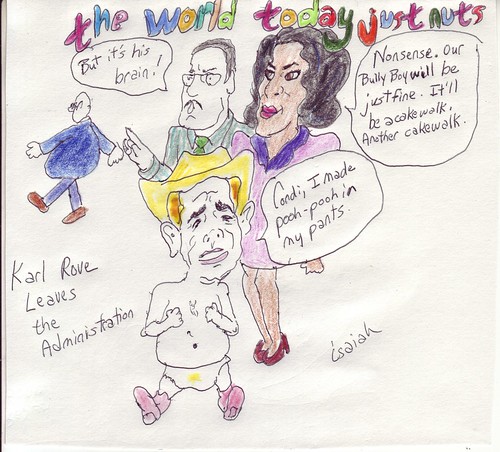
Karl Rove Leaves The Administration

karlroveleaves

That's "Karl Rove Leaves The Administration" from August 13, 2007.


Karl left and I had to do a comic noting that. It couldn't wait until the weekend. So Bush's Brain left the White House and you get Bully Boy soiling himself and talking "pooh-pooh.''

This basically drew itself.

Here's C.I.'s "Iraq snapshot:"

Thursday, March 10, 2011. Chaos and violence continue, Nouri appears before Parliament, Nouri sees one MP of his coalition resign, protests continue in Iraq, the US Director of National Intelligence excuses the brutality the Iraqi forces have heaped on protesters, where are Barack's benchmarks, and more.
"First, I'd like to welcome our witnesses for today's hearing on current and longer-term threats and challenges around the world. We are delighted to have James Clapper here for the first time as the Director of National Intelligence, along with the DIA Director General Ron Burgess," declared Chair Carl Levin this morning at the start of the Senate Armed Services Committee hearing. In his opening remarks, the Director of National Intelligence did nod to Iraq.
James Clapper: In Iraq, I think actually what has happened in Iraq has been a very interesting and encouraging evolution as they have gone -- they're going through a very difficult transition into a democracy. Uhm, they have too had demonstrations that have taken place widely throughout many cities in Iraq and personally was heartened by the uh excellent performance of the Iraqi security forces who reacted temperately to the professionally for the most part to these demonstrators.
However, it is equally true that Levin noted in his opening remarks, "We will want to learn from our witnesses their estimate of the prospects for democracy and for security for religious minorities in Iraq." Those topics were never touched on. In fact, Carl Levin was the only senator to ask of Iraq. Iraq exchange in full:
Chair Carl Levin: Can you give us an assessment of the vulnerability of the government of Iraq to the kinds of protest which have -- we've seen in other parts of that region? And has the government of Iraq cracked down on peaceful demonstration and could that lead to greater demonstrations?
James Clapper: Well, sir, I think the people in Iraq have the same aspirations as we're seeing throughout the MidEast, uh, the same four factors I indicated. And, uh, I think, uh, the word "crackdown" I guess -- that's somewhat of a loaded word. I guess they have curtailed -- controlled these demonstrations and, uh, I think the real test is the, uh, how responsive the, uh, Iraqi government can be for things like provisions of water and electricity to-to the people. And I think it's, uh, sort of basic fundamental, uh, needs, uh, and the government of Iraq, I think, understands that. The -- Prime Minister Maliki certainly does and that, uh, he's got to deliver. And that's going to be the test. And to the extent that, uh, they're not able to do that, then I think that, uh, frustration will fester more among the Iraqi people.
Chair Carl Levin: And just to tie that up, what's the Iranian influence in the Iraqi government, what's the extent of it?
James Clapper: Well sir it's, uh -- I think sometimes there is a tendancy to overstate that. I think, uh, clearly they're interested, uhm, they're going to try to influence, uh, things in Iraq in a manner that's, uh, supportive of their interests. Uh, I think, though, Prime Minister Maliki is, uh, his eyes are wide open here. He's got some background with the Iranians and, uh, I think they are very much aware of that. And certainly that's a great concern to others in the region.
Chair Carl Levin: So a limited effect? The Iranian influence?
James Clapper: Well I wouldn't -- I don't know what the right characterization is. It is a concern it's a factor and uh certainly the Iranians will try to exploit any openings they can whether in Iran -- Iraq or anywhere else in the region. And some measures -- some-some ways, uh, they would like to exploit the situation. But uh, I think that's going to be very problematic for them.
No one else bothered to ask. Ranking Member John McCain asked in a Senate Armed Services Committee hearing this week (see Tuesday's snapshot, it's noted in full -- and that was the only time Iraq came up in that hearing). Let's see we heard about Mexico being the new Columbia and we heard about the Balkans and we heard about -- Goodness, it was so bad maybe we should be grafeful no one felt the need to note the 'great' Grenada invasion of 1983.
While we were at the Senate Armed Services Committee, US Secretary of State Hillary Clinton was testifying in front of the House Foreign Affairs Subcommittee on State and Foreign Operations. Simmi Aujla (Politico) reports, "Clinton told House Republicans that cutting the agency's 2012 budget would also threaten U.S. progress in [typo error at Poliltico edited out here] Iraq and Afghanistan." I'm sorry, Hillary, we need to do that why? Those of us attending the Senate Armed Services Committee hearing this morning heard the US "world wide threat assessment" and Iraq wasn't one. Russia was number one and China was number two. We know that because after Clapper made that surprising announcement in response to Senator Joe Manchin's questions, Chair Carl Levin quickly brought him back to that issue to make sure everyone had heard correctly. (Levin: "I was frankly quite surprised by your answer.") They had. Levin gave him a third attempt to self-correct noting how it will look -- especially in Russia -- when the headlines emerge (I doubt they will outside of Russia, there were not a lot of front page press types at the hearing) of "Russia Greatest Threat To The US." Clapper said he was sticking with his answers because, for greatest threats, only Russia and China would have the capability.
In fact "cyber threats" -- specifically "malicious software" -- were the focus of more grave words from Clapper than was Iraq. The US and England led the world into the Iraq War (Australia tagged along with John Howard as everyone's pudgy kid sister). But the United Kingdom's not fretting Iraq these days. From the March 1st snapshot, when Hillary was appearing befor the full House Committee on Foreign Affairs:
While Hillary was repeatedly saying that the billions to go into Iraq -- a third surge, was how she billed it -- were necessary for national security, a curious thing was happening across the Atlantic Ocean. Alex Stevenson (Politics) reports, "Britain has shaken up its international development budget by placing renewed emphasis on poor countries which directly affect the UK's national security. The move means 16 countries including Angola, Niger, Cameroon and Lesotho will no longer receive any funding from Britain. Neither will Russia, Iraq, Vietnam, Bosnia, Serbia and Burudni." That's very interesting. The Iraq War was started and led by the US and the UK. They spent the most money on the illegal war and sent the most bodies to fight it (and had the most foreign people die in Iraq). To sell the Iraq War in the US, Bully Boy Bush resorted to many lies including that Iraq had sought yellow cake uranium from Africa. Tony Blair, then prime minister of England, had the ability to use chemical and/or biological weapons on England within 45 minutes. That's much quicker than an attack on the US and that's because England is physically closer to Iraq than is the US. So why is it that the UK argues today that they don't need to give Iraq anymore aid because it's not a threat to their own national security but the US -- White House and Hillary Clinton -- is arguing differently?
So can Hillary and the White House get honest about what's really going on? Clearly England is as tied to Iraq as the US and they're not calling it a threat to their national security and, turns out, based on Clapper's testimony, the US isn't either. Maybe we're back to what Ted Koppel, on NPR's Talk of the Nation Tuesday, speaking with Neal Conan declared?
Ted Koppel: We're there because of U.S. interests, and those U.S. interests can be summarized quite simply in one or two words: oil and natural gas. The stability of the Persian Gulf is of enormous national interest to the United State. No politician wants to send young men and women to die for oil. But the fact of the matter is that it is one of the politically most - no pun intended - inflammable issues. When the price of gasoline goes up, as it is going up right now, to $4 a gallon, if we were to leave before there is genuine stability in Iraq, if that area no longer had the oversight of American military, I think you could very easily see the price of oil go up to seven, eight, nine dollars a gallon. And the fact of the matter is then you would have all kinds of political yelling and screaming on Capitol Hill, all kinds of pressure being raised by the American public, which would not want to see that happen to its economy.
That was noted in the March 8th snapshot. So was this:
It would be "very unwise" to leave, he insisted and those who think the US is trying to help Iraq are looking at it wrong because "the prism that we're there for Iraq's interests? We're not. We're there because of US interests."
That quote is incorrect and should have included "[. . .]" and the first "we're" should have been "United States" -- my error, my apologies. What Koppel stated was, "the prism that we have been learned to - that we have been taught to accept over the last few years, and that is that the United States is in Iraq for Iraq's interests. We're not. We're there because of U.S. interests, and those U.S. interests can be summarized quite simply in one or two words: oil and natural gas. The stability of the Persian Gulf is of enormous national interest to the United States." My apologies for my error.
Is oil what Hillary's calling national security? If so, the White House needs to get honest about it. If not, they need to do a lot of explaining due to the fact that Iraq's not a national security issue for the US. It never was. It was never a threat to the US' safety. When Barack, Joe, Hillary, et al start insisting "national security" for the US staying in Iraq, they are LYING the exact same way Bush did when he claimed Iraq was a threat to the United States. If that's the standard they want to meet, then let all three of them be judged accordingly.
When Barack declared his candidacy for the Democratic Party's presidential nomination, February 2007, Tom Eley (WSWS) broke down the realites of 'antiwar' Barry:
In the coded language of official American politics, a ''responsible end'' can mean only one thing: the total subjugation of Iraq, in one way or another, and the expropriation of its enormous oil wealth, delicately referred to by Obama as ''our interests in the region."
"Our interest in the region"? What are they? Barack's a War Hawk. And he's as dishonest as Bully Boy Bush. Back to Eley:
Obama endorses and recycles as his own all of Bush's "thirteen benchmarks" for "progress" in Iraq. Among them, Obama singles out the demand for "eliminating restrictions on US forces." In other words, the Pentagon should be given an even freer hand to drown the Iraqi resistance in blood. Obama also demands the Iraqi government reduce "the size and influence of the Militias" -- that is, fully confront the powerful Al Mahdi militia.
Benchmarks. As Eley notes, Barack was thrilled to grab onto Bush's benchmarks. In fact, he, Joe and Hillary -- all US senators at the time -- were calling for benchmarks. Where are his benchmarks?
Let's review a few of the targeted groups in Iraq.
* Christians and other religious minorities
* the LGBT community
* women
* orphans
* special needs persons
There are many more targeted populations. Barack is in the White House and desperately wants to be in it in 2013. Shouldn't he have something to add? The US tax payer is being asked to fork over billions of more dollars and for what? So Nouri and his thugs can torture gay men and suspected gay men? So they can seal these men's anuses with glue and cause them to die a very painful death?
We have seen zilch from this White House when it comes to Nouri's violations of basic human rights. Doubt it? Let's go over an exchange today one more time.
Chair Carl Levin: Can you give us an assessment of the vulnerability of the government of Iraq to the kinds of protest which have -- we've seen in other parts of that region? And has the government of Iraq cracked down on peaceful demonstration and could that lead to greater demonstrations?
James Clapper: Well, sir, I think the people in Iraq have the same aspirations as we're seeing throughout the MidEast, uh, the same four factors I indicated. And, uh, I think, uh, the word "crackdown" I guess -- that's somewhat of a loaded word. I guess they have curtailed -- controlled these demonstrations and, uh, I think the real test is the, uh, how responsive the, uh, Iraqi government can be for things like provisions of water and electricity to-to the people. And I think it's, uh, sort of basic fundamental, uh, needs, uh, and the government of Iraq, I think, understands that. The -- Prime Minister Maliki certainly does and that, uh, he's got to deliver. And that's going to be the test. And to the extent that, uh, they're not able to do that, then I think that, uh, frustration will fester more among the Iraqi people.
Clapper thinks the security forces showed moderation. Really? When they beat five journalists in Basra last Friday? When did they show restraint? When they injured protesters? When they killed them? When did they show restraint? When they beat up Baghdad journalists? When? And how the hell does this behavior earn the support of the US government?
It's an illegal war and the US has installed a thug. But if that doesn't matter to the current White House -- and it obviously doesn't since it was the current White House that ensured Nouri continued as prime minister -- how about this: The man considered an idiot (George W. Bush) laid down (under duress, true) benchmarks that Iraq was supposed to meet in order to continue to receive US tax payer money; however, someone supposedly smarter than George W. Bush doesn't even see the need for benchmarks today. Doesn't see the need while despite the targeting of religious minorities, of Iraq's LGBT community, of Iraqi women and on and on. That's very telling and what it's telling on the current White House isn't at all pretty.
Turning to Iraq, Emad Kamel (Al Mada) reports on the threats to Iraq's food security and agriculture as a result of water concerns and notes that experts are predicting future wars will revolve around water resources. Related, Al Mada reports that Iraq's Minister of Agriculture is requesting that the Iranian government clarify their plans on building dams effecting the bodies of water the two countries share.
Reuters quotes Iraq's Deputy Prime Minister Saleh al-Mutlaq stating, "If [Nouri al-] Maliki cannot administer his government in these three months in a way to meet the ambitions of people, I believe he himself should resign. These protests are not against this current government. They are against the accumulation of financial and administrative corruption and against building the country in an inappropriate way for the last eight years." This as the editorial board of the National Newspaper observes, "As The National reported yesterday, Nouri al Maliki, the incumbent prime minister, continues to dither on promised power-sharing deals, and points fingers instead. He's given his cabinet 100 days to reform or face unspecified 'changes'. He has also accused al Qa'eda and Baathists of encouraging street demonstrations. Both moves are ill-conceived attempts to divert blame from his own leadership. Mr al Maliki must recognise that it is not only his future on the line, but Iraq's. Both will lose out if he fails to address the grievances of its people." Al Rafidayn notes al-Mutlaq is a member of Iraqiya and states he is trying to limit any anti-government fallout from Nouri's inaction attaching to him (al-Mutlaq). Alsumaria TV points out Nouri appeared before the Parliament today.
In April 2006, Nouri al-Maliki became prime minister-designate. In May of 2006, he became prime minister. By misusing the powers of his office, he ensured he would remain prime minister despite the results of the March 7, 2010 elections and the will of the people. So Nouri is now serving his fifth year as prime minister. Qassim Abdul-Zahra (AP) reports that when Nouri appeared before Parliament today he attempted to spread the blame ("The current situation is not the responsibility of one group, rather it is a joint responsibility. The executive and legislative authorities share responsibility in both successes and setbacks.") but that some rejected that attempt and MP Maha al-Douri (Sadr bloc) is quoted as stating, "He tried to throw the ball into the parliament's court for the failures that took place in the country. What we need is immediate solutions for the problems, not long speeches." But the most telling evaluation of Nouri's performance may be via Aswat al-Iraq which reports MP Saifya al-Suhail (Nouri's State Of Law slate) issued a statement stating that, due to "the non-democratic ways," she was leaving State Of Law: "I have suffered blackballing, ignoring and marginalizing when it comes to contributing to key political decision-making for the bloc. There was meager coordination and consultation as well as autocracy practiced by a limited number of persons."
Tuesday's snapshot included the following, " Aswat al-Iraq reports that US Special Forces did 'an air drop operation on a village in al-Huweija district and raided some houses, killed a physician and arrested his brother' -- and if you're wondering, US Special Forces roam free in Iraq. Osama al-Nujefi, Speaker of Parliament, wants an investigation into US actions." Today Parliament's health committeee held a press conference. Aswat al-Iraq quotes the statement issued: "The Committee, denouncing the killing of an Iraqi physician during a raid by U.S. soldiers and Salah al-Din security forces on his house, calls on the prime minister to launch immediate investigations into the incident and bringing the persons involved to justice."
Al Mada reports that Moqtada al-Sadr has concluded his meetings with various officials and office holders in his party. In related news, KRG President Massoud Barzani is in Baghdad. Dar Addustour reports he is present in an attempt to resolve the issue of the National Council. And no doubt, he's present in an attempt to hold together the fragile power-sharing agreement -- especially after calls from the White House.
Dar Addustour notes that Nouri is set to make a series of proposals, allegedly in response to the demands of protesters, and also to make his nominations for the Cabinet positions he still has not filled all this time later. Al Mada notes that the Commission on Parliamentary Srvices has declared that it will be very difficult for the demands to be met.
Meanwhile New Sabah reports that Kut saw protests yesterday in response to an attempt to move the commander of their rapid response regiment to Baghdad and that there was a walk out, that it was peaceful and that the demands are to keep the commander in Kut. So there's now a split in Kut. There are those who are outraged by the treatment of the protesters last month -- with at least one killed and close to fifty injured -- and there are those who want the man seen as responsible for the violence to remain in Kut. Dar Addustour reports a Baghdad protest by workers with the State Company of Heavy Equipment for the oil industry, numbering around 500, protested in Firdaus Square against corruption and unfair wages. They are threatening a hunge strike. In Dhi Qar, Iraqis with special needs marched outside the province's council offices calling for funding that would increase the quality of their lives and noting that they suffer because they are not able to work. Protests are scheduled for tomorrow.
In economic news, Mohammed Tawfeeq (CNN) reports the bombing of an oil "pipeline in Ninevah province [which] pumps about 500,000 barrels of crude oil every day to the Turkish port of Cevhan". Citing Ministry of Oil spokesperson Asim Jihad, AP states that it is expected the pipeline will be shut down for a minimum of three days; however, Jihad tells Reuters, "We (the oil ministry) have put a 5-day timeframe to fix it, starting from yesterday. We are trying to shorten this time." Hassan Hafidh (Dow Jones) explains, "Iraq usually pumps between 450,000 and 490,000 barrels a day via that pipeline. The crude oil is exported to Europe and Turkey." Brendan Conway (MarketWatch) adds that "U.S. stocks were sharply lower Thursday, dragging the Dow Jones Industrial Average below the psychologically important 12000 mark for a time [. . .] The stock sldie comes at a point when investors have been battered for weeks by fears of continued political unrest in the Middle East and North Africa. The continued fighting in Libya between rebel forces and those loyal to Moammar Gadhafi is still the focal point, but investors are also watching reports of new protests scheduled for Friday in other countries including Saudi Arabia and Iraq." And clarifying priorities, Aswat al-Iraq notes, a pipeline to the northwest of Mosul was attacked today and a security source explains, "Pumping oil to Syrian did not stop, but pumping water to a village dropped due to the explosion."
Billie Jean Grinder and Marcus R. Alford Sr. died serving in Iraq February 21, 2010. Hugh G. Willett (Knoxville News Sentinel) reports their loved ones have filed a suit as a result of the helicopter crash that claimed the lives of Grinder and Alford, "At the time of the crash, the Department of Defense said Grinder and Alford were trying to land their helicopter near Qayyarah Airfield West, about 30 miles south of Mosul, were not under fire and no enemy forces were nearby. Named as defendants in the suit, filed Feb. 18, are Bell Helicopter Textron, Rolls-Royce North America, Goodrich Pump and Engine Control Systems, Unison Industries and Honeywell International. According to the suit, the Kiowa's FADEC system failed on a Feb. 21, 2010, mission in Iraq, resulting in the crash that killed Alford and Grinder."
Moving over to today's violence . . .
Bombings?
Reuters notes a Baghdad roadside bombing which claimed the life of 1 police officer (three more injured), another Baghdad roadside bombing which left one civilian injured, a third Baghdad roadside bombing which injured three people (one was a police officer), a fourth Baghdad roadside bombing which injured one person, a fifth one which left three police officers injured, a sixth one which left four police officers injured, a fifth one which left five people injured and, dropping back to Wednesday, a Baghdad sticky bombing which left two people wounded. Aswat al-Iraq notes a Falluja sticky bombing claimed 1 life.
Shootings?
Reuters notes a Baghdad "shootout" in which 2 civilians and 4 police officers were killed but the assailants escaped apparently unharmed. Aswat al-Iraq notes 1 person shot dead in Falluja.
Corpses?

Aswat al-Iraq reports one corpses was discovered in Missan.
Ed Tibbetts (Globe Gazette) reports that US House Rep Bruce Braley "has reintroduced legislation that would require an accounting of the 'long-term human and financial cost' of the wars in Iraq and Afghanistan through 2020." Iowa's The State quotes Braley stating, "In the last 10 years, Congress has appropriated over a trillion dollars for the wars in Iraq and Afghanistan. But what we don't account for in that figure is the more than 5,800 U.S. Service members who've been killed in the line of duty in Afghanistan and Iraq. Or the more than 40,000 who've been wounded and who will spend the rest of their lives treating injuries like PTSD, traumatic brain injury, severe burns and amputated limbs. These are not just costs that our troops and their families bear -- these are also significant costs for the Veterans Affairs department and all American taxpayers. As a nation, we have a right to know what these conflicts will actually cost us." US House Rep Bruce Braley's office released the following yesterday:

Braley Fights to Expose True Cost of Iraq, Afghanistan Wars
Introduces bi-partisan bill to require reporting on true cost of wars

Washington, DC -- Today, Congressman Bruce Braley (IA-01) introduced a bill that would require a full accounting of the human and financial costs of the wars in Iraq and Afghanistan. Earlier this week, Rep. Braley returned from a Congressional fact-finding mission in Afghanistan where he met with General David Petraeus and discussed the cost of the Afghanistan war with him. Rep. Braley also met with several top commanders on the ground and numerous Iowa National Guard troops -- 3,500 of which are currently stationed in Afghanistan.

"These wars are incredibly personal for me and the people of my district," said Rep. Braley. "I've met with dozens of my constituents -- young men and women and their families -- who have sacrificed a great deal in the wars in Iraq and Afghanistan. And when I meet injured soldiers and I see the hardships -- physical and financial -- that they and their families will endure for the rest of their lives it becomes crystal clear that the true cost of the war is not being accurately reported. With this bill, we can change that."

The bipartisan True Cost of War Act, co-sponsored by Republican Congressman Walter Jones (NC-03), requires the President to work with the Secretaries of Defense, State and Veterans Affairs to submit a written report to Congress on the long-term human and financial costs of the war in Iraq and Afghanistan through 2020.

"In the last 10 years, Congress has appropriated over a trillion dollars for the wars in Iraq and Afghanistan," said Rep. Braley. "But what we don't account for in that figure is the more than 5,800 U.S. Service members who've been killed in the line of duty in Afghanistan and Iraq. Or the more than 40,000 who've been wounded and who will spend the rest of their lives treating injuries like PTSD, traumatic brain injury, severe burns and amputated limbs. These are not just costs that our troops and their families bear -- these are also significant costs for the Veterans Affairs department and all American taxpayers. As a nation, we have a right to know what these conflicts will actually cost us."

Rep. Braley has been fighting for a true accounting of the Iraq and Afghanistan wars since he came to Congress. He has introduced and passed similar language in several amendments to past House bills.

Click here for text of the legislation.

In related news, Morris Workman (Mesquite Local News) explains he was wrong to support Barack Obama in 2008 for president: "For example, he promised he would get us out of Iraq. Today, there are still Americans in military uniforms carrying weapons around Baghdad, but they don't count because Obama removed their official designation as 'combat troops'. He hasn't done much to get us out of Afghanistan either, keeping our troops in harm's way without a real plan, without an exit strategy, and without even bothering to come up with a real reason beyond the Elmer Fudd-sounding excuse of 'Eh-h-h-h, there's got to be some Tawiban awound here somewhere'." And while some in the press blame Americans for not knowing what is not reported, Gary Daily (Terre Haute Tribune Star) uses his column to cover the wars in Iraq and Afghanistan and to note what the media spends so much time on instead:

It's the same old, same old when I read the newspaper. Republicans believe (or pretend to believe) that the 7 percent of union members in America's workforce caused the Bush Depression. Charlie Sheen again demonstrates which part of "Two and Half Men" he is. And college sports scandals continue to blossom and smell stronger than the sweat in a crowded locker room or the money in a big booster's off-shore bank account.
Not getting as much attention is the same old news on America's wars in Iraq and Afghanistan. I guess the expiration date on interest in these costly wars (trillions and counting) and deadly (thousands and counting) has run out.
U.S. newspapers and television programs also ignore the wars. Some broadcasters do acknowledge the wars thousands of miles away, but they also say these wars are rarely the lead story, on grounds that people are not that interested.
But the truth is the Obama Administration is happy to keep the popular pressure off as the fighting goes on.
Obama is following his predecessor, George W. Bush, regarding war policies and censorship. The Bush Administration barred coverage by reporters and cameramen of the American soldier coffins. But the truth is the Obama Administration is happy to keep any anti-war popular pressure off against the wars as the fighting continues.
Those pictures might upset the country and leave us asking, "Why are we still fighting and dying in those wars?" We have yet to get a straightforward answer from Obama, as to why he chooses to continue the Bush-instigated wars.


Read on ...

Thursday, March 3, 2011

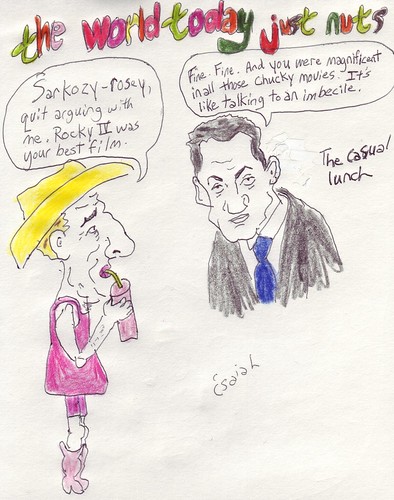
The Casual Lunch

thecasuallunch


That's August 12, 2007's "The Casual Lunch." Bully Boy Bush meets the French ruler.

I worked forever coming up on Bully Boy Bush's outfits. He wore cowboy boots all the time (in my comics) and he was usually in pinkish running shorts. He'd have his yellow cowboy hat on. And some form of a shirt -- which always popped out at his bulging middle.


I need to find something similar for Barack. I watched the press conference today on CNN trying to pick up some clues, ideas or insight. All I took away was how Barack scowled and how he looked bored when he thought the camera was no him.
Here's C.I.'s "Iraq snapshot:"


Thursday, March 3, 2011. Chaos and violence continue, protests are planned in Iraq for tomorrow, crackdowns go into effect, Nouri's ground appears shakier, Bradley Manning faces new charges, and more.
This week on Raising Hope (episode "Snip, Snip," written by Mike Mariano, Fox, Tuesday nights, streams online), Virginia (Martha Plimpton) and Burt (Garret Dillahunt) have a pregnancy scare. When their adult son Jimmy (Lucas Neff) finds out, he holds a family meeting in the living room. Also present is Maw Maw (Cloris Leachman), Virginia's grandmother, who appears off in her own little world as she examines a remote control.
Jimmy: How could you be so irresponsible?
Virginia: We're responsible. We're also passionate and spontaneous.
Burt: Those would be our gladiator names if we were on American Gladiator. Which we still might do!
Virginia: Because we're spontaneous.
Jimmy: Okay, first of all, Gladiator sounds awesome. But no babies. One of you has to get fixed or spayed.
Burt: No way.
Virginia: You cannot decide that, Jimmy. That is a personal decision.
Burt: She's right. I think we should take a family vote. All those in favor of everyone keeping their original plumbing?
Virginia and Burt raise their hands.
Virginia: Sorry, Jimmy, you're out voted two to one.
Maw Maw: I vote with Jimmy!
Jimmy: Hold on! Two to two!
Burt: Only if she's lucid! She's only allowed to vote if she's lucid!
Virginia: Maw Maw, we are currently at war with what country?
Maw Maw: Iraq and Afghanistan.
Jimmy: Is she right?
Burt: I think so but I'm not sure.
Maw Maw: It's right, you morons. One more reason why you shouldn't have another baby.
Burt and Jimmy aren't the only ones who appear to have forgotten the wars. Yesterday the Commission on Wartime Contracting in Iraq and Afghanistan issued a [PDF format warning] press release
Asking if Iraq is "a forgotten mission," the bipartisan Commission on Wartime Contracting in Iraq and Afghanistan has released a special report to Congress warning that the U.S. Department of State faces large funding and contract-management challenges in Iraq once the U.S. military completes its agreed-upon withdrawal by the end of 2011.
To deal with Iraq's long-standing ethnic, religious, and regional rivalries, the State Department is working to set up two permanent and two temporary stations remote from the U.S. embassy in Baghdad. The department is also working with the Department of Defnse to deal with hundreds of functions currently provided by the U.S. military in Iraq.
State's taking on security, facilities management, air transport, and other tasks will require thousands of contractor employees. "Yet State is short of needed funding and program-management staff," the report says. "Very little time remains for State to develop requirements, conduct negotiations, and award competititve contracts for work that must begin at once. Inadequate support risks waste of funds and failure for U.S. policy objectives in Iraq and the region."
The report recommends that:
"1. Congress ensure adequate funding to sustain State Department operations in critical area of Iraq, including its greatly increased needs for operational contract support."
"2. The Department of State expand its organic capability to meet heightened needs for acquistion personnel, contract management, and contractor oversight."
"3. The Secretaries of State and Defense extend and intensify their collaborative planning for the transition, including executing an agreement to establish a single, sneior-level coordinator and decision-maker to guide progress and promptly address major issues whose resolution may exceed the authorities of departmental working groups."
Nathan Hodge's article in today's Wall St. Journal opens, "U.S. officials are beginning to talk about the possibility of keeping some troops in Iraq beyond 2011, complicating the Pentagon's plans to rein in military spending." Hodge also notes the new report from the Commission on Wartime Contracting which Mark Bruce (ABC News) covers as well as the hearing:

The State Department is not ready to assume leadership for the U.S. role in Iraq as the military draws down its mission there, Commissioners Grant Green and Michael Thibault of the Commission on Wartime Contracting in Iraq and Afghanistan argued before lawmakers today.
"Is the State Department ready? The short answer is 'no,' and the short reason for that answer is that establishing and sustaining an expanded U.S. diplomatic presence in Iraq will require State to take on thousands of additional contractor employees that it has neither funds to pay nor resources to manage," Green testified before the Oversight and Government Reform Committee.

Mike Kellerman (Press TV -- link has text and video) adds: "Another couple hundred billion is estimated to pay for diplomats, CIA workers, para military advisors, embassy security, and tens of thousands of contractors. AT this Congressional hearing, several lawmakers balked at the projected price for Obama's long-term scheme to keep the American presence strong in Iraq indicating the government can no longer afford it. The US special inspector general for Iraq testified not only will it cost a lot at a time when budget cutters in Congress are slashing the State Department's budget but also the State Department is far from ready to take over the occupation of the country from the US military." If you want to end something, you work to end it. You don't, a few days after an election -- say, one in 2008 -- post a pathetic message on your supposed peace website that all is well and you're off. The Iraq War continues. Those of us who said "Out of Iraq Now!" need to figure out whether we meant it or not -- specifically "NOW!" -- or whether we were just lying to try to help Democrats do better in elections. I'm not sure what conclusion most will form but I was opposed to the Iraq War and meant it which is why I remain opposed to the Iraq War. Opposed -- not posing. There's a difference. Non-posers will gather across the country this month on the anniversary of the Iraq War with the biggest protest planned for DC. A.N.S.W.E.R. and March Forward! and others will be taking part in this action:

March 19 is the 8th anniversary of the invasion and occupation of Iraq. Iraq today remains occupied by 50,000 U.S. soldiers and tens of thousands of foreign mercenaries.

The war in Afghanistan is raging. The U.S. is invading and bombing Pakistan. The U.S. is financing endless atrocities against the people of Palestine, relentlessly threatening Iran and bringing Korea to the brink of a new war.

While the United States will spend $1 trillion for war, occupation and weapons in 2011, 30 million people in the United States remain unemployed or severely underemployed, and cuts in education, housing and healthcare are imposing a huge toll on the people.

Actions of civil resistance are spreading.

On Dec. 16, 2010, a veterans-led civil resistance at the White House played an important role in bringing the anti-war movement from protest to resistance. Enduring hours of heavy snow, 131 veterans and other anti-war activists lined the White House fence and were arrested. Some of those arrested will be going to trial, which will be scheduled soon in Washington, D.C.

Saturday, March 19, 2011, the anniversary of the invasion of Iraq, will be an international day of action against the war machine.

Protest and resistance actions will take place in cities and towns across the United States. Scores of organizations are coming together. Demonstrations are scheduled for San Francisco, Los Angeles, Chicago, Washington, D.C., and more.


The Iraq War isn't over. BBC News reports that a Haditha suicide bomber has taken his own life today and the lives of many around him. NPR's Mike Shuster (on the hourly headlines) says that the death toll could rise and that most of the victims are "police or army personnel who gathered at a bank to receive their pay." Reuters counts 10 dead so far with twenty-six injured.
In political news, the big news may be Ayad Allawi's announcement. Al Rafidayn reports the Iraqiya leader has given a TV interview in which he has declared he will have no part of the National Council on Supreme Policies. He termed his decision "final" and said Iraqiya could nominate or back someone else for that post if they want to. Iraiqy won the most votes in the March 7th elections which should have meant Ayad Allawi had first crack at forming a government but the Constitution wasn't followed. To end the stalemate, the US government increased the pressure on various parties resulting in an agreement largely brokered by the Kurds which gave Nouri the prime minister poster and would make Allawi head of the National Council on Supreme Polcies; however, that body has still not been created. For those who can remember, after the agreement there was much fan fair in Parliament the next day . . . except for Iraqiya walking out as it became obvious that their rewards in the agreement were not priority. Among those who walked away then was Allawi. It probably would have been smart for others in Iraqiya to have taken a stand back then when it might have made a difference. Dar Addustour reports the assertion that the National Council wil lbe formed. When? Iraq still doesn't have a full Cabinet. In related news, New Sabah reports that Iraqiya is stating Nouri is using his '100 days' (a time of review Nouri's given himself) not to reform, but to stall. Arab News reports: "The Chairman of the Supreme Iraqi Islamic Council (SIIC), Ammar al-Hakin, and the Leader of al-Iraqiya Coalition, Iyad Allawi, have discussed on Wednesday the activiation of the agreements, reached among different Iraqi political parties, to activiate the national partnership to respond to the people's demands, an SIIC statement said on Thursday. In further related news, Alsumaria TV reports, "Al Sadr Front threatened to stop supporting the government of Prime Minister Nuri Al Maliki if he keeps on his weak performance and failures. The front even hinted about allying with Iraqiya leader Iyad Allawi to form a parliamentary majority in case the government fails to provide its people the needed services within the six month deadline set by Sadr's referendum." UPI notes, "The party loyal to Shiite cleric Moqtada Sadr could rally against the country's prime minister if he doesn't address national woes." The Econimist notes, ". . . Mr Maliki is becoming still more authoritarian. In January a supreme federal court ruling allowed several independent institutions, including the central bank and various committees that are meant to oversee elections, fight graft and uphold human rights, to fall under the control of the executive. Mr Maliki has been trying to place his allies in several of these outfits. Qassim Aboudi, who heads the electoral committee, said he feared that Mr Maliki would interfere even more in the next election than he did in the past one. Worst of all, reports have been circulating that security forces loyal to Mr Maliki are again running secret prisons where detainees are being tortured." Mediate notes that US House Rep Ron Paul appeared on Judge Andrew Napolitano's Fox Business News program Freedom Watch and noted Nouri's crackdown on protesters before stating, "I would say that our success at providing a free society for Iraq is a total failure and they do not have freedom. There's less fredom of religion there -- the Christians have all been run out. Even under the horrible dictator Saddam Hussein -- he was more tolerant of Christianity than the current government is in Iraq." Iraqi Christians remain in Iraq, many have been run out of their homes -- some have moved to northern Iraq, some have left the country.

Protests are called for tomorrow in Iraq. Jack Healy and Michael S. Schmidt (New York Times) report, "On Thursday night, the authorities banned all cars and motorcycles from the streets of Baghdad, making it hard for protesters to reach the central square. Similar bans were announced in Samarra and Kirkuk." Daniel Serwer (Washington Post) notes, "Iraqis have been thinking about what they need to do to achieve national reconciliation: Redefine the relationship between citizens and the state, reform education at all levels, suppress incitement, limit foreign interference in domestic politics. Members of parliament I spoke with wondered what it would take to produce a 'culture of forgiveness.' There was a healthy debate." At the Council on Foreign Relations, Raad Alkadiri offers this take of the protests thus far:
These protests have not reached the scale of those witnessed in Egypt, Libya, and Tunisia, and demonstrators have not demanded regime change per se. Nonetheless, the tight security measures taken to contain the "day of rage" protests in Baghdad -- including blocking access to the city and putting a tight military cordon around Tahrir Square, the focal point of the demonstrations -- and Prime Minister Nouri al-Maliki's efforts to link the unrest to al Qaeda and Baathist provocateurs suggest that his government is rattled. And with good cause, because if Baghdad cannot respond effectively to popular demands, the current government's political survival is no less at stake than those in Cairo, Tripoli, and Tunis.
Although there is undoubtedly an element of contagion influencing events in Iraq, which began with small demonstrations in Baghdad led by intellectuals and professionals, the protests there are driven by local grievances. Popular anger at the persistent lack of services -- especially electricity -- has been rising steadily over the past few years. Demonstrations protesting power shortages occurred in Basra last summer, expressing a frustration common to Iraqis across the country; some parts of Baghdad, for example, received around two hours of electricity per day from the national grid in early February. Iraqis also share growing resentment toward pervasive government corruption, a factor that has been particularly important in driving demonstrations against the regional administration in Kurdistan. Iraq ranked 175 out of 178 countries on Transparency International's 2010 corruption index. Meanwhile, there is broad resentment of the high salaries and generous benefits that public officials have granted themselves, especially given the government's apparent ineptitude.
None of these grievances is new; Iraqis have complained about poor services and unresponsive government since the U.S. invasion in 2003. But in the bloody, chaotic years that followed Hussein's fall, security was the biggest popular concern. Now that levels of violence have diminished, Iraqis' patience with their government's inadequacies is wearing thin.

Nayla Razzouk (Bloomberg News) notes that Saber al-Issawi, mayor of Baghdad, has tendered "his resignation [. . .] following street protests in the country to demand better living conditions and anti-corruption measures". The mayor of Falluja has resigned, Babil Province Governor Salman Nasser Hamidi has resigned and Basra Governor Shaltagh Abboud. In addition to the planned protests for tomorrow, Reuters notes that Moqtada al-Sadr has called for protests "against any possible US Military intervention in Libya, saying the US installed Gaddafi and now wants to remove him."
Late yesterday, new charges were lodged against Bradley Manning. The rest of the snapshot will be devoted to issues having to do with Iraq War veteran Bradley. Monday April 5th, WikiLeaks released US military video of a July 12, 2007 assault in Iraq. 12 people were killed in the assault including two Reuters journalists Namie Noor-Eldeen and Saeed Chmagh. Monday June 7th, the US military announced that they had arrested Bradley Manning and he stood accused of being the leaker of the video. Leila Fadel (Washington Post) reported in August that Manning had been charged -- "two charges under the Uniform Code of Military Justice. The first encompasses four counts of violating Army regulations by transferring classified information to his personal computer between November and May and adding unauthorized software to a classified computer system. The second comprises eight counts of violating federal laws governing the handling of classified information." Manning has been convicted in the public square despite the fact that he's been convicted in no state and has made no public statements -- despite any claims otherwise, he has made no public statements. Manning has been at Quantico in Virginia, under military lock and key, for months. David S. Cloud (Los Angeles Times) reports that the military has added 22 additional counts to the charges including one that could be seen as "aiding the enemy" which could result in the death penalty if convicted. David E. Coombs is Bradley's attorney and provides a walk through on Article 104. Like many, Sophie Elmhirst (New Statesman) emphasizes the possibility of the death penalty. Elmhirst notes:

Last week, I met David House, the only person allowed to visit Manning at the Marine Corps Brig in Quantico, Virginia apart from his lawyer, David Coombs (the full article is in this week's magazine). Manning has been held there since 29 July 2010, and House has been visiting him since September, and has noticed his rapid deterioration. Manning, who is held under a Prevention Of Injury (POI) order, spends 23 hours a day alone in his cell, and is now unable to speak at any length or with coherence. He is allowed out for an hour to walk in circles around an empty room. For three days in January he was put on suicide watch, his glasses were removed and he was kept in his cell for 24 hours a day, although his psychological evaluations have stated that he is not a risk to himself. He has also gained weight and appears exhausted.

Most recently, House told me, he has appeared almost catatonic, barely able to communicate at all. "I can't really describe how bizarre it is to see a 110-pound, five-foot-three individual done up in chains from his hands to his feet, connected at the waist, so he can't really move," he said. Pentagon officials maintain that Manning receives the same treatment and privileges as all other prisoners held in what the military calls 'maximum custody' ". But House points out that Manning is the only maximum-custody detainee at Quantico, "so he is being treated like himself".

Could he face the death penalty? He could. If found guilty, he could even be put to death. How likely is that? It was less likely in 2005 because we had a movement against the Iraq War. But the reality is that it's an illegal war and that the 2002 authorization doesn't say go to war. That wouldn't be hard to establish in court -- you have various Democrats who voted for it in 2002 -- including some who ran for the party's presidential nomination -- and insisted after that this was not a vote for war, it was a vote for inspections and on and on. Meaning, if it is on record by the very people who voted for the authorization that the measure did not declare war, it would be very hard to establish that this was a legal war. (It's an illegal war by every international law. We're sticking to national issues due to the fact that this case, if prosecuted, would be in military courts at the start. On appeal, it would leave the confines of the military.)

Does the military want to be arguing -- with US soldiers still on the ground in Iraq -- that Bradley allegedly aided the enemy? No, they don't.

They don't want to because that opens up two defense avenues. The first is, where is the proof that anyone was aided -- burden of proof, even in the military court, would be on the prosecution to prove their charge. The second is the legality issue.

Reality: US troops aren't leaving Iraq at the end of 2011. You can accept that reality or not. But it's not happening. The US military cannot continue to hold Bradley as they have been doing. The outcry is building. So a trial of some form (or an agreement) had to start (or be reached) in the near future. The military does not want a legality issue on the war. We've seen that in case after case. Think of Camilo Mejia's case or anyone else's. The military doesn't want that but this charge invites that. You cannot claim that someone's actions have aided the enemy and not give them the right to respond as to "what legally defined enemy?" which is the issue of the (domestic) legality of the Iraq War.

It's a stupid charge on their part because it actually expands the case the defense could make -- even if the prosecution insists "We won't go for the death penalty," making that charge expands the scope. During Vietnam, case after case had to be dropped because of the legality issue -- I'm referring to cases which did include charges of 'aiding the enemy.' One of the reasons Jane Fonda was never charged with any crime was that the Justice Dept did not want to get into a court battle over the legality of what the US was doing in Vietnam. Charging her -- as some reactionary members of Congress wanted at the time -- with "aiding the enemy" or "treason" would require the Justice Dept explaining that the US was at war with what Congressional proclamation? (Only Congress can declare war legally in the US.) Putting the war on trial, especially when it is ongoing, is not something that any branch of the government seeks.

What may be happening is that this may be an effort to scare Bradley. The military may have reached a dead end or a wall and, with little to no additional options on ways to attempt to force something out of him, they may have decided to drop a number of new charges on him all at once in the hope that they can intimidate or scare him or his attorney.

Anything can happen, the future is not foretold. But based on past experiences in the US, this plays more like an intimidation tactic by the government -- and an incredibly desperate one at that. Ellen Nakashima (Washington Post) notes the military has stated they will not seek the death penalty. That only makes it more likely that this was a desperation move on the part of prosecutors who know they need to move forward on the case but apparently have little or no case at present. Although it has allowed for some to run around like chickens with their heads cut off and I'm sure the prosecutors are loving that. Meanwhile Glenn Greenwald's demonstrating yet again what a poor legal mind he has. Link here and provided just for the purpose of laughter. (Heads up came from three friends who are Constitutional lawyers.) At one point, GG's going on about military law while indicating that he doesn't understand it. The chief thing to remember with the military court is that it does have civilian oversight in the appeals process. (It was US District Court Judge Benjamin Settle, for example, who ruled in Ehren Watada's favor.) Even worse than GG's alarmist attitude is what he does when he realizes he hasn't a clue about the issues involved. US citizen Bradley Manning will supposedly face a (US) military court. Not sure of the issues (but too scared to admit it), GG looking for an expert and thinks he found one in an "international law professor." No, GG, no. That espeically is producing howls of laughter in the legal community. I know the small, online world tends to think GG's a brilliant legal mind up there with Atticus Finch but he repeatedly demonstrates that he's just not that smart -- neither when it comes to thinking on his feet or strategizing. (Which is how the White House managed to Rick-roll him on ObamaCare all those months.) The charges against Bradley are not "international law" charges. They are domestic military charges. He should have called any number of attorneys familiar with domestic law, especially military law, such as Eugene Fidell. Fidell's always popular with the press and, in fact, Charlie Savage (New York Times) has already spoken to him about the new charges:
Eugene Fidell, who teaches military law at Yale Law School, noted that several of the charges seemed to be describing the same basic act, but in different ways. He said that it was "typical for military prosecutors to draft charges in as many ways as possible," and he predicted that the defense would challenge the redundancies later in the process.
"We're potentially entering a new chapter with this set of charges," Mr. Fidell said.
That's one opinion. There are others. AP's David Disneau finds some -- unlike GG, to find out what could happen, Dishneau goes to military law experts. If you're presenting someone as an expert on a sujbect, they need to be not just an expert but an expert whose expertise applies to the issue at hand. Again, GG's a laugh-laugh. It's only the online world that thinks he's all that. If he hadn't tossed his lot in online with Democrats (he's not a Democrat), he wouldn't have his fame -- such as it is -- but if you tell blind partisans (of either party) just what they want to hear often enough, they'll hail you as a genuis. Of course, most of the praise comes from people who have never sat foot in courtroom, let alone taken even one legal course. You'd think even the mindless, reading today's column, would realize there's some sort of cognitive problem with GG -- presenting Bradley as guilty and then, in his final paragraph, noting Bradley's been convicted of nothing. Which is it?
And we bring it up not just because of GG -- we rarely mention him, he has no use to us. But we note him today because GG's part of the problem. 'What will sway the public!!!!!' Time and again, that's what GG's inflated nonsense is about. Now you can make an argument that attempts to persuade and is still coherent and factual. When you are unable to do that, you just keep upping the ante -- lying -- and end up like John Nichols, who, Bob Somerby points out today, helped start (another) huge lie on the left, it spread like wildfire and people had egg on their face. We don't need that. We all make enough mistakes on our own (and I'm sure I make more than anyone else) without relying on people who have record of stretching, bending, distorting and molesting the truth.
GG makes some idiotic claims -- and he's far from alone today -- how does that hurt anyone? I don't care about Glenn Greenwald and his cult will continue to fawn over him. But the reason we have screamed and pissed people off on the Bradley Manning issue is because I do give a damn about Bradley. I do care when Bill Quigley -- at the Center for Constitutional Rights website -- is calling Bradley the leaker. I do care that Bradley be able to enter a plea and not have one assigned to him -- either by the government stooges or by my fellow idiots on the left. The charges have always been serious ones against Bradley in terms of punishment. It is no one's business -- that includes Daniel Ellsberg who has pissed off the Manning family with some of his public statements -- but Bradley's to make a claim or assertion. He can -- and will -- do that through his attorney. He may be innocent. He may be guilty and want to plead innocent. He may want to plead guilty. But that's his plea. And that CCR would feature Quigley's crazy -- an attorney at a website for attorneys -- calling Bradley the leaker when Bradley's never identified himself as that is beyond crazy.
As is upping the ante. What Bradley's experiencing does qualify as torture. You don't have to add to it, you don't have to inflate it. What's going on is already bad enough. His attorney David E. Coombs notes the military felt the need to strip Bradley of all his clothing for over seven hours. Now if we wanted to live in Speculation City, I could rip them apart over that and what they may have been trying to do in terms of humiliation. But Bradley's never spoken of his sexuality to the press and we've left that out of the snapshots because Adrian Llamo is a liar and a convicted felon. We're not interested in the many lies that sewage mouth repeatedly spouts. (And as we noted long ago, a real prosecution does not let Llamo leak the way he has. Llamo's leaking long ago indicated he wasn't a witness in a future trial, he was part of the prosecution.) 7 hours without clothing. In his cold cell. For what reason? We don't know but we know that's not right. But some today will overlook that grave injustice -- which is a violation of military policy. Even if Bradley were to be put on suicide watch, he would be placed in scrubs. He would not be forced to be naked for hours. The military has violated their own guidelines. But, again, some today will overlook it. They'll hear about it and think, "Oh, well, that's minor! The US military wants to execute him!!!!"
What is being done to Bradley now is already outrageous. When your way of 'helping' him is to focus on what might happen as you let your horses run free (nod to Prince) all over Crazy Town, you make the outrageous actions of the US military seem far less than what they are. That's one reason why we don't docu-drama an ongoing legal case. Another reason is that once you start lying, there is the risk that your lie will be exposed. If and when that happens, that one lie goes to your entire presentation. "They lied about __ and if they would lie about ___, who knows what else they would lie about." So when Coombs responds to Pentagon flack Geoff Morrell's assertions, you're undercutting him (and Bradley) if you're forever 'improving' on the story.
Let's deal with another way some of the 'helpers' are harming. The Cult of St. Julian tries to tie Assange with Bradley. There's no reason to do that. Despite claims by Julian Assange that they would support Bradley (whom Assange has always stated may or may not be the whistle blower because WikiLeaks does not know the person who lead the data) and his legal defense, they didn't. Shamed on the national stage, WikiLeaks finally ponied up a small amount -- $15,000. From a review by Marcus Baram (Huffington Post) of Daniel Domscheit-Berg's Inside WikiLeaks: My Time With Julian Assange at the World's Most Dangerous Website:
The arrest of U.S. Army Private Bradley Manning for allegedly copying and leaking classified information represented the worst moment in the history of WikiLeaks, writes Domscheit-Berg. The arrest prompted the group to debate the effectiveness of its mechanism for protecting sources -- could a document be so dangerous for a source that WikiLeaks should not publish it? Domscheit-Berg also reveals that the organization let down Manning after promising to hire lawyers and raise $100,000 for his defense. By the end of 2010, only $15,000 had been transferred to Manning's support network. "I have to admit that we at WL, myself included, utterly failed on this score," he writes.
That's despicable. And there are reasons not to link them beyond that. While Julie plays martyr, Bradley's facing real hardships. And has been for months now. If Bradley is the leaker, he's the one who risked by leaking. He should be the focus. (If he's not the leaker, his being held is even more outrageous.)
And according to Julian Assange, the US government is trying to link him to Bradley. So why the cult of St. Julian wants to equate the two over and over is beyond me -- because they like doing the prosecutor's work or are they just that stupid?
If he's the leaker -- big if at this point -- the public record still would only (thus far) reflect a connection between Bradley and WikiLeaks -- no connection between him and Julian Assange would be established. If you really live in fear that St. Julie's going to be tried in the US, stop poisoning a potential jury pool by doing the government's work for them.
Equally true is Bradley's never received the support or attention his case warrants. Even World Can't Wait -- one of the few to truly work the Collateral Murder video -- refuses to treat him as his own important story and lumps him in with Julian Assange. As Assange grows more toxic, that's not a smart strategy for Bradley. It's not necessary to feel a damn thing towards non-reporter Julian Assange in order to support Bradley. But, as usual, the ego maniac Julie eats up all the left's attention.


Read on ...
Creative Commons License
This work is licensed under a Creative Commons Attribution-Share Alike 3.0 Unported License.