Showing posts with label Karl Rove. Show all posts

Thursday, March 31, 2011

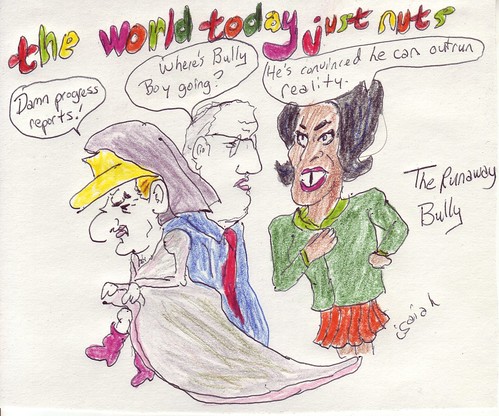
The Runaway Bully


runawaybully

That's "The Runaway Bully" from September 2, 2007. Again, I overdid the bridal motif.


One of Bush's daughters (Jenna) had announced she was engaged. That provided me with two solid ideas for comics. The first one was the first I did in the series (two posts down) and I liked it. That was followed by numerous comics of Bush in a wedding dress until we got to the pay off comic of him, Barney (the dog) and his mother. But, proving how faulty memory can be, I thought all the ones between the first and last were awful.

That's not the case, I actually like the one above. I laughed when I saw it. Bully Boy Bush was attempting -- in real life at the time -- to again play "turned corner in Iraq" and the events on the ground in Iraq were saying "NO WAY."

So that's what the comic's conveying. It's also helped by the two people present besides him: Karl Rove and Condi Rice. Condi was always my ace in the hole. Anytime I could include her in a comic, it made it better (to me, anyway). And I think that's because while it may have been Bush's administration (with Cheney calling the shots), no one better represented the 'logic' of the administration than Condi publicly.

Here's C.I.'s "Iraq snapshot:"


Thursday, March 31, 2011. Chaos and violence continue, Human Rights Watch notes the closing of one Iraqi secret prison doesn't end the problems, the US military was on the ground in Tikrit Tuesday storming into a government building despite US military command claims otherwise, Iraqis call for the United Nation to intervene and protect them, more political parties in Iraq express displeasure with Nouri's leadership, NPR airs a factually incorrect and apparently biased (against the Kurds) 'report' that implies they no longer bother to check facts before airing anything, a new study finds burn pits put US service members and contractors at risk, and more.
Human Rights Watch declared today that the announced (March 14th) plan to close the secret Iraqi prison Camp Honor is "only a first step" and that Iraq needs to do much more. As January wound down, Ned Parker. reported on the secret prisons for the Los Angeles Times and Human Rights Watch issued their report on it. Parker's January report on the secret prisons and how they were run by Nouri's security forces, the Baghdad Brigade followed up on his earlier report on how the Brigade was behind the prison that he and the paper exposed in April 2010. All the whilte Nouri insisted that there were no secret prisons in Iraq. Such as February 6th when Mohammed Tawfeeq (CNN) reported, "The Iraqi government on Sunday denied a human rights organization's allegation that it has a secret detention center in Baghdad, run by Prime Minister Nur al-Maliki's security forces." The report then quoted Nouri's spokesperson Ali al-Moussawi stating, "We don't know how such a respectable organization like Human Rights Watch is able to report such lies." Camp Honor is a prison that's under Nouri's control, staffed by people working for him. Amnesty International would also call the use of secret prisons out while Nouri continued to deny them. In the middle of this month, the world was supposed to forget all the denials and rejoice that (yet again) Nouri had been caught operating a secret prison and that he was saying (yet again) he would close one and saying that (yet again) secret prisons did not belong in the 'new' Iraq and would not be part of it. The lie would continue until March 15th.
Iraqi officials should establish an independent body with authority to impartially investigate the torture that occurred at Camp Honor and other sites run by the 56th Brigade, also known as the "Baghdad Brigade," and the Counterterrorism Service - the elite security forces attached to the military office of the prime minister. The investigating body should recommend disciplinary steps or criminal prosecution of everyone of any rank implicated in the abuse, Human Rights Watch said.
"Shutting down Camp Honor will mean little if detainees are shuffled to other facilities to face torture again," said Joe Stork, deputy Middle East director at Human Rights Watch. "There needs to be a genuine, independent investigation and criminal prosecution of everyone, regardless of rank, responsible for the horrific abuses there."
The Justice Ministry announced on March 14 that it would close Camp Honor after members of a parliamentary investigative committee, consisting largely of parliament's Human Rights Committee members, found evidence of torture during a spot inspection of the facility five days earlier. Investigative committee members told Human Rights Watch that they had observed 175 prisoners in "horrible conditions" at the prison, in Baghdad's fortified Green Zone. They said they saw physical "signs of recent abuse, including electric shocks" and marks on detainees' bodies, including long scars across their backs.
Detainees described to committee members the torture they endured there and said that more than 40 other detainees had been hastily moved from the facility less than an hour before members of the committee arrived.
Iraq's Minister of Justice Hussein al-Shammari told Human Rights Watch on March 29 that all of Camp Honor's detainees - between 150 and 160 - had been moved to three other facilities under the control of his ministry. According to the parliamentary committee, however, the number of detainees held at Camp Honor was higher. The committee, established by parliament on February 8 after a Human Rights Watch report and a Los Angeles Times article documented the abuse of detainees at Camp Honor, said it had officially requested from prison authorities a list of all the detainees' names, but had received no information as of March 29.
In response to repeated allegations of serious abuse at Iraqi detention facilities, Prime Minister Nuri al-Maliki issued a statement on March 19 reiterating that "there are no secret detention centers, and all prisons and detention centers are open to regulatory authorities and judicial authorities, which must report any violations found, if any, and notify judicial authorities to take legal action against the perpetrators."
However, the February 1 report by Human Rights Watch described a new secret prison within Camp Justice, a sprawling military base in northwest Baghdad, run by the same forces in charge at Camp Honor - the 56th Brigade and the Counterterrorism Service - both of which report directly to the prime minister's military office. The Counterterrorism Service works closely with US Special Forces.
The issue of prisons and prisoners in Iraq is huge and a major motivator in the protest movement taking place there -- especially the ones featuring attorneys in three cities (Baghdad, Basra and Mosul). However, the shotgun marriage of xenophobia and lazy meant that the protests would be protrayed differently to the outside world which ran with the nonsense that Iraqis were just sitting around, unaware and uninformed until one day, sitting in front of their satellite TVs, they saw what was taking place in Egypt and said, "Hey, that looks fun, let's try that!" Iraqi protests were going on, unreported by the western media, in 2010. The same western media then flocking to Egypt had no interest in the protests taking place in Iraq -- possibly due to the fact that western reporters rarely go anywhere in Iraq other than Baghdad and the KRG. Basra and Mosul aren't spots they frequent let alone other hotbed areas. But the first Iraq protests in 2011 took place far from Baghdad and the issues were the prisons, the families being unable to see their loved ones, the denial of trials, the denial of rights. The calls against corruption and for reform include the prison and justice (or 'justice') system in Iraq. All one ever had to do was listen to the protesters but a narrative got imposed by the press and what was at stake to the Iraqi people mattered far less to the press than its own narrative.
Friday, in Baghdad's Liberation Square, protests again took place but were largely ignored by the western media. Among the groups protesting were the wives, mothers and sisters of prisoners. (See Sunday's "And the war drags on . . ." for some screen snaps of the women from videos which can be found at The Great Iraqi Revolution Facebook page). For those women to be present, they had to overcome physical hurdles such as closed bridges, barbed wire, a ban on traffic and a light rain. They joined with other women protesting to account for the largest female presence at a Baghdad protest so far this year. They carried photos of their imprisoned loved ones and cried out for justice.
Urgent Appeal to the United Nations, represented by the UN Secretary-General Mr. Ban Ki-moon because of the suffering of the IRaqi people and the demonstrators were killed, tortured and displaced by the government-proclaimed by the US occupation in 2003, and all participants in this campaign, asking for immediate intervention in the Iraqi situation now.
Among those joining the call is Nabeel Alnabeel who writes, "We are with you all, the heart, soul and body are one for Iraq and for support for the rights of Iraq." Sarah Adeeb adds her support to the campaign and wonders over the the assault in Salah al-Din Province Tuesday (Tikrit's provinical government offices), "Why parliament or provincial councils has not suspended its meetings, even for one day??? Why did not stand a minute of silence for the souls of all those that lost their martyrs in the provinces of Salah al-Din??? Is sectarianism?? Who died or are not Bhranyen??? [. . . .] [Ahmed] Chalabi, who collects donations for Baharain."

Aswat al-Iraq reports
that Osama al-Nujafi has led a moment of silence in Parliament this afternnon to remember the victims of the Tuesday assault on the Salahuddin provincial council building. Sarah Adeeb's point still stands because the Parliament took a ten day holiday (which they only concluded last weekend) to show solidarity with the protesters in Bahrain. Sarah Adeeb is correct to be offended that Iraqi politicians will take ten days off to show solidarity with non-Iraqis but make no time to demonstrate solidarity with the people they are supposed to be representing. The Economist notes the Parliament's response and shut down in a piece today:
Politicians from Iraq's Shia majority, including a former prime minister, Ibrahim al-Jaafari, castigated the Saudi intervention. Some Sunni, Kurdish and Christian members of Iraq's parliament also condemned the Saudis, but the speaker, Osama el-Nujaifi, who hails from a leading Sunni family in Mosul, Iraq's strongly Sunni city in the north, decided to close parliament down for ten days. Some Iraqi politicians, including Iyad Allawi, a Shia who leads the main Sunni block in parliament, said that a hiatus was required to stop sectarian tension boiling over in parliament.
But it is still bubbling. Politicians and religious leaders have continued to respond to events in Bahrain along sectarian lines. Muqtada al-Sadr, a populist Iraqi Shia cleric with a big following who leads his movement from a temporary home in Iran, has castigated the intervention too. Members of his political party have called for Bahrain's embassy in Baghdad to be closed, whereas Haider al-Mulla, a Sunni MP, blames the uprising in Bahrain on Iranian interference and says that Iran's embassy in Baghdad should be shut.
No similar outcry from politicians followed the assault in Tikrit (this despite the fact that the assault can be seen as an assault on government itself). Alsumaria TV reports that AP released film of the Tirkit attack: "A soldier on the building's roof shows as pointing to the place of hostages while employees were seen going down the stairs to escape the building". Xinhua has posted video from CNTV of the assault and they note, "Iraqi security force surrounded the building and engaged in heavy fighting with the gunmen. Hours later, US and Iraqi SWAT teams stormed the building and killed the attackers."
Earlier this week, Tim Arango (New York Times) reported, "The American military did not participate in the retaking of the building but observed from nearby, according to a military spokesman." Ben Lando (Wall St. Journal) quoted US military spokesperson Col Barry Johnson stating, "Our assistance has been limited to providing aerial surveillance of the scene and keeping our soldiers on site to receive further requests for assistance if needed."
Xinhua reports, "Iraqi security force surrounded the building and engaged in heavy fighting with the gunmen. Hours later, US and Iraqi SWAT teams stormed the building and killed the attackers." Laith Hammoudi (McClatchy Newspapers) reports, "Witnesses said U.S. troops responded to the attack and entered the building with Iraqi forces trying to rescue the hostages. No U.S. casualties were reported, however, and it wasn't clear how many of the dead were hostages, gunmen or members of the Iraqi security forces. At least three of the gunmen were wearing explosive suicide belts, Iraq's Interior Ministry said."
So which is it? It's Hammoudi and Xinhua's version. The US military command has lied and a functioning press would be all over this story and how US forces -- well after Barack Obama's laughable claim that "combat operations" ended August 31st -- were rushing into a hostage situation with no knowledge of how many assailants were present in the building but knowing that the assailants had guns and bombs and had already demonstrated their willingness to use both. Combat didn't end, the Iraq War didn't end. If it ended, there'd be no need today for Hugh Fisher (Salisbury Post) to report, "Soldiers from Salisbury's National Guard aviation unit are preparing to deploy to Iraq in the coming weeks. About 80 members of C Company, 1-131st Aviation Regiment, will go to Fort Hood, Texas, where they will receive additional training before going overseas."
The Iraqi forces and the US military failed to save any hostage.
Nouri al-Maliki's been forced into promising an investigation -- most of his promised investigations never reveal anything. In fact, you could probably change that to "all of his promised investigations never reveal anything." Dar Addustour reveals the Ministry of the Defense is blaming the assault on the building's security guards. If true, that really doesn't explain the five hour standoff, now does it? And the investigation is not supposed to end with 'how it started' but, most importantly, why Iraqi forces were unable to save a single hostage. Online yesterday, The NewsHour (PBS) spoke with Jane Arraf of Al Jazeera TV and the Christian Science Monitor to get her take on the assault's meaning. (Starting with CNN before the Iraq War, Arraf has a long track record of covering Iraq and is not an insta-expert but someone who can speak with real authority on the topic.)

What's the security situation like in Iraq?

ARRAF: Since the protests started (in February), there actually has been a lull of attacks in Baghdad. Baghdad has traditionally been one of the more violent places -- it's a very target-rich environment with a lot of government ministries and basically all the symbols of not just the Iraqi government, but of the U.S.

One of the things we've seen evolve over the past year or so is a change in tactics. Al-Qaida and other groups seem to have moved away from things like bombings in marketplaces, where they indiscriminately kill civilians, because there's been a huge backlash against that. They're still specifically targeting Shias, because one of their aims appears to be to reignite the sectarian violence that led the country into civil war, and they're still targeting security forces: police, the army and government officials. Government officials are harder to get to in Baghdad because they're in the Green Zone for the most part, and it's very well-protected.

But certainly security officials are out there, and we've seen a lot of targeted assassinations -- things like gunmen using silencers and a lot of sticky bombs, or bombs placed under the carriage of a person's car that explodes when they get in.

The biggest one like (Tuesday's siege in Tikrit) that we've seen is the church attack in October. That was a similar incident -- a coordinated attack involving layers of attacks and then a response by Iraqi forces that led to further deaths. Al-Qaida in Iraq took credit for that one and said it would continue to attack Christians.


Returning to The Economist piece on the ten-day vacation Parliament took to show solidarity with people of another country and its effects within Iraq:
Iraq's parliament has now reopened but the row has weakened a coalition government that is in any case built on a fragile ethno-sectarian power-sharing agreement. More than a year after elections, no defence or interior minister has been appointed. Iran, it is said, has been promoting its own candidate for the interior ministry, whereas the defence ministry was promised to Mr Allawi's Sunni-backed block. But Mr Maliki has rejected several of Mr Allawi's nominees. Although the prime minister has a firm grip on the security services and has been trying to expand his own executive powers, he is looking more isolated as erstwhile allies complain that he has broken the promises he made when he was putting his ruling coalition together.

Today Al Mada reports that the Islamic Supreme Council of Iraq (ISCI) has declared, via a MP yesterday, that they feel they are being marginalized in the Iraqi government. Leaving Al Mada, to provide background. ISCI is headed by Ammar al-Hakim who took over when his father Abdul Aiz al-Hakim died in August of 2009. (Ammar al-Hakim assumed leadership after ISCI voted to make him the leader.) During the long stalemate, they sent conflicting messages before finally agreeing to back Nouri al-Maliki. They are a Shi'ite group and one that is frequently at odds with Moqtada al-Sadr and his backers as well as with Nouri al-Maliki. During the stalemate, although the White House had already decided to back Nouri, the administration was regularly lobbied by Americans (including the CIA) who felt ISCI would be a better bet and that al-Hakim would better represent America's interests in the region. Al Rafidayn carries the same story and notes that Iraqiya has also floated a trial balloon about withdrawing support from Nouri's government. Al Rafidayn reports Speaker of Parliament Osama al-Nujafi has noted the gulf between the people and the people's representatives in Iraq. He was speaking at a conference attended by the provincial council heads and governors and declared that the errors and doubts were "eating away at the body of this young nation."

Nouri al-Maliki and his Dawa Party (not to be confused with his State Of Law slate) are behind the shutting down of many nightclubs, wedding lounges and alcohol stores, Al Raifdayn notes, and yesterday Nouri was forced into publicly insisting that Iraq was a civil state, not denominational or sectarian but "a civil society and people have the freedome to embrace demnomiations and religions of their choice." Dar Addustour explains the word is that today the Parliament will vote on Nouri's latest Cabinet nominees and that Ali al-Lami, in reference to the nomination of Khaled al-Obeidi, is insisting that Nouri doesn't have the legal power to grant exceptions to "Ba'athists" the Justice and Accountability Commission is investigating or lodging harges against. Ali al-Lami is the Miss Hathaway to Ahmed Chalabi's Mr. Drysdale. The two used the Justice Accountability Commission in 2009 and 2010 to weed out serious rivals with false charges of "Ba'athist!" Nouri didn't complain at the time because he benefitted from the actions.


In other Parliamentary news, Al Mada reports the legislative body is questioning the claim that Iraq has the ability to produce 12 million barrels a day of crude oil. The infrastructure of Iraq's oil industry is only one of the questions being raised. It's also noted that the International Monetary Fund is skeptical of the claim. Tuesday AFP reported that the IMF, citing "infrastructure constraints," expressed grave hesitation over the claim that Iraq could be producing as much as 13 million barrels of oil per day by the year 2017. Reaching 12.2 million barrels per day would be "the very best case scenario" and "huge investments" were needed "in port facilities, pieplines, desalination plants (for water to be injected into oil fields) and storage facilities." Jaafar al-Wannan (Zawya) reminds, "The Oil Ministry announced at the end of last year a five year plan to raise the country's oil production to 12 million bpd from the 2.7 million bpd currently produced."

Moving from Baghdad to the oil-rich province of Kirkuk, the region is claimed by Kurds and by Baghdad. The dispute is not new and, in 2005, Iraqis came up with a solution to resolving the conflict: a census would be taken of the region and a referendum held in the region to determine Kirkuk's fate. They were so comfortable with this decision that they didn't just endorse it publicly, they wrote it into the country's Constitution (Article 140). Approximately a half-year after the Constitution was ratified, Nouri al-Maliki became Prime Minister for the first time (May 2006 he moved from prime minister-designate to prime minister). Despite Article 140 clearly stating that the census and referendum must take place by December 31, 2007 and despite agreeing to the US White House benchmarks which included the resolution of the rights to Kirkuk, Nouri did nothing. He pushed it back and pushed it back and suddenly, during the long stalemate following the March 7, 2010 elections, when he wanted to remain prime minister, he brought out the issue of Kirkuk again in an attempt to sway the Kurds to support him in his bid for prime minister. He even (again) scheduled a start to the census. It would take place in December 2010! But in November, he became prime minister-designate and, no longer feeling he needed Kurdish support, he quickly announced that the December census was (once again) off.
Tuesday's snapshot dealt with the Kirkuk issue and noted International Crisis Group new report entitled [PDF format warning] "Iraq and the Kurds: Confronting Withdrawal Fears" which quoted an adviser to Nouri stating, "Some of the prime minister's promises will be delivered in two to three weeks, some in two to three years, and some will take ten years. There are lots of [unimplemented] promises left over from 2006 [when the first Maliki government was formed]. We still didn't finish Article 140, and this will take perhaps ten more years." Wednesday Mike Shuster (NPR's Morning Edition) reported on the issue and, possibly due to time constraints, he didn't do a very good job. He noted that, in February, the peshmerga (elite Kurdish security force) surrounded Kirkuk when they took positions in the east and south -- as well as their positions already in the north and west. It probably would have been a good idea to give the background on why they were already in the north and west because that would have made the report come off less one-sided. They have been there for some time and been there because Baghdad was unable (or unwilling some argued in the early years of the war) to provide security to the region. Does that mean the peshmerga are angels and the Kurdistan Regional Government salvation? No. But it does allow the basic facts to be noted. Shuster notes Arab leaders in the region (the region is ethnically mixed with one of the largest minority groups, the Turkmen, frequently voicing their displeasure at both Kurds and Arabs) felt there was no real compelling danger at the time which forced the peshmerga to take up positions in the east and south. Shuster notes:
Parts of Kirkuk are bristling with weapons. One of the most heavily armed spots in the city is the Kirkuk Provincial Council. The council building and surrounding neighborhoods are crawling with police carrying AK-47s. Each of the 40 members of the council has several bodyguards, and they are all carrying pistols prominently displayed. No demilitarization here. Not surprising, given the political maneuvering that dominated the news in Kirkuk last week. The second move in the latest Kurdish gambit. Kirkuk has not held an election for governor and other positions since 2005. So a back room deal was struck between the Kurds and the Turkmen to divide up key positions. This gave more power to the Turkmen parties, with one of their own, Hassan Toran, promised the chairmanship of the provincial council.
That's more than a little confusing and it's because Shuster can't or won't call out Nouri al-Maliki who has been the obstacle in provincial elections since he became prime minister in 2006. But it's not accurate that no governors have been elected in Kirkuk and I'm really surprised that no one at NPR caught that. (Well, it's not like they have a functioning ombudsperson. But I meant the actual journalistic staff -- not a supposed watchdog who's forever napping under the front porch.)
Earlier this month, the provincial council chief and governor announced their resignations. Shuster's report aired Wednesday. Tuesday, the day before, Alsmaria TV reported, "Kirkuk Provincial Council elected on Tuesday a new governor from Kurdistan Alliance and appointed head of the council from the Turkman Front. Kirkuk Provincial Council voted by unanimity on Kurdistan Alliance member Najmddin Karim as the new governor and named Hassan Toran from the Turkman Front as head of the council, a source from Kirkuk Provincial Council told Alsumaria News." Reuters reported, "A new Kurdish governor and a Turkmen provincial council chief were elected on Tuesday in Iraq's northern Kirkuk, enraging Arab politicians in the disputed city who said they would boycott the council. [. . .] The provincial council elected Najimeldin Kareem, a Kurd, as the city's new governor and Hassan Toran, a member of the Turkmen ethnic minority, as provincial council head on Tuesday. The Arab bloc in the council boycotted the vote."
Again, someone needs to ask how and why NPR allowed Mike Shuster to report "Kirkuk has not held an election for governor and other positions since 2005. So a back room deal was struck between the Kurds and the Turkmen to divide up key positions."? Because that's not accurate. And they need to wonder why the report was filed one day after Kirkuk, in fact, elected a governor. Kirkuk is not California and if Mike Shuster can't understand the difference, NPR might need to send him back to California. I desperately want English-language reporting on Iraq but not so desperately that I'm thrilled with innaccurate and increasingly biased reporting. We've complained about Shuster before, I'd love to stop. But his reports are factually inaccurate before you even get to the slant that he's puts on them. That's nothing for NPR to brag about. A day after multiple outlets are reporting on Kirkuk electing a governor, Shuster takes to NPR airwaves to proclaim that Kirkuk's never elected a governor. Someone want to explain that? Someone want to poke (NPR ombudsperson) Alicia Shepherd in the ribs and tell her to wake up already?
We've covered Kirkuk here from the beginning and back then -- maybe Shuster has the same ignorance I suffered from -- I didn't realize its huge importance to so many or how easily some could assume you were taking a side. The only side I have ever taken is that Constitution needs to be followed or the Constitution needs to be amended. I have repeatedly stated that the US does not need to be involved in this situation which will be, once decided, like the issue of the "lost homeland" elsewhere in the Middle East and causing tensions for decades to come. The US does not need to make this decision both because it is not the US's decision to make and because the US doesn't need more animosity breeding over the coming years. Listening to Shuster's report, it's hard not to detect an anti-Kurdish bias. That goes beyond the fact that Shuster may truly be ignorant that governors in Iraq are not elected in the same manner that they are in California. That goes to this section of the report about the peshmerga moving to the south and east and, therby, encircling all of Kirkuk:
Mike Shuster: Kurdish officials claimed the move was necessary because of threats from Arab insurgent and nationalist groups, who intended to hold protests in Hawijah to the west of Kirkuk. Those protests, on February 25th, resulted in the torching of a government building and the deaths of three people.
But was there any connection in "those protests" -- outside of the city of Kirkuk but still inside the province of Kirkuk (does Shuster understand that) -- and Kirkuk itself? If so, Shuster should report it, right? Because, as it stands, his report makes the Kurds look like liars. They well may be, they well may not be. But Shuster failed to do the work required (and why do I feel that's been on every one of his report cards?). Reporting March 30th on Kirkuk's election of a governor, Hiwa Husamaddin (Zawya) explained:
Rizgar Ali stepped down from the chairmanship of the provincial council March 15, following a wave of public protests that swept through Iraq including Kirkuk. During the protests in the province, protesters in the predominantly Arab-populated town of Hawija set government buildings on fire.
Protesters chanted slogans that called for the abolition of article 140 of the Iraqi constitution. Article 140 sets a roadmap to resolve territorial disputes between Kurds and other ethnic groups in the country over Kirkuk and other disputed areas.

During the protests in the [Kirkuk] province, protesters in the predominantly Arab-populated town of Hawija set government buildings on fire. Protesters chanted slogans that called for the abolition of Article 140 of the Iraqi Constitution." That would appear to back up, at the very least, concern on the part of the Kurds. al Qaeda in Iraq is a blanket every official (US and Iraqi) appears to grab for security whenever anything goes wrong in Iraq. If the group is truly responsible for everything its credited with, then nothing's ever stopped it, let alone slowed it down. I don't know. My opinion is that it's an easy out, an easy source of blame, when things go wrong. My opinion. But if you're reporting on Kirkuk and especially on Hawijah, you might need to note the bragging at the start of February when Iraqi military -- not Kurdish peshmerga -- were bragging that they had arrested two al Qaeda in Iraq militants in -- where? -- Hawijah. Not doing so allows you to portray the Kurds as big fat liars and maybe that's why Shuster couldn't include that fact -- among many others -- in his report.
Turning to reported violence . . .
Wednesday Reuters reported a Mosul grenade attack which injured thirteen people, a Mosul bombing which claimed the life of 1 person and a Tuesday evening Baghdad roadside bombing which left five people injured. Today Reuters notes a Kalar clash in which five people were injured, 1 corpse discovered in Mosul (gunshot wounds), a Baghdad mortar attack which claimed 1 life and left three more people injured, a Baghdad sticky bombing which injured a college student, and, dropping back to Wednesday for both of the following a Baghdad home invasion in which an Iraqi officer was injured and 2 of his brothers were killed and a beheaded corpse (small boy) discovered in Baaj. Reuters also notes today a Tuesday home invasionin Baghdad in which a police officer was killed and three of his family members left wounded. This is not the incident from Tuesday's snapshot in which another police officer's home was invaded -- that one took place in Falluja: " Aswat al-Iraq reports a Falluja home invasion resulted in the death of 1 police officer and his wife and three children left injured."
I forgot to include violence in yesterday's snapshot, my apologies. Today, I had hoped to note . Kelly McEvers' All Things Considered (NPR) report. Didn't happen. We don't have room. And she's already got another report. We'll try to pick them both up in tomorrow's snapshot.
The American Chemical Society is concluding their National Meeting & Exposition in Anaheim, California today. At the conference, a presentation was made on a research study which found that Iraq War service members and contractors have been exposed to air pollution which "could pose immediate and long-term health threats." The multi-year study was explained by the research team's Jennifer M. Bell, "Our preliminary results show that the fine particulate matter concentrations frequently exceed military exposure guidelines and those individual constituents, such as lead, exceed U.S. ambient air quality standards designed to protect human health. [. . .] Coarse particles are large enough to get trapped in the hair-like fibers that line the nasal passages and the trachea preventing them from entering the lungs. Fine and ultra fine particles are so small that they bypass the body's natural defenses. When we take a breath, they travel into the deepest part of the lung where oxygen exchange takse place." She also stressed, "We are especially concerned about fine airborne particles that originate from motor vehicles, factories, open burning of trash in pits, and other sources." Karen Kaplan (Los Angeles Times) adds, "The study is being funded by the U.S. Army Research Laboratory. A summary of the findings is available here. "

There's a summit planned for this issue later this month:

Burn Pit Summit
Monday, April 18 at 9:00am
Location: Washington D.C.

Reminder: If you served in the US military and you were stop-lossed, you are owed additional money. That money needs to be claimed. DoD announces the date to file for that additional payment has been extended:

The deadline for eligible service members, veterans and their beneficiaries to apply for Retroactive Stop Loss Special Pay (RSLSP) has been extended to April 8, 2011, allowing personnel more time to apply for the benefits they've earned under the program guidelines.
The deadline extension is included in the continuing resolution signed by President Obama Friday, providing funding for federal government operations through April 8, 2011.
Retroactive Stop Loss Special Pay was established to compensate for the hardships military members encountered when their service was involuntarily extended under Stop Loss Authority between Sept. 11, 2001, and Sept. 30, 2009. Eligible members or their beneficiaries may submit a claim to their respective military service in order to receive the benefit of $500 for each full or partial month served in a Stop Loss status.
When RSLSP began on Oct. 21, 2009, the services estimated 145,000 service members, veterans and beneficiaries were eligible for this benefit. Because the majority of those eligible had separated from the military, the services have engaged in extensive and persistent outreach efforts to reach them and remind them to apply. Outreach efforts including direct mail, engaging military and veteran service organizations, social networks and media outlets, will continue through April 8, 2011.
To apply for more information, or to gather more information on RSLSP, including submission requirements and service-specific links, go to http://www.defense.gov/stoploss.


Read on ...

Thursday, March 10, 2011

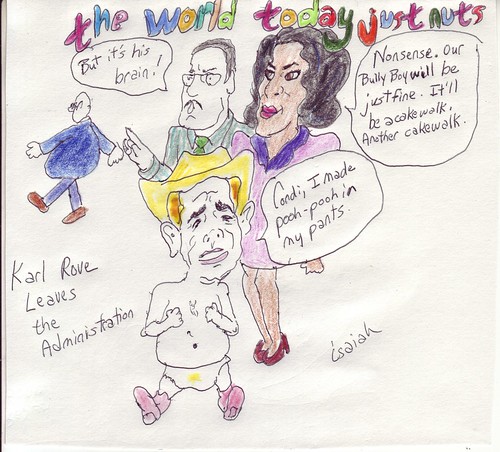
Karl Rove Leaves The Administration

karlroveleaves

That's "Karl Rove Leaves The Administration" from August 13, 2007.


Karl left and I had to do a comic noting that. It couldn't wait until the weekend. So Bush's Brain left the White House and you get Bully Boy soiling himself and talking "pooh-pooh.''

This basically drew itself.

Here's C.I.'s "Iraq snapshot:"

Thursday, March 10, 2011. Chaos and violence continue, Nouri appears before Parliament, Nouri sees one MP of his coalition resign, protests continue in Iraq, the US Director of National Intelligence excuses the brutality the Iraqi forces have heaped on protesters, where are Barack's benchmarks, and more.
"First, I'd like to welcome our witnesses for today's hearing on current and longer-term threats and challenges around the world. We are delighted to have James Clapper here for the first time as the Director of National Intelligence, along with the DIA Director General Ron Burgess," declared Chair Carl Levin this morning at the start of the Senate Armed Services Committee hearing. In his opening remarks, the Director of National Intelligence did nod to Iraq.
James Clapper: In Iraq, I think actually what has happened in Iraq has been a very interesting and encouraging evolution as they have gone -- they're going through a very difficult transition into a democracy. Uhm, they have too had demonstrations that have taken place widely throughout many cities in Iraq and personally was heartened by the uh excellent performance of the Iraqi security forces who reacted temperately to the professionally for the most part to these demonstrators.
However, it is equally true that Levin noted in his opening remarks, "We will want to learn from our witnesses their estimate of the prospects for democracy and for security for religious minorities in Iraq." Those topics were never touched on. In fact, Carl Levin was the only senator to ask of Iraq. Iraq exchange in full:
Chair Carl Levin: Can you give us an assessment of the vulnerability of the government of Iraq to the kinds of protest which have -- we've seen in other parts of that region? And has the government of Iraq cracked down on peaceful demonstration and could that lead to greater demonstrations?
James Clapper: Well, sir, I think the people in Iraq have the same aspirations as we're seeing throughout the MidEast, uh, the same four factors I indicated. And, uh, I think, uh, the word "crackdown" I guess -- that's somewhat of a loaded word. I guess they have curtailed -- controlled these demonstrations and, uh, I think the real test is the, uh, how responsive the, uh, Iraqi government can be for things like provisions of water and electricity to-to the people. And I think it's, uh, sort of basic fundamental, uh, needs, uh, and the government of Iraq, I think, understands that. The -- Prime Minister Maliki certainly does and that, uh, he's got to deliver. And that's going to be the test. And to the extent that, uh, they're not able to do that, then I think that, uh, frustration will fester more among the Iraqi people.
Chair Carl Levin: And just to tie that up, what's the Iranian influence in the Iraqi government, what's the extent of it?
James Clapper: Well sir it's, uh -- I think sometimes there is a tendancy to overstate that. I think, uh, clearly they're interested, uhm, they're going to try to influence, uh, things in Iraq in a manner that's, uh, supportive of their interests. Uh, I think, though, Prime Minister Maliki is, uh, his eyes are wide open here. He's got some background with the Iranians and, uh, I think they are very much aware of that. And certainly that's a great concern to others in the region.
Chair Carl Levin: So a limited effect? The Iranian influence?
James Clapper: Well I wouldn't -- I don't know what the right characterization is. It is a concern it's a factor and uh certainly the Iranians will try to exploit any openings they can whether in Iran -- Iraq or anywhere else in the region. And some measures -- some-some ways, uh, they would like to exploit the situation. But uh, I think that's going to be very problematic for them.
No one else bothered to ask. Ranking Member John McCain asked in a Senate Armed Services Committee hearing this week (see Tuesday's snapshot, it's noted in full -- and that was the only time Iraq came up in that hearing). Let's see we heard about Mexico being the new Columbia and we heard about the Balkans and we heard about -- Goodness, it was so bad maybe we should be grafeful no one felt the need to note the 'great' Grenada invasion of 1983.
While we were at the Senate Armed Services Committee, US Secretary of State Hillary Clinton was testifying in front of the House Foreign Affairs Subcommittee on State and Foreign Operations. Simmi Aujla (Politico) reports, "Clinton told House Republicans that cutting the agency's 2012 budget would also threaten U.S. progress in [typo error at Poliltico edited out here] Iraq and Afghanistan." I'm sorry, Hillary, we need to do that why? Those of us attending the Senate Armed Services Committee hearing this morning heard the US "world wide threat assessment" and Iraq wasn't one. Russia was number one and China was number two. We know that because after Clapper made that surprising announcement in response to Senator Joe Manchin's questions, Chair Carl Levin quickly brought him back to that issue to make sure everyone had heard correctly. (Levin: "I was frankly quite surprised by your answer.") They had. Levin gave him a third attempt to self-correct noting how it will look -- especially in Russia -- when the headlines emerge (I doubt they will outside of Russia, there were not a lot of front page press types at the hearing) of "Russia Greatest Threat To The US." Clapper said he was sticking with his answers because, for greatest threats, only Russia and China would have the capability.
In fact "cyber threats" -- specifically "malicious software" -- were the focus of more grave words from Clapper than was Iraq. The US and England led the world into the Iraq War (Australia tagged along with John Howard as everyone's pudgy kid sister). But the United Kingdom's not fretting Iraq these days. From the March 1st snapshot, when Hillary was appearing befor the full House Committee on Foreign Affairs:
While Hillary was repeatedly saying that the billions to go into Iraq -- a third surge, was how she billed it -- were necessary for national security, a curious thing was happening across the Atlantic Ocean. Alex Stevenson (Politics) reports, "Britain has shaken up its international development budget by placing renewed emphasis on poor countries which directly affect the UK's national security. The move means 16 countries including Angola, Niger, Cameroon and Lesotho will no longer receive any funding from Britain. Neither will Russia, Iraq, Vietnam, Bosnia, Serbia and Burudni." That's very interesting. The Iraq War was started and led by the US and the UK. They spent the most money on the illegal war and sent the most bodies to fight it (and had the most foreign people die in Iraq). To sell the Iraq War in the US, Bully Boy Bush resorted to many lies including that Iraq had sought yellow cake uranium from Africa. Tony Blair, then prime minister of England, had the ability to use chemical and/or biological weapons on England within 45 minutes. That's much quicker than an attack on the US and that's because England is physically closer to Iraq than is the US. So why is it that the UK argues today that they don't need to give Iraq anymore aid because it's not a threat to their own national security but the US -- White House and Hillary Clinton -- is arguing differently?
So can Hillary and the White House get honest about what's really going on? Clearly England is as tied to Iraq as the US and they're not calling it a threat to their national security and, turns out, based on Clapper's testimony, the US isn't either. Maybe we're back to what Ted Koppel, on NPR's Talk of the Nation Tuesday, speaking with Neal Conan declared?
Ted Koppel: We're there because of U.S. interests, and those U.S. interests can be summarized quite simply in one or two words: oil and natural gas. The stability of the Persian Gulf is of enormous national interest to the United State. No politician wants to send young men and women to die for oil. But the fact of the matter is that it is one of the politically most - no pun intended - inflammable issues. When the price of gasoline goes up, as it is going up right now, to $4 a gallon, if we were to leave before there is genuine stability in Iraq, if that area no longer had the oversight of American military, I think you could very easily see the price of oil go up to seven, eight, nine dollars a gallon. And the fact of the matter is then you would have all kinds of political yelling and screaming on Capitol Hill, all kinds of pressure being raised by the American public, which would not want to see that happen to its economy.
That was noted in the March 8th snapshot. So was this:
It would be "very unwise" to leave, he insisted and those who think the US is trying to help Iraq are looking at it wrong because "the prism that we're there for Iraq's interests? We're not. We're there because of US interests."
That quote is incorrect and should have included "[. . .]" and the first "we're" should have been "United States" -- my error, my apologies. What Koppel stated was, "the prism that we have been learned to - that we have been taught to accept over the last few years, and that is that the United States is in Iraq for Iraq's interests. We're not. We're there because of U.S. interests, and those U.S. interests can be summarized quite simply in one or two words: oil and natural gas. The stability of the Persian Gulf is of enormous national interest to the United States." My apologies for my error.
Is oil what Hillary's calling national security? If so, the White House needs to get honest about it. If not, they need to do a lot of explaining due to the fact that Iraq's not a national security issue for the US. It never was. It was never a threat to the US' safety. When Barack, Joe, Hillary, et al start insisting "national security" for the US staying in Iraq, they are LYING the exact same way Bush did when he claimed Iraq was a threat to the United States. If that's the standard they want to meet, then let all three of them be judged accordingly.
When Barack declared his candidacy for the Democratic Party's presidential nomination, February 2007, Tom Eley (WSWS) broke down the realites of 'antiwar' Barry:
In the coded language of official American politics, a ''responsible end'' can mean only one thing: the total subjugation of Iraq, in one way or another, and the expropriation of its enormous oil wealth, delicately referred to by Obama as ''our interests in the region."
"Our interest in the region"? What are they? Barack's a War Hawk. And he's as dishonest as Bully Boy Bush. Back to Eley:
Obama endorses and recycles as his own all of Bush's "thirteen benchmarks" for "progress" in Iraq. Among them, Obama singles out the demand for "eliminating restrictions on US forces." In other words, the Pentagon should be given an even freer hand to drown the Iraqi resistance in blood. Obama also demands the Iraqi government reduce "the size and influence of the Militias" -- that is, fully confront the powerful Al Mahdi militia.
Benchmarks. As Eley notes, Barack was thrilled to grab onto Bush's benchmarks. In fact, he, Joe and Hillary -- all US senators at the time -- were calling for benchmarks. Where are his benchmarks?
Let's review a few of the targeted groups in Iraq.
* Christians and other religious minorities
* the LGBT community
* women
* orphans
* special needs persons
There are many more targeted populations. Barack is in the White House and desperately wants to be in it in 2013. Shouldn't he have something to add? The US tax payer is being asked to fork over billions of more dollars and for what? So Nouri and his thugs can torture gay men and suspected gay men? So they can seal these men's anuses with glue and cause them to die a very painful death?
We have seen zilch from this White House when it comes to Nouri's violations of basic human rights. Doubt it? Let's go over an exchange today one more time.
Chair Carl Levin: Can you give us an assessment of the vulnerability of the government of Iraq to the kinds of protest which have -- we've seen in other parts of that region? And has the government of Iraq cracked down on peaceful demonstration and could that lead to greater demonstrations?
James Clapper: Well, sir, I think the people in Iraq have the same aspirations as we're seeing throughout the MidEast, uh, the same four factors I indicated. And, uh, I think, uh, the word "crackdown" I guess -- that's somewhat of a loaded word. I guess they have curtailed -- controlled these demonstrations and, uh, I think the real test is the, uh, how responsive the, uh, Iraqi government can be for things like provisions of water and electricity to-to the people. And I think it's, uh, sort of basic fundamental, uh, needs, uh, and the government of Iraq, I think, understands that. The -- Prime Minister Maliki certainly does and that, uh, he's got to deliver. And that's going to be the test. And to the extent that, uh, they're not able to do that, then I think that, uh, frustration will fester more among the Iraqi people.
Clapper thinks the security forces showed moderation. Really? When they beat five journalists in Basra last Friday? When did they show restraint? When they injured protesters? When they killed them? When did they show restraint? When they beat up Baghdad journalists? When? And how the hell does this behavior earn the support of the US government?
It's an illegal war and the US has installed a thug. But if that doesn't matter to the current White House -- and it obviously doesn't since it was the current White House that ensured Nouri continued as prime minister -- how about this: The man considered an idiot (George W. Bush) laid down (under duress, true) benchmarks that Iraq was supposed to meet in order to continue to receive US tax payer money; however, someone supposedly smarter than George W. Bush doesn't even see the need for benchmarks today. Doesn't see the need while despite the targeting of religious minorities, of Iraq's LGBT community, of Iraqi women and on and on. That's very telling and what it's telling on the current White House isn't at all pretty.
Turning to Iraq, Emad Kamel (Al Mada) reports on the threats to Iraq's food security and agriculture as a result of water concerns and notes that experts are predicting future wars will revolve around water resources. Related, Al Mada reports that Iraq's Minister of Agriculture is requesting that the Iranian government clarify their plans on building dams effecting the bodies of water the two countries share.
Reuters quotes Iraq's Deputy Prime Minister Saleh al-Mutlaq stating, "If [Nouri al-] Maliki cannot administer his government in these three months in a way to meet the ambitions of people, I believe he himself should resign. These protests are not against this current government. They are against the accumulation of financial and administrative corruption and against building the country in an inappropriate way for the last eight years." This as the editorial board of the National Newspaper observes, "As The National reported yesterday, Nouri al Maliki, the incumbent prime minister, continues to dither on promised power-sharing deals, and points fingers instead. He's given his cabinet 100 days to reform or face unspecified 'changes'. He has also accused al Qa'eda and Baathists of encouraging street demonstrations. Both moves are ill-conceived attempts to divert blame from his own leadership. Mr al Maliki must recognise that it is not only his future on the line, but Iraq's. Both will lose out if he fails to address the grievances of its people." Al Rafidayn notes al-Mutlaq is a member of Iraqiya and states he is trying to limit any anti-government fallout from Nouri's inaction attaching to him (al-Mutlaq). Alsumaria TV points out Nouri appeared before the Parliament today.
In April 2006, Nouri al-Maliki became prime minister-designate. In May of 2006, he became prime minister. By misusing the powers of his office, he ensured he would remain prime minister despite the results of the March 7, 2010 elections and the will of the people. So Nouri is now serving his fifth year as prime minister. Qassim Abdul-Zahra (AP) reports that when Nouri appeared before Parliament today he attempted to spread the blame ("The current situation is not the responsibility of one group, rather it is a joint responsibility. The executive and legislative authorities share responsibility in both successes and setbacks.") but that some rejected that attempt and MP Maha al-Douri (Sadr bloc) is quoted as stating, "He tried to throw the ball into the parliament's court for the failures that took place in the country. What we need is immediate solutions for the problems, not long speeches." But the most telling evaluation of Nouri's performance may be via Aswat al-Iraq which reports MP Saifya al-Suhail (Nouri's State Of Law slate) issued a statement stating that, due to "the non-democratic ways," she was leaving State Of Law: "I have suffered blackballing, ignoring and marginalizing when it comes to contributing to key political decision-making for the bloc. There was meager coordination and consultation as well as autocracy practiced by a limited number of persons."
Tuesday's snapshot included the following, " Aswat al-Iraq reports that US Special Forces did 'an air drop operation on a village in al-Huweija district and raided some houses, killed a physician and arrested his brother' -- and if you're wondering, US Special Forces roam free in Iraq. Osama al-Nujefi, Speaker of Parliament, wants an investigation into US actions." Today Parliament's health committeee held a press conference. Aswat al-Iraq quotes the statement issued: "The Committee, denouncing the killing of an Iraqi physician during a raid by U.S. soldiers and Salah al-Din security forces on his house, calls on the prime minister to launch immediate investigations into the incident and bringing the persons involved to justice."
Al Mada reports that Moqtada al-Sadr has concluded his meetings with various officials and office holders in his party. In related news, KRG President Massoud Barzani is in Baghdad. Dar Addustour reports he is present in an attempt to resolve the issue of the National Council. And no doubt, he's present in an attempt to hold together the fragile power-sharing agreement -- especially after calls from the White House.
Dar Addustour notes that Nouri is set to make a series of proposals, allegedly in response to the demands of protesters, and also to make his nominations for the Cabinet positions he still has not filled all this time later. Al Mada notes that the Commission on Parliamentary Srvices has declared that it will be very difficult for the demands to be met.
Meanwhile New Sabah reports that Kut saw protests yesterday in response to an attempt to move the commander of their rapid response regiment to Baghdad and that there was a walk out, that it was peaceful and that the demands are to keep the commander in Kut. So there's now a split in Kut. There are those who are outraged by the treatment of the protesters last month -- with at least one killed and close to fifty injured -- and there are those who want the man seen as responsible for the violence to remain in Kut. Dar Addustour reports a Baghdad protest by workers with the State Company of Heavy Equipment for the oil industry, numbering around 500, protested in Firdaus Square against corruption and unfair wages. They are threatening a hunge strike. In Dhi Qar, Iraqis with special needs marched outside the province's council offices calling for funding that would increase the quality of their lives and noting that they suffer because they are not able to work. Protests are scheduled for tomorrow.
In economic news, Mohammed Tawfeeq (CNN) reports the bombing of an oil "pipeline in Ninevah province [which] pumps about 500,000 barrels of crude oil every day to the Turkish port of Cevhan". Citing Ministry of Oil spokesperson Asim Jihad, AP states that it is expected the pipeline will be shut down for a minimum of three days; however, Jihad tells Reuters, "We (the oil ministry) have put a 5-day timeframe to fix it, starting from yesterday. We are trying to shorten this time." Hassan Hafidh (Dow Jones) explains, "Iraq usually pumps between 450,000 and 490,000 barrels a day via that pipeline. The crude oil is exported to Europe and Turkey." Brendan Conway (MarketWatch) adds that "U.S. stocks were sharply lower Thursday, dragging the Dow Jones Industrial Average below the psychologically important 12000 mark for a time [. . .] The stock sldie comes at a point when investors have been battered for weeks by fears of continued political unrest in the Middle East and North Africa. The continued fighting in Libya between rebel forces and those loyal to Moammar Gadhafi is still the focal point, but investors are also watching reports of new protests scheduled for Friday in other countries including Saudi Arabia and Iraq." And clarifying priorities, Aswat al-Iraq notes, a pipeline to the northwest of Mosul was attacked today and a security source explains, "Pumping oil to Syrian did not stop, but pumping water to a village dropped due to the explosion."
Billie Jean Grinder and Marcus R. Alford Sr. died serving in Iraq February 21, 2010. Hugh G. Willett (Knoxville News Sentinel) reports their loved ones have filed a suit as a result of the helicopter crash that claimed the lives of Grinder and Alford, "At the time of the crash, the Department of Defense said Grinder and Alford were trying to land their helicopter near Qayyarah Airfield West, about 30 miles south of Mosul, were not under fire and no enemy forces were nearby. Named as defendants in the suit, filed Feb. 18, are Bell Helicopter Textron, Rolls-Royce North America, Goodrich Pump and Engine Control Systems, Unison Industries and Honeywell International. According to the suit, the Kiowa's FADEC system failed on a Feb. 21, 2010, mission in Iraq, resulting in the crash that killed Alford and Grinder."
Moving over to today's violence . . .
Bombings?
Reuters notes a Baghdad roadside bombing which claimed the life of 1 police officer (three more injured), another Baghdad roadside bombing which left one civilian injured, a third Baghdad roadside bombing which injured three people (one was a police officer), a fourth Baghdad roadside bombing which injured one person, a fifth one which left three police officers injured, a sixth one which left four police officers injured, a fifth one which left five people injured and, dropping back to Wednesday, a Baghdad sticky bombing which left two people wounded. Aswat al-Iraq notes a Falluja sticky bombing claimed 1 life.
Shootings?
Reuters notes a Baghdad "shootout" in which 2 civilians and 4 police officers were killed but the assailants escaped apparently unharmed. Aswat al-Iraq notes 1 person shot dead in Falluja.
Corpses?

Aswat al-Iraq reports one corpses was discovered in Missan.
Ed Tibbetts (Globe Gazette) reports that US House Rep Bruce Braley "has reintroduced legislation that would require an accounting of the 'long-term human and financial cost' of the wars in Iraq and Afghanistan through 2020." Iowa's The State quotes Braley stating, "In the last 10 years, Congress has appropriated over a trillion dollars for the wars in Iraq and Afghanistan. But what we don't account for in that figure is the more than 5,800 U.S. Service members who've been killed in the line of duty in Afghanistan and Iraq. Or the more than 40,000 who've been wounded and who will spend the rest of their lives treating injuries like PTSD, traumatic brain injury, severe burns and amputated limbs. These are not just costs that our troops and their families bear -- these are also significant costs for the Veterans Affairs department and all American taxpayers. As a nation, we have a right to know what these conflicts will actually cost us." US House Rep Bruce Braley's office released the following yesterday:

Braley Fights to Expose True Cost of Iraq, Afghanistan Wars
Introduces bi-partisan bill to require reporting on true cost of wars

Washington, DC -- Today, Congressman Bruce Braley (IA-01) introduced a bill that would require a full accounting of the human and financial costs of the wars in Iraq and Afghanistan. Earlier this week, Rep. Braley returned from a Congressional fact-finding mission in Afghanistan where he met with General David Petraeus and discussed the cost of the Afghanistan war with him. Rep. Braley also met with several top commanders on the ground and numerous Iowa National Guard troops -- 3,500 of which are currently stationed in Afghanistan.

"These wars are incredibly personal for me and the people of my district," said Rep. Braley. "I've met with dozens of my constituents -- young men and women and their families -- who have sacrificed a great deal in the wars in Iraq and Afghanistan. And when I meet injured soldiers and I see the hardships -- physical and financial -- that they and their families will endure for the rest of their lives it becomes crystal clear that the true cost of the war is not being accurately reported. With this bill, we can change that."

The bipartisan True Cost of War Act, co-sponsored by Republican Congressman Walter Jones (NC-03), requires the President to work with the Secretaries of Defense, State and Veterans Affairs to submit a written report to Congress on the long-term human and financial costs of the war in Iraq and Afghanistan through 2020.

"In the last 10 years, Congress has appropriated over a trillion dollars for the wars in Iraq and Afghanistan," said Rep. Braley. "But what we don't account for in that figure is the more than 5,800 U.S. Service members who've been killed in the line of duty in Afghanistan and Iraq. Or the more than 40,000 who've been wounded and who will spend the rest of their lives treating injuries like PTSD, traumatic brain injury, severe burns and amputated limbs. These are not just costs that our troops and their families bear -- these are also significant costs for the Veterans Affairs department and all American taxpayers. As a nation, we have a right to know what these conflicts will actually cost us."

Rep. Braley has been fighting for a true accounting of the Iraq and Afghanistan wars since he came to Congress. He has introduced and passed similar language in several amendments to past House bills.

Click here for text of the legislation.

In related news, Morris Workman (Mesquite Local News) explains he was wrong to support Barack Obama in 2008 for president: "For example, he promised he would get us out of Iraq. Today, there are still Americans in military uniforms carrying weapons around Baghdad, but they don't count because Obama removed their official designation as 'combat troops'. He hasn't done much to get us out of Afghanistan either, keeping our troops in harm's way without a real plan, without an exit strategy, and without even bothering to come up with a real reason beyond the Elmer Fudd-sounding excuse of 'Eh-h-h-h, there's got to be some Tawiban awound here somewhere'." And while some in the press blame Americans for not knowing what is not reported, Gary Daily (Terre Haute Tribune Star) uses his column to cover the wars in Iraq and Afghanistan and to note what the media spends so much time on instead:

It's the same old, same old when I read the newspaper. Republicans believe (or pretend to believe) that the 7 percent of union members in America's workforce caused the Bush Depression. Charlie Sheen again demonstrates which part of "Two and Half Men" he is. And college sports scandals continue to blossom and smell stronger than the sweat in a crowded locker room or the money in a big booster's off-shore bank account.
Not getting as much attention is the same old news on America's wars in Iraq and Afghanistan. I guess the expiration date on interest in these costly wars (trillions and counting) and deadly (thousands and counting) has run out.
U.S. newspapers and television programs also ignore the wars. Some broadcasters do acknowledge the wars thousands of miles away, but they also say these wars are rarely the lead story, on grounds that people are not that interested.
But the truth is the Obama Administration is happy to keep the popular pressure off as the fighting goes on.
Obama is following his predecessor, George W. Bush, regarding war policies and censorship. The Bush Administration barred coverage by reporters and cameramen of the American soldier coffins. But the truth is the Obama Administration is happy to keep any anti-war popular pressure off against the wars as the fighting continues.
Those pictures might upset the country and leave us asking, "Why are we still fighting and dying in those wars?" We have yet to get a straightforward answer from Obama, as to why he chooses to continue the Bush-instigated wars.


Read on ...

Thursday, January 28, 2010

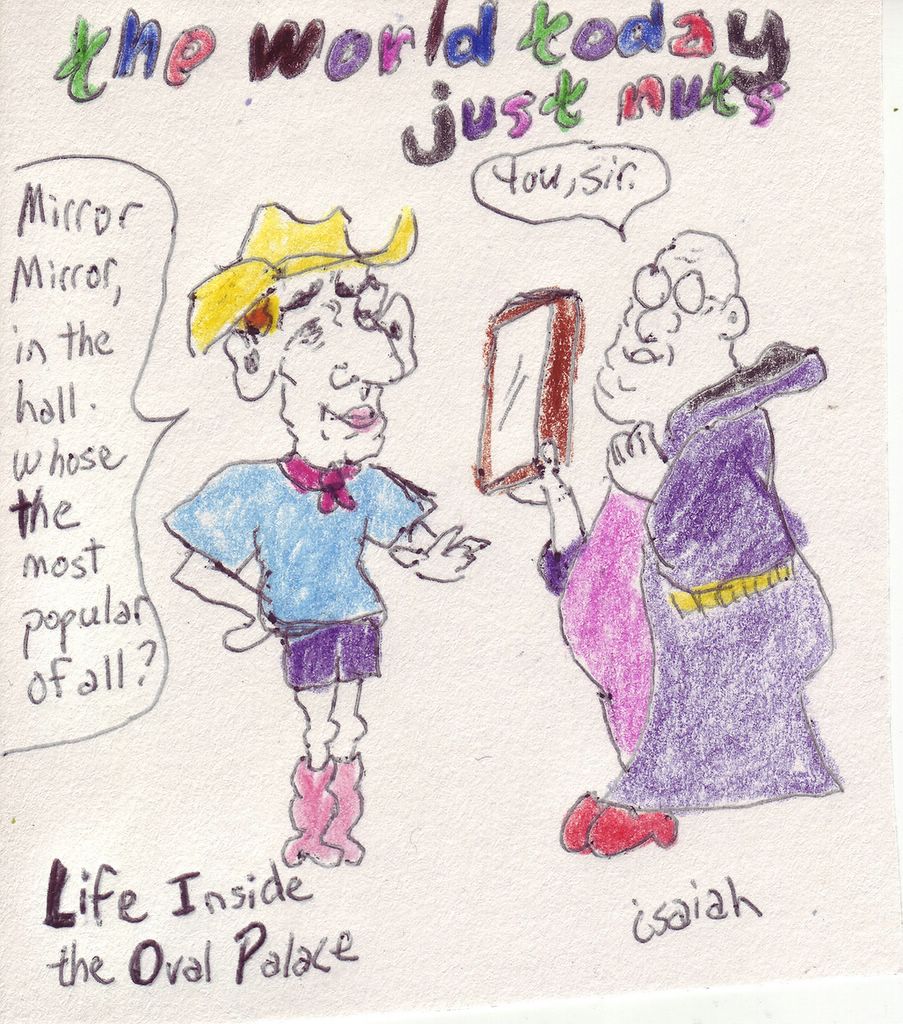
Life Inside the Oval Palace


From May 7, 2006, that's "Life Inside the Oval Palace."

I really don't know what I was thinking. Or didn't, when I looked at this comic. I didn't even remember it. Then I saw Karl's robe and, honestly, my niece loves Disney and we had watched Sleeping Beauty together because she was staying over here while her parents were out of town at a wedding.

So that's really why that comic came to be. Yeah, it's more Snow White with the whole looking glass. I just remember being impressed with the velvet and purple shades in Sleeping Beauty.


And here's C.I.'s "Iraq snapshot:"

Thursday, January 28, 2010. Chaos and violence continue, a former US Staff Sgt admits to money laundering (for plastic surgery and other 'needed' items) while serving in Iraq, the US Senate continues to ignore a bill proposed to assist veterans exposed to toxic hazards, Iraq cracks down on the media again, and more.

Today the Senate Veterans Affairs Committee held a hearing to vote on a nomination and proposed legislation. Starting with the nomination, November 9th, US President Barack Obama nominated Raul Perea-Henze to be the Assistant Secretary of Policy and Planning, Department of Veterans Affairs. Today the Senate Veterans Affairs Committee took a vote. Excepting Ranking Member Richard Burr, Lindsey Graham and Johnny Isakson, all voted in favor of Perea-Henze (Graham was not present during the vote, Burr asked that the record reflect Graham and his own votes opposing the nomination). ("All voted in favor? I would assume the entire committee. Most of whom did not show -- eight of the fifteen committee members were present during the vote -- for the hearing but if Graham's vote in opposition is recorded despite him not being present, I would assume those not present could also vote in favor of the nomination.)

Markup hearing? If you're thinking they addressed S. 1779, you are wrong. That bill addressed the need for a federal registry, similar to the one for Agent Orange exposure, for veterans exposed to contaminates while serving. It was
introduced by Senator Evan Bayh, has been held up by the Committee since October 21st. Bayh's bill is co-sponsored by Byron Dorgan (who has been also been a leader on this issue), Robert Byrd, Jeff Merkley, John Rockefeller, Ron Wyden and Richard Lugar. That bill's still buried.

If that surprises you, imagine being Senator Jay Rockefeller who had a statement on the bill all ready for delivery. In fact,
it's posted at the Committee's website:

Mr. Chairman, I want to thank you for this mark up, following up on the powerful and emotional hearing of October 8th last year with military personnel and family members exposed to toxic materials in their combat service, and even from their military housing.
At that hearing, my remarks and questions focused on Russell Powell, a medic with the West Virginia Guard. He and hundreds of other members of the Guard were exposed to toxic chemicals while on duty guarding the Qarmat Ali Water Treatment Facility in Basra, Iraq. For years, they were kept in the dark -- not told about their exposure. And today, they are still struggling to get the health care they need.
That is simply not acceptable. It must be fixed. And I believe today's mark represents the first important step forward.
I greatly appreciate that Chairman Akaka has incorporated a vital provision from Senator Bayh's legislation -- which I have cosponsored -- to guarantee these guardsmen the quality VA health care coverage they have earned.
That guarantee is an important element of the Homeless Veterans and Health Care Act and I strongly support it.
But at last fall's hearing, we also were moved by the heartbreaking testimony from military family members.
In particular: families describing serious water problems at Camp Lejeune and dangerous toxins in the air at Atsugi Naval Air base in Japan.
There is no doubt, we all agreed: Military personnel and family members dealing with the painful consequences of toxic exposure deserve the best health care possible.
Chairman Akaka's new legislation provides the right kind of care to families from Camp Lejeune and Atsugi Naval Air base.
But his bill goes beyond those two locations and their toxic exposure incidents. It creates a process between the VA and DoD to deal with thousands of potential exposures through a joint board. And, so future families don't have to wait for decades, the bill establishes a clear time frame for the board's decisions.
I firmly believe we must be absolutely clear about our shared responsibility. The VA's responsibility is our veterans and their care. DoD has a longstanding policy of caring for their military dependents.
DoD bears significant responsibility and has to take responsibility, today. The Pentagon has to acknowledge what happened and bear the financial costs. This matters.
The Akaka bill strikes the proper balance -- allowing the VA to provide coverage for veterans while DoD covers their families. The Chairman's legislation gets it right and I strongly support his efforts. This is our chance to do the right thing, honor our veterans' service and recognize their families' sacrifice, by ensuring they get the care they seek, they need, and they deserve.

It needed saying. Sadly, it went unsaid. There was no time for the needed bill.

What did they discuss? We'll note Richard Burr's remarks.

Ranking Member Richard Burr: As you know one of my top priorities in the Congress has been to end homelessness among our country's veterans. And the Committee Print S. 1237, the Homeless Veterans and Other Health Care Authorities Act of 2010, furthers that goal and I applaud all the members for their commitment to homelessness. I'm concerned however that the Committee's marking up legislation without having the official views of the Dept of Veterans Affairs on S. 1547, one of the key measures in the Committee Print before us today. We've heard the President talk about el-eliminating duplicate programs. We have had a legislative hearing on 1547 in October at which time where officials views from the administration were promised but, three months later, we still don't have those views. Without those views, the Committee doesn't have a full scope of key questions such as how the creation of a new program or the expansion of an existing ones will be coordinated with other homeless programs administered by the VA and other federal agencies? Or how this legislation fits with the [VA] Secretary's overall plan to end homelessness in five years? As well: What is the cost of the legislation and how long will it take the VA to be able to be appropriately staffed to carry out the bill's mandates? Now I'm not suggesting by any stretch of the imagination that any administration's testimony should dictate how this Committee proceeds but it would be helpful to have information to make an informed judgment on what's best for veterans and addressing their specific needs. As for the second bill on the agenda, quite frankly I'm disappointed. I'm disappointed at the approach used to provide health care for veterans and family members exposed to contaminated well water at Camp Lejeune. Not only might this bill be subject to Rule 25 Point Of Order because of subject matter, it's arguably in another Committee's jurisdiction, it also fails to appreciate the deep distrust that family members and veterans have for the Dept of Defense and, specifically, it's handling of these matters once these wells were found to be contaminated and, in the years since, on the scientific inquiries that have been ongoing. Frankly, to those effected by the contamination at Camp Lejeune, requiring DoD to be a key decision maker and provider of health care is absurd. Now. I'm disappointed personally that the majority has decided to take the tack that they have to put a different bill in. Uh-uh. I don't think it's been the practice of the Committee in the past. And, uhm, I hope this is not an indication of how we proceed forward in this Committee. I understand the Chairman has the votes, I know what the outcome is. It won't change my passion for this debate. It will not change the degree of description of what I share with the members . It is the reason that and I other members have turned to this legislation and it is certainly indicative of why Democrats and Republicans in the House next week will introduce practically the same bill with VA responsibilities to provide health care to individuals and family members that have disease that could likely be tied to exposure to contaminants on a military installation. Now I would only ask the members of this Committee -- likely included that group are some of your constituents -- and though you haven't had to fight the Dept of Defense day in and day out on behalf of this group, I have and members before me have -- without any conclusion, without any finality, without any help. Today as we sit here getting ready for this markup, even though under US Code 42, statutorily the Secretary of the Navy is obligated to pay for the studies required to understand the health and mortality effects of this exposure, the Secretary of the Navy refuses to fund the CDC's arm at ASTDR that is obligated entity to go out and share with the country their scientific conclusion. Let me say that again: The Secretary of the Navy has refused to fund -- even though the law says he has to. So for me in good conscience to turn this over to the Dept of Defense to determine the scope of coverage for these individuals is insane. If the outcome of this vote is pre-determined, then so be it. I would hate for members to leave the markup today and believe that they will not revisit this issue. It will be revisited time and time and time again until the Congress recognizes that maybe the Dept of Defense, maybe the Secretary of the Navy can hide but the Congress can't hide from these people. These are people we represent. These are people that have asked us to come here and represent their interests, their health concerns, their future and I can't hide from them.

To be clear, his objection to the second bill is that DoD is being put in charge when DoD is seen as the person who put people at risk to begin with and is seen as refusing to admit to the contamination after the public discovered it. He is advocating for, among other things, the VA being over the issue the way that the House proposal will advocate (US House Rep Chet Edwards is introducing that measure). Burr proposed an amendment, 9 (Democrats plus Bernie Sanders -- Sanders was not present) voted to table the amendment, all five Republicans voted against tabling it. (Again, only 8 of the 15 Committee members were present.)

On the first bill, his objection is one that is being whispered by Democrats and will probably come out in public in the next months: The administration promises to get back to Congress but never does. Publicly, Ike Skelton and Carl Levin (chairs of the House and Armed Services Committee) have made statements in hearings regarding this issue but look for more serious statements to be made. (Congress -- those two committees in fact -- have still not been provided with the so-called 'withdrawal' plan from Iraq by the administration despite repeated promises.)

Burr is stating that he is unsure of whether the bill is workable or what is needed because the VA has not provided the feedback that was promised. He is stating that hearing from the VA wouldn't mean a yes or a no vote for him but it would mean that he and the Committee would have a stronger framework to judge the bill and the needs. That is what he is saying. But what Democrats are saying (Burr is a Republican) is that they're getting very tired of the administration promising testimonies and witnesses and reports that never arrive. A Republican brought it up for the first time in a hearing this year but if the White House doesn't start living up to their promises to Congress, Democrats who are complaining privately are going to go public and they will not do it as nicely as US House Rep Skelton and US Senator Levin did last year.

For Jon Tester and you can read
Kat tonight -- she'll cover his testy nature. Wally filling in for Rebecca tonight intends to note one aspect of Burr's remarks.

Today the
US Justice Dept announced that Theresa Russell (not the actress, this is a one-time US Army Staff Sgt) entered a guilty plea to money laundering while 'serving' in Iraq and that her ill gotten gain went on to fund her purchase of "a car, cosmetic surgery, and" more. From the Justice Dept news release:

WASHINGTON -- A former staff sergeant in the U.S. Army pleaded guilty today to a one-count criminal information charging her with money laundering arising from a scheme involving the fraudulent awarding and administration of U.S. government contracts in Iraq, announced Assistant Attorney General Lanny A. Breuer of the Criminal Division.
Theresa Russell, 40, of Pleasanton, Texas, pleaded guilty in federal court in San Antonio. According to court documents, from January 2004 through October 2004, Russell was deployed to Logistical Support Area (LSA) Anaconda, a U.S. military installation near Balad, Iraq. As part of the plea, Russell admitted that from April 2004 to February 2005, she received more than $30,000 in cash from John Rivard, a former major in the U.S. Army Reserves. Russell admitted that she knew the money she received from Rivard was the proceeds of bribery.
In July 2007, Rivard pleaded guilty to bribery, among other offenses, in connection with his service as an Army contracting officer at LSA Anaconda. According to court documents, from April 2004 to August 2005, Rivard conspired with a government contractor to steer federally-funded contracts to the contractor's company in exchange for hundreds of thousands of dollars in illicit bribe payments.
According to court documents, Rivard instructed Russell to divide the payments she received from him into several smaller monetary bank deposits, which she admitted she did, in an effort to avoid the detection of law enforcement authorities. Russell admitted that she subsequently used the criminal proceeds to purchase, among other things, a car, cosmetic surgery, and household furnishings and goods.
The maximum penalty for the money laundering charge is 10 years in prison, a $250,000 fine and three years of supervised release following the prison term. Sentencing is scheduled for May 21, 2010.
This case is being prosecuted by Trial Attorneys Daniel A. Petalas and Justin V. Shur of the Criminal Division's Public Integrity Section, as well as Trial Attorney Ann C. Brickley. This case is being investigated by Army Criminal Investigation Command; Defense Criminal Investigative Service; the FBI; Internal Revenue Service-Criminal Investigation; Special Inspector General for Iraq Reconstruction; and U.S. Immigration and Customs Enforcement.

While we're on the legal system, we'll drop back to last week. Danny Fitzsimons is a British citizen who stands accused of killing two 1 British citizen (Paul McGuigan) and 1 Australian citizen (Darren Hoare) while wounding one Iraqi (Arkhan Madhi) in an
August 9th Baghdad shooting.

"They gave me a gun" he said
"They gave me a mission
For the power and the glory --
Propaganda -- piss on 'em
There's a war zone inside me --
I can feel things exploding --
I can't even hear the f**king music playing
For the beat of -- the beat of black wings."
[. . .]
"They want you -- they need you --
They train you to kill --
To be a pin on some map --
Some vicarious thrill --
The old hate the young
That's the whole heartless thing
The old pick the wars
We die in 'em
To the beat of -- the beat of black wings"
-- "The Beat of Black Wings," words and music by
Joni Mitchell, first appears on her Chalk Mark In A Rainstorm.

Iraq War veteran Danny Fitzimons joined the British military at the age of 16 and was deployed on his first mission at the age of 18. Before he was 28-years-old, he'd been diagnosed with PTSD. Out of the military, he began working for the contractor AmrourGroup Inc in August 2009. The shootings took place August 9th. By August 10th,
Martin Chulov and Steven Morris (Guardian) were reporting that British embassy staff was not allowed to speak with Danny and that the Iraqi government or 'government' was announcing Danny had been in court (the day after the incident) and given a full confession. To be clear, the reporters were not vouching for the confession. Only an idiot -- or an American reporter -- would do that. Iraq has a long history (even just post-invasion) of forcing 'confessions'. August 11th, Amnesty International issued the following:

Responding to reports that a British employee of a security company working in Iraq may face a death sentence, Amnesty International UK Media Director Mike Blakemore said: 'It's right that private military and security company employees like Danny Fitzsimons are not placed above the law when they're working in places like Iraq and it's right that the Iraqi authorities are set to investigate this very serious incident. 'However, as with all capital cases, Amnesty would strenuously oppose the application of the death penalty if applied to Mr Fitzsimons in this case.'Iraq has a dreadful record of unfair capital trials and at least 34 people were hanged in the country last year alone. 'The important thing now is that if Danny Fitzsimons is put on trial he is allowed a fair trial process without resort to the cruelty of a death sentence.' Last year 34 criminals were hanged in Iraq. Private security guard Fitzsimons, employed by UK firm ArmorGroup, would be the first Westerner on trial since the invasion of Iraq in 2003.

Kim Sengupta (Independent of London) reported last Thursday that Danny appeared in Iraqi court and "was sent for psychiatric evaluation minutes after the start of his trial". Oliver August (Times of London) adds, "Efforts to have Mr Fitzsimons tried in the UK have failed since Iraq and Britain do not have a prisoner transfer agreement. However, once he has been sentenced or is found to be mentally ill, London and Baghdad may discuss the possibility of bringing him back." Adam Schreck (Time magazine) reports, "The trial has been adjourned until Feb. 18, according to Fitzsimons' attorney, Tariq Harb." There is a petition on Facebook calling for Danny to be tried in the United Kingdom and not in England. Reprieve is raising funds for Danny's defense.


Yesterday's snapshot noted: "Vying for the title of Idiot of the Week, Hill has competition!, is Ali al-Lami who insists to Asharq Al-Awsat that he is not controlled by Iran. The fresh from prison al-Lami heads the extra-legal Accountability and Justice Commission. And certainly, if you were released from prison mere months ago, you too would be heading a government commission because that's what cronyism is all about, right, Ali? Don't call him Ahmed Chalabi's lover because they insist they are just friends. With no benefits. Or none they admit to. But Ali explains that he's cracked down on the media and they've figured out their place and 'calmed down' because he's threatened them with 'lawsuits'. He's a little bully." Lawsuits are just one path to censorship in Iraq -- a path Nouri al-Maliki's sashayed down repeatedly. Aseel Kami, Missy Ryan and Andrew Roche (Reuters) report today that Iraq's government or "government" is attempting to convince Syria, Lebanon and Egype to shut down various satellite channels originating from their countries. This will be presented as 'fair' but anyone in the world paying attention will say, "Hey, Iran's a neighbor. Iran's got stations 'inflaming' tensions as much as anyone else." But notice that Iran isn't a source of concern. Notice that and then start looking at the media reports and noticing how many fail to raise that issue.

Let's turn to some of today's reported violence . . .

Bombings?

Reuters notes a Kirkuk roadside bombing injured seven police officers and a Kirkuk mortar attack left four people injured.

Shootings?

Reuters reports 1 Sunni Imam shot dead outside a Baghdad mosque and that 1 police officer was wounded in a Baghdad shooting.

Monday, Baghdad was slammed with bombings and the death toll is at least 41 with over seventy wounded. Yesterday Ann noted Martin Chulov of the Guardian appearing on KPFA's The Morning Show and explaining:

After that there was a lot of shooting very near our location. Some colleagues of my staff wanted to run to their families who lived inside the Hamra compound. We had to restrain them. We were very near and it became clear that a car was trying to get through -- to get inside the hotel. So we ran and the car did get inside and it detonated. During the explosion, most of my colleagues emerged unscathed. There were some walking wounded at the Washington Post who had a house inside the area and also in the hotel itself. And sadly, one of our collegues from the Times of London a longtime local employee was killed.

Ann also notes, "Now to see photos of the destruction inside the al-Hamra Hotel,
click here for an Iraqi correspondent with McClatchy Newspapers." Yasser was killed and yesterday's snapshot noted Lourdes Garcia-Navarro (NPR's Morning Edition. link has text and transcript) remembering him and James Hider (Times of London) remembering him as well. The Times of London's Richard Beeston notes:

Yasser, the Times's driver killed on Monday in a bomb attack, was among the very best. He delivered daily accounts of the vicious sectarian street battles that erupted in Baghdad between 2005 and 2007. He knew better than anyone how the contest between Sunni gunmen and Shia militias was being played out because he and his family lived in one of the disputed areas.
Driving through the city he would point out which roads were safe and which were dangerous. His intelligence assessment was far more valuable than anything I ever heard at security briefings in the American or British embassies.

The Economist notes today that their correspondent was wounded in the al-Hamra Hotel bombing. The Economist also tackles the banning of political candidates in Iraq:


IN THE run-up to a general election due on March 7th, Iraq's authorities seem to be taking a page out of Iran's illiberal electoral rule book by barring candidates they dislike. One of the competing parties, the Iraqi National Congress, led by Ahmed Chalabi, a longtime Shia exile who helped persuade George Bush to invade Iraq in 2003, has persuaded the election's overseers to ban some 500 candidates deemed too close in the past to Saddam Hussein's Baath party. After the invasion the Americans put Mr Chalabi, then their closest Iraqi ally, in charge of "deBaathification", but he later fell out with them, so he turned for succour to Iran. Now, with a view to winning more votes for himself, he is using his long-dormant post to accuse his foes of having supported the deposed dictator. Though the list contains many Shias, Iraq's minority Sunnis, who ruled the roost under Mr Hussein, are outraged, seeing a plot to discriminate against them. The episode could badly tarnish the poll.
Many other Shia politicians have joined what looks like a witch hunt. Muhammad al-Haidari, a leader of the Islamic Supreme Council of Iraq (ISCI), a powerful Shia group, says that Baathists are worse than Nazis; all past members should, he says, be banned from public life. In the holy city of Najaf, ISCI's heartland, a new rule decrees that former Baathists must be purged from government and chased out of town. Never mind that Iraq's post-invasion constitution bars only senior Baathists from public office and that millions of ordinary Iraqis joined the party only out of necessity, not conviction. Ostracising them threatens once again to split Iraq down the middle and disfranchise many Sunnis, who used to dominate the Baath party.

The
National Newspaper offers:

Maliki has not only failed to condemn the commission's decision to bar 511 candidates, he has embraced it, piously invoking the law -- and surely reckoning that standing up for the Baath party in the name of reconciliation is political suicide, especially in an election year. Yet not many months ago, Maliki was negotiating with the Sunni leader Saleh al Mutlaq, one of the current campaign's main targets, to form a joint coalition.
The crisis of today represents the consequences of yesterday's bad policies: both the Americans and the ruling parties have encouraged the selective use of de-Baathification -- whether to protect people with suspect records who were prepared to serve the new order, or those who proved useful in the campaign against insurgents. The US appears motivated primarily by the need to keep things relatively stable and solidly on track for a smooth troop withdrawal, regardless of what may come afterward. The Maliki government has used the threat of de-Baathification to bring people to its side and under its control, while getting rid of those who were unwilling to co-operate or whom it felt it could never trust.
The Baath party, which is today a thoroughly discredited shadow of its former self, would seem to pose little threat even to Iraq's fragile political stability. But a small group of self-interested figures have seized the opportunity to use de-Baathification to advance their own electoral prospects, precipitating a far greater crisis in the process: the de-Baathification genie has escaped and gone on a rampage.

Turning to England where it's surely not Waiting For Lefty so maybe it's Waiting for Godot?

What is known is that Tony Blair is set to appear before the
Iraq Inquiry in London -- the Inquiry did not hold a public hearing today. A major protest is expected to take place as War Criminal Tony attempts to wash the blood off his hands. From Stop The War Coalition's "Protest on Tony Blair's Judgement Day: 29 January from 8am:"

Queen Elizabeth Conference Centre, BroadSanctuary, Westminster, London SW1P 3EEOn Friday 29 January, Tony Blair will try to explain to the Iraq Inquiry
the lies he used to take Britain into an illegal war.
Writers, musicians, relatives of the dead, Iraqi refugees, poets, human rights lawyers, comedians, actors, MPs and ordinary citizens will join
a day of protest outside the Inquiry to demand that this should be Tony Blair's judgement day.
There will be naming the dead ceremonies for the hundreds of thousands slaughtered in Blair's war. Military families who lost loved ones in Iraq will read the names of the 179 British soldiers killed.Join us from 8.0am onwards.
And protests are already ongoing.
Sian Ruddick (Great Britain's Socialist Worker) reports:

Three days of activity against the wars in Afghanistan and Iraq began with a 200-strong public meeting in central London tonight, Wednesday.
The meeting took place in on the eve of a meeting of Nato leaders to discuss sending more troops to kill and be killed in Afghanistan. This will be followed by Tony Blair's appearance before the Iraq inquiry on Friday.
Anti-war activists will protest at both of these events.
Andrew Murray, chair of the Stop the War Coalition (StWC), described the Afghan conference as an "admission of failure" of the war and occupation of the country.
Andrew said that protesters will defy any police ban and demonstrate outside both the conference and the Iraq inquiry.
Kate Hudson, chair of CND, spoke from the platform. She said, "Whatever these goverments agree, they will be at odds with the populations of their countries. Some 82 percent of French people oppose their government's involvement in the war. Meanwhile 71 percent of British and German people want the troops home."
The meeting heard messages of solidarity from across Europe.
Tony Benn, president of the StWC, told the meeting, "The war in Afghanistan has cost billions. The latest plan is to bribe the Taliban to comply with the occupation -- which will make the situation ever more bitter."
Anger at the lies world leaders have told us ran through the meeting. Lindsey German, convenor of the StWC, said, "We need a complete holding to account to all those in charge when we went to war. If we don't have this, how can we be sure it won't happen again?"
Guardian journalist Seamus Milne also spoke from the platform. "These two events show history catching up with those who unleashed this pain and suffering.
"Gordon Brown tries to tell us this is a war for democracy and freedom. Well tell that to the families of the hundreds of thousands of Afghans killed in air strikes."
Respect MP George Galloway said, "The life and blood of soldiers and Afghans is too precious for this war to continue."
People left the meeting determined to build the protests tomorrow and Friday.
Protest at the Afghanistan Conference
Blockade the conference, 8.30am, Thursday 28 January, Lancaster House, Stable Yard, Saint James's Palace, London SW1A 1BH
Blair's judgement day at the Iraq inquiry
Protest from 8am Friday 29 January, Queen Elizabeth Conference centre, SW1P 3EE. Nearest tube Westminster.
Go to
» www.stopwar.org.uk for more information

Will the War Criminal offer revelations to the Inquiry? Will the press covering the team brought in Tuesday to provide constant coaching since Tuesday? Will he wear sun glasses and a hat with veil for dramatic impact?
Ann Talbot (WSWS) observes, "But whether or not he faces awkward questions, he can do so without fear that he may be indicted for the war crimes of which he is so clearly guilty. The Chilcot inquiry was specifically set up in order to avoid the possibility of a war crimes trial. It has no remit to determine whether the war was legal or not. Its members have no legal training or experience and they sit without legal advice. Sir John Chilcot made it clear when the inquiry began that he did not see his task as one of determining guilt. Witnesses are not under oath and none of them are cross examined as they would be in a court of law. They have been allowed to give long, self-serving statements that have gone entirely unchallenged." Chris Ames' Iraq Inquiry Digest notes multiple developments today.

Lastly on Iraq, we'll note this from Dahr Jamail's "
When Scholars Join the Slaughter" (MidEast Dispatches):The two highest ethical principles of anthropology are protection of the interests of studied populations and their safety. All anthropological studies consequently are premised on the consent of the subject society. Clearly, the HTS anthropologists have thrown these ethical guidelines out the window. They are to anthropology what state stenographers like Judith Miller and John Burns are to journalism.Truthout consulted David Price, author of "Anthropological Intelligence: The Deployment and Neglect of American Anthropology in the Second World War" and a contributor to the "Counter-Counterinsurgency Manual," a work of the Network of Concerned Anthropologists, of which he is a member. According to Price, "HTS presents real ethical problems for anthropologists, because the demands of the military in situations of occupation put anthropologists in positions undermining their fundamental ethical loyalties to those they study. Moreover, it presents political problems that link anthropology to a disciplinary past where anthropologists were complicit in assisting in colonial conquests. Those selling HTS to the military have misrepresented what culture is and have downplayed the difficulties of using culture to bring about change, much less conquest. There is a certain dishonesty in pretending that anthropologists possess some sort of magic beans of culture, and that if only occupiers had better cultural knowledge, or made the right pay-offs, then occupied people would fall in line and stop resisting foreign invaders. Culture is being presented as if it were a variable in a linear equation, and if only HTS teams could collect the right data variables and present troops with the right information conquest could be entered in the equation. Life and culture doesn't work that way; occupied people know they are occupied, and while cultural knowledge can ease an occupation, historically it has almost never led to conquest - but even if it could, anthropology would irreparably damage itself if it became nothing more than a tool of occupations and conquest."

TV notes.
NOW on PBS begins airing Friday on most PBS stations (check local listings):

Haiti's catastrophic earthquake, in addition to leaving lives andinstitutions in ruin, also exacerbated a much more common and lethalemergency in Haiti: Dying during childbirth. Challenges intransportation, education, and quality health care contribute to Haitihaving the highest maternal mortality rate in the Western Hemisphere, anational crisis even before the earthquake struck. While great strides are being made with global health issues likeHIV/AIDS, maternal mortality figures worldwide have seen virtually noimprovement in 20 years. Worldwide, over 500,000 women die each yearduring pregnancy. On Friday, January 29 at 8:30 pm (check local listings), a NOW team thathad been working in Haiti during the earthquake reports on this deadlybut correctable trend. They meet members of the Haitian HealthFoundation (HHF), which operates a network of health agents in more than100 villages, engaging in pre-natal visits, education, and emergencyambulance runs for pregnant women.

Those looking for commentary on the laughable State of the Union address (and the jokes is on all of us) can see Cedric's "
That's presidential?" and Wally's "THIS JUST IN! HE'S A FUNNY BOY?"; Betty's "Congress disgraces themselves," Stan's "No, it wasn't presidential" and Isaiah's Isaiah's The World Today Just Nuts 'Wheel of Misfortune'."

iraq
joni mitchell
amnesty international
kim sengupta
the independent of london
iraq inquiry digestchris amesthe socialist workerdahr jamail
nprmorning editionlourdes garcia-navarro
james hider
the times of london
now on pbs
pbs


Read on ...
Creative Commons License
This work is licensed under a Creative Commons Attribution-Share Alike 3.0 Unported License.