Thursday, February 10, 2011

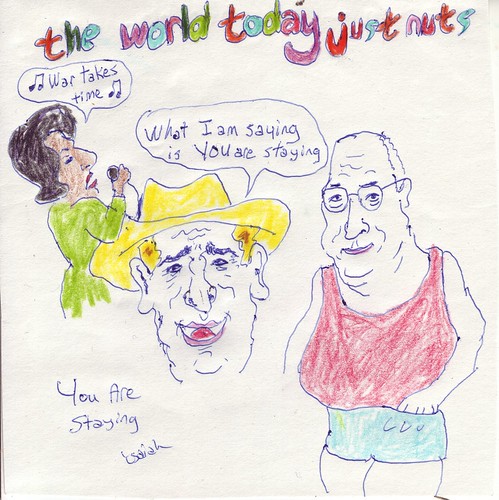
You Are Staying

youarestatying


That's "You Are Staying" from July 15, 2007. Honestly, I had nothing.

Decided to go musical.

"You are staying." In Iraq. And four years later, they're still there.

Wish we could have found a president who wanted to end the Ira War.


Here's C.I.'s "Iraq snapshot:"

Thursday, February 10, 2011. Chaos and violence continue, Shi'ite pilgrims are targeted, Iraqi Christians migration is studied, Peace Mom Cindy Sheehan names names and declares, "But the people who are high up in the anti-war movement, high up in these organizations that literally used me to promote anti-Bush -- you know, the anti-Bush agenda -- which I was anti-Bush, I still am anti-Bush -- to promote that agenda without following through on, you know, what I felt was the most important thing and that's ending the wars.," and more.
We'll open with Peace Mom Cindy Sheehan. Abby Martin (Media Roots Radio) interviewed Cindy and you can stream it here.
Abby Martin: We just wanted to jump kind of straight to the point here.
Abby Martin: You know, it seemed like when you were the figurehead of the peace movement, the mainstream media was fully behind you and then it seemed like they turned against you and the antiwar movement turned against you too. They used you as a symbol and they used you as kind of a scapegoat. Do you want to elaborate on that? What did you think about when that happened?
Cindy Sheehan: Uh, well first of all when I went to Crawford in 2005 it was a media circus. I remember like on the third or fourth day, there was this really cool AP photographer named Matt and he was down there constantly. And every day, I'd say, "Matt, is it a media circus yet?" And he'd go, "Not quite. Not quite." Then about Thursday, it was a media circus. He agreed that it was a media circus. And I think that -- You know, I used to think that the media was biased towards the right when Bush was president. And so a lot of that media -- and all the media, when they started to realize that I was like serious, I wasn't just a fluke and I wasn't going to go away, they like put the brakes on it and started to marginalize me, painting me as just a grieving mother or a slightly off-kilter because of my grief. And so that started to happen that summer. But still the so-called progressive liberal media, I was still like featured so many times on, you know, like Randi Rhodes or Stephanie Miller or Ed Schultz or whomever was considered on the left up until the Democrats came back into power in 2007. And then they didn't like it that I was saying the same thing about the Democrats that I said about the Republicans. So that came to an end. And I realized then when the Democrats came back into power -- and, you know, I'm just naming names. You know. Organizations like United For Peace & Justice and MoveOn. I realized then that they were not peace organizations. You know, United For Peace & Justice should really be United For Electing Democrats. And MoveOn really is like 'Let's Move On To Full Democratic Tyranny of Our Government.' And so, yeah, they didn't like somebody who realized that it was a systemic problem not a problem of political parties or -- You know, it wasn't just a problem for one side, it was a problem for the world. And so it's been hard -- especially since Obama's been elected because, especially in the beginning, I felt like I was one of the only people in this entire country who was saying, "No, he's -- First of all, why did you support him when he said he was going to send more troops to Afghanistan? When he said he was going to increase hostilities to Pakistan? And, you know, all of his hostile rhetoric against Iran and places like that. And his votes during the Senate? Supporting war, paying for the war, supporting the reauthorization of the Patriot Act for example? Things like that." I was like, "How can you? We have good candidates."
Abby Martin: Right.
Cindy Sheehan: We have Cynthia McKinney. We have Ralph Nader. They always have said and done the right things. So why are you supporting someone who's against what you supposedly believe in? You were against those same things when Bush was president. Why are you now pro these things now that Obama's president? So it was really, really hard, you know. But I never once considered saying, "Oh, let's just give him a chance. Let's wait and see." You know, because of the three days after, the three days after he was [sworn in] he bombed Pakistan. So it-it seems to be getting a little better. A lot of people are starting to come around. But I think that it's just -- it's just like finally, two years into this administration, you're against the wars again.
Abby Martin: Again, yeah. That's why I loved that, I remember I saw you immediately after Obama got elected, I think I saw you in San Diego speaking at the peace rally.
Cindy Sheehan: Right, it was a couple of months after, yeah.
Abby Martin: And you were just saying the same things. You said, "Why are we surprised he said he was going to do the things."
Abby Martin: "We shouldn't be shocked that he's doing them. He's an aggressive imperialist. This is -- this is who he campaigned on -- as." So I loved that. You didn't skip a beat. So that means you're a true advocate for peace. And a lot of people align themselves with the Democrats and think that's-that's an alternative and that's for peace. It doesn't make any sense. They're both aggessive imperialists, they're just two sides of the coin.
Cindy Sheehan: But there's -- but there's some people who are so-called anti-war, so-called peace activists who know the two party system is a sham, who know the Democrats are no different from the Republicans. But still it's about political party over policy and over peace and over progressivism. And so we can't -- There's some people who had just had it after eight years of the Bush administration, like all of us did. And they wanted a change and they didn't care what Obama was saying. They saw how he was saying it, they didn't hear what he was saying. So those people are one thing. But the people who are high up in the anti-war movement, high up in these organizations that literally used me to promote anti-Bush -- you know, the anti-Bush agenda -- which I was anti-Bush, I still am anti-Bush -- to promote that agenda without following through on, you know, what I felt was the most important thing and that's ending the wars.
Abby Martin: Yeah. Right. Exactly.
Cindy Sheehan: There's no excuse for those people.
Abby Martin: Right. There isn't. And just going along with what you're saying, it's astounding, that video I sent you about just interviewing people in the Bay Area and how asleep they are. All these people, they love Obama but they don't know why. They can't tell you one thing that he's doing.
Abby Martin: And just encountering other peace activists. Do you think -- Do you see more of a trend now, like you said, two years into his presidency, finally, do you see people waking up more and saying, "Oh my G**! I was duped!"
Abby Martin: So you are encountering that a lot more?
Cindy Sheehan: Yes and just like it happened when Bush was president that so many Republicans e-mailed me and said that they felt the same way. You know, at first they hated me but then they really started to research or he did something that sent them over the edge or whatever. And that started happening at the end of the Bush administration. And it's starting to happen now too because, I think really, the people who were opposed to Bush and opposed to his policies are -- I would think they were more of the intelligent people in our country. So it's not going to take them eight years to wake up like it took some Bush supporters. I'm not saying Bush supporters are stupid. [Laughter.] I guess I am saying that. If you supported Bush and still support him, what's the matter with you? Really. Come on.
Abby Martin: It's just, I almost feel like they're -- Yeah, I'd love to give people the benefit of the doubt and be like, you know, it's going to take you a couple of years to wake up. But I mean, if you got it and you woke up during the Bush administration, I don't see how you got duped at all.
Cindy Sheehan: Absolutely.
Abby Martin: There was really no -- I just don't see it. No change in civil liberties, no change in foreign policy.
Cindy Sheehan: Except for the worse. Except since Obama's been president, many things have gotten worse.
Abby Martin: Oh, yeah, exactly.

Again, you can stream it here at Media Roots Radio. Time permitting, we'll note more of the interview tomorrow. It's a really frank and important interview (as is to be expected from Cindy). And she has praise as well, including for World Can't Wait which she sees as a real organization dedicated to peace. (In fact, World Can't Wait should make their slogan, "Peace Mom approved.")
Death was in the ancient fortress
Shelled by a million bullets
From gunners, waiting in the copses
With hearts that threatened to pop their boxes
As we advanced into the sun
Death was all and everyone
-- "All and Everyone," written by PJ Harvey, from her forthcoming album Let England Shake released next Tuesday
CNN reports that an Al-Dujail "suicide bomber drove into a rest tent for Shiite pilgrims" and took his own life and that of 8 other people while thirty more were left wounded. Xinhua has the pilgrims marching and a car rigged with explosives going off as they passed and notes: "The pilgrims were heading to Samarra, some 110 km north of Baghdad to mark the death of Iman Hassan al-Askari at his tomb in the shrine of Ali al-Hadi in the Sunni dominated city. The shrine of Ali al-Hadi is one of the four most revered Shiite shrines in Iraq. It contains the tombs of Ali al-Hadi who died in 868 A.D. and Hisson Hassan al-Askari who died in 874 A.D." AFP adds, "The mosque itself was built in 944, and the golden dome was added in 1905." The golden dome, Lara Jokes (AP) reminds, was "sheered off" in February 2006 bombings, "Its destruction in 2006 sent Iraq into a downward spiral of violence between Sunnis and Shiites that left whole neighborhoods around the country cleansed and divided by sect." Sabah al-Bazee, Waleed Ibrahim, Jim Loney and Mark Trevelyan (Reuters) notes 8 people died and quotes Raysan Abood stating, "I know them by name. They were our friends and they were delivering food and tea to the pilgrims who came from other towns." They also note it was a suicide car bombing. In other reported violence?
Bombings?
Michael S. Schmidt (New York Times) reports a Baghdad bombing which left two people injured. Reuters notes a Mosul roadside bombing injured one Iraqi soldier, a second Mosul roadside bombing wounded one police officer and a third Mosul roadside bombing left a young girl injured.
Corpses?
Michael S. Schmidt (New York Times) reports 1 corpse was discovered in Baghdad.
How is our glorious country ploughed
Not by iron ploughs
How is our glorious country ploughed
Not by iron ploughs
Our land is ploughed by tanks and feet
Feet
Marching
Our land is ploughed by tanks and feet
Feet
Marching
-- "The Glorious Land," written by PJ Harvey, from her forthcoming album Let England Shake released when? This Tuesday.
Alsumaria TV reports protests took place in Babel Province today with one protest calling for the release of prisoners and another calling out the continued lack of public services. Dar Addustour reports the the Council of the Bar Association issued a call for a Baghdad demonstration calling for corruption to be prosecuted, for the Constitution to be followed and sufficient electricity in all the schools. Nafia Abdul-Jabbar (AFP) reports that approximately 500 people (mainly attorneys "but also including some tribal sheikhs") marched and that they also decried the secret prisons. They carried banners which read "Lawyers call for the government to abide by the law and provide jobs for the people" and "The government must provide jobs and fight the corrupt." Bushra Juhi (AP) counts 3,000 demonstrating and calls it "one of the biggest anti-government demonstrations in Iraq" this year. Juhi also notes that attorneys staged smaller protests in Mosul and Basra today. Al Rafidayn reports that five provinces saw protests yesterday as the people demanded reliable public services and an end to government corruption. Noting the Babylon Province protest, the paper quotes Amer Jabk (Federation of Industrialists in Babylon president) stating that the provincial government has not provided any of the services the province needs, that basic services have deteriorated and that heavy rains have not only seen streets closed but entire neighborhoods sinking. Hayder Najm (niqash) observes protests have taken place across Iraq, "The protesters' grievances have been many and varied: the quality and level of basic services, government restrictions on civil liberties and freedom of expression, violations against civil servants, and the rampant financial and administrative corruption within state institutions. [. . .] Eight years after the US invasion of Iraq, the electricity supply in most areas of the country still does not exceed two hours a day, and the country still suffers from poor infrastructure, a weak transport network, and an acute crisis of drinking water and sanitation."
October 31st kicked off the latest wave of targeting Christians in Iraq with the assault on Our Lady of Salvation Church in Baghdad. Catholic Culture reports that Iraq's Ministry of Tourism has announced Pope Benedict XVI may visit Iraq, specifically make a pilgrimage to Ur. Meanwhile Simon Roughneen (National Catholic Register) reports:

Al Qaeda in Iraq has targeted the country's fast-disappearing Christian population, describing them as "legitimate targets" and causing unknown hundreds of thousands to flee in recent years. Out of an estimated 800,000 to 1.3 million Christians during the Hussein era, now less than half are thought to remain in the country.
Since an Oct. 31 attack on Baghdad's Our Lady of Salvation Church, thousands more Iraqi Christians have run to Turkey. Exact figures are unknown, but Chaldean Church records show more than 600 arrivals in December 2010 alone, which exceeds the total arrivals for all of 2009.
The Oct. 31 attack began when Islamic militants with ties to al Qaeda took Sunday worshipers hostage. As police moved in, 58 people, including two priests, were killed. According to accounts of the carnage, a young child was killed when one of the attackers blew himself up inside the church. Over 100 more were wounded.
The latest arrivals are seeking asylum in Turkey and applying for formal refugee status in the hope of transfer to third countries, such as the United States, Canada and Australia. According to Father Gabriel, a Turkish Chaldean priest from the east of that country and now on sabbatical from his parish in Brussels to assist refugees in Istanbul, the resettlement process takes about two years.

Some of the injured in the October 31st assault found medical treatment and asylum in France. Jim Bitterman (CNN) reports, "They are part of a group of nearly 60 brought here in early November after a bloody massacre at their church in Baghdad. In that attack, believed to have been carried out by al Quaeda, 56 people died, including two auxiliary priests, and more than 70 were injured -- among them the parish priest of Our Lady of Salvation, Father Raphael Kuteimi." The International Organization for Migration provides [PDF format warning] an update on Iraqi Christians through January 31st. The report notes that Erbil has seen an increase in Internally Displaced People families. It explains, "Monitors in Baghdad report that Christians continue to face grave threats. Some Christians remaining in Baghdad rely on newly-created security checkpoints near their homes for protection, and church leaders are in contact with Iraqi security forces for assistance in protecting their communities. However, despite increased security measures an atmosphere of extreme insecurity persists among Christians remaining in Baghdad and many still intend to move or emigrate." And beyond temporary?
An increasing number of displaced Christian families intend to integrate into their current location. IOM monitoring teams in the field report that a clear majority of the displaced Christians in Erbil, Dahuk, and Sulaymaniyah governorates now plan to settle in their current location due to stable security environments and welcoming host communities. However, a far smaller number of the displaced Christians in Ninewa governorate expressed a desire to remain in their location of displacement. Monitors estimate that fewer 10% of the displaced in the Bashiqa district of Mosul intend to integrate locally.
While many displaced Christian families intend to locally integrate, monitors also report increasing Christian emigrations. IOM monitors only assess internally displaced persons, but monitoring teams have been told by community leaders of increasing Christian emigration to Turkey since November 2010, which is confirmed by colleagues in Turkey as well as recent media reports.
Turning to England where the Tenth Imperial War Museum Film Festival Awards were held in London. Richard Moss (Culture 24.org) reports, ". . . Iraqi filmmakers dominated the honours in the museum's Annual Film Festival Awards by grabbing two out of the three main prizes. Doctor Nabil (2007), a searing documentary recounting the experiences of a surgeon working in a busy and under-resourced Baghdad hospital, won the Audience Poll for the young Iraqi documentary maker Ahmed Jabbar. Best Documentary went to fellow Iraqi Emad Ali for A Candle for the Shabandar Cafe (2007). The film tells the story of a the favourite haunt of Baghdad's writers and intellectuals which was destroyed in March 2007 by a suicide bombing which ripped the heart out of the historic Al-Mutanabbi street book market killing 26 people."
I have seen and done things I want to forget
A Corporal whose nerves were shot
Climbing behind a fierce, gone sun
I seen flies swarming everyone
Soldiers fell like loads of meat
These are the words, the words are these
Death lingering, stunk
Flies swarming everyone
Over the whole summit peak
Flesh quivering in the heat.
This was something else again
I fear it cannot explain
The words that make, the words that make murder
What if I take my problem to the United Nations
-- "The Words That Maketh Murder," written by PJ Harvey, from her forthcoming album Let England Shake
The Status Of Forces Agreement was misunderstood by many (and many understood it but chose to lie about it). The SOFA is a treaty. It's not a valid one for the US because it didn't follow the Constitution. Joe Biden knows that and he and Barack were opposed to it . . . until the day after the election when that lovely campaign website scrubbed the objection. Suddenly, they were happy to have the War Criminal George W. Bush's treaty and damn the Constitution and damn Senate approval. Bush pushed it through and a Democratic administration ran with it. Meaning that a precedent has been established -- call it another facet of the unitary executive view -- and future presidents will likely resort to it for treaties that cannot pass the Senate. That's not a minor damage and it's one that future generations will have to deal with it.
Having noted the legal aspect, let's move to what it was. As we have always explained, all the SOFA did was replace the UN Security Council mandate. There was not UN resolution to allow for war. It is an illegal war of choice started by War Hawks in various countries. But after the war started, the UN Security Council did do a resolution which made it legal for forces to be on the ground. It was a yearly mandate. It was renewed near automatically each year. The first time the renewal was a big problem -- so much so that even the US press had to take note -- was near the end of 2006 when the new prime minister Nouri renewed it. The Parliament was enraged. They said they had to be informed and they had to approve. This is important to grasping the SOFA, pay attention if you're new to the topic. They were right on that per the country's Constitution. Nouri swore that if it was renewed again, he'd get their approval. He was so full of regrets. Never trust a word from Nouri. In 2007, the UN resolution was again due to expire. Did Nouri go to the Parliament?
No, Nouri signed off on it on his own. If the Parliament and the people were enraged in 2006, a new word needed to be created for what they felt as 2007 drew to a close and 2008 began. The UN mandate kept Iraq in receivership on many issues. It didn't have true control over monies and assets. For certain things (the tag sale) the US wanted, it was in the US interests to stop using the mandate. For Nouri to get his hands on more oil money (oil money from before the war began), he needed to get out of receivership as well. So it was in both the US government and Nouri's interest to drop the UN out of the equation and draw up an agreement just between the two countries. In doing so, the repeat objection was known and discussed. It was thought that Nouri couldn't keep going back yearly, it was hurting him politically. So they'd make it a three year contract (actually they were yearly options which could run three years). Whatever happened after the three years (end of 2011), they could deal with then but Nouri wouldn't have to go through the yearly signing and deal with the backlash. When the SOFA was in doubt (in terms of being signed, not in terms of legal) Joe Biden was very clear about what happened if the US didn't get the SOFA: US forces had to immediately leave. If the UN mandate wasn't renewed by Iraq and an agreement didn't replace it, then US forces could not legally be on Iraqi soil. Making the agreement a three-year arrangement spared Nouri a great deal of grief. Nouri promised the Parliament that, if they'd vote for it, it would go to the people for a vote. That vote was supposed to take place in July 2009. Guess what? Nouri's promise? He never kept it.
That's Nouri. The same Nouri who courted the US government during the political stalemate by assuring them that support for Nouri meant an extension of the SOFA. Did he mean it? With Nouri, one never knows. Where the US government is currently is hoping that Nouri will extend the SOFA before the end of this year. (The SOFA waited until Thanksgiving Day, some of the UN mandate renewals came as the year was closing.) So it may yet happen. But the US government has a back up plan. US forces (and contractors) remain in Iraq past the end of this year but they get around it by taking these forces from under the control of the Defense Dept and putting them under the State Dept. This has been reported, this has been discussed in open Senate hearings (including last week in Tuesday's Senate Foreign Relations Committee hearing and in Thursday's Senate Armed Services Committee hearing). So when Adm Mike Mullen, Chair of the Joint Chiefs of Staff, declares, "all troops out of Iraq" by the end of this year, he's being dishonest which is also known as lying.
This would be the weaponization of diplomacy. In England today, Oxfam issued the following release:

The UK government should learn from other countries' costly mistakes and resist the temptation to use the UK's internationally respected aid programme to pursue narrow military and security interests, Oxfam said today.

Whose Aid is it Anyway? a report published today by the international agency found that billions of pounds of international aid that could have transformed the lives of people in the poorest countries in the world has been spent on unsustainable, expensive and sometimes dangerous aid projects, as donor governments including the US, Canada and France have ignored international agreements and used aid to support their own short-term foreign policy and security objectives. Aid budgets have also been increasingly skewed towards Iraq and Afghanistan at the expense of equally severe conflicts and crises elsewhere.

Although the conflicts in Iraq and Afghanistan clearly increased the amount of aid the UK spent in those two countries, overall the UK has followed better practice than many other major donors.

There is a danger the UK will increasingly use aid to pursue foreign policy objectives, a move which would tarnish its reputation as a global leader on aid. During 2010, the coalition government has emphasised the need for greater integration of the work of the foreign office, ministry of defence and DFID, and has brought aid for priority countries under the scrutiny of the new National Security Council. There is also a requirement on DFID to show that UK aid overall is making the "maximum possible contribution to national security".

Kirsty Hughes, Oxfam Head of Policy, said: "British aid to fragile states is at a crossroads. Ministers have a choice between making every penny of British aid count for poor people or prioritising short-term security goals that risk leading to over-expensive, ineffective and often dangerous aid, while making little impact on security and stability."

Three reviews of aid, expected to report in the next two months, will be vital in determining the UK's path. A government-commissioned, independent review of UK humanitarian assistance in conflicts and natural disasters, led by Lord Ashdown, will assess the appropriate role of the military in humanitarian aid and two official reviews will determine the future of UK bilateral and multilateral aid.

Oxfam's report warns that 225 aid workers were killed, kidnapped or injured in attacks during 2010, compared to 85 in 2002. In part, this reflects the greater number of workers operating in violent places but a large part of the increase was due to a rise in politically motivated attacks. Aid workers' neutrality is compromised if local people see aid as a tool of the military.

Hughes said: "The stark lesson from the last decade is that politicising aid during conflicts does more harm than good. Ill-thought out 'politicised' projects alienate the very people whose 'hearts and minds' they seek to win. Blurring the role between civilian aid workers and the military turns aid workers and the communities in which they work into targets for attack."

Since 2001, more than 40% of the total increase in development aid from the OECD club of rich donors has gone to just two states, Afghanistan and Iraq, with the remainder shared out between around 150 other poor countries, the report found.

Standing at more than $1.5bn in 2010, aid funds used for short-term projects by US military commanders in Iraq and Afghanistan are now almost as large as the US' worldwide poverty-focused development assistance budget.

Lifesaving humanitarian aid for urgent needs amidst conflict has also been skewed. At best, humanitarian aid per head given annually to the Democratic Republic of Congo has been a twelfth of that spent in Iraq. This is despite the fact that thousands of civilians in the DRC die every year as a result of conflict and per capita income in the DRC is more than ten times lower than in Iraq.

In addition, 'War on terror'-led foreign policy in targeted countries has in some places made it harder for aid agencies to provide help to those who need it. New US and European anti-terror laws have prevented potentially lifesaving aid reaching areas controlled by proscribed groups.

Hughes said: "Britain should reinforce its reputation as a world leader on aid by ensuring that all UK aid is focussed on tackling poverty and meeting vulnerable people's needs. This would do more for Britain's standing in the world than choosing to use aid as a tool of foreign policy.

"Aid will only win hearts and minds when it is clearly distinct from military efforts and aimed at reducing poverty and suffering, rather than addressing the short-term security problems of donor governments."

Read the report: Whose Aid is it Anyway?

To arrange an interview, obtain a copy of the full report or for further information contact: Jon Slater on 01865 472249/ jslater@oxfam.org.uk or Rebecca Wynn 01865 472530/ 07769 304351/ rwynn@oxfam.org.uk

Though the issue gets little traction from the US Panhandle Media, the latest Guardian Focus podcast focused on it. Madeleine Bunting explained, "In recent years a disproportionate amount of aid has been swallowed in countries such as Afghanistan and Iraq alongside UK military operations. UK aid to Afghanistan alone is set to increase by forty percent over the next three years. I'm Madeleine Bunting and this week's Guardian Focus podcast examines what some call the securitization of aid -- the subordination of aid and development programs to defense and security objectives. And we ask: What is the role aid should play in a war zone?" With that she began a discussion with the Guardian's Jonathan Steele, the European Council on Foreign Relation's Daniel Korski, Oxfam's Mike Leis and War on Want's John Hilary. Excerpt:
John Hilary: I think it's wrong to suggest that the British intervention in Afghanistan has anything to do with development. It's been made quite clear by the government -- [Prime Minister] David Cameron in many of his speeches and also recently in the National Security Strategy -- that Britain's role in Afghanistan is drive by British interests of security and also of geo-strategic principle. It's not a humanitarian intervention a la Blair Doctrine or any of the ideas which have been dealt with over the last ten years. It's a military and strategic intervention. And from that follow all the other consequences. Particularly not for us around the politicization of aid because aid has always been political but around the militarization of aid. Not just the delivery of aid by military or joint-military and civilian teams, but also the use to militarize the Afghan state and that's become one of the characteristics of British and US interventions across the world. It's not just Afghanistan here. You look at Iraq. You look at occupied Palestinian territories where I was some months ago and spoke to the representatives of some European there. They were horrified at the level of militarization of the state. And that's becoming almost the leading theme for us -- build up a state, militarize it, make it stronger --
Madeleine Bunting: Can you explain how aid militarizes the state? And presumably in this instance you're talking about the Afghan state.
John Hilary: In Afghanistan, almost half of the aid given by the US government, for example, has gone to arming the police and building up the military. And so that formation of a highly militarized state with very over, excessively armed police officers with rocket propelled grenades and all of that, that's become a facet of life in terms of our interventions. Again, in Palestine, instead of building up a democratic system, you put all of your eggs in that one militarized basket. You try to build up the strong, excessively hyped state and that's your model for dealing with instability. And that whole stabilization agenda -- this is the whole thing which is sort of forwarding this -- the stabilization agenda is explicitly a militarized agenda not a development agenda.
More room would mean we'd include more. It was an important discussion. One key point in terms of the US, the State Dept and USAID are lumped together in budget and by Barack. In the US, some remember the wars continue. Daniel White (Maine Campus) writes:
In setting out to eradicate an enemy, the United States is creating more enemies.
These wars are happening and here we are at a university, safe and blissfully preoccupied with where our place in society will be. These wars are not a part of our daily awareness, so it is hard to feel connected to them. It is also hard to feel we can make a difference, even if we do oppose war. I am telling you it is worth the effort.
The powers that be prefer the public doesn't know what is going on because people cannot organize against something that is unknown to them. Knowledge is power and there is power in numbers. There is a growing movement on campus to gather strength and support to protest the injustice of these wars and the system that perpetuates them.
If you feel opposed to the wars as we do and want to be a part of something meaningful, please participate in the Maine Peace Action Committee on campus. What you do matters.
Also remembering the wars is the Jewish Daily Forward whose editorial board asks:
How can we forget those American Jews who have fought in these wars, and the 37 who have died? How can we ignore or minimize their sacrifice? Part of the answer lies in the complex attitude toward these wars, burdened as they are with faulty missions and uncertain outcomes. What are we hoping to accomplish in Afghanistan? Why did we invade Iraq in the first place? The imperative to defend Israel is clear and -- in the minds of some, holy -- while our wars just seem intractable.
Listen to the family members of the fallen, and those explanations become empty excuses. "I think people are surprised to learn that Jews serve in the military in America because people think that any Jew interested in serving in the military is going to serve in the IDF," says Beverly Wolfer-Nerenberg, whose brother, Stuart, was killed in Baghdad. "I think that people overlook the fact that Jews living in this country are patriotic and do have a sense of duty and gratitude and are grateful for what this country has given to us over the years."
The truth is, we overlook that fact in ourselves. In some of the painful interviews collected for this week's "Profiles of Our Fallen" feature, we heard from parents initially worried and embarrassed about their childrens' choice. Melinda Kane, whose son, Jeremy, died in Afghanistan, described "the stigma that a nice Jewish boy from Cherry Hill would want to go into the military. It was really unheard of and sadly I was afraid that people would judge my son for being a certain way that was not who he was."

Rick Hampson (USA Today via Cherry Hill Courier Post) wonders about the impacts in the US from the Iraq and Afghanistan Wars:
"Americans are used to being successful, and these wars have not been successes," says Mark Lytle, the historian who writes the most current chapters of the U.S. history textbook Nation of Nations. "It erodes the image that Americans are exceptional."
The wars have lasted almost a decade, cost hundreds of billions of dollars and claimed the lives of more than 5,000 U.S. servicemembers and tens of thousands of Iraqis and Afghans. The impact on the U.S. military, and military families, is obvious. What about people and places with no military connection?
Yesterday the US House Veterans Affairs Committee heard about JP Morgan Chase breaking the law and harassing veterans. We covered the hearing in yesterday's snapshot, Kat covered it in "Grading the new Chair of the House Veterans Affairs Committee," Wally covered it at Rebecca's site with "JP Morgan Chase's song and dance" and Ava covered it at Trina's site with "The crooks get away with it (Ava)." Stephanie Mudick is with JP Morgan Chase and was identified correctly in a paragraph but was wrongly called "Susan" in the transcript of her exchange with Ranking Member Bob Filner. I typed up the transcript and dictated the rest so it was my mistake (and I had "Susan" in my notes so I added a note to Kat, Wally and Ava's posts noting it was my error). My apologies for my mistake. (How was it right in the dictated portion? I was flipping through the various handouts including the prepared statements of the witnesses.)
We'll close with this from the Senate Veterans Affairs Committee:


(Washington, D.C.) – Today, Senate Veterans' Affairs Committee Chairman, Senator Patty Murray, released the following statement on the joint report from the Departments of Veterans Affairs and Housing and Urban Development's on veterans homelessness which was released today.

"I commend the Obama Administration for taking real steps to shine a light on a problem that has for too long been ignored. For too long homeless veterans have been forgotten heroes. But this report provides an important foundation to better understand who these veterans are, the nature of the problems they face, and how to develop solutions to address their needs. This is a critical piece of the Obama Administration's laudable effort to prevent and end homelessness among veterans.

"What this report shows is a stark and finally more accurate picture of this serious issue. It shows that the disabilities and mental health challenges facing many of our nation's veterans put many of them, particularly those living in poverty, at greater risk of homelessness. It also shows that current economic conditions and the influx of young veterans are putting many more of our veterans at risk of homelessness."

"What this report calls on all of us to do is clear - more. We need to build on the work we have begun. With the HUD-VASH program that I restarted in 2008 we have been able to provide vouchers and supportive services for those who have sacrificed for our nation but are now homeless. We need to continue this program that has proven its worth.

"But we also need to do more to prevent veteran homelessness before it starts. That means prevention programs like the pilot program I worked with my colleagues to create near some of our nation's military installations. Prevention also includes focusing on getting our veterans into stable employment. We need to help veterans translate the skills and expertise they learned on the battlefield into the skills needed in today's working world.


"We also need the Administration to continue to come together as they have with this report. If we are going to bring veterans off the streets and into steady housing and employment we need VA, HUD, and the Department of Labor to continue working together. I look forward to working with all of these agencies, as well as the U.S. Interagency Council on Homelessness to put forth innovative and effective solutions to get our veterans into safe, secure, and stable housing."

As Chairman of the Senate Housing Appropriations Committee and the Veterans' Affairs Committee, Senator Murray has initiated and passed into law critical help for homeless veterans including the
Veterans Affairs Supportive Housing (HUD-VASH) program which provides housing vouchers and supportive services for homeless veterans and the Veterans Homelessness Prevention Demonstration (VHPD) program which provides housing, health and other supportive services at areas adjacent to military installations to help prevent homelessness. Both programs were cited by today's report as critical sources of help for homeless veterans.

Today's report shows that female veterans are twice as likely to be represented in the homeless population as they are to be the U.S. adult female population. Last Congress, Public Law 111-275, Veterans' Benefits Act of 2010, included provisions derived from legislation introduced by Chairman Murray which provides new support for
homeless women veterans reintegrating into the workforce.

Chairman Murray has also introduced
veterans jobs legislation that aims to reduce a rising unemployment rate among returning veterans.


Read on ...

Thursday, February 3, 2011

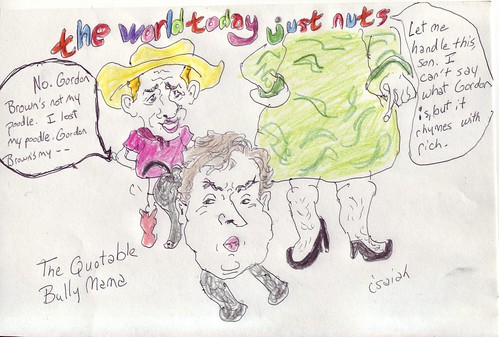
The Quotable Bully Mama

quotablebullymama

That's "The Quotable Bully Mama" from July 1, 2007.


Barbara Bush is the (comedic) gift that just keeps giving.

In this one, Tony Blair, the poodle is gone and Gordon Brown is the new prime minister. So he 'presents' to Bully Boy and Bully Mama -- probably drunk on Coors -- gets to update her bitchy line about Geraldine Ferraro.

While the UK's new prime minister, Gordon Brown, appears to be . . . presenting, Bully Boy declares, "No. Gordon Brown's not my poodle. I lost my poodle. Gordo


Here's C.I.'s "Iraq snapshot:"

Thursday, February 3, 2011. Chaos and violence continue, the US Senate Foreign Relations Committee doesn't appear to think US troops are leaving Iraq (nor do they appear to support the departure), one man steals nearly $250,000 of US tax payer monies while working for the State Dept in Baghdad, the US Ambassador to Iraq touts 'progress' and 'stability' in his testimony today as protesters riot in an Iraqi city over the lack of basic services, and more.
Starting in the US with President Barack Obama who declared, "It's time to stop spending billions of dollars a week trying to put Iraq back together and start spending the money putting America back together." Of course, he said that back in Feburary 2008 when he was campaigning for the Democratic Party's presidential nomination and would tell any lie with a happy smile. But what did War Hawk Samantha Power tell the BBC in March 2008, "You can't make a commitment in whatever month we're in now, in Marach of 2008, about what circumstances are going to be like in January 2009. We can't even tell what Bush is up to in terms of troops pauses and so forth. He will of course not rely on some plan that he's crafted as a presidential candidate or as a US Senator." So yet another lie from the man who's told so many.
When Pretty Speeches told his lie about it being time to "start spending the money putting America back together," the US wasn't aware they were about to enter the Great Recession (as Marcia pointed out last night). Tuesday the US Ambassador in Iraq James Jeffrey and the top US commander in Iraq Gen Lloyd Austin appeared before the Senate Foreign Relations Committee to beg for more money -- specifically three billion to three-and-a-half billion for this year alone. As Wally noted in his report on the hearing, "We have a record number of US citizens on food stamps, if the ambassador doesn't know, and we can't even seem to keep unemployment payments going without repeatedly voting for extensions in Congress, but James Jeffrey is comfortable spending your money and mine in Iraq." Tuesday the Senate Foreign Relations Committee also released a 20 page report entitled [PDF format warning] "IRAQ: THE TRANSITION FROM A MILITARY MISSION TO A CIVILIAN-LED EFFORT." From the report:
The State Department is scheduled to assume full security responsibilities in a still dangerous and unpredictable environment and must strike a difficult balance between maintaining a robust presence and providing sufficient level of security. In almost any scenario, the United States will continue to have military personnel stationed at the American embassy in a non-combat role under the Office of Security Cooperation. As in many countries around the world, these troops will be responsible for enhancing the bilateral defense relationship by facilitating security assistance. But the size, scope, and structure of this presence remain undetermined, even at this late date. Perhaps most significantly, it is unclear what kind of security relationship the incoming Iraqi Government would like with the United States.
In the wake of such uncertainities, a complicated diplomatic plan has emerged that highlights a dilemma that will likely confront the nation for as long as counterinsurgency warfare and state-building are central components of American foreign policy: How can the State Department effectively operate in difficult security environments without the support of the American military?
The U.S. Government should ensure that the scope of the mission in Iraq is compatible with the resources available, including State Department capacity, the financial commitment from Congress, a degree of U.S. military support and the backing of the Iraqi Government.
The report highlights key issues and we'll emphasize the first two:
* First, it is unclear whether the State Department has the capacity to maintain and protect the currently planned diplomatic presence without U.S. military support.
* Second, uncertainty about the nature of the U.S. military presence in Iraq after 2012 is complicating all other aspects of transition planning.
Golly, gee, and here we thought the US military presence in Iraq had already been addressed. Or that's what we've been repeatedly told (lied to). The Senate Foreign Relations Committee runs through four options in their report. 1) All US troops leave at the end of 2011 ("except for a limited Office of Secuirty Cooperation housed within the embassy") which would require the State Dept scale back their current plans. 2) Many US troops leave at the end of 2011 but the Office of Security Cooperation is expanded with "military forces" who will "provide logistical support for the Iraqi army, shore up administrative gaps within the Ministry of Defense, and prove 'behind the wire' capabilities". 3) A new security agreement is negotiated to allow the US military to continue in Iraq. ("This approach should only be considered if it comes at Iraq's request".)
Imagine if, instead of lying and providing cover for Barack, Tom Hayden and so many others had stayed focused on the Iraq War and pressed for an end to it? Back to the report:
But regardless of whether the U.S. military withdraws as scheduled or a small successor force is agreed upon, the State Department will take on the bulk of responsibility for their own security. Therefore, Congress must provide the financial resources necessary to complete the diplomatic mission. Consideration should be given to a multiple-year funding authorization for Iraq programs, including operational costs (differentiated from the State Department's broader operational budget), security assistance, and economic assistance programs. The price tag will not be cheap -- perhaps $25 - 30 billion over 5 years -- but would constitute a small fraction of the $750 billion the war has cost to this point.
$25 to 30 billion is what the Senate Foreign Relations is prepping to spend over the next five year on the Iraq War. Yet two years ago this month, campaigning for the Democratic Party's presidential nomination, Barack insisted, "It's time to stop spending billions of dollars a week trying to put Iraq back together and start spending the money putting America back together."
You like roses and kisses and pretty men to tell you
All those pretty lies pretty lies
When you gonna realize they're only pretty lies
Only pretty lies just pretty lies
-- "The Last Time I Saw Richard," written by Joni Mitchell, first appears on her album Blue
Staying with the money issue, we'll again note this exchange from Tuesday's hearing:
Senator Ben Cardin: On that same side, the chairman's talked about a long term committment to Iraq, I think we all understand we're going to be there from the point of view of helping to rebuild the country. What can you tell us is being put in place to make sure that the US funds are being used in the most cost-effective way, that we have protections against US funds being used to help finance corruption -- local corruption -- in the country, how do we avoid that and what are we doing for promoting US values including gender equity issues, making sure that we continue to make progress? Do we have -- Do you have an accountability system in place that gives confidence that we should be considering a more permanent, longterm, committment to Iraq?
US Ambassador James Jeffrey: Yes, sir, on all of those accounts,Senator. First of all, this is an important priority for us and it's an important priority for this administration and the last administration. In fact, a unique institution, uh, the Special uh Inspector General for Iraq, SIGIR, has been set up and they have a very active uh program, they have dozens of uh people stationed or with us TDI either out in the field in Iraq. We also have the State Dept and other IGs but SIGR in particular has been very active in looking into assistance programs and how effective and how efficient they are and, uh, to what extent there is corruption. Uh, I, uh, meet with the head of it, with [Stuart] Bowen, with his deputy and with other members frequently. In addtition, uh, uh, since the time of [former US Ambassador to Iraq] Ryan Crocker, we've organized the embassy in a unique way: where normally we have the ambassador and then a deputy chief of mission But for the economic and assistance elements of it -- we've created essentially a second, uh, deputy chief of mission -- the assistant chief of mission, currently Ambassador Peter Bodde who looks into that and focuses directly on the issues of "Are we getting our bang for the buck?," uh, "Are we looking into corruption?," uh, and these kind of issues. Uh, a good deal of our assistance goes -- and a good deal of our political relationships with Iraqis and our engagement with them goes to issues such as gender equality, minorities, the refugee issue. We have a very, very broad dialogue with them. We played a role behind the scenes on some of the decisions taken in the Iraqi Constitution on -- under equality -- for example, 25% of the Parliament has to be uh, uh female. Uh, now there are problems with this at times. For example, uh Iraqis -- both men and women -- were unhappy with the makeup of the Cabinet. Uh, the prime minister then decided that he would have to hold off on completion of the Cabinet until he could find more female candidates and that process is ongoing.
And as we pointed out Tuesday: "In terms of SIGR, they do strong work. It's also after-the-fact work. Meaning, they are auditing programs that are often completed or the money is all spent. In other words, after the money (or the bulk of it) has been mispent. In addition, how dare an employee of the US State Dept claim responsibility for SIGIR which was created, in 2004, by an act of Congress. 'What are you doing' was the question Jeffrey was asked. The answer is: Not real damn much."
Today AFP reports a US jury found a Jordanian guilty of theft. The US Dept of Justice issued a press release yesterday explaining the man was 36-year-old Osama Esam Saleem Ayesh, "resident of Jordan hired by the Department of State as a shipping and customs supervisor at the embassy in Baghdad". Though DoJ is happy to note he was convicted of "two counts of theft of public money and one count of engaging in acts affecting a personal financial interest," that the first two convictions come with a maximum ten year sentence and the third with a maximum five year sentence and that he stole "nearly $250,000" of US tax payer money, they never note any of it being recovered. They're sketchy on other details as well. Such as when it took place. The Cypress Times reports he wired $243,416 from the US State Dept "to his wife's account in Jordan" and that he conducted his theft from November 2008 through June 2010. So he started stealing in November of 2008 and he wasn't indicted until (according to the DoJ press release) October 15, 2010? The criminal complaint was filed August 16, 2010. One person, two years of theft, of hundreds of thousands of dollars (which no one's rushing to insist were recovered) and we're supposed to believe James Jeffrey's lame remarks about checks to ensure the money is not wasted or misspent?
Switching over the US House of Representatives for a moment, the House Veterans Affairs Committee held their organizational meeting (their first meeting). I had noted earlier this month that they had no meetings scheduled and an e-mail to the public account reminds me that the now-Republican led Committee held a meeting January 26th. Of course, that's not the type of meeting I was referring to (and other House Committees this session held their organizational meetings earlier). I was noting that under Bob Filner's leadership, the House Veterans Affairs Committee and its Subcommittees held four hearings in the month of January -- not one of those was an organizational one. (You can refer to the January 11th snapshot.) They currently have two hearing scheduled for February and two for March (one in March is a joint-hearing with the Senate Veterans Affairs Committee). Jeff Miller is the new Chair and, in fairness to him (and the Republicans), I will note what the e-mail didn't: the Democrats still haven't filled their seats on the Committee. That's nothing to do with Jeff Miller. The Democrats (minority party) have eleven slots on the Committee, four of which remain empty. Bob Filner is the Ranking Member. The Republicans have fifteen slots on the Committee, two remain absent. That does fall on Chair Jeff Miller. Of the four Subcommittees announced, the one we most often follow is the Subcommittee on Disability Assistance and Memorial Affairs and the Chair of it will be Jon Runyan of New Jersey while Jerry McNerney of California will be the Ranking Member. In a press release which came with the e-mail, Chair Jeff Miller states, "I am honored to be chairing this Committee at such a critical time for our nation and its veterans. It will be the top priority of this Committee to ensure stringent oversight over veterans' programs. We must ensure that taxpayer dollars are being used efficiently to provide the best services and world class health care to nation's warriors and their families. I am also proud of the Committee's bipartisan oversight plan that lays out an aggressive agenda that includes 79 specific items. I consider this plan a basic blueprint for our oversight activities but, it is not exclusive and I expect to expand on it throughout the Congress."
Today the US Senate Armed Services Committee held a hearing on Iraq and Jeffrey and Austin appeared before them to provide testimony. At the top of the meeting, Chair Carl Levin welcomed new Committee members Senators Jeanne Shaheen, Kirsten Gillibrand, Richard Blumenthal, Rob Portman and Kelly Ayotte. In addition, he welcomed back to the Committee Senator John Cornyn who "previously served on the Committee for six years until 2008." As is so often the case, Chair Levin didn't try to pretty it up in his opening statement, instead laying facts as they were.
Chair Carl Levin: Last December, after eight months of discussions, Iraq's political leaders agreed to form a national unity government. But the agreement was only partial. Iraq still awaits the nominations by Prime Minister al-Maliki to the key cabinet positions of Minister of Defense, Minister of Interior and Minister of National Security as well as the resolution of issues relating to the powers of the National Council on Higher Priorities, to be headed by former Prime Minister Ayad Allawi. The pressure on the Iraqi government to fill in these large gaps must continue.
Yes, this was in stark contrast to the rosy "a government has been formed" we sat through on Tuesday. Levin noted the realities on violence, the realities on the security forces and offered a fact-based opening statement. Again, in stark contrast to Tuesday. Back to his opening statement (and we're jumping ahead, if there was room, we'd include the entire opening statement).
Chair Carl Levin: One major question is what security relationship the United States and Iraq will have once the 2008 Security Agreement expires in December. It is unclear whether the Maliki government will seek any type of continuing US military presence after December given the terms of the security agreement that all our troops be removed by this December. Iraq needs to engage with the United States sooner rather than later if such a request is going to be forthcoming. The government of Iraq should understand that the days of the American tax payer bearing the costs of developing Iraq's security forces are ending. Iraq has significant oil revenue which will continue to increase. According to the latest quarterly report from the Special Inspector General for Iraq Reconstruction, Iraq's efforts to attract foreign investment continue to 'bear fruit' and development of Iraq's oil fields is making 'better than expected progress.' We should work with the government of Iraq to make available the equipment and training it needs for its long-term security, but Iraq should not expect us to bear the costs of its security needs. Finally, an important issue for the government of Iraq remains the security of Christian and other religious minorities. During our visit we met with leaders of Christian communities, which have suffered from suicide attacks, targeted killings, kidnappings and other intimidation by violent extremist forces. These communities live in fear, and large numbers of Christians have either fled the country or uprooted to safer regions in northern Iraq. The leaders we met explained with pride how Iraq has been home to some of the earliest Christian communities and Iraqi Christians do not want to have to leave their country to feel safe. Iraq has a long tradition of religious tolerance. On our visit we urged the government of Iraq to act with urgency to provide the security necessary to preserve these ancient Christian and other religious minority communities and to protect its religious minorities. Ambassador Jeffrey and General Austin, we know from our conversations in Iraq and here that you will continue to keep the safety of the various religious minority communities in Iraq as one of your top priorities in your discussions with the government of Iraq.
After opening statements from Ranking Member John McCain, Austin and Jeffrey.
Chair Carl Levin: You talked about stability and security and self-reliance of an Iraqi state and an Iraqi government and that surely has been the goal. One of the threats to that success and that achievement of that goal and to the stability and security of Iraq is the failure of the political leaders of Iraq to reach conclusions on some critical issues. This has always been a problem, we've always expressed the importance of the political leaders coming together. Now some of the current political issues that are unresolved include the following: an agreement to create a National Council for Higher Policies with real executive power, headed by former Prime Minister Allawi. There's an agreement that the Council be created but there's no agreement on what their powers are. I think I mispoke. There's an agreement that such a Council be created, there's no agreement yet on what the powers of that Council will be. The positions of Minister of Defense, Interior and National Security are still unfilled. There is no agreement yet on oil policies, the division of oil revenues. These are huge issues that remain unresolved and I believe threaten the goals and objectives that we have and hopefully that the Iraqis have for themselves. Can you comment on this matter? Is it important that the leaders of Iraq get on with the decisions in those areas, Ambassador?
Ambassador James Jeffrey: Thank you, Mr. Chairman.
Chair Carl Levin: And we're going to have a seven minute round, by the way. I usually announce how long the round of questions will be.
Ambassador James Jeffrey: It is vitally important that they finish the job of forming the government. Uh, they have taken most of the steps necessary but, uh, you have outlined several of the remaining issues that we've been pressing them on but more importantly they've been pressing themselves on. We have seen some progress in the last several weeks on the National Council and the two sides have basically agreed to everything but the modality of how to select Dr. Ayad Allawi. Everybody agrees that he should be selected. We think that this should be resolved in the next few days. I was in contact with President [Masoud] Barzani of the, uh, Kurdistan Regional Government, uh, this morning and the embassy with other people, uh, to take the temperature of where we are on these steps. There are also some names that are floating on compromise candidates for both of those ministries that you mentioned. And, again, we are encouraged by what we've heard over the past several days but the proof is in the pudding and we have to see uh, uh, if they will finish the job. It is very important that they finish the job and get on with the business of, uh, government. On the oil account -- two positive developments. Uh, as with everything else in Iraq, it moves forward in relatively small steps, Senator, but it does move forward. The, uh, Kurds and the other coalition parties agreed on a 19-point plan or on most of a 19-point plan that includes giving priority to a hydrocarbons law and a revenue sharing law. This vital. But meanwhile the central government, Prime Minister Maliki personally and the Kurdistan Regional Government have agreed on an interum step of allowing up to 150,000 barrels of oil in the Kurdistan Regional Government to flow out into the pipeline. This is a very significant development and it gives us hope that they will continue down this path, sir.
Chair Carl Levin: Thank you. General Austin, is the withdrawal of our forces by the end of this year as agreed to by President Bush and Prime Minister Maliki on track?
Gen Lloyd Austin: Thank you, Senator. It is indeed on track. Uh, we just recently completed our planning process that will, uh, will govern the rest of -- the remainder activities from now until the end of December. And we've issued Operations Order 1101 which again prescribes, uh, the major activities that we will be conducting focused on strengthening the Iraqi Security Forces, uh, reposturing our forces, uh, and also transitioning responsibilities, uh, to, uh, the Embassy, the government of Iraq and Central Command. We continue to synchronize that plan and we're also synchronizing the activities of the Embassy along with our activities as we -- as we go about executing the plan.
Chair Carl Levin: Thank you. Is there any indication -- and I'll ask this of both of you -- that Iraq is going to request that any elements of our military forces remain beyond December?
Ambassador James Jeffrey: We have received, uh, no such request, Senator. We are working with the Iraqis, as the general said, on the security elements of our post 2011 presence which will include a large OSCI element for our security cooperation and the police training which will be a major program both of these are under the framework of the Security -- uh, the Strategic Framework Agreement which was the second agreement signed in 2008. It does not have a deadline and calls for a broad cooperation across the spectrum of bilateral relations including specifically security. So we're working with the Iraqis now on just what exactly the components of that would be, sir.
Chair Carl Levin: Do you expect a request beyond that from the Iraqi government?
Ambassador James Jeffrey: We haven't yet, sir, and I-I can't say what they'll do in the future.
Chair Car Levin: We don't have any indication that such a request is going to be forthcoming? As of this time?
Ambassador James Jeffrey: As of this time there's no specific request on the table. They will want to see how we will meet their training and equipping needs uh with the program that we set up.
Gen Lloyd Austin: Senator, I echo the Ambassador's comments. We haven't had any requests. And, again, I think he covered the entire gamut there so I would not add anything to that.
On the National Council, Jeffrey was Happy Talking. Haider Roa (Iraqhurr.org) reported yesterday that Iraqiya is very bothered by the delay and quoted Iraqiya member Saleh al-Mutlaq (second only to Allawi in terms of power in the Iraqiya bloc) stating he would be stepping down if there is not movement on the National Council while others express their dismay and Andan al-Sarraj (State Of Law -- Nouri's slate) insists that implementing is taking place.
In his questions, Ranking Member John McCain noted one obvious problem with the claim that US forces leave at the end of December.
Ranking Member John McCain: Are they [Iraq] going to be able to build an air force without US presence there?
Gen Lloyd Austin: They-they do have a number of options to both aquire equipment from-from or training from other nations. Certainly --
Ranking Member John McCain: So they would have to aquire equipment and trainers from other nations?
Gen Lloyd Austin: They-they would.
It's been known for years now that the US Air Force will have to be in Iraq beyond 2011 in order to train the Iraqi Air Force. How far back. From the June 14, 2007 snapshot:

The Pentagon report has many sections and one of interest considering one of the 2007 developments may be this: "There are currently more than 900 personnel in the Iraqi Air Force. . . . The fielding of rotary-wing aircraft continued with the delivery to Taji of five modified UH II (Iroquois) helicopters, bringing the total delivered to ten. The final six are scheduled to arrive in June. Aircrews are currently conducting initial qualifications and tactics training. The Iroquois fleet is expected to reach initial operation capability by the end of June 2007." By the end of June 2007? One of the developments of 2007 was the (admission of) helicopter crashes. US helicopters. British helicopters. Some may find comfort in the fact that evacuations and mobility will be handled by Iraqis . . . whenever they are fully staffed and trained. Four years plus to deliver the equipment, training should be done in ten or twenty years, right?

January 29, 2008, on Ned Parker and Saif Hameed's "Bomb Kills 5 U.S. Soldiers in Iraq" (Los Angeles Times):

They note the claims by puppet of the occupation Nouri al-Maliki made over the weekend that can only be described as 'get tough' and how "Additional Iraqi tanks and aircraft arrived in Mosul" and I'll assume they think we're flat out stupid since there's no Iraqi "aircraft" to speak of and the Iraqi air force does not conduct missions and is begging for money to upgrade their air 'power.'

From the November 4, 2008 snapshot:

There's no rush to leave Iraq or even a desire. That needs to be grasped. Iraqi General Nasier Abadi made that pretty clear during Sunday's press conference in the Green Zone. Questioned by the Washington Post's Mary Beth Sheridan as to when the Iraqis would be able to handle "their own internal security . . . how many years are you away from reaching that goal," Abadi tried to distract by listing duties before declaring, "We have no duties or missions to protect the air on the borders of the country. But in case we have this responsibility, there is a brief that -- to the minister of defense, if he ask us to -- task us with that, a reportw ent also to the Prime Minister, what are the capabilities and the army's specifics to do those duties?" Asked how many years again, he responded, "Building an aerial force, building an Army is not easy, but it's still easier than building naval and air force. The naval force, as I said before, that the first ship will come in 2009 and the fourth will arrive in . . . at the end of 2011. In regard to 200- . . . Air Force, the first aircraft we will receive in 2011 until 2015. And that depends on the support and the help that the coalition forces can secure to Iraq so we can be able to maintain and defend our airspace and territories. Without that, there will be also agreements with the neighboring countries on the security of Iraq. But it's possible that we will go with those missions without having an air force or naval force because this is a common battle, it's not just an army's duty." Setting aside the naval force and focusing only on the air, if the period they'll be taking possession of aircraft will last from 2011 through 2015, how likely is it that they will be prepared to handle their own airspaceby the end of 2011?

And the two most recent major articles on this issue were Elisabeth Bumiller's "Iraq Can't Defend Its Skies by Pullout Date, U.S. Says" (New York Times, July 29, 2010) and Gareth Porter's "U.S. Envoy Secretly Offered Troops in Iraq after 2011" (Dissident Voice).
At today's hearing, McCain stated he was "very concerned about Sadr, his activities, his followers and his close ties with Iran as well as Talabani and others. I mean, I'll just be very -- And I'm deeply concerned about that." Talabani does have diplomatic ties to Iran and a bit more than that but I believe John McCain meant "Maliki." If that section had been clear, we'd be highlighting it but the Talabani aspect mucked it all up (especially when al-Maliki is close to Iran and wasn't included in the statement). It was also interesting to watch Jeffrey downplay "king maker" Moqtada al-Sadr. We agree with his comments and have made them here but in light of the press orgasm over Moqtada's (brief) return to Iraq, it was interesting to hear Jeffrey say of al-Sadr's bloc, "But at the end of the day, Senator, they received 660,000 votes out of more than 12 million cast. They have only 39 seats in the coalition which has roughly 300 seats and, uh, their role -- which is relatively minor in the government -- reflects their voting power."
We'll wind down noting Senator Jack Reed's foolishness.
Senator Reed: As the mission migrates from the Dept of Defense and from DoD to the civilian side, the State Dept, as it looks more like foreign aid than supporting troops in the field, the reality, which Senator McCain pointed out, in this environment, is going to be very difficult to sustain and he's also pointed out perceptively if we don't sustain this effort than we have invested a lot of blood and a lot of material in an effort that could be frustrated. That would be a tragedy.
And on that note (Reed and foolish), Wally will pick up tonight at Rebecca's site, Kat will report on the hearing at her site and Ava will cover it at Trina's site. (And we'll link to all three reports in tomorrow's snapshot.)
In Iraq, Ali Abdel Gentlemen (Al Mada) reports, many Iraqis see not the progress Jeffreys spoke of but "a paralysis of government" and more and more and more are taking to the streets to protest "the deterioration of living conditions" which is why leather and textile workers protested in Baghad and Hilla this week and activist Mohammed Salami is quoted stating, "There is daily frustration over the fact that successive political changes have not brought a new [better] level of service." That was earlier this week. Today things were not so peaceful. Suadad al-Salhy (Reuters) reports that the police began shooting at protesters in Diwaniya today (at least three were injured). Approximatley one thousand were out in the streets calling attention to the "shortages of power, water and other services" and they "set tires ablaze, hurled stones and tried to storm the local police station, witnesses said." But Jeffrey wanted to ride yet another wave of Operation Happy Talk while appearing before the Senate Armed Services Committee today.
Today Iraq was rocked with violence. Reuters reports 3 Ramabid bombs claimed 6 lives with twelve injured (police's toll is 8 dead and 22 injured), a Ramadi roadside bombing left 4 children and 5 police officers injured, 2 Baghdad roadside bombings claimed 2 lives and left twelve people injured, a third Baghdad roadside bombing injured two police officers, a fourth claimed 2 lives and left four more people wounded, a fifth Baghdad roadside bombing claimed 2 lives and lef three people injured, a Samarra suicide bomber took his own life and wounded three people, in Tuz Khurmato a police man driving with his family was attacked by gunmen who shot dead 1 of his children and injured "him and two of his other children" and 1 "employee of a government bank" in Baghdad was shot dead. On the suicide bombing, Fang Yang (Xinhua) reports that police in Salahudin Province are claiming credit for 'foiling' a suicide attack by "forcing a suicide bomber to blew up his explosive vest, wounding two people" -- no, that does not sound like foiling to me either. Alsumaria TV drops back to Tuesday today to note, "Two members of Iraqi Intelligence Forces were killed in two separate incidents in Baghdad on Tuesday night. Unknown gunmen opened fire on Tuesday night on the car of Razzaq Qasem Ali, a division chief at Iraqi Intelligence Department, as he was passing near Baghdad gate in Taji District, a police source told Alsumaria News. Qassem Ali was killed on the spot. Another intelligence officer was killed in the same way and in the same region few hours following the first incident."
Yesterday Alsumaria TV broke news. (Again we ask, where are the US outlets?) Despite Nouri and a so-called legal expert insisting that the power-grab (Nouri got the Supreme Court to put independent bodies under his control) was Constitutional, "Alsumaria News got a copy of a document released by Iraq's Supreme Court in 2006 in clarification to the inquiries of the former Parliament's Integrity Commission over the exact meaning of independence mentioned in Constitution Article 102 and the difference in content between Articles 102 and 103. The court's clarification came contradictory with its last ruling on January 18 stipulating to have independent institutions supervised by the Cabinet and not the Parliament." We've pointed out this week that the Electoral Commission has specifically asked the United Nations to step in and the embarrassing nonsense the UN's top person in Iraq, Ad Melkert, offered (boiled down: Ignore this issue, let's focus on the economy!). Yaser Ali (AK News) reports:

Al-Iraqiya deputy Hani Ashour told AKnews that Melkert's comments contravene the mission of the UN in Iraq which is to support the country in its democratic foundations and help the Iraqi people without interfering in constitutional and legal details.
[. . .]
"The natural role of the Council of Representatives is to consider the implications of such decisions through dialogue between parliament and the government to agree on the definition of independence," he told reporters in Baghdad.
Ashour said that the UN must promote the convergence of views between the political parties, and not to offer its support to any one faction.
What is at stake here, said the al-Iraqiya deputy, is the "independence of the Iraqi institutions according to the constitution".

Yesterday, Ousam al Nujaifi, Speaker of Parliament, called out the ruling. Al Mada reports that he is proposing a bill which would clarify roles and re-order the courts.


In other Parliament news, Ayas Hossam Acommok (Al Mada) reports that the members of Parliament are being prevented from visiting Iraqi prisons unannounced and an unnamed official in Nineveh states this is due to the fact that a number of prisoners are missing and that these people are being held in secret prisons. Acommok notes the news comes after Human Rights Watch revealed Nouri and his forces are running secret prisons. Iraqhurr.org reports that the Minister of Justice Hassan Shammari met yesterday with the International Committee of the Red Cross Iraq Chief Magne Barth and promised the the ICRC would be able to visit Camp Honor which has been identifed by Ned Parker (Los Angeles Times) and by Human Rights Watch as one of the secret prisons. AFP quotes ICRC spokesperson Layal Horanieh stating, "We did talk about access to places of detention, including the place in question in the Green Zone. It is a strong dialogue, a good dialogue and it's a beginning we hope to help us gain access to the places we want to gain access to." AFP also notes that despite the ministry's Deputy Minister Busho Ibrahim claiming last month that the ICRC had inspected Camp Honor, the ICRC "has never inspected the facility."
Meanwhile Ali Abdel Gentlemen (Al Mada) reports that the Cabinet is checking their offices for listening devices, are constructing new office walls out of fear of listening devices and that trust is in short supply with the behavior indicated a state of high anxiety among politicians and an unnamed insider (who plyas "a leading role in a political bloc) declares that "Maliki himself does not trust anyone."

David DeGraw and Amped Status are back up and be sure to check out the site's new look. There are two upcoming actions in the US that will be here before you know it and we'll try to note them at least twice a week in the snapshots until they take place. First, this is the upcoming Iraq Veterans Against the War event:

February 25, 2011 9:30 - 10:30 am
Busboys & Poets, Langston room
14th & V st NW Washington DC
This report back will be to answer questions from media and the peace movement about the recent trip back to Iraq by members of Iraq Veterans Against the War. The war is not over but it is not the same as it was in years past. What is the humanitarian situation in Iraq?
How can we do reparations and reconciliation work?
Speakers are all returning from this delegation and include:
Geoff Millard (IVAW) Hart Viges (IVAW) Haider Al-Saedy (Iraqi Health Now)
Richard Rowely (
Big Noise Films)
The following month, A.N.S.W.E.R. and March Forward! and others will be taking part in this action:

March 19 is the 8th anniversary of the invasion and occupation of Iraq. Iraq today remains occupied by 50,000 U.S. soldiers and tens of thousands of foreign mercenaries.

The war in Afghanistan is raging. The U.S. is invading and bombing Pakistan. The U.S. is financing endless atrocities against the people of Palestine, relentlessly threatening Iran and bringing Korea to the brink of a new war.

While the United States will spend $1 trillion for war, occupation and weapons in 2011, 30 million people in the United States remain unemployed or severely underemployed, and cuts in education, housing and healthcare are imposing a huge toll on the people.

Actions of civil resistance are spreading.

On Dec. 16, 2010, a veterans-led civil resistance at the White House played an important role in bringing the anti-war movement from protest to resistance. Enduring hours of heavy snow, 131 veterans and other anti-war activists lined the White House fence and were arrested. Some of those arrested will be going to trial, which will be scheduled soon in Washington, D.C.

Saturday, March 19, 2011, the anniversary of the invasion of Iraq, will be an international day of action against the war machine.

Protest and resistance actions will take place in cities and towns across the United States. Scores of organizations are coming together. Demonstrations are scheduled for San Francisco, Los Angeles, Chicago, Washington, D.C., and more.

Click this link to endorse the March 19, 2011, Call to Action.


Read on ...
Creative Commons License
This work is licensed under a Creative Commons Attribution-Share Alike 3.0 Unported License.