Thursday, August 20, 2009

Come back, Harriet Miers


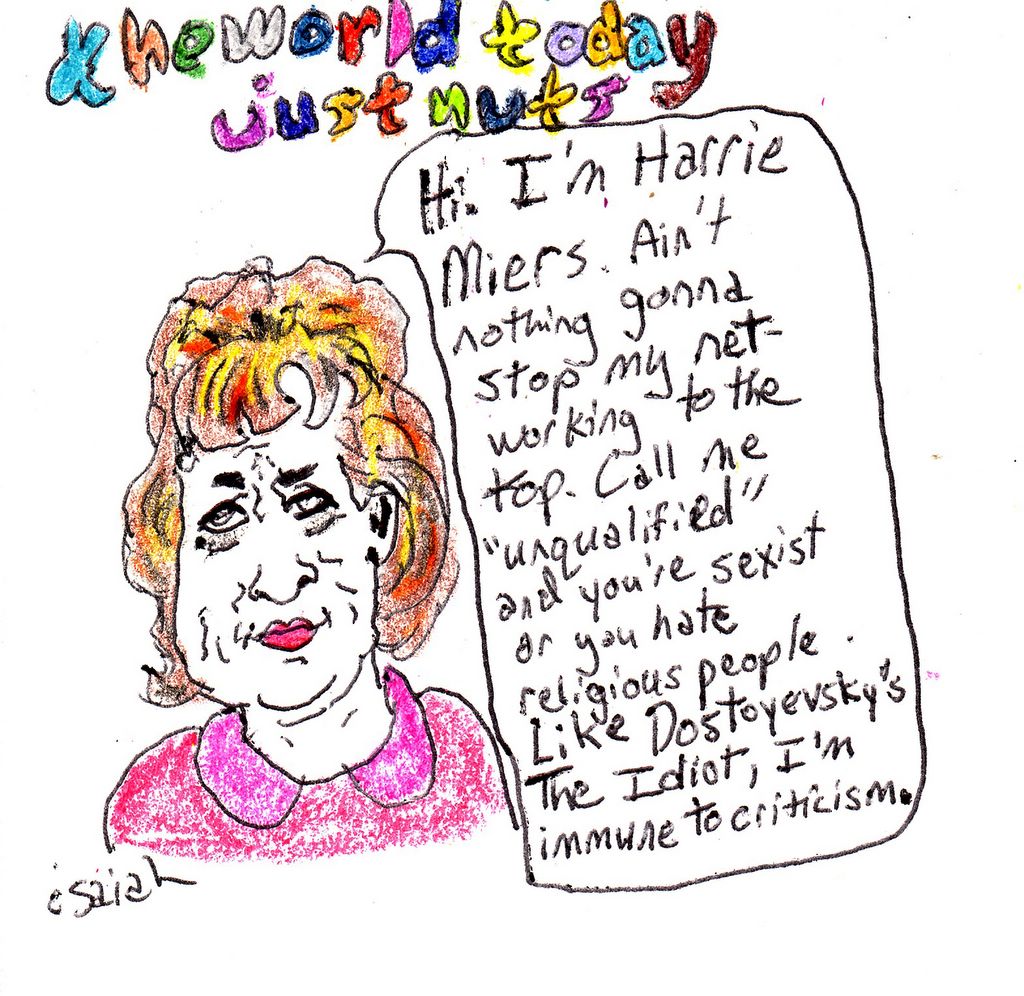
Harriet Miers. The torture attorney. My goodness, I had forgotten how much I missed her until I saw this comic a second ago. I don't even remember this one. But Harriet was fun to draw because she didn't appear too bright and her hair had a ton of different colors.


Harriet was always good for a laugh.

Maybe Congress will force her to testify?

They should. Her presence would make everyone feel immensely safer.

When a village is missing its buffoon, we all suffer. Come back to the village, Hariet Mier.

In the comic from October 23, 2005, she says, "Hi. I'm Harrie Miers. Ain't nothing gonna stop my networking to the top. Call me 'unqualified' and you're a sexist or you hate religious people. Like Dostoyevsky's The Idiot, I'm immune to criticism."


Here's C.I.'s "Iraq snapshot:"

Thursday, August 20, 2009. Chaos and violence continue, yesterday's Baghdad bombings had a death toll of 95 and that toll has risen, surprisingly little broadcast media coverage of the violence, 11 Iraqi security forces are arrested, Cindy Sheehan gears up for demonstrating on Martha's Vineyard and more.

Sinan Saleheddin (AP) notes yesterday's Baghdad bombings resulted in the deaths of "at least 101 people and wounded more than 500." A death toll like that -- even half that -- would generally result in some reporting on your TV screens. That wasn't the case. Commercial broadcast networks? NBC Nightly News with Brian Williams, of all the commercial network evening news shows, stood alone in offering a report on the bombings.

Lester Holt: This is one of the bloodiest days in a long time in Iraq. It's certainly the most violent since US forces withdrew from Iraqi cities in June. Multiple bombings killed at least 95 people in Baghdad and wounded more than 500. A major test for Iraq's security forces and for US policy. We get more now from our Pentagon correspondent Jim Miklaszewski. Mick, good evening.

Jim Miklaszewski: Good evening, Lester. US officials are already blaming al Qaeda for today's bombings in an effort to stir up sectarian violence but whos ever responsible, today's bloody and blatant bombings raise serious questions about Iraq's ability to take over its own defense. Six powerful bombs rocked Baghdad within minutes in one of the deadliest days of the entire Iraq War. One blast shook up a meeting of tribal leaders. As smoke filled the room, the speaker called it terrorism. The carnage began with a suicide car bombing at Iraq's Finance Ministry at about eleven this morning. Only three minutes later, a massive truck bomb exploded outside the Foreign Ministry. Then over the next ten minutes four separate bombs tore through Baghdad in a highly coordinated attack. The Foreign Ministry took the most devastating hit -- two tons of explosives shredded the front of the building, killing at least 59 Iraqis. The wounded flocked to Baghdad hospitals. This man said one explosion threw his car into the air. The attacks come less than two months after American combat forces withdrew from Baghdad in an agreement with Iraq's government. Iraqi forces were supposed to take over security operations, but after today's bombings, NBC News producer Ghazi Balkiz says the Iraqis admit they failed in their mission.

Ghazi Balkiz: In a surprising statement tonight, the Iraqi Defense Ministry admitted that the attacks were the result of Iraqi forces negligence and said that they should take most of the blame for the security breach.

Jim Miklaszewski: Prime Minister Nouri al-Maliki could ask the US forces to return to the cities but that would be political suicide and it's unlikely American combat forces would step back into the middle of an Iraqi sectarian war.

Ret General Barry McCaffrey : The last time we went in to take Baghdad, we had several thousand killed and wounded. We won't do it again. We shouldn't do it again.

Jim Miklaszewski: And despite today's attacks and a recent spike in overall violence, US military and Pentagon officials say they still intend to withdraw all US combat forces on schedule. According to one senior official, it's time for the Iraqis to step up and take over ready or not. Lester.

Lester Holt: Jim Miklaszewski, tonight at the Pentagon, thank you.

One of the deadliest days of the entire Iraq War and instead of covering that, CBS Evening News with Katie Couric spent nine minutes on the passing of CBS News' Don Hewitt. 'Once upon' a noted passing at a network resulted in the final thirty seconds with a title card showing the date of birth and date of death. Last night, CBS short changed the news and wallowed in an attempt to turn a private tragedy into world news. On non-commercial broadcast TV, PBS, The NewsHour spoke with Jane Arraf (Christian Science Monitor) about the bombings in Baghdad (link has text, audio and video option).

RAY SUAREZ: Jane Arraf, welcome to the program. You were in the part of Baghdad targeted by these attacks. Tell us what you saw.

JANE ARRAF: Well, it was mostly what I heard, first of all. I was going to the U.N., which was commemorating the sixth anniversary of the bombing of U.N. headquarters, when there was a huge explosion, which turned out to be a mortar, landing fairly close to the U.N. building. And then the blast, this huge blast that was part of a wave of explosions that rocked Baghdad in what really is the biggest security challenge, perhaps, to the Iraqi government in some time, and certainly a challenge to Iraqi security forces' ability to secure the city. Now, the biggest one was outside the Foreign Ministry, where a truck packed with an estimated ton of explosives detonated. There was another bomb shortly after near the Finance Ministry that collapsed part of an overpass. Now, these are some of the most heavily defended buildings in Baghdad. Iraqi authorities say that they confiscated a third truck packed with explosives and showed that on television, big, red plastic barrels filled with explosive material. All in all, it's seen as a test, and a test that Iraqi security forces have failed today.

RAY SUAREZ: Who is the Iraqi government blaming for this explosion? Who would have an interest in committing this kind of crime?

JANE ARRAF: Well, that's the problem in Iraq. Pretty much everyone has an interest, but this specifically, the Iraqi government is saying it's Sunni insurgents and former Saddam loyalists, a strange sort of mix. But it does have the hallmarks of al-Qaida. I went to the site later this afternoon to see what the wreckage looked like and talked to some of the survivors, and it was a huge bomb that actually did look quite a bit like -- the remnants did look like that bombing six years ago.
It was a truck that managed to get close enough and packed with enough explosives that it did tremendous damage. The big ones are normally thought to be al-Qaida, the big suicide bombs, sophisticated attacks, coordinated attacks, and that's who's being blamed for this one today, being blamed, as well, on the streets. A lot of Iraqis think this is either al-Qaida or ex-Baathists, although some of them persist in believing it's the Americans.

If the US just had two broadcast networks, it would have been a pretty good night for US news thanks to NBC and PBS. CBS tossed online Sheila MacVicar's report features CBS News' Mohammed Khalil stating, "Just like the days of the war. You could see dead people in cars still burning. Very awful." At one minute and 23 seconds, more time was spent on 'memories' of Don Hewitt than on reporting deadly violence. On 'memories'. That's not counting the lengthy opening report. That' just trotting out Andy Rooney and others to offer their thoughts on Don's passing. Anyone with half a brain knows you do not make the death of one of your own behind the camera people -- natural causes death -- the LEAD story on your evening broadcast. Anyone with half a brain knows that in 22 minutes newscast, you do not spend 9 minutes on the death of one of your own. 1 minute and 23 seconds is how long Sheila MacVicar's report is. They couldn't spare more time because they devoted 9 minutes to Don Hewitt and, please note, the first person to scream the loudest over that would have been Don Hewitt.

***ADDED: The above has been altered at a friend (at CBS's request). A friend at CBS News states Sheila MacVicar's report did air on the East and Central time zone's CBS Evening News. If so, one minute and 23 seconds were spent on Iraq and over nine minutes on Don. Almost everyone I know is on vacation so I'm going by one person and only one person stating the report aired. It is not on the Evening News I Tivo-ed. I don't do corrections in snapshots, the policy is the next day. I'm doing this because "I'm swearing to you, we had that report" is what I was told. Normally, I would want more than one person stating that. It also doesn't explain why one person at CBS gave me the time Sheila MacVicar's report was dumped online but I can't get ahold of him right now. Because "I'm swearing," I'll take the word of one and change the above. **********

101 deaths and over 570 injured from violence versus the natural causes death of one name not known outside the news industry? Which was news? If you picked "B," you're an embarrassment and may have a bright future in TV news -- at least on CBS and ABC.

Ernesto Londono and Greg Jaffe (Washington Post) report a despondent, 54-year-old man sat outside the Foreign Ministry, eyeing, wondering about his two sons whom he couldn't be reach by phone and who "worked at the ministry," his two sons of whom he says, "They've disappeared." That is a story. That is news. News is Adam Ashton (McClatchy Newspaper) quoting Um Khatab asking, "Where are the police? I lost a brother, and they are sitting in their cars with air conditioning?" News is Adam Ashton informing, "Her cries of mourning reverberated in the street while teams of police officers sifted through the site, making their way past burnt-out cars and scorched pavement." Jane Arraf (Global Post) reports, "After the active nightmare of the bombing, by evening the street had the feel of a bad dream -- amid the groups of curious young men, a ministry employee wlaked with blood seeping through the bandage on his head. An anguished mother stumbling over her shoes asked everyoen if they'd seen her missing daughter." It shouldn't be difficult to grasp the heartache and loss of over 100 unexpected deaths due to violence. It shouldn't be but apparently at the once upon a time Tiffany network, it is.

But, hey, CBS News just ignored the tragedy. The White House celebrated it. Jake Tapper and Karen Travers (ABC News) report "A Senior Administration official" states "we believe these attacks will energize our Iraqi partners" and Tapper and Travers underline that comment by observing, "Note the spin at the end that this will energize iraqi troops, not scare them off -- not a view held by all observers of the conflict." Apparently the White House believes, when over 100 people die in bombings, squeeze their bones and call it lemonaide? At the White House today, spokesperson Robert Gibbs did not denounce the remarks thereby saying to the world, "That unnamed official was speaking on behalf of the White House." (For potential fall out effects from the remark, click here.)

The New Statesman observes, "The bombs, which went off yesterday, were directed against the main centres of power, including the parliament and cabinet buildings and the ministries of finance, foreign affairs, health, housing, and education." Robert Dreyfuss (The Nation via NPR) uses the bombings as an attempt to grind his axe against the Kurds, "While President Obama and the Pentagon are focused on Afghanistan, the war in Iraq is showing signs of heading south, and fast. It's not unexpected. Iraq's Arabs and Kurds are nearly at war along the long front that separates the Kurdish region from the rest of Iraq, especially in and around Nineveh province, whose capital is Mosul, and over Tamim province, whose capital, Kirkuk, is coveted by the expansionist Kurds." It takes a real hatred to find a way to attack the Kurds in the midst of supposedly addressing the Baghdad bombings. As Dreyfuss damn well knows, Kirkuk is disputed and Saddam Hussein was the one who kicked the Kurds out of the region. Kirkuk is coveted by the expansionist Nouri al-Maliki and the central government of Baghdad as much as it's covered by "the expansionsit Kurds". It's that kind of observing that reminds people Dreyfuss used to work for Lyndon LaRouche. The Guardian points to: "The cocky reaction of Iraqi generals and police chiefs when the Americans began their withdrawal to the sidelines looks pretty overblown in retrospect. Not only could they handle security as well as the Americans, some of these officers implied, they could handle it better with the foreigners out of the way. Now the Iraqi forces are face to face with their own deficiencies." Liz Sly and Usama Redha (Los Angeles Times) add, "U.S. helicopters were seen buzzing over the blast sites Wednesday, but Maliki did not ask for help." The Financial Times of London counters that violence would always happen (true) and that the problems are the security forces ("little more than rebadged militia") and "Although Nouri al-Maliki, the Shia Islamist prime minister, is trying to reinvent himself as a nationalist, he has failed to pursue the national reconciliation -- above all with a Sunni minority dispossessed of power by the invasion -- for which the 'surge' was meant to create space. Instead, ahead of elections in January, he has vaingloriously taken credit for reduced violence and for the US troop pullback he hails as a 'liberation'." Jane Arraf (Christian Science Monitor) reports, "Prime Minister Nouri al-Malaki and senior officials met late into the night after the attacks to reassess security measures. The government had pledged to remove concrete blast walls from the city's main roads and reopen streets closed to traffic by mid-September, but now residents expect them to stay." Sahar Issa and Adam Ashton (McClatchy Newspapers) report, "Eleven Iraqi police and military officers are under arrest as part of an investigation into how two trucks loaded with explosives managed to detonate outside government offices Wednesday . . . The detained officials include two army regiment commanders, the commander of a police emergency company and five chiefs of neighborhood police units."

Kirit Radi (ABC News) reports on the Pentagon press conference US Lt Gen Frank Helmick participated in today via videolink from Baghdad where he declared, "What I am personally frustrated with is that, again, we must continue to develop the capabilities inside the Iraqi military. And we are doing that as fast as we can. My frustration is we -- I am not doing it fast enough." Viola Gienger (Bloomberg News) adds that the Lt Gen revealed Nouri's people were asking for US "intelligence, surveillance and forensics assistance". She notes that when Nouri was in DC last month, he floated the idea that US troops might remain in Iraq past the end of 2011.
The US military presence on the ground in Iraq needs authorization. Any foreign military being on the ground in Iraq needs authorization. The failure of the British and Iraqi government to reach an agreement (Parliament adjourned before finalizing the agreement) is why the British military had to pull back to Kuwait last month. For the bulk of the illegal war, the invasion was illegal but the occupation had the cover of the United Nations. The UN did not authorize the invasion. It did authorize the occupation and that provided the authority for foreign forces to be on the ground in Iraq. Nouri wasn't supposed to renew the mandate in 2006 but he did. And he did so without the authorization of the Parliament. That's an important detail. Parliament was outraged. He vowed he would get their approval next time but as the mandate was set to expire, he renewed it in 2007. Without their approval. For a vareity of reasons -- including Iraq's debt issues -- Nouri did not want to renew the mandate when it expired December 31, 2008. He and the White House went with a treaty masquerading as a Status Of Forces Agreement. The SOFA replaces the UN mandate. Each year the UN mandate had to be renewed. To bide time, the SOFA allowed US forces to remain in Iraq for three years. (The contract can be cancelled by either side at any time. 12 months after official notification of cancellation, all US forces would have to be out of Iraq.) The SOFA did not end the Iraq War. That is a misreading of the SOFA and of contract law. The SOFA replaces the UN mandate and, instead of being yearly, covers three years. If it's not renewed or if it's cancelled -- and if nothing replaces it -- US forces have to leave. But the SOFA is not "THE END OF THE IRAQ WAR." If it was that, then all hail George W. Bush for ending the Iraq War because the SOFA is George's document. Barack's chosen to follow it but it's George's document.

Nouri is correct that the US could stay on if the prime minister of Iraq and (maybe) their Parliament wanted it. "Maybe" on the Parliament -- as counseled by the US State Dept in 2006 and 2007, Nouri knows his cutting the Parliament out of the UN mandate issue allowed him to seize powers which the prime minister can now maintain is his or her power due to "custom." That has implication in terms of the elections scheduled for January which Nouri is currently stating will include a referendum on the SOFA. By "custom," the vote matters less than the prime minister's say so. The Parliament grumbled in 2006 and 2007 but did not seek to address the issue (renewing the UN mandate) through the court system or pass binding legislation. By "custom," Nouri's established the renewal option as belonging to the office of the prime minister. So Nouri may let the SOFA go to a vote but that vote would only matter if the prime minister (which may or may not be Nouri) decides it matters. That's for January.

In terms of US forces leaving Iraq, the SOFA does not mean that. The SOFA was not created to end the Iraq War. It was created to replace the UN mandate (Nouri didn't want to renew it due to the economic issues among other things; the Bush administration didn't want to renew it due to the obligations the US would have as an occupying power -- obligations never lived up to and that had received very little attention). The SOFA was about finding a way for US forces to remain in Iraq. If it runs the full three years, it can expire at the end of the three years and the US military (except marines guarding the US embassy in Baghdad) could leave. But it can also be renewed or replaced with another agreement. The SOFA does not say: "THERE SHALL BE NO RENEWAL." It's a one year contract with two options for renwal which allow it run three years if neither side objects. Then it done or it's renewed or it's replaced.

As long noted, the Iraqi military will not be ready to patrol their own air space at the end of 2011 (an issue raised in the press conference). That and Nouri's comments and the comments of others in the Iraqi government indicate that 2011 is not necessarily the end of the Iraq War. Asked at the press conference today, Kirit Radia (ABC News) reports, Lt Gen Frank Helmick stated, "The review of any security agreement with the Iraqi government is up to the government of Iraq and the United States. That is a policy decision that will have to be discussed between the two governments." Sahar Issa and Nancy A. Youssef (McClatchy Newspapers) report, "Iraqi politicians, who are vying for January's scheduled parliamentary elections, want to exert their independence from the Americans. At the Pentagon, commanders are looking for ways to shift resources from former President George W. Bush's war toward Afghanistan, which . . ." Sorry Nancy and Sahar, it's Barack's war. He's president now and it hasn't ended. Not only has it not ended, Barack's operating it under George W. Bush's plan. Barack's continued the Iraq War, he owns it now. In August of 2005, Senator Russ Feingold put foward a proposal people appear to have forgotten today: December 2006 as the target date for US troops to withdraw fully (not just 'combat' troops). That's fifteen months. It's do-able. Barack, who promised at first to have "troops" (in his rah-rah speeches, he didn't specify "combat troops") out in sixteen months and then promised they'd be out in ten. Those are do-able as well. Largely forgotten is that, when running for president in 1972, George McGovern had a plan for withdrawing ALL US troops from Vietnam in six weeks. It was do-able -- and the US had many more service members in Vietnam and much, much more equipment so all US forces could be withdrawan today in six weeks. Instead of using any of those options, Barack's elected to continue the illegal war and, apparently tired from all of his photo shoots, didn't have time to come up with his own plan so he's continuing Bully Boy's Bush's. But it's his war now. And that sentence? It's not reporting. It might belong in a column -- which would be opinion -- but "At the Pentagon, commanders are looking for ways to shift resources from former President George W. Bush's war toward Afghanistan" does not belong in reporting. It is inaccurate. A war continuing seven months after Bush left the White House is no longer his war. That's reality and it's that sort of bulls**t that goes to the press love of Barack Obama. That's why they're considered biased and they should be considered biased when they're foolish enough to try to pass that off as reporting.

In Barack Obama's illegal war today, many were reported dead.

Bombings?

Sahar Issa (McClatchy Newspapers) reports a Baghdad motorcycle bombing which claimed 2 lives and left four people injured, a Mosul roadside bombing which claimed the life of 1 Iraqi solider and left five more wounded and, dropping back to yesterday, a Mosul roadside bombing which claimed the life of 1 Iraqi soldier and left four more injured. Sami al-Jumaili, Michael Christie and Richard Williams (Reuters) report Babel bombings and possible mortar attacks which claimed 7 lives and left fifty-five people injured based on police reports and they note "there appeared to have been at least three blasts."

Shootings?

Sahar Issa (McClatchy Newspapers) reports a Wednesday night attack on a Nineveh checkpoint which claimed the life of 1 police officer and left three more wounded.

Corpses?

Sahar Issa (McClatchy Newspapers) reports the corpses of 5 "members of the Patriotic Union of Kurdistan" (Jalal Talabani's political party) were discovered today following their kidnapping this morning.

Monday Human Rights Watch released a report entitled "'They Want Us Exterminated': Murder, Torture, Sexual Orientation and Gender in Iraq." For the 67-page report [PDF format warning] click here. At the Guardian, HRW's Scott Long explains:

Across Iraq, a killing campaign has spread since early this year. Armed gangs have kidnapped men and tortured them, leaving castrated and mutilated bodies dumped in the garbage or in front of morgues. In April, during a Human Rights Watch research trip to Iraq, men told us tales of death threats, blackmail, midnight raids by masked men on private homes and abductions from the streets. The targets? Men suspected of being gay, or of not being "masculine" enough in their killers' eyes.
Most survivors pointed to Moqtada al-Sadr's Mahdi army, the largest Shia militia in Iraq, as the driving force behind the killings. Sadrist mosques and leaders have warned loudly that homosexuality threatens Iraqi life and culture – though even some Sunni militias may have joined the violence, competing to show their moral credentials. No one can yet give an accurate tally of the victims, but some say the dead may number in the hundreds.
Police and prosecutors ignore the murders. Infiltrated by militias, fearing for their reputations if they defend "effeminate" men, government officials give the killers virtually complete impunity. One 21-year-old even told us how interior ministry forces kidnapped him in February, believing that gay people had access to western money. They tortured him and raped him repeatedly over three weeks, until he managed to raise cash to pay for his freedom. He says he saw the bodies of five other gay men whom the police killed because they could not pay.

Scott Long explained to Deutsche Welle earlier this week, "Iraq's leaders are supposed to defend all Iraqis, not abandon them to armed agents of hate. Turning a blind eye to torture and murder threatens the rights and life of every Iraqi." Weighing in on the report, Chris Floyd (Empire Burlesque) observes:

Yes, when you destroy a society by aggressive war, when you kill more than one million innocent people (out of a total population of 25 million: a kill rate of one out of every 25 Iraqis), when you dispossess four million innocent people, when you join with your local puppets in a savage war of ethnic cleansing, when through invasion and prior years of near-genocidal sanctions you eviscerate one of the most secular states in the Middle East, when you empower violent religious extremists to further your own agenda of domination, this is what you get: the eruption of the human mind's most savage instincts and blind fears, set loose in a maelstrom of degradation.
And still, the urbane, educated, civilized, "progressive" president can stand before the world and declare that America's military rapine of Iraq is
"an extraordinary achievement." And so it is. And so was the Holocaust, the Inquisition, the Trail of Tears, the liquidation of the "kulaks" and many other epiphanies of human civilization. But to be extraordinarily evil is not usually considered something to brag about. That Obama can do so without batting an eye is a telling indication of moral degradation of our own society.

Yesterday's snapshot noted the attempts in England to deport a gay Iraqi male. Jessica Green (Pink News) reports, "Liberal Democrat MP for Brent Sarah Teather, who has championed the case of her constituent, has said the news means it is more likely he will be killed if he is deported. The man, who has not been named to protect his safety, was due to be deported in February after it was ruled he would be safe in Iraq. His lawyers won a judicial review and the case is currently being considered by Home Office ministers. He originally applied for asylum in 2001." And he'll be safe, the government is maintaining, because he can be "discreet." UK government documents advise that he should be able "to conduct such relationships in private on his return to Iraq." Yes, they really are that damn stupid or uncaring. They really are. Meanwhile Chris Jai Centeno (The Advocate) reports, "Gay Iraqis seeking refugee status in Sweden are being barred by the government amid protests from human rights activists advocating for cessation of deportations of asylum seekers on the basis of sexual orientation and gender."

"There comes a time when silence is betrayal" is one of two quotes by MLK that Cindy Sheehan notes in "We Have the Moral High Ground" (Cindy's Soapbox) and the silence on the targeting of Iraq's LGBT community is a betrayal. But she's commenting on another one and that's the left that came down with a severe case of laryngitis:

I remember back in the good ol' days of 2005 and 2006 when being against the wars was not only politically correct, but it was very popular. I remember receiving dozens of awards, uncountable accolades and even was nominated for the Nobel Peace Prize.
Those were the halcyon days of the anti-war movement before the Democrats took over the government (off of the backs of the anti-war movement) and it became anathema to be against the wars and I became unpopular on all sides. I guess at that point, I could have gone with the flow and pretended to support the violence so I could remain popular, but I think I have to fiercely hold on to my core values whether I am "liked" or not.
Killing is wrong no matter if it is state-sanction murder or otherwise. Period. Not too much more to say on that subject, except what I quote above from Dr. King.
However, while the so-called left is obsessed over supporting a very crappy Democratic health care plan, people in far away countries are being deprived of their health and very lives by the Obama Regime's continuation of Bush's ruinous foreign policy.


Read on ...

Thursday, August 13, 2009

Love Is The Answer


Having trouble viewing this message? Click here | Add to your address book

http://lists-columbia.sonybmgemail.com/t/3569560/4036146/317117/0/


http://lists-columbia.sonybmgemail.com/t/3569560/4036146/329245/0/ Pre-Order 'Love Is The Answer'
If you haven't had a chance to Pre-Order Barbra's first new studio collection since 2005, featuring intimate jazz settings by Diana Krall & arrangements by Johnny Mandel, then head over to the Barbrastreisand.com official store now. Don't forget that upon completing your order, you can enter for a chance to win tickets to her first intimate club show at New York’s Village Vanguard since she opened for Miles Davis in 1961.

http://lists-columbia.sonybmgemail.com/t/3569560/4036146/329245/0/


http://lists-columbia.sonybmgemail.com/t/3569560/4036146/331092/0/
Barbra Talks About 'Love Is The Answer'
Visit Amazon.com now to view an exclusive video of Barbra Streisand talking about Love Is The Answer. The exclusive video features sample audio clips from the album, as well as in-studio stills from her sessions with Diana Krall. Amazon.com is also running a sweepstakes for a chance to win tickets to the Village Vanguard performance. No purchase necessary, visit the entry page here for more info.

Watch Now »


Can't get enough Barbra Streisand? Visit the official pages:
http://lists-columbia.sonybmgemail.com/t/3569560/4036146/317112/0/Facebook http://lists-columbia.sonybmgemail.com/t/3569560/4036146/317113/0/Myspace http://lists-columbia.sonybmgemail.com/t/3569560/4036146/317115/0/iTunes http://lists-columbia.sonybmgemail.com/t/3569560/4036146/329248/0/Amazon http://lists-columbia.sonybmgemail.com/t/3569560/4036146/317117/0/Official Site


Rebecca's always been very supportive and encouraging to me and don't think I forget that. Barbra Streisand is her favorite artist and she's really excited about Barbra's new album. To help get the word out, this week I'll skip an archived comic and instead note that Barbra Streisand has a new album due out.


This is C.I.'s "Iraq snapshot:"


Thursday, August 13, 2009. Chaos and violence continue, the US State Dept blows off Camp Ashraf, Danny Fitzsimmons legal team states they fear their client will be scapegoated if tried in Iraq, US and Iraqi officials try to lie (again) to the world, and more.

Today two bombers launched an assault outside of Mosul.
Jamal al-Badrani Yara Bayoumy and Tim Pearce (Reuters) report that they "detonated vests packed with explosives" at a Sinjar cafe. Iran's Press TV describes it as "a popular coffee shop in an outdoor market". BBC News counts 21 dead and thrity injured and notes a curfew has been imposed on Sinjar. Al Jazeera states the village's "inhabitants are from the minority Yazidi sect". CNN reminds the Yazidis were targeted in August 2007 when over "400 people died and at least 300 were injured" from "suicide truck bombers". Jane Arraf (Christian Science Monitor) explains the official word: The bombings are an attempt to decrease confidence in Nouri al-Maliki prior to the elections currently scheduled for January. We're all supposed to buy that crap when the only thing more amazing is that US and Iraqi officials manage to say it with a straight face.
Point of fact for the Iraqi officials and US officials, we're not as stupid as you think we are. You do not start assaults in August to influence elections in January. Especially not in Iraq. If you want to influence elections scheduled for January, you start no sooner than the end of November and you do that, as anyone who knows one damn thing about revolutions or rebellions, because to start sooner is to risk being caught and derailed. So starting in August risks the entire operation being shut down in October and giving the impression that Nouri's god-like. "Oh look, we had bombings, but Nouri, bless Nouri, he stopped them! I'm voting for Nouri!!!!" You don't do it and everyone knows that. The United Nations did not come out six months ahead of the elections held at the start of this year and state violence is going to start spiking! No. They waited until the immediate time before which is roughly six to eight weeks ahead of an election. That's whn you can influence an election with violence and not have to worry that you'll be caught and your entire operation shut down before the campaigning even begins.
What's the reason for the violence? No one knows at this point. But apparently they've exhausted phoney targets to blame so now they're pretending to be interested in "why." What may be happening, what MAY be happening, is that we may be seeing dry runs, tests for areas of weakness prior to a wave of violence intended to influence elections. That's a possibility especially since the targets largely remain out of Baghdad. (Baghdad is seeing and has seen violence. Including some mass fatalities from bombings; however, the bulk of the most recent of the deadliest attacks have been outside of Baghdad. Some -- though apparently not all -- the Bremer walls in Baghdad are supposed to be coming down and that could be another reason for not attacking Baghdad as heavily. Wait until those walls come down to launch a spectacular attack.) The resistance could be attempting to locate soft spots, weak ones, and measuring response time with the hopes of attacking the most vulnerable areas immediately prior to the elections. That's just a possibility and it could be 100% wrong. No one knows. But it makes no sense for a 'wave of violence proves Nouri's unable to secure the country' to be launched in August if elections are taking place in January.

In other reported violence today,
Mohammed Al Dulaimy (McClatchy Newspapers) reports 2 Baghdad roadside bombings which clained 1 life and left eight people injured, 1 bicycle bombing which claimed 2 lives and left thirteen injured, four home bombings in Mosul, a Baquba suicide bomber who took his/her own life (no one else reported dead or injured).

Adam Ashton and Sahar Issa (McClatchy Newspapers) report, "Tempers are cool in Iraq despite a string of bombings that's killed more than 125 people in the past two weeks, fueling hopes that the attacks won't trigger retalitory killings, at least for now." See that's what real reporters can do. As opposed to Rod Norland's "Shiites in Iraq Show Restraint as Sunnis Keep Attacking" (New York Times) which apparently operates under the belief "Real Journalists Take Sides and Hand Out Gold Stars." As Elaine noted Tuesday night of Nordland's article, "Now here's reality, 2006 the genocide began and the New York Times didn't tell you about it. They underplayed it. It continued through 2007. They covered it a little better but didn't use 'ethnic cleansing,' let alone genocide. But catch any of those reporters when they're giving their speeches in this country and listen as they explain to you that ethnic cleansing took place. They just won't put that in the paper. Tomorrow Rod Norland and the paper attack Sunnis. The same Sunnis they refused to defend during the genocide." Equally true is that the New York Times is saying, "Good Shi'ite thugs armed by Nouri" (that's who is being congratulated by the paper, not the average Shi'ite in Iraq) "for not responding." How the hell does Rod Nordland know what's going on? Mass graves turn up in a month is he going to retract? Hell no, they never do. He doesn't know what the hell is going on but anyone reading that garbage this morning grasps that the paper trying to re-sell the illegal war is in bed with Nouri.
Shane Bauer (Mother Jones) offers some reality on the leaders of Sahwa aka "Awakenings" aka "Sons Of Iraq". The US military created insta-sheiks, tossing around CERP funds:


Eifan is a beneficiary of what some American personnel call the "make-a-sheikh" program, a semiofficial, little discussed policy that since late 2006 has bankrolled Sunni sheikhs who are, in theory, committed to defending American interests in Iraq. The program was a major part of the Awakening, which the Pentagon has touted as a turning point in reducing violence and creating the conditions for an American withdrawal. It was also a reinstitution of a strategy started by
Saddam Hussein, who picked out tribal leaders he could manipulate through patronage schemes. The US military didn't give the sheikhs straight-up bribes, which would have raised eyebrows in Washington. Instead, it handed out reconstruction contracts. Sometimes issued at three or four times market value, the contracts have been the grease in the wheels of the Awakening in Anbar--the almost entirely Sunni province in western Iraq where Fallujah is located.
The US military has never admitted to arming militias in Iraq--or giving anything more than $350 a month to Anbari tribesmen to fight alongside Americans against Sunni resistance groups and Al Qaeda. But reconstruction payments, sometimes handed out in shrink-wrapped bundles of $100 bills, have left plenty of extra for the sheikhs to "help themselves as far as security goes," as one Marine officer describes it, or "buy guns," as Eifan's uncle, Sheikh Talib Hasnawi, puts it.
[. . .]
Most of these kinds of projects are funded through the Commander's Emergency Response Program, which allows batallion commanders to hand out reconstruction contracts worth up to $500,000 without approval from their superiors or Washington. CERP was founded in 2003 by then-Coalition Provisional Authority head
Paul Bremer, who took its initial funding from a pool of seized Iraqi assets. Over the next five years, the program disbursed more than $3.5 billion in American taxpayer dollars. A Pentagon manual called "Money as a Weapon System" broadly defines CERP's purpose as providing "urgent humanitarian relief and reconstruction." The guideline has been interpreted liberally: CERP recently funded the development of a $33 million Baghdad International Airport "Economic Zone" with two hotels, a remodeled VIP wing, and a $900,000 mural depicting an "economic theme."
CERP regulations explicitly prohibit the use of cash for giving goods, services, or funds to armed groups, including "civil defense forces" and "infrastructure protection forces"--Pentagonspeak for militias. But Sam Parker, an Iraq programs officer at the United States Institute of Peace, says it's "no real secret" among the military in Iraq that CERP contracts are inflated to pay off sheikhs and their armies. Austin Long, an analyst with the Rand Corporation who has been studying the Awakening, says it is not unusual for contracts to go to sheikhs who, like Eifan, had little or no construction experience before the 2003 invasion. "Contracts are inflated because they are only secondarily about the goods and services received," explains Parker. "It's very problematic. You are rewarding the guys with the guns."
Shane Bauer is one of the three Americans currently in Iran. Sara Shourd and Joshua Fattal are the other two. They allegedly were hiking in northern Iraq and allegedly wandered into Iran.
New England Cable News (link has text and TV) notes that the three have been moved to Tehran. The three were discussed on the second hour of NPR's The Diane Rehm Show, last Friday (noted in that day's snapshot):

Diane Rehm: And what about the three Americans who were arrested for apparently crossing the border from Iraq into Iran, Nancy?

Nancy Youssef: That's right, that's right. These are three hikers in Iraq in Kurdistan who somehow crossed the border and we learned this week and again there's a question of what their fate is and what-what --

Diane Rehm: But they were warned. That's what bothers me. They were warned by Iraqis that they were getting close to the border.

James Kitfield: Can we -- can we put out an all points bulletin now: "Please American hikers don't go into the Kurdistan mountains near the border with Iran because that's not helpful. It's not helpful to you and it's not helpful to our diplomacy with Iran."?

Susan Glasser: And it's not helpful to Iraq which is so trying to change its image and saying that this is a place you can come to and this is a safe place and trying to revamp it's image and, um, this does not help it.

Diane Rehm: So what happens next or is there some ongoing communication, Susan?

Susan Glasser: Well, I think, unlike in dealing with North Korea, there is a much more established, you know, track record of Americans being able to engage with Iran through back channels. Europeans, of course, several countries actually have relations with Iran. So, you know, there's a much more filled out relationship that's ongoing even in times of stress than with North Korea for example. One question and I didn't see what the follow up was, I think these hikers actually were still being kept in Iranian Kurdistan which probably bodes well for their fate. You know, if they're trucked all the way to Tehran --

Diane Rehm: I see.

Susan Glasser: -- and they're put on trial as spies and that sort of thing, then they're going to -- you might need another President Clinton mission at that point to get them out. If it remains at that level, I think you're dealing with something, once the Iranians verify these do indeed seem to be semi-clueless students who were language students in the region in Syria, at least, a couple of them were. So perhaps they can still be handled at the level of clueless interlopers.

James Kitfield: History suggest they'll use them as pawns in whatever game in whatever diplomatic game they decide to play with us and eventually let them go. What-what I will say about this is interesting to me right now is that the clocks that are ticking on the Iran issue are almost out of sync. We -- Obama has set for next month, as a deadline for Iran to-to-to respond to his offer of engagement. A lot of people are saying we should have a tactical policy because you don't want to be engaging with a regime that's lost significant legitimacy because of these elections. On the other hand, the Israelis who are trying to sort of push them to peace negotiations are saying "You have got to at least put a deadline on your dealings with Iran and your sanctions because we think they're going to get the bomb sometime in the next year to sixteen months." So it's very difficult right now this-this problem, these internal problems with Iran, although interesting have really sort of skewed the diplomatic schedule that Obama has set for Iran and it's difficult to know how you put it back in sync.

By Susan Glasser's judgment last Friday, if they were moved to Tehran, things changed. They have now been moved to Tehran.

Will the US be moving out Iraq anytime soon? Over 130,000 US troops remain in Iraq, still more than were in Iraq at the start of 2007.
T.J. Buonomo (Foreign Policy In Focus) explores the potential possibilities:

Under the terms of the Status of Forces Agreement (SOFA), President Barack Obama is currently bound to withdraw all U.S. forces from Iraq by the end of 2011. Three
factors, however, make it probable that the president will attempt to renegotiate the terms of the agreement as it approaches its conclusion: Iraqi security forces will continue to be logistically dependent on the U.S. military. The United States will be increasingly dependent on oil from Iraq and the wider region. And the American left will be unable to exert significant electoral pressure on the legislative or executive branch, given the U.S. foreign policy establishment's calculation of the strategic consequences of a complete withdrawal.
Given their continued dependency on the U.S. government and despite their resentment of the occupation, Iraqi leaders might be inclined to agree to a SOFA extension. This would likely entail, at a minimum, continued close air support and logistical assistance to Iraqi Security Forces, as well as a continued advisory mission within the Iraqi defense and interior ministries. It would probably also include continued access to airfields in Iraq to serve as a deterrent against Iran. The Senate would not likely require ratification of a SOFA extension, given its prior decision to accept the Bush administration's claim that the SOFA isn't a treaty and therefore doesn't require Senate approval. A less conspicuous U.S. military mission of perhaps fewer than 50,000 troops would also generate less public opposition, thereby reducing pressure on the Senate to exercise such oversight.

The US military needs to withdraw from Iraq immediately. They remain on the ground while Nouri insults them publicly and while they are sitting ducks, easily picked off targets. The illegal war should never have started and there is no reason to keep them on the ground in Iraq to prop up Nouri's puppet government. They did not sign up to be targets on a shooting range. They signed up willing to defend the United States which, for the record, has not been attacked by Iraq. They are of little to use to anyone in Iraq as is demonstrated by recent events at Camp Ashraf. At the US State Dept today, the issue of Camp Ashraf was raised. July 28th, Nouri al-Maliki launched an assault on the camp despite promising the US earlier this year that he would take no such action. Human rights activists and lawyers have called for the US and the United Nations to step in. "Obviously as we have said many times," declared assistant spokesperson Philip Crowley, "we regret the -- uh, what happened at Camp Ashraf and the loss of life and injury that occurred even as we understand the government of Iraq desiring to extend it's sovereignty into that camp. Uh. We're still in conversations, you know, through [US] Embassy Baghdad, you know, with the Iraqis, and we hope that the-the interests of, uh, the people of the camp will be respected and, uh, that conversation continues. [. . .] Well, obviously we have, uh, a relationship with Iraq. It is moving towards, you know, you know, from a military dominant relationship to a-a partnership. We're in dialogue with Iraq on a variety of issues. Human rights is one of them. Uh. We have, uh, you know, have understandings with Iraq about how the people in this camp will be treated We are continuing to pay attention to that and this is -- this is one among many issues on which we will continue to have significant dialogue with our Iraqi counterparts." Asked if it were true, as the MEK states, that the US had gone back on promises to support them, Crowley responded, "Well there's an inherent contradiction in that this was an attempt for the Iraqis to establish, I think, a police station in the camp and bring, uh, officials into the camp which we completely understand. It is -- it is, we had a small contingent of-of forces nearby. It was not necessarily their purpose to protect these people. We have received assurances from Iraq that, uh, that they will respect, uh, this particular group, uh, and-and their rights, uh, and we continue that dialogue. But as I said yesterday, uh, it is regrettable that in trying to do something that was understandable, it was not executed well, uh, and I think that the Iraqis understand that as well. This is not an issue that we're, you know, we're ignoring. We remain in active discussion with Iraq about Camp Ashraf and will continue to, uh, talk to them and to focus on this issue but it is this is fundamentally about Iraq and it's ability to govern its own countries and the people who are within its soverign boundaries."

Asked after that non-answer if the US had made promises to Camp Ashraf regarding their safety, Crowley hemmed and hawwed through, "I-I-I, we-we received assurances that they would be well treated and we understand that what happend, uh, you know, was a mistake --". He got a few more almost sentences in before he was stopped and asked whether or not he could answer the question regarding whether the US promised residents of Camp Ashraf anything. He will get back with the answer for that.

The US did make promises and that includes the current administration. The response to the assault is not coming from the US State Dept, the US State Dept is not 'over' Iraq. But that's no excuse for the nonsense Crowley spewed in the press conference today.
Girish Gupta (Guardian) reports that the London protests in support of the residents of Camp Ashraf include a hunger strike and Fatemeh Khezrie is "seriously ill" and on day 17 of her hunger strike, "After seven days with neither food nor water, Khezrie was taken to St Mary's hospital where doctors put her on a fluid drip, but she removed it and returned to the embassy on hunger strike. However, yesterday she announced that despite her deteriorating health she would stop taking fluids again as she feels the British and US governments, as well as the media, are taking no notice." We'll again note this press release from US Committee for Camp Ashraf Residents:

In a news briefing today at the National Press Club, international and U.S. lawyers of residents of Camp Ashraf presented documents of crimes against humanity perpetrated by the Iraqi government during the July 28 attack on Camp Ashraf. They also made public the agreements signed between the U.S. government and every resident of the Camp Ashraf for their protection. Camp Ashraf is home to members of the main Iranian opposition group, the People's Mojahedin Organization of Iran (PMOI/MEK). Its residents had signed an agreement with the Multi-National Force-Iraq in 2004, according to which the US agreed to protect them until their final disposition. "The official U.S. government response to the events at Ashraf is that all issues concerning the Camp are now matters for the Iraqis to determine, as an exercise of their sovereignty. But that is a red herring: no one contests the sovereignty of the State of Iraq over Ashraf. Sovereignty does not provide an excuse for violating the human rights of the residents. Nor does it justify inaction on the part of the United States," said Steven Schneebaum, Counsel for U.S. families of Ashraf residents. He stressed: "The U.S. was the recipient of binding commitments by the Government of Iraq to treat the Ashraf residents humanely, and we know that has not happened. Moreover, it was the United States with whom each person at Ashraf reached agreement that protection would be provided until final decisions about their disposition have been made. And the United States remains bound also by principles of international humanitarian law and human rights law that make standing by during an armed attack on defenseless civilians unacceptable, and that impose an obligation to intervene to save innocent lives." Francois Serres, Executive Director of the International Committee of Jurists in Defense of Ashraf, which represents 8,500 lawyers and jurists in Europe and North America, added, "This [assault] is a manifest of crime against humanity by the Iraqi forces, attacking, with US-supplied weapons and armored vehicles, unarmed residents of Ashraf. The Iraqi government cannot be trusted in protecting the residents of Ashraf. The U.S. must undertake efforts to protect them until international protection is afforded to the residents." "We will pursue this matter before the International Criminal Court and courts in France and Belgium. Iraqi Prime Minister Nouri Al-Maliki is fully responsible for these atrocities and he will be held to account," he added. Zahra Amanpour, a human rights activist with the U.S. Committee for Camp Ashraf Residents also spoke at the news briefing. Ms. Amanpour, whose aunt is in Ashraf, said: "Why are the Department of State and the White House stone-walling us, the families of Camp Ashraf residents? Thirty-five people have been on a hunger strike outside the White House for 13 days, and we still don't have any reply by the administration."

The US military can't protect the residents of Camp Ashraf. They are allowing the assualts to continue by being present and we all need to grasp that. It's the point Joe Biden was making in April 2008 when he was a US Senator and not the vice president of the United States. His point was that their very presence means they are taking sides (Nouri's) in a civil war. I think it's ethnic cleansing and not a civil war, but whatever. By being on the ground, they continue to shore up Nouri's puppet and illegitmate government. Nouri only returned to Iraq, after decades out of the country, once the US invaded. Like so many 'leaders' (installed by the US), he doesn't represent Iraq, he's not the average Iraqi. He's an exile who was too cowardly to fight for his own country but more than willing to drag the US into an illegal war. As
Mike pointed out last night, "In Iraq, AFP reports that there is a bill that's won approval from Nouri's cabinet which would mean that the president of Iraq, the prime minister, speaker of parliament, their underlings and ministers and commanders would have to be Iraqi citizens and only Iraqi citizens. No more dual citizenship. That would eliminate many. Has Nouri denounced his dual citizenship?" The first ambassador Iraq had to the US was, of course, someone who also held US citizenship. We'll address her tomorrow. But the point is that the puppet government is largely staffed with these exiles. Now if you buy that Iraqis lived in brutality prior to the invasion, you need to ask why they would want to be represented by a bunch of cowards who fled the country, by bunch of chickens who didn't have the guts to stay and fight? And you need to ask yourself if you'd tolerate that? You probably wouldn't. The puppet government of Nouri al-Maliki is an illegitmate one and that's why he's forever making 'consoldiation' attempts that are nothing but empty promises prior to an election. (As demonstrated by his campaign promises last January.)

"They gave me a gun" he said
"They gave me a mission
For the power and the glory --
Propaganda -- piss on 'em
There's a war zone inside me --
I can feel things exploding --
I can't even hear the f**king music playing
For the beat of -- the beat of black wings."
[. . .]
"They want you -- they need you --
They train you to kill --
To be a pin on some map --
Some vicarious thrill --
The old hate the young
That's the whole heartless thing
The old pick the wars
We die in 'em
To the beat of -- the beat of black wings"
-- "The Beat of Black Wings," words and music by
Joni Mitchell, first appears on her Chalk Mark In A Rainstorm.


Danny Fitzsimons is facing a trial in Iraq and could be sentenced to death. He served in the British military for eight years and was stationed in Afghanistan and Kosovo. He is
accused of being the shooter in a Sunday Green Zone incident in which 1 British contractor, Paul McGuigan, and 1 Australian contractor, Darren Hoare, died and one Iraqi, Arkhan Madhi, was injured. Eric and Liz Fitzsimons spoke to the BBC (link has video) and noted that they are not asking for Danny to 'walk.' They stated that he has to take responsibility. But they want a fair trial and do not believe that is possible in Iraq. His legal defense team doesn't believe he can get a fair trial either stating today that the British military's presence in Iraq during the war means that Fitzsimons will be used as scapegoat. We'll come back to his legal team but first Deborah Haynes and Richard Ford (Times of London) report on Danny Fitzsimon's legal problems prior to going to Iraq (going apparently last week):Last November Mr Fitzsimons was given a one-year suspended sentence for robbery and possessing prohibited ammunition, the Crown Prosecution Service said. The Greater Manchester Probation Service said that it was conducting a review to establish whether the quality of supervision he was given met the required standard. Early findings indicate that he had complied with the terms of his supervision, which required him to report to his probation officer every two weeks. His last appointment was at the end of July and he is understood not to have voiced his plan to accept the security job in Iraq, which would have meant breaking the terms of his supervision. That could have resulted in Mr Fitzsimons being brought to court. He was due to return to court in Bolton on August 24 for sentencing over a public order offence.Danny's mother, father and step-mother have been very clear about their belief that he was suffering from PTSD. The article explains how the arrest should have raised some flags. The arrest may or may not stem from PSTD but it does not appear he was receiving treatment for that condition and it does appear treatment was needed.If he's already on probation, that's another reason to move the case to England because he appears to have potentially broken the rules of his probation. The Guardian of Manchester has a podcast titled Guardian Daily podcast. We've linked to it before. Today Jon Dennis speaks with John Tipple who is part of Danny Fitzsimon's legal team.John Tipple: We would need to go back a long way if we were going to remedy the situation as it is in Iraq today, wouldn't we? Because this has been an illegal war and the mess that that's left behind it is incredible. And the very idea that a British subject would get any kind of justice out there -- especially given our client's history with the British armed forces -- is also incredible. We do not trust the Iraqi authorities and we want to see our client back in the UK instead tried here so he can answer to his peers.Jon Dennis: But nevertheless, the very serious offenses that Mr. Fitsimons is accused of did happen on Iraqi soil. Shouldn't they have the right to try a suspect under their own system?John Tipple: Well we challenge whether it is a viable system in any case. But "no" would be my answer to that. Since 1861 there's been a statute in this country that makes provisions to try people here. And we have established a legal system in this country by serious effort and by making sure that the law is as sound as possible. None of that process has taken place in Iraq. It's in this country that the law has been tested and it's in this country that Daniel should be tried.Jon Dennis: You've spoken to Mr. Fitzsimons. What's his mood at the moment?John Tipple: As you might imagine, he's a very concerned and somewhat confused man. He's being processed and that process is not only intimidating, as you might imagine, because he clearly knows the consequences. Everybody saw Saddah Hussein strung up and the farce that that was and for those of us who do not believe in hanging or capital punishment looking at what goes on Iraq is aberrant.Jon Dennis: What sort of assistance are you getting from the security company that employed Mr. Fitzsimons?John Tipple: I can tell you that I consider that that company has a duty of care. And if they look past their corporate image than they should show humanity and a duty of care to Daniel Fitzsimons and they should facilitate his defense including the case that we've made to the request that we've made to them directly which is to be flown out of Baghdad today because clearly my client is in a state of confusion and he's getting legal advice from who knows and what qualifications these people have? We need to get professionals out there to help him properly. Jon Dennis: Does-does Mr. Fitzsimons' family believe that he was in a fit mental state to take what must have been a very stressful job working for a security company in Baghdad ?John Tipple: When Daniel Fitzsimons was in the Parachute Regiment is when he was damaged there through effectively Post Traumatic Stress Disorder and he-he clearly had that when he was in the British Army.Jon Dennis: And so you think that possibly not, that possibly he wasn't in a fit mental state really to take such a stressful job?John Tipple: I think that is a serious question that you have asked there and I think the answer to it is according to the information that's before me is no he's not.Jon Dennis: Are you getting much assistance or any assistance from the British Foreign Office in your attempts to get him tried in the UK?John Tipple: I'm getting -- I am actually having some very good contact with the Foreign Office and I've expressed my concerns to them and they have concerns themselves But we've handed over to the Iraqi authorities -- whoever they are and whatever credibility they may have It certainly is not a satisfactory situation. But they've handed over to them and this is a consequence of the whole debacle of the Iraqi War. And our client is going to be used as a scapegoat. That is our real fear: that he gets -- he gets treated because of the hatred that the British army and British forces in general have clearly earned themselves.

Turning to the US, the Wartime Contracting Commission held two hearings this week. Yawn. I'm not going into DC for their crap. They're a do-nothing commission.
Free Speech Radio News covered them yesterday:

Matt Pearson: As military operations in Iraq and Afghanistan have progressed since 2001 the need for military translators has increased And as government spending for translation services has increased so too has competition among intelligence corporations to receive government contracts. Pratap Chaterjee, author and managing editor of the watchdog group
CorpWatch, says the rapid growth and the need for translators has created problems.

Pratap Chaterjee: The United States employs upwards of 10,000 translators in Iraq, Afghanistan and Guantanamo Bay today and this is something that has, you know, grown, expanded considerably over the last seven years starting in 2001. Originally they had one tiny little contract for a company called BTG to provide a dozen or so translators in Kuwait. Now this is over 10,000 people, the military needs a lot of translators and so they say we'll take as many as you can get and because they themselves, as they have admitted in this testimony, had no expertise. Nobody at INSCOM Intelligence and Security Command, speaks Arabic or Dari Pashto. So they'd relied heavily on these translators, these companies like Titan and L3 to bring in the translators.

Matt Pearson: In 2006 a company called Global Linguist Solutions of GLS took over the government linguist contract for $4.6 billion and has been the primary contractor ever since. They have retained L3, the previous contractor, as a sub-contractor for the hiring and development of translators in Iraq and Afghanistan. The two corporations are at the center of the Wartime Commission investigation this week with so much government money going towards GLS the commissioners on Wednesday pried for answers regarding waste, incompetence and in some cases minor fraud.

Charles Tiefer: This contract and the tax payer became a cash cow. So the great big juicy steak the two companies were cutting thick slabs out of this cash cow. Poor taxpayer.

Matt Pearson: That was Charles Tiefer one of the commissioners and a professor of law at the University of Baltimore. He and the other seven members of the commission grilled the executives from GLS and L3 for explanations on certain expenditures in the face of salary cuts for translators.

Charles Tiefer: $5 million in spending that was overspent because of private housing for vendor management and administrative personnel, private 3-bedroom apartments for individual employees, an isolated incident of a contractor with deployed dependents at government expense, automobile densities of 1:1 ratio for management personnel, loss productivity due to less than expedient translative linguists into Iraq. Is that what your experience got us?

Matt Pearson: Some observers say that GLS could provide translators for the war efforts without subcontracting L3 and others. In 2006 and 2007, L3 protested the rewarding of the contract [to] GLS on three separate occasions eventually getting a $1 billion subcontract from GLS as a concession. The GLS executive says they would not have awarded L3 with a subcontract if they had not protested on multiple occasions. Still Tom Miller representing L3 at the hearing said the company provides much needed expertise to the staffing of translators in the Middle East

Tom Miller: By becoming a part of the GLS team we became a part of their management we grafted onto them our experience our lessons learned, you know, our abilities and then we didn't stop at that we literally handed over proprietary intellectual property because that was the best thing for the contract. You're looking for an altruistic sort of action on the part of an American corporation? There it is right there. Because we had a greater concern about the performance of this contract we wanted it to go very well.

Matt Pearson: The commission will release a report this year based on its findings from these hearings and research. Matt Pearson, Free Speech Radio News in Washington.

I'm not wasting my time own that 'commission.' If FRSN covers it or someone else worth noting, we'll cover it that way. But I've already set through their faux hearings. The commission is a joke and we've covered that here before. We gave it a chance until it's first hearing. We attended that hearing, see the
February 2nd snapshot, and Kat rightly ripped it apart in June when we learned at a House hearing that the commission was going to start setting some goals. Start setting some goals? It's a two year commission. It's mandated to issue an interim report (it has and that was a joke) this year and then a full report next. And yet, in June, they're working on defining goals? It's a joke because of the commissioners: one commissioner was announcing less than 4 months ago that he was $300,000 in debt (doesn't scream confidence to the American people) and of course you have the lovely Dov S. Zakheim, PNAC signers, George W. Bush's foreign policy tutor in 1999 and 2000 and went to work for the Defense Dept under Bush. Now the commission is supposed to be investigating contracting abuses? Hmm. Dov was the Defense Dept's chief financial officer. Conflict of interest much? You'll get more information (not to mention honesty) in Pratap Chetterjee's article written Tuesday than in both days of the commission's 'hearings'.

Independent journalist
David Bacon wonders "Can Labor Get Out Of This Mess?" (In These Times):For anyone who loves the labor movement, it's not unreasonable today to ask whether we've lost our way. California's huge healthcare local is in trusteeship, its leading organizing drive in a shambles. SEIU's international is at war with its own members, and now with UNITE HERE, whose merger of garment and hotel workers is unraveling.In 1995, following the upsurge that elected John Sweeney president of the AFL-CIO, the service and hotel workers seemed two of the unions best able to organize new members. Their high profile campaigns, like Justice for Janitors and Hotel Workers Rising, were held out as models. Today they're in jeopardy.This conflict has endangered our high hopes for labor law reform, and beyond that for an economic recovery with real jobs programs, fair trade instead of free trade, universal health care, and immigration reform that gives workers rights instead of raids. The ability of unions to grow in size and political power is on the line.Bacon is the author most recently of latest book is Illegal People -- How Globalization Creates Migration and Criminalizes Immigrants (Beacon Press) a wonderful book and an award winning one, having just received the C.L.R. James Award. He recently discussed the book at Against The Current.


iraq
free speech radio newsmatt pearsonpratap chatterjeecorpwatch
bbc news
the christian science monitorjane arraf
mcclatchy newspapers
sahar issa
adam ashton
the new york timesrod nordland
nprthe diane rehm show
nancy a. youssef
the times of londondeborah haynesrichard fordthe guardianjon dennis
david bacon
joni mitchell


Read on ...

Thursday, August 6, 2009

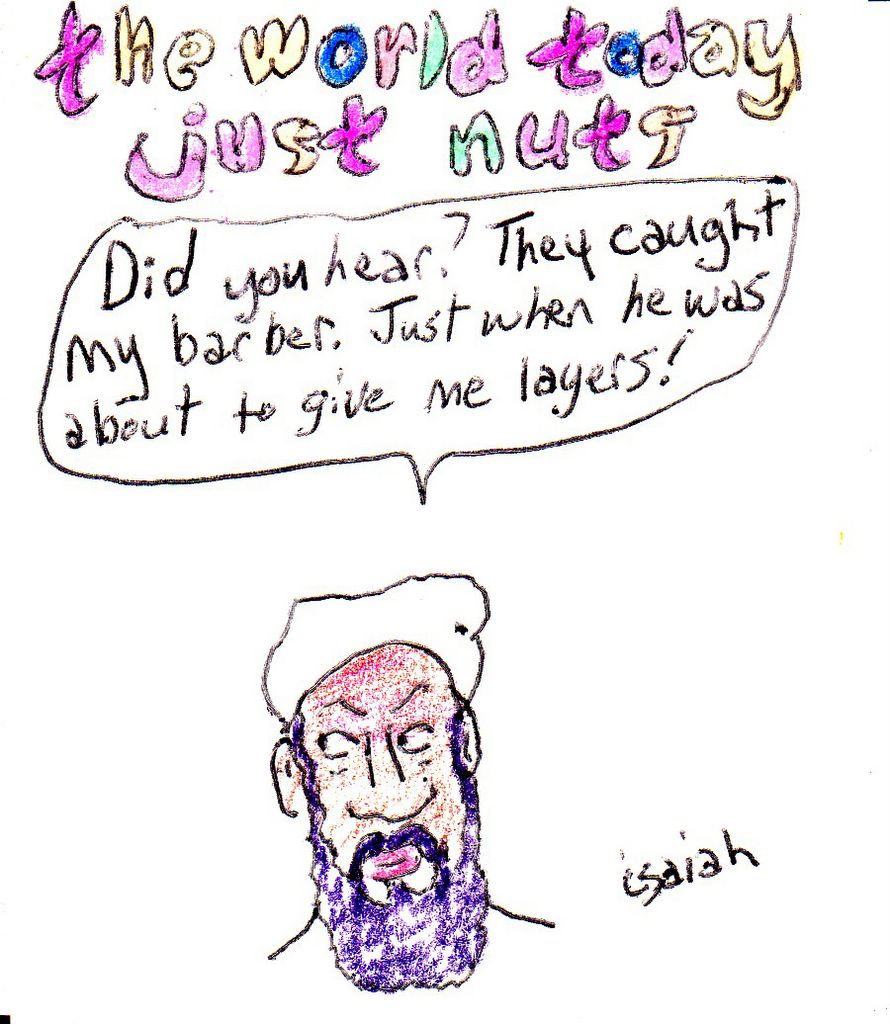
US forces caught the barber!


That's from October 16, 2005. The news then was "They caught Osama's barber!" Truly, I'm not making that up. Some weeks, the Bush administration made it very easy to draw a comic.

So I have Osama asking if you've heard the news and then lamenting that this was "Just when he was about to give me layers!"


Here's C.I.'s "Iraq snapshot:"

Thursday, August 6, 2009. Chaos and violence continue, Anthony Zinni explains how he was almost the US Ambassador to Iraq, the US State Dept and White House are criticized for no visible efforts regarding the victims of Camp Ashraf, Iraqi Christians and Sahwa are targeted in violence, and more.

US Gen Anthony Zinni is now retired from the military. He is now promoting a new book he's written with Tony Koltz entitled
Leading the Charge: Leadership Lessons from the Battlefield to the Boardroom. He was supposed to be serving in the current administration. On NPR's The Diane Rehm Show today, Diane raised that issue.

Diane Rehm: General Zinni, you almost went to work for the Obama administration. I'd like to hear from you --

Anthony Zinni: Right.

Diane Rehm: -- what happened.

Anthony Zinni: Well, uh, I was called right before the inauguration and asked if I would be willing to serve as, uh, to serve in the administration in a couple of possibilities. And then --

Diane Rehm: By whom?

Anthony Zinni: By General [James L.] Jones, the National Security Advisor. And I said I would given the-the positions he mentioned,. And right after the inauguration, he called and asked if I would serve as the ambassador to, uh, Iraq. And I said I would. And, uh, received a call from the vice president thanking me that I would take that on --

Diane Rehm: Vice President [Joe] Biden.

Anthony Zinni: Vice President Biden. And, uh, I met with Secretary of State [Hillary] Clinton and, uh, deputy -- two deputies. Spent a long time with her in the office. She was asking me what I understood about Iraq, my assessment. I had just gotten back not long before that doing an assessment out there. And then I left that meeting, you know, understanding fully, you know, I was going to be the nominee. I mean I was told to prepare for it, we would move the process forward very quickly because of the outgoing Ambassador Ryan Crocker was coming out very quickly.

Diane Rehm: You shook hands on it?

Anthony Zinni: Yes, we did. I mean, there was no way I left and didn't think this was going to happen. And actually thought I had a very short period of time to get my affairs in order. I mean, obviously, there are a number of things you have to do in your own financial family and all that sort of thing. And for -- a week went by and I was told to stay in touch, be prepared, quote: "Move the paperwork forward." That we were going to move up the confirmation hearings. And nothing was happening. And I tried to contact people and I couldn't get any answers. And finally late -- about a week later -- I finally got a hold of General Jones and he informed me I was not the choice and I was kind of shocked and surprised by it. And then the next morning in the Washington Post, I read that it's Chris Hill and I thought: "Had I not gotten ahold of General Jones, that's how I would found out." To be honest with you, I-I don't, I can understand people changing their minds and I don't object to that. You know that's a fact of life. I-I was just put back by not being called or told by anyone and, to this day, I haven't had anybody explain to me what happened so. But I moved on. Clearly, you know, you have to understand Washington and the way things work and I've moved on from there.

Diane Rehm: What's your best guess as to why you were not chosen?

Anthony Zinni: Honestly, Diane, I don't know. Uh, one of the reasons -- I-I started getting calls that very day from the media, from the press and, uh, people saying, "These are the rumors we're hearing." And they were attributed to senior government officials so that was disturbing. And many of the-the reasons given, I clearly knew were not right because --

Diane Rehm: Such as?

Anthony Zinni: Such as, "Well the Pentagon didn't want you." Or, "A certain general didn't want you." All-all of whom I knew personally and it's just the opposite and matter of fact were calling me upset that-that it hadn't gone through. So I began to be bothered by some of the rumors that obviously were coming out of the -- supposedly attributed by the media to senior government officials.

Diane Rehm: What kinds of rumors?

Anthony Zinni: Well, it was this particular lobby that worked against you, it was this particular individual that-that stopped it or this person. And-and to me that -- you know, to me, many of them I knew weren't true, many of them I thought were only based on rumor and so I thought it important since they were asking me what happened I tried to not engage them but then I finally said, "Well look, let me just tell you the course of events that went by. So there's no misunderstanding that I didn't know or understand that I was be the nominee. And what happened." And-and to this day, nobody's told me what happened. Not that I'm interested anymore. But [laughing] I haven't been told.

Diane Rehm: So even speaking with General Jones, he did not give you a reason?

Anthony Zinni: He did not. Our last conversation, right after that was "Well I'll get back to you as I find out." And, you know, that was in January and then I have not heard anything about it. Not that I'm, again, I'm not interested anymore in what happened.

Diane Rehm: Of course you're not interested anymore since it's over and done with. On the other hand, as a human being, if I had been in your position, I would have felt really stung.

Anthony Zinni: Yeah -- well, yes. I guess the best way to describe my feelings, was I was disappointed because there were many friends and people I respected tremendously in this process and, uh, so that-that created a disappointment and confusion on my part as to what exactly happened.

We'll come back to another section of
The Diane Rehm Show in a bit. As Michael Crowley (New Republic) pointed out this week, Chris Hill has no experience with Iraq, doesn't speak Arabic "and has a background in Eastern Europe and Asia." Chris Hill demonstrated in his confirmation hearings that he didn't grasp the issues at stake around disputed Kirkuk. Hill doesn't appear to grasp the issue of the MEK or how the lack of visible efforts to stop the targeting of the MEK by Nouri al-Maliki's forces is causing global outrage. James Morrison (Washington Times) reports Democrats and Republicans in the US House of Representatives have called out the inaction in a letter to the US State Dept -- 21 Democrats, 11 Republicans including Barbara Lee, Sheila Jackson Lee, Brad Sherman, Diane Watson, John Boozman, Bob Inglis, Ted Poe, Dana Rohrabacher, Carolyn B. Maloney and Edolphus Towns. The representatives note, "A community of protected persons has been set upon by security forces of the state to which we relinquished their protection. We believe there is cause to fear the forced expulsion of the Ashraf residents by Iraqi forces." The legislators urge Hillary to instruct Chris Hill to address with Nouri's government "international law and with the assurances Iraq gave the U.S. regarding Ashraf residents." Last Tuesday, Nouri al-Maliki ordered the assault on Camp Ashraf, home to the MEK. The MEK has been in Iraq for decades. They are Iranian exiles welcomed into Iraq by Saddam Hussein. They are currently considered "terrorists" by the US. They were formerly considered such by the European Union and England; however, both re-evaluated and took them off the terrorist watch list. The US military protected the residents of Camp Ashraf during the first six years of the Iraq War. UPI explains, "Iraqi police in July stormed the Camp Ashraf base of the People's Mujahedin of Iran using tear gas and water cannons, promising to expel the 3,500 members of the group." Today The Economist notes, "After the Americans took over in 2003, the PMOI people at Camp Ashraf, as the place is known, were disarmed. More recently the Iraqis decided to take over the camp, doubtless with the ecnouragement of their ruling fellow Shias in Tehran. Ignoring American protests, the Iraqi forces killed at least 11 inmates. If such crude methods are used elsewhere -- for instance, in handling insurgents wanting to come onside -- natioanl reconciliation is unlikely to be achieved." The National Council of Resistance of Iran released the following statement today:

At 9:45 local time this morning, two Iraqi helicopters armed with heavy machine guns flew at low altitude over Camp Ashraf in a bid to intimidate the residents and patrol the area. The helicopters also dropped propaganda flyers. In light of last weeks' massacre of defenseless residents of Ashraf by Iraqi suppressive forces and the US forces' inaction in this respect, and in view of the US forces' role in Iraq's aerial control, particularly in Diyala province;
1- The Iranian Resistance expresses its strongest protest to the American forces for allowing Iraqi helicopters to fly over Ashraf and demands aerial security guarantees from the US forces for Ashraf and prevention of a war crime by violation of Ashraf air space. Considering widespread influence of the terrorist Qods force in Iraq, which has been emphasized by US commanders in Iraq on a number of occasions, and with regards to Iranian regime's plots to annihilate the residents of Ashraf, opening of Ashraf air space to such flights would no doubt be misused by the Iranian regime to commit further crimes.
2- According to our information, the clerical regime's ambassador to Baghdad, Revolutionary Guard Kazemi Qomi who is one of the commanders of terrorist Qods force, had provided the content of the propaganda flyers to the office of the Iraqi Prime Minister on Tuesday, August 4, to be dropped on Ashraf.
3- There is no doubt that all these measures have been dictated by the Iranian regime's Supreme Leader Ali Khamenei to the government of Iraq in the midst of Iranian people's escalating uprising. Nouri al-Maliki, Iraqi Prime Minister, has now turned into a tool in the hands of the Iranian regime to be used against mullahs' main opposition.
Ashraf's defenseless residents who stood empty handed against barrage of bullets in one of the most barbaric criminal attacks last week by the Iraqi forces do not give any credit to Khamenei and Maliki aerial shows, thus they tore up the documents produced by Khamenei's Revolutionary Guards in Qom and Baghdad before the eyes of Iraqi forces and set fire to them.
Secretariat of the National Council of Resistance of Iran August 6, 2009

Former US House Rep Tom Tancredo pens a column about the MEK for the Washington Times and he states:

Human Rights Watch has called for an impartial investigation into the Iraqi police action. Videos of the July 28 attacks show police wielding not only batons and water canons but iron bars in their assault on unarmed residents. Military Humvees ran over injured protesters. Residents also claim that at least two people were killed by sniper fire. Iraqi security forces have prevented journalists from entering the camp to interview residents.
Independent observers know that the action on July 28 is hardly an isolated incident, as it came on the heels of repeated Iraqi government statements that it intends to disband the camp and evict its residents. Such statements are contrary to the agreement signed with the United States guaranteeing the safety of the refugees.
Iraq is also a party to the International Covenant on Civil and Political Rights, which forbids the forcible return of political refugees who face torture or cruel punishments. But where can they go if the United States continues to label them terrorists?

Iraq's
Alsumaria reports that Shirwan Waeli, Minister of State, declared they will not grant asylum to the refugees. Mohammed Abbas (Reuters) reports that Nouri's bag boy Ali al-Dabbagh issued denials that water, medical supplies and food were being blocked from arriving at Camp Ashraf and notes that the claims of the blockage comes from human rights activists as well as Camp Ashraf residents.

The betrayal of the residents of Camp Ashraf should alarm some in England. Today US Maj Gen Richard Nash briefed reporters at the Pentagon. Nash was appearing via satellite from Basra and he was explaining how, in sourthern Iraq, Iraqis are showing leadership. The British turned Basra over to the US and the US is now eager to pass it on to Iraqis. Nash declared, "The Iraqis have stepped up to the challenge and have faced threates head on." How does this apply to England? As the British troops left, they left behind a dog and a cat and asked the Americans to take care of them.
Deborah Haynes (Times of London) reports the dog is Sandbag and has 32,000 Facebook friends and 6,000 people who petitioned the British government to allow Sandbag to come to England. Instead, Downing Street released this statement: "Our US colleagues have assured us that both Sandbag and Hesco will be well cared for. Both are currently fit and healthy." Hesco is the Iraqi cat the British soldiers adopted. Of course, the residents of Camp Ashraf were assured by Americans that they would be protected. And, seeing how that turned out, maybe the world should worry Nouri will next launch an assault on Sandbag and Hesco? If so, apparently the White House will remain mute as it has throughout the Camp Ashraf assault.

Turning to some of today's reported violence . . .

Bombings?

Laith Hammoudi (McClatchy Newspapers) reports a Baghdad sticky bombing which claimed 1 life and left three people injured, a Baghdad bombing which claimed 1 life and a Mosul bombing which claimed 2 lives and left one person injured. Reuters notes a Kirkuk car bombing which claimed 4 lives and left thirty injured, and a Mosul home bombing which injured two Christian females.

Shootings?

Laith Hammoudi (McClatchy Newspapers) reports 1 money exchange office owner shot dead in Baquba and an attack on a Sahwa checkpoint in Baquba which claimed the life of 1 Sahwa. Reuters notes 1 woman shot dead in Mosul by a drive-by and 1 man shot dead in a Mosul home invasion.

Corpses?

Reuters notes 1 corpse discovered in Mosul.

At the end of last month,
Ruth noted that three journalism students, Jennifer Canfield, Tom Hewitt and Jessica Hoffman, with the University of Alaska were headed to Iraq. They are in Iraq and they are reporting at Short Timers. Tom Hewitt offers an overview of events so far including:

While on our way to get our credentials at the Combined Press Information Center in the Green Zone, our convoy came within a few minutes of being hit by an IED, which made the situation getting into the Green Zone a bit tricky due to fears of another attack. We eventually made it into the CPIC, however, and got credentialed.

On the subject of journalists in Iraq,
Shon Meckfessel (The Nation) states, "I'm writing this statement to help people understand what happened to my three friends, Shane Bauer, Sarah Shourd and Josh Fattal, who went missing by the Iran/Iraq border. I have been close friends with Shane and Sarah for years, and recently met Josh, a longtime friend of Shane. Shane is a language student and freelance journalist; Sarah is an English teacher, and Josh arranges student exchange trips. All of us have done some writing about our travels, and all of us share a deep appreciation for Middle Eastern cultures." His statement continues. The three were said to have been hiking. They were in northern Iraq, Kurdistan, and allegedly ended up on Iranian soil. (Anyone paying attention to Iraq in the last years knows the external border disputes especially with regards to Iran though it generally gets more attention when the external border dispute has to do with fishermen allegedly entering Iranian waters.) The three are currently held and jailed by the Iranian government. For more on them, see Meckfessel's statement.

Now returning to
The Diane Rehm Show where Diane spoke with retired Gen Anthony Zinni today. She raised the issue of Col Timothy Reese's memo.

Diane Rehm: General, there's talk that the administration may declare victory and leave Iraq sooner than planned. What are your thoughts?

Anthony Zinni: Well I-I think first of all in terms of combat troops, I-I think the schedule we're on is the right one. Uh, we've done about all we can do in terms of our troops -- coalition troops -- patrolling the streets and in the cities. We have worked hard enough and long enough with the Iraqi security forces that they have the capability to stand up to the challenge. Now they will have problems, they're not perfect. I do think as we go forward, we'll have to continue security assistance programs helping them with the right equipment training education of their leaders and officers. And that's not just military, that's police and-and other security elements that they have there. But I think that's on track. And I think -- I think an ongoing program of that kind of support is necessary to maintain. It's now up to the Iraqi government. I mean, I think we have put him in a position to succeed. It's going to be an issue of their capability and competence to administer, to allocate funds to build programs. I spent some time over there, late last year, at the request of Ambassador Crocker and General [Ray] Odierno, part of an assessment team looking around and I came away -- especially when I was with some of the ministers and some of the ministries in the Iraqi government -- you know, realizing that they're learning something that they have no experience in and that's how to govern, how to build a bureaucracy, how to make policy. They have some inherent friction points. Obviously it isn't like there's one party in office so you can be consistent. They have a Sunni, a Kurd, a Shia. And you have differences that they have to come to grips with internally. They're beginning to learn the -- how bureaucracies function and how governments need to-to do the nitty gritty of getting things done. And in walking some of the streets and talking to some of the people, trying to assess what some of their expectations are, it came out clear to me that it will succeed if they feel their government is responsive to their needs. They want security. They want their essential services met. They want that electricity on 24-7 and garbage picked up.

Diane Rehm: But suppose all that breaks down. Then what happens to the US and its military?

Anthony Zinni: Well -- it -- I feel, you know, of course, I opposed going into Iraq when we did. Wrong war, wrong place, wrong time. And you know that's -- people have come down on different sides of that but the reason I did is we could not afford a deep stabilized disconnected Iraq -- especially since we had other requirements around the world particularly Afghanistan, Pakistan and the entire Taliban and al Qaeda. It-it -- a fragmented destabilized Iraq, right in the heart of the Middle East, I don't think will be for the international community, will be, uh, uh, able to cope with that or able to deal with that by ignoring it. That was my concern: Once you're in, you're in all the way. And I don't think you're going to see a total collapse but I do think my worry would be and-and I don't think this will happen but you could get a fragmentation and see a Kurdish area, a Sunni area, a Shia area split up and, you know, the violence that may go with that. Because at the points where they meet and the fault lines of course there's-there's great danger. Uh, that is going to be difficult for the region. And that's going to wash over and create more problems that we have and-and I would hate to say this but I think we're going to be in a position where we can't let that happen and we need to redefine that "we" is not only the United States. And we need to build more support for ensuring it doesn't happen to begin with or be prepared to take the right actions to react to it.

Diane Rehm: But isn't there very little support internationally?

Anthony Zinni: There is very little support internationally. As a matter of fact, one of my worries about Afghanistan, we're beginning to see waning support and I know you want to talk about that but Iraq of course because the initial entry into Iraq was not received favorably, you know, in the international community with some exceptions. And so the stomach for reengagement obviously isn't there. But I want to say I left there -- and I went there as a skeptic of course and-and-and -- but I admired what General Petraeus did, what Ryan Crocker did, General Odierno because I think they turned it around and gave it a chance. I would -- I would say right now, I do think it will have bumps along the road but it can succeed and I would give you some things to watch. There are three elections in this year. We've already had one, it went very well. If the other two go well, and what I mean by well, the people come out to vote, it's secure, there's no fraud or-or excess influence that shouldn't be -- inappropriate influence, those are going to be good signs. If you begin to see essential services, they're being met. You see the electricity going up, I think then it's going to be on its way to reasonable stability -- at least in the near term and maybe in the long term even more sustainable stability.

What three elections this year is he talking about? The one that's taken place, that he's describing, sounds like the Kurdistan elections last month. But he means the January elections (14 provinces voted). If he's including national elections, they're supposed to take place next January (though they could be postponed again). He does say "him" (apparently meaning Nouri) in the above remarks. It's a prettied-up-view of Iraq. But let's stick with elections.
We'll drop back to Friday to rerun this:


By the way, Patrick Cockburn was one of the fools insisting in the last weeks that the Iraqis would be able to vote yesterday on the treaty masquerading as a Status Of Forces Agreement. That didn't happen. That was never going to happen. It was obvious for some time and by June, with no move to organize voting and poll workers, it was obviously not happening. But fools and liars -- like Cockburn -- continued to insist it would. Just like they continue to lie that the White House was forced into the SOFA when the White House got everything they wanted with the SOFA.
Timothy Williams and Abeer Mohammed cover some of yesterday's reported violence in today's New York Times and also explain:

["]The government of Prime Minister Nuri Kamal al-Maliki has proposed scheduling the referendum for Jan. 15 to coincide with parliamentary elections.On Thursday, one of the few public mentions of the July 30 deadline was made by Tariq al-Hashemi, one of Iraq's two vice presidents."This date had been carefully chosen to provide the necessary time to have a tangible result," Mr. Hashemi said in a statement. "Failure to meet the date is a delay that denies the Iraqi people their rights."In the meantime, various Iraqi governmental entities pointed fingers at one another for failing to convene an election.["]

The brackets are to note that's all from the paper (obvious in the origianl entry but both paragraphs above are in bold print). It's obvious. And something else is obvious, Patrick Cockburn isn't the worst reporter in indymedia. The worst reporter is the one who stole the New York Times article and has sentences in 'their' report that are word-for-word from the NYT report by Williams and Mohammed. Just a thought, besides being theft, is it really smart for those allegedly against the Iraq War to steal from the New York Times to begin with? It's really not an "anti-war" paper. But pay attention and see if you can spot the NYT rip-off, it's an article that's popping up at many sites currently.

In Iraq, Als
umaria reports Parliament is outraged by Nouri's latest stunt: Calling treaties memos of understanding so he can bypass Congress. You know, the US might be able to call this out . . . Oh wait, they US Congress (including the now-president of the US, Barack Obama) rolled over after the SOFA was approved by the Iraqi Parliament. And Bully Boy Bush called it a SOFA (it was a treaty) to avoid having to put it through the US Congress for approval. Hmmm. It appears Nouri was watching and did learn something -- though not what Zinni outlines as things needed to pass on. Meanwhile, the Bremer walls are coming down around Baghdad -- at least some of them. Maybe. The ethnic cleansing that took place to purge Baghdad ended some time ago. Baghdad's still targeted with bombs, don't pretend it isn't. But the walls were primarily about -- as so many rightly feared -- corralling and herding the 'undesirables,' the ones targeted. Ernesto Londono (Washington Post) kind of notes the walls, but really focuses on the more impostant issues such as: "Iraqi authorities have threatened to seize U.S. vehicles that do not have Iraqi license plates, sending hundreds of American government employees and contractors scrambling to Baghdad's equivalent of the DMV." Sam Dagher (New York Times) notes the claims that "most" of the walls will be removed in 40 days. That claim has been made before, by the way. No one seems aware of that. Dagher notes that the plans do "not cover many of the giant walls put up by the United States military two years ago around Baghdad neighborhoods like Dora, Huriya and Saidiya that experienced the worst of the sectarian bloodshed."

Jason Swindlehurst, Jason Creswell, Alec Maclachlan, Alan McMenemy and Peter Moore, all British citizens, were kidnapped in Baghdad May 29, 2007. Jason Swindlehurst and Jason Creswell were dead when their bodies were turned over to the British authorities after the two leaders of the group bragging about having done the kidnappings were released from US custody. (The same group, and why the brothers had been imprisoned originally by the US, bragged about their actions in assaulting a US base and killing 5 American soldiers.) The British government considers Alec and Alan to be dead (the families remain hopeful) and it is thought (by the British government) that Peter Moore is alive. The group taking credit for the kidnappings and for the deaths of 5 US soldiers is alternately called the Righteous League or the League of Righteous by the press. The press? They got press this week, see
Monday's snapshot, because Nouri met with them to bring them back into the government. As noted in the Tuesday snapshot, the press spin that the group has given up violence is false. Their spokesperson says they will not attack Iraqis but that they will continue to go after US service members.Peter Moore is assumed alive and Alec and Adam may be. And Nouri's welcoming the group back to the 'political' process in Iraq? Nouri's spokespeople refute claims made by Gordon Brown's flacks. They claim he's pressing the group on the British citizens. Nouri's spokesperson dismissed that idea and stated it's not a concern for Nouri. Jason Swindlehurst's sister Lizzette Swindlehurst tells the Skelmersdale Advertiser, "To me he [Gordon Brown] could have done something. At the end of the day he is the one with the power in the country, isn't he? I don't know how my mum and dad feel, but I think a lot more could have been done than they said they were doing. I think they knew more as well." Mark Johnson (Skelmersdale Advertiser) quotes her explaining, "They [doubters] were originally saying he had committed suicide. He would not have taken his own life. He would not have done that. Only people who knew him knew he would not do that. He had too much to live for -- he had a little girl." Steve Orme (Liverpool Echo) covers the funeral yesterday. Orme quotes father Russell Swindlehurst stating, "We may not have agreed with their [the government's] policy on the news blackout, but who is to say if the media was informed of everything that went on, the outcome would have been different?"

Turning to the US,
Debra Sweet (World Can't Wait) writes about the peace movement and notes four upcoming dates:


Monday October 5, in Washington DC. Protest at the White House against Obama's Wars, on the anniversary of the US attack on Afghanistan, in coalition with
National Campaign for Nonviolent Resistance (NCNR) and Witness Against Torture, Activist Response Team & Veterans for Peace. We will march from McPherson Square to the White House, and the action will include non violent civil resistance.
Tuesday October 6.
We Are Not Your Soldiers! A day of resisting recruitment in high schools, nationwide. In high schools, this means everything from wearing a button or orange armband, to holding film showings & talks, to bringing in anti-war veterans of Iraq & Afghanistan, to sitting in or walking out to protest at recruiting stations. In support of these actions, we urge people to hold war protests on October 6 at recruiting stations, or city centers.

Saturday, Sunday October 10/11:
Equality March in Washington DC. World Can't Wait will be present to support the just demand for marriage equality for gay & lesbian partners and for the repeal of the "Defense of Marriage Act." We are not against the repeal of the discriminatory "Don't Ask, Don't Tell" policy, but we plan to challenge anyone to say why people should go into the military now, when they will contribute to the illegal, unjust, illegitimate, immoral war, and occupations.

Saturday, October 17: Local Protests to
End the Iraq & Afghanistan Wars and Occupations.

A majority of people taking the
survey said they are ready to organize for October, or want more information. The basic plans are coming together, and we're asking YOU to develop the details as we go forward.

iraq
the diane rehm show
npr
laith hammoudimcclatchy newspapers
the times of londondeborah haynes
mohammed abbas
alsumaria
the washington posternesto londonothe new york timessam dagher
steve ormemark johnson
debra sweet


Read on ...
Creative Commons License
This work is licensed under a Creative Commons Attribution-Share Alike 3.0 Unported License.