Thursday, December 17, 2009

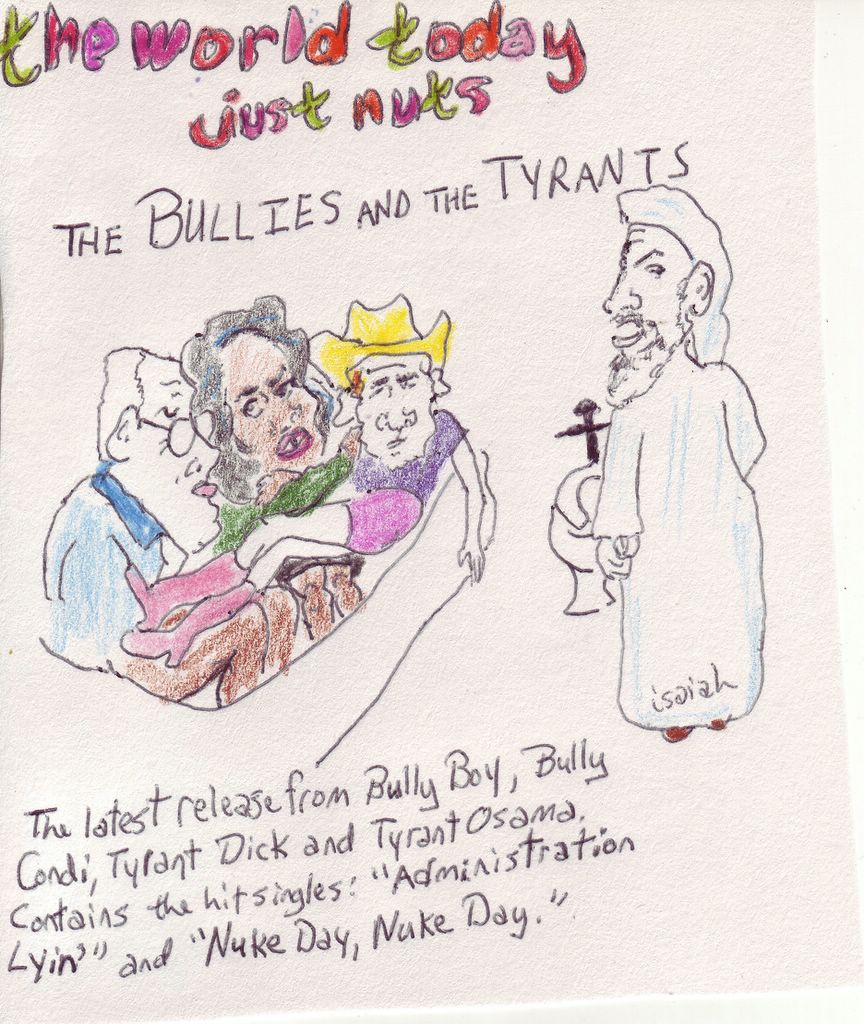
The Bullies and The Tyrants


That's "The Bullies And The Tyrants" from March 5, 2006. Thhat was a day when I was searching for an idea.

I finally merged the Mamas and the Papas debut album cover with Bruce Springsteen's Born In the USA.

I think this works visually. I think it was okay for a day's comic. I don't think it has any staying power. It was visual at least.

When you're doing a weekly comic, there's a lot of pressure. Now days, I do several comics each week and I can really feel like the well has run dry.

And let me take a moment to thank Betty and Ann for their kind words.

Here's C.I.'s "Iraq snapshot:

Thursday, December 17, 2009. Chaos and violence continue, the Iraq Inquiry decides it's all about them, the US House prepares to give even more money to the Pentagon,

Starting with War Hawk Tony Blair, former prime minister of England and lapdog to George W. Bush.
Neil Clark (First Post via Information Clearing House) notes that the Blair War Crimes Foundation has "an online petition addressed to the President of the UN General Assembly and the UK Attorney General, which lists 14 specific complaints relating to the Iraq war, including 'deceit and conspiracy for war, and providing false news to incite passions for war' and violations of the Geneva Conventions by the occupying powers." Tony Blair is set to testify next year to the Iraq Inquiry in London. Today at the Iraq Inquiry, Chair John Chilcot declared will be in public. At the end of the hearing, he declared:

Evidence will only be heard in private in the narrow circumstances we have set out in the published protocols on our website. But I would like to be absolutely clear about this: eveidence sessions with key decision makers, including the former Prime Minister, will be in public. They will be openly questioned about the big issues that they were involved in.

Will come back to today's hearing in a minute. Of the remarks made by Tony Blair over the weekend that he would have found another rationale for the Iraq War if WMD hadn't been handy,
Mick Hume (Spiked) offers the opinion that people are missing the point:

Today the obsession with the tired arguments about Iraq's imaginary nuclear arsenal is also distracting attention from the bigger political questions about the war. Yes, we all know now there were no WMD, it seems the authorities knew it before they invaded Iraq, and many of us had firm suspicions about all that for years beforehand. So, why did Blair and New Labour take Britain to war?
There are two bigger issues here that should be examined, which have little or nothing to do with WMD, or indeed with events in Iraq. The first is about old-fashioned great power realpolitik -- the importance of the US-UK alliance to the British state. The second concerns a more contemporary problem: the domestic crisis of authority facing the British elite.
The role that Britain's relationship with America played in drawing the UK into the invasion has been raised around the Iraq inquiry, but only in terms of what one former official described as Blair's 'sycophancy' towards President George W Bush's administration. The New Labour leader may well have loved the limelight on the White House lawn. But the fact is that any UK prime minister from any establishment party would have found it hard not to sign up for the Iraq War.
Standing alongside America in such conflicts is about more than being Washington's 'poodle'. It is the one chance Whitehall still has of looking like a British bulldog on the world stage. Being a nuclear power with the military force to play a part in great power politics is what still gives the British government a place at the top table of world affairs. That is why, for all the talk of how Gordon Brown would pursue a very different policy towards America from the 'sycophant' Blair, Brown is now the main European cheerleader and lieutenant for President Obama's Afghan adventure. It will take a more courageous political class than this to face up to the truth about Britain's place in the world.

Another opinion is expressed by Aijaz Zaka Syed (Arab News): "Blair and Bush told us this war had been absolutely critical to the security and stability of the "civilized world." Just like the morally bankrupt politicians before them did, they told us the war was necessary for peace! Even when the whole world stood up against the war, from Americas to Asia, the coalition stuck to its guns, insisting the war on Iraq -- already on the brink after two major wars and years of devastating Western sanctions -- was essential to rid the world of Iraq's weapons of mass destruction! And now Blair turns around to tell us WMD or no WMD, the Coalition of the Willing would have invaded Iraq anyway. Ironically though, in doing so, the man who has turned the old-fashioned deceit and lying into a refined art, may be telling the truth for a change! In a now infamous interview with BBC's Fern Britton, Blair gloated: 'I would still have thought it right to remove him (Saddam). I mean obviously you would have had to use and deploy different arguments, about the nature of the threat'." Sian Ruddick (Great Britain's Socialist Worker) reminds, "It is against international law to attack a country on the basis of regime change."

Binoy Kampmark (CounterPunch) focuses on the Inquiry members themselves, "The body reeks of musty establishment. [Director of Public Prosecutions, Ken] Macdonald is quite right to note the less than taxing nature of the proceedings so far. Questioning has been 'unchallenging' and the chair, Sir John Chilcot, has done nothing to suggest that things might change in 2010." Media Lens (via Dissident Voice) has a similar conclusion, "In short, Brown's selection of the Chilcot inquiry committee was one more establishment insult to the British people and to our victims attempting to survive in the wreckage of Iraq. It was one more gesture of contempt for compassion, truth and democracy." Of what the Inquiry has seen during public testimony, Adrian Hamilton (Independent of London) offers: "Senior officials from the Foreign Office turned up before Chilcot to whine about how they were kept out of the loop of Blair's planning, with the implication that somehow it might all have been different if they had been brought in. Sir Jeremy Greenstock, our representative to the UN before the invasion and in Baghdad after, even declared that he was prepared to resign if another UN resolution went against us. Prepared to resign? Anyone who has ever worked in an organisation knows that the threat of future resignation isn't worth the paper it isn't written on." Chris Ames (at Iraq Inquiry Digest) looks at some of the press on the inquiry:To get the headline issues out of the way first, the Daily Mail and others focus on witnesses' doubts about whether the human cost of the war was justified by the outcome, the Independent and Mirror look at Sir John Sawers' admission that Britain had some advance knowledge of problems at Abu Ghraib and the BBC covers both issues, as well as pointing out that:"Panel member Sir Roderic remarked that [Lt Gen Sir Robert Fry] was the first witness to suggest that the UK's contribution was 'critical' to winning the war."The BBC's Peter Biles also says that:"With the steady accumulation of evidence over the past few weeks, there has been a noticeable and welcome change of tone at the inquiry."Mehdi Hasan (New Statesman) offers this take on Sawers, "So, according to the head of MI6 - who also happens to be a former foreign-affairs adviser to Tony Blair - it was not 'reasonable' to assume the violence should have been foreseen and that only President Mubarak of Egypt predicted the manner in which the invasion of Iraq would exacerbate the threat of al-Qaeda-related terrorism, inside and outside Iraq. Is he lying, suffering from amnesia or just plain ignorant? It must be one of the three because I can assure Sir John that countless intelligence reports, terrorism experts, diplomats, politicians and pundits, at home and abroad, warned that invading Iraq wouldn't be the 'cakewalk' predicted by the neocons and that it would only radicalise Muslims across the globe, destabilise the country and the region and provide new opportunities for jihadists to attack western troops on a Muslim battlefield." Sawers' testimony isn't the only one being loudly questioned. From yesterday's snapshot:In addition to Sawers possible problems noted earlier by Sparrow and Ames, the Belfast Telegraph states that another witness, also with M16 at one point (Sawers is the current head of M16) has problems: John Scarlett. They note his claim that the assertion of Iraq being able to attack England "within 45 minutes" was both "reliable and authoritative" is refuted by Brian Jones ("senior WMD analyst"): "Dr Jones, who was head of the nuclear, chemical and biological branch of the Defence Intelligence Staff in the run-up to the invasion, said that it was 'absolutely clear' the intelligence the Government relied upon was coming from untried sources. The 45-minute claim was one of the key assertions that convinced MPs to take Britian to war."Today Michael Savage (Independent of London) reports:The Iraq inquiry committee has come under pressure to recall Britain's former spy chief to give further public evidence after allegations that he misled them over Saddam Hussein's ability to use weapons of mass destruction. Sir John Scarlett, who oversaw the drafting of the government's controversial 2002 dossier outlining the case for invading Iraq, had claimed that intelligence indicating that Iraq could launch missiles within 45 minutes was "reliable and authoritative". But Dr Brian Jones, the most senior WMD analyst who saw the original intelligence, told The Independent that it was vague, inconclusive and unreliable.

And those sort of opinions -- which are held by a great many -- may be why today's hearing seemed to be less about the witnesses and more about the Inquiry itself.
Jim Drummond, Martin Dinham and Stephen Pickford appeared before the committee (link goes to transcript and video options -- unless otherwise noted, all quotes are from the transcript). Today Chilcot announced that the hearing would draw to a close . . . and then went on to speak and speak in a defensive manner (including the already quoted section about Blair testifying in public). On and on he spoke. "With that I will draw this session to a close" appears at the bottom of page 113. And then launches into a defensive ramble that finally ends at the bottom of page 118. "We have . . ." "We expect . . ." "We will . . ." Criticism appears to be getting to Chilcot (that's a good thing). Let's hear a bit of the defensive posturing:

Chair John Chilcot: In the hearings so far, a huge amount of valuable and illuminating evidence has been uncovered, and that's why we approach the opening phase of hearings in the way we did. We have not been trying to ambush witnesses or score points. This is a serious Inquiry and we are not hear to provide public sport or entertainment. The whole point of our approach has been to get to the facts. We have been asking fair questions and have been expecting, and getting, full and truthful answers. That is the essence of a formal public inquiry and witness[es] have responded to this approach by being commendably open and candida, highlighting a number of issues which we shall examine much more closely as the Inquiry continues. Our model of questioning and our selection of witnesses in the hearing up until 11 January is designed to help to establish the narrative. We took a conscious decision to do this through the oral hearings rather than through the publication of a mass of documentary material because we believe that this is the most helpful way to provide the necessary context. We have, therefore, not yet made any requests to government to declassify documents to allow them to be published. As we move into the next phase of evidence taking, where we will hear from ministers and the most senior civil servants and military officers, the Inquiry will increasingly wish and need to draw on government documents and records which are currently classified, in some cases highly classified, in its questioning.

Chilcot's salutation, or 'ring off,' came as the Iraq Inquiry rested for the rest of the year. They will next reconvene January 5th in the new year. When that happens, they might try pursuing a list of questions
Michael Evans (Times of London) has proposed including: "Why was no action taken when intelligence arrived in March 2003 -- just before the invasion -- that Saddam's chemical weapons had been disassembled?" We may go over today's hearing in tomorrow's snapshot but the big point today was Chilcott's need to offer a lengthy defense of the inquiry he is chairing.

In other news,
Andy Sullivan (Reuters) reports that yesterday in the United States, the House of Representatives signed off on a $636 billion military spending bill (395 members voted for it, 34 against it). The huge figure only covers operations through the end of the 2010 fiscal year (September 30, 2010) and doesn't include the monies US President Barack Obama will need for his Afghanistan 'surge.' Today the Center For Arms Control and Non-Proliferation breaks down the bill that $497.7 billion of that is just Dept of Defense "base" spending and not to fund the "military operations in Iraq and Afghanistan." The analysis by Christopher Hellman shows that weapons and gadgets rank third on the funding (under "Procurement" with $105.2 billion) and they include such big ticket items as F/A-22 "Raptor" Fighter, C-130J Transport Aircraft, Joint Cargo Aircraft and C-17 Trasnport. $1.6 billion is budgeted for EA-18G Jamming Aircraft. Jamming aircraft?

All that money goes to waste if the military doesn't even understand the importance of encrypting.
Mike Mount and Elaine Quijano (CNN -- link has text and video) report an "unamed" US Official has told them that 'insurgents' have been able to monitor the live streaming feeds the Predator drones flying over Iraq have been sending to the US military. The story was first reported this morning by the Wall St. Journal's Sibohan Gorman, Yochi J. Dreazen and August Cole who noted, "Senior defense and intelligence officials said Iranian-backed insurgents intercepted the video feeds by taking advantage of an unprotected communications link in some of the remotely flown planes' systems. Shiite fighters in Iraq used software programs such as SkyGrabber -- available for as little as $25.95 on the Internet -- to regularly capture drone video feeds, according to a person familiar with reports on the matter." Brett Israel (Discover Magazine) blogs, "The Defense Department has responded by saying they discovered the vulnerability a year ago, and are working to encrypt all drone communications links in Iraq, Afghanistan, and Pakistan. However, there are at least 600 unmanned vehicles and thousands of ground stations to upgrade, so the security improvement will not happen overnight. However, officials say they have made technical adjustments to systems in key threat areas to block the signal interception." Chris Gaylord (Christian Science Monitor) provides the walk through: "The setup requires a PC, satellite dish, satellite modem, and software such as SkyGrabber, which was developed by the Russian firm SkySoftware. Because of Iraq and Afghanistan's rough terrain, military officials cannot assume the Predators will have a clean, line-of-sight connection with the bases that send them orders. To work around the problem, the drones switch to satellite linkups. However, unlike credit card payments and cellphone calls, this military satellite data is not encrypted." Ewen MacAskill (Guardian) offers, "The US air force is responsible for drones in Iraq and Afghanistan, and the CIA for those in Pakistan. The CIA video feeds are reported to have been encrypted, while some of the air forces ones were not." Take away? Declan McCullagh (CBS News) observes that the "apparent security breach [. . .] had been known in military and intelligence circles to be possible".


Another known is that Iraqi Christians have been repeatedly targeted throughout the Iraq War.
Tuesday two Christian churches were targeted with bombs in Mosul. Meelad Qaseera (Azzaman) reports today that Yonadam Kanna ("the Christian representative in the Iraqi parliament") believes that the targeted is based on "political motives rather than religious beliefs" and "Kanna said it appeared that the government and its troops were incapable of protecting the Christian minority and bringing the perpetrators of violence to justice." Catholic News Agency reports, "Archbishop Francis Chullikat, the Apostolic Nuncio to Iraq and Jordan, has demanded the immediate intervention by Iraqi leaders to 'guarantee the necessary safety of the Christian minority,' in the wake of the attacks on two churches in the city of Mosul." Asia News quotes the Archbishop of Kirkuk, Louis Sako, stating, "The situation is very tense. Just last week two Christian brothers were killed and two more were abducted. Where was the local government? And the Central government? Where are the representatives of the ruling parties?" Spero News interviews Biship Shlemon Warduni ("the Chaldean Catholic Auxiliary Bishop of Baghdad")

[Question:] What is the current situation of the Christian community in Iraq?[Bishop Shlemon Warduni:] Our situation sparks concern and pain. The context is well-known: for years, Iraq has been ravaged by internal and external wars that have robbed the people of peace and basic social services like health and education. The consequences of the last war and military occupation are tragic. The political instability and anarchy has generated misery and destruction. This is why many Christians - along with thousands of other citizens - have had to leave the country. We have lost about a third of our community. It is a tragedy of vast dimensions, which is witnessed by the world.[Question:] Have you noticed improvements in the last year? What do you hope from the new elections?[Bishop Shlemon Warduni:] What has occurred is that the lack of political planning has led to the proliferation of terrorism, which today has its own agenda and destabilizes the country. Legality and security are lacking, the government is weak, and the elections (not yet established with certainty) will have to address these urgent needs, otherwise they will be useless. Meanwhile, attacks on churches and Christians continue: in the last two weeks there have been explosions in three churches in Mosul, not to mention in Baghdad, where three months ago a car bomb outside a church killed two young people and wounded 30, causing great material damage. [For us], tranquility is a small break between two attacks.

Meanwhile
Alsumaria reports, "Christians started preparations and shopping for this year's season wishing peace security and happiness for all Iraqis." But AINA offers a different picture for Iraqi Christians in Basra, "Christmas is likely to be a subdued affair for the dwindling Christian population of this once-cosmopolitan city. This year, the holiday falls amid the Shiite festival of Ashoura, when much of the city's population will take to the streets to commemorate the martyrdom of the Prophet Muhammad's grandson -- many by ritually cutting themselves and whipping their backs with chains." In other religious minority news, AFP reports a Yazidi Murad Sardar was arrested on Monday and his family has not seen him since. His crime? Apparently selling alcohol in Babylon Province. He is the last known seller of alcohol. "Freedom brought to Iraq by the USA! This message brought to you by the Re-Elect Barack Obama Committee."

In other news of violence . . .

Bombings?

Reuters notes a Baghdad car bombing targeting "lawmaker Nadeem al-Jabiri" in which 1 person died and ten people were douned (but al-Jabiri was not present), a Baiji grenade attack which injured police officer Mudher Ahmed, a Baghdad sticky bombing which injured two people, a Kirkuk car bombing which injured a police officer and a Mosul bombing that left one child wounded.

Shootings?

Laith Hammoudi (McClatchy Newspapers) reports 1 police officer shot dead in Mosul. Reuters notes 1 "Christian lab assistant . . . shot dead . . . in Mosul," another police officer shot dead in Mosul

Laith Hammoudi (McClatchy Newspapers) reports 1 corpse discovered in Mosul.


In the US,
March Forward! is a new group, one that's "an affiliate of the ANSWER Coalition," composed of veterans and active-duty service members including James Circello and Michael Prysner whom we've noted here before. The group has a "10 Point Program for Struggle:"1) We demand the right to refuse illegal and immoral orders.Service members should no longer be bound to carry out the plans of the Pentagon and Wall Street in violation of U.S. law, international law and people's right to self-determination. Service members deserve the right to resist, without persecution, orders that conflict with internationally recognized laws or that conflict with their own conscience. 2) We demand an immediate end to the criminal occupations of Iraq and Afghanistan. Service members should no longer be sent to fight, kill, die, be seriously wounded and/or psychologically scarred furthering the domination of U.S. corporations over other nations. We have nothing to gain from these wars. The occupations of Iraq and Afghanistan serve only the interests of the rich, not the service personnel who are sent over and over to repress people who have the right to determine their own destiny. The people of Iraq and Afghanistan are not our enemies. The more than 800 U.S. bases in 130 countries around the world should be shut down and the troops, fleets and air power brought home. 3) We demand an end to the existing officer corps. The existing class stratification in the military must end. Officers -- who are overwhelmingly from more privileged sectors of society -- enjoy a much higher standard of living. They are paid significantly more, are provided much higher quality housing, and have access to services not available to enlisted personnel. Officers advance their careers on the backs of enlisted personnel, going so far as to send their troops into harm's way for the good of their resumes. The existing officer corps should be dismantled and replaced by enlisted service members who are democratically elected by their units and who are subject to recall at anytime. Officers should no longer enjoy special privileges, including hand salutes. We also demand the right for lower enlisted ranks to unionize and form committees to address grievances with the chain of command, the unit and the military. 4) We demand an end to racism, sexism and homophobia prevalent in the military. These are intentional barriers to rank-and-file unity against the will of the Pentagon, and must be eliminated through comprehensive education and strict disciplinary action. We demand an end to the "Don't Ask, Don't Tell" policy and all other discriminatory measures against lesbian, gay, bisexual, transsexual and transgender individuals. 5) We demand adequate funding for The Department of Veterans Affairs.Veterans should have full access to quality health care. Services should be drastically expanded to meet the real physical and mental health needs of veterans and their families. Independent medical investigations should be initiated to research the effects of potentially harmful experimental drugs and chemical, biological and nuclear agents to which service members have been exposed. Any service member who has served in a combat theater should automatically receive lifetime compensation from the VA for being forced to suffer or inflict physical and/or psychological harm in advancing the interests of U.S. corporations. 6) We demand the right to a job, housing, health care and education for all.Service members are lured into the military with the hopes of escaping economic hardship as a civilian, and to obtain education benefits and job training. Yet thousands of service members must remain in the military, literally trapped due to the lack of opportunities in the civilian world. No service member should have to choose between military service and poverty. Housing, a job, and access to free quality education and job training should be a right for everyone. 7) We demand the immediate end to all military aid to governments in service of US imperialism. U.S. domination is not only exercised through direct military involvement, but also through a myriad of brutal client regimes and comprador governments that are funded, supported and directed by the U.S. government. Service members should not have to serve a military that uses billions of dollars in funds and weapons to prop up governments that are guilty of committing war crimes or repressing their citizens for the interests of the Pentagon and Wall Street. Aid to such countries as Israel, Colombia, Saudi Arabia, Taiwan, South Korea, Uganda and Egypt should be immediately cut off. All remaining funds, military equipment and weapons should be repossessed. Reparations should be paid to the populations that the military aid was used to repress. 8) We demand the immediate dismantling of the permanent military-industrial complex. As long as there is a system in place that allows U.S. corporations to reap massive profits from going to war, there will be war for profit. The domination of the military-industrial complex has caused the death of tens of thousands of service personnel, and millions of innocent people -- all in the name of profit. All private military corporations should be shut down or nationalized. The more than 1 trillion dollars a year that feeds the Pentagon and the military-industrial complex should be used to meet people's needs. 9) We demand that all those involved in pursuing war for profit be indicted.To ensure that service personnel no longer have to fight for the interests of the rich, all those responsible must be held accountable. Politicians, policy makers, lobbyists, CEOs and others involved in pursuing warfare -- both military and economic -- as a means to reap profit should be indicted for war crimes. Media outlets involved in disseminating false information in support of these plans should also be held accountable. 10) We demand full reparations paid, with interest, to all victims of the U.S. military. As service members in the U.S. military, we have been told that our enemy is the poor and oppressed abroad. But they are not our enemies. To begin to undo the injustices in which we have been forced to take part, the U.S. government should pay for the rebuilding of every structure bombed, compensating families for every person killed and providing a lifetime of health care and disability benefits for every individual wounded, including resistance fighters who took up arms against the U.S. military.

Joe Wolverton II (The New American) adds, "In what is sure to be a controversial call to action or inaction, the organization March Forward, a group of patriotic retired and active-duty servicemen, has recommended that soldiers refuse orders to deploy to Afghanistan and Iraq."

Tonight on
Anderson Cooper 360 (CNN):Roy Hallums was kidnapped in 2004. He was rescued in 2005. He endured 311 days as a hostage in Iraq. He was actually buried alive when he was rescued and now we have the exclusive videotape of his rescue. We'll show you how the special forces team did it. Hallum says what might appear hyperbolic with a calm earnestness. "I hoped they wouldn't decide to just cut off my head and videotape the occasion for mass distribution to the international media." Instead, we have the videotape of his rescue. Michael Ware reports Thursday at 10 p.m. ET.


Unrelated to Iraq but US House Rep Jared Polis has a column at CNN ("
No good reason to be in Afghanistan"). Staying with the topic of TV, "Can a breakthrough health care innovation in Rwanda work in the U.S.?" asks NOW on PBS this Friday (on most PBS stations -- check local listings):In rural Rwanda, the simple and time-tested idea of medical house callsis not only improving the health of the community, but stimulating itseconomy as well. On Friday, December 18 at 8:30 pm (check locallistings), NOW travels to the village of Rwinkwavu to meet the Rwandandoctors, nurses and villagers who are teaming up with Boston-basedPartners in Health and the Rwandan government to deliver medicine andmedical counseling door-to-door. Would such an innovation work inAmerica? In the capital of Kigali, NOW's David Brancaccio sits down with RwandanPresident Paul Kagame to talk about international aid and Kagame'sultimate vision for a healthy, financially-independent Rwanda.

We'll close with this from independent journalist
David Bacon's "In Oakland, Hunger Is Multicultural" (East Bay Express):

Everyone knows that Oakland is diverse. Probably more people from more races and nationalities live in the city than anywhere west of New York or north of Los Angeles. But before we celebrate diversity, think of its most diverse places. Some of them are surely the lines of hungry people lining up for food.
Oakland has many food pantries -- programs run primarily by churches on a shoestring. Church elders are often found at the Alameda County Community Food Bank's huge warehouse out by the airport, buying as much food as they can for as little money as possible. They worry that the bags of cans and produce they distribute will run out before everyone in line gets one.
Reverend Lee from the Cornerstone Baptist Church, a food bank stalwart, fills the small storefront off MacArthur Boulevard with white plastic bags of cans, dried goods, and bread. Then the people come. Mostly Chinese-American and African-American families get their food from the African-American activists from his church.

David Bacon's latest book is Illegal People -- How Globalization Creates Migration and Criminalizes Immigrants (Beacon Press) which just won the CLR James Award. Bacon can be heard on KPFA's The Morning Show (over the airwaves in the Bay Area, streaming online) each Wednesday morning (begins airing at 7:00 am PST). And I'm going to squeeze in one more thing. Last month, AK Press released The Battle of the Story of The Battle Of Seattle by David Solnit and Rebecca Solnit. We did a book discussion about it at Third. It's a strong book and an important one. A good holiday present if you're looking for ideas. With Aimee Allison, David Solnit authored the must read and community favorite Army Of None. His sister Rebecca Solnit is known for her own numerous writings as well as for her work with Courage to Resist.

iraq
the independent of londonmichael savageadrian hamiltonchris ames
the socialist worker
bbc newsthe times of londonmichael evanssian ruddick
mike mountthe wall street journalyochi j. dreazenaugust cole
mcclatchy newspaperslaith hammoudicnnanderson cooper 360anderson coopermichael ware
pbsnow on pbs
david baconkpfathe morning show
david solnitaimee allisoncourage to resist


Read on ...

Thursday, December 10, 2009

The House On Boo Corner


That's "The House on Boo Corner" and it went up March 3, 2006. It was one of the few times I was ready and Blogger was the problem. There was a problem that I don't even remember now but I remember C.I. calling me and apologizing. I said it can wait, don't worry.


And it could and it did. This was about how Bush was always grandstanding on 9-11 to scare us. Kind of like Barack does now.

Maybe I should just take all my Bush cartoons and past Barack's face on to them?


Here's C.I.'s "Iraq snapshot:"

Thursday December 10, 2009. Chaos and violence continue, the US military announces another death, Nouri finds a new group to scapegoat for violence in Iraq, Nouri orders residents of Camp Ashraf 'relocated,' big oil circles Baghdad, as does Defense Secretary Robert Gates on layover, and more.

Today the
US military announced: "BAGHDAD -- A Multi-National Division–Baghdad Soldier died, Dec. 10, of non-combat related injuries. The name of the deceased is being withheld pending notification of next of kin and release by the Department of Defense. The names of service members are announced through the U.S. Department of Defense official website at http://www.defenselink.mil/releases/. The announcements are made on the Web site no earlier than 24 hours after notification of the service member's primary next of kin. The incident is under investigation." The announcement brings the number of US service members killed in Iraq since the start of the illegal war to 4368.

Bombings?

Jenan Hussein (McClatchy Newspapers) reports a Mosul roadside bombing injured two Iraqi soldiers. Reuters notes another Mosul roadside bombing which injured one person, a third Mosul roadside bombing which left five people wounded (two were police officers) and a fourth Mosul roadside bombing which injured three bodyguards for police Brig Gen Majed al-Bayati.

Shootings?

Jenan Hussein (McClatchy Newspapers) reports the Baghdad assassination of 1 sheik.

Meanwhile, this afternoon Iraqi journalist
Riyadh Mohammed (New York Times' At War Blog) explained, "Since the American invasion of Iraq in 2003, I had kept a list of ever relative or friend killed in violence. As of late 2006, I counted 124 deaths. Suddenly I stopped. No. 125 was my father. My father had told me a few weeks prior to his tragic death that his phone book was filled with telephone numbers of killed and missing people. He was soon to join my list."


As the violence continues in Iraq and people are wounded and dying, it's not all about oil,
Ayla Jean Yackley (Reuters) helpfully explains, it's about the "drilling rigs" which will need "thousands of tonnes of cement and steel, many miles of pipeline and tens of thousands of trained and qualified workers." PFC Energy's Raad Alkadiri crows, "Iraq will place a massive call on the service sector. It will start to be a black hole, sucking a lot of the sector in from the region and beyond." Hassan Hafidh and Guy Chazan (Wall St. Journal) report on the running of the bores, foreign oil execs who "are flocking to Iraq" in the hopes of landing some of the winning bids in the Friday and Saturday rounds of bidding. Remember, if you're going to Baghdad Green Zone, be sure to wear the blood of many dead, if you're going to Baghdad Green Zone . . . Sinan Salaheddin and Brian Murphy (AP) report 15 fields are up for bid and 44 companies are competing to be the big winner (the people of Iraq have already been cast as the big losers in the continued filming of The Theft Of Iraqi Oil). Reuter's Simon Webb has apparently been hired to do the soundtrack and performs a modified Elvis classic "It's now or never . . for Big Oil in Iraq." During a spoken rap at the bridge, Webb explains, "It is one of the largest auctions ever held, with around the same reserves on offer as all the oil in OPEC-member Libya." The Iraq War, the illegal war, is big business. Iran's Press TV today reports on the $2.4 billion, BILLION, weapons deal Iraq entered into with the Ukraine. If you're missing the point, Bellamny Pailthorp (KPLU -- link has audio and text) quotes Iraq Ambassador to the US sami Sumaida'ie in Seattle declaring, "Iraq is open for business." On the visit, Chris Grygiel (Seattle Post-Intelligencer) adds: "The purpose of Samir Sumaida'ie's two-day visit to the region was to meet with Boeing, Microsoft and others as Iraq continues to rebuild after the Saddam Hussein regime was toppled and the United States scales back its military presence in the country."

Scaling back the military presence? Before the tag sale? Not hardly. In fact, some might consider the US Secretary of Defense, Robert Gates, landing in Baghdad today increasing the US military presence.
Kevin Baron (Stars and Stripes) reports Gates met with President Jalal Talabani. Remember the supposed 'improved' 'security' in Iraq? Even now, nearly seven years after the Iraq War started (March, 2003), Robert Gates still has to sneak into the country on what Baron terms an "unannounced stop". Iran's Press TV terms it "a surprise visit" which sort of makes you picture Gates arriving with a bag of presents. Gates may have wante to be in and out on the same day; however, Nouri put him off and now Gates has a layover as he waits for Nouri to find the time to meet with him. Elisabeth Bumiller and Marc Santora (New York Times) explain, "American defense officials insisted that Mr. Maliki had not rebuffed the defense secretary, but it was not until late Thursday, hours after Mr. Gates landed in Baghdad, that they said that Mr. Maliki had agreed to see him on Friday morning. Mr. Gates' aides scrambled to rearrange his schedule." CNN adds that Gates "called off a planned news briefing as a result" of the postponement.

Nouri was busy with a number of things today including facing Parliament.
Mu Xuequan (Xinhua) quotes Nouri insisting: "It is hard for us to appoint the chief of intelligence since each political bloc demands that this man should be from their blocs." Al Jazeera quotes from this melodramatic Nouri moment: "All of the recent crime is because of political and sectarian differences. I call on parliament to issue a decision to purify the security services from anyone who belongs to any political party, including my party." BBC News explains that quotes from Nouri "were relayed to reporters after the closed door-meeting on Thursday." Which only makes it more confusing because Nouri's talking out of every side of his mouth. Tuesday he did what he always does, insist it's former Ba'athists in Syria. David Kenner (Foreign Policy) notes Nouri did that in August and October as well (on "Bloody Wednesday" and "Bloody Sunday") and that, "Maliki raised eyebrows for previously pointing the finger at Syria, when the released evidence looked less than definitive. However, the fact that he is repeating his claims now shows he has on intention of backing down -- and is an important data point on where Iraq will stand on intra-Arab disputes in the future. Saudi Arabia, for example, has remained intensely skeptical of the Shia-dominated government, and has so far refused to send an ambassador to Baghdad." Meanwhile Lara Jakes (AP) explores Rabiya, on the border Iraq and Syira share, and finds little to support a claims of Syrian foreign fighters or Ba'athists entering from Syira and "Iraqi and American security forces alike [. . .] say they've neither seen nore heard of Baathists illegally crossing the border in recent months." In Syria, Andrew England (Financial Times of London) speaks with former Ba'athists, "Syria has rejected all those claims. Mr [Abdul Nasser al-] Jenabi, who represents a Sunni insurgent group aligned with Izzat Ibrahim al-Douri, a Baathist who served as deputy head of Saddam Hussein's Revolutionary Command Council, said his group did not target Iraqis and had no role in the bombings. He said that he and others like him in Syria were involved in media relations and political issues. Some observers also say Mr Maliki may have decided to point the finger of blame because of the damage the attacks have caused to his own credibility."

Credibility? Nouri? Tuesday,
Dar Al Hayat reported (translation is mine and my Arabic is very poor) that there is a possiblity Sahwa ("Awakenings," "Sons Of Iraq") will stop receiving payment from the Iraqi government at the end of December and that this comes as Sahwas continue to be targeted (gives an example of recent violence that claimed 6 lives). The article notes that the Sahwa were supposed to have been incorporated into Iraqi jobs by the end of this year "according to an agreement between US forces and the Iraqi government". A Sahwa leader (from western Baghdad), Naji, speaks of concerns about a security vacuum should Sahwa be taken off the payrolls and he notes the possiblity that they could return to their older ways (the US military paid them off originally so they would stop attacking US military personnel and equipment) -- he terms this "a big problem." He speaks of announcements by the National Reconciliation Commission (a body in Parliament headed by Zuhair al-Jalabi) that they will be closing out the Sahwa at the end of the year. A Diyala Province Sahwa leader, Sheikh Hussam, issued a call on the Iraqi government to live up to the promises it made to Sahwa and refers to the need for the government to compensate the families and children of Sahwa who have been killed. Again, that's my translation and it's very poor.

Nouri's credibility? Today wasn't all melodrama, Nouri also played bully.
Iran's Al-Alam News reports that he stated (at his website) that the Mujahedin-e Khlaq Organization (MKO -- also known as the MEK) would be "quarantined in a far-fetched region south of Iraq before leaving the country." The residents of Camp Ashraf are Iranian dissidents who were welcomed into Iraq by Saddam Hussein. When the US invaded in 2003, they took over the protection of Camp Ashraf. An agreement was reached between Nouri and the previous administration at the end of last year whereby Nouri promised not to attack or harm the residents. Nouri never lived up to that promise and -- pay attention, KRG -- the US didn't do a damn thing. Not a damn thing. [Pay attention, KRG? The KRG's been promised a lengthy list of items by the Obama administration. A great many of those things will require the consent of Nouri or the next prime minister. And if they don't consent? The US government doesn't exactly have a record they can point to.] July 28th, Nouri ordered an assault on Camp Ashraf, at least 11 residents were killed. Nouri's announcement today of moving them (possibly as soon as next Tuesday) is certainly beneficial . . . for him. Sarah Cosgrove (Edgware Times) reports British "MPs and Peers from across the political spectrum have welcomed a Spanish court's deicison to investigate claims Iraqi troops killed refugees at Camp Ashraf." Since the attack, Nouri's barred most journalists and aid organizations from visiting Camp Ashraf. Now, as Spain's going to investigate, he wants to ship all the residents to "a far-fetched region"? The Secretariat of the National Council of Resistance on Iran states Nouri is taking orders from Iran and:

The Iranian Resistance denounced remarks by Iraqi Prime Minister Nouri al-Maliki, concerning "Transfer of Camp Ashraf residents to Nuqrat al-Salman" which was described by him as a "step towards expelling them (from Iraq)," as unlawful and disgraceful kowtowing to orders of the religious fascism ruling Iran in the midst of nationwide uprising in Iran. The Iranian regime has set the suppression of Ashraf residents in Iraq as a precondition to its support for al-Maliki in the upcoming parliamentary elections in Iraq.
Simultaneous with the nationwide uprising during the past few days that people have been chanting "Down with Khamenei" and "Down with the principle of velayat-e faqih (absolute rule of clergy)" that has sounded the death knell of the regime;
While the international community has condemned suppression of uprising in the strongest terms and the UN High Commissioner for Human Rights stressed that "The suppression of protests is escalating, it is much more serious," and has been "calling for respect for the right to protest that is also a fundamental freedom," and Amnesty International described "Human rights violations in Iran are now as bad as at any time in the past 20 years";


Turning to London where the Iraq Inquiry continues. John Chilcot is the chair of the five member commission -- six if you count Margaret Aldred.
Mark Tran (Guardian) gives an overview of the commission. Today's witness was M16 head John Sawyers (link has video and transcript) which is England's Secret Intelligence Service. Sawyers is the third head of M16 since the start of the Iraq War. Before the war broke out Richard Dearlove headed M16. In 2004, he was replaced by John Scarlett (who offered testimony yesterday) and Sawyers took over in 2009. Prior to that he held many jobs but the one pertaining to Iraq would be the UK Special Representative in Baghdad (2003). Prior to that -- we're including this because a friend in England's telling me that several press accounts are getting it wrong -- prior to be the UK Special Representative in Baghdad, he was the British Ambassador to Cairo and held that position from 2001 until 2003. There appears to be some confusion about when he was an advisor to Tony Blair (his title was "Foreign Policy Advisor to Prime Minister) that was 1999 to 2001 and not, as some are reporting, from 2001 to 2003). We'll pick up with Sawyers complaint today about the US military:

Yes, General Mike Jackson, who was then the newly appointed chief of general staff, visited Baghdad in my first few days there and and I talked with a small company of paras who were there to help protect our -- I think they were a platoon actually to protect our embassy, which was outside the Green Zone, and in discussion it became clear that part of the problem was the posture of the US army. They were in their tanks, in their Darth Vader kit, with wraparound sunglasses and helmets and flack jackets and everything else, and there was no real rapport between the US army and the ordinary citizens of the capital, and Mike Jackson -- and I have to say I have some sympathy with this -- thought there was a case of bringing a large contingent of paras, not just the 20 or so in the platoon, but a battlion of paras up to work with the Americans to demonstrate a different way of the army deploying in urban areas, and this was all part of what we had learnt in other places, in Northern Ireleand and so on. I reported this as one option backt o London, after I discussed it with Mike, but it was clearly a military matter -- Mike Jackson. There were differences of views between the Chiefs of Staff on this.

He had strong criticism for ORHA (Office for Reconstruction and Humanitarian Assistance -- later becomes the CPA in Baghdad -- Coalition Provisional Authority) as well:

But ORHA, as an organisation, did not have a clear strategy and was not well managed or coordinated and didn't have very many resources. Living conditions were pretty appalling. I had certainly not experienced the sorts of conditions that we had to live under, the heat. For the first time in my life I was sleeping in a dormitory with a lot of other people. There were no doors to the bathrooms. There was itnermittent water and electricity. It was pretty grim. So the US civilians were unable to [get] their own act together, let alone the act for the rest of Iraq.

Sawyers also spoke of problems the British were having in 2003, including in getting reliable information back to London (he did not feel the media reports were reliable -- he didn't say whether they were overly bleak or overly optimistic in his opinion). This led Committee Member Roderic Lyne to raise the point Hilary Synnott did earlier this week, about having no equipment to communicate with London on and the US military giving him a computer and his using Yahoo to send messages. Sawyers said that when the British embassy staff finally arrived in May, "they then had access to Foreign Office communications. But it didn't last very long because the place where the embassy was located, which was outside the Green Zone, was very soon determined to be unsafe for us to occupy." The illegal war never should have been started. After it was, more bad decisions were made (that's what happens when you build onto an illegal framework). Two of the most cited poor decisions are the de-Ba'athification program and the disbanding of the Iraqi military. On the first, the de-Ba'athification referred to removing Ba'athists from various positions. The Ba'ath Party was Saddam Hussein's political party. He was overthrown (and executed). A purge of all Ba'athists followed. This caused huge problems and, despite repeated promises from Nouri, it has still not been addressed and continues to fester in Iraq. No de-de-Ba'athification program has been implemented. The issue of de-Ba'athifcation was touched on at length today.

Committee Member Roderic Lyne: You arrived on 8 May, [head of CPA, the US' L. Paul] Bremer on the 12th, and within Bremer's first two weeks he had promulgated two extremely important decisions on de-Ba'athification and on dissolving the former Iraqi army. Can we look at those two decisions? To what extent were they Bremer's decisions or -- how had they been pre-cooked in Washington? I see you have got the Rand Report there, and the Rand Report suggests there had been a certain interagnecy process in Washington leading to these decisions, albeit Rand is quite critical of that process. And, very importantly for us, was the United Kingdom consulted about these crucial decisions? Was the Prime Minister consulted? Were you consulted? It is pretty late in the day be then for you to have changed them. Can you take us through that story.

John Sawyers: Can I separate them and deal with de-Ba'athification first.

Committee Member Roderic Lyne: Yes.

John Sawyers: When I arrived in Baghdad on 8 May, one of the problems that ORHA were facing was that they had been undiscriminating in their Iraqi partners. They had taken, as their partners, the most senior figures in the military, in -- not in the military, sorry, in the ministries, in the police, in institutions like Baghdad University, who happened to be there. And in several of these instances, Baghdad University was one, the trade ministry was another, the health ministry, the foreign ministry, the Baghdad police -- the working level were in uproar because they were being obliged to work for the same Ba'athist masters who had tyrannised them under the Saddam regime, and tehy were refusing to cooperate on that basis. So I said, in my first significant report back to London, which I sent on the Sunday night, the day before Bremer came back, that there were a number of big issues that needed to be addressed. I listed five and one of those five was we needed a policy on which Ba'athists should be allowed to stay in their jobs and which should not. And there was already a debate going on among Iraqi political leaders about where the line should be drawn. So I flagged it up on the Sunday evening in my first report, which arrived on desks on Monday morning, on 11 May. When Bremer arrived late that evening, he and I had a first discussion, and one of the first things he said to me was that he needed to give clarity on de-Ba'athification. And he had some clear ideas on this and he would want to discuss it. So I reported again early the following monring that this was high on the Bremer's mind and I needed a steer as to what our policy was. I felt that there was, indeed, an important need for a policy on de-Ba'athifciation and that, of the various options that were being considered, some I felt, were more far-reaching than was necessary but I wasn't an expert on the Iraqi Ba'ath Party and I needed some guidance on this. I received some guidance the following day, which was helpful, and I used that as the basis for my discussion with Bremer -- I can't remember if it was the Wednesday or the Thursday that week but we had a meeting of -- Bremer and myself and our political teams, where this was discussed, and there was very strong support among the Iraqi political parties for quite a far-reaching de-Ba'athification policy. At the meeting itself, I had concerted beforehand with Ryan Crocker, who was the senior American political adviser, and I said to him that my guidance was that we should limit the scope of de-Ba'athification to the top three levels of the Ba'ath Party, which included about 5,000 people, and that we thought going to the fourth level was a step too far, and it would involve another 25,000 or so Iraqis, which wasn't necessary. And I thought Crocker was broadly sympathetic to that approach but at the meeting itself Bremer set out a strong case for including all four levels, ie the top 30,000 Ba'athists should be removed from their jobs, but there should be a policy in place for exemptions. I argued the alternative. Actually, unhelpfully, from my point of view, Ryan Crocker came in in strong support of the Bremer proposal, and I think he probably smelled the coffee and realised that this was a policy that had actually already been decided in Washington and there was no point getting on the wrong side of it. I was not aware of that at that stage and, in fact, it was only when I subsequently read the very thorough account by the Rand Corporation of these issues that I realised there had been an extensive exchange in -- between agencies in Washington.

Commitee Member Roderic Lyne: Just to pause on that, this crucial decision, not just to take the top 5,000, which probably was not a matter of argument, but to add 25,000, sweeping up a lot of professionals, teachers, doctors people like that, who had been obliged to become members of the Ba'ath parties, had been stiched up between agencies in Washington but without any consultation with the number 1 coalition partner, Britain, who were going to be vitally affected by that?

John Sawyer: I cannot vouch for that because I wasn't in London, I wasn't involved in those exchanges.

Commitee Member Roderic Lyne: But you would have been aware of if we'd been (inaudible), somebody would have told you.

John Sawyers: When I was doing my calls in London on the previous week, this was not an issue that had been raised with me. So I don't know in the embassy in Washington or people in Whitehall were plugged into the debate. I would just say, though, Sir Roderic, that we do need to keep this in context, that a lot of parallels are drawn about Iraq in 2003 with Germany in 1945, and I have to say that was the intellectual mindset that Bremer brought with him, there was a parallel with the reconstruction of Germany in 1945. In 1945, the Allies excluded 2.5 per cent of the German population from jobs because of their links with the Naxi party. What Bremer was proposing was excluding 0.1 per cent of the Iraqi population, ie 25 times fewer, proportionately, than was the case in Germany. And in that context he was looking for a policy of -- a scope for giving exemptions.

Now let's skip way ahead. They weren't listening to the British. Who was the US listening to on this decision? Sawyers said, "Why London wasn't involved in it you will have to ask others because I wasn't in London at the time. But it had clearly been thought through in Washington and they were, to some extent, under the influence of people like Ahmed Chalabi, who took a very hard line on this issue."

Sawyers testified that, as with the de-Ba'athification program, Bremer told him at their first meeting that he wanted to disband the Iraq army and that DC had agreed to this and issued "a decree". Sawyers stated, "This, again, was a new issue for me."

The Inquiry does not hear from any witness tomorrow. They resume public testimony on Monday with five witnesses scheduled, Lt Gen John Kiszely, Lt Gen Robin Brims, Lt Gen Jonathon Riley and Gen Peter Wall. Independent journalist
John Pilger weighs in on the Inquiry with "Normalising the Crime of the Century" (Information Clearing House):More than anyone, it was Sir Jeremy who tried every trick to find a UN cover for the bloodbath to come. Indeed, this was his boast to the Chilcot enquiry on 27 November, where he described the invasion as "legal but of questionable legitimacy". How clever. In the picture he wore a smirk. Under international law, "questionable legitimacy" does not exist. An attack on a sovereign state is a crime. This was made clear by Britain's chief law officer, Attorney General Peter Goldsmith, before his arm was twisted, and by the Foreign Office's own legal advisers and subsequently by the secretary-general of the United Nations. The invasion is the crime of the 21st century. During 17 years of assault on a defenceless civilian population, veiled with weasel monikers like "sanctions" and "no fly zones" and "building democracy", more people have died in Iraq than during the peak years of the slave trade. Set that against Sir Jeremy's skin-saving revisionism about American "noises" that were "decidedly unhelpful to what I was trying to do [at the UN] in New York". Moreover, "I myself warned the Foreign Office … that I might have to consider my own position ...". It wasn't me, guv. The purpose of the Chilcot inquiry is to normalise an epic crime by providing enough of a theatre of guilt to satisfy the media so that the only issue that matters, that of prosecution, is never raised. When he appears in January, Blair will play this part to odious perfection, dutifully absorbing the hisses and boos. All "inquiries" into state crimes are neutered in this way. In 1996, Lord Justice Scott's arms-to-Iraq report obfuscated the crimes his investigations and voluminous evidence had revealed.

TV notes. Friday on most PBS stations (check local listings),
NOW on PBS asks: "Why are we sending thousands of military personnel to Guam?"Over the next five years, as many as 30,000 servicemembers and their families will descend on the small island of Guam, nearly tripling its presence there. It's part of a larger agreement that the U.S. signed with Japan to realign American forces in the Pacific, but how will this multi-billion dollar move impact the lives and lifestyle of Guam's nearly 180,000 residents? On Friday, December 11 at 8:30 pm (check local listings), NOW on PBS travels to the U.S. territory of Guam to find out whether their environment and infrastructure can support such a largeand quick infusion of people, and why the buildup is vital to our national security.This Sunday the History Channel airs The People Speak, Anthony Arnove notes it's "the long awaited documentary film inspired by Howard Zinn's books A People's History of the United States and Voices of a People's History of the United States." It airs Sunday, December 13th at 8:00pm EST and 7:00 Central (8:00pm Pacific as well):

Using dramatic and musical performances of the letters, diaries and speeches of everyday Americans, the documentary feature film THE PEOPLE SPEAK gives voice to those who spoke up for social change throughout U.S. history, forging a nation from the bottom up with their insistence on equality and justice.Narrated by acclaimed historian Howard Zinn and based on his best-selling books, A People's History of the United States and, with Anthony Arnove, Voices of a People's History, THE PEOPLE SPEAK illustrates the relevance of these passionate historical moments to our society today and reminds us never to take liberty for granted.THE PEOPLE SPEAK is produced by Matt Damon, Josh Brolin, Chris Moore, Anthony Arnove, and Howard Zinn, co-directed by Moore, Arnove and Zinn, and features dramatic and musical performances by Allison Moorer, Benjamin Bratt, Bob Dylan, Bruce Springsteen, Chris Robinson, Christina Kirk, Danny Glover, Darryl "DMC" McDaniels, David Strathairn, Don Cheadle, Eddie Vedder, Harris Yulin, Jasmine Guy, John Legend, Josh Brolin, Kathleen Chalfant, Kerry Washington, Lupe Fiasco, Marisa Tomei, Martín Espada, Matt Damon, Michael Ealy, Mike O'Malley, Morgan Freeman, Q'orianka Kilcher, Reg E. Cathey, Rich Robinson, Rosario Dawson, Sandra Oh, Staceyann Chin, and Viggo Mortensen.

And finishing up TV notes, Monday December 14th, ABC airs
Jennifer Hudson: I'll Be Home for Christmas (8:00 to 9:00 pm EST, first hour of prime time). Academy Award and Grammy winner Jennifer Hudson's guest for her special is Michael Buble.

In other news,
Princess Tiny Meat had another big day. Mr. Vanity accepted the Nobel 'Peace' Prize while most Americans were asleep. They missed nothing but the continued display of Barry O's enormous ego. In an attempt to sound humble, he declared, "I have no doubt that there are others who may be more deserving." Apparently, he didn't study English in this country. "I have no doubt" "there may be" do not go together. The wording is, "I have no doubt that there are other who are more deserving." When he says that "there may be"? That indicates doubt. As per usual, Barry O's ego trumped grammar. See who catches it and watch how many look the other way. Last night, Cedric's "He's not winning them over" and Wally's "THIS JUST IN! THE REVIEWS WERE BRUTAL!" (joint-post for Cedric and Wally) and Ann's "Didn't they have diplomacy and manners in Chicago?" addressed the topic of Barry O's latest award. And earlier this week, World Can't Wait noted "Barack Obama Deserves the Nobel War = Peace Prize!:"The U.S. organization "The World Can't Wait," having organized weeks of protest against President Barack Obama's escalation of troops to Afghanistan, announced today that it accepts the wisdom of the Nobel Committee's choice of Obama as winner of its most famous prize. We find no irony in December 10 being International Human Rights Day. We hope the Nobel Committee is satisfied that Barack Obama's increase of US troops to occupy Afghanistan is enough to merit the prize. The speech he delivered at West Point on December 1 echoed 8 successful years of George Bush justifications, and Obama's commitment to "win" certainly should have removed any reservation that he deserves the prize.
His speech rested on the notion that war brings peace, that the military is an instrument of peace. Strange because though basic training teaches many, many things, conflict resolution really isn't one of them.


iraq
riyadh mohammed
reutersayla jean yackleythe wall street journalhassan hafidhguy chazan
bellamy pailthorpthe seattle post-intelligencerchris grygiel
the new york timeselisabeth bumiller
lara jakes
now on pbsanthony arnovehoward zinn
john pilger


Read on ...

Thursday, December 3, 2009

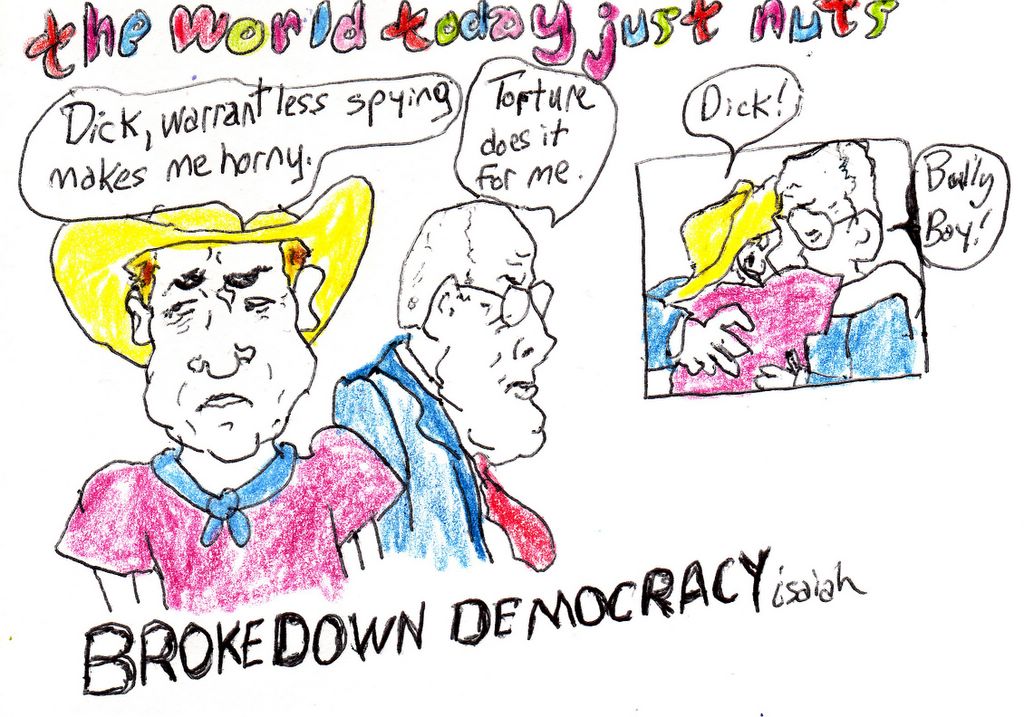
Brokedown Democracy


That's "Brokedown Democracy" -- Feb. 19, 2006. And I used to do a lot of movie parodies. Why did I stop?

It wasn't intentional. Partly because I really don't have time for movies these days so I'm not thinking, "Oh, that would make a good comic!" Partly because I'm always rushing to do one comic. The ones you see on Sunday night at The Common Ills are my last for the week until Thursday (unless I do a bonus at TCI as I did this week). I do Hilda's Mix (published Tuesday) on Saturdays. So I just have to do the Sunday night cartoon and I'm done. And each Sunday I think I won't have anything. I've come close to that but, knock wood, have managed thus far. We shall see how long that will continue.

I already have a January 2010 comic in mind, by the way. So . . .

Here's C.I.'s "Iraq snapshot:"

Thursday, December 3, 2009. Chaos and violence continue, the inhumane and criminal counter-insurgency suffers a highly public rebuke, the election stalemate continues in Iraq, the Iraq Inquiry in London brings lots of chatter about Donald Rumsfeld but very little about John Howard, All Things Media Big and Small gets spanked by the Secret Service but watch everyone pretend that didn't happen, and more.

Starting with the topic of counter-insurgency, war on a native people, Monday, David Price explained in "
Human Terrain Systems, Anthropologists and the War in Afghanistan" (CounterPunch):

Today, in Iraq and Afghanistan, anthropologists are being told that they're needed to make bad situations better. But no matter how anthropological contributions ease and make gentle this conquest and occupation, it will not change the larger neocolonial nature of the larger mission; and most anthropologists are troubled to see their discipline embrace such a politically corrupt cause.Human Terrain Systems is not some neutral humanitarian project, it is an arm of the U.S. military and is part of the military's mission to occupy and destroy opposition to U.S. goals and objectives. HTS cannot claim the sort of neutrality claimed by groups like Doctors Without Borders, or the International Committee of the Red Cross. HTS's goal is a gentler form of domination. Pretending that the military is a humanitarian organization does not make it so, and pretending that HTS is anything other than an arm of the military engaging in a specific form of conquest is sheer dishonesty.

The
American Anthropological Association's annual meeting started yesterday in Philadelphia and continues through Sunday. Today the association's Commission on the Engagement of Anthropology with the US Security and Intelligence Communities issued their [PDF format] "Final Report on The Army's Human Terrain System Proof of Concept Program." The 74-page report is a blow to War Criminals and their cheerleaders who have long thought that the social science could be abused or that the social sciences were psuedo sciences. It was in December 2006 when Dumb Ass George Packer raved over Dumb Ass Montgomery McFate and her highly imaginative and fictional retelling of both her childhood and her current work which Packer identified as "Pentagon consultant" working on Cultural Operations Research Human Terrain. Packer was jizzing in his shorts and not even warnings from other anthropologists ("I do not want to get anybody killed") could sway him.

By the time she showed on up the
October 10, 2007 broadcast (link goes to October 11, 2007 snapshot) of NPR's The Diane Rehm Show, Monty was being billed as "senior advisor to the US Army." Monty lied throughout the broadcast and most infamously when she insisted that Afghans or Iraqis can tell the difference between "a lethal unit of the US military and a non-leathal unit of the US military". David Price of the Network of Concerned Anthropologists offered reality during the broadcast by raising the issue of David Rohde's "Army Enlists Anthropology in War Zones" (New York Times) and explaining it "talks about an anthropologist I think named Tracy and that's the only name that's given. So anthropologists need to be transparent about who they are and who they're working for. . . . But I worry how transparent the program is if the people who are doing it aren't being self-identified? Now the story says it's being done for security reasons and so on. But if you go to the New York Times story and look at the nifty, little video they have -- you know backing the story, it's very strange because they don't show the anthropologist -- they intentionally withhold the person's identity. Yet they show all these people who are talking to the anthropologist which of course they're doing so at some personal risk, one would assume, in Afghanistan. And I worry about any sort of program where there's a one-way mirror that's going on."

Susan Page: . . . there was a New York Times article last week which actually prompted us to do this show today. And it did talk about this anthropologist named Tracy, but it wasn't clear to me, Montgomery McFate maybe you know, whether her [full] name was just not disclosed to the New York Times article, or if her full name is not being disclosed to the people she's interatcing with in Afghanistan. Do you know -- do you know the answer to that.

Monty [quick intake and slow first word -- always a clue Monty's inventing -- seriously, that was evident when she was a child]: Her name was held from the New York Times story and in other media that's come out of Afghanistan at her own request.

Susan Page: But does she give her [full] name to the Afghanis that she's talking with.

Monty: Yes, she does.

Remember that moment in Annie Hall when Annie (Diane Keaton) and Alvy Singer (Woody Allen) are in line for movie tickets and the man behind them can't shut up about Marshall McLuhan and Alvy confronts him? And pulls McLuhan over? And McLuhan declares, "I heard what you were saying. You know nothing of my work. You mean my whole fallacy is wrong. How you got to teach a course in anything it totally amazing."? Well a moment like that happened to Monty with her being the blowhard who got corrected. Monty was swearing that the woman identified herself and gave her full name and did this and did that and blah blah blah. And then David Rohde, who wrote the New York Times article, joined the conversation.

David Rohde: Um, she was transparent with them. I don't think she gave her full name, I think she does identify herself as an anthropologist. I saw her briefly, but I don't know what she does at all times. She personally, um, actually chose to carry a weapon for security that's not a requirement for members of the team, I've been told. And she wore a military uniform which would make her appear to be a soldier, um, to Afghans that she wasn't actually speaking with.

Susan Price: And so you think Aghans knew that she wasn't a soldier even though she was wearing a military uniform and carrying a weapon? Or do you think that they just assumed that she probably was?

David Rohde: I would think that they assumed that she was.

Poor stupid Monty. Counter-insurgency is war on a people. It has been used in many wars and it is not a tactic of peace nor is it anything an ethical person should take part in. That is not a controversial statement to anyone old enough to remember Vietnam or any war further back. But, in the US, whether you want to cite Spengler or make comparisons to Sisyphus, we are a culture put together each dawn with very little historical recall. Which is how Monty McFate and others have been able to market their inhumane acts as a 'science.' Others include A Problem From Hell: Samantha Power. And, of course,
Sarah Sewall who played Peppermint Patty to Monty's Marci on Charlie Rose in 2007. For the record, those three and many other counter-insurgency gurus advised Barack Obama during his presidential campaign and/or advise him today. (Yes, despite the fact that Monty's sister was a government spy who spied on peace groups. Or maybe because of.) These War Criminals use their training and the science but do not adhere to any of the ethics of their profession which does include, but it not limited to, full disclosure.

The report released today notes, "Responding to concerns raised about this program, in the fall of 2007 the AAA's Executive Board released a statement on HTS [Human Terrain Systems], in which it expressed its disapproval and concluded the program to be 'an unacceptable application of anthropological expertise'." The report states that by April of this year there were 417 HTS employees. (There have been some reductions since then.) Of that group, only six had PhD in anthropology and only 47 others had masters in the field. The report notes, "It is important to indicate, based on this, that despite the attention given to the central role of anthropology in the program, the great majority of present HTS employees have been trained and hold degrees in other fields of the social sciences and elsewhere." The report notes:

Training in "research methods" for HTTs is notable insofar as it combines what appears to be field-based social scientific data collection (e.g. use of ethnography of the anthropological sort) with instrumental or soft power goals of "shaping the environment." This raises a number of concerns regarding the separability, and so ethics, of the research component from the strategic, tactical, and operational goals of military decision-makers, and the role of HTT activities with respect to the goals of these decision-makers. Such an emphasis upon "rapid ethnographic research," too, suggest an apt comparison of HTTs with other anthropological modes of data collection of the rapid appraisal and assessment sort, which are typically carried out over weeks or months, and which are commonplace in the world of international development, among other applications.

The report explains that the social science methods to increase knowledge of people and cultures are used instead to push military objectives and that is not independent research nor is it what the social sciences exist for. Nor do the social sciences exist to provide targets for the military but some speaking to HTTs may be targeted by the military. This is especially a concern when HTTs turn over raw data to the military but it is a concern regardless especially due to the devices the military issues them.

Some anthropologists voiced criticisms that assert the inherently political nature of HTS as a facilitator of counterinsurgency. These critiques connect HTS to historical instances in which anthropological field techniques and theories were used to subjugate native peoples in colonial and neocolonial campaigns. Identifying participants in HTS with such terms as "technicians of power," these critics pointedly situate the activities of HTS in the context of U.S. involvement in Iraq and Afghanistan, often described as neo-colonial wars of occupation "in the service of empire." Ethical and political critiques are sometimes kept distinct and sometimes made together. If CEAUSSIC's 2007 Report distinguished ethics from politics, and focused on the former, the political character of many critical reactions to HTS has to be acknowledged. If HTS advocates stress the "reduction of harm" by the use of embedded HTS social scientists, anthropological critics reject such arguments, instead focusing on the political context of what can become of anthropology as a discipline, if used as a tool for problematic military occupations, even if designed to reduce violence.

As
Patricia Cohen (New York Times) explains, "The panel concluded that the Pentagon program, called the Human Terrain System, has two conflicting goals: counterinsurgency and research. Collecting data in the context of war, where coercion and offensive tactics are always potentially present, 'can no longer be considered a legitimate professional exercise of anthropology' the report says." Trina was weighing in on counter-insurgency Monday: "Counter-insurgency is a War Crime. It is an abuse of the social science. It breaks all the ethics. And Tom Ricks doesn't know that because he's not a social scientist. He's nothing but a keyboard jockey who sniffed the skivies of a few grunts and generals and decided he was an expert on war. He's not an expert on anything. He's not even an expert on how to be a successful reporter because those days ended some time ago for Ricks. He is an ass and he is a War Criminal." Well said.

Turning to England where the
Iraq Inquiry heard public testimony. And it was not a good day for John Howard, former prime minister of Australia. Like the mistress showing up at the funeral, Howard's been repeatedly ignored as the special relationship between George W. Bush and Tony Blair has been touched on non-stop. Today, John Howard got a brief mention . . . or at least was alluded to.

Committee Member Lawrence Freeman: Can you say something a bit more about this question of influence as a factor in British military planning? Because it is assumed that if we had just gone for the package 2, which would not have been a trivial thing, which would have been quite a substantial commitment by the UK, that that would not have brought influence? After all, the Australians didn't provide that much, but they seem to have got a certain amount of influence and kudos with the Americans from what they did. We're a different sort of power to the Australians, but is there a direct relationship between the size of force and the amount of influence?

Michael Boyce: I am not sure the Australians did have any influence. They certainly got a lot of kudos from the Americans and we were very grateful for their contribution. I don't think they were as heavily involved in the planning process as we were. Also -- although you might say the final outcome didn't indicate it -- we had quite a lot of influence with regards to what was called Phase 4, all the aftermath planning as well, as a result of the size of our contribution.

For video or transcripts for witnesses,
click here. The Inquiry, chaired by John Chilcot, heard from Boyce and Kevin Tebbit (Permanent Under Secretary at the Ministry of Defence) today. Of Boyce, Andrew Gilligan (Telegraph of London) observes, "It's been the turn of Admiral Sir Michael Boyce, former chief of the defence staff, at the Iraq Inquiry today -- and it's striking how closely what he told Sir John Chilcot mirrors what we reported in the Telegraph, using leaked papers, before the inquiry even started. Notice any similarities between this story -- 'Hoon stopped me buying essential kit for troops, says Forces chief' -- and this one -- 'Troops rushed into battle without armour or training'? You read it here first." Richard Norton-Taylor (Guardian) reports, "Boyce said the defence chiefs 'ramped up' planning for possible war after a key meeting between Tony Blair and George Bush at the US president's ranch in Crawford, Texas, in April 2002, 11 months before the invasion." Which appears to be the point all witness who've given public testimony in the nine days the panel has heard testimony can agree on. Mark Stone (Sky News) feels that today was "a drip-drip of evidence" with former US Secretary of Defense Donald Rumsfeld's name repeatedly coming in and him being seen "as the architect of the war" and quotes Boyce stating, "I could not get across to them [US] that the coalition would not be seen as a liberating force and that flowers would be stuck on the end of the rifles and we would be welcomed and it would all be lovely." Reflecting on all the testimony given since last week, Stone offers, "Perhaps all the witness are playing a fine game of passing the buck onto the Americans or perhaps the UK never really had any leverage over the Americans at all." David Brown (Times of London -- link has text and video) reports, "Lord Boyce said he had warned Tony Blair and the Cabinet that there must be a proper legal basis for military action before he could send British forces into Iraq. He said that he was given a certificate by Lord Goldsmith, the Attorney-General, although he indicated that he would have preferred a second Security Council resolution, which would have 'really nailed it'."

Committee Member Roderic Lyne: Within these frank conversations, were there times when you had to express serious reservations or warnings to the Prime Minister about the course we were heading down?

Michael Boyce: I would certainly, on a number of occasions, have expressed views about, for example, the holding up decisions to get reserves mobilised, the decision to go overt or to start allowing the preparations to be made, and whatever other problems as I saw them, as they came up, you know, which we would then go about solving. I certainly never had any hesitation in making those known, and, indeed, was taken aside from time to time to say, "Can't we make it more of a half-full rather than a half-empty assessment?", but my view was what I had to do was provide as realistic an appraisal as possible, which was what I was being asked to do and I never felt I was being shut out from doing that.

Committee Member Roderic Lyne: Lord Butler's report --

Michael Bryce: Not by the Ministry anyway.

Who had the power? Who had the power to stop the Iraq War?
Ruth Barnett (Sky News) notes Boyce stated the Parliament could have stepped in at any time to prevent the war and Tebbit agreed but added that stopping late in teh game could have done "serious damage to the bilateral relationship" between England and the US. Peter Walker and Andrew Sparrow (Guardian) report that Boyce stated, "No matter how many times you said to senior American officers, and indeed Mr Rumsfeld, that we were not committing our forces until we had been through the proper UN process, and had been through parliament as well, there was a complete reluctance to believe that." BBC News' Peter Biles offers this analysis: "The inquiry's committee missed an opportunity to pursue this in greater detail. As earlier witnesses have pointed out, the situation was further complicated by the different groups, and divergent views, within the US administration."

On yesterday's NewsHour (PBS -- link has text, audio and video options), Judy Woodruff observed, "In other news today: A top U.N. official in Iraq said elections will have to be delayed by more than a month. The voting had been set for January, but Iraqi lawmakers have not agreed on reforming the election process." Alsumaria reports that Jalal Talabani, President of Iraq, and Nouri al-Maliki, Prime Minister and thug of the occupation, met late last night to address the issue of elections: "After the meeting Talabani stresses that it is necessary to pass the law fast adding that delaying elections is unacceptable since it is necessary to hold the same according to Iraq constitution. The President, Prime Minister and Speaker have the right to extend the parliament's term for one month only, Talabani added." January 31st, Parliament's term expires (as does Nouri's -- Nouri was elected by Parliament). If Tariq al-Hashimi wants to veto the latest election law alterations, he allegedly has until the end of today to do so. Al Jazeera (link has text and video) reports: "The High Judicial Council ruled that the deadline would be extended to Sunday, because the 10-day period would legally end on Friday, and a decision could await the subsequent working day, Abdul-Sattar Birqdar, a court spokesman said. In Iraq, the weekend is Friday and Saturday." Jamal Hashim (Xinhua) reports that Ayad Allawi (the prime minister immediately before Nouri) was also visited last night by various "leaders of several political factions" to explore the elections issues and quotes an unnamed "parliamentary source" stating, "The meeting discussed how to reach a consensus over the election law, and some proposals were made during the meeting." Hadi al-Ameri is one of the leaders identified in the article and is quoted stating, "There was an agreement among the politicians in the meeting that seats for the provinces would remain as it is before the veto to the election law by Vice President Tariq al-Hashimi, but the Kurds would be granted two more seats and then number of parliament seats will increase to 325 instead of 323."

Turning to some of today's reported violence . . .

Bombings?

Laith Hammoudi (McClatchy Newspapers) reports a Baghdad bombing which claimed 1 life and left six people injured, a Baghdad sticky bombing which claimed 1 life and left two people injured, a Mosul bombing which left a child injured and 1 Tirkrit suicide bomber who took his own life and claimed the lives of 1 "commander of the anti-riot force in Tikrit" and 3 of his bodyguards with fifteen other people injured. Sabah al-Bzee, Michael Christie and Angus MacSwan (Reuters) report that the commander in Tikrit was Lt Col Ahmed Subhi al-Fahal who had been shopping when he was attacked. Ernesto Londono and Muhanad Saif (Washington Post) explain, "The bomber ran toward Lt. Col. Ahmed al-Fahal, who heads the city's anti-terrorism and anti-riot force, as he was walking in a crowded market, according to Lt. Ibrahim al-Duir, a police spokesman in Tikrit."

Shootings?

Laith Hammoudi (McClatchy Newspapers) reports 1 police officer wounded in a Mosul drive by and 2 Iraqi soldiers killed in Mosul clashes. Reuters notes 1 Iraqi soldier shot dead in Baghdad yesterday and an attack on a Baghdad cafe in which 1 man was shot dead.

Today at World Can't Wait, Mathis Chiroux shares his thoughts on Barack Obama's Afghanistan War speech:

So it's come to this. Obama's gotta wage his war, and I gotta sit in the street.
It's not that I like blocking traffic or getting arrested or dealing with the fall-out when I could be reading a book. It's that I can't live with endless war and I must end it or surely die.
I'm not leaving this country. This is my mess, so help me, and I'll scrub it till my fingers bleed. I will not compromise with genocide. I will not run from those behind it.
Endless war is the promise of our time, signed in blood and sealed with death's own kiss. Its stench hangs around us heavy smog. While I dare not breathe for fear of intoxication, I cannot hold much longer.
This is the American nightmare, and it's shattering my heart like glass.

Yesterday on
KPFA's Flashpoints, Dennis Bernstein, Robert Knight and Nora Barrows-Friedman tackled the realities so much of the media ignores regarding the speech and its meanings. (Barrows-Friedman gets Palestinian reaction to the speech). Guests included A.N.S.W.E.R.'s Richard Becker, Iraq Veterans Against the War's Michael Kern (who speaks of being unable to sit passively through the speech and also speaks of resistance), Military Families Speak Out's Lisa Lietz who discusses what it means in terms of her husband and others in the service, Georgia Stillwell Bissomette who offers both the perspective of a mother and of a Native American (don't miss her comments regarding colonization), Rami al-Meghari and Dahr Jamail (who speaks of military suicides, in addition to other topics, and we'll hopefully have time to highlight that tomorrow). At Amped Status, they explore "Af-Pak War Racket: The Obama Illusion Comes Crashing Down." Noted professor and attorney (international law is his specialization) Francis A. Boyle, at ZNet, provides a walk through on the issues of legality re: the Afghanistan War:

War of Aggression Against Afghanistan

Bush, Jr. instead went to the United National Security Council to get a resolution authorizing the use of military force against Afghanistan and Al Qaeda. He failed. You have to remember that. This war has never been authorized by the United Nations Security Council. If you read the two resolutions that he got, it is very clear that what Bush, Jr. tried to do was to get the exact same type of language that Bush, Sr. got from the U.N. Security Council in the late fall of 1990 to authorize a war against Iraq to produce its expulsion from Kuwait. It is very clear if you read these resolutions, Bush, Jr. tried to get the exact same language twice and they failed. Indeed the first Security (OOTC:FRCT) Council resolution refused to call what happened on September 11 an "armed attack" - that is by one state against another state. Rather they called it "terrorist attacks." But the critical point here is that this war has never been approved by the U.N. Security Council so technically it is illegal under international law. It constitutes an act and a war of aggression by the United States against Afghanistan.

No Declaration of War

Now in addition Bush, Jr. then went to Congress to get authorization to go to war. It appears that Bush, Jr. tried to get a formal declaration of war along the lines of December 8, 1941 after the Day of Infamy like FDR got on Pearl Harbor. Bush then began to use the rhetoric of Pearl Harbor. If he had gotten this declaration of war Bush and his lawyers knew full well he would have been a Constitutional Dictator. And I refer you here to the book by my late friend Professor Miller of George Washington University Law School, Presidential Power that with a formal declaration of war the president becomes a Constitutional Dictator. He failed to get a declaration of war. Despite all the rhetoric we have heard by the Bush, Jr. administration Congress never declared war against Afghanistan or against anyone. There is technically no state of war today against anyone as a matter of constitutional law as formally declared.


On the subject of Iraq, there is a
National Geographic special set to air December 13th (9:00 pm EST) entitled Inside the Iraq War:

A controversial war that has claimed the lives of more than 4,000 U.S. troops and tens of thousands of civilians. A war with countless stories of bravery, triumph, sacrifice and tragedy. Even as six years of news coverage and policy debate have framed our understanding of the war in Iraq, what have our service members really experienced? And what can their up-close insight teach us about this war?Transporting viewers to war-torn Iraq, National Geographic Channel (NGC) provides an unflinching, personal and in-depth look at the last six years in Inside the Iraq War, premiering Sunday, December 13, at 9 p.m. ET/PT. From the producers of Inside 9/11, Inside the Iraq War opens a window into the first-person experiences of the men and women who live this war on a daily basis the dangerous missions, the interrogations, the life-or-death situations and the ongoing battle for the hearts and minds of the Iraqi people. The film avoids the policy debate that raged in the United States and around the world and opens a window into the soldier's battlefield perspective through a complex tapestry of video shot by the troops themselves, news footage from embedded journalists, rare photos and compelling personal accounts from those on the front lines.

Staying with TV,
NOW on PBS debuts its latest episode Friday on most PBS stations and this one examines:

As Congress hammers out legislation that will determine the future of health care in this country, NOW travels to the nation's heartland to see what reform could mean for the middle class. On Friday, December 4 at 8:30 pm (check local listings), NOW Senior Correspondent Maria Hinojosa meets two tight-knit Oklahoma families whose problems with private health insurance left them unable to get proper medical care -- and on the brink of financial ruin. One of those families - the O'Reillys -- grapples with the issue of how to cover needed respiratory therapy treatment for their eight-year-old daughter, Sophie, who was denied coverage for what the insurance company labeled a "pre-existing condition.""People pretty frequently say, 'Oh, you know, my plan works great for me'," says Sophie's mother Natalie O'Reilly." And my answer to that is -- insurance works really well until you need it. Until you really, truly need it."

Turning to something non-Iraq related. Today in the Committee on Homeland Security hearing, US House Rep Eleanor Holmes Norton got a refresher in how blind trust in the media can leave you with egg on your face. Sounding very sure of herself, she repeated the claim that always sounded false but was so pleasing to so many: Barack Obama is receiving more death threats than anyone ever has!!!! Eleanor's not the first person to repeat that nor did she originate the false assertion. She just had the misfortune of repeating it to the Director of the Secret Service Mark J. Sullivan who quickly corrected her and explained that Barack had not received more threat at this point in his presidency than had Bill Clinton or George W. Bush at the same time in Clinton's presidency or Bush's whatever you want to call it. (I have never used the "p" word to refer to Bush and never will.)

Eleanor's a smart woman (except when it comes to films) and she's not a liar. She didn't create the claim. She read it, she heard it. It was all over the media.
By October, Bryan Bender was asserting in the Boston Globe -- though careful readers may have noted that he had no source for it in his article. The false claims -- it felt so good to so many! -- first surfaced in an article by Toby Harnden (Telegraph of London) where he clearly identified it as appearing in a book by Ronald Kessler. That's August 3, 2009. It just felt so good and so righteous! to so many freak shows. By August 12, Matthew Rothschild (The Progressive) was repeating it. The same Rothschild, it should be noted, who spent the bulk of this decade explaining how one 'threat' against Bush after another was in fact not a threat but an overreaction which led to an innocent person being targeted. But that's when a Republican's in the White House. When it's a Democrat, Matty's no longer concerned about examining alleged threats, he's too busy rushing forward with bad columns. Why? Because he feels so good thinking everyone wants to get Barack. He feels so wonderful. It makes him feel special and, yes, superior. And if you've ever seen Matthew Rothschild then you know feel superior to anyone isn't something he's often been able to pull off. But there was Matty in August insisting that Barack was getting 30 death threats a day! A 400% from Bush! And who was the source? Toby's source. Ronald Kessler. It's curious that Matty, writing for The 'Progressive,' didn't feel the need to identify Kessler who allegedly did interviews with unnamed Secret Service agents to get his 'facts'. Kessler publishes with what outlet? Oh, yes, Newsmax. Newsmax. Not an unbiased publication. Matty knew his readers -- all three -- would laugh like crazy if he explained who Kessler was or his Newsmax ties. So he just left that out. Conservatives, Matty will invite you into his bed but, remember, in the morning you'll need tip-toe down the hall. So that's the source and has always been the source -- a single source -- Ronald Kessler. Kessler's always played loose with the facts and it's often bitten him in the butt. For anyone other than right-wing partisans to take him or his sensationalistic and gossipy books seriously is rather surprising. But Matty did. Because it said what he wanted to hear. It said what he needed to hear in order to feel special about himself and to feel like he was so much better than the country he lived in. In fact, I think I hear the first sentence of The Matthew Rothschild Story: "From an early age, he was driven by a need to feel better than the country he lived in and better than its people. He was of them, yet he was never for them."

Testifying to Congress today, the head of the Secret Service corrected the falsehood. Wait and see which of the many (Amy Goodman also repeated the nonsense claims) freaks will come forward and say, "OOPS!" It was a pleasing tale to tell for many, it just wasn't true. By the way, Kat attended the Senate Armed Services Committee hearing on Afghanistan and the House Foreign Affairs Committee on the same topic Wednesday and wrote about it last night in "
Depressing time in the House and Senate." And, again, we didn't open with Iraq. But this lie about the threats has been repeated over and over and we'll open with the facts. Unless Sullivan retracts or 'clarifies' his statement, that is now the public record and liars are on notice. The hearing was this morning. For those who'd like to see it, click here to stream and it may not be posted until Friday morning.

Lastly
Danny Schechter been reporting on the Congo this week -- here, here and here [I join Marcia in recommending those reports -- see Marcia's "Recommended reading" and "Not one word from me on the War Hawk (promise)"].


iraq
the diane rehm show
david h. price
george packer
the telegraph of londonandrew gilligan
sky newsruth barnett
the guardian
richard norton-taylor
andrew sparrow
the times of londondavid brownbbc newspeter biles
mcclatchy newspaperslaith hammoudi
the newshourjudy woodruffalsumariapeter walkerjamal hashimxinhua
kpfaflashpointsdahr jamail
francis a. boyle
danny schechter
now on pbs


Read on ...
Creative Commons License
This work is licensed under a Creative Commons Attribution-Share Alike 3.0 Unported License.