
From October 31, 2013, that's "Accountability." It's often forgotten now just how corrupt Barack's administration was. Kathleen Sebelius is one of the worst. C.I. noted:
Health and Human Services Secretary Kathleen Sebelius hard at work as usual declares, "Hold me accountable for the debacle. I'm responsible." She also wonders, "Can we wrap this up now? I still have to get a facial." Isaiah archives his comics at The World Today Just Nuts.
She never took accountability for anything.
Here's C.I.'s "Iraq snapshot:"
Saturday, June 11, 2016. Chaos and violence continue, the persecution
of the Sunnis continue, Barack Obama's inability to address the roots of
the Islamic State's support in Iraq continue, Moqtada al-Sadr orders
his followers to stop protesting, and much more.
NATIONAL IRAQI NEWS AGENCY reports that the head of the Islamic Supreme Council of Iraq, Ammar al-Hakim, has decried the protests Friday at the offices of various political figures and parties.
Friday, bridges and roads to Baghdad were closed by the US-installed prime minister of Iraq Haider al-Abadi in an attempt to head off protests against corruption in the government. ALSUMARIA reported Haider issued a statement stressing actions against political officials or public institutions will be dealt with firmly.
IRAQI SPRING MC reported that the Dawa party is shooting at protesters in Dawa. The Dawa political party is the party that both the present prime minister (Haider) and the most recent one (Nouri al-Maliki) hail from. Forever thug Nouri denounced the Najaf protesters who had blocked off his office. In Wasit, protesters stormed political headquarters.
NATIONAL IRAQI NEWS AGENCY reports that the head of the Islamic Supreme Council of Iraq, Ammar al-Hakim, has decried the protests Friday at the offices of various political figures and parties.
Friday, bridges and roads to Baghdad were closed by the US-installed prime minister of Iraq Haider al-Abadi in an attempt to head off protests against corruption in the government. ALSUMARIA reported Haider issued a statement stressing actions against political officials or public institutions will be dealt with firmly.
IRAQI SPRING MC reported that the Dawa party is shooting at protesters in Dawa. The Dawa political party is the party that both the present prime minister (Haider) and the most recent one (Nouri al-Maliki) hail from. Forever thug Nouri denounced the Najaf protesters who had blocked off his office. In Wasit, protesters stormed political headquarters.
Iraq, a major OPEC exporter which sits on one
of the world's largest oil reserves, ranks 161 out of 168 on
Transparency International's Corruption Index.
The dispute within Iraq's majority Shi'ite community began turning violent when Sadrist protesters stormed Baghdad's heavily fortified government district, known as the Green Zone, for a second time, on May 20. Four demonstrators were killed.
Sadr's followers have been staging protests demanding anti-corruption reforms since February. His rivals see in the demonstrations an attempt by the cleric to dictate his views to the rest of the political class.
Today, ALSUMARIA reports Shi'ite cleric and movement leader Moqtada al-Sadr called on those protesting corruption by targeting the headquarters of political parties to cease their demonstrations and wait until the end of the holy month of Ramadan to protest. He added that regardless of when they protest, the government forces must protect protesters, not attack them. ALL IRAQ NEWS adds that he also called on his followers to pray and practice worship.
Those have not been the only protests in Iraq.
The dispute within Iraq's majority Shi'ite community began turning violent when Sadrist protesters stormed Baghdad's heavily fortified government district, known as the Green Zone, for a second time, on May 20. Four demonstrators were killed.
Sadr's followers have been staging protests demanding anti-corruption reforms since February. His rivals see in the demonstrations an attempt by the cleric to dictate his views to the rest of the political class.
Today, ALSUMARIA reports Shi'ite cleric and movement leader Moqtada al-Sadr called on those protesting corruption by targeting the headquarters of political parties to cease their demonstrations and wait until the end of the holy month of Ramadan to protest. He added that regardless of when they protest, the government forces must protect protesters, not attack them. ALL IRAQ NEWS adds that he also called on his followers to pray and practice worship.
Those have not been the only protests in Iraq.
Demonstrations in Karbala #Iraq against the Iranian Qassem Soleimani & Against the Iranian occupation
 بن قفيط
Concern continues to grow in Iraq over the involvement of the Iranian government within Iraq's borders. At MIDDLE EAST MONITOR, Dr. Noureddine Miladi offers:
American satellite TV channels as well as human rights organizations have signposted the Iranian involvement in the invasion of Fallujah and other remaining Sunni majority places. The Al-Hashd Al-Shaabi army has been reported to be waging a war by proxy for the Iranian ‘Revolutionary’ Guard. The fact that Kassim Sulaiman, leader in the Iranian ‘Revolutionary’ Gard, is roaming free in Iraq, giving advice to the militia, while he is wanted internationally raises a lot of questions, argues the head of Al-Hayat newspaper in New York.
The recent shutting down of Al-Jazeera offices in Iraq is another attempt to silence the witness. Along with other Arab media outlets, Al-Jazeera has been accused of misinformation and fabrication of news. The same reasons ostensibly had been given by the US army in 2003 when they decided also to shut down the channel’s offices in Iraq because of its daring journalism.
History will soon unveil that the invasion of Fallujah is not merely to uproot [the Islamic State] but to strategically broaden the sectarian rule backed by Iran on all Iraqi soil. This plan is partly about silencing all forms of Sunni dissent against the sectarian government of Baghdad and partly to expand the Iranian hegemony in the region.
The liberation or 'liberation' of Falluja continues. The Iraqi military -- which includes the Shi'ite militias -- struggle to follow commands, Shi'ite militia leaders openly criticize Haider al-Abadi, civilians are targeted and persecuted.
Chris Rogers (GUARDIAN) writes:
As US and Iraqi forces continue to press against Isis in Falluja, over 50,000 civilians remain trapped in the city. Protecting them is not only a moral imperative, but critical to long-term US strategic objectives. As a new report by the Open Society Foundations details, failing to do so would be a rebuke to the hard-learned lessons of US generals in Afghanistan.
 #IRAQ شمرية العراق
Shia Militias crimes
فديو مسرب جديد يظهر الحشد الشيعي الارهابي يعذب شيوخ سنه عراقيين كبار بالعمر بطريقه وحشية
 د.ماجد محمد
Iraqi Sunni civilians displaced from Fallujah tortured by Shia Militias #warcrimes #IRAQ
#warcrimes
افضحوها
النائبة الشيعية حنان الفتلاوي تهدد الشاهد السني الذي قال انها اشرفت على تعذيبي
حياته الان بخطر

 Michael P Pregent
This needs to be investigated - Dawa Party MP Hanan al-Fatlawi allegedly oversaw the torture of Sunni captives

Dawa Party MP Hanan al-Fatlawi allegedly oversaw torture of Sunni captives fm Fallujah - see video @hanan_alfatlawi


Dawa MP Hanan al-Fatlawi https://youtu.be/8VFchfOOiCM

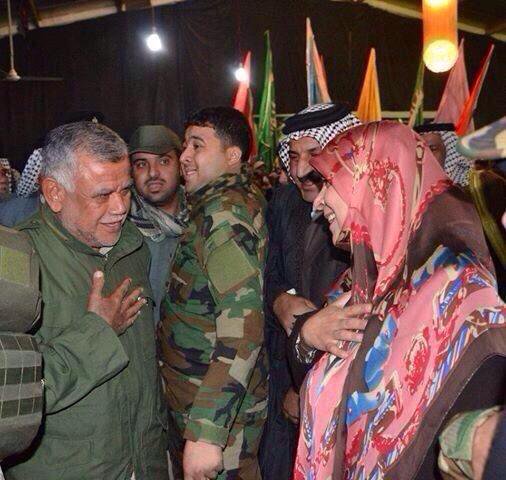
Douglas Burton (WASHINGTON TIMES) speaks with Sunni Atheel al-Nujaifi, the former governor of Nineveh Province who states that he's assembles a force of 1500 Sunni fighters:
Mr. Nujaifi shares the concerns of many U.S. analysts that the largely Sunni populations in Islamic State-held cities such as Mosul and Fallujah harbor deep suspicions of the Iraqi national army and Shiite militias that are leading the fight in Anbar Province.
Mike Pregent, an adjunct scholar from the Hudson Institute and a former U.S. military intelligence officer, warned that "continued U.S. support to Iraqi units that work with, tolerate and integrate Shia militias into their operations will reset the conditions that led to ISIS to begin with: A disenfranchised Sunni population that would be ripe for ISIS 2.0 to exploit."
Added retired Gen. Jay Garner, director of the Office for Reconstruction and Humanitarian Assistance for Iraq following the 2003 invasion: "If the Shia militia enter Mosul, there will be a bloodbath."
The US continues to ignore the War Crimes.
Why?
Same reason they tolerated Nouri al-Maliki's persecution of the Sunnis throughout Nouri's second term, they want to change Iraq -- not for the Iraqi people but for the corporations. That's what the IMF invasion is all about. Grand Ayatollah Ali al-Sistani gets that which is why he warned against it throughout 2015 and this year.
The violence continues in Iraq. ALSUMARIA reports a Baghdad roadside bombing left three people injured, and a bombing outside of Baquba left two Iraqi soldiers injured.
Today, the US Defense Dept announced:
Strikes in Iraq
Fighter and remotely piloted aircraft and rocket artillery conducted 18 strikes in Iraq, coordinated with and in support of Iraq’s government:
-- Near Baghdadi, two strikes destroyed two ISIL artillery pieces and an ISIL front-end loader.
-- Near Fallujah, two strikes struck a large ISIL tactical unit; destroyed nine ISIL fighting positions, two ISIL recoilless rifles, three ISIL light machine guns, two ISIL heavy machine guns and an ISIL anti-air artillery piece; and denied ISIL access to terrain.
-- Near Habbaniyah, two strikes struck an ISIL tactical unit and destroyed an ISIL staging area, an ISIL command and control node, and two ISIL storage areas and denied ISIL access to terrain.
-- Near Haditha, a strike destroyed an ISIL rocket cache.
-- Near Kisik, a strike struck an ISIL tactical unit and destroyed an ISIL supply cache and an ISIL vehicle.
-- Near Mosul, three strikes struck two ISIL tactical units; destroyed an ISIL fighting position, three ISIL assembly areas, an ISIL vehicle bomb and an ISIL heavy machine gun; and denied ISIL access to terrain.
-- Near Qayyarah, seven strikes struck a large ISIL tactical unit, five ISIL communication sites, an ISIL recruitment facility, and an ISIL bed-down location; destroyed four ISIL assembly areas, an ISIL vehicle, six ISIL rocket rails and an ISIL mortar position; and suppressed a separate ISIL mortar position.
Task force officials define a strike as one or more kinetic events that occur in roughly the same geographic location to produce a single, sometimes cumulative, effect. Therefore, officials explained, a single aircraft delivering a single weapon against a lone ISIL vehicle is one strike, but so is multiple aircraft delivering dozens of weapons against buildings, vehicles and weapon systems in a compound, for example, having the cumulative effect of making those targets harder or impossible for ISIL to use. Accordingly, officials said, they do not report the number or type of aircraft employed in a strike, the number of munitions dropped in each strike, or the number of individual munition impact points against a target. Ground-based artillery fired in counterfire or in fire support to maneuver roles is not classified as a strike.
This has been Barack Obama's answer since August of 2014, daily bombings.
They've really not helped.
At the end of March, Brookings' Kenneth M. Pollack attempted to spin things pretty but even he struggled:
As has too often been the case in Iraq, progress in the military sphere is not being matched by equivalent (or even commensurate) political progress. I continue to see Prime Minister Haider al-Abadi as a decent, intelligent man who wants to take Iraq in what I consider to be the right direction: toward ethno-sectarian reconciliation, more efficient government, and a more balanced foreign policy (or at least reduced foreign influence in Iraq). He continues to make smart moves in the military sphere, he has taken some important steps to decentralize power to the provinces, and his desire for a more technocratic and less political (or cronyist) government is laudable. However, his government continues to have little to show for all its good intentions, and that is costing the prime minister support in a variety of quarters.
[. . .]
As part of this debilitating process, reconciliation among Sunni and Shiite Arabs remains moribund. President Fuad Massoum has convened a committee on reconciliation to try to push the process forward, but the committee rarely meets, and when it does, it accomplishes little. Sunni leaders are pleased with Abadi’s willingness to decentralize authority and resources to the governors of Anbar and Salah al-Din provinces to help with the reconstruction of Ramadi and Tikrit respectively, but still regard it with suspicion, fearing that the prime minister is giving them that rather than seats at the table in Baghdad.
Even some of Abadi’s closest allies among the moderate Sunni leadership are becoming frustrated that there is so little tangible progress on reconciliation. Of course, the Sunni leadership remains badly fragmented (even more so than the ever more fragmented Shiite leadership), but the government makes little effort to unify them or to use proxies to negotiate on behalf of the Sunni community. As I have written previously, I believe it critical for the United States to take on that role because I do not believe the Iraqis are able to do so themselves. That point was only reinforced by my impressions from this trip.
Trying to spin pretty, Pollack sugar coated the political failure by glorifying the military success -- or, as it turns out, 'success.'
On last weekend's THE NEWSHOUR (NPR), host Hari Sreenivasan spoke with REUTERS' Ned Parker about Parker and Jonathan S. Landay's report on the state of the Iraqi military:
HARI SREENIVASAN: The Reuters news agency reports that the 17- month U.S. effort to train and build up the Iraqi army has fallen short. Current and former U.S. officers and officials told Reuters that despite U.S. efforts, the army’s combat capacity has barely improved, and that the government relies too heavily on Shiite militias to do the fighting.
For more about the readiness of the Iraqi army, I am joined via Skype by Ned Parker of Reuters, who co-wrote the report.
For someone watching at home, give us a little bit of the lay of the land here. What’s the mix between the Iraqi army and the militias? Who is doing most of the fighting?
NED PARKER, REUTERS: Well, it’s a mixed bag, really. The problem is is that the Iraqi army only has about five functioning divisions, according to U.S. officers. And those divisions are about 60 to 65 percent capacity. So on the ground now, when fighting happens, the Iraqi military has basically a shortage of labor. And the one good fighting force that’s there, that’s effective from the state, is the Iraqi Special Forces. And according to U.S. officers, those forces are in real danger of burning out because they are the only force the state has been able to rely upon time and time again over the last two years.
So the other force fighting alongside the special forces are militia groups that many of them are funded by Iran. They have hard-line sectarian ideology, and have been deeply controversial. So on the ground, what happens is many places like north of Baghdad, in areas like Tikrit or Beiji that were retaken from the Islamic State, by the Iraqi special forces, as soon as the battle is over in effect, the militias take over. And people in these areas, whether local officials, ordinary citizens, see not the state but the militia forces as the ultimate power.
There's no real success in Iraq because the issues that drove the rise of the Islamic State have still not been addressed.
The White House has focused solely on a military solution despite Barack declaring June 19, 2014 that the only answer was a political solution.
In September of 2014, the RAND Corporation's Ben Connable testified before the Senate Foreign Relations Committee and declared, "The thrust of my proposition here is that the success or failure of any coalition effort to defeat IS -- and ultimately to stabilize Iraq -- hinges not on tactical considerations or tribal engagement efforts, but on the more critical issue of Sunni Iraqi reconciliation. I believe the new anti-IS coalition can succeed if it predicates all of its actions in Iraq on national reconciliation between Sunni and Shia Iraqis. If political reconciliation is not the core aspect of an anti-IS strategy then coalition efforts are likely to fail in the long run."
As Loveday Morris and Missy Ryan (WASHINGTON POST) observed this week:
At the same time, only limited progress has been made in addressing the frustration that Iraqi Sunnis have with their Shiite-led government, a core reason some of them initially welcomed militants into their cities. That jeopardizes the longevity of any territorial victories U.S. trainers hope to achieve.
the washington post Read on ...


 Malcolmite
 عمر مدنيه


 هدهدالــخـ☆ــيرIRAQ#
 Tony Duheaume

 jonathan s. landay


