Showing posts with label Bully Boy. Show all posts

Thursday, October 29, 2009

Alito does his business


I completely forgot about this one. I remember drawing Feingold, Kennedy and Feinstein but have no idea who else is under the urine.


This was called "Alito does his business on the Senate Dems." And back then, January 15, 2006, I really thought, "One day Dems will own the Congress and look out then!"

Yeah, I was a real idiot.

It happens.

They've got control of both houses and have had it since 2007 but they've done nothing.

Maybe they live to be pissed on?

Here's C.I.'s "Iraq snapshot:"

Thursday, October 29, 2009. Chaos and violence continue, the US military announces another death, the Iraqi refugee crisis continues, problems with the public inquiry into the Iraq War the UK government plans to hold, no election law passed by the Iraqi Parliament, and more.
Today the US military announced: "JOINT BASE BALAD, Iraq – A Soldier who was currently assigned to the 13th Sustainment Command (Expeditionary) died Wednesday of a non-combat related injury at Camp Adder, Iraq. The name of the deceased is being withheld pending notification of next of kin and release by the Department of Defense.The names of service members are announced through the U.S. Department of Defense official website at http://www.defenselink.mil/releases/. The announcements are made on the Web site no earlier than 24 hours after notification of the service member's primary next of kin. The incident is under investigation." The announcement brings the total number of US service members killed in Iraq to 4353.
Meanwhile Sunday's Baghdad bombings have pretty much erased the August Baghdad bombings ("Bloody Wednesday," "Black Wednesday," "Gory Wednesday," "Iraq's 9-11," etc.). Press TV reports, "Iraq has arrested some 60 security forces over the weekend twin bombings which targeted government buildings in Baghdad, killing up to 153 people." The Sentinel states the 60 were compoes of "11 army officers and 50 security officials". Xinhua adds, "The arrested were in charge of providing security for a downtown Baghdad district which was hit by the deadly suicide attacks that targeted government buildings, Major General Qassim Atta said." BBC News notes, "The BBC's Gabriel Gatehouse in Baghdad says it is not clear whether those arrested are accused of negligence or collusion. However, he added, it seems to confirm what many people have suspected - that the security forces are susceptible to infiltration by insurgents or are just not up to the job." Reuters reports Qassim al-Moussawi, spokesperson for Baghdad security, "said that officers, foot soldiers and police in areas where attacks happen would be arrested in the future and placed under investigation." Jomana Karadsheh (CNN) adds, Baghdad Governor "Abdul Razzaq said security forces made mistakes and were negligent in their work, and he demanded a court-martial for those who allowed explosive-laden vehicles to get through checkpoints." Karadsheh also notes the number arrested is 61. Timothy Williams and Mohammed Hussein (New York Times) explain, "The statement Thursday that announced the arrest order came from Baghad Operations Command, which is responsible for security in the capital and reports directly to Prime Minister Nuri Kamal al-Maliki. The statement did not offer any further details, so it remained unclear whether the 61 security force members were suspected of having adied those who carried out the attacks."
The death toll for the Sunday bombings is at least 155 and does include children. Mohammed Jamjoom (CNN) reports:

The force of the blast threw Rawnaq against the wall of her office at the Ministry of Justice. She instantly thought of her two children in the day care center just two floors below.
"I rushed downstairs and found all the children under the rubble," says Rawnaq, "My daughter Tabarak was standing near the stairs. My son Hamoodi outside. Me and a colleague took them out, running. A police car drove us to the hospital."
Both children were injured, 3-year-old Tabarak much more so than her 2-year-old brother. Severe head and back injuries have left the little girl needing extensive surgery and unable to sleep due to unceasing pain. She is also deeply afraid.
Back in August, the day before Bloody Wednesday, Iraqi Thug and Prime Minister Nouri al-Maliki was in Syria where he was demanding that nearly 200 Iraqis be handed over to Iraq. It was all like a bad acid flashback since Nouri spent years in Syria and the Syrians refused to turn him over at the whims of Saddam Hussein. Nouri was grateful back then, now he's just a raging drama queen. Bloody Wednesday came the next day and Nouri immediately blamed the bombings on Syria. He and his spokespeople and cabinet would sometimes say that it was former Ba'athists in Syria. Sometimes. Mainly they would rail against Syria. That hasn't ceased all this time later. Phil Sands (Le Monde) offers today that "Syria is perhaps the only country in the Arab middle east that can truly claim to be independent from the US, and Damascus remains a thorn in the side of American regional ambitions. [. . .] In the post-Saddam Hussein world, the Iraqi government is jealous of its sovereignty, an independence that goes only as deep as the presence of more than 100,000 American soldiers on Iraqi soil allows. There is little sign a planned pull-out will be complete." Syria has a huge number of Iraqi refugees and we'll turn now to the topic of Iraqi refugees. Joseph A. Kechichian (Gulf News) explains:
According to the International Organisation on Migration, there are still 1.6 million internally displaced Iraqis who cannot "return home". Many are trying to survive "without work, their own home, schooling for children, access to water, electricity and health care". These refugees are Iraqi citizens who are not represented in government but whose fates will probably determine whether the pool from which opposition forces can recruit bombers will shrink. As it is widely recognised, remnants of the Baath party or any number of the security services created by the old regime are still active, even if Baghdad and its allies continue to hearken to Al Qaida.
The United Nations' World Food Program has launched "a pilot project in Damascus" in which food vouchers are distributed "in the form of mobile phone text messages to Iraqi refugees. [. . .] Around one thousand families are involved in the four-month pilot phase, which will be extended if it is successful. The project has been developed in cooperation with the Syrian government, enabling the refugees to redeem their vouches in state-run stores in the Jaramana and Sayeda Zeinab neighourhoods of Damascus. The mobile phone service provider MTN has donated SIM cards for the project." Cassandra Vinograd (Wall St. Journal) reported Tuesday, "In the WFP program, each family will receive one $22 voucher per person every two months. After each transaction, families will receive an updated balance, also sent by SMS to their mobile numbers -- free of charge. There are more than 1.2 million displaced Iraqis in Syria, according to government figures. To date, about 130,000 regularly receive food assistance from WFP with complimentary food and non-food assistance from the U.N.'s refugee agency." Though some have criticized the WFP for targeting people with cell phones (under the mistaken belief that refugees wouldn't have them), Richard Spencer (Telegraph of London) reports, "The discovery that most of the 130,000 people to whom the organisation provided food vouchers had mobile phones gave officials the idea for the pilot scheme, to be targeted at 1,000 families in the first instance." Laura MacInnis (Reuters) quotes Emilia Casella, WFP spokesperson, stating, "They will be able to exchange their electronic vouchers for rice, wheat, flour, lentils, chickpeas, oil and canned fish, as well as cheese and eggs -- items that cannot usually be included in conventional aid baskets." Saeed Ahmed (CNN) quotes Casella stating, "It infuses some contribution to the communities, because we're not giving food away. They have to go to the local shops to buy it." Staying with Syria, the United Nations High Commissioner for Refugees expects more Iraqi refugees to flee to Syria as a result of Sunday's bombings. EU News Network states UNHCR spokesperson Andrej Mahecic "told a delegation in Geneva earlier this month that the United Nations recommended the resettlement of more than 80,000 Iraqi refugees to other countries." Meanwhile UNHCR is building homes in Taza, Iraq following bombings there this sumemr which ledft many people homeless, "Immediately after the blast, UNHCR field staff visited Taza to assess the damage and to distribute emergency aid to the survivors. The team found that about 160 houses, mostly made from mud bricks, had been totally destroyed and some 400 damaged. As a result, around 3,500 people were left without shelter. The refugee agency immediately swung into action, funding the reconstruction of 150 collapsed homes and the renovation of 73 shops and two other buildings in Shorja Market. The work was carried out by an Iraqi implementing partner as part of UNHCR's emergency shelter programme which has helped rehabilitate some 10,000 conflict-damaged buildings for refugees and internally displaced Iraqis and aims to double this figure in 2010." But in Syria, IRIN reports, a significant number of Iraqis are attempting to win asylum "across the Middle East to Europe and North America" and they note, "A year after its launch, strikingly few Iraqis have taken up the UN's Voluntary Repatriation Programme. Less than 300 families from Syria have returned to Iraq under the programme, though the number claiming resettlement has grown rapidly."
The Chicago Tribune did a multi-article series at the start of the week on Iraqi refugees in the US. The paper noted of one group: "Back home, they worked for the Americans, as translators, project specialists and office managers. For that, they received death threats from militants opposed to the U.S., and they ask to remain anonymous, fearing retribution against relatives in Iraq." Then there's Layla Mousa whose husband is in Jordan while she and their three children are in Chicago where she struggles to make ends meet, find work (she's a hair dresser) and rebuffs offers of payment for sex and states, "Now I want to go back to Iraq, not even Jordan. America is just a lie." Layla Mousa is among the Iraqi refugees who Ahlam Mahmoud attempts to asist even though she herself is a refugee: "She didn't have it easy herself. When she and her two children arrived in Chicago in 2008, she had only the clothes she was wearing when she left Syria, where, she says, she was imprisoned for refusing to spy on foreigners. The apartment they got in Chicago had three beds, one plate, a fork, a spoon and two knives." In Syria, Ahlam Mahmoud was also someone refugees turned to. Using her own resourceful nature, she quickly began developing a network of assistance and advice. Due to her connections, the Syrian government attempted to force her to spy on other Iraqi refugees. She refused and was thrown into prison. When the outcry and attention became too much, the Syrian govenment ordered her released from prison and she was quickly transported to the US. Also attempting to assist other refugees is Fatima Hindi who became an Iraqi government official, was then kidnapped and sought Egypt and then the US for safety along with her three-year-old daughter Takwa. She states, "They kidnapped me because of America. America couldn't protect me. When I first got here, I cried on the street."
Today Nancy Eshelman (Patriot-News) reports on Iraqi refugee Zina Alkubaisy who ended up in the United States with her husband and their children following her husband's kidnapping: "Alkubaisy began working the phones. She contacted people who knew people and eventually learned what militant group had snatched her husband. Her connections arranged to have him released the next day. But a chilling phone call warned the couple they would not be so lucky the next time. It would be in their best interest to leave the country."
UNHCR is concerned about the fact that some European states have begun forcibly returning Iraqi originating from the region of Central Iraq over the last few months. In our guidelines issued last April, we noted that in view of the serious human rights violations and continuing security incidents throughout Iraq, most predominantly in the central governorates, asylum-seekers from these governorates should be considered to be in need of international protection. UNHCR therefore advises against involuntary returns to Iraq of persons originating from Central Iraq until there is a substantial improvement in the security and human rights situation in the country.
This reminder comes after the UK attempted to forcibly return 44 Iraqi men to Baghdad earlier this month. They were reportedly unsuccessful asylum claimants held in immigration removal centres in the UK. Iraq only accepted 10 who were allowed to leave the chartered aircraft in Baghdad, and the remaining 34 were returned to the UK and placed in immigration centres.
Other European states have signed readmission agreements with Iraq for voluntary and forced return. Denmark has forcibly returned 38 people originating mainly from Central and Southern Iraq since signing its agreement in May 2009. Sweden has undertaken some 250 forced returns with an unspecified number of returnees originating from the five central governorates of Iraq since signing an agreement in February 2008. UNHCR has also concerns about the safety and dignity of these returns.
Concerning asylum-seekers from the three northern governorates, as well as those from the southern governorates and Al Anbar, UNHCR recommends that their protection needs are assessed on an individual basis.
Colin Yeo (Guardian) evaluates the UK Home Office's attempt to forcibly deport Iraqi refugees this month:
The second problem is a profound lack of understanding or respect for the rule of law at all levels of UKBA. Six Iraqis were taken off the removals flight because they had managed to get in touch with good lawyers. A high court judge was persuaded that the flight might be unlawful because the route and destination were unknown and Iraq is a highly unstable country, as the appalling recent bomb attacks and interviews with those who did return to Iraq vividly demonstrate. The flight was no less unlawful for the other Iraqis yet UKBA went on regardless, simply because the other Iraqis did not manage to get a lawyer. Some may disagree with the refugee convention and human rights law, but they are the law of the land and while they remain so they must be respected.
But like an unruly toddler, the Home Office believes that what matters is whether they are caught, not what the rules are. Time and time again the Home Office is found to be acting unlawfully: on prolonged unlawful detention, secret policies, misleading the courts and failure to respect court judgments in the last fortnight alone. Substantial compensation is paid to some of the victims as a result. What UKBA fails to appreciate is that there are many, many more victims whose rights are violated but who never manage to secure the protection of the rule of law.
Friday's snapshot noted that Christians in northern Iraq were under attack again and weighing whether or not to leave Kirkuk. Richard Spencer (Telegraph of London) noted "Baghdad's dwindling Christian population. Even in the darkest days of Saddam Hussein's rule, it was a thriving community. Now it is half gone,d riven out by the casual lawlessness of the streets." Iraqi Christians make up a significant number of external refugees. (It should also be noted that Baghdad's Jewish community has been decimated since the start of the illegal war.) While much attention was given to the government buildings damaged and destroyed in Sunday's bombings, Adirenne S. Gaines (Charisma Magazine) reports that St. George's Church in Baghdad was also badly damaged. Though the issue wasn't important enough for the New York Times to put it in print, they did post a blog by Rod Nordland: "Built in 1936 by the British military during their occupation of Iraq, the church loast some of its famous stained-glass windows when the United States military bombed a nearby building in 1992, and more were destroyed during the invasion in 2003, leaving only three examples remaining. They were mementos of British regiments stationed there. Sunday the last three stained glass windows were blown out by suicide bomb blasts that destroyed three Iraqi government buildings nearby, according to the church's lay pastor, Faiz Georges." Episcopal Life notes the church has approximately 2,000 members.
On the issue of Iraq's religous minorities, Senator Carl Levin's office released the following statement Monday:


WASHINGTON -- Calling the plight of religious minorities in Iraq "a tragic consequence" of the war there, Sen. Carl Levin, D-Mich., today introduced a Senate resolution calling on the U.S. government, Iraqi government and United Nations Mission in Iraq to take steps to alleviate the dangers facing these minority groups. Sens. Sam Brownback, R-Kan., and Dick Durbin, D-Ill., joined Levin in sponsoring the sense of the Senate resolution.
"While violence has declined in Iraq overall, religious minorities continue to be the targets of violence and intimidation," Levin said. "Members of many minority groups who have fled other parts of the country have settled in the north, only to find themselves living in some of the most unstable and violent regions of Iraq. We strongly urge the Iraqi government, the United Nations and the U.S. government to address this crisis without delay."
Of approximately 1.4 million Christians of various denominations living in Iraq in 2003, only 500,000 to 700,000 remain. Another minority group, the Sabean Mandeans, has seen its population decline by more than 90 percent. Iraq's Jewish community, once one of the largest in the Arab world, has almost ceased to exist.
According to the U.S. Commission on International Religious Freedom, members of religious minorities "have experienced targeted intimidation and violence, including killings, beatings, abductions, and rapes, forced conversions, forced marriages, forced displacement from their homes and businesses, and violent attacks on their houses of worship and religious leaders." The U.N. High Commissioner on Refugees reported that in 2008, there were an estimated 2.8 million internally displaced persons living in Iraq. Of that 2.8 million, nearly two out of three reported fleeing their home because of a direct threat to their lives, and, of that number, almost nine out of ten said they were targeted because of their ethnic or religious identity.
The resolution introduced by the senators addresses the tragedy in several ways. It states the sense of the Senate that the fate of Iraqi religious minorities is a matter of grave concern and calls on the U.S. government and the United Nations to urge Iraq's government to increase security at places of worship, particularly where members of religious minorities are known to face risks. The resolution calls for the integration of regional and religious minorities into the Iraqi security forces, and for those minority members to be stationed within their own communities. The resolution calls on the Iraqi government to ensure that minority citizens can participate in upcoming elections, and to enforce its constitution, which guarantees "the administrative, political, cultural, and educational rights" of minorities. Finally, it urges a series of steps to ensure that development aid and other forms of support flow to minority communities in Iraq.
Iraq is the source of more external refugees than any other country currently; however, Iraq does have refugees in its own country including the Palestinians who are trapped on borders and largely ignored by the global community as they live lives as prisoners, unable to leave Iraq and unable to leave the tented, border communities they've been exiled to since the start of the illegal war. In addition to the Palestinians, there are the Iranian refugees of the MEK. Welcomed into Iraq by Saddam Hussein decades ago, they've called Iraq home for some time. The Iranian government doesn't care for them so you know Nouri's going to jump when that government snaps. Until 2009, the US was protecting the MEK who reside in Camp Ashraf. Nouri gave the US government repeated assurances that he would respect the refugees. Then, on July 28th, he launched an assault on Camp Ashraf.
Saturday Jamshid Karegarfar's account of what happened was published in the Washington Times:
The situation came to a head July 28, when some 2,000 Iraqi forces stormed Ashraf, and to add insult to injury, used American Humvees and weapons to do so, while the Americans stood by and watched. The attack left 11 dead and 500 injured - and the Iraqis took 36 Ashraf residents as hostages. I was one of them.
At first, we were held outside Ashraf. During the first days of captivity we were severely beaten, and went through physical and psychological torture. Some of us who were run over by Humvees and hit by bullets were in excruciating pain.
Then, we were transferred to the local prison in the city of Khalis. From there, they took us to an Iraqi military intelligence detention center and finally to the prison at al-Muthana airfield.The goal was to break us down. But we refused to give in.
In protestof the raid and being taken hostage, we went to a hunger strike and refused food for weeks, and we prayed for deliverance. We had no idea what was happening or why we were being held. And we had no idea of the support we were getting around the world.
The government or 'government' out of Baghdad can't help the refugees or their own people. They can't even pass an election law apparently. "If it doesn't make a deal before this weekend, Iraq will run out of time to organize an election before Prime Minister Nouri al-Maliki's term expires," Renee Montagne observed on today's Morning Edition (NPR).

Renee Montagne: What, Quil, is at stake with the delay of this election law?

Quil Lawrence: Well, as you say, the Iraqi prime minister and his government's term run out on January 31st so the election commission here has said they need 90 days to organize a legitimate poll and Parliament is deadlocked on over a dozen or so complicated issues regarding the election. They may vote on it today. If the elections are delayed or if they are rushed, there's a risk that Iraq's government could be deemed illegitimate and then a whole Pandora's Box of problems can open up -- issues of legitimacy of the government, maybe even a crisis like we've seen in Afghanistan. One big question is whether the US has done enough to push it through, especially since their plan to pull out 70,000 troops by August can't really start until the elections are done.

Renee Montagne: Well six years on the ground in Baghdad, hasn't the American embassy there worked up a fair amount of what you might call institutional knowledge regarding Iraqi politics?

Quil Lawrence: Well the problem is it took the Obama administration four months to get an ambassador confirmed and out here and that's taken that ambassador another couple of months to assemble a new political team. So he's got a good number of people with expertise in the region -- a good number of Arabic speakers -- but they've never been to Iraq before, many of them. So before they can have much influence, they need to learn who the players are and build these personal relationships with them and that could take months and years.

Renee Montagne: Although haven't American diplomats been, in a sense, pressing the flesh at the Parliament.

Quil Lawrence: There's been as many as six of them at a time over at the Parliament but it's sometimes curious who they're meeting with or not meeting with on the Iraqi side. And like I said, they're just getting up to speed so it's possible they could walk right past a very important Iraqi politician in the halls of Parliament and not even know him by face.

Okay, on the above. On pulling out troops (which is the draw-down, not the "withdrawal" as so many outlets keep insisting -- confusing the two in a way that even the White House doesn't) and how it can't start until after the election?

Yesterday, the KRG swore in their prime minister's cabinet. Yesterday. Elections were held in July. In December 2005, Iraq last held the national elections. Nouri comes along in April as the US-installed prime minister (after the US rejected the Iraqis first choice). In May, he announces his cabinet. Point? The counting of the votes, the verifying and assorted other issues mean the elections are not 'over' in January even if held then. As for a vote happening as early as today, CNN reports that as well but notes, "The Kurdish bloc in the Iraqi parliament intends to boycott the vote on a proposed election law if the oil-rich province of Kirkuk is banned from voting in next year's national elections, two Kurdish lawmakers say." Mu Xuequan (Xinhua) reports that "the Iraqi parliamentary legal committee again failed to reach a compromise over Kirkuk issue, and decided to delay Thursday's parliament session to Sunday, an official in the parliament told Xinhua." This, Xuequan reports, despite efforts today by US Ambassador to Iraq Chris Hill and the top US commander in Iraq Gen Ray Odierno to "urge" Iraqi politicians to pass a law.
No law was passed but violence continued . . .
Bombings?
Laith Hammoudi (McClatchy Newspapers) reports a Baghdad roadside bombing injured five people and a Mosul suicide bomber took his own life.
Shootings?
Laith Hammoudi (McClatchy Newspapers) reports an armed attack on a Mosul police checkpoint which left 3 police officers dead and an armed clash in Mosul in which one person was injured.
Today is the 2413 day of the Iraq War. Jake Armstrong (Pasadena Weekly) notes that and other facts -- and he notes Iraq facts each week, by the way, in his "The Count."
In England, Peter Walker (Guardian) reports that the inquiry into the Iraq War will hear evidence starting November 24th and that former Prime Minister Tony Blair will be offering public testimony. Chris Ames (at The Index on Censorship) reports:
As the Chilcot Inquiry into the Iraq war announces its first public hearings, serious concerns about censorship and secrecy are beginning to arise. Some of those who are thinking about giving evidence are wondering how free they will be to do so and whether the evidence they present will ever see the light of day.
Tony Blair's upcoming appearance at the Inquiry has taken centre stage, with his actions on Iraq threatening his bid to become the first EU president. While Blair won't face prosecution in this Inquiry for launching the war, witnesses fear they might be prosecuted for talking about it.
Other political factors also play a role in the timing of the hearings, which will open on 24 November. Sir John Chilcot said that the Inquiry intends to stop these hearings during the general election campaign, expected in the spring. It appears that the move is intended to limit the possibility for highly charged appearances or new disclosures to influence voters. This should not be a consideration for the Inquiry, which is supposedly independent of government.
Chilcot has also suggested that the Inquiry's report, which is not expected until at least the end of next year, might not be published in full but might include a secret annexe dealing with intelligence matters.
Meanwhile in Malaysia tomorrow and Saturday, Meena L. Ramadas (Sun Daily) reports, a tribunal, the War Criminal Conference and Exhibition, will be held which will hear from "a Sudanese reporter and a Briton who were detained without trial in Guantanamo Bay" "in an effort to bring Iraq war perpetrators to justice." Tun Mahathir bin Mohamad (Malaysia's prime minister from 1981 to 2003) will be the keynote speaker and he states, "International institutions and the courts established by the United Nations charter have done nothing in dealing with war crimes. Even the powerful nations like the United States and the United Kingdom have done nothing."
War is big business. Tom Fowler (Houston Chronicle) reports that with KBR getting less work in Iraq, it "reported a 14 percent drop in third-quarter profit". KBR insists it did professional work. Few not currently working for KBR who've seen their work in Iraq make the same assertions. KBR's shoddy work may be responsible for multiple deaths of US citizens -- death by shower. On the topic of death by shower, Jeremy Scahill's "Pentagon Investigation Iraq Electrocution Death" (The Nation) reports:

The Department of Defense has confirmed that the US Army Criminal Investigation Command has launched a formal investigation into the electrocution death of 25-year-old Adam Hermanson, a US Air Force veteran-turned private security contractor who died in a shower at the compound of his employer, Triple Canopy, at Camp Olympia inside Baghdad's Green Zone on September 1, 2009. The State Department's Regional Security Office is also investigating.
The DoD appears to be placing responsibility for the deadly incident squarely on Triple Canopy. "As part of the terms and conditions of the JCC-I/A contract, Triple Canopy is solely responsible for providing billeting, showers, latrines and other life support activities to its employees at Camp Olympia," according to Under Secretary of Defense Ashton B. Carter. Hermanson is the nineteenth US soldier or contractor to die from electrocution in Iraq since 2003.
KBR denies having anything to do with the wiring which, if true, would mean they weren't responsible for the above shock . . . just approximately 230 other ones.
The heartbeat went out of our house
The rhythm went out of our romance
But in life that happens and you just have to remember to breathe . . .

That's from Carly Simon's "Coming Around Again" as redone on her latest album, Never Been Gone. Today she was on NPR's Talk Of The Nation and discussed a variety of topics including singing with Lucy Simon in the Simon Sisters and recently on the phone. In terms of revisiting ten of her classic songs for the new album, Carly observes, "Yes, it was a very interesting kind of synergy between the old and the new." To hear her segment with host Neal Conan click here and note NPR online has paired it up with her 2008 concert which you can also stream. Click here to watch Carly on Monday's Good Morning America (ABC). Carly Simon appeared on NBC's Today Show yesterday and performed "You Belong To Me."


Read on ...

Thursday, October 8, 2009

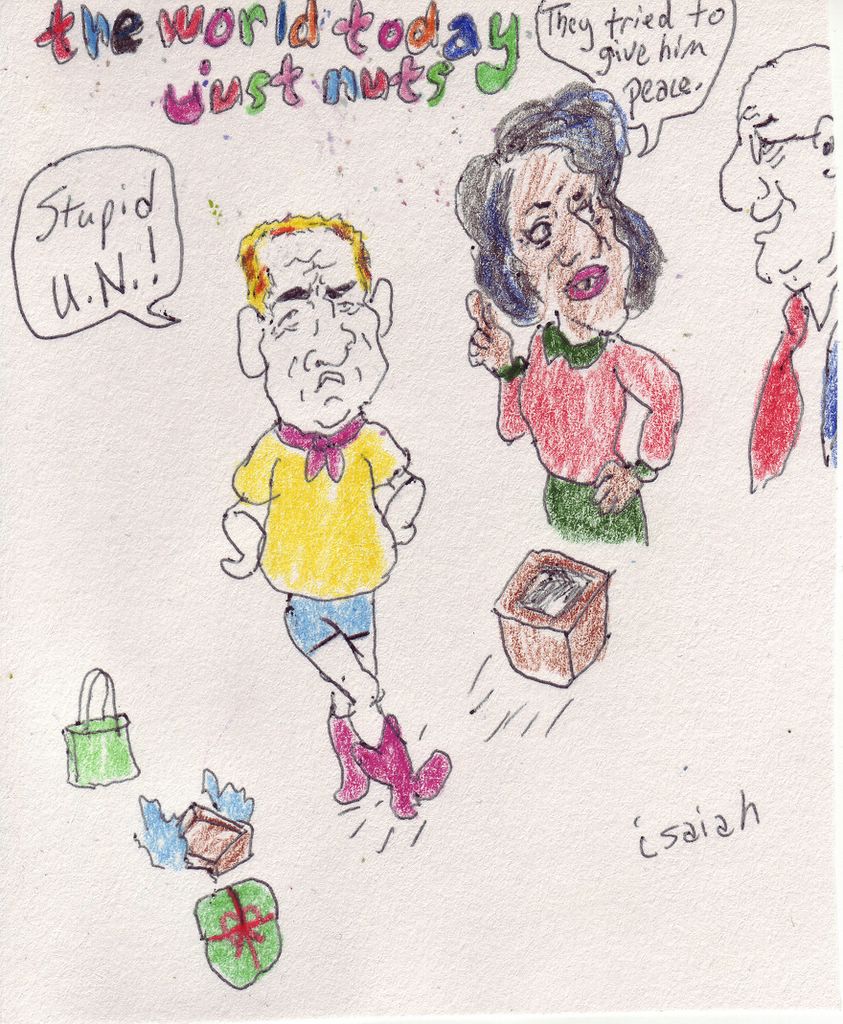
Bully Boy's scary Christmas


The above is from Christmas Day 2005 and Bully Boy's freaking out.

Why?


Because the UN offered him a the gift of peace.

So he throws a tantrum.

Completely believable.

Here's C.I.'s "Iraq snapshot:"

Thursday, October 8, 2009. Chaos and violence continue, the Senate explores military chemcial exposures that put people at risk, Senator Jay Rockefeller notes of the miltiary and VA's 'response,' "And I don't get it, why they don't learn?", an update on War Criminal Steven D. Green, and more.

Today the US Senate Committee on Veterans Affairs, chaired by Senator Daniel Akaka, held a hearing entitled "VA and DoD Response to Certain Military Exposures." We're going to jump into the first panel -- well into it -- and then work a bit backwards. Imagine yourself infected or exposed to a substance that puts your life in danger. Imagine that your government put you at risk and/or hid the risk. After the exposure is known of, how's the government contacting you, getting the word out?

Senator Daniel Akaka: Many of you have given heart-felt testimony regarding some very, very personal issues that have effected your lives. I know I speak for the entire committee -- members of this committee -- when I say that we appreciate your here today. I'd like to ask my question to four of our witness: Mr. Partain, Ms. Pennington, Ms. Paganelli and Mr. Powell. Are you satisfied with the military's response to each of the exposures your or your family member was effected by including high-risk list -- high-risk health problems? Mr. Partain?

Michael Partain: As far as the military's response to my exposures at Camp Lejeune, I would say no. I was diagnosed with male breast cancer in April 2007. My wife found the disease when she gave me a huge before bed one night. Two months later, I discovered that I had been exposed in the womb while at Camp Lejeune. I had no knowledge of my exposures until then. It just happened to be -- my father was watching a newscast and saw a hearing about Camp Lejeune and that's how I became aware of this.

Senator Daniel Akaka: Ms. Pennington?

Stacy Pennington: We-we were disappointed actually with the doctors at actually Duke University for orally citing the reasons for my brother's aggressive AML [Acute Myelogenous Leukemia]. When pushed again, they admitted it was definitely due to chemical exposure but they couldn't prove it. And there is some pushback that they are receiving from the military there at Fort Bragg. And I don't know the details to that. They wouldn't elicit any further. I can tell you the [Matt] Bumpus family, no, has not received any assistance from the VA or military because Matt ended his service one year after -- or the disease came to light one year after his service. So the VA has harshly denied the connection between the AML and his service in Iraq and where he was stationed in Balad. So, no, they are not receiving any benefits from the VA or military and are completely dissatisfied.

Senator Daniel Akaka: Thank you. Ms. Paganelli.

Laurie Paganelli: Thank you. I would say on behalf of [US Naval Air Facility] Atsugi residents and past Atsugi residents, "no," because I really strongly believe there needs to be a accurate registry and so many families are not informed. I just really would like there to be a registry for these families and benefits for those who, further down the line, need them. Some acknowledgment for that. Thank you.

Senator Daniel Akaka: Thank you. Mr. Powell?

Russell Powell: I think that the Army did, or the Department of Defense did kind of lack in acknowledgment that we were even exposed later, about five years later. after we returned home. And it was just kind of an eye opener. So that's kind of -- I'll tell you like this. We go to the VA and the VA has no idea what's going on with us but they still are kind of timid on what to say -- whether it's exposure or anything like that. They're just -- are trying to back away from us. So we're all pretty disappointed. We're on a registry but the registry, to us, doesn't -- still doesn't say "You guys were exposed." Or a lot of soldiers try to put in claims for the chemical exposure get denied.

They were not informed. They were not informed at all. The first panel was composed of those four plus Colorado State University's John R. Nuckols, University of South Carolina's Charles Feigley, Dr. Robert F. Miller and Herman Gibb who has a PhD. We're focusing on the four witnesses already quoted above.

Michael Partain's parents were stationed at Camp Lejeune. His mother became pregnant there, he was born on base. Camp Lejeune residents "were exposed to high levels of tetrachloroethylene (PCE), trichloroethylene (TC), dichloroethylene (DCE), benzene and vinyl chloride in the tap water provided to my family by the Marine Corps." In his testimony, Partain discussed the song-and-dance and outright lies between 1981 through November December 198 and, "The misrepresentation did not end with the public and the media, it extended to the EPA. On November 1, 1985, there was a meeting at Camp Lejeune between base officials and EPA representatives. During this meeting, base officials including Robert Alexander, told the EPA that the contamination had not reached the distribution plants. Three years later, another base official, Assistant Chief of Staff Facilities, Col Thomas J. Dalzell was quoted in the media that prior to 1983: 'At that time, we were not aware of any of these particular compounds that might have been in the ground water and we have no information that anyone's health was in any danger at that time'." Again, among the many health problems that Michael Partain faced as a result of his exposure to these chemicals was breast cancer.

Stacy Pennington is the sister of Staff Sgt Steven Gregory Ochs and was speaking on behalf of him and their family and on behalf Staff Sgt Matt Bumpus and his family. Her brother was in the military for 14 years and Matt for 8 and 3/4 years. Both men were deployed to Iraq.

Stacy Pennington: Both of these brave soldiers you see before you dodged bullets, mortar attacks, roadside bombs and suicide bombers. Eventually their tours of duty would take their lives. The ultimate sacrifice for a soldier, for his country, is death. However, their deaths did not show up in the manner you may assume. In Balad is the site of the infamous enormous burn pit that has been called by Lt Col Darrin L. Curtis, USAF and Bio-environmental Engineering Flight Commander, as "the worst environmental site" he had ever visited. Staff Sgt Ochs and Staf Sgt Bumpus were both stationed in Balad and war, as strategic as it is, followed them home. Death lay dormant in their blood and waited for them to return safely home and into the arms of their loved ones. Like every silent ticking bomb, it eventually exploded. On September 28, 2007, just months after Steve's return home from his third tour, he was diagnosed with Acute Myeloid Leukemia, also known as AML. He spent the next ten months as a patient -- more like a resident -- at Duke University Hospital. Doctors at Duke said his aggressive form of AML was definitely chemically induced and, like Steve, both agreed it was due to the exposures he experienced while in Iraq and Afghanistan. However, the doctors refused to go on record citing as the reason that they could not prove it. The aggressive AML that Steve endured was similar to bullets ricocheting in the body causing torturous pain. The graphic images embedded in my mind are of Steve's last screams for air as he was rushed into ICU. Steve waved goodbye to my husband. Steve, with very little strength, said, "I love you, sis" and my mom kissed his forehead and said, "We will see you when you get comfortable." Five minutes later, while in the ICU waiting room, the nurse came in to tell us Steve went into cardiac arrest and they were working on him now. My mom ran into ICU -- fell to her knees as she realized her son was dying. Screams filled the air as we begged God to keep Steve here with us. We know Steve heard us as tears were in Steve's eyes. Doctors and nurses pumped on Steve's chest trying to revive him. But I knew immediately he was gone. His spirit that surrounded my dear, sweet brother was gone. We were left alone with Steve's body for hours as we were all in pure shock. My mom looked upon my brother's face and wiped away the tears puddled in his eyes. And at that very moment, our lives were changed forever. Steve died on July 12, 2008. Two weeks later, on the opposite of the coast, Staff Sgt Bumpus would succumb to the same fate. For Staff Sgt Matt Bumpus, the ticking time bomb exploded with a vengeance on July 31, 2006. Matt was rushed to the hospital by ambulance with acute appendicitis. In Matt's own words, I quote, "The next thing I remember is hearing that I had been diagnosed with AML." Doctors declared that there was chromosome damage due to exposures he must have come in contact with while in Iraq. Matt ended his prestigious service to the Army one short year before the war zone chemical warfare showed signs of its presence. As if this was not enough suffering, Staff Sgt Bumpus' family was met by the VA with harsh claims of denial to benefits. This battle continues to this day as Lisa, Staff Sgt Bumpus' wife, is left alone with two small children to raise with no VA or military benefits for her family. The aggressive assault of the AML in Matt's body was taking claim. Jo, Matt's mother, recalls the haunted look in Matt's eyes as he revealed to her that the AML invasion was back. Matt's mother will never forget the discouragement and sadness that overwhelmed Matt as the realization that promises he made to his wife and children to provide for his family, to love and protect them, and that his sacred word would be broken. He knew now that the battle was over and he would be leaving his family behind. Tuesday, July 29, 2008, Matt once again entered the hospital with fever and septic infection that discharged throughout his body. Doctors notified the family that it would just be days before his demise. Matt was heavily sedated as the pain and incubation was unbearable. Nate, Matt's ten-year-old son, bravely entered his father's hospital room to lay on his daddy's chest as he said his final goodbye. Nate curled up by his dad and cried and cried. Despite Matt's heavy sedation, Matt too was crying. Matt, being a devoted Christian, appropriately passed away on a Sunday morning, surrounded by his wife, mother, father and sister as they expressed to Matt their everlasting love. They, too, were in shock and stayed with Matt's body as the realization overwhelmed them that Matt would not be going home. Matt died on August 3, 2008.

Later, with Senator Jay Rockefeller, Pennington would pick back up on this topic and note,
I need to tell you that my brother immediately upon return from his third tour in Iraq the end of April 2007, suffered from flu-like symptoms almost immediately. He went to Womack [Army Medical Center] Hospital at Fort Bragg, North Carolina three times. The doctors did exactly what you just said. They said, 'You have some type of virus." She explained he was sent home with Ibuprofin and, not until September and after "he had to get special permission to be seen by a private hospital, where the private hospital actually discovered that my brother actually had AML."


Laurie Paganelli spoke "on behalf of my family and as a representative for hundreds of Sailors, Marines and civilians who were unknowingly exposed to and have been adversely affected by the contaminated air, soil and water at US Navy Air Facility Atsugi, Japan." Her husband is a member of the US Navy and he and his family were stationed at Atsugi from 1997 to 2000. Their son Jordan was only five years old in 1997. Eleven years later, January 11, 2008 ("our lives changed forever") when their son "was diagnosed with a rare, vicious and highly aggressive form of cancer -- so aggressive, in fact, that by the time he displayed any symptoms, his cancer had already progressed to a Stage Four condition. The name of his cancer is Alveolar Rhabdo-Myo-Sarcoma, "ARMS" for short." He was sixteen-years-old and his parents were learning he had cancer and that his type of cancer does not have a high survival rate. He immediately went into treatment which included "twelve total weeks of radiation" and ended up on crutches "quite a contrast to the young boy who played at Atsugi Base and the high school cross country star he had been just months prior to diagnosis." The Shinkampo Incineration Complex on the base was releasing toxic fumes and chemicals. Starting in 1997, when Laurie Paganelli's family was stationed at the base, the Navy started to let a few people know of some of the risks. The limited risks the Navy was willing to acknowledge were further minimized by encouraging people to believe they were safe as long as they were inside when chemical plumes from the incinerator were visible in the air. She explained, "The Navy had knowledge that Atsugi residents were being exposed to Dioxin in the SIC's emissions by the early 1990s; and they knew what detrimental effects such exposure would do to the human body. As you remember, Dioxin is what made Agent Orange so toxic. So it's no surprise that, by 1998, the Navy recognized their liability and instituted a one-page waiver that did not convey information of the known long-term risk associated with SIC. We were all required to sign this waiver."

Russel Powell joined the army in 1994 and was discharged in 2001 and he then enlisted in the West Virginia Army National Guard. March 2003, he was deployed to Iraq. In Iraq, "1092nd Charlie Company was assigned as security for the KBR contractors. My duties consisted of battalion medic and supplied defensive positions and cover fire if needed to protect KBR contractors at Qarmat Ali Water treatment plant in Basra, Iraq." They were immediately confronted with the orange dust everywhere which coated everything and spilled out of open sacks, caught up in the dust storms which Powell estimated hit "ten times daily." They were not offered protective clothing or masks, nor were they warned that the orange powder was dangerous.

Russell Powell: After a few weeks of being at the facility, several personnel began getting lesions on their hands, arms, faces and nostril area. As a medic, I felt very concerned for the safety and health of persons exposed. I questioned of the KBR workers, I have forgotten his name, and he told me that his supervisors told him not to worry about it, that we were allergic to sand and dust. Shortly there after, there was another severe dust storm. I ate an MRE and my throat and stomach began to burn like nothing I have felt before. My nose began to bleed and I was nauseated. After this particular storm, I was severely sick to the point that when we returned to Kuwait City, Kuwait, I was told that I was not going out on the mission the following day. The following day, I went to the infirmary at Camp Commando and was seen by a Naval doctor. After a brief examination, he dismissed me as being sick and prescribed me Motrin and Tylenol. Approximately thirty minutes later, I went to a bombshell bunker to give myself an IV, a couple soldiers found me. I was delirious and coughing up blood. I do not remember anything until waking up the following day in the Kuwait Soldiers Hospital. My face and lips were burnt and my throat was sore to the point I couldn't swallow anything. I was there for almost a week getting antibiotics intravenously. The doctors had no explanation why I was sick or why my face and lips were burnt so badly. The day I was released from the hospital, I returned to Qarmat Ali with Charlie Company 2nd platoon. Upon my return to Qarmat Ali, numerous soldiers were complaining of the same symptoms I was experiencing. I prescribed those soldiers antibiotics; however, the symptoms persisted. At the end of June 2003, the Indiana National Guard relieved us of our duties. Our unit moved into northern Iraq. The nose bleeds subsided a little, but the nausea was still present daily. After leaving Iraq in April 2004, I went to the VA clinic in Clarksburg, West Virginia to talk to the doctors about my skin rashes and lesions, stomach problems and nose bleeds. The doctors were unable to determine what the cause is of these problems. In 2009, I received a letter from the West Virginia National Guard stating we were possibly exposed to Sodium Dichromate while serving at Qarmat Ali and the VA doctors believe that this could be what's causing my health issues, but because they know little about Sodium Dichromate, they are researching and trying to figure out the affects of it on the human body.

Senator Jay Rockefeller was thanked by name by Russell Powell and he's worked on this issue for decades. He was sharing in the hearing about twenty-five years ago when they were dealing with it with regards to WWII. He spoke of doctors with the VA who have ignored the problems or suggested "take an aspirin and go home or you've got a virus, go home, sleep, get a good sleep. It makes me mad. And what scares me is that I don't know if the culture has changed." He spoke of the frustration with the same situations repeating over and over: "And I don't get it, why they don't learn? And maybe I'm wrong but until someone shows me I'm wrong, I'm just mad." We'll note this section of Rockefeller's questioning.

Senator Jay Rockefeller: What fascinates me but angers me so much is that -- as I said, and you'll remember this, Russell, at our August hearing -- is there such a direct comparison between this and the Gulf War Syndrome? The denial on the part of the military, their refusal to not only respond to soldiers whose lives were being shredded -- couldn't sleep, couldn't keep marriages, couldn't get jobs, couldn't read newspapers because they were being told to take a pill, which had never been cleared by the FDA for animal use -- much less for human use, to protect them from what they thought Saddam [Hussein] was going to do and it turned out actually it was the wrong pill anyway. It was for the chemical he didn't have . And that's another story. But the refusal -- and I want to get into the military culture. Now I know the military is the next panel and I'm not going to be here in the next panel. But your a medic, Russell, and you're a good one and you've been through this and you come and you testify and you tell us about what you're going through and you've see the letter from [Secretary of the VA] Eric Shinseki that he sent this morning --

Russell Powell: Correct.

Senator Jay Rockefeller: -- which has some promise to it. He says he's going to give full pulmonary tests and, in West Virginia, we've discovered all of those people who weren't on the registry or weren't yet found. In Indiana, I'm not sure they have. They have a lot more of them but I'm not sure that they've discovered all of those. But when you got into that situation and you had the orange dust and you're a medic and you've got some stature and you go over to that place and you just lie down and try to give yourself an IV and all the rest of it, it-it says something about soldiers -- Well, first of all, it says something about the military's inability to deal with something that might either be embarrassing for them or for which they can't explain because they're busy fighting wars which is a rather large task. On the other hand, there are people who are doctors and who have medical responsibilities and they're not fighting wars, they're taking care of soldiers. There's something which prevents -- and I've heard this in other sessions about other types of problems -- soldiers taking on the military even as they suffer. And I want to talk about that for a moment. From your point of view, first of all, I understand the chain of command, I understand -- From my point of view, this is kind of a repeat, you went through this in 2003?

Russell Powell: Correct.

Senator Jay Rockefeller: And nobody discovered what you had until 2009. What-what is the culture problem we're dealing with here?


Russell Powell: Well the biggest problem is when you go to -- Or let me say this. I don't think the army knew fully -- was fully aware with the chemicals being on the ground through the KBR not actually providing-providing them with that information. And -- but the Army could have actually told us a little bit sooner whenever they did find out in August -- August of 2003. But they didn't tell any of the soldiers and there are still some of the soldiers that I've talked to who are government employees who just found out within a week that they were one of the guys that were exposed to chemicals and he's a government employee. And they're saying they can't find these gentlemen at and this is the Dept of the Army saying they can't find them. Well one of the officers, high-ranking officers from West Virginia was on an aircraft with him and this was a month or two ago. And still on that individual -- because I can't really tell you what he does for the government -- but, uh, he was talking to one of our generals and he told them that he was in the 1092nd Charlie Company. And the general just didn't say, "Well maybe you might want to look at this or look at that." And he was just dumbfounded until we linked up with that individual just through e-mails and trying to find all our soldiers because we're trying to do our best to find out where our people went and give them the heads up on their actual medical problems because a lot of them didn't have medical problems just didn't know why. And when you go to the VA or anything like that and it's so horrible because you say you're a medic and a flight medic and they kind of look down to you in a sense because they say, "Well you already know everything" or "Mister Know It All." That's how most physicians feel. And we're not even trying to do that, we're saying, "Hey, this is what's wrong with me. I'm pretty sick. I'm not -- I'm not faking a funk on you. I was doing medicine for a lot of years, I'm not trying to get over on you." And it's real frustrating because they're just brushing you off, brushing you off. Now there are a few doctors that are actually concerned and figure out the problems for mechanicals but most of them just kind of brush you off at the VA and it's really a hard obstacle to go through.

Senator Jay Rockefeller: Dr. Gibbs, do you have any thoughts about that? Why is it that people, strong men like Russell can't -- or they look down at a medic or they -- Some doctors are good, some doctors are bad. Whatever. For heaven's sakes, they knew they were going to send you to this camp, to Qarmat Ali and therefore they had to have been there. For the fact of there being some orange dust must not have escaped them unless they were color blind and so I don't understand that. There's a lack of thoroughness or a lack of concern or a lack of care. I mean if you saw the orange dust -- you now know and knowing what the world now knows six years later, it's not very complicated to me. They were entering a risky environment and chose not to know about it, not to warn about it, to take steps to clean it up or to do whatever. Now, Dr. Gibbs, I don't know if you have any thoughts on that?

Dr. Herman Gibbs: I think they had a significant exposure there. I mean, some of the soldiers described looking like orange powder dough nuts. And it was all over the ground. Statements of the soldiers at the previous hearing indicate that it was everywhere. Uhm, I think that -- and the bags read: Sodium Dichromate. It wasn't like guessing. So they should have known and it should have been reported and, again, I don't think there was a good understanding of what Sodium Dichormate is or what it's effects are. So I think there was a significant exposure that should have been addressed immediately as soon as they learned what it was. So I-I think that there was just, uh, uhm, I feel like it was dealt with uh, irresponsibly. I can't think of a better word.

Senator Jay Rockefeller: Well let me be -- let me be tougher about it then. Doesn't the military have a responsibility? And particularly when you're not in a huge situation which varies a lot. Like the Second World War, the First World War, you know, whatever. But you've got a particular type of territory where there are certain factors which are common for all that territory. Basra, I guess was where you were. And then there's this orange dust. I don't understand that. I don't understand why, if there are doctors who are in charge of the health, are they not in the deployment decision process in any way? Are they left out until somebody does get sick? Is there anybody here can answer that question?

Dr. Herman Gibbs: Again I think that the knowledge of industrial hygiene is uh we could do -- you could recommend pre-deployment physicals and post-deployment physicals and those kinds of things but if you don't understand what substances that you're dealing with those kind of physicals are not going to get the kind of information that you need. So you know I think this was um a lack of -- a lack of understanding of the industrial hygiene, of the environmental health. And then the follow-up to that was uh . . . You know -- It was just . . . sort of like "Don't worry about it, it's okay." And I think uh that, you know, that to me is just uh uh I don't want to say -- unconscionable> But I think it was uh -- This was -- This was a very dangerous substance, this was a very potent carcinogen, a very irritating substance. You don't have to look very far to find out about the effects of Sodium Dichromate. It's not some arcane chemical that we don't know about.

And, as Dr. Robert Miller pointed out, the military knew about it and issued a memo sent out for the soldiers exposed from the 101st Airborne [Fort Campbell] that said Sulfur Dioxide is not a problem it has no known serious side effects, it's not a carcinogen. They had measurements that the levels were toxic well above the military's baseline of thirteen parts per million" and a 62nd Brigade Medical Staff report that also insisted that the exposures were safe.

Iraq isn't safe. And the violence continued today . . .

Sahar Issa (McClatchy Newspapers) reports a Yousifiyah roadside bombing which claimed 3 lives and left ten people injured and, dropping back to Wednesday, a Mosul sticky bombing which claimed the life of 1 person and left "four of his family members" wounded and a Mosul roadside bombing which wounded three people. The Scotsman notes the death toll on the Yousifiyah bombing has risen by 2 -- from three to five. Reuters drops back to yesterday to note a Jalawla roadside bombing which claimed the lives of 2 police officers and left four more injured.

Wow. Imagine what it would be like if, for example, we ignored either McClatchy or Reuters? Imagine if we ignored it when the Los Angeles Times updates a death toll. Imagine the crap-fest of a count we'd end up with each month? We do a monthly count now because there are too many damn lies. And we note, in the monthly count summary, that it's an undercount based on western outlets reporting. And anyone can click on any of those days and check our count. But what if we just went with Reuters? And what if we kept a 'toll' and what if we were cited by the New York Times and other outlets for our 'count' of Iraqis killed? That would be pretty pathetic. On our part and their part. And I'm not going to be nice too damn much longer. We called out IBC for their nonsense and we'll call out anyone else. This is where I'm nice and bite my tongue and that's the last time I'm nice. Next time I raise the issue, I won't be nice. When do I plan for that to take place? When the month of October toll is addressed. So the first day(s) of November. If you're an outlet and you're citing numbers, you better be damn sure of the count someone else is using if you're citing it. Or you better be prepared for it to get ugly because I intend to make it very ugly. Western reporting on deaths is an undercount. For a number of reasons including limited mobility on the part of those outlets and the fact that a number of deaths are never known by reporters. But if anyone's being cited as an expert on the count, they damn well better be using more than one source. And reporters damn well better know what they're citing. The Iraq War is one long undercount. I'm not in the mood to be part of that. This was the one warning. Come November, it'll be ugly. And we'll open with it.

In July, July 27th, Nouri al-Maliki ordered an assault on Camp Ashraf which led to at least 11 deaths and to 36 Iranian dissidents being hauled off to an Iraqi prison. They were kept there until yesterday despite rulings that they should be released. As noted in yesterday's snapshot:

BBC News reports the 36 have been released and returned to Camp Ashraf: "A spokeswoman for the group told the BBC they had been tortured in custody and were now being treated in hospital." Anne Barker (Australia's ABC) notes "An Iraqi judge had ruled three times they must be released, but officials refused to comply" until today and that the US "The United States recently called for assurances that camp residents would be treated humanely and not sent back to Iran." Tim Cocks (Reuters) adds, "The camp's residents and the 36 arrested on rioting charges had said they were on hunger strike until they were released. PMOI spokesman Shahriar Kia, speaking by phone, said the detainees were critically ill because of their hunger strike, which he said had gone on for many days. It was impossible to verify this claim."

Today
Sebastian Usher (BBC News) reports the international protests will continue -- the hunger strike is ended -- until the United States and/or the United Nations takes back over the security responsibilities for Camp Ashraf.


Turning to the United States and war criminal Steven Dale Green.
May 7th Steven D. Green was convicted for his crimes in March 12, 2006 gang-rape and murder of Abeer Qassim Hamza al-Janabi, the murder of her parents (Kassem and Fakhriya) and the murder of her five-year-old sister (Hadeel) while Green was serving in Iraq. Green was found to have killed all four, to have participated in the gang-rape of Abeer and to have been the ringleader of the conspiracy to commit the crimes and the conspiracy to cover them up. May 21st, the federal jury deadlocked on the death penalty and instead kicking in sentence to life in prison. September 4th, Green stood before US District Judge Thomas B. Russell for sentencing. Kim Landers (Australia's ABC) quoted Judge Russell telling Green his actions were "horrifying and inexcusable." As mentioned in that snapshot, not noted in any of that day's coverage (it came from a friend present in the court), Steven Dale Green has dropped his efforts to appear waif-ish in a coltish Julia Roberts circa the 1990s manner. Green showed up a good twenty pounds heavier than he appeared when on trial, back when the defense emphasized his 'lanky' image by dressing him in oversized clothes. Having been found guilty last spring, there was apparently no concern that he appear frail anymore.


Green was tried in civilian court because he had already been discharged before the War Crimes were discovered. Following the gang-rape and murders, US soldiers attempted to set fire to Abeer's body to destroy the evidence and attempted to blame the crimes on "insurgents." Having been convicted, Green attempted to climb up on the cross September 4th and play the victim.
AP's Brett Barrouguere quoted the 'victim' Green insisting at today's hearing, "You can act like I'm a sociopath. You can act like I'm a sex offender or whatever. If I had not joined the Army, if I had not gone to Iraq, I would not have got caught up in anything." He's a sociopath and even he knew you didn't rape and even he knew you didn't sexually assault a young girl. And he knew you don't murder. He knew you don't break into a family's home and murder them. He thought he could get away with it. We see how that worked out for him. As the Fayetteville Observer noted last month of Green's 'defense' that serving in the military made him do it, "Some things can plausibly be linked to military service: post-traumatic stress disorder, obviously. But there's no rape training in Army basic, no instruction in murdering unarmed civilians."


Last week,
Barrouquere reported that Green was assigned to the United States Penitentiary in Terre Haute, Indiana. Barrouquere informs that Green's in "good spirits" according to his father (John Green) but they had their fingers crossed that he'd be assigned to a prison closer to the family in Texas. Yes, that is too bad. How unfair! Poor Steven Green. What were his actions again? Oh, yeah, Barrouquere reminds us, "raping Abeer Qassim al-Janabi, conspiracy and multiple counts of murder. [. . .] Green shot and killed the teen's mother, father and sister, then became the third soldier to rape her before shooting her in the face. Her body was set on fire March 12, 2006, at their rural home outside Mahmoudiya, Iraq, about 20 miles south of Baghdad." Yeah, the great 'tragedy' is that Green's prison wasn't closer to Texas. He can take comfort in the fact that many won't forget him . . . or his crimes. Asst Director of the National Security Branch of the FBI Arthur M. Cummings testified Monday to the Senate Judiciary Committee's Subcommittee on Human Rights and the Law and noted of the FBI's efforts with regards to international human rights:

For its part, the FBI is committed to supplementing the international community's efforts to advance human rights. Our mission is to identify human rights violators in the U.S. and bring them to justice for violations committed within and outside of the United States. We investigate violators for both human rights and traditional criminal violations. For example, together with U.S. Immigration and Customs Enforcement (ICE), we investigated Roy M. Belfast, aka "Chuckie Taylor," son of the former Liberian dictator Charles Taylor. Chuckie Taylor was found guilty in federal court on multiple counts of torture and violent crime offenses for his role in commanding the paramilitary Anti-Terrorist Unit in Liberia between 1999 and 2003. In addition, together with the U.S. Army Criminal Investigations Division, the FBI investigated Steven D. Green, a Ft. Campbell, Kentucky soldier who was eventually convicted of sexually assaulting a 14-year-old Iraqi girl and murdering both the girl and her family.

Finally, we'll note Sherwood Ross' "
Internet More International-Minded Than mainstream Media, Journalists Say" (Australia.To News):

A survey comparing online and mainstream media finds that 27 percent of lead news stories in the former had an international focus compared with 16 percent in the latter.
"That's a pretty big difference," says Paul Hitlin of Pew Research Center's Project for Excellence in Journalism(PEJ) of Washington, D.C.
Only five of the top 10 stories in media overall last year were international, compared to seven of 10 in online media, Hitlin told a conference of journalists and journalism authorities at the Massachusetts School of Law at Andover(MSL).
The seven international stories that made the top online 10, he said, were Iraq, Pakistan, the Olympics, Afghanistan, the Georgia-Russia conflict, the Israeli-Palestinian conflict, and Zimbabwe.
For the conventional media---newspapers, TV, and radio---the campaign and the economy were "by far" the biggest stories, Hitlin said, taking up 51 percent of all space. Online, those two stories combined to make up 39 percent of all space.
To track Internet coverage, Hitlin says PEJ is publishing a New Media Index Friday mornings on its website, Journalism.org.
Two characteristics of Internet activity, he said, are opinion columns and stories that are driven by small, but intensely interested, groups of readers.
"Articles that get the most attention from bloggers are not articles, they're columns," Hitlin says. "They're opinion pieces, very often New York Times columns." Paul Krugman or David Brooks of the Times "will write something, and those will become among the most talked-about things by bloggers."
"So they're starting not with a piece of reporting, but a piece of opinion, and then they offer their opinion on the opinion. It becomes cyclical, and people offer their opinions on the opinions, and so forth," Hitlin says.
Small groups of readers can keep a story alive on the Internet for weeks, Hitlin added. He pointed to an optical firm that sold eyeglasses for as little as $8 a pair that was among the top five online stories for two weeks in a row.
Hitlin said PEJ measures the popularity of a story in terms of percentage of links. "We're talking roughly 200 blogs linking to a story in a week makes our top list," he said.
Some Internet experts are giving their stories titles that "are unbelievably boring, and they do that on purpose," Hitlin said, "so that when people search (a subject) on the Internet, "their stuff comes up."
Jonathan Last, online editor of The Weekly Standard, another conference participant, faulted print media publishers for giving their material away for free online. "I think that's a problem (and) that a lot of publications are going to pay for that by going out of business."
"It just seems to me ludicrous that you have to pay, what is it, $59 to get the New York Times delivered to your doorstep, but you can access all of it for free online. Well, what are you paying for?"
Last went on to say, "I think the traditional media does general interest news gathering very, very, very well" (but) the Internet does general interest news very, very, poorly, because they don't do news gathering, they do news commentary."
What the Internet does really well, Last added, "is super-specialized technical discussions….if you're looking for a serious discussion about intellectual property law, or fisheries management, or stamp collecting, or scotch, publications are not going to do that very well. If you go online, though, you're going to find very small communities of very, very specialized experts who are not media in any way, they do something else for a living" and who conduct "high-level, very in-depth discussions which I think are super valuable."
Transcripts of the conference at MSL are published in the book "News Media In Crisis"(Doukathsan) and are available by emailing
landers@mslaw.edu.
The Massachusetts School of Law at Andover is a 21-year-old law school whose pioneering mission is to inexpensively provide rigorous legal education, a pathway into the legal profession, and social mobility to members of the working class, minorities, people in midlife, and immigrants.
Through its television shows, videotaped conferences, an intellectual magazine, and internet postings, MSL - - uniquely for a law school - - also seeks to provide the public with information about crucial legal and non legal subjects facing the country.(Further Information: Sherwood Ross, media consultant to Massachusetts School of Law at Andover at
sherwoodross10@gmail.com ) #

iraq
bbc news
mcclatchy newspapers
sahar issa
steven d. green
brett barrouquere
sherwood ross


Read on ...

Friday, July 3, 2009

An Injustice Is Born


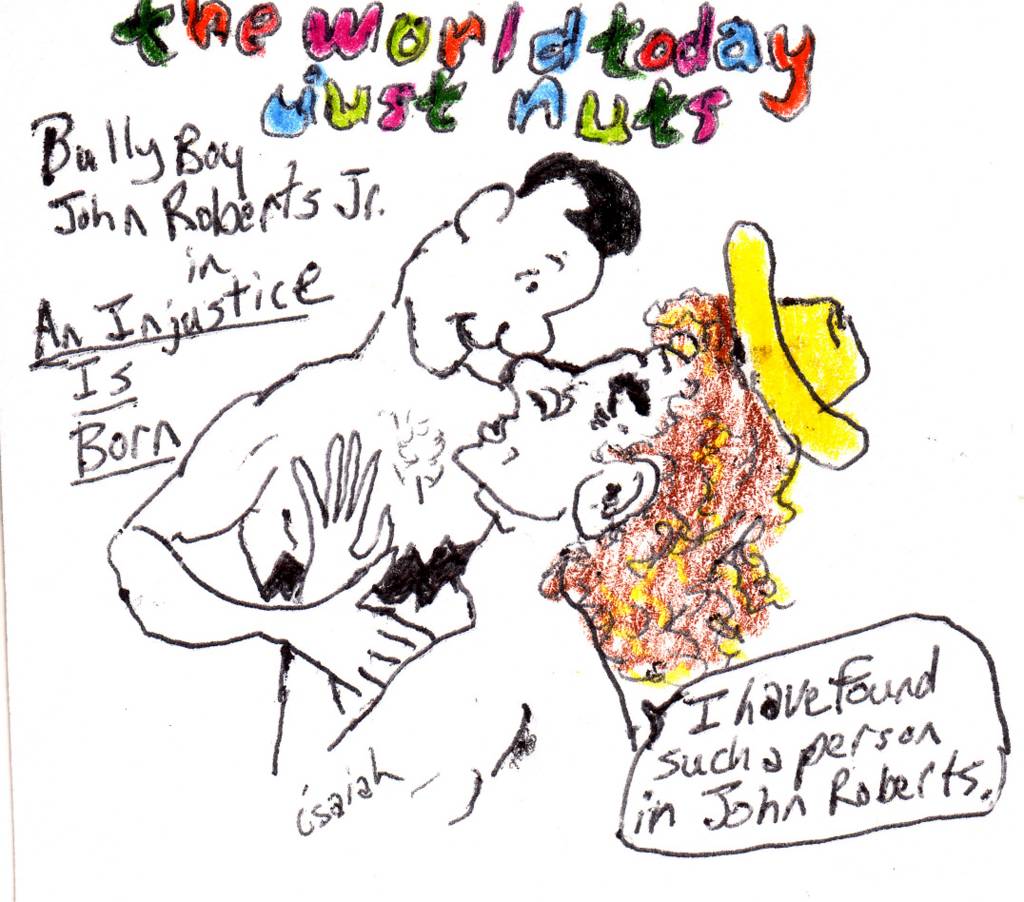
September 11, 2009, "An Injustice Is Born."


The movie comics always get attention and this one wasn't an exception. If you don't get the film, it's Barbra Streisand's A Star Is Born. Bully Boy's got his hair fixed like her. It's a silly comic about a silly nominee who never should have been seated on the Court.

Roberts was always drawn like Charlie Brown, both because he looked a little like him and also because he was a block head.

Though Roberts is bare chested to get the poster feel of the Streisand movie, I went ahead and included the stripe on his chest as if he were wearing the Charlie Brown shirt.


Moving to another topic. Dona, Jess, Dallas and I wrote an article for Third ("A Rucka, a Batwoman, a Zeus and a Heatwave") and that was a lot of fun to write and a lot of fun to take part in.

Zeus Comics (in Dallas, Texas) is a very nice store and if you're ever in that area, you should check it out (it's on Lemmon Avenue). I will if I'm back in Dallas any time soon.

And thank you to Dallas, Dona and Jess for being so much fun to work with.

Here's C.I.'s "Iraq snapshot:"

Friday, July 3, 2009. Chaos and violence continue, Joe Biden is in Iraq, so are land mines and the UN is drawing attention to the crisis, al-Sadr followers protest Biden, and more.

"Biden has come here to divide Iraq according to his plan." Vice President Joe Biden arrived in Iraq
yesterday and among today's activities is a protest of his visit by supporters of Moqtada al-Sadr. Andrew Quinn and Sattar Rahim (Reuters) report al-Sadr supporters marched in Baghdad and remarks from al-Sadr (including "Biden has come here to divide Iraq according to his plan") were read aloud to the crowd. The remark by al-Sadr refers to Biden's support for a federation of three autonomous areas in Iraq: Shia, Sunni and Kurd. That plan is among the reasons Biden has become the point-person for the administration on Iraq because the Kurds are increasingly unhappy with the US and increasingly vocal about what they see as US abandonment of their interests and needs. Quinn and Rahim note that al-Sadr's supporters were vocal as well, chanting "down, down USA" while burning US flags during their protest. Jane Arraf (Christian Science Monitor) reports the Kurds aren't the only ones worrying that Iraq has been abandoned and she quotes Hoyshar Zebari, Iraq's Foreign Minister, stating, "My message to them [US] is . . . you lost Afghanistan in 2001, 2002, and 2003 because you turned your attention to Iraq from Afghanistan -- now you are redirecting your attentions of Afghanistan and if you disengage with Iraq, it could be another failure. The situation is not that solid." Sheryl Gay Stolberg and Timothy Williams (New York Times) quote Biden declaring he is there to ask: "What is their plan to resolve the real differences that exist?" Mark Silva (Chicago Tribune) quotes Biden stating, "The reason I came is the president wants focus within the White House on the implementation of our administration's plan to both draw down troops in Iraq and also to promote a political settlement on unresolved issues from boundary disputes to the oil law."
Alsumaria notes it is is a three-day visit and that the vice president "arrived to Baghdad Airport amidst a sand storm which prevented him from conducting a scheduled visit to the US Embassy." The White House offers three photos of the arrival and Biden being greeted by Zebari and the top US commander in Iraq Gen Ray Odierno. Thomas M. Defrank (New York Daily News) reports Biden had breakfast with son Beau. Delware's WDEL has an audio report here. Beau Biden is the Attorney General for the state of Delaware and serving in Iraq as a captain in Delaware's Army National Guard. Biden's the first child of a president or vice president to serve in this decade's Iraq War. (The 2008 Republican presidential ticket had two candidates with children serving in Iraq. US Senator John McCain's son Jimmy served in Iraq. Governor Sarah Palin's son Track is serving in Iraq.) Despite George W. Bush sending other people's children into harm's way, neither of his daughters served in his illegal war of choice. Nor did Mary or Deferment Cheney, Dick Cheney's daughters, serve.


Taking a sidebar on Dick Cheney, for those who have forgotten, retired Ambassador Joe Wilson was sent by the CIA to Nigeria to vet accusations that Saddam Hussein (then president of Iraq) was attempting to obtain yellow-cake uranium from the country. Wilson found no evidence to support the claims. Despite that investigation, the false assertion began working its way into cases for the illegal war made by the Bush administration and Bully Boy Bush himself would say that they'd recently learned Saddam attempted to obtain yellow-cake uranium from Africa. Was that Nigeria?Wilson, at that point didn't know, and attempted to find out. Maybe Saddam had tried with another African country? Nope. It was Nigeria. The administration was lying.What do you do?Wilson began warning reporters and then began speaking out publicly.In retaliation, the administration that LIED and attacked. This was their pattern repeatedly. When former Treasury Secretary Paul O'Neill went public with issues, the administration attacked him and the press -- hey, David Gregory -- ran with the administration's lies and presented them as fact. In O'Neill's case, he was being accused of stealing government information on discs. Gregory stood on camera, for Today, waiving a copy of Ron Suskind's The Price of Loyalty and repeating the White House charges with a who-knows-what-really-happened spin. Apparently the only one who could know reality would be the non-idiots who knew to read the introduction of a book before repeating baseless charges because the discs are covered in the intro. (As was so often the case on Today, Katie Couric would have to grab the mop and clean up for her co-workers the following day.)Now they were going after Joe Wilson.And it wasn't enough to go after Joe Wilson because this was a petty, mafia-like administration. They didn't just go after Wilson, they went after his wife and began outing her to the press as a CIA agent until they found some one (Robert Novak) willing to print their tale.Valerie Plame was an undercover CIA agent and her cover was blown by the government she worked for.Thanks to the efforts of George H.W. Bush and his administration, what had just taken place was a crime. Not for reporters, but for government officials or workers involved in the outing.Dick Cheney's right-hand I. Lewis (Scooter) Libby ended up convicted from the investigation. Many thought and hoped others would be as well. That was not the case. It was hoped that with a new administration, Valerie Plame and Joe Wilson would have the support of the government on their side as they attempted to discover what had happened to them.That has not been the case. "Status quo you can believe in" is the Obama administration's slogan and they've done everything they can to prevent the truth from coming out.R. Jeffrey Smith's "
New Evidence Cheney Swayed Reaction to Leak" (Washington Post) takes you through the latest that's emerged as Barry O's Justice Dept argues the truth must be buried. One of their claims is that to allow Cheney's testimony during the Plamegate investigation to be known would prevent other vice presidents from offering testimony to a criminal investigation. Uh, no, it wouldn't. And if testimony means anything, it means that it's not buried out of fear of what might happened some day.Barack's administration is not open, it's not trying to be open and is not attempting to put the US back on balance. It is attempting to continue all the abuses from the Bush administration. And it gets a lot of help from a cowardly Congress. (It's noted in the article that Congress once fought the Bush White House to make Cheney's testimony public. Not noted in the article is that any member of Congress could make Cheney's testimony public on the House or Senate floor.)

Back to Iraq, Biden is not the only official visiting Iraq.
Alsumaria reports that France's Prime Minister Francois Fillon met with Nouri al-Maliki and Jalal Talabani today with Fillon and Maliki doing a joint-press conference at Baghdad International Airport ". . . Fillon pointed out that Iraq is on the right track. No one should be worried over Iraq redress for it intends to cooperate with its neighbor and it constitutes an intergral part of the region's stability. France undertakes to help Iraq to reach stability as soon as possible, to resolve conflicts with its neighbor and to get fast result, Fillon said. He also added that France takes upon itself assisting Iraq to emancipate from international sanctions which hinder development process." Xinhua reports the two "signed a cooperation agreement to promote bilateral economic, cultural and scientific relations. According to the statement, the agreement stated that France comitted to support Iraq to join the World Trade Organization (WTO) and to conclude a partenership agreement with the European Union." CCTV observes (link has text and video) that Fillon was heading a delegation of "30 high-level business executives" and quotes him stating, "It is high time now we look to the future. The team accompanying me represents major French firms. Currently we have firms working in Iraq in the field of transportation and airports." At the start of the week, Jonas Gahr Storra met with Zebari. Store is the Norewegian Foreign Affairs Minister. Among the topics discussed were assisting Iraq in clearing land mines. Yesterday Patrick Quinn (AP) explained that the United Nations sees Iraq as "one of the world's most contaminated countries" when it comes to land mines and quotes the UN"s Development Fund's Kent Paulusson stating, "The government needs to recognize the size of the problem and deal with it. [. . .] Some areas are so contaminated that people can't live there." CNN notes that UNICEF joined the UN Development Fund in drawing attention to the land mine problem in Iraq and notes UNICEF's report: "The report says about 1 million Iraqi children are at risk of being injured or killed by mines and unexploded ordnance. Some 2,000 children -- a quarter of all victims -- have been maimed or killed by cluster bomblets since 2003, the report said." Aseel Kami (Reuters) adds Iraq's Environment Ministry estimates there are 25 million land mines in Iraq and that the border between Iraq and Iran "is particularly mine-infested." David Morgan (Global Arab Network) observes, "Vast stretches of potentially highly productive agricultural land cannot be cultivated because of the potentially lethal hazards presented by explosive materials that still lie undetected. Hundreds of Iraqi people continue to suffer injuries and dozens have been killed."
Today the
United Nations High Commissioner for Refugees notes a new "special residentail centre for Iraqi refugees in the southern Armenian village of Darbnik. The building, a former agricultural college provided to UNHCR by the government last year, features 46 apartments and a social and recreation room. It was rehabilitated by UNHCR implementing partner, YMCA/Shelter." The Iraq War has resulted in a refugee crisis of both external and internal refugees. The refugees are a diverse group but a large number of them are Iraqi Christians. The assault on Iraq's LGBT community has led to a number of them becoming refugees as well. Sunday July 5th BBC Radio 5 airs Gay Life After Saddam (7 to 8 p.m. in England -- that will be eleven to noon PST). Ashley Byrne and Gail Champion produce the special for Made in Manchester. James Chaperlard (Crain's Manchester Business) reports:

In Gay Life After Saddam, presenter Aasmah Mir finds out how life for the country's gay, lesbian, bisexual and transgendered community (LGBT), has got worse since the fall of Saddam Hussein in 2003. Human rights campaigners claim hundreds of LGBT people have been killed or tortured while others have fled the country fearing for their safety since Saddam was toppled from power six years ago.

Not noted in the article but among the people interviewed for the special is Nouri al-Maliki, puppet of the occupation.

At CounterPunch today,
Anthony DiMaggio offers a look at Iraq and it's a serious attempt so he gets a link. I don't agree with the bulk of anything he says and feel he's repeating points that were made some time ago and that many don't hold up today. The continued and illegal occupation does stabilize Iraq. It puts into power the US interest, their puppets, and it blocks any real representation of Iraqis. It is not a sovereign government. It's one that would not exist were the US not still occupying the country.The illegal war itself and the continued occupation breed violence but part of the breeding is not just resentment over the continued presence of the US, it's also resentment over the installation of the puppet government. The exiles placed in power (by the US) are not representative of Iraq.The US took sides, installed one faction, a fundamentalist faction, and backed them because they believed this faction was ruthless and unafraid to resort to violence (the US was correct on both counts) and that these thugs would intimidate Iraqis into silence.Violence has never gone away in Iraq since the start of the illegal war. But that doesn't mean the puppet regime doesn't 'stabilize' it to a point where the violence lowers slightly, just enough to lull people into looking the other way.The 'civil war' wasn't a civil war. It was a genocide where the thugs in power went about ethnically cleansing parts of Baghdad. They succeeded. They did that with the whole world watching and with most of us not even grasping what was going on.DiMaggio is taking on the continued presence of US forces and also disputing the idea that there's any level of 'stability' in Iraq currently. The resentment and rage goes beyond the presence of foreign fighters. It goes to the fact that the 'rulers' are exiles installed by the occupiers, not chosen by the people. And those 'rulers' do allow for a form of 'stability' but they do it by targeting the Iraqi civilians and by using terror tactics.DiMaggio's argument's great for 2003 but it's completely out of step today because the people still pushing for continued war on and occupation of Iraq are not being countered with any claims DiMaggio's making. Their argument is that when the US leaves, violence levels will soar. DiMaggoi insists that US forces on the ground cause resentment and violence. That was true in 2003 and remains true today; however, we know more today and what he's saying isn't enough. It's not just the military, it's what they prop up, it's the 'government' the US has created.The response to those who insist in 2009 that the illegal war must continue for stability is that no one knows what will happen when US forces leave but there's not a real government there now and claiming stability via a thug regime doesn't encourage democracy or allow US forces to ever leave. The government is not of the people and it doesn't represent them. It will always need force behind it to remain in power.Lastly, the referendum on the Status Of Forces Agreement is not happening this month. It can't. It requires planning. The US stepped in and al-Maliki was more than happy to go along with it. The claim is it will now be held in January when national elections are held. Alsumaria explains, "Meanwhile, the government seeks to delay the referendum till January 2010, when the country also holds parliamentary elections as holding both at the same time will save money. In this concern, lawmakers and electoral authorities say there is no way a referendum can be organized in just a month." Jane Arraf (Christian Science Monitor) reports, "Attention here is now shifting to national elections expected in January. The elections are seen as the best hope for addressing the grievances of Iraqi factions that feel they've been left out of a political system created by the US and dominated since 2003 by a Shiite-led government."


Turning to some of today's reported violence . . .

Bombings?

Laith Hammoudi (McClatchy Newspapers) reports a Mosul roadside bombing which injured three Iraqi soldiers and a Tikrit roadside bombing wounded one police officer.

Shootings?

Laith Hammoudi (McClatchy Newspapers) reports 1 person was shot dead in Mosul and "an officer in the Iraqi army called Saddam Hussein" was shot ded in Kirkuk. Reuters notes "three judges who were traveling together in a car in northern Hilla" were injured in a shooting by unknown assailants.

Corpses?

Reuters notes 1 male corpse was discovered in Mosul and 1 female corpse in Hilla -- both has "bullet wounds to . . . head and chest".

Yesterday the
US Defense Dept identified the four soldiers killed in Baghdad June 29th: "They were assigned to the 120th Combined Arms Battalion, Wilmington, N.C. Killed were: Sgt. 1st Class Edward C. Kramer, 39, of Wilmington, N.C. [;] Sgt. Roger L. Adams Jr., 36, of Jacksonville, N.C. [;] Sgt. Juan C. Baldeosingh, 30, of Newport, N.C. [and] Spc. Robert L. Bittiker, 39, of Jacksonville, N.C." Jennifer McLogan (WCBS) speaks with Baldeosingh's sisters Jennyfer and Diana Baldeosingh. Jennyfer states, "At first it's anger. Why did he go? Why him?" Diana states, "Some of them have done two or three tours, they have families and kids, they need to be with them -- not over there. We did our time there. It's time to come home, please." John Valenti and Sophia Chang (Newsday -- link has text and video) also speak with the two sisters and they note: "He also leaves behind his wife, Rebecca, and three young daughters -- Emily, 2, and 5-year-old twins, Isabella and Kylie." ENCToday speaks with Brian Wheat, the stepfather of Robert Bittiker and explains, "Bittiker leaves behind his wife Tami, and two sons Cameron, 14, and Ronnie, 18, who just graduated from Southwest High School". The Salisbury Post notes Edward Kramer's wife Vicki issued a statement explaining, "He loved us very much and he did this for his children [Erica, age nine, and Megan, age seven] so they wouldn't have to". Catherine M. Welch (WHQR) reports a Sunday event to remember Kramer, "A memorial walk is planned for Sunday at 6:00 p.m. It will start at the Wilmington Fire Department Headquarters on Marketstreet in downtown Wilmington and end at the National Guard Armory."

World Can't Wait has several upcoming actions including:

Monday, July 13, The World Can't Wait and other organizations will protest the inclusion of military recruiters at the national NAACP Convention in New York City.
4:30-7:00pm New York Hilton Hotel 1335 6th Avenue (53/54 Streets)Also, on Thursday, July 16, when Barack Obama addresses the convention, we'll be there protesting the expanded war in Afghanistan, drone attacks on civilians in Pakistan, and Obama's refusal to release the torture photos and prosecute the Bush era war criminals. 9:30am until noon @ New York Hilton
Read letter sent by NYC High School student to Benjamin Jealous, CEO of the NAACP, asking him why recruiters are invited to the convention. Sign on to letter to be sent to the officers and Board of the NAACP this week:To Benjamin Jealous, President & CEO, NAACP

iraqjane arraf
the christian science monitorthe new york timessheryl gay stolberg
timothy williams
mark silvathe chicago tribune
anthony dimaggio
mcclatchy newspapers
laith hammoudi
aseel kami
alsumaria

cnn

Read on ...
Creative Commons License
This work is licensed under a Creative Commons Attribution-Share Alike 3.0 Unported License.