Showing posts with label Eric Holder. Show all posts

Saturday, January 9, 2016

Eric investigates Eric


eric investigates eric 001


From May 27, 2013, that's "Eric Investigates Eric."  C.I. noted:


Attorney General Eric Holder explains, "The Justice Department went too far in targeting the press and I am the one to figure who is responsible.  After that, my wife has asked me to look into who forgot to take the trash out?  In both cases, I can assure you I will not be found responsible."  Isaiah archives his comics at The World Today Just Nuts.

When I'm drawing a real person, it's very rare that I don't pick the drawing apart afterwards.

But I really felt like that one above captured Eric Holder.

Again, that's not a common feeling for me.


Here's C.I.'s "Iraq snapshot:"


Saturday, January 9, 2016.  Chaos and violence continue, Basra's a hotspot again (who could've guessed? Uh, anyone paying attention), Haider al-Abadi's talking anti-corruption again, a drone crashes in Iraq and much more.


Starting with terminology.


One definition of "distraction" would be "a thing that prevents someone from giving full attention to something else."  That's the definition we're interested in today.

From December 31, 2015's "Those never-ending victory laps:"


I guess every day is going to be about declaring and celebrating the liberation of Ramadi -- since it was first claimed on Monday and until the day finally comes that it is liberated.
Point of fact, it's still not liberated.
But every day, the limited amount of time the world press spends on Iraq is taken up by tales of Ramadi's liberation.
And so much more gets ignored.
For example?
IRAQI SPRING MC reports counter-terrorism forces in Diyala shot dead a female civilian in front of civilians and Iraqi troops.
Or how about a new flashpoint developing?
IRAQI SPRING MC notes troops being sent to Basra.  This comes as NATIONAL IRAQI NEWS AGENCY notes MP Abd al-Salam al-Maliki is calling for the declaration of a state of emergency in Basra arguing the situation there is turning into a crisis.
But by all means, let's all waste another day declaring Ramadi liberated (when it's not).


That's how the year ended -- and with no western press coverage of Basra, to be very clear.

Nine days later?

Sinan Salaheddin (AP) reports, "Fear has become part of daily life amid a surge of violence in Basra, where rampant crime, kidnappings and extortion have become commonplace. Marauding Shiite militiamen drive around in cars with tinted windows and without plates, while local clans wage bloody feuds."

Basra's struggling and, in part, that's said to be because Iraqi forces are being deployed elsewhere in Iraq.

Such as?

Ramadi.


See the Iraqi forces are like the western press -- they apparently are small in number and can only focus on one thing at a time.

How does Basra fall off the radar?

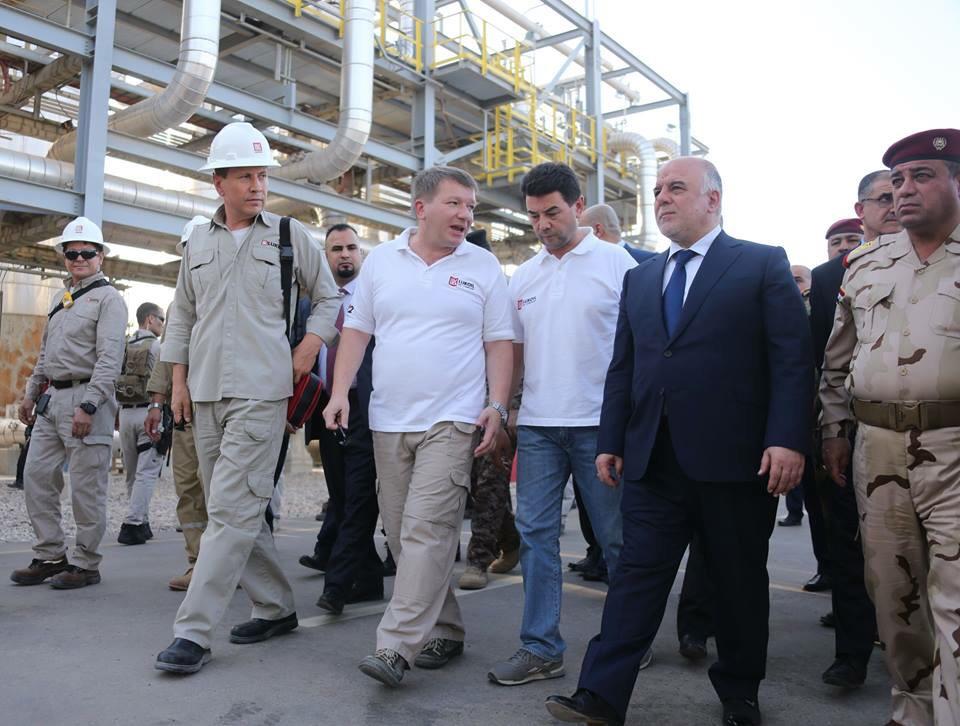
Or has everyone forgotten this photo op?

PM Al-Abadi visits West Qurna 2 in Basra and adopts new measures to enhance security for international oil companies
Embedded image permalink


From the August 22, 2015 snapshot, "Iraq Times reports the reaction to citizens in Basra which was to protest Haider's visit. The activists noted that he traveled all the way to Basra to reassure Big Oil but he did not meet with a single local protester to address the concerns that have had them pouring into the streets for the last weeks.  The report notes that the British and US Ambassadors to Iraq had lobbied Haider to visit Basra to reassure Big Oil.  As Iraq Times also notes, just north of Basra is where a protester -- protesting against Big Oil -- was shot dead by security forces working for yet another foreign oil company in Iraq."

And the protests?  They continue in Basra.  ALSUMARIA reports Friday saw continued protests there against the government's corruption.


Yes, the western press should have been paying attention to Basra last year.


So much gets ignored.

Including the lack of success in Barack Obama's never-ending bombing of Iraq.  Today, the US Defense Dept announced:


Strikes in Iraq
Coalition forces used rocket artillery, fighter, bomber, and remotely piloted aircraft to conduct 22 strikes in Iraq, coordinated with and in support of the Iraqi government:
-- Near Haditha, a strike struck an ISIL tactical unit and destroyed an ISIL heavy machine gun and four ISIL fighting positions.
-- Near Mosul, four strikes struck two separate ISIL tactical units and destroyed three ISIL fighting positions, three ISIL weapon caches and three ISIL assembly areas.
-- Near Ramadi, six strikes struck a large ISIL tactical unit, denied ISIL access to terrain, and destroyed 21 ISIL fighting positions, two ISIL sniper positions, two ISIL recoilless rifles, an ISIL vehicle bomb facility, and two ISIL weapon caches.
-- Near Sinjar, a strike struck two separate ISIL fighting positions and suppressed an ISIL light machine gun.
-- Near Sultan Abdallah, a strike destroyed an ISIL-used culvert and an ISIL fighting position.

Task force officials define a strike as one or more kinetic events that occur in roughly the same geographic location to produce a single, sometimes cumulative, effect. Therefore, officials explained, a single aircraft delivering a single weapon against a lone ISIL vehicle is a strike, but so is multiple aircraft delivering dozens of weapons against buildings, vehicles and weapon systems in a compound, for example, having the cumulative effect of making those targets harder or impossible for ISIL to use. Accordingly, officials said, they do not report the number or type of aircraft employed in a strike, the number of munitions dropped in each strike, or the number of individual munition impact points against a target.
Jack A. Smith (GLOBAL RESEARCH) goes where the western press fears to tread:

• IN IRAQ, WASHINGTON’S DISASTROUS WAR has lasted nearly 13 years from March 2003 with the exception of two and a half years until returning in August 2014 to fight against the Islamic State (IS) — itself a product of the first war. President Obama propelled the second intervention soon after IS captured Mosul, Iraq’s second largest city, in June 2014. Late last month, after losing much ground, Iraqi forces backed by American air power recaptured the key city of Ramadi, destroying a large portion of the city in the process. The battle to recapture Mosul may take place this year.
However, many sources in and out of Congress argue that only a significant ground war will ultimately defeat the Islamic State in both Iraq and Syria. This could take many years. Aside from 3,500 U.S. military “trainers and advisers” in Iraq, President Obama is reluctant to engage in a ground campaign in either country, given the Pentagon’s difficulties in actually winning winning a major war in the Middle East. If political pressure doesn’t oblige him to deploy a large number of ground troops against IS this year, there is a likelihood his successor may do so in 2017. Regardless, the Iraq war will become more intense in 2016.
There are several other important problems regarding Iraq, but two stand out.
(1) The Islamic State is a militant Sunni “caliphate” based on Islamic fundamentalist Wahhabi doctrine mainly propagated by the Kingdom of Saudi Arabia. The IS evidently considers its main enemy to be the Shia branch of Islam, which departed from the Sunni version in the 7th century. Virtually all of the many Sunni jihadist groups follow a form of fundamentalist Wahhabism or the nearly identical Salafism, and most condemn adherents of Shia Islam.  The IS “state” occupies large portions of two Shia-governed countries, Iraq and Syria. Sunni Arabs in Iraq — most of whom do not share fundamentalist views — constitute 15 to 20% of the Iraqi population. But many oppose the Shia controlled Baghdad government. Unless a substantial number of these Sunnis turn strongly against the IS, defeating it will be more difficult.
Kurds make up 17% of the Iraqi population and are described as “mainly secular Sunnis” who seek independence from Iraq in the future to build their own independent state — but at the moment they supply the most effective ground forces against the IS. The Shia represent up to 65% of the population but have long existed under Sunni rule, usually as secondary citizens. It was only after the U.S. destroyed the minority secular Sunni government of Saddam Hussein and his B a’ath Party that the Shia won power in an election. The Bush/Cheney Administration probably knew that regime change in Iraq — Iran’s enemy neighbor to the west — could strengthen the Shia government in Tehran, but since they initially planned to invade Iran (as well as Syria) after Iraq was subdued they ignored the risk. The U.S. sank so deeply in the Iraqi quagmire that it never was able to expand its ridiculous imperialist escapade.
Iraq continues to splinter and fall apart. 
Though the Shia and Sunni divide has garnered the most attention in recent months, there's also the reality that the Kurds, as Smith notes above, seek independence.
The Kurdish Regional Government is in northern Iraq and has been semi-autonomous for years.  The Kurds would like full autonomy.
The Kurds remain the largest ethnic group in the world without a homeland.  
Kurds in Syria and Turkey feel suppressed and both countries have governments that fear an independent Kurdistan in Iraq would increase demands for independence for Kurds in both Syria and Turkey.
Hannah Lynch (RUDAW) wonders if this is the year the KRG sees full independence and notes:

Kurdish president Masoud Barzani has echoed the sentiment of many people that the Kurdish region would fare better on its own.
In the summer of 2014 when ISIS took over large swathes of Iraq’s territory, Barzani asked the Kurdish parliament to set a date for an independence referendum, saying that the Kurds no longer wanted to be part of Iraq’s troubles.
"There might be some negative consequences arising with the declaration of independence in the beginning. We need to be patient because in the end it is worth it, and we can provide a better tomorrow for our people," says Ayub Hassan, a goldsmith in downtown Erbil.
From reality, to fantasy.  Iraq is not just a corrupt country, it is regularly found in the top ten of most corrupt countries  in the world.  On its most recent corruption index, Transparency International ranked Iraq the 170th most corrupt country in the world out of 175 countries.
Anyone remember the protests of 2015?
Let's drop back to the October 5th snapshot:


Haider al-Abadi was installed as the new prime minister in the fall of 2014 in an attempt to reset the clock and pull Iraq back from the brink.
During his year and counting as prime minister, he's accomplished very little but flapped his gums a great deal.
For example, protests started (re-started) months ago.
The spark was the lack of electricity in 100-plus degree days.
Ghaith Abdul-Ahad (Guardian) reports:
More than a decade after the US invasion – and more than $40bn (£26bn) of investment later – Iraqis must still make do with limited electricity. In a country with one of the world’s largest oil reserves, this is a matter of great exasperation for locals.
“People here get a few hours of electricity every day, so when the current comes there is a huge demand: everyone plugs in their fridges and air conditioners, the old network is overloaded and transformers fry and cables melt,” said Faris. “We work three shifts, 24 hours a day, trying to patch up the old network and we can’t keep up.”
When summer temperatures peak above 50C (122F), it’s a matter of life and death – a far more emotive issue than Isis and the sectarian divide. This summer, as temperatures surged and tempers frayed, thousands of people staged a series of protests, pressing into city centre squares to denounce the corruption that riddles the system.


All these months later, all these grand pronouncements from Haider later, and the electricity issue is still not addressed.
But Haider did announce, over the weekend, that he'd accomplished something to meet the demands of the people.
Sunday, AFP reported that Haider al-Abadi, prime minister of Iraq, declared that opening the Green Zone to the public is part of his fulfilling his promise to the Iraqi people.
Strange, I don't require any signs carried by the protesters in recent months that called for opening the Green Zone.
And, of course, it's not really that open.  As AFP noted, "The measure offers limited access to the vast area, with most streets still requiring a special badge [. . .]"
Haider never met the demands of the protesters.  And the corruption continues.
But do nothing Haider al-Abadi spoke today.  PRESS TV notes:
“2016 is the year of eliminating corruption, there is no such things as acceptable corruption and non-acceptable corruption,” Haider al-Abadi said in a Saturday speech at a ceremony to celebrate Police Day in the capital, Baghdad.
The comments came following a criticism by Iraq’s senior Shia cleric Grand Ayatollah Ali al-Sistani, who urged the Iraqi government to reform the current administration and take more serious measures against graft.
Covering the speech, ALSUMARIA notes that he gave a similar anti-corruption speech on September 23, 2015 but that, back then, he likened corruption to terrorism.
Haider al-Abadi's empty words have been useless.

Let's move to rumors.

US helicopters are taking part in attacks in Kirkuk.

ALSUMARIA reports that this rumor is being denied by US Ambassador to Iraq Stuart Jones.

And did a US drone crash in Iraq?  Yes, RUSSIA TODAY reports, "Washington has confirmed that one of its Predator drones deployed in a mission against Islamic State terrorists crashed in Iraq. However, the military denied ISIS militants’ claims that the jihadist group shot the drone down." Lolita C. Baldor (AP) adds, "U.S. Air Forces Central Command says the military lost control of the drone, but the specific cause of its crash is being investigated." And Phillip Swarts (AIR FORCE TIMES) observes, "In the last eight months of 2015, Air Combat Command reported the loss of at least three RPA's -- two in the Middle East and one in Africa."


But what about what happened in Mosul?

ALSUMARIA notes Turkey's President Recep Tayyip Erodgen is insisting that Turkish troops defended Camp Ba'shiqah near Mosul from the Islamic State.

But REUTERS notes, "Iraq's joint operations command denied on Saturday that Turkish forces based in northern Iraq had been attacked by Islamic State or had clashed with the militants, refuting claims by Turkish President Tayyip Erdogan."

On that one, it's still unclear what is just rumor and what is fact.

What about those false US rumors about the Iraq War having ended?  Michelle Tan (ARMY TIMES) reported Friday on new deployments, "About 1,300 soldiers will deploy to Iraq this spring to support Operation Inherent Resolve. The other 500 soldiers will deploy to Afghanistan for Operation Freedom’s Sentinel."

So, no, Barack did not end the Iraq War.  Or close Guantanamo . . . Or . . .


We'll note this Tweet:


The Shia cleric al-Sarkhi al-Hasani: "Shias clerics have forgotten about the executions of Sunnies in "
Embedded image permalink


Indeed.


In some of today's violence, ALSUMARIA reports a south Baghdad bombing left five people (including three children) injured, and 1 corpse was discovered dumped in Baghdad (shot dead).


Turning to England, Jonathan Owen (INDEPENDENT) reports:

Dozens of cases in which British soldiers are accused of unlawfully killing Iraqi civilians have already been referred to prosecutors, The Independent can reveal, with more than 50 deaths set to be examined.
The Iraq Historic Allegations Team (Ihat) has sought advice from the Service Prosecuting Authority (SPA) on unlawful death cases involving 35 alleged killings, and 36 cases of alleged abuse and mistreatment, it can be disclosed.


This has been a story there for over a week but until now there were many allegations being made to the press.  These are still allegations but they've now been turned over to legal prosecutors.  Lexi Finnigan (TELEGRAPH OF LONDON) adds:


On Friday night MPs and forces chiefs labelled the move to contact 280 soldiers a “despicable witch-hunt”. 
Some veterans have even been handed the letters personally and quizzed on their doorsteps by taxpayer-funded detectives. 


iraq
rudaw


the telegraph of london


Read on ...

Friday, January 24, 2014

Priorities


Priorities

From September 26, 2010, that's latest The World Today Just Nuts "Priorities." C.I. noted:

Ken Salazar notes Barack posing and asks, "What's going on?" Eric Holder explains, "He's rehearsing for Tuesday. He prefers mass adulation to actually governing." Isaiah archives his comics at The World Today Just Nuts.


That was my first time doing Eric Holder and I got so much mail on that.  People seemed to feel I'd captured him.

Which honestly only made me panic. 

And made it that much harder to draw Holder again.

I like when people enjoy the comic for whatever reason.

But if there's too much praise, I'm left in kind of a panic.


Here's C.I.'s "Iraq snapshot:"


Thursday, January 23, 2014.  Chaos and violence continue,  Iraq's Speaker of Parliament Osama al-Nujaifi speaks in DC, Martha Raddatz goes back to Iraq, the assault on Anbar continues, Barack's allegedly gotten the US Congress to cave and he'll be able to give despot Nouri al-Maliki additional weapons, and more.


Iraq's Speaker of Parliament Osama al-Nujaifi is currently in the United States.  With Vice President Tareq al-Hashemi currently in exile, al-Nujaifi is the highest ranking Sunni in the Iraqi government.  This morning, he spoke at the Brookings Institution.


Speaker Osama al-Nujaifi:  We first got rid of an oppressive regime and it was followed by a military occupation then a Constitution that was written in unfavorable conditions and circumstances.  There was also a road map that was set.  The Iraqis were not able to contribute to this road map because we were in a rush.  And we wanted Iraq to be an exemplary democracy.  
The Constitution in Iraq was written under very difficult circumstances and in a very sensitive period in the country  and on the hand of politicians who suffered a lot in the past -- arrested or condemned to execution, exiled or in prison.  So the psychological environment was very hard and there were mutual fears between the Iraqi components.  This was the reason why the Constitution has some problems.  And some Articles in the Constitution can be interpreted in different ways. 
We also set up mechanisms to build institutions.  But the orientation of the Constitution was not as it should have been because of the political tension and divisions.  And the institution stipulated in the Constitution was not built as it should because of the problems.  
For instance, the Federal Supreme Court which is the highest judicial body and it rules on the conflicts between different parts of the country.  
So far, we were not able to implement it because this law needs two-thirds of the votes in the Parliament and all the political parties do not agree.  So far it is tribunal.  
Now we have courts that do exist so it is not does not have the Constitutional prerogatives to be able to rule on interpreting the Constitution or deciding if the laws are Constitutional.  That's why there are Constitutional differences between the provinces, between the provinces and Baghdad or between the legislative and the executive powers. 
All this made political life more complicated in Iraq.  And our path towards being the democratic process that we seek was not smooth. There are bad implementation of the law and selective implementation. Parliament adopted some 215 laws.  Some are very important for the stability of Iraq and for providing services to the people and for building the state as it should be built.  But some of these laws were not implemented.  They were adopted, published in the journal -- official journal -- and theoretically should have been implemented but so far they are not because there are unilateral political decisions not to implement them.  
For instance, the law on the provinces that give important prerogatives to the provinces and enough funds and means to implement the essentialization of the state.  But this law was not implemented because some in the country believe that it should not be.  
Also the law about customs, it was adopted two years ago but it is paralyzed on purpose.  
So we are facing many obstacles when it comes to building institutions and building the state of Iraq.  There is selectivity in implementing the laws.  Sometimes the law is implemented on some Iraqi parties and not on some other Iraqi parties. Hence a lack of confidence by the citizens in the political process, in the state institutions and also in the participation in the political process.  
Iraq is now facing a terrorist threat as we've seen since the beginning of the year when the change has started.  And now we need to know how to defeat terrorism at the security and at the ideological level.  
We do know that in 2007 with the surge of the American forces sectarian violence ended in the country.  And we set a plan to fight al Qaeda and the terrorist groups with the support of the Sunni clans -- most especially in Anbar -- they were armed, financed and promises that they will be part of the armed forces.  And the clans were able to defeat al Qaeda and security was restored in Anbar that represents 31% of the surface of Iraq.  So we were able to bring security back and the world is witness.  
But after this victory, there was no follow up on the promises that were given to them and they did not get their rights as, for instance, to integrate into the armed forces, to get the salaries that they need to protect them from being targeted by the terrorists.  Very few of them got salaries, those who did get salaries got salaries that were very, very low, many of them were arrested because of systematic targeting by sectarian politicians or even by al Qaeda because they wanted to undermine the rule of the tribes.  
From 2009 until a few months ago, these forces were almost completely destroyed and then al Qaeda came back stronger than before.  al Qaeda was able to paralyze the tribes and the central state did not follow up on its moral and verbal promises. 
So al Qaeda is back and it is exploiting political differences and the general feeling of frustration among the Iraqi people.  It also is exploiting the systematic corruption at the political and economic level, finding the support, finances and means in some provinces in Iraq.  And in 2013, more than 9,000 Iraqis were killed and more than 25,000 were wounded and this is the highest figure in recent years. 
So the political components in Iraq were not able to build the Iraqi political system or to implement the Constitution and to reach a genuine partnership and a genuine reconciliation.  They were not able to implement the laws as it should be and get rid of corruption and abuses and they did not respect all the Iraqi components as to represent them  in a fair manner in the armed forces.  According to the Constitution, they did not provide the provinces with enough funds. Also we did not adopt the law on hydrocarbons oil and gas which is very important to set a balanced relation between the provinces and the center for the production and exportation of oil.  
So some parties are implementing the Constitution based on their own perspective and this is hindering the building of the state, the national cohesion and is leading to more division.  And more and more people are being disappointed and do not trust the political process at this point as we have seen by the very low turnout in the last general elections [2013 provincial elections] and the ones before [2010 parliamentary elections]. We believe that Iraq is, at this point, at a crossroad.  The key to situation is clear and we can find a solution.  What we need though is a strong determination and the political will for everyone to agree on the Constitution and to forget the past, to move beyond the fears and to stop punishing the Iraqi people and move to reconciliation and prevent Iraq from sliding into even greater troubles.  
In the Kurdish provinces [Kurdistan Regional Government, three semi-autonomous provinces in northern Iraq] there was a law adopted to amnesty every one who committed a crime against the Kurdish people and worked with the previous regime.  Some of them were accused of violent crimes but they decided to amnesty everyone.  And the situation in the Kurdish provinces is stable and everyone is part of the political process.  The Kurdish provinces are now an example of security and successful investment and  wise politics.  
But in central Iraq, we are still arresting people and we are also still implementing the law on the Justice and Accountability in a partial sectarian way.  We are still banishing some of the Iraqi people who were not part of the previous regime and doing so for political reasons.  That is unfair. 
So we have failed in implementing this law.  
The political process is now in jeopardy.  
We need to act clearly and swiftly.  
The next elections are very important and could solve many problems. 
The situation should be stable and calm.  
We should put an end to the violence and the  killings and we should avoid any political measures that are provocative and the day before yesterday a decision to [create three new provinces] which led to lots of reactions.  
Also the issue of what is happening in Anbar Province. Of course, al Qaeda is there and we should fight al Qaeda and we believe so.  The tribes are fighting terrorism at this point.  But not everyone in Al Anbar Province is a terrorist.  [Some residents have been taking part in protests.] There are political demands and rights and problems that need political solutions and not military answers.  
So I am ready to answer your questions now but let me state again that Iraq is at a crossroad -- either it will move towards success and democracy and provide a successful example of a democratic country in a difficult region or, God forbid, we will move into something similar to what's taking place in Syria today.  The second option is to be expected if we do not confront the existing problems in the correct manner. 
Today, Iraq needs national reconciliation and partnership instead of the marginalization 


Okay, on the above.  This is the second week where inadequate translators were provided at a DC Iraq event.  Last week, it was Deputy Prime Minister Saleh al-Mutlaq at the US Institute of Peace.   Brookings' translator -- a woman -- was better than the man translating at the US Institute of Peace.  He was awful.  It took him so long -- lengthy pauses -- to figure out what was being said that he would stop mid-sentence because a new person had begun to speak.

She wasn't that bad.  But "[Some residents have been taking part in protests.]"?  I have no idea what he said because she rushed through a bad translation.  She did this also with the section where I have "[create three new provinces"] which instead found her stating that the military launched campaigns in four provinces on Tuesday.

Until the end of the speech, she repeatedly used the term "confessional" when the English word for the term al-Nujaifi was using was "sectarian."  I do realize that context is a great deal.  I really think if you're translating on current events, you should know current events.  The woman did better than the man who stumbled and fumbled and left whole sections untranslated.  But this really shouldn't be considered acceptable.  As I've noted before I have a friend who runs a translation firm.  I told her about this experience and asked if it's considered acceptable?  She said it wasn't.  And I don't see how it could be.  Two people were hired to do jobs which were translating the remarks of visiting politicians.  If you're not translating the remarks, if you're not translating them correctly, you're not doing your job.

On the above, I also broke it up into paragraph form.  Normally, we don't do that.  But that's such a large section of words.  And they had to be included because if Saleh al-Mutlaq and the MPs last week got very little US media coverage, Osama al-Nujaifi is getting even less coverage.

Gus Taylor (Washington Times) is one of the few covering this morning's event.

With fears growing that the situation could trigger an all-out civil war between Iraq’s Shiites and Sunnis, Iraqi Prime Minister Nouri al-Maliki has yielded to pressure from the Obama administration to delay using the Iraqi military, which is dominated by Shiites, to mount full-scale assault on Anbar.
Mr. al-Maliki has also begun paying more secular Sunni tribesmen to fight back against the extremists in Fallujah.
But Mr. al-Nujayfi on Wednesday suggested the move may be too little too late — or that it must be expanded upon significantly and quickly if the Maliki government has any hope of forging a sustainable alliance with secular Sunni tribal leaders going forward.
He also said the rise of al Qaeda-linked groups in Anbar could most accurately be blamed on the Maliki government’s abandonment of previous alliances that U.S. military forces once nourished with those tribal leaders.
Karen DeYoung and Ernesto Londono (Washington Post) report on the Brookings event and on the visit to the US:

The amount of face time that Nujaifi got with top U.S. officials — including Secretary of State John F. Kerry and Defense Secretary Chuck Hagel — suggested that Washington realizes that mobilizing Iraq’s beleaguered Sunni community will be key to restoring order in Anbar. A State Department official said Washington is hopeful that the ongoing crisis might deliver a larger breakthrough in Iraq’s stagnant politics.
“A big part of what Nujaifi and we are trying to do is move this beyond the military front,” said the official, who was not authorized to speak publicly about the situation. “Even if you can quell the al-Qaeda advances long-term, you won’t be able to make any progress without political reform as well.”
Yesterday, Iraq's Speaker of Parliament Osama al-Nujaifi met with US President Barack Obama.


And yesterday, the White House issued the following:
The White House
Office of the Vice President

Readout of Vice President Biden's Meeting with Iraqi Council of Representatives Speaker Osama al-Nujaifi


This afternoon, President Obama joined Vice President Joe Biden’s meeting with Iraqi Council of Representatives Speaker Osama al-Nujaifi and a delegation of Iraqi parliamentarians. Both sides reaffirmed the importance of the strategic partnership between the United States and Iraq.   The President encouraged Iraq’s leaders to continue dialogue to address the legitimate grievances of all communities through the political process. Both sides agreed on the need for both security and political measures to combat terrorism, and discussed efforts to formally integrate local and tribal forces into the state security structures consistent with the Government of Iraq’s public commitments in recent days.  President Obama and Vice President Biden also expressed the United States’ strong support for continued cooperation between local and tribal leaders and the Iraqi Government against al-Qaeda in Iraq (AQI)/the Islamic State of Iraq and the Levant (ISIL).  The President and Vice President underscored that the United States stands with Iraq and its people in the fight against AQI/ISIL and other extremist groups.


Osama al-Nujaifi's visit was also noted in today's US State Dept press briefing conducted by spokesperson Marie Harf.


QUESTION: There’s been a number – two of the highest-ranking Sunni political – elected political leaders from Iraq have been through town in the last week.

MS. HARF: Mm-hmm. Yep.

QUESTION: The speaker of --

MS. HARF: Nujayfi.

QUESTION: Yeah. Nujayfi is here now. I was wondering if you could, first, just kind of give us a sense of whether or not he’s having any official meetings in this building --

MS. HARF: Mm-hmm. Yeah.

QUESTION: -- and who’s he going to be meeting with and what are they going to talk about?

MS. HARF: Yeah. So I have a couple updates on Speaker Nujayfi’s travel to the States. On Monday, so four days ago, Secretary Kerry met with the Speaker of the Iraqi Council of Representatives, Usama al-Nujayfi, to discuss bilateral issues, including the ongoing situation in Anbar province. They discussed our shared commitment toward a long-term partnership under the Strategic Framework Agreement.
The Secretary noted the importance of cooperation between Anbari local and tribal leaders, the Iraqi security forces, and national leaders in the fight against the Islamic State of Iraq and the Levant in Anbar province. In that light, the Secretary welcomed the stated commitment by the Government of Iraq to incorporate Iraqi citizens in Anbar who stand up to fight ISIL and other extremist groups into the formal security structure of the state.
The Secretary further praised Speaker Nujayfi’s commitment to support efforts to enlist tribes to control their local areas, in coordination with provincial councils and the Government of Iraq. The two also discussed the importance of Iraq’s national election in April. And Secretary Kerry assured Speaker Nujayfi that the United States will continue to work with United Nations Assistance Mission for Iraq to ensure that the election occurs on time, is transparent, and reflects the will of the Iraqi people.
And the Vice President also met with Speaker Nujayfi. This was yesterday, I believe. President Obama joined Vice President Joe Biden’s meeting with Iraqi Council of Representatives Speaker Usama al-Nujayfi and a delegation of Iraqi parliamentarians. Both sides reaffirmed the importance of the strategic partnership between the United States and Iraq. The President encouraged Iraq’s leaders to continue dialogue to address the legitimate grievances of all communities through the political process.
Both sides agreed on the need for both security and political measures to combat terrorism and discuss efforts to formally integrate local and tribal forces into the state security structures. Both the President and Vice President expressed the United States strong support for continued cooperation between local and tribal leaders and the Iraqi Government against al-Qaida in Iraq and the Islamic State of Iraq in the Levant, and of course, underscored that the United States stands with Iraq and its people in this fight against extremist groups.
And I can check on the timing of that meeting. So those are just a couple of his meetings he’s had.

QUESTION: Just one more. Could you just speak to the challenges associated with – of managing these meetings with opposition figures from a political situation that’s fairly tense with sectarian divisions right now? I mean, has the Maliki government or the prime minister had anything to say about the fact that these guys are coming, and is there – have you followed up with him within the context of these meetings?


MS. HARF: Not to my knowledge. I mean, we’ve made very clear to the Iraqi Government that we will talk to the different political leaders from all sides as part of our engagement. The Vice President has spoken a number of times to Prime Minister Maliki in the recent weeks. The Secretary has made calls. A lot of people have made calls. Brett McGurk, who folks know knows Iraq very well, was just there for an extended trip where he met with political leaders from across the board. So this has certainly been our practice. I haven’t heard anyone suggest that it should be otherwise.

QUESTION: Thank you.

QUESTION: Change of subject?

MS. HARF: Yes. What, on Iraq?

QUESTION: On Iraq, yeah. I’m just – there’s been a proposal in recent days, I believe by the Maliki government, to break off three new pretty much Sunni-dominated provinces in Iraq. They would be in mostly western and northern Iraq, but it would be two provinces in Anbar around Fallujah and Tuz Khormato, and then up north in Ninawa near Tal Afar. I’m just wondering if this came up in the discussions with the Secretary or to your extent of knowledge with the Vice President, and what the Administration feels about this. I know there’s been a strong sense of keeping one country of Iraq --

MS. HARF: Absolutely.

QUESTION: -- but I don’t know how that would equate with breaking off into new provinces within Iraq.


MS. HARF: Right. It’s a good question and I actually – I’m sorry to do this to you twice today – don’t know the answer. So let me check with our folks. I’m not aware of the details of the proposal, but I can see if it came up in discussions and see what our take is on what that might mean. You’re absolutely right that we’ve long said Iraq needed to remain a unified country, certainly, but I’m happy to check on that.


Still on the topic of the US and Iraq, this evening on ABC World News, Martha Raddatz reported from Iraq.

Martha Raddatz:  When the sun goes down in Baghdad, this is what happens: The American military moves in.  ABC News obtained these images -- a massive American cargo jet delivering weapons to Iraqi partners.  2400 rockets to arm Iraqi helicopters [. . .]


Bradley Klapper (AP) reported this morning, based on unnamed sources, that US senators -- such as Senator Bob Menendez -- have been persuaded to drop their objections regarding Apache helicopters among other weapons Barack wants to provide to Iraq's prime minister and chief thug Nouri al-Maliki.


Mustafa al-Kadhimi (Al-Monitor) conducted a major interview with Shi'ite politician Adil Abdul-Mahdi who was Vice President of Iraq.  In 2006, he and Tareq al-Hashemi were Iraq's two vice presidents; in 2010 he and al-Hashemi were again named Vice Presidents and, in 2011, Khondair al-Khozaei was named a third vice president, weeks later Abdul-Mahdi resigned his post in protest of the ongoing corruption and other issues.  He is a member of the Islamic Supreme Council of Iraq (led by Ammar al-Hakim) and he has often been mentioned as potential prime minister -- most often in 2005 and 2006. He shared that he thought Nouri made a mistake in seeking a second term and all of the crises which followed that.

We noted that section yesterday.  In light of today's AP news, we're noting a different section.


Al-Monitor:  You served as vice president of Iraq for a number of years and then resigned from the post this term. Do you think that the presidency carried out its role on the constitutional level, and how do you view the presidency in the absence of President Jalal Talabani?

Abdul-Mahdi:  First, I hope that President Talabani regains his health and well-being, so that he can regain his role as a balanced figure whom everyone turns to in times of crisis. But to answer your question, I would say: No, it did not play a role on the political and constitutional levels. The presidency is not, as they say, an honorary institution. Rather, according to the Constitution, it is a supervisory institution, and its task is to monitor the correct implementation of the Constitution. It has a lot of tools to do this. But it failed to carry out this role and in turn contributed to negative developments. However, it cannot be denied that, in some way, they [presidency officials] served as a safety valve, as political leaders at least gathered to ensure calm in periods of crisis.


Jalal Talabani is the President of Iraq.  Or he's supposed to be.  The question continues to be: Can you be the president of a country you're not in?   December 2012,  Iraqi President Jalal Talabani suffered a stroke.   The incident took place late on December 17, 2012 (see the December 18, 2012 snapshot) and resulted in Jalal being admitted to Baghdad's Medical Center Hospital.    Thursday, December 20, 2012, he was moved to Germany.  He remains in Germany currently.  Over a year and one month later, he remains in Germany.  He's been posed for three sets of photos starting in May of 2012.  They don't want you to see his left side.  They also don't want anyone to try to speak to him -- not reporters, not Iraq's prime minister, not members of Talabani's political party and not Speaker of Parliament Osama al-Nujaifi.

Barack wants to send more weapons to Nouri who doesn't have a check on him anymore.

As Abdul-Mahdi pointed out, it is not a ceremonial position.  The presidency acts as a check, a balance.


Dropping back to Tuesday's snapshot:


UPI reports, "Iraq was the only member of the Organization of Petroleum Exporting Countries to post a decline in oil production last month, the IEA said Tuesday."  Nouri al-Maliki's Iraq stands out -- just never in a good way.  Today the prime minister and chief thug of Iraq wanted to take bows again.  AP notes that Nouri's government issued a declaration, "The justice ministry carried out the executions of 26 (men) convicted of crimes related to terrorism on Sunday."  CNN adds, "One of those executed was Adel al-Mashhadani, a militia leader in Baghdad who was "famous for sectarian crimes," the statement said. He was a member of the Awakening, the Sunni tribal fighting force who fought alongside the United States against al Qaeda militants."  The announcement of the executions come one day after UNAMI issued their [PDF format warning] latest human rights report on Iraq which included:


16. Declare a moratorium on the use of the death penalty in accordance with UN General Assembly resolutions 62/149 (2007), 63/168 (2008), 65/206 (2010) and 67/176( 2012) ; revie w the criminal code and the criminal procedure code with a view to abolishing the death penalty; and consider acceding to the Second Optional Protocol to the ICCPR aimed at abolishing the death penalty; 
17. Implement international standards that provide safeg uards of the rights of those facing the death penalty , as set out in the annex to Economic and Social Council resolution 1984/50 of 25 May 1984 , until the death penalty is abolished in Iraq.


Clearly, Nouri's not listening to the United Nations.
Today Human Rights Watch issued World Report 2014 which notes 2012 saw Nouri's government execute at least 129 people while 2013 saw the number increase to 151.  BBC News notes today's executions come after "m the UN High Commissioner for Human Rights for an immediate halt to executions in Iraq. A spokesman for Navi Pillay said in October large-scale killings were 'obscene and inhumane'."


On Sunday, Nouri authorized 26 executions.  Today?  Raheem Salman, Isabel Coles and Robin Pomeroy (Reuters) report 11 executions were carried out today. AFP observes, "UN chief Ban Ki-moon urged Iraq to halt executions on a visit to Baghdad this month, but was publicly rebuked by Prime Minister Nuri al-Maliki who said the country does not 'believe that the rights of someone who kills people must be respected'."


On security, National Iraqi News Agency reports a Qabri-Laabid home invasion left 1 police member and 2 other people dead, 1 corpse was discovered dumped in Basra (gun shot wounds), an armed attack in Alsinaiyah left two Iraqi soldiers injured, an Aini-Lbeidhah roadside bombing left 1 soldier dead and four more injured, a Hit city roadside bombing claimed the life of 1 police member and left three more injured, the Iraqi military's shelling of Falluja left 2 civilians dead and ten more injured ("including women and children"), an Abu Ghraib armed clash left 1 Iraqi soldier dead and three more injured,  and 1 contractor shot dead in Badush, a Muqdadiyah bombing left two Iraqi soldiers injured.  All Iraq News adds, "Two terrorists of what is so called the Islamic State of Iraq and Syria were killed nearby the Iraqi-Syrian borders."  Alsumaria reports an eastern Baghdad attack by assailants on motorcycles who shot dead 1 shop owner and left a worker injured, and the corpse of 1 child was discovered hanging in a Zammar market.


Again, this evening on ABC World News, Martha Raddatz reported from Iraq and spoke with US Ambassador to Iraq Robert Stephen Beecroft.

Martha Raddatz: [. . .]  America's Ambassador tells us Falluja has fallen to an al Qaeda that is now rising across this country. 

Robert Beecroft:  We're in a very precarious situation.  They're capable of-of serious assaults.

Martha Raddatz:  Do you know what -- approximately how many number of al Qaeda are there in Ramadi?

Robert Beecroft:  A lot of people saying these days you've got around 2,000 in the country hard core.

Martha Raddatz:  An astonishing number.  Falluja is really not far from Baghdad.  We wanted to see how far we could get.  It would not be far. Iraqi forces are ringing the city with checkpoints and armored vehicles.  About five miles out of Falluja, the roads became far more desolate and Iraqi security forces warned us we should not go any further.

It's a two minute report, there's not time for a lot.  So let's note Ann:


This is happening because Nouri wouldn't listen to the peaceful protesters who have been protesting now for over a year and because he is terrorizing Anbar Province.

Violence breeds more violence -- especially when the violence is carried out by the government.

I want you to look around your neighborhood the next time you are out.  Figure out how many streets make up your neighborhood.

And then picture that your neighborhood was being bombed and shelled and Hellfire missiles fired on it by the government.

Why?

Because they insisted 'terrorists' were in the neighborhood.

Maybe they were, maybe they weren't.

But you know your not a terrorist.  And you should know your neighbors next door and across your street.

Looking around, you should see a lot of innocent people.

And realize that they are all suffering.

Why?

Because the inept government either doesn't know how to combat terrorism or just wants an excuse to destroy you and your family and your neighbors.

This is collective punishment.

Wikipedia notes:


Collective punishment is the punishment of a group of people as a result of the behavior of one or more other individuals or groups. The punished group may often have no direct association with the other individuals or groups, or direct control over their actions. In times of war and armed conflict, collective punishment has resulted in atrocities, and is a violation of the laws of war and the Geneva Conventions. Historically, occupying powers have used collective punishment to retaliate against and deter attacks on their forces by Resistance movements (e.g. destroying entire towns and villages where such attacks have occurred).


It is illegal and it is a War Crime.

Yet instead of the White House demanding Nouri cease and desist immediately, Barack rushes to arm Nouri with more weapons he continues to use on the Iraqi people.

War Crimes.


Twitter exchange on Iraq today:


    1. When I reach Twitter marks and think I'm a big shot I remember 's phone autocorrects my name to 'trashcan'
    2. Mine doesn't autocorrect your name! Always know it's you! LOL!
    3. Haha I appreciate it. Mercifully, most phones autocorrect my name to 'peasant', rather than the alternative.
    4. LOL! That is MUCH better than Liz's! Hope you're well today!
    5. Can't complain at all. Baghdad has been quiet (touch wood) today. Thanks for asking, hope you're well too.
    6. Very concerned about things are going there and in Anbar. Stay safe!!


  • Finally, Christopher A. Preble notes a CATO Institute event on Iraq to be held next month:


    Just over two years after the last U.S. combat troops were withdrawn from Iraq, an insurgency is raging throughout the country. The black flags of ISIS – the Islamic State of Iraq and al-Sham – now fly over Fallujah, the site of some of the bloodiest battles of the U.S war in Iraq. These recent gains by extremists, and the apparent inability of the Iraqi government to exercise control over its territory, have many in U.S. foreign policy circles worried.
    Many blame Iraqi Prime Minister Nuri al-Maliki for the uptick in violence, arguing that his heavy-handed policies toward the Sunni minority laid the groundwork for the current insurgency. (e.g. here) Others blame the Obama administration for failing to successfully negotiate a Status of Forces Agreement (SOFA), which would have allowed a small residual U.S. force to remain in the country to help train the Iraqi army and conduct counterterrorist operations. The claim that such forces would have been able to exert great leverage over the Iraqi political class, and that Obama himself bears some blame for the violence because he withdrew U.S. troops rather than leave them in Iraq without a SOFA, ignores that our forces were unable to fix Iraq’s shattered political system even when they were in Iraq in large numbers. (More on this here.)
    Iraqi politics, Iranian influence, and a spillover of violence from the Syrian civil war make the situation far more complex than most want to admit. It’s one thing to assign blame, it’s quite another to find solutions.
    At an upcoming Cato policy forum, “Understanding the Continuing Violence in Iraq,” experts will provide context for the current situation, outline obstacles facing the Iraqi government, and debate what role, if any, the United States should play. Speakers include Douglas Ollivant of the New American Foundation, who wrote on this subject earlier this month, and Harith Hasan who, with Emma Skye, commented on Iraqi politics here last year, and has also written a book on the subject.
    The event begins at Noon, on Tuesday, February 12th. To learn more, and to register, click here.


    the associated press


    Read on ...
    Creative Commons License
    This work is licensed under a Creative Commons Attribution-Share Alike 3.0 Unported License.