Showing posts with label Iraq War. Show all posts

Thursday, October 7, 2010

The Same Old Song

resolution

That's from February 17, 2007, "The Same Old Song." That's a resolution sings! "I'm just a resolution, A non-binding resolution, I ain't legislation, I won't end the occupation, I ain't now solution, Just a toothless resolution."

What was it about?


The 2006 mid-terms, remember, found Dems saying give us one house of Congress and we'll launch investigations and we'll end the Iraq War. They passed a non-binding resolution on the war. That's about all they ever managed. They ended up with both houses of Congress and they did no investigation into the Iraq War.

They lie so often. Too bad they do it so badly.


Here's C.I.'s "Iraq snapshot:"


Thursday, October 7, 2010. Chaos and violence continue, the political stalemate continues and celebrates its 7th month birthday, Nouri is reportedly using Iraq's press organs to promote him as a done-deal, Senator Daniel Akaka wants to be sure surviving spouses of deceased veterans are getting all they deserve, the SIG worries Iraq is prepping for news domination as a result of violence (due to the stalemate), and more.

The Iraq War hasn't ended. A big-to-do was made over a new phase of the illegal war. But now it appears the already laughable to-do was even more fake.

Oh things are gettin' real crucial
Up the old wazoo
Yet you cry, "Why am I the victim?"
When the culprit's y-o-u
What did your mama tell you about lies
She said it wasn't polite to tell a white one
What did your daddy tell you about lies
He said one white one turns into a black one
So, it's gettin' ready to blow
It's gettin' ready to show
Somebody shot off at the mouth and
We're getting ready to know
-- "Skeleton," written by Stevie Wonder, first appears on his album Characters

Press TV reports today that the central government or 'government' out of Baghdad is complaining about the American military "moving around the city without being escorted by Iraqi forces, while using Iraqi army uniforms and vehicles as a disguise." Nouri al-Maliki's spokesperson Ali al-Dabbagh is quoted stating, "We Iraqi people cannot accept the presence of foreign troops on our land soldiers, it is crushing the national feeling and that is why we have been happy that the troops are leaving and the balance of the troops is going to diminish next summer." At Texas Tech yesterday, the Special Inspector General for Iraq, Stuart Bowen, spoke about the Iraq War. Logan G. Carver (Lubbock Avalanche-Journal) reports Bowen does not see an immediate rosy future for Iraq and that he declared, "Iraq will soon be back, I fear on the front pages. Our worst fears could be realized." Anthony Shadid heads the New York Times' Baghdad Bureau and he spoke earlier this week at the University of Central Oklahoma expressing his own worst case for Iraq. Mark Schlachtenhaufen (Edmond Sun) reports, "Iraq is entering a crucial period, which could include a coup triggered by disenchantment and frustation with the political class, a Pulitzer Prize-winning journalist [Shadid] said Monday." The Iraq War is not over and even those serving in Iraq currently have made it repeatedly clear how insulting they find that press notion, many in the press continue to repeat the spin. Thomas E. Ricks (CNAS) post an e-mail from a soldier who explains that the August 31st speech ending 'combat operations' meant little to nothing. Excerpt:


"ALARACT 314/2010 CLARIFICATION ON WARTIME AWARDS AND BADGES FOR OPERATION NEW DAWN, DTG 051621Z OCT 10.
This message provides clarification on the awarding of wartime awards and badges for Operation New Dawn (OND). Effective 1 Sep 10, OND began signifying an end to combat operations in Iraq. However, combat conditions are still prevalent. Due to the nature of combat conditions, wartime awards will continue to be issued in theater until a date to be determined. Commanders will continue to process retroactive award recommendation through their peacetime chain of command to…"
So, we aren't executing combat operations, BUT we still have combat conditions. In conjunction with this, Hostile Fire Pay (rightly, in my mind) continues to be paid to those serving in Iraq and environs.

And today Military Familes Speak Out calls on the US government to bring all the troops home from the wars;

October 7, 2010 -- Today marks the 9th anniversary of the start of the Afghanistan War, now the longest war in American history, with 1,321 American service members killed in action, at least 8,000 wounded, tens of thousands of Afghani civilians killed, and over 352 billion of American taxpayer dollars wasted. Military Families Speak Out (MFSO), the largest organization of military families to speak out against the wars in Iraq and Afghanistan, calls on Senators and Representatives to bring our troops home now and provide the support they need to recover from the wounds of war, including Post Traumatic Stress Disorder (PTSD), Traumatic Brain Injury (TBI), and Military Sexual Trauma (MST).


Members of Military Families Speak Out (MFSO), and their chapter Gold Star Families Speak Out (GSFSO), will be participating in vigils and actions to mark this day. We are also involved in the launch of a national veteran-led campaign to end the military's widespread practice of deploying wounded troops into war zones. Iraq Veterans Against the War (IVAW) Operation Recovery: Stop the Deployment of Traumatized Troops will focus on ending the practice of deploying service members suffering from Post Traumatic Stress Disorder (PTSD), Traumatic Brain Injury (TBI), and Military Sexual Trauma (MST).


One MFSO family member recalls the experience of her cousin who served in the US Marine Corps, and was deployed after 2 tours of duty, including the 2007 troop surge in Fallujah, Iraq, "He wasn't mentally stable enough to return to combat operations in Afghanistan but the Marines deployed him anyway. He had to go because orders are orders. On December 26th 2009
, just two weeks into combat operations in Afghanistan, he killed himself because he couldn't handle the war raging in his head."


How many more lost lives and injured young souls will it take before our Congressional leaders will demonstrate the kind of courage our loved ones in the military show every day? When will Congress stop thinking about political posturing, show the courage to end the war, and allow our surviving troops to heal and recover from this nine-year debacle?


Family members of both the Afghanistan and Iraq War veterans, including many with personal experience of having a loved one deployed while wounded, are available for interview. We will be supporting the IVAW press conference at 1:30pm at Russell Senate Office Building, (Constitution Ave NE, and Delaware Ave. NE) At this press conference, veterans and military family members will testify about their experiences with redeployment and announce the launch of Operation Recovery.


Military Families Speak Out includes over 4,000 military families whose loved ones serve or have served in the military since 2002; it is the largest organization of military families to be speaking out against wars in the history of the United States. Gold Star Families Speak Out is a national chapter of MFSO and includes families whose loved ones died as a result of the wars in Iraq or Afghanistan. More information about Military Families Speak Out can be found at www.mfso.org; more information about Gold Star Families Speak Out can be found at www.gsfso.org


Alsumaria TV reports, "Iraqi Prime Minister Nuri Al Maliki held talks with US under Secretary of State for Political Affairs William Burns over Iraq government formation." And in a ridiculous attempt to make Nouri look 'powerful,' his administration leaks news of a supposed assassination attempt that was foiled. That many people want Nouri dead would not be surprising. But it's 2010 -- nearly 2011 -- and when you leak news of a 2007 attempt today, you really are reaching. But it's a special day.


March 7th, Iraq concluded Parliamentary elections. The Guardian's editorial board noted last month, "These elections were hailed prematurely by Mr Obama as a success, but everything that has happened since has surely doused that optimism in a cold shower of reality." 163 seats are needed to form the executive government (prime minister and council of ministers). When no single slate wins 163 seats (or possibly higher -- 163 is the number today but the Parliament added seats this election and, in four more years, they may add more which could increase the number of seats needed to form the executive government), power-sharing coalitions must be formed with other slates, parties and/or individual candidates. (Eight Parliament seats were awarded, for example, to minority candidates who represent various religious minorities in Iraq.) Ayad Allawi is the head of Iraqiya which won 91 seats in the Parliament making it the biggest seat holder. Second place went to State Of Law which Nouri al-Maliki, the current prime minister, heads. They won 89 seats. Nouri made a big show of lodging complaints and issuing allegations to distract and delay the certification of the initial results while he formed a power-sharing coalition with third place winner Iraqi National Alliance -- this coalition still does not give them 163 seats. They are claiming they have the right to form the government. In 2005, Iraq took four months and seven days to pick a prime minister. It's seven months. Seven months, blow out the candles, Nouri.

Salah Hemeid (Al-Ahram Weekly) observes, "Al-Maliki is believed to have made enormous concessions to the Sadrists in order to lure them into supporting a new government with him as prime minister, including the promise of key government posts, a larger say in political and security decisions, and the release of Sadrists members jailed for violence." Matt Kane (Huffington Post) surveys the current talk and notes:

It's obvious from an American point of view why this is a startling development. In addition to al-Sadr having openly fought American troops, he receives a lot of support from Tehran. In a political game which saw America send its vice president to Iraq to broker a deal, a reversal that favors Iranian interests (as an Iraqi government with a strong Sadrist influence does) is a worrisome development.
From an Iraqi standpoint, the alliance between the Shiite coalition of al-Sadr and some INA parties and the Shiite al-Maliki to form a strongly Shiite government, despite the Sunni-backed al-Iraqiya party winning a plurality of the vote in March, could strain sectarian relations. The party has already stated that they will not take part in an al-Maliki government, and a powerful Sunni governor has said that the country is "headed for a dictatorship" if al-Maliki stays in power. Given that Sunnis and Shiites were engaged in sectarian violence that amounted to civil war not three years ago, these developments are not beneficial to what is a very socially fragile state.


Noting a media campaign under way in Iraq to crown Nouri prime minister, Sappho (Roads To Iraq) explains, "The great­est dif­fi­culty faces Al-Maliki will be his abil­ity to con­vince the Kur­dis­tan Alliance (Maliki still needs the Kurds to block Allawi's attempts to form the gov­ern­ment), this is because offer­ing the Pres­i­dent office is no longer an issue for the Kurds, Tal­a­bani, Kur­dis­tan -- Barzani came to see that the Pres­i­dent post for the Kur­dis­tan Alliance is beyond discussion. Maliki needs to offer more con­ces­sions to the Kur­dis­tan Alliance, and for sure Kirkuk will be one of many. If Maliki agrees to hand-over Kirkuk to the Kurds, he will face seri­ous con­se­quences, at least the with­drawal of the Iraqi National Alliance's deci­sion to sup­port Maliki's can­di­dacy (espe­cially, the Sadrists)."

Turning to some of the reported violence today . . .

Bombings?

Sahar Issa (McClatchy Newspapers) reports a Baghdad roadside bombing injured three people, another Baghdad roadside bombing which claimed 1 life and left three traffic police officers injured, a Baghdad carrier-bag bombing exploded in a shoe store leaving two people wounded, a Baghdad sticky bombing left three people injured and a Falluja sticky bombing which claimed 1 life and left another person wounded. Reuters notes 2 Iskandariya bombings which claimed 3 lives and left eight people injured.

Shootings?

Sahar Issa (McClatchy Newspapers) reports a Baghdad attack in which 1 man was shot dead, a Mosul home invasion in which 1 woman and her teenage daughter were shot dead, a Mosul attack that damaged a car in "the motorcade of Nineveh Provincial Council member," 1 "woman and her daughter" were shot dead in Mosul as they were walking, and, dropping back to Wednesday, 2 people were shot dead in Mosul in separate incidents.


War is big business. Peter W. Galbraith knows that as he's just gotten "between $55 million and $75 million," James Glanz (New York Times) reports, as a result of posing as an impartial advisor to the Kurds while working for the oil coompany DNO -- DNO being a detail he concealed. Glanz notes:

Iraqi government officials and American analysts have asserted that Mr. Galbraith's dual role during the constitutional negotiations implied a conflict of interest, since the provisions he championed could have increased the value of his own interests. But he has rejected such claims, saying that he was merely helping the Kurds press their long-stated policy goals. "So, while I may have had interests, I see no conflict," Mr. Galbraith said last year.

Farah Stockman (Boston Globe) adds
that the latest news could harm Peter's state senate run in Vermont and observes, "Yesterday's announcement confirms that Galbraith played a crucial role in helping a Norwegian oil company, DNO, set up operations in the semi-autonomous Kurdish territory of Iraq in 2004. A year earlier, Kurdish leaders had paid Galbraith to help them negotiate with Iraq's central government. He also helped draft provisions of Iraq's constitution that gave Kurds control over newly discovered oil fields in their region. In 2005, he advised the Kurds informally on an unpaid basis."

We've covered this issue since before the DNO details came out. I've repeatedly called Peter out here for years and years, check the archives. We've now finished up the issue unless there are charges and/or new details that emerge or unless Peter speaks on the issue. I know the family and I showed no favoritism on the issue but I'm done with it now and if Glanz wasn't covering it today and/or Peter wasn't running for elected office, we wouldn't be noting it today. But we did and we opened with. Barring the already noted new developments, we're done with this story except as a detail in the story of greed and how it motivated the illegal war.

On greed, know how to detect a con job? A con artist offers you what sounds like a really good deal but there's a qualifier to it, usually something along the lines of, "there's a limited window of time" as they attempt to hurry you into making a risky move. Remember that as you read
Leila Fadel's report (Washington Post) about US officials such as the Commerce Dept's Francisco Sanchez leading an Iraq tour and telling business execs, "If you want to really play a role here, you have to be here now." As Fadel points out, "Iraq is ranked fifth from the bottom on Transparency International's Corruption Perceptions Index - tied with Sudan and ahead of only Burma, Afghanistan and Somalia. Iraq's ranking has dropped drastically since 2003." Jane Arraf (Christian Science Monitor) quotes Sanchez insisting, "I'm not trying to sugar-coat this but what I am trying to say is, the Iraqi government is sorting through some of these challenges as the physical security increasingly improves. You can't wait for everything to be perfect." Serena Chaudhry (Reuters) notes, "Companies on the mission included Boeing, Bell Helicopter Textron, ICON Global Architectural Engineering and Wamar International." One wonders Sanchez will promise to attend any and all funerals? Probably not. He'll pitch to get American business into Iraq but he'll be busy if and when the funerals roll around. Like most con artists, he'll have moved on to his next mark. In other blood money news, CBS News reports, "The State Department is awarding contracts that could amount to $10 billion to eight private security companies over the next five years. The Worldwide Protective Services contracts will cover safeguarding State Department facilities and personnel in Iraq, Afghanistan, Pakistan and Israel, according to sources familiar with the contracting arrangements. The contracts, which are for one year with four options to renew, will be awarded over the next few months. So far, close to a billion dollars has been awarded to SOC to provide security for the U.S. Embassy and diplomats stationed in Baghdad."


The illegal war has led to filings with the Iraq Inquiry from human rights attorneys. The UK's Law Gazette reports, "The Solicitors International Human Rights Group and the Law Society's international action team found fault with the UK government's two main justifications for the invasion, in a written submission to Sir John Chilcot's inquiry into the Iraq conflict."

Turning to the US, are the surviving spouses of deceased veterans receiving all they are owed? Senator Daniel Akaka's office issues this alert:

WASHINGTON, D.C. -- Veterans' Affairs Committee Chairman Daniel K. Akaka (D-Hawaii) is urging widows and widowers of deceased veterans to check to be sure that they received VA compensation for the month of their spouse's death. According to new figures from the Department of Veterans Affairs, approximately 196,030 widows and widowers have received a total of $124,348,136 in month-of-death back payments since Senator Akaka uncovered a VA accounting error in December 2008.
"Nearly 200,000 widows and widowers have finally received their benefits, but I want to be sure that all surviving spouses receive the compensation they are eligible for. I urge the survivors of disabled veterans to contact VA if they did not receive compensation during the month of their loved one's death," said Akaka.
For almost 12 years, surviving spouses of veterans were wrongly denied benefits. In 1996, a law was enacted instructing that when a veteran receiving VA benefits died, the spouse would be entitled to a payment for the month of death. However, due to an error, VA wrongly demanded the money back from many surviving spouses. Senator Akaka learned of the problem when a Maui widow contacted him for assistance after a paymetn for the month of her husband's death was taken from her bank account by the Treasury Department.
Looking into the case, Akaka discovered that VA had failed to adjust its computer programs and notification letters to surviving spouses after the law was changed. As a result, surviving spouses were still being told that the check they received was an overpayment which needed to be returned to VA. In cases where the money had been spent, such as for funeral expenses, the Treasury would withdraw the money from the widow or widower's bank account.
VA has implemented new notification letters and changed its practices. However, surviving spouses should ensure that their month-of-death benefit was paid as promised. In some cases, VA may not be aware that the veteran had a surviving spouse, as marital data is not always collected if the veteran's benefit does not take a spousal amount into account. (This occurs when a veteran's monthly compensation check is based on a disability rating of less than 30 percent, or when a veteran does not tell VA that he or she has married after VA benefits are commenced.)
For more information from the Department of Veterans Affairs, click here. LINK.
Kawika Riley
Communications Director and Legislative Assistant
U.S. Senate Committee on Veterans' Affairs
Senator Daniel K. Akaka (D-Hawaii), Chairman


Yesterday's snapshot covered the Senate Veterans' Affairs Committee hearing on the VA's IT program. Kat covered the hearing last night in "MUMPS?" covering the technology aspect (confusing terms) and noting Roger Baker stated, "We wrestled mightily with implementing the Chapter 33 system and a lot of it was because of the short time frame to get it implemented and then the fact that it was very popular with the folks using it. And so we had a relatively poor IT system that VBA had to use in that first semester and we saw the impact of that. Veterans did not get paid in a timely fashion. With another year, we're able to implement the longterm solution much better." That was the only other mention of the 'mix up' involving the Post 9/11 GI Bill. (Yesterday's snapshot noted Belinda's Finn's remark on it.) Wally covered it at Rebecca's site with "The economics of today's hearing" which focused on asking why are contractors getting bonus pay just for doing their job, and Ava covered the hearing at Trina's site focusing on Scott Brown (Trina's senator) "What Senator Scott Brown has learned (Ava)."

An important hearing took place last week, Bob Filner chaired a hearing on the true costs of war which was covered in the September 30th snapshot and the October 1st snapshot. Kelley B. Vlahos (Antiwar.com) reported on the hearing at length on Tuesday and I want to note one section first:

You could practically count the number of members who bothered to show up on one hand, and they were all Democrats. Three congressmen not on the committee sat in, including Rep. Walter Jones (R-N.C.), one of the few GOP war critics in Congress, who sat noticeably in front of 25 empty committee seats. But within an hour or so, all were gone but Chairman Bob Filner (D-Calif.), looking lonely across from the sizable (but definitely not standing room only) audience of mostly veterans' advocates all too used to the feeling of talking to a wall.

Congress voted to adjourn before the hearing. Filner and those present deserve tremendous credit -- my opinion -- for being there. I believe the others were Walter Jones, Harry Mitchell, Harry Teague, Ciro Rodriguez, Jerry McNerney, Zachary Space, Jim Moran and George Miller. All of those House members are running for re-election but they managed to be at the hearing. And Congress is still adjourned so I think Senators Daniel Akaka, Richard Burr, Scott Brown and Mike Johanns deserve credit for being present for yesterday's Senate Veterans Affairs Committee hearing. And, personal note, if I'm tired or have a small child with me, I usually sit as far in the back as possible. At the House Veterans Affairs Committee hearing, I was both tired and had one of my goddaughters with me (Rebecca's daughter) so I was in the back.


The hearing focused on the true costs of the war which including caring for those who served -- a bill that's ignored repeatedly. We'll again note this from Chair Bob Filner's opening statement (delivered, not his written statement:

Chair Bob Filner: It struck me as I looked at a lot of the facts and data that we-we see across our desks that, as a Congress, as a nation, we really do not know the true costs of the wars we are fighting in Iraq and Afghanistan. [. . .] We all look at the data that comes from these wars. It struck me one day that the official data for, for example, the wounded was around 45,000 for both wars. And yet we know that six or seven hundred thousand of our veterans of these wars -- of which there are over a million already -- have either filed claims for disability or sought health care from the VA for injuries suffered at war -- 45,000 versus 800,000? This is not a rounding error. I think this is a deliberate attempt to mask what is going on in terms of the actual casualty figures. We know that there is a denial of PTSD -- Post Traumatic Stress Disorder. It's a 'weakness' among Marines and soldiers to admit mental illness so we don't even have those figures until maybe it's too late. We all know that women are participating in this war at a degree never before seen in our nation's history and, yet, by whatever estimate you look, whether it's half or two-thirds have suffered sexual trauma. The true cost of war? We know that over 25,000 of our soldiers who were originally diagnosed with PTSD got their diagnosis changed or their diagnosis was changed as they were -- had to leave the armed forces, changed to "personality disorder." And not only does that diagnosis beg the question of why we took people in with the personality disorder, it means that there's a pre-existing condition and we don't have to take care of them as a nation. Cost of war? There have been months in these wars where the suicides of active duty have exceeded the deaths in action. Why is that? When our veterans come home from this war, we say we support troops, we support troops, we support troops? 30% unemployment rate for returning Iraqi and Afghanistan veterans. That's three times an already horrendous rate in our nation. Guardsman find difficulty getting employment because they may be deployed. Now a democracy has to go to war sometimes. But people have to know in a democracy what is the cost. They have to be informed of the true -- of the true nature -- not only in terms of the human cost, the material cost, but the hidden cost that we don't know until after the fact or don't recognize. We know -- Why is it that we don't have the mental health care resources for those coming back? Is it because we failed to understand the cost of serving our military veterans is a fundamental cost of the war? Is it because we sent these men and women into harms way without accounting for and providing the resources necessary for their care if they're injured or wounded or killed? Every vote that Congress has taken for the wars in Iraq and Afghanistan has failed to take into account the actual cost of these wars by ignoring what we will require to meet the needs of our men and women in uniform who have been sent into harms way. This failure means that soldiers who are sent to war on behalf of their nation do not know if their nation will be there for them tomorrow. The Congress that sends them into harms way assumes no responsibility for the longterm consequences of their deployment. Each war authorization and appropriation kicks the proverbial can down the road and whether or not the needs of our soldiers wounded in Iraq and Afghanistan will be met is totally dependent on the budget priorities of a future Congress which includes two sets of rules: One for going to war and one for providing for our veterans who fight in that war. We don't have a budget for the VA today as we are about to enter the new fiscal year. We are trying to provide for those involved in atomic testing in WWII -- who were told would be no problems and yet they can't get compensation for cancers. We cannot -- This Committee and this Congress has a majority of people who say we should fully compensate the victims of Agent Orange for injuries in WWII -- I'm sorry, Vietnam. Yet was have a pay-go rule on a bill that's coming out of here. They say it's going to cost ten billion dollars or twenty billion over the next ten years. We don't have it. Why don't we have it? They fought for this nation. We're trying to deal with the Persian Gulf War still -- not to mention all the casualties from this one. So we have to find a pay-go. But the Dept of Defense doesn't have to. So they system that we have for appropriating funds in Congress is designed to make it much easier to vote to send our soldiers into harms way. That's much easier than to care for them when they come home. This Committee and everyone of the people here has had to fight tooth and nail to get enough money for our veterans. We got to fight for it every day. We've been successful in the last few years but we don't know if that will -- if that rate of growth will continue. This is morally wrong in my opinion and an abdication of our fundamental responsibilities as members of Congress. It is past time for Congress to recognize that standing by our men and women in uniform -- meeting their needs -- is a fundamental cost of war and we should account for those needs and take responsibility for meeting them at the time that we send these young people into combat. Every Congressional appropriation for war, in my view, should include money for what, I'm going to call it, a veterans' trust fund that will ensure the projected needs of our wounded and injured soldiers are fully met at the time that their going to war is appropriated. It's not a radical idea. Business owners are required to account for their deferred liability every year. Our federal government has no such requirement when it comes to the deferred liabiilty of meeting the needs of our men and women in uniform even though meeting those needs is a moral obligation of our nation and a fundamental cost. It does not make sense fiscally, it does not make sense ethically. If in years past, Congress had taken into account this deferred fiscal liability and moral obligation of meeting the needs of soldiers, we would not have the kind of overburdened delivery system that we have today in the Veterans Administration. And would veterans and their advocates on Capitol Hill have to fight as hard as they do every year for benefits that should be readily available as a matter of course? Would they have to worry as much as they do today that these benefits will become targets in the debate over reducing the federal budget? Listen to this statement by one of the co-chairs of the National Commission on Fiscal Responsibility -- that's trying to figure out how we balance our budget -- former Senator [Alan] Simpson said, "The irony is that veterans who saved their country are now in a way not helping us to save this country in this fiscal mess." That is, they should defer their health and welfare needs because of a budget problem.

On the mounting costs of the current wars, Kelley B. Vlahos offers a common sense solution:


Here's an idea -- how about ending the wars? Several (failed) attempts were made in July by members to start withdrawing troops now (instead of 2011 -- what's the difference?). Most "experts" are increasingly framing operations in Afghanistan as hopeless, and with Muqtada al Sadr on the ascent in Iraq, we're likely not too long for that place either. Why not save a few skulls (and a lot more money) in the meantime? Then we can concentrate on the billions in lifetime costs we're already obligated to pay.
If a kid repeatedly broke his bones climbing trees, his father wouldn't take on a part-time job just to pay for the medical bills, he would tell the kid to stop climbing the damn trees and come home.
We need to get our men and women out of the trees and back home, and then we can start the healing.


David Bacon's latest book is Illegal People -- How Globalization Creates Migration and Criminalizes Immigrants (Beacon Press) which won the CLR James Award. Bacon can be heard on KPFA's The Morning Show (over the airwaves in the Bay Area, streaming online) each Wednesday morning (begins airing at 7:00 am PST). And we'll close with this from Bacon's "California's Perfect Storm" (Rethinking Schools):

The United States today faces an economic crisis worse than any since the Great Depression of the 1930s. Nowhere is it sharper than in the nation's schools. It's no wonder that last year saw strikes, student walkouts, and uprisings in states across the country, aimed at priorities that put banks and stockbrokers ahead of children. California was no exception. In fact, other states looked on in horror simply at the size of its budget deficit-at one point more than $34 billion. The quality of the public schools plummeted as class sizes ballooned and resources disappeared in blizzards of pink slips. Fee increases drove tens of thousands from community colleges and university campuses.
But California wasn't just a victim. Last year it saw a perfect storm of protest in virtually every part of its education system. K-12 teachers built coalitions with parents and students to fight for their jobs and their schools. Students poured out of community colleges and traveled to huge demonstrations at the capitol. Building occupations and strikes rocked the University of California (UC) and the California State University (CSU) campuses. Together, they challenged the way the cost of the state's economic crisis is being shifted onto education, with a particularly bitter impact on communities of color. Activists questioned everything from the structural barriers to raising new taxes to the skewed budget priorities favoring prisons over schools.
Rise and Fall of the Master Plan
When the current recession hit, California had already fallen from one of the country's leaders in per-pupil education funding in the 1950s to 49th among the 50 states in the last decade. That fall was more than just a decline in dollars. It was the end of a commitment to its young people that started in 1960, when a wave of populist enthusiasm put liberals in control of the California Legislature and governor's mansion. Together, they issued a Master Plan for Higher Education that promised every student access to some degree of postsecondary schooling. Community colleges were free, omnipresent, and accepted everyone. UCs had no tuition and charged only nominal "fees" for university services. Strikes led by Third World students and civil rights demonstrations opened the doors wider to people of color and youth of working-class families generally. The state's reputation as an economic and technological powerhouse owed much to the students who passed through the system in the decades that followed.
By last year, that era wasn't even a memory for students who have grown up in an age of shrinking expectations. Yet on paper, at least, the promise remained. In urging students and teachers on UC campuses to fight instead of giving up, noted radical sociologist Mike Davis called it an epic challenge. "Equity and justice are endangered at every level of the Master Plan for Education," he argued. Davis called on his fellow faculty members to look out of their office windows. "Obscene wealth still sprawls across the coastal hills, but flatland inner cities and blue-collar interior valleys face the death of the California dream. Their children-let's not beat around the bush-are being pushed out of higher education. Their future is being cut off at its knees."
Strike! he urged them. "A strike," he said, "by matching actions to words, is the highest form of teach-in. The 24th [the date last September for the first walkout] is the beginning of learning how to shout in unison."


iraq
the lubbock avalanche-journal
logan g. carver
the edmond sun
mark schlachtenhaufen
anthony shadid
kelley b. vlahos
antiwar.com
mcclatchy newspapers
sahar issa
the new york times
james glanz
the boston globe
farah stockman
the washington post
leila fadel
the christian science monitor
jane arraf
reuters
serena chaudhry
cbs news
the law gazette


Read on ...

Thursday, April 1, 2010

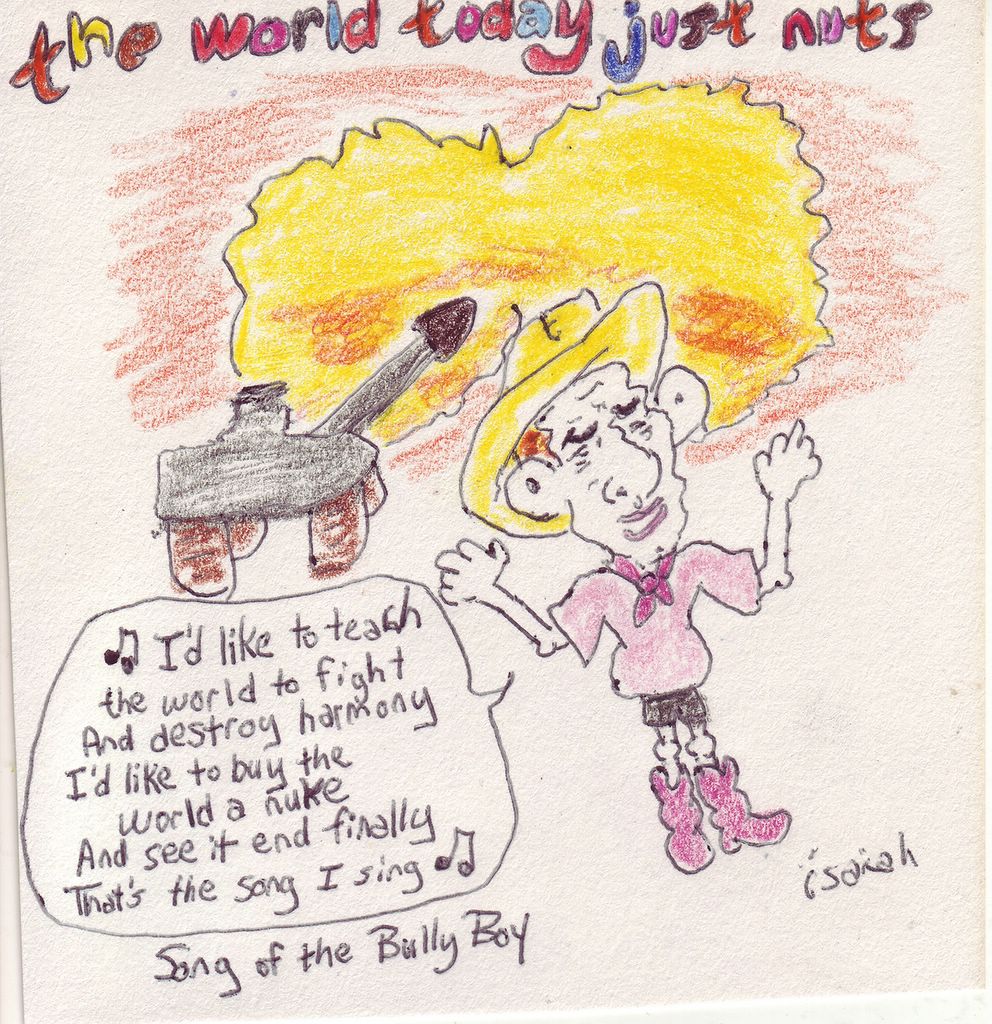
Song of the Bully Boy


That's "Song of the Bully Boy" from July 16, 2006.

Here's the story on that comic.


I wanted to do more on the war and aware that Doonesbury, et al do. I had the visual. I had nothing for it. Then I was drinking a Coke. That's the song, the old Coke theme.

Does it work?

It works for me because I wanted a comic that acknowledged the illegal war.

Here's C.I.'s "Iraq snapshot:"

Thursday, April 1, 2010. Chaos and violence continue, Chris Hill flat-out lied (and the press covered for him), 6 elected candidates end up banned in Iraq, the Red Cross reports on conditions in Iraq, a US study focuses on veterans and service members, the Justice Dept files charges against KBR, and more.

Tuesday, the International Committe of the Red Cross released their latest report on Iraq, entitled "
Iraq: coping with violence and striving to earn a living." The report noted the continued violence so far this year, the families in Mosul who have fled as a result of violence (these were largely Iraqi Christians) and that, internally and externally, the refugee crisis continues. Potable water remains a dream for the bulk of the people with "only 45 per cent of the population, on average, hav[ing] clean drinking water and 20 per cent proper sewage disposal." The ICRC has worked on water projects in Iraq and has also assisted with the health care. Their duties also include visiting prisoners.

The ICRC notes that the decline in agriculture (which began before the start of the illegal war) continues and that drought and lack of an adequate water supply have increased the problem. In addition, the violence has led many house holds without "their main wage earner." The repeated attack on the subsidies program was always very disgusting, but in the current climate, it's especially disgusting.
IRIN reports that the already slashed Iraqi food aid program is facing even more cuts. The rations program began in 1995 and has been repeatedly slashed since the start of the Iraq War at the repeated request of the US government which frowns upon aid to the poor and struggling. Attempts to outright kill the program have been repeatedly met with a strong pushback from Iraqis so the US has pushed for incremental cuts until there is little left. IRIN notes that the packages will now only offer "flour, rice, sugar, cooking oil and milk." Milk for some, of course. Milk for all was cut sometime ago. Gone are the days of tomato paste, tea, chicken, soap, beans, detergent, cheese, etc. In a population of less than 30 million (US government estimates vary between 26 million and 28 million -- of course, Nouri 'forgot' to conduct the census he was supposed to do in 2007), over eight million Iraqis are dependent upon the program to meet basic dietary needs as a result of the extreme poverty in Iraq.

Yesterday, the
United Nations Security Council offered this press release:The following Security Council press statement on the Iraq elections was read out today by Council President Emmanuel Issoze-Ngondet (Gabon):The members of the Security Council welcome the Independent High Electoral Commission of Iraq's (IHEC) 26 March announcement of the provisional results of the Iraqi parliamentary election and look forward to the certification by the Supreme Court. The members of the Security Council congratulate the Iraqi people and Government, including the Iraqi security forces, and IHEC for holding this successful election. The members of the Security Council express their support for IHEC's work, particularly its established mechanisms to ensure all political entities can register complaints and appeals in accordance with IHEC procedures and Iraqi law. They also commend the United Nations Assistance Mission for Iraq (UNAMI) and the role played by the Secretary-General's Special Representative for Iraq, Ad Melkert, in providing technical assistance and support throughout the electoral process.The members of the Security Council recognize the assistance provided by Iraqi domestic observers and civil society organizations and by the international community, including the European Union, Arab League, Organization of the Islamic Conference, as well as the support of United Nations Member States in providing electoral assistance and observation missions. The members of the Security Council take note of the findings of these international and independent Iraqi observers, who affirmed their confidence in the overall integrity of the election.The members of the Security Council call for the political entities to respect the certified election results and the choices of the Iraqi people. The members of the Security Council also urge Iraq's political leaders to avoid inflammatory rhetoric and actions. The members of the Security Council look forward to the formation of the new Government in a spirit of cooperation and respect for national unity.Having attempted to hijack the process, Nouri al-Maliki is now presenting a new face. Alsumaria TV reports he's calling for people to respect the process -- even as he continues attacking the process and the results. NPR's Deborah Amos reports (at Pakistan Observer), "The prime minister has shown he will use the tools of incumbent power. He has reportedly released long-held prisoners loyal to the Sadrist political movement. The Sadrists ran for office in a rival Shia bloc and Maliki will need their support to challenge Allawi's victory. In addition, the McClatchy newspapers report that at least four Sunni Muslim candidates on Allawi's ticket are under investigation by the prime minister's security forces. This is hardball politics, Iraqi style." Deborah Amos is the author of the just released Eclipse of the Sunnis: Power, Exile, and Upheaval in the Middle East. Monday, April 5th, Amos appears on The Exchange with Laura Knoy, New Hampshire Public Radio which first broadcasts at 9 a.m. EST. Meanwhile, The Hindu's editorial board explains of the post-announced-results period:


The initial problems have to do with the conduct of Prime Minister Nouri al-Maliki, whose first response to the result was to demand a recount. A day before the results were announced, he persuaded Iraq's Supreme Court to rule that the government would be formed by the leader of the bloc that has the largest number when parliament convenes, which will probably be in June. In a manoeuvre that smacked of electoral fraud, officials of the Accountability and Justice Commission, who are involved in removing former members of Saddam Hussein's Baath Party from public posts, banned six candidates, including three from Mr. Allawi's party, on the eve of the March 7 election. Iraqiya will appeal the bans in the courts.
They join the
Los Angeles Times' editorial board in using their voice to call out abuses that threaten the entire process. It's a small chorus, but hopefully a growing one. Again, Iraqis are watching, they are paying attention to what the foreign press does and does not call out and silences will send a message.

At OpEd News, Hamma Mirwaisi examines some of the Iraqi players rushing to and from Iran for various reasons:Iraqi President Jalal Talabani is in Iran for Nowruz celebrations. He wants very badly to be President of Iraq for another term. He runs to his master the Iranian president Mahmoud Ahmadinejad for help. He is helping PM al-Maliki indirectly. He is very close friend of Iranian President Mahmoud Ahmadinejad they do share a secret. The Kurds are speculating that President Talabani helped President Mahmoud Ahmadinejad with the plan to kill Dr. Abdul-Rahman Ghassemlou the leader of the Iranian Kurd in 1989 in Vienna. What other secrets are there between both Presidents? What kind of secrets are they sharing to be so close to one another? May be the CIA knows the answer better. The US forces arrested one of the killers of Dr. Abdul-Rahman Ghassemlou in Arbil-Iraq and then they released him after integrations for long time without extraditing him to Austria to face justice. President Jalal Talabani for sure is sharing many secret with Iranian president Mahmoud Ahmadinejad they are old friends from during the Iran-Iraq war. Just likewise he was sharing many secrets with Iraqi President Saddam Hussein for many years before the war. President Jalal Talabani is the survivor. He is kind of master spy, one can make many movies about his work; he is dealing with so many intelligent services around the world in the same time without getting implicated.

Meanwhile
Rod Nordland (New York Times) adds, "The ink was hardly dry on the polling results when three of the four major political alliances rushed delegations off to Tehran. Yet none of them sent anyone to the United States Embassy here let alone to Washington." Mohammed Tawfeeq, Yousif Bassil and Mohammed Jamjoom (CNN) report on Moqtada al-Sadr's tossing the issue to the people in a referendum now scheduled for tomorrow and Saturday and notes that Ayad Allawi has expressed concerns that Iran is interfering with the post-election events. We'll also highlight this from their report, on the Justice and Accountability Commission's attempt to ban members of Allawi's slate after the election (and after Allawi's slate was ruled the winner):

The U.N. special representative in
Iraq, Ad Melkert, said the United Nations in February declared that the accountability panel is "perfectly legitimate" and "it is the Iraqi choice to draw a line under the responsibility of the people under the Saddam regime."
He added, "There many parallels in the other countries in the past as well, but the process has had some flaws and we were concerned by that. We have expressed those concerns" but in the end the Iraqis must make the ultimate decision.

Chris Hill lied. We said so in the
March 30th snapshot:

If not, it's probably because you're thinking of the actions of the Justice and Accountability Commission (and for those who keep e-mailing about that commission, that is it's English translation -- for some reason some press outlets want to go alphabetical, it's Justice and Accountability). Reuters' Susan Cornwell immediately raised that issue.

Chris Hill: Well, let me just say that certainly political commentators here in Iraq sort of look at a challenge like that and wonder to what extent it reflects a political challenge. Certainly, I think the UN has made very clear that this is no time to be challenging people who have won seats. But I think the UN has also made very clear that the proper place for any such challenges is to the courts. If they want to sue the IHEC, they can do that and let the courts take this up. I think going forward, certainly for the next election, certainly for the next period of Iraq's history, they're going to have to deal with this whole issue about accountability and justice. They're going to have to deal with the issue of what to do with people who have ties to the Baathist regime in the past, how they're going to deal with this, whether a South African model or some other model. But certainly, what we want to see in the future is something that is transparent and something that does not appear to many people to have politics written all over it.

Oops, the manic half of his manic-depression appears to be fading. Like a
Joyce Carol Oates character, he's going lethargic leading all to wonder, "What is he saying? What does he mean?" (Nod to JCO's "Where Are You Going? Where Have You Been?")

Chris Hill appears to be saying that without UN approval no candidates will be banned. And that if an Iraqi official doesn't like that, he can take the UN to court. That's what he appears to be saying.

But I've been on the phone with two friends at the UN and they say that's news to them. Not only is that news to them, Hill establishes that as 'reality' one minute and then appears to forget what he just said.

That and more appeared in the March 30th snapshot. You need to ask why news outlets didn't feel the need to include in their reports -- and everyone filed within 24 hours on Hill's press conference -- that Hill was lying or at least that the UN denied it. (Two asked me while I was in the midst of calling friends at the UN if it was true and I said I had one saying it wasn't but I was calling another. That should have prompted them to call their sources.) Chris Hill lied. He flat out lied. And it's an indictment of the US press that they refused to tell you that this week. Even now, they avoid telling you it. The press appears to think it's worse to have an embarrassment like Hill as an ambassador but many would argue it's worse to have a press that refuses to tell you that.

Al Jazeera reports that "six winning candidates" from Ayad Allawi's slate have been banned by the Justice and Accountability Committee led by Ahmed Chalabi and his boy-pal Ali al-Lami. Adam Roston (The Nation) explains that Ahmed's found a way to increase his power in Iraq while waiting on the sidelines:

After all the damage done by Chalabi, who has virtually no constituency in Iraq, why does he have any influence at all? True, there is his sheer skill as a political fixer and influence peddler. He continues to wield power as chairman of the Accountability and Justice Commission (the new name for his old De-Baathification committee, set up soon after the US invasion). And as American officials have acknowledged, he has close ties with Iran and its Revolutionary Guard.
But according to several Iraqi businessmen and American officials, another key to Chalabi's resurgent influence -- one that has received far less attention from the news media--is his connection to Iraq's banking sector. The man whose organization, the Iraqi National Congress, received tens of millions of US taxpayers dollars in the run up to the Iraq war--and who was convicted in a massive bank fraud case in Jordan -- is believed to have immense influence over banking in Iraq today.


Legal challenges by Maliki's party (alleging voter fraud — charges raised only after Maliki slipped out of first place) remain. At least five of Allawi's winning candidates still face the possibility of losing their appeals after disqualification by the election screening committee (led by pre-war Pentagon favorite Ahmad Chalabi). The Kurdish coalition will try to play kingmakers.
Phyllis Bennis (IPS) uses the elections as a jumping off point:
Regardless of the final legality, there's no question that months of political jockeying -- with the potential for significant election-driven and sectarian violence rising -- lie ahead. Iraq's election was held, once again, under the military occupation of 98,000 U.S. troops and more than 100,000 U.S.-paid contractors. Obama is committed, by his own promises and the U.S.-Iraq security agreement signed by Bush, to the withdrawal of all U.S. combat troops by the end of this July, and to complete withdrawal of all U.S. troops by the end of 2011.
Whether Obama plans to use the inevitable election instability as an excuse to postpone those troop withdrawals -- either by re-missioning combat troops by re-naming them "trainers" or "logisticians," or by simply renegotiating the U.S.-Iraq agreement to extend the December 31, 2011 withdrawal deadline, depends on how much political pressure can be brought to bear on the administration. Pressure to demand a much faster withdrawal just might help ensure that at least the existing deadlines -- already far too lengthy -- are rigidly respected.

Eric Ruder (US Socialist Worker) speaks with Michael Schwartz who offers the following possiblities re: Nouri's statements currently:

On the other hand, his rhetoric may reflect behind-the-scenes maneuvering by the United States. This could be the first -- or really a continuing -- effort to justify continued U.S. military intervention, beyond the December 2011 deadline, when all the U.S. troops are supposed to be out.
We know that the leadership in the Obama regime is not interested in removing all the U.S. troops. They want to have about 50,000 troops there, which was the original goal from before the war. They want to have five enduring bases, which are already built and functioning with no sign of decline. They want to have 2,000 diplomats inside Iraq, housed in the billion-dollar embassy located in the Green Zone, running the headquarters of the American Empire in the Middle East. And so maybe this is going to be the occasion when the promise to fully withdraw is officially reversed.
All along, when the question was put to American military commanders about whether U.S. troops in Iraq were more needed in Afghanistan, the answer was, "No, they can't leave yet. We have to wait until we see that the election aftermath doesn't create a new crisis."
To me, the subtext to that was that the election might produce a result that was going to be unacceptable to the U.S., and they might need the military to reverse the result. So it may be that when we hear Maliki say, "I'm going to have to declare martial law," and "Allawi is so unruly," and "He can't control his people," and "The Sunnis are going to start fighting again," it may be the expression of Obama administration anxiety about the negative result they had always feared.

Turning to some of today's reported violence . . .

Bombings?

Sahar Issa (McClatchy Newspapers) reports a Baghdad roadside bombing injured two people, a Baghdad stun bombing created chaos among shoppers and, dropping back to yesterday, a Baghdad roadside bomging wounded one person (both today and yesterday's roadside bombings appear to have targeted alcohol vendors in Baghdad). Reuters notes that a US helicopter fired a missle in Basir at two suspects killing both while a Mosul roadside bombing wounded one person and a Baghdad sticky bombing wounded three people.

Shootings?

Sahar Issa (McClatchy Newspapers) reports that 1 man was shot dead in Baghdad and that the Ministry of Health's Director General Muhammed Chillab was shot dead yesterday outside his Baghdad home.

Corpses?

Sahar Issa (McClatchy Newspapers) reports that the corpse of 1 woman and the corpse of her daughter were discovered in Baghdad.

"Many men and women return from the war zone successfully and adjust to their lives out of theater, but others have had difficulty in readjusting or transitioning to family life, to their jobs, and to living in their communities after deployment." That statement appears on page one of the 192 page report issued yesterday by the Committee on the Initial Assessment of Readjustment Needs of Military Personnel, Veterans, and Their Families; Board on the Health of Selected Populations; Institute Of Medicine. The report is entitled
Returning Home from Iraq and Afghanistan: Preliminary Assessment of Readjustment Needs of Veterans, Service Members, and Their Families. The Institute Of Medicine defined the task as (a) "identify preliminary findings regarding the physical and mental health and other readjustments needs for members and former members of the armed forces who were deployed to OEF or OIF and their families as a result of such deployment" and (b) "determine how it would approach [. . .] a comprehensive assessment of the physical, mental, social and economic effects and to identify gaps in care for members and former member of the armed forces who were deployed" in the Iraq and Afghanistan Wars. Among other things, IOM found many programs had been created to help the veterans of both wars; however, little evaluation of the programs had been done. The report states that little attention has been paid to either the costs or helath condition needs in long-term care for TBI. In addition, it notes that there "is the critical shortage of health-care professionals -- especially those specializing in mental health -- to meet the demands of those returning from theater in Iraq and Afghanistan and their family members."

The report refers to all levels of care. Last week, US House Rep Michael Michaud chaired a hearing of the House Veterans Subcommittee on Health and US House Rep Gabrielle Giffords spoke of the bills she is sponsoring
HR 2698 and 2699 -- both of which are concerned with treatment for PTSD. The first would provide a scholarship to train VA workers and allow veterans to access PTSD health care at the VAs even if -- especially if -- the PTSD is newly emerging/manifesting. The first bill would put more and better trained workers in the VA and allow the veterans greater access to treatment. The second bill would create pilot pograms that would provide treatment but also track feedback from the veterans and their families in order to devise better treatments. The bills she is sponsoring are both in keeping with the recommendations of the 192-page report. HR 2698 currently has 48 co-sponsors including the Chair of the House Veterans Affairs Committee Bob Filner. At least 13 of the co-sponsors are Republicans; however, the Committee's Ranking Member, Steve Buyer, has not signed on as a co-sponsor.

The report notes a barrier to receiving help: "Stigma, real or imagined, is perceived by military personnel who are (or are considering) seeking care for mental health or substance-abuse problems. And active-duty military and veterans fear that vistis to a mental health provider will jeopardize their careers because of the military's long-standing and understandable policy of reporting mental health and substance-abuse problems to the chain of command."

They will argue that they recommended "a review" of confidentiality policies. Yes, they did. And I will turn around and argue that Deborah Mullen (wife of Joint Chief of Staff Mike Mullen) made stronger remarks on this topic (stigmas as barriers to treatment) in her speech at the DoD-VA Suicide Prevention Conference in DC last January.

As you read through the report, it becomes obvious that there are few solutions offered, just calls for more study. If you doubt that, check out the section on "Identify policy remedies" which reads:

Implicit in much of what the committee has found and has written is that dealing with the population-level consequences of OEF and OIF will require policy changes. The scope of the potential policy rememdies will be targeted at preventing, minimizing, or addressing the impacts, gaps, and needs identified during the committee's work. It is anticipated that this work will generate specific recommendations that may require statutory changes to implement.

They may feel they have met their mission's mandate but what it reads like is "there are problems, we recommend further study." In other words, kick the can. Or maybe hot potato. Though weak on solutions, the study does provide interesting raw data such as the fact that 1.9 million members of the service have been deployed to either Afghanistan or Iraq for over 30 days since 2001. That these 1.9 million have been deployed "in 3 million tours of duty". 7,944 women served in Vietnam while "over 200,000 women" have served and are serving in Iraq and Afghanistan (accounting for 11% of the personnel). Non-reserve personnel? Nearly half the officers "are over 35 years old" compared to the reserve officers figure of 73.6% "are over 35 years old." Well over half the reserve, non-officer members are 30 or less while in the non-reserve category, 85% are under the age of 35 with the greatest number being between the ages of 20 and 24. That group makes up 43.9% of the Army (non-officers, remember), 45.9% of the Navy, 39.1% of the Air Force and 65.6% of the Marine Corps. For the non-officers in the reserves, there is no one age group that consistently tracks across the branches. In the Army national Guard, the largest portion (30%) are between the ages of 20 and 24 and that is true also for the Army Reserve (32.1%) and the Marine Corps Reserve (58.1%); however, for the Navy Reserve, most members (24.3%) are between the ages of 35 and 39 (with the second highest being the ages 40 to 44), ages 40 to 44 make up the largest percent of the Air Force Reserve (18.4%). That's all the reserve branches except for the Air National Guard and their highest percentage is 16.6% which is the percentage of their deployed members ages 20 to 24 but it is also the percentage of their deployed members age 35 to 39.

With no distinction made between officers and non-officers, service members deployed to Iraq and Afghanistan have been "66% [. . .] white, 16% black, 10% Hispanic, 4% Asian, and 4% other race." That's reserve and non-reserve. Of the non-reserve, 55.2% are married and that number is 49% for the reserves. Children? 43% non-reserves are a parent and reserves? They aren't tracked. Which appears to echo the RAND Corporation critieria for their recent study which
Anita Chandra discussed with Congress last month. Reserves and non-reserves (the report calls it "active component" but I've heard too many reserves note that they are active and have been active month after month) share one thing in common, for both over 60% of the Navy branches have been deployed to either Iraq or Afghanistan. For non-reserves, that is the highest of any branch. For the reserves, the Air Force Reserve has deployed even more with over 80% of their members have been deployed to either Iraq or Afghanistan. [See Figure 2.5 and 2.6 of the report for more on that breakdown.] The report notes:

The rate of domestic violence is higher in military couples than in civilian couples. Marshall et al. (2005) reported that wives of Army servicemen reported significantly higher rates of husband-to-wife violence than demographically matched civilian wives. Although it has bee nreported that spousal abuse has declined over the last few years, domestic violence still affects 20% of military couples in which the service member has been deployed for at least 6 months (Booth et al., 2007).

On the topic of families:

The conflicts in Iraq and Afghanistan have taken a toll on the children of US troops deployed there. Children of US troops deployed to Iraq and Afghanistan reportedly sought outpatient mental health services 2 million times in 2008 (Andrews et al, 2008). Impatient visits by military children have increased by 50% since 2003. Additionally, an increase in the rate of child maltreatment has been reported since the start of the conflict. Rentz et al (2007) conducted a time-series analysis from 2000 to 2003 to investigate the effect of deployment on the occurrence of child maltreatment in military and nonmilitary families. They reported a statisically significant two-fold increase in substantial maltreatment in military families in the 1-year period after Septemeber 11, 2001, compared with the period before then. A recent study of over 1,700 military families (Gibbs et al, 2007) found that the overall rate of child maltreatment, especially child neglect, was higher when the soldier-parents were deployed than when theyw ere not deployed. Because of the demographics of those who are serving in Iraq and Afghanistan (older service members who are married and have children), the number of children who have been affected by these conflicts is clearly larger than in past conflicts.

Julie Sullivan (Oregonian) examines the report with a focus on Oregon service members, "Nearly 51 percent of the returning soldiers told commanders they have no job waiting. More than 170 have no permanent address. And, an exhaustive new national report finds that the most challenging transition for their families will come after they arrive." Gregg Zoroya (USA Today) boils the report down to the VA "has no way of determining long-range health care costs for the veterans of the war in Iraq and Afghanistan".

Monday's snapshot covered the Commission on Wartime Conracting in Iraq and Afghanistan in DC which heard about abuses and problems to do with KBR and also heard from KBR. Kat covered the hearing in "Commission on Wartime Contracting," Ava covered it at Trina's site with "Fraud and waste" and Wally covered it at Rebecca's site with "The arrogance and waste of KBR." The Commission's attention isn't the only negative attention KBR is receiving this week. The US Justice Dept issued the following today:


WASHINGTON -- The United States has filed a lawsuit against Kellogg Brown & Root Services (KBR) alleging that the defense contractor violated the False Claims Act, the Justice Department announced today. The suit, filed in U.S. District Court in Washington, alleges that KBR knowingly included impermissible costs for private armed security in billings to the Army under the Logistics Civil Augmentation Program (LOGCAP) III contract. The LOGCAP III contract provides for civilian contractor logistical support, such as food services, transportation, laundry and mail, for military operations in Iraq.
The government's lawsuit alleges that some 33 KBR subcontractors, as well as the company itself, used private armed security at various times during the 2003-2006 time period. KBR allegedly violated the LOGCAP III contract by failing to obtain Army authorization for arming subcontractors and by allowing the use of private security contractors who were not registered with the Iraqi Ministry of the Interior. The subcontractors using private security are alleged to have also violated subcontract terms requiring travel only in military convoys. The government's lawsuit further alleges that at the time, KBR managers considered the use of private security unacceptable and were concerned that the Army would disallow any costs for such services. KBR nonetheless charged the United States for the costs of the unauthorized services.
"Defense contractors cannot ignore their contractual obligations to the military and pass along improper charges to the United States," said Tony West, Assistant Attorney General for the Civil Division of the Department of Justice. "We are committed to ensuring that the Department of Defense's rules are enforced and that funds so vital to the war effort are not misused."
This case is being brought as part of a National Procurement Fraud Initiative. In October 2006, the Deputy Attorney General announced the formation of a National Procurement Fraud Task Force designed to promote the early detection, identification, prevention and prosecution of procurement fraud associated with the increase in government contracting activity for national security and other government programs. The Procurement Fraud Task Force is chaired by the Assistant Attorney General for the Criminal Division and includes the Civil Division, U.S. Attorneys' Offices, the FBI, the U.S. Inspectors General community, and a number of other federal law enforcement agencies.
Along with the Justice Department's Civil Division, the Defense Criminal Investigative Service, Army Criminal Investigation Division and FBI participated in the investigation of this matter. This case, as well as others brought by members of the task force, demonstrates the Department of Justice's commitment to helping ensure the integrity of the government procurement process.

NOW on PBS begins airing on most PBS stations Friday night (check local listings) and this week's program:The number of inmates in American prisons is outpacing the system's ability to hold them all. In one startling example, California prisons hold well over 50,000 more inmates than they're designed for, even though the state has built a dozen new prisons in the last 15 years. One of the biggest reasons is rampant recidivism. On Friday, April 2 at 8:30 pm (check local listings), NOW goes inside an Illinois prison that may have the answer to California's problems. With its innovative plan to keep released inmates from coming back, the Sheridan Correctional Center is trying to redefine "tough on crime" by being the largest fully dedicated drug prison in the country. The approach involves aggressive counseling, job training, and following the convicts after they get out. Can their novel approach keep convicts out of jail for good?

And we'll close with this from
Tom Over (OpEd News) report on the activities of World Can't Wait and speaks with Debra Sweet, national director of World Can't Wait:Sweet said that during the Bush presidency, protests against the wars in Afghanistan and Iraq had a lot more people participating. "A Presidential candidate and then a president was brought forward who represented on the surface something very different. This was change we were supposed to believe in and huge numbers of people, including anti-war leaders, put all their energy into electing Obama, regardless of the fact that he was promising to expand the war in Afghanistan," Sweet said. Perhaps interestingly, as Sweet and I spoke, Public Enemy's "Don't Believe The Hype" played on the PA system. Also interesting was that Sweet uttered a combination of words-- 'hoodwinked and bamboozled ' -- Malcolm X used to famous effect, which was made more famous by way of Spike Lee's film about the civil rights leader. "A lot of people have been hoodwinked and bamboozled. Many of us weren't, but we need to be all that much more visible and protesting now, because even more than ever, we need a movement that says 'no' to this whole package of continuing the Bush direction," Sweet said.

iraq
irin
the los angeles times
the new york timesrod nordland
cnnmohammed tawfeeq
yousif bassil
mohammed jamjoom
phyllis bennis
eric ruder
mcclatchy newspaperssahar issa
the oregonian
the world cant waitdebra sweet
oped newshamma mirwaisiirintom overdeborah amosjulie sullivan
usa todaygregg zoroya
pbsnow on pbs


Read on ...
Creative Commons License
This work is licensed under a Creative Commons Attribution-Share Alike 3.0 Unported License.