Thursday, January 6, 2011

Alberto's Hospital Rounds

albertoshospitalrounds

That's from May 28, 2007, "Alberto's Hospital Rounds."


I was not and am not a fan of Bush's original AG (or any of his AGs) but even I felt bad for him when he was in the hospital recovering and Alberto barges in and tries to bully him (John Ashcroft) into going along with his opinions.

That story had broken and I did that comic and thought maybe two people would like it. Instead it was huge and I saw it in about 20 different places online. I would see it and think, "What do people like about that?"

I'm guessing it's the real life story that gave it a lift.


Here's C.I.'s "Iraq snapshot:"

Thursday, January 6, 2011. Chaos and violence continue, military suicides increased at Fort Hood in 2010, the Marines saw an increase in attempted suicides, Moqtada al-Sadr scolds his followers, is Turkey the victor in the Iraq War, and more.
The New KPFA Morning Show airs on KPFA from 8:00 a.m. to 9:00 a.m. PST Mondays through Fridays. The show has a rotating set of hosts and Thursdays it's Project Censored. Today's show saw Project Censored's Mickey Huff speak with a number of guests about under-the-radar stories. We'll note this section between Huff and Dave Lindorff.
Mickey Huff: We have a few minutes left in this segment, Dave, and earlier you had mentioned the Church Committee and COINTELPRO and, of course, we could do whole shows on those. The Church Committee, Senator Frank Church, came in after Watergate and did a lot of investigating about these types of counterintelligence programs and infilitratration of groups. And this is exactly the kind of thing you're talking about, we've had this massive return. And I don't know how familiar you are with this but one of Obama's appointees to head the Office of Information and Regulatory Affairs, a Harvard law professor named Cass Sunstein, is calling for a return to infiltrating groups, disrupting groups --
Dave Lindorff: Yeah, he's horrible. He's horrible.
Mickey Huff: It's funny that you don't hear much though. During the Bush years, you heard a lot of the rattling on the left among progressives about this kind of officious behavior and this -- Really it's been legal since the Patriot Act I suppose although it seems fiercely unconstitutional. But do you have something to say about Sunstein or maybe the silence of progressives about people like Sustein?
Dave Lindorff: Well, yeah. I mean actually, I'm working on getting a contract for a bookto do a Case for Impeachment II and make the argument that this administration is committing the same crimes and some new ones that were impeachable under Bush and are now impeachable under Obama. [Laughing] It's hard to get a publisher, frankly.
Mickey Huff: Yeah and that's my -- and that's sad given how much evidence there is to continue that saga from that book. I mean it's just Part II of all of that. And I know a lot of people -- a lot of progressives and people on the left -- don't want to deal with that and they want to say 'Well it's the lesser of two evils' or 'It's better than not' and so forth. And I suppose that's understandable given what Americans went through for eight years. But we can't turn a blind eye to this and, I mean, the media is just disappeared. There's almost no coverage of this whatsoever. They have one faux controversy after another -- whether it's the birth certificate or whether Obama's a Socialist. And here we have things going on right under our noses -- this cognitive infiltraton problem in particular that you mentioned that we have here with Sunstein. And so there's definitely a lot of work to be done and a lot of things that we should be dealing with
Dave Lindorff: Yeah, I know. I mean, people have to realize this isn't a Democrat or a Republican issue. This is the corporate state that is militarized and it is looking at the American public as the enemy. And I think that's the way that we have to view it. And it's not a matter of you know "Do we not do something because this is a Republican or a Democratic administration so it will be better" -- and it's not better. And every -- We're actually in a ratcheting up with every administration of more and more invasiveness into our lives and more monitoring of our activities.
In Tuesday's snapshot, I mentioned this post by Ruth but there was no link -- Ruth's been covering various KPFA issues this week -- also see here and here.
Turning to military suicides, Jim Turpin (The Rag Blog) reported last October:
Even with the spin from the current administration that the "war is over" in Iraq, it is well known that 50,000 combat-ready troops remain in the country. Add to that a recent deployment of 2,000 troops from the 3rd Armored Cavalry Regiment from Fort Hood in Texas. At present almost 100,000 troops remain in Afghanistan.
With the total number of U.S. military personnel cycling through both Afghanistan and Iraq at almost 1.8 million, and with the RAND corporation estimating that 18% have PTSD (which is deemed low by some experts), this would put the returning numbers with PTSD at 324,000.

A recent article in The New York Times confirms what the organizers of the Killeen-based GI coffeehouse Under the Hood Café have been battling at Fort Hood for the last year and a half: suicides are at the highest point since 2008, with 14 confirmed suicides since the beginning of 2010. In one recent weekend, there were three suicides and one murder-suicide at Fort Hood.
With the population at Fort Hood ranging from 46,000 to 50,000 soldiers at any given time, the rate of suicide is four times the national average, based on Center for Disease Control and Prevention estimates of 11.5 suicides per 100,000 people.

Today Bob Grotenhuis (KTSM) reports that there were 22 suicides or suspected suicides at Fort Hood in 2010, "double the number of suicides from 2009 and nearly two-and-a-half times the national average for the same age group." Gregg Zoroya (USA Today) broke the news on the story this morning and noted the record number came "despite a mental health effort aimed at reversing the trend" and, of Fort Hood's population, "Many of the 46,500 soldiers at Fort Hood have returned from war zone or are on their way to them." Fort Hood, in a review of the year 2010 published today, notes, "Deployments, the continual coming and going of military members to and from Fort Hood, remained the 'new normal' at the Great Place in 2010. Just two weeks after the 1st Cavalry Division uncased its colors on Cooper Field announcing the division's return from its third tour of duty in Iraq, III Corps cased its colors Feb. 2 as it became the nucleus of United States Forces - Iraq." On suicide, the year-in-review notes:
Suicide prevention, likewise, remained an important issue for the Army in 2010, as well as here in Central Texas. The key to suicide prevention is engaged leadership, according to senior leaders here.
"We use this term of 'engaged leadership,' in some cases, it requires intrusive leadership to break through some of these little points of insularity that we're finding in our Soldiers and certainly in society," Grimsley told media members at the Resiliency Campus Sept. 29.
"I tell you that every one of these is tragic," he said of the suicides committed in 2010. "The rate is higher than any of us, anybody in a leadership position in the Army wants," he stressed. Grimsley said Fort Hood remains dedicated to the well-being of its force and their families.
"I think we have extraordinary resources at Fort Hood," he said, noting family life onsultants, chaplains, behavioral health specialists and Army Community Services counselors available to Soldiers, civilians and their families, dedicated to the well-being of body, mind and soul.
"The point is," he said, "there are an awful lot of people who are committed to do the right thing."
The Marines also have suicide news this week. Gretel C. Kovach (San Diego Union Tribune) reports, "The number of suicides among active-duty Marines dropped last year for the first time since 2006, plunging 29 percent below 2009's record high, according to preliminary figures released by the Marine Corps. In 2010, 37 Marines committed suicide, compared to 52 in 2009. The latest numbers include nine suspected yet to be confirmed by the Armed Forces Medical Examiner." While the number of suicides has gone down, the Marines saw an increase in 2010 in the number of attempted suicides. The Defense Dept notes, "The military suicide rate has increased steadily over the past five years, exceeding the national average of 11.1 suicides per 100,000 people. The military last year averaged 12.5 suicides per 100,000 according [to] DOD reports." James Coogan (WSWS) offers:
American military personnel are continuing to take their own lives in unprecedented numbers, as the wars in Afghanistan and Iraq drag on. By late November, at least 334 members of the armed forces had committed suicide in 2009, more than the 319 who were killed in Afghanistan or the 150 who died in Iraq. While a final figure is not available, the toll of military suicides last year was the worst since records began to be kept in 1980.
The Army, National Guard and Army Reserve lost at least 211 personnel to suicide. More than half of those who took their lives had served in either Iraq or Afghanistan. The Army suicide rate of 20.2 per 100,000 personnel is higher than that registered among males aged 19 to 29, the gender age bracket with the highest rate among the general population. Before 2001, the Army rarely suffered 10 suicides per 100,000 soldiers.
The Navy lost at least 47 active duty personnel in 2009, the Air Force 34 and the Marine Corp, which has been flung into some of the bloodiest fighting in Iraq and Afghanistan, 42. The Marine suicide rate has soared since 2001 from 12 to at least 19.5 per 100,000.
For every death, at least five members of the armed forces were hospitalised for attempting to take their life. According to the Navy Times, 2 percent of Army; 2.3 percent of Marines and 3 percent of Navy respondents to the military's own survey of 28,536 members from all branches reported they had attempted suicide at some point. The "Defense Survey of Health-Related Behaviors" also found "dangerous levels" of alcohol abuse and the illicit use of drugs such as pain killers by 12 percent of personnel.
Many soldiers, servicemembers and veterans are not receiving the help they need. Many are taking public stands to highlight the issue. Clare Bayard (ZNET) notes:

They also included the public surrender of an injured AWOL soldier, Army Specialist Jeff Hanks, at Ft. Campbell, Kentucky. Hanks went AWOL to resist redeployment to Afghanistan last fall after the military refused to treat him for severe PTSD. Supported by military and civilian allies alike, Hanks and other veterans testified about the military's negligent and often abusive treatment of severely traumatized soldiers seeking care. Hanks decided he wanted to turn himself in publicly to draw attention to these widespread practices. If he is court-martialed, he could face up to two years in prison and a lifetime felony conviction on his record. The Army could also attempt to forcibly deploy him again. At the gates of Ft. Campbell, 25 supporters stood with Hanks as he told his story to reporters. Another AWOL soldier from his unit traveled to join the rally, disclosing similar experiences. One supporter explained that her husband, who is currently deployed, was sent against medical advice.

In the weeks following the November 11 actions, a number of other soldiers gone AWOL from the 101st due to mental health struggles have reached out to Operation Recovery for support.

Visibility and support are important factors influencing not only the morale of traumatized troops and their families, but also the military's treatment of people who go public. Aaron Hughes of IVAW shared with supporters that, "Jeff's command was extremely hostile when he turned himself in on Veterans Day, but after the CBS story aired on Friday, they changed their tune" (Hanks was interviewed by Katie Couric).

Click here for one CBS story (text and video) with links to other CBS coverage of Jeff Hanks. And, like Elaine, let's pair that with an upcoming event by Iraq Veterans Against the War:

February 25, 2011 9:30 - 10:30 am Busboys & Poets, Langston room 14th & V st NW Washington DC This report back will be to answer questions from media and the peace movement about the recent trip back to Iraq by members of Iraq Veterans Against the War. The war is not over but it is not the same as it was in years past. What is the humanitarian situation in Iraq? How can we do reparations and reconciliation work? Speakers are all returning from this delegation and include: Geoff Millard (IVAW) Hart Viges (IVAW) Haider Al-Saedy (Iraqi Health Now)
Richard Rowely (
Big Noise Films)
That's next month and will hopefully help get across that the Iraq War continues.
Sunday, 2 US soldiers were killed in Iraq. Today, DoD released the following: "The Department of Defense announced today the death of two soldiers who were supporting Operation New Dawn. They died Jan. 2 in Taji, Iraq, of wounds suffered when insurgents attacked their unit with an improvised explosive device. They were assigned to the 1013th Engineer (Sapper) Company of the Pureto Rico Army National Guard, Aguadilla, Puerto Rico. Killed were: Sgt. Jose M. Cintron Rosado, 38, of Vega Alta, Puerto Rico; and Spc. Jose A. Delgado Arroyo, 41, of San Juan, Puerto Rico. For more information, media may contact the Puerto Rico National Guard at 787-289-1474." The deaths bring the total number for US military deaths in the ongoing Iraq War to [PDF format warning] 4435.
Tuesday, Jake Armstrong (Pasadena Weekly) notes, was "day 2,817 of the war in Iraq."
AP notes the Illinois National Guard is preparing to send 75 service members to Iraq. Brian Stanley (Herald News) reports on some of the deployed:

Dennis McWherter has been married for 23 years, his youngest child is 17 and he's got enough experience in law enforcement to head the narcotics unit as a lieutenant with the Joliet Police Department.
Rigoberto Garcia is still in college, he and his girlfriend of two years have considered getting married in the next few years and he wants to work for a local fire department when he completes his paramedic training.

In Iraq, they will be assinged to preserve the rule of the likes of Moqtada al-Sadr who returned to Iraq yesterday. Alsumaria TV reports, "Head of Al Sadr Front cleric Moqtada Al Sadr returned to Iraq on Wednesday. Al Sadr returned to Najaf after spending three years outside the country in Qumm, Iran. Al Sadr's visit coincides two weeks after the formation of Iraq's new government." Iraq is nothing but a laughing matter to the US State Dept as evidenced by yesterday's briefing. When spokesperson Philip J. Crowley was asked about al-Sadr's return, he declared, "Well it's not for us to be for or against any particular leader or party in Iraq." A response that was met with disbelief and led to shocked remarks and bringing up Saddam Hussein (whom the US government started an illegal war to topple). Crowley thought he was being amusing by declaring, "In the new Iraq." It wasn't funny. It's an ongoing war and possibly the next time any State Dept spokesperson sees a war as a laughing matter, they can sign up for forty hours a week of community service at Walter Reed. Might seeing the wounded make them take war a little more seriously next time?
The Australian hails al-Sadr's return as "the latest example of waning US influence in Iraq" and they quote Kenneth Katzman of the Congressional Research Service stating, "I don't think the US embassy is at all happy about this. Sadr has made the calculation that US influence is low enough that the US is not going to pressure him, or chase him . . . or pressure Maliki to arrest him." al-Hayat reminds that the Basra 2008 Iraqi-US attack on Basra ("Charge of the Knights") had al-Sadr and Nouri al-Maliki on opposite sides of the fence. Paul McGeough (Sydney Morning Herald) adds, "For months after the election Mr Sadr sat on his hands, leaving would-be prime ministers Mr Maliki and Iyad Allawi without the support they needed to form a coalition government. It was only after the intervention of Tehran that a deal was struck in the seventh month of the post-poll stand-off. [. . .] As recently as last year, Mr Sadr's mouthpieces in Iraq were dismissing Mr Maliki as a successor to Saddam and as an American lackey." Kim Sengupta (Belfast Telegraph) notes the 2008 "intense battle" in Basra as well. Strangely these reports from today are still focusing on Basra only. It was also Sadr City or does no one have longterm memory. Protests against the assault on Basra sprang up in the Sadr City section of Baghdad. From the March 25, 2008 snapshot:
Gina Chon (Wall St. Journal) reports, "Fighting broke out Tuesday on the streets of Sadr City . . . and the Mahdi Army militia announced it had taken over Iraqi army checkpoints in an escalation of tension with Iraqi government security forces. The sound of gunfire could be heard in Sadr City throughout the morning and Mahdi Army members walked down the streets carrying rifles, rocket-propelled grenade launchers and other weapons in what appeared to be a show of force, accodring to two witnesses." AFP reports that fighting was ongoing in Baghdad, Basra, Kut and Hilla with the clash between Sadr's forces and the US in Baghdad being "the first time since last October". Atul Aneja (The Hindu) explains, "The Iraqi government's decision to establish its hold over the oil city of Basra dominated by Shia armed militias has sparked heavy fighting there" and that "field commanders of the Mahdi army in Najaf ordered to the militia 'to strike the occupiers' and their Iraqi allies." Robin Stringer (Bloomberg News) notes 18 dead and forty wounded from the Basra fighting alone and threats that the actions will go "nationwide."
The following day (Wednesday, March 26, 2008), Leila Fadel (then with McClatchy) appeared on The Diane Rehm Show (NPR) via phone to report on the Basra assault. We'll note this section of the discussion:
Diane Rehm: And Leila, you're in Baghdad what's the situation there right now?
Leila Fadel: Well the Medhi army has done a forced sit-in in all Medhi army neighborhoods and so what has happened is that they sealed off neighborhoods where they have large control and, at gun point, told shopkeepers to close, the kids are not allowed to go to school, in one situtation they evacuated the school that was functioning. In Sadr City there have been violent clashes between Iraqi security forces, US forces and the Medhi army in Sadr City. Sadr officials are saying that at least 20 people have died and a hundred were wounded, among them women and children. But it's unclear what's happening there because it's completely sealed off by the militia.
March 28, 2008, Sudarsan Raghavan and Sholnn Freeman (Washington Post) reported, "U.S. forces in armored vehicles battled Mahdi Army fighters Thursday in the vast Shiite stronghold of Sadr City, and military officials said Friday that U.S. aircraft bombed militant positions in the southern city of Basra, as the American role in a campaign against party-backed militias appeared to expand." Today Xinhua notes, "Many Sadrists viewed Maliki's crackdown as a means to weaken his Shiite rivals and to facilitate the political benchmarks set by the U.S. administrations before the country's provincial elections early in 2009." David Kenner (Foreign Policy) observes, "Some analysts also suggested that his return could be motivated by a desire to retain his preeminence over the movement's leaders in Iraq, who have overseen the party's impressive gains in recent years. 'His party is becoming stronger and bigger, and the need for him to preside over it has grown, especially since there is fear that new leaders within the party could surpass him,' wrote Hazem al-Amin in the Arabic daily al-Hayat." Mohamad Bazzi (Council on Foreign Relations) offers:
Now, Sadr has returned home to play a central part in Iraqi politics and to oversee his movement's transition from a militia force to a powerful political group with forty seats in parliament. But Sadr's ascendance threatens to stoke sectarian tensions in Iraq: His followers were responsible for some of the worst atrocities against Sunnis during the country's recent civil war. Sadr's militia, the Mahdi Army, unleashed death squads that assassinated Sunnis and drove them out of Shiite neighborhoods.
Rania El Gamal and Suadad al-Salhy (Reuters) run down possibilities such as whether or not he'll remain in Iraq, if he remains will he attempt to be a political or religious figure, will tensions rise, will sectarian violence return, etc. Anthony Shadid (New York Times) reports that al-Sadr sent a message to his followers today which read, "The lack of discipline of some of you as I performed my religious rituals bothered me and hurt me. Please exercise discipline and refrain from excessive chants and pushing which harms me, others, you, your reputation and the reputation of the Sadr family." This was how he thanked those who greeted him with chants and shout yesterday and today. Leadership's always easier when you don't have to be around your followers. Moqtada al-Sadr seems a little testy for someone who's had years to take a break from his follwers. BBC News adds, "The BBC's Jim Muir in Baghdad says that despite his four-year absence, the charismatic Moqtadr Sadr has lost none of his influence on the largely impoverished Shia population of Iraq. But the situation in Iraq has changed since the cleric fled the country after a warrant was issued for his arrest, our correspondent adds." On All Things Considered today, Kelly McEvers reports from Baghdad:
Kelly McEvers: Many analysts say Sadr is looking to style his group as the next Hezbollah, the Shiite militia that now weilds considerable power in Lebanon's government. The reasoning that both groups give for maintaining an armed wing is resistance. In Lebanon, it's resistance against Israel. Here, says Sadr political adviser Balqis al-Khafaji, it's resistance against American troops.
Reuters reports that a Hawija sticky bombing injured a police officer and that an attack on a Mosul church was prevented by the Iraqi military.
In other Iraq news, the PKK is a rebel group which supports a Kurdish homeland. Turkey, the US and others label the PKK a terrorist organization. (Recent WikiLeaks revelations on the PKK suggest that the US government also backs them from time to time.) The Turkish military regularly bombs the mountains of northern Iraq where the PKK has set up bases. Stephen Farrell, Shiho Fukada and Steven Lee Myers (New York Times -- text, numerous photos and video) report from the mountains:

It is not easy to visit the mountainous borderlands of northern Iraq where the Kurdistan Workers' Party operates, but it is not impossible either.
Such is the peculiar position of a group of committed insurgents against Turkish rule in Kurdish lands -- even as Turkey and Iraq seek deeper and deeper ties, through diplomacy and trade, especially with Iraq's semiautonomous Kurdish region.

A few years back when Oliver August and Deborah Haynes (Times of London) -- among others -- were reporting from the PKK bases in Iraq, Nouri had a meltdown and started threatening to expel any foreign reporters who visited the PKK bases. It's interesting that the New York Times has decided to file this report. This comes as Anthony Shadid files a report on Turkey and its influence in Iraq:

Turkey's influence is greater in northern Iraq and broader, although not deeper, than that of Iran, with its ties to the Shiite leadership, in the rest of the country. While the United States invaded and occupied Iraq, losing more than 4,400 troops there, Turkey now exerts what may prove a more lasting legacy -- so-called soft power, the assertion of influence through culture, education and business.
"This is the trick -- we are very much welcome here," said Ali Riza Ozcoskun, who heads Turkey's consulate in Basra, one of four diplomatic posts it has in Iraq.
Turkey's newfound influence here has played out along an axis that runs roughly from Zakho in the north to Basra, by way of the capital, Baghdad. For a country that once saw the Kurdish region in northern Iraq as a threat, Turkey has embarked on the beginning of what might be called a beautiful friendship.

Shadid's article and other things lead Judah Grunstein to wonder "Did Turkey Win the Iraq War?" (World Politics Review):

The same can't be said for Turkey, which has also benefitted from the dramatic changes in the region's geostrategic landscape wrought by the Iraq War. This N.Y. Times article detailing Turkey's enormous and growing trade ties in the Kurdish north, as well as its political influence in Baghdad, is only part of the story. Ankara's opposition to the war, and the Bush administration's obstinacy in pursuing it, in some ways prepared the way for Turkey's rebalancing of its foreign policy approach from a Western-focused alignment to a Turkey-centric strategic hub. And the power vacuum created by the fall of Saddam Hussein, though initially as destabilizing as Ankara had feared and warned, subsequently helped create the space for Turkey to assume the regional role it aspired to.
Turning to the US where Ron Robins asks, "Can US Bankers and Politicians be Truthful?" And the answer may be found in this from David Swanson (at Euro Atlantic Quarterly):
The two parties scream at each other on television quite a lot and attract supporters who come from two very different cultures. But over half of every dollar of income tax in the United States is spent on the military, and that number reliably increases every single year regardless of who is in power.
The Afghan and Iraq wars were launched with overwhelming support from both parties' officials, and the Iraq War with Democratic control of the Senate. In 2006 U.S. voters told exit-pollsters that their primary motivation for electing Democrats to control both houses of Congress was Iraq war opposition, and Congress proceeded in 2007 to escalate the war on Iraq. War opposition also drove the 2008 elections, after which two Democratic houses and a Democratic president in 2009 escalated the war on Afghanistan.
Americans tell pollsters that ending the wars is their second highest priority after repairing the U.S. economy. (How many understand the close relationship between the two, the wars' negative impact on the domestic economy, is not clear.) Majorities think the Afghan and Iraq wars should never have been launched, but majorities supported launching them at the time in 2001 and 2003. Electing Democrats to act on the will of the new majority has been tried and failed, and now the House is going back to Republican control.
There will be no gridlock on matters of war and foreign relations (two areas that are identical in the understanding of the U.S. government, as made clear by the cables leaked to Wikileaks). To the extent that a minority of Democrats in the House will object to anything on the military's agenda, it will not matter as the President and the Republicans are in complete agreement. In fact, Congress may seek to pass a new "Authorization to Use Military Force" that would strengthen any president's unconstitutional power to wage wars, without any purported connection to the crimes of September 11, 2001, as required by the routinely violated AUMF of 2001. The new bill may also license unconstitutional presidential violations of civil liberties during "war time," a state of affairs that is now understood to be without spatial or temporal limit. Republicans are principled supporters of presidential war powers even when they despise the current president.


Read on ...

Sunday, January 2, 2011

Exit the Poodle

thepoodle

That's from May 13, 2007, "Exit the Poodle." Tony Blair. I actually didn't do a lot of Blair comics.


I also didn't do a lot of Gordon Brown ones. I remember one Gordon Brown but there may be others. I think there were two or three Tony Blairs. It's not that I didn't find them ridiculous, I did. But I also felt, as a US citizen, the one I needed to call out the loudest was George W. Bush.

A catty Australian blogger, in 2005, re-posted one of my comics with a snide little message about how he disliked all my stuff except for that one comic. Hey, jag-off, that comic isn't yours to repost. I've been reposted at other sites too but they didn't usually steal my comic and insult me at the same time so I haven't much paid attention (but I retain the rights to all of my comics). I bring this up because this Australian blogger never, EVER, called out John Howard. Throughout the Iraq War, he trashed Bush and Tony Blair (he stopped blogging before Gordon Brown replaced Blair -- which was before Barack replaced Bush -- notice how many "B"s are War Hawks?). But he would never trash John Howard who was a War Hawk and who sent the Australian military into the Iraq War. He would never call out John Howard. What a coward. His own country's leader and he couldn't call him out.

I never wanted to be a coward. So I've always made a point to call out US leaders before I call out anyone else. In some countries -- and who knew that included Australia -- calling out leaders can't get you killed or hurt.

Stealing this from Third:

Kat's "Kat's Korner: 2010 in music" Ruth's "Ruth's Radio Report: 2010," Isaiah's The World Today Just Nuts "2010: The Urkel Moment," C.I.'s "2010 in books (Martha & Shirley)," "2010: The Year of Enough," Marcia's "2010 in Page Turners" and Rebecca's "2010 in page turners" and Ann's "10 Best DVDs of 2010" and Stan's "10 Best DVDs of 2010" -- year in review pieces in the community.

Those are the year-in pieces so be sure to check those out and I'll include this list of new stories at Third:


Read on ...

Friday, December 24, 2010

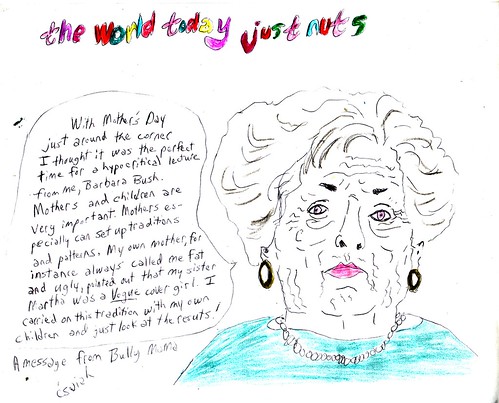
Bully Mama

bullymama


That's "Bully Mama." From May 6, 2007. The one and only Barbara Bush (thank goodness about one and only).


I always felt -- my thoughts -- that Bully Boy Bush had a real nasty streak and really didn't care for a lot of people that others would be sympathetic towards and I always felt -- my thoughts -- that he got that from Babsie Bush who has rarely uttered a public remark that didn't contain a huge helping of resentment.


Here's C.I.'s "Iraq snapshot:"

Friday, December 24, 2010. Chaos and violence continue, Nouri's incomplete Cabinet continues to receive criticism, a father offers an 'excuse' for killing his own daughter, and more.
Marci Stone (US Headlines Examiner) reports, "Friday afternoon, Santa is currently in Baghdad, Iraq and on his next stop is Moscow, Russia, according to the 2010 NORAD Santa Tracker. The North American Aerospace Defense Command (NORAD) has been tracking Santa as he makes his annual journey throughout the world." Gerald Skoning (Palm Beach Post) quotes Santa saying, "We send our special wishes for peace and goodwill to all. That includes the people of Iraq, Afghanistan, Iran and North Korea." Please note that this is Santa's seventh trip to Iraq since the start of the Iraq War and, as usual, his journey was known in advance. No waiting until he hit the ground to announce he was going to Iraq -- the way George The Bully Boy Bush had to and the way US President Barack Obama still has to. In the lead up to Santa's yearly visit, many 'authorities' in Iraq began insisting that Christmas couldn't be celebrated publicly, that even Santa was banned.

Gabriel Gatehouse (BBC News) quotes
Shemmi Hanna stating, "I wasn't hurt but I wish that I had been killed. I wish I had become a martyr for this church, but God kept me alive for my daughters." Shemmi Hanna was in Our Lady of Salvation Church in Baghdad when it was assaulted October 31st and she lost her husband, her son, her daughter-in-law and her infant grandson in the attack. The October 31st attack marks the latest wave of violence targeting Iraqi Christians. The violence has led many to flee to northern Iraq (KRG) or to other countries. Zvi Bar'el (Haaretz) notes, "This week the Iraqi legislature discussed the Christians' situation and passed a resolution in principle to help families who fled. However, the parliament does not know where the Christians are, how many are still in Iraq, in their homes, and how many have found asylum in Iraqi Kurdistan." John Leland (New York Times) reports:

The congregants on Friday night were fewer than 100, in a sanctuary built for four or five times as many. But they were determined. This year, even more than in the past, Iraqi's dwindling Christian minority had reasons to stay home for Christmas.
"Yes, we are threatened, but we will not stop praying," the Rev. Meyassr al-Qaspotros told the Christmas Eve crowd at the Sacred Church of Jesus, a Chaldean Catholic church. "We do not want to leave the country because we will leave an empty space."

Raheem Salman (Los Angeles Times) reports, "Rimon Metti's family will go to Christian services on Christmas Day, but his relatives will be praying for their own survival and wondering whether this is their last holiday season in Baghdad. If they had any grounds for optimism about the future of their faith in Iraq, it vanished this year amid repeated attacks on fellow believers." Shahsank Bengali (McClatchy Newspapers) adds, "Nearly two months after a shocking assault by Islamist militants, Our Lady of Salvation Catholic Church will commemorate Christmas quietly, with daytime mass and prayers for the dead, under security fit more for a prison than a house of worship. It is the same at Christian churches across Baghdad and northern Iraq, where what's left of one of the world's oldest Christian communities prepares to mark perhaps the most somber Christmas since the start of the Iraq war."
Meanwhile Taylor Luck (Jordan Times) reports on Iraqi refugees in Jordan:

Although the calendar will say December 25, for Theresa, Saturday will not be Christmas.
There will be no cinnamon klecha cooling on the dining room table, no outdoor ceramic nativity scene, no readings of hymns with relatives.
The 63-year-old Iraqi woman has even refused to put up Christmas lights in the crowded two-room Amman hotel apartment she has called home since fleeing Baghdad last month.
"There is no holiday spirit. All we have is fear," she said.
This holiday will instead mark another year without news from her 46-year-old son, who was kidnapped outside Baghdad in late 2006.

From Turkey, Sebnem Arsu (New York Times -- link has text and video) notes the increase in Iraq refugees to the country since October 31st and quotes Father Emlek stating, "I've never seen as many people coming here as I have in the last few weeks. They also go to Lebanon, Jordan and Syria but it seems that Turkey is the most popular despite the fact that they do not speak the language." Jeff Karoub (AP) reports on the small number of Iraqi refugees who have made it to the US and how some of them "struggle with insomnia, depression and anxiety."
One group in Iraq who can openly celebrate Christmas are US service members who elect to. Barbara Surk (AP) reports that tomorrow Chief Warrant Officer Archie Morgan will celebrate his fourth Christmas in Iraq and Captain Diana Crane is celebrating her second Christmas in Iraq: "Crane was among several dozen troops attending a Christmas Eve mass in a chapel in Camp Victory, an American military base just outside Baghdad." Marc Hansen (Des Moines Reigster) speaks with six service members from Iowa who are stationed in Iraq. Sgt 1st Class Dennis Crosser tells Hansen, "I certainly understand from reading the paper what's going on in Afghanistan and the attention definitely needs to be on the troops there. But everyone serving here in Operation New Dawn appreciates a little bit of attention as we finish this up."

Today Jiang Yu, China's Foreign Minister, issued the following statement, "We welcome and congratulate Iraq on forming a new government. We hope that the Iraqi Government unite all its people, stabilize the security situation, accelerate economic reconstruction and make new progress in building its country." James Cogan (WSWS) reports:
US State Department official Philip Crowley declared on Wednesday that Washington had not "dictated the terms of the government". In reality, constant American pressure was applied to Maliki, Allawi, Kurdish leaders and other prominent Iraqi politicians throughout the entire nine-month process to form a cabinet. The US intervention included numerous personal phone calls and visits to Baghdad by both President Barack Obama and Vice President Joe Biden.
The key objective of the Obama administration has been to ensure that the next Iraqi government will "request" a long-term military partnership with the US when the current Status of Forces Agreement (SOFA) expires at the end of 2011. The SOFA is the legal basis upon which some 50,000 American troops remain in Iraq, operating from large strategic air bases such as Balad and Tallil and Al Asad. US imperialism spent billions of dollars establishing these advanced bases as part of its wider strategic plans and has no intention of abandoning them.
Cogan's only the second person to include the SOFA in his report. Some are impressed with the 'feat' of taking nearly ten months to form a government, stringing the country along for ten months while no decisions could go through. The editorial board of the Washington Post, for example, was full of praise yesterday. Today they're joined by Iran's Ambassador to Iraq, Hassan Danaiifar. The Tehran Times reports that Danaiifar was full of praise today hailing the "positive and final step which ended the 10-month political limbo in Iraq." However, Danaiifar was less pie-in-the-sky than the Post editorial board because he can foresee future problems as evidenced by his statement, "We may witness the emergence of some problems after one and half of a year -- for example, some ministers may be impeached." Of course, there are already many clouds on the horizon, even if Iranian diplomats and Post editorial boards can't suss them out. For example, Ben Bendig (Epoch Times) noted the objection of Iraq's female politicians to Nouri al-Maliki's decision to nominate only one woman (so far) to his Cabinet: "Some 50 female lawmakers went to the country's top leadership, the United Nations and the Arab League to voice their concern and desire for increased representation." BNO notes that protest and also that a group of Iraqi MPs are alleging that Iraqiya bought seats in the Cabinet via money exchanged in Jordan. UPI adds, "Maliki, a Shiite who has a long history of working with Tehran, has named himself acting minister of defense, interior and national security, three most powerful and sensitive posts in the government he is stitching together. Although Maliki appears to be bending over backward to accommodate rivals among Iraq's Shiite majority as well as minority Sunnis and Kurds in his administration in a spirit of reconciliation, he is unlikely to relinquish those ministries that dominate the security sector." DPA reports, "Sheikh Abdel-Mahdi al-Karbalaei, a confident of influential Shiite spiritual leader Ayatollah Ali al-Sistani, said that the new cabinet is 'below the standards' Iraqi citizens had hoped for and suggested it could prove to be weaker than the previous government." Ranj Alaaldin (Guardian) also spots clouds on the horizon:

Lasting peace and stability depends on resolving outstanding disputes with the Kurds on oil, revenue-sharing, security and the disputed territories (Kirkuk in particular). The Kurds, rather than exploiting their kingmaker position to take a stronger proportion of ministries in Baghdad (they are taking just one major portfolio – the foreign ministry), are instead banking on guarantees from Maliki to implement their list of 19 demands that includes resolving the above disputes in their favour.
They may have been naive, though. With their historical and federalist partners, the Islamic supreme council of Iraq in decline, the Kurds may be isolated in the new government – a government dominated by the nationalistic and centrist characteristics of the INM, the Sadrists and indeed State of Law.
Maliki may, therefore, turn out to be unable to grant concessions even if he wanted to and could use Osama Nujayfi, the new ultra-nationalist speaker of parliament and Kurdish foe, to absorb the Kurdish criticism and insulate himself from any attacks.

AP reports that Iraqi police sought out a 19-year-old woman because of rumors that she was working with al Qaida in Mesopotamia only to be greeted with the news that her father allegedly killed her and the father showed the police where he buried the woman . . . last month. The story begs for more than it offers. The most obvious observation is: what does it say that a woman's allegedly killed by her father and no one says a word for over a month? After that, it should probably be noted that there are many men in Iraq killing women who, no doubt, would love to also be able to pin the blame on al Qaida. In other violence, Reuters notes a house bombing in Haswa which claimed the life of Mohammed al-Karrafi, "his wife, two sons and a nephew" -- as well as injuring four more people, and a Samarra roadside bombing which claimed the lives of 2 police officers. DPA notes it was two homes bombed in Haswa and that the Samarra roadside bombing also injured four Iraqi soldiers. Jomana Karadsheh (CNN) reports, "Another policeman was wounded in Baghdad Friday night when a roadside bomb detonated by a police patrol, an Interior Ministry official told CNN."
And we'll close with this from Peace Mom Cindy Sheehan's latest Al Jazeera column:
The recent repeal of the US military policy of "Don't ask, don't tell" is far from being the human rights advancement some are touting it to be. I find it intellectually dishonest, in fact, illogical on any level to associate human rights with any military, let alone one that is currently dehumanising two populations as well as numerous other victims of it's clandestine "security" policies.
Placing this major contention aside, the enactment of the bill might be an institutional step forward in the fight for "equality"; however institutions rarely reflect reality.
Do we really think that the US congress vote to repeal the act and Obama signing the bill is going to stop the current systemic harassment of gays in the military?
While I am a staunch advocate for equality of marriage and same-sex partnership, I cannot - as a peace activist - rejoice in the fact that now homosexuals can openly serve next to heterosexuals in one of the least socially responsible organisations that currently exists on earth: The US military.
It is an organisation tainted with a history of intolerance towards anyone who isn't a Caucasian male from the Mid-West. Even then I'm sure plenty fitting that description have faced the terror and torment enshrined into an institution that transforms the pride and enthusiasm of youth into a narrow zeal for dominating power relations.

And we'll close with this from Francis A. Boyle's "2011: Prospects for Humanity?" (Global Research):

Historically, this latest eruption of American militarism at the start of the 21st Century is akin to that of America opening the 20th Century by means of the U.S.-instigated Spanish-American War in 1898. Then the Republican administration of President William McKinley stole their colonial empire from Spain in Cuba, Puerto Rico, Guam, and the Philippines; inflicted a near genocidal war against the Filipino people; while at the same time illegally annexing the Kingdom of Hawaii and subjecting the Native Hawaiian people (who call themselves the Kanaka Maoli) to near genocidal conditions. Additionally, McKinley's military and colonial expansion into the Pacific was also designed to secure America's economic exploitation of China pursuant to the euphemistic rubric of the "open door" policy. But over the next four decades America's aggressive presence, policies, and practices in the "Pacific" would ineluctably pave the way for Japan's attack at Pearl Harbor on Dec. 7, 194l, and thus America's precipitation into the ongoing Second World War. Today a century later the serial imperial aggressions launched and menaced by the Republican Bush Jr. administration and now the Democratic Obama administration are threatening to set off World War III.

By shamelessly exploiting the terrible tragedy of 11 September 2001, the Bush Jr. administration set forth to steal a hydrocarbon empire from the Muslim states and peoples living in Central Asia and the Persian Gulf under the bogus pretexts of (1) fighting a war against international terrorism; and/or (2) eliminating weapons of mass destruction; and/or (3) the promotion of democracy; and/or (4) self-styled "humanitarian intervention." Only this time the geopolitical stakes are infinitely greater than they were a century ago: control and domination of two-thirds of the world's hydrocarbon resources and thus the very fundament and energizer of the global economic system – oil and gas. The Bush Jr./ Obama administrations have already targeted the remaining hydrocarbon reserves of Africa, Latin America, and Southeast Asia for further conquest or domination, together with the strategic choke-points at sea and on land required for their transportation. In this regard, the Bush Jr. administration announced the establishment of the U.S. Pentagon's Africa Command (AFRICOM) in order to better control, dominate, and exploit both the natural resources and the variegated peoples of the continent of Africa, the very cradle of our human species.

This current bout of U.S. imperialism is what Hans Morgenthau denominated "unlimited imperialism" in his seminal work Politics Among Nations (4th ed. 1968, at 52-53):

The outstanding historic examples of unlimited imperialism are the expansionist policies of Alexander the Great, Rome, the Arabs in the seventh and eighth centuries, Napoleon I, and Hitler. They all have in common an urge toward expansion which knows no rational limits, feeds on its own successes and, if not stopped by a superior force, will go on to the confines of the political world. This urge will not be satisfied so long as there remains anywhere a possible object of domination--a politically organized group of men which by its very independence challenges the conqueror's lust for power. It is, as we shall see, exactly the lack of moderation, the aspiration to conquer all that lends itself to conquest, characteristic of unlimited imperialism, which in the past has been the undoing of the imperialistic policies of this kind….

On 10 November 1979 I visited with Hans Morgenthau at his home in Manhattan. It proved to be our last conversation before he died on 19 July 1980. Given his weakened physical but not mental condition and his serious heart problem, at the end of our necessarily abbreviated one-hour meeting I purposefully asked him what he thought about the future of international relations.

cnn
jomana karadsheh


Read on ...

Thursday, December 16, 2010

Little Miss Bully Boy


littlemissbullyboy

That's "Little Miss Bully Boy" from April 29, 2007 and the point here was to try to illustrate Laura Bush's claim (on NBC's Today show before I did the comic) that, "No one suffers more than their president and I do."


And I think it's funny and don't regret it. But I will give Laura a few more props than I would have when she was in the White House.

That's because of her wording in a lot of things and the way she conducted herself as compared to the way Michelle does. I was basing Laura on Hillary who is one-of-a-kind. Hillary was a hard working First Lady. I felt Laura was (a) unhappy in the role and (b) not working hard at all. But she was a workhorse compared to clotheshorse Michelle Obama.

SO I will note that. I don't regret any comic I did of her. But I will say that she was probably better than I gave her credit for. I will not say the same about her War Hawk husband.


Now here's C.I.'s "Iraq snapshot:"

Thursday, December 16, 2010. Chaos and violence continue, Joe Biden mentions Iraqi Christians, news about the Kurdish deal with Nouri surfaces, Julian Assange is out on bail, activists protest the war outside the White House, and more.
Last night on WBAI, Joy of Resistance (available in the WBAI archives for 89 days from today) found host Fran Luck addressing the topic of "Swedish and US rape laws and the current wave of misogny that has surfaced in response to rape allegations against WikiLeaks founder Julian Assange" with attorney Jill Filipovic. Excerpt:
Fran Luck: We're going to be looking at some of the aspects that haven't been discussed very much, certainly in the leftist media, about -- or in the right wing media, only in the feminist media -- about some of the kind of side effects of the rape accusations against Julian Assange that have kind of brought up huge amounts -- almost dust clouds -- of misogyny that, amazing, has been all over the internet. And we're going to look at that and we're also going to look at Swedish law on rape with Jill who is a feminist lawyer as well as being a blogger for Feministe. I was first alerted to this when I began to see these huge amounts of just absolutely evil posts calling, oh, God, talking about women as just these revenge motivated monsters, acting out of jealousy, all of the tropes, everything that women in court rooms have to confront when they are accusing men of rape, okay, their characters are defamed, etc. Now my position on this whole thing is that I don't know what happened. I don't know if Assange is guilty of these charges, I don't know that he is not. I know many people feel the circumstances are suspicious and I agree with that. I also am very much rooting for WikiLeaks and I think what they're doing is absolutely marvelous for the world. However, you know, that doesn't mean that their founder is a wonderful person. We don't know. He may be wonderful in some aspects and not in others. I think we need to keep an open mind to both sides. I certainly am not going to dismiss any rape allegations by any woman. So, Jill, what's your take on this?
Jill Filipovic: Well I think that's right. I think that part of the problem with the Julian Assange accusations is that there's become such a cult of personality around Assange himself that he's now so tied to the WikiLeaks project that any criticism of him at all is seen as somehow feeding into this right-wing target that's been painted on his back. You know, I think we can all agree Assange is under fire and he is in a very difficult situation and he is heading up what I believe is a very valuable project. We can believe that and also realize that life is complicated and he can head up a very valuable project and also potentially have done some very bad and illegal things. We can also withhold judgment on whether or not he's guilty. And, at the same time, we can withhold judgment on whether or not the women who have accused him of rape are just making up their accusations.
Fran Luck: Mm-hmm. I know the lawyer for the two woman has said his clients have been assaulted twice. "First physically, before being sacrificed to a malevolent online attack." And the women were having a very tough time and we know one of them has now fled which has some people saying, 'Well the charges weren't real, that proves it." And, you know, as a feminist I can understand caving under that kind of pressure, that kind of assault. Another target has been the government of Sweden and the laws of Sweden. There's been a lot of misrepresentation. I mean, all over the internet, there are posts that say: 'Oh! A man can be arrested for not wearing a condom in Sweden.' Which is also very funny, right? Tell us why.
Jill Filipovic: Right. I mean that is such an incredible mischaracterization. You know, what I think has happened, there's been a series of, I think, over-reliance on statements made by Julian Assange's criminal defense attorneys. I believe they're the ones who first used that phrase "sex by surprise" which isn't actually a crime in Sweden, isn't a legal term in Sweden. A lot of the reporting on it is centered around one tabloid, Daily Mail article that used the "sex by surprise" term and that also basically said that these accusations are about a broken condom and a lady who was mad because a condom broke when, if you actually read what the Swedish prosecutors have said in public -- which isn't a whole lot, but they've made the charges pretty clear, is that one of the women says that she was physically held down during sex and Assange also refused to wear a condom. And the second woman says that Assange had sex with her without a condom while she was asleep. That's very different than: The condom broke and we all agreed we would just keep going and the next morning I have -- what a right-wing blogger called --'buyer's remorse' and so I'm going to report this man for rape. These are crimes that involve physical force, that involve lack of consent, that are serious crimes and that would be considered crimes -- that would be considered sex crimes and sexual assault in place other than Sweden which has been sort of painted as the lefty feminist out of control country when in fact their rape laws are entirely reasonable.
Fran Luck: Why don't you talk about their rape laws and how they differ from US rape laws.
Jill Filipovic: Sure. I'm not an expert in Swedish rape laws so I don't want to put forth the idea that I'm issuing some sort of expert Swedish opinion here. But I have read the Swedish penal code and I have been doing a good deal of reading of how rape is treated in Sweden and, you know, it's clear that in Sweden they have what would sort of be our first degree rape law which is forceful sexual intercourse and then they also have a law that covers sexual coercion. So a law that basically says if there's a lack of consent, if sex is coerced, then that's a sex crime. And I think that is sort of what fits into a lot of what we've been talking about here in the Assange case which is that one of the accusers has said that the incident started out consensually and that at some point consent was withdrawn and Assange didn't stop. When you actually think about how that plays out, if you're having sex with someone consensually and then you say "No stop" because the condom broke or because it hurts or because something just went wrong, most people are going to stop at that point. The only person that's not going to stop at that point really is going to be a rapist. And it's not such an out there thought that consent should be able to be withdrawn at any point during sex. The idea that consent can be withdrawn -- even after sex has commenced -- is not the law across the United States. It's the law in some states, it's not the law in others. In a lot of states, it's very unclear whether or not you can withdraw consent. You know, in the US, we really hang a lot on the idea of force when it comes to rape and sexual assault.
Fran Luck: In our laws.
Jill Filipovic: In our laws. And I think in our culture as well. But legally we pin a lot on this force issue and the way that consent tends to be used in rape trials and in rape cases is with the defendant saying 'well she consented' as a defense. You don't see a lot of folks being prosecuted based on the idea that the woman did not consent. Instead, what you see is you see the prosecution focusing on the force issue, you know, whether or not there was violence involved, how much, how much force was used, how much force you can prove. You know, there aren't -- The idea of consent and a lack of consent translates into assault is just not really part of American legal culture which I think has led to a lot of confusion and, I think, a lot of the derision of Swedish laws.
Fran Luck: Mmm-hmm. What's the basic philosophical difference between basing your rape laws on lack of consent versus force?
Jill Filipovic: I think the basic philosophical difference is how you view sex versus how you view crimes and violence. As someone who is a big proponent of a "Yes Mean Yes" model of consent -- affirmative consent -- my view is that sex is something that should be fun for everyone involved. That sex is great. And people should like it. And they should have fun with it. And, you know, at the point where you are creating sexual assault laws that don't just say any sex without consent isn't assault but instead say, "Eh, if you don't consent that's maybe not assault. You have to physically do violence to someone, you have to hold someone down, you have to hit them, you have to punch them, you have to threaten them with a weapon and only then are we going to say that you broke a law, to me, is a really sexually unhealthy way to view the world, to view sex." And I think that a much better model and a much clearer model for all of us would assume that sex is something that shared, something positive. And as much as I hate to compare women's bodies to objects, you know if I leave a hundred dollar bills out on my table it doesn't mean that just because you're in my house you get to take that and walk away and then claim that because I didn't say that you couldn't have it, that I gave it to you. It's a little bit of an icky metaphor.
Fran Luck: So-so here we are with Sweden being just vilified and being seen by many misogynist men as home of these crazed radical feminists who -- which another wonderful term, I think --
Jill Filipovic: "Leftist, atrocious sluts" is what one blog post call them.
Fran Luck: Oh, okay. Yeah, we have some examples. You know, here's one. "She is one" -- I guess they're talking about one of the rape accusers, "She is one of the many Swedish women who advocate using false rape charges in the name of gender equality. In other words, she's a complete raving lunatic and should be" I can't say this, something-"slapped and subsequently put in jail." And in another one, one of these women is called a psychotic bitch and Sweden is a" another word I can't say, a word that goes with the word "whipped." What you're saying when a woman is dominating a man, that it's that kind of country. So this is all over the internet and in reality there laws are really -- should be -- they should be honored because they are kind of advanced. So I wanted to -- I did want to talk about that.
Again, for those who can enjoy online streaming, the episode is available in the WBAI archives for 89 days. Fran's other guests were Susan J. Douglas, Lu Baily and Amanda Marcotte. The next installment of Joy of Resistance will air January 5th. Trina caught the broadcast and noted, "On The Issues magazine was mentioned repeatedly thoughout the show so I'm giving a link to that in case listening/streaming audio doesn't work for you (due to equipment issues or hearing issues) and you can read a number of strong articles including a few by some of the guests."
Henry Chu (Los Angeles Times) reports, "After nine days in jail, WikiLeaks founder Julian Assange was granted bail Thursday in a politically charged case concerning alleged sex crimes in Sweden. [. . .] But he must surrender his passport, submit to monitoring by an electronic tag, abide by a curfew and report to the police daily." BBC News adds he will be staying at the home of Vaughan Smith. BBC News' Maddy Savage reported on the day for PRI's The Takeaway: "Dramatic scenes in the last few minutes as supporters outside the court are cheering and screaming in joy at the decision. What happened here is that the decision to grant Julian Assange bail has been upheld following an appeal by prosecutors and this means that he should be able to leave jail shortly". Al Jazeera quotes Assange stating, "I hope to continue my work and continue to protest my innocence in this matter and to reveal as we get it, which we have not yet, the evidence from these allegations." Generally speaking, a defendent sees evidence during a trial.
At The Atlantic, David Samuels writes, "Julian Assange and Pfc Bradley Manning have done a huge public service by making hundreds of thousands of classified U.S. government documents available on Wikileaks -- and, predictably, no one is grateful. Manning, a former army intelligence analyst in Iraq, faces up to 52 years in prison. [. . .] It is dispiriting and upsetting for anyone who cares about the American tradition of a free press to see Eric Holder, Hillary Clinton and Robert Gibbs turn into H.R. Haldeman, John Erlichman and John Dean." You know what? It is dispiriting and upsetting for anyone who cares about the American tradition of innocent until proven guilty to see David Samuels convict Bradley Manning.
Monday April 5th, WikiLeaks released US military video of a July 12, 2007 assault in Iraq. 12 people were killed in the assault including two Reuters journalists Namie Noor-Eldeen and Saeed Chmagh. Monday June 7th, the US military announced that they had arrested Bradley Manning and he stood accused of being the leaker of the video. Leila Fadel (Washington Post) reported in August that Manning had been charged -- "two charges under the Uniform Code of Military Justice. The first encompasses four counts of violating Army regulations by transferring classified information to his personal computer between November and May and adding unauthorized software to a classified computer system. The second comprises eight counts of violating federal laws governing the handling of classified information." Manning has been convicted in the public square despite the fact that he's been convicted in no state and has made no public statements -- despite any claims otherwise, he has made no public statements. Manning is now at Quantico in Virginia, under military lock and key and still not allowed to speak to the press. As Daniel Ellsberg reminded from the stage in Oakland last September, "We don't know all the facts." But we know, as Ellsberg pointed out, that the US military is attempting to prosecute Bradley. Paul Courson (CNN) notes Bradley is a suspect and, "He has not admitted guilt in either incident, his supporters say." Cameron Joseph (National Journal) reports that Daniel Ellsberg was at the White House today "chained to its snowy gates as part of a protest organized by Veterans for Peace [. . .] Ellsberg was one of dozens arrested, the Associated Press reported." David Jackson (USA Today) explains, "It's cold and snowy in Washington, D.C., but that didn't stop protestors from showing up at the White House today to demonstrate against the wars in Afghanistan and Iraq. Police appeared to arrest an unknown number of protestors as they sought to chain themselves to the White House fence." UPI offers a photo essay of the protest by Kevin Dietsch. David Swanson's War Is A Crime offers video of the protest. Paul Courson (CNN) states 131 is the number of activists arrested and cites US Park Police spokesperson David Schlosser as the source for that number. At Stop These Wars (umbrella group for the various groups and individuals organizing the action) it's noted, "131 veterans and others were arrested December 16 in front of the White House. Preliminary gallery of photos here. More to come."
.
Moving to the topic of Iraqi refugees, Michael Sheridan (New York Daily News) reports, "A desperate journey for freedom met a horrific end after a boat believed to carry as many as 80 asylum-seekers from Iran and Iraq broke up and sank off the Australian coast on Wednesday. The wooden craft smashed against jagged rocks near Christmas Island, breaking into pieces and dumping its passengers into the cold ocean, as witnesses said they were helpless to do anything." Bonnie Malkin (Daily Telegraph) adds, "As the refugees -- women, children and men -- were thrown, or jumped into the water, residents launched desperate, but ineffectual, rescue efforts: lifejackets were tossed but then thrown back by the wind, a rope was thrown, but it broke. The passengers stood no chance, said one resident. Another spoke of the horror of children dead in the water. Yet another told of the utter despair at being unable to help." The Telegraph estimates that at least 28 people have died but "Navy boats managed to pluck 41 people from the water and one man swam to shore. The rescue effort was suspended over night but fresh attempts to search for the estimated 28 people still missing in the morning were being hampered by continuing bad weather." Matthew Taylor (Guardian) adds, "According to figures from the UNHCR, 128 boats carrying asylum seekers have landed in Australia so far this year."
Iraq is the largest refugee crisis in the MidEast. Violence and instability has created the crisis (both stem from the US-led Iraq War). ". . . the recent atrocities committed against the Iraqi Christians. There is a shared consensus and empathy between the government and the Iraqi people to provide security and safe environment for Iraqi Christians who have played an important role in the Iraqi national heritage and-and movement in rebuilding our country. International support is critical to encourage Iraqi Christians to stay in their homeland as an integral part of the Iraqi society," Hoyshar Zebari, Foreign Minister of Iraq, declared yesterday at the United Nations Security Council meeting. The latest wave of attacks on Iraqi Christians began October 31st with the assault on Our Lady of Salvation Church in Baghdad in which at least seventy people were killed and another seventy injured. Since then, Baghdad and Mosul especially have been flashpoints for violence aimed at Iraqi Christians with many fleeing -- and many fleeing to the KRG. Asia News notes the kidnapping of an Iraqi Christian in Mosul yesterday and quotes Monsignor Athanase Matti Shaba Matoka declaring to the European Parliament on Wednesday that "Iraq's Christians live in fear of the future." C.M. Sennott (Global Post) quotes the editor of the Catholic weekly periodical America stating, "What is often unnoticed in the Middle East is the devastating effect of US policy on Christians in the region. US policy makers have never taken the plight of Christians seriously, whether in Iraq or in Lebanon. There may be protests of specific violations, but not in those areas where the US or Israelis have other strategic interests. For all the communication with US government over the past 20 years, I have seen no serious action from any administration to improve protection for Christians. Religious freedom is basically a reporting matter and no more."
We'll try to note more on Zebari and the UN in tomorrow's snapshot. There's not time or space today. At UN Security Council meeting yesterday, US Vice President Joe Biden spoke to the UN Security Council and stated, at one point, "Attacks by extremists remain an unacceptable aspect of daily life in Iraq. We're particularly concerned about recent attempts to target innocents because of their faith, including both Christians and Muslims, and to lash out at security forces working to keep the country safe." Of Bident's remark, Katherine T. Phan (Christian Post Reporter) quotes USCIRF Deputy Director Elizabeth K. Cassidy stating, "We were pleased that he mentioned that issue in his statement although it was a fairly general statement." In speaking, he became the highest ranking official in the administration to speak out against the targeting of Iraqi Christians thus far (last month US Secretary of State Hillary Clinton spoke on the issue). The US Commission on International Religious Freedom issued the following yesterday:
WASHINGTON, DC - The U.S. Commission on International Religious Freedom (USCIRF) today condemned the terrorist attack of December 14 against worshippers at a mosque in Chabahar, Iran, and similar attacks in Iraq, on the eve of the Shia Muslim festival of Ashura and called on governments in the region to be especially vigilant in protecting all religious worship during this holiday season.

"This is the latest of a long string of despicable attacks launched by the forces of extremism and intolerance against innocent religious worshippers in the region," said Leonard Leo, USCIRF chair. "From Ashura to Christmas, public religious observances during this time of year continue to provide targets for religiously motivated violence in the Middle East and other parts of the world. We strongly urge greater protection for worshippers during this special season."

Similar violence has struck Ashura celebrations in neighboring Iraq this year. Over the past few days, several attacks have targeted Shia pilgrims in Iraq, including a roadside bomb in Baghdad on Tuesday that killed at least 39. During last year's Ashura observance in Iraq, a series of bombings killed at least 19 individuals and injured more than 100. A recent wave of attacks against Christians in Iraq, including the October 31 attack on Baghdad's Our Lady of Salvation Church, also has heightened concern about the prospect for escalating attacks as the Christmas holiday approaches.

The Ashura holiday commemorates the death of Imam Hussein in 680 A.D.

USCIRF is an independent, bipartisan U.S. federal government commission. USCIRF Commissioners are appointed by the President and the leadership of both political parties in the Senate and the House of Representatives. USCIRF's principal responsibilities are to review the facts and circumstances of violations of religious freedom internationally and to make policy recommendations to the President, the Secretary of State and Congress.

To interview a USCIRF Commissioner, contact Tom Carter, Communications Director at
tcarter@uscirf.gov This e-mail address is being protected from spambots. You need JavaScript enabled to view it , or (202) 523-3257.
While Iraqis continue to die in Iraq and outside of Iraq, thug Nouri al-Maliki may indeed win a second term. Time magazine is wrapping up the year and they note Nouri as a "People Who Mattered." Ishaan Tharoor's sketch includes this: "Revelations in WikiLeaks' Iraq war logs, published in October, counted thousands of previously unreported civilian casualties, many at the hands of Maliki's state security forces. It's bad press the controversial politician could ill afford." Meanwhile UPI notes, "Mahmoud Othman, a Kurdish lawmaker, told London's pan-Arab daily Asharq al-Awsat that, while the main Shiite alliance in Iraq backed many proposals offered by the Kurds, the Iraqiya slate was holding up several measures. He said Iraqiya is opposed to measures describing the territorial boundaries of the Kurdish provinces and authority over the Kurdish military force Peshmerga." Kholoud Ramzi (Niqash) notes the potential obstacles to the power-sharing deal that's led to Nouri being declared prime minister-designate, "But even before the agreement was signed, the Kurds supported Maliki. In bilateral talks with the President of the Kurdistan region, he had sought to reassure the Kurds that he would resolve some of the controversial issues causing tension between the central government and that of the region. These include the oil and gas law, the financing of the Peshmerga forces, the population census process, and the deployment of the Iraqi army in areas usually described as "disputed", most notably Kirkuk province." Why did they support Nouri? UPI provides one reason: "In a previously undisclosed August-dated Kurdish communique published by the Iraq Oil Report, Kurdish Regional Government President Massoud Barzani pressed Baghdad to drop its opposition to KRG contracts with foreign oil companies, agreements the federal government deems illegal."
March 7th, Iraq concluded Parliamentary elections. The Guardian's editorial board noted in August, "These elections were hailed prematurely by Mr Obama as a success, but everything that has happened since has surely doused that optimism in a cold shower of reality." 163 seats are needed to form the executive government (prime minister and council of ministers). When no single slate wins 163 seats (or possibly higher -- 163 is the number today but the Parliament added seats this election and, in four more years, they may add more which could increase the number of seats needed to form the executive government), power-sharing coalitions must be formed with other slates, parties and/or individual candidates. (Eight Parliament seats were awarded, for example, to minority candidates who represent various religious minorities in Iraq.) Ayad Allawi is the head of Iraqiya which won 91 seats in the Parliament making it the biggest seat holder. Second place went to State Of Law which Nouri al-Maliki, the current prime minister, heads. They won 89 seats. Nouri made a big show of lodging complaints and issuing allegations to distract and delay the certification of the initial results while he formed a power-sharing coalition with third place winner Iraqi National Alliance -- this coalition still does not give them 163 seats. November 10th a power sharing deal resulted in the Parliament meeting for the second time and voting in a Speaker. And then Iraqiya felt double crossed on the deal and the bulk of their members stormed out of the Parliament. David Ignatius (Washington Post) explains, "The fragility of the coalition was dramatically obvious Thursday as members of the Iraqiya party, which represents Sunnis, walked out of Parliament, claiming that they were already being double-crossed by Maliki. Iraqi politics is always an exercise in brinkmanship, and the compromises unfortunately remain of the save-your-neck variety, rather than reflecting a deeper accord. " After that, Jalal Talabani was voted President of Iraq. Talabani then named Nouri as the prime minister-delegate. If Nouri can meet the conditions outlined in Article 76 of the Constitution (basically nominate ministers for each council and have Parliament vote to approve each one with a minimum of 163 votes each time and to vote for his council program) within thirty days, he becomes the prime minister. If not, Talabani must name another prime minister-delegate. In 2005, Iraq took four months and seven days to pick a prime minister-delegate. It took eight months and two days to name Nouri as prime minister-delegate. His first go-round, on April 22, 2006, his thirty day limit kicked in. May 20, 2006, he announced his cabinet -- sort of. Sort of because he didn't nominate a Minister of Defense, a Minister of Interior and a Minister of a National Security. This was accomplished, John F. Burns wrote in "For Some, a Last, Best Hope for U.S. Efforts in Iraq" (New York Times), only with "muscular" assistance from the Bush White House. Nouri declared he would be the Interior Ministry temporarily. Temporarily lasted until June 8, 2006. This was when the US was able to strong-arm, when they'd knocked out the other choice for prime minister (Ibrahim al-Jaafari) to install puppet Nouri and when they had over 100,000 troops on the ground in Iraq. Nouri had no competition. That's very different from today. The Constitution is very clear and it is doubtful his opponents -- including within his own alliance -- will look the other way if he can't fill all the posts in 30 days. As Leila Fadel (Washington Post) observes, "With the three top slots resolved, Maliki will now begin to distribute ministries and other top jobs, a process that has the potential to be as divisive as the initial phase of government formation." Jane Arraf (Christian Science Monitor) points out, "Maliki now has 30 days to decide on cabinet posts - some of which will likely go to Iraqiya - and put together a full government. His governing coalition owes part of its existence to followers of hard-line cleric Muqtada al Sadr, leading Sunnis and others to believe that his government will be indebted to Iran." The stalemate ends when the country has a prime minister. It is now nine months, nine days and counting. Thursday November 25th, Nouri was finally 'officially' named prime minister-designate. Leila Fadel (Washington Post) explained, "In 30 days, he is to present his cabinet to parliament or lose the nomination." Steven Lee Myers (New York Times) added, "Even if Mr. Maliki meets the 30-day deadline in late December -- which is not a certainty, given the chronic disregard for legal deadlines in Iraqi politics -- the country will have spent more than nine months under a caretaker government without a functioning legislature. Many of Iraq's most critical needs -- from basic services to investment -- have remained unaddressed throughout the impasse." Jane Arraf (Al Jazeera) offered, "He has an extremely difficult task ahed of him, these next 30 days are going to be a very tough sell for all of these parties that all want something very important in this government. It took a record eight months to actually come up with this coalition, but now what al-Maliki has to do is put all those people in the competing positions that backed him into slots in the government and he has a month to day that from today."
Henceforth 11 days were left for this difficult task. For this reason, Maliki try to accelerate the process to form the goverment as soon as possible during the negotiations. Some analysts point out that the constitutional limitation, laws and the timing were violated many times before. Therefore, Maliki may break the deadline. This assumption could be regarded as correct considering the previous examples. Besides the deadline issue is a vital problem for Iraq politics with each passing day, because it is observed that al Irakiyya waits for the opportunity in case Al Maliki fails.
Second political issue is that the head of the Kurdistan Regional Government, Masoud Barzani focused on the right of self determination in the speech made in 13th Congress of KDP on December 11 and its effects. Two subjects from Masoud Barzani's speech that contain several massages cause serious reflections. The main points of the speech were poverty, fight against corruption, and respect for ethnic and sectarian identities, the Kurd role in government formation process, Kurdish claims of KerkĂĽk and the right of self determination. The last two of them starts new arguments in Iraq politics. Different reactions come to the idea of self determination right and the claims that Kurds will not give up from KerkĂĽk. These reactions are generally critical.
Yesterday, Joe Biden chaired the United Nations Security Council meeting on Iraq.
US Vice President Joe Biden: Since President Obama asked me to oversee our administration's Iraqi policy when we took office, let me assure you that the United States will continue to work with Iraqi leaders on the important tasks that lie ahead: Conducting the census, integrating Kurdish forces into Iraqi security forces, keeping commitments to the Sons Of Iraq, resolving disputed internal boundaries and the future of Kirkuk, passing critical hydrocarbon legislation and a fiscally responsible budget in helping stabilize its economy. We must also continue our efforts to protect and support those displaced by war and to help enable voluntary, safe, diginifed and sustainable returns.
Grabbing the issue of Sahwa (Awakenings, Sons Of Iraq), Lara Jakes (AP) reports that plans to bring Sahwa into the fold appear "at risk of being derailed" and that Nouri and those close to him are pushing the problem off on "local officials and the Shiite dominated Interior Ministry" of being resistant and they state that the plan is to pie-in-the-sky to be achieved. Turning to today's violence, Reuters notes a Baghdad roadside bombing left three people injured. Xinhua reports that in addition to those three injured in Baghdad, a Dujail bombing left five people wounded.
Turning to the US, 4433 is DoD's figure for the number of US service members killed in Iraq. One of the fallen is Sgt Michael Ferschke, another is Spc Morganne McBeth.

Charlie Reed and Chiyomi Sumida (Stars and Stripes) report
that Ferschke's widow has finally -- by an act of Congress (not joking) -- been allowed to reside in the US with their son. That's providing Barack signs it into law -- it passed the House yesterday (the Senate earlier this month):

Congress move essentially grants an exemption to U.S. law that will allow Hotaru Ferschke to relocate from Okinawa to the Tennessee hometown of her husband, Sgt. Michael Ferschke.
"I kept my promise to my son. This is what makes me feel so much better than anything," said Robin Ferschke, Michael's mom, who has been fighting to help her daughter-in-law move to the U.S. "I am sure my son is proud of me."

WBIR adds, "The effort to pass the measure in the House appeared dead for the year, but Knoxville Rep. John J. Duncan, Jr. was able to secure a final vote with just hours remaining in the current 111th Congress" and they quote Duncan stating, "This is something that everyone has wanted to support all through this process, and it is a great moment for this family. Helping people caught up in extraordinary circumstances like the Ferschke's is one of the most basic and important jobs of Congress, and I am so grateful for all the bipartisan support in the House and Senate."

Spc Morganne McBeth was killed in Iraq as well and apparently by those she served with. Drew Brooks (Fayetteville Observer) reports that Spc Tyler Cain faced an Article 32 hearing yesterday at Fort Bragg: "Prosecutor Capt. Mike Lovelace argued that Cain lied to officials investigating the death of Spc. Morganne McBeth by giving two versions of the events that led to her death. Cain's lawyers, including Maj. Greg Malson, argued that Cain only clarified his earlier statements and that there was no intent to deceive investigators." Wisdom Martin (Fox) reports Lovelace is charged with conspiracy and Spc Nicholas Bailey with involuntary manslaughter. He also quotes Sylvia McBeth (Morganne's mother) stating of the military, "They're still trying to cover this thing up from us because they're still not contacting us and letting us know anything. We did not even know there was going to be a hearing today."
Meanwhile Senator Daniel Akaka is the Chair of the Senate Veterans' Affairs Committee and his office issued the following today:

WASHINGTON, D.C. -- Today, the House of Representatives passed the Post-9/11 Veterans Educational Assistance Improvements Act of 2010 (S. 3447), a bill introduced by Senate Veterans' Affairs Committee Chairman Daniel K. Akaka to improve educational assistance for those who served in the Armed Forces after September 11, 2001. The bill was unanimously approved by the Senate on Monday and now awaits the President's action.

"Assisting veterans who are pursuing an education is a vital part of our commitment to the young men and women in the armed services," said Senator Akaka. "This bill will improve the Post-9/11 GI Bill benefit, and I applaud my colleagues in the House and Senate for supporting it. I thank the veterans service organizations that came together to help us develop and pass this important measure. I urge President Obama to sign the bill into law."

The committee report for S.3447 can be found here. For more information on the GI Bill, please visit http://www.gibill.va.gov.


Read on ...
Creative Commons License
This work is licensed under a Creative Commons Attribution-Share Alike 3.0 Unported License.